
Paperis Articles
Europe's Two Courts — Who Has the Last Word?
The Court of Justice of the EU, which interprets EU law, the European Court of Human Rights, which checks compliance with a human rights treaty, and their tensions with national constitutional courts
Your field's papers, as audio
Pick your fields and journals — Paperis summarizes the key papers and turns them into audio. Listen on your commute.
Start Paperis free →Europe's Two Courts — Who Has the Last Word?
A Lawsuit Filed by a Swiss Association
A Swiss citizens' association filed a case against its own government. The association's name is "KlimaSeniorinnen," and the dispute was about climate change. The claim was that the government had not done enough to combat climate change, thereby harming the members' rights.

Figure: A citizens' association that brought a case against its own government before a court beyond its borders
The body that judged this case was not a Swiss court. It was an international court located in Strasbourg, France. That court ruled that the Swiss government's failure to take appropriate and consistent legislative and administrative measures constituted a breach of the state's obligations (KCI ART003273079).
The judgment was not unanimous. The majority opinion acknowledged that courts must be very cautious about intervening in policy, but concluded that when state policies affect the rights of individuals or groups, the matter can extend beyond politics into the realm of law. The dissenting opinion criticized the majority for unnecessarily broadening who qualifies as a victim and who has the standing to bring a case (DOI: 10.35867/ssulri.2024.60..005).
In Europe, it happens that courts outside a country judge cases brought by citizens against their own government. There are two such courts in Europe. This article covers these two European courts, and the comparison with South Korea is addressed in the final section, "From a Korean Perspective." This article is written as of November 2026.
The single question this article will follow is this: Who has the final say on the law of a nation?
Two Courts with Similar Names
The two courts have similar names and are often confused, but they are separate courts belonging to different organizations.
First is the one the Swiss association approached. The European Convention on Human Rights is a treaty in which European countries promise to protect people's basic rights and freedoms. Countries that join this treaty are called contracting states.
The European Court of Human Rights is an international court located in Strasbourg that decides in individual cases whether a contracting state has respected the European Convention on Human Rights (DOI: 10.1163/9789004482265). The Council of Europe is the international organization of European countries to which the European Convention on Human Rights and the European Court of Human Rights belong.
The other belongs to the European Union, or the EU for short. The EU started out in economic cooperation and has expanded into an organization covering environment, health, labor, security, and immigration (OpenStax Introduction Political Science 15.4). The Court of Justice of the European Union is the EU's court that has the final say on what EU law means (DOI: 10.1111/j.1468-0386.2011.00559.x).
Switzerland is not an EU member state. Even so, the Swiss association was able to bring its case to the European Court of Human Rights. This case shows that the two courts belong to different organizations.
The two systems also overlap. While the EU treaties state that the EU will accede to the European Convention on Human Rights, the Court of Justice of the European Union issued Opinion 2/14 in 2014 opposing the draft accession agreement on the grounds of the autonomy of the EU legal order (DOI: 10.17248/knulaw..84.202401.35). The European Court of Human Rights acknowledged in the Bosphorus judgment that the EU's human rights protection is substantially equivalent to the Convention, though there is criticism that this stance may undermine fairness among contracting states (DOI: 10.17248/knulaw..90.202507.31).
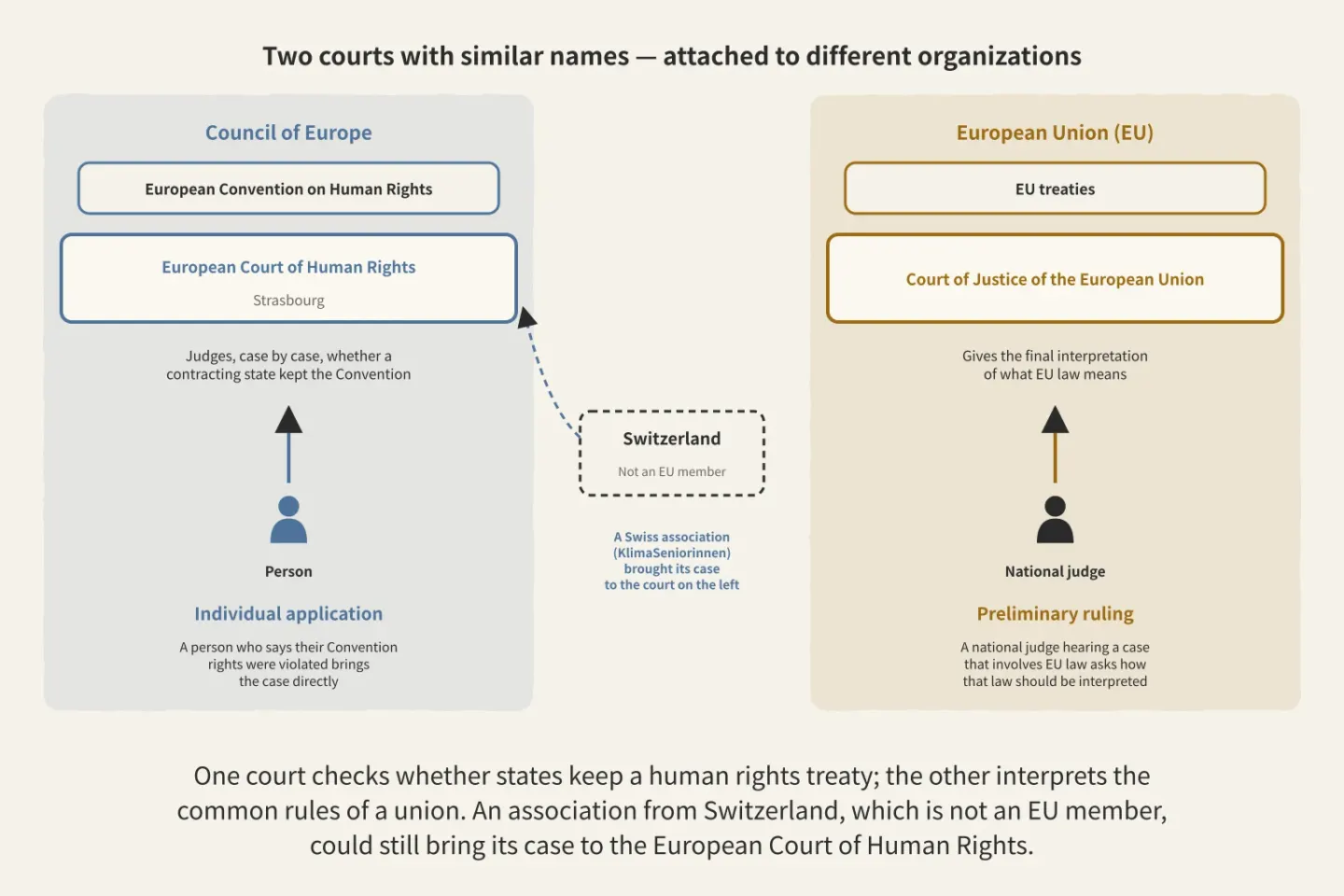
Figure: a diagram Paperis drew using only what the article says
To sum it up: one side is a court that checks whether human rights treaties are being followed, while the other is a court that interprets the shared rules of a union.
1963, Two Principles Created by Case Law
Let us look at the EU courts first. On February 5, 1963, the court of the community that led to the present-day EU delivered its judgment in the case of Van Gend en Loos v. Nederlandse Administratie der Belastingen. On July 15 of the following year, 1964, it ruled on the case of Costa v. ENEL (DOI: 10.1057/9780230283268_6). The two judgments are referred to by their case numbers, 26/62 and 6/64, respectively (DOI: 10.15166/2499-8249/286).
Direct effect is the principle that EU law creates rights for individuals, and that the courts of each member state must protect those rights (DOI: 10.1057/9780230283268_6). The 1963 judgment recognized that EU law can have direct effect within the legal order of member states (DOI: 10.1017/s1574019614001151). This means an agreement between countries becomes a right that an ordinary citizen of those countries can pull out and use in court.
The primacy of EU law is the principle that when EU law and member state law collide within the sphere entrusted to the EU, EU law takes precedence (DOI: 10.1057/9780230283268_6). The 1964 judgment recognized this principle (DOI: 10.1017/s1574019614001151). The goal is to ensure that EU law is actually applied with the same meaning in all member states (DOI: 10.4236/blr.2013.42009).
There is a separate pathway through which these two principles operate in practice. A preliminary ruling is a procedure in which a member state judge handling a case involving EU law asks the Court of Justice of the European Union for an interpretation of that law (DOI: 10.1057/9780230283268_6). Thanks to this pathway, an uninterrupted dialogue continues between the Court of Justice of the European Union and the judges of each country, and the courts view this pathway as the backbone that gives EU law its force (DOI: 10.15166/2499-8249/286).
There is a point to note here. The principle of primacy was established through the case law of the Court of Justice of the European Union (DOI: 10.4236/blr.2013.42009). As early as 1978, academia called this work of forging direct effect and primacy through judgments the "constitutionalization" of treaties (DOI: 10.1007/978-3-531-90095-7_2). The Treaty establishing a Constitution for Europe, adopted in 2004 and awaiting ratification, contained a clause explicitly stating the primacy of EU law (DOI: 10.1111/j.1468-0386.2005.00260.x). The subsequent Treaty of Lisbon did not provide much additional textual support for primacy (DOI: 10.1093/yel/yeu024).
Why did the courts establish such principles? A single judgment from the same date, November 13, 1964, provides a clue. In that case, the court did not permit member states to take retaliatory measures of their own against another country's breach of promises (DOI: 10.1093/icon/mow006). Researchers read the three judgments as a single piece. They argue that the practice of countries forcing compliance with promises through retaliation was replaced by a method where courts in each country directly apply EU law (DOI: 10.1111/eulj.12085).
Interpretations have not converged into one. One side reads these judgments as the ordinary result of an international court dealing with treaties, while the other side reads them as the birth of a new legal order closer to domestic law than to international law (DOI: 10.1017/s1574019614001151).
There is a common misunderstanding that easily arises from how these two principles operate in practice. The conflicting domestic law is not abolished on the spot. Disapplication is when a member state judge chooses not to use a domestic law provision that conflicts with EU law in that specific case (DOI: 10.1017/elo.2022.33). This paper argues that disapplication does not arise from primacy alone, but occurs when an EU regulation possessing direct effect exists alongside primacy. There are also exceptions recognized by the courts (DOI: 10.1017/elo.2022.33).
The single line to take away from this section is this: The primacy and direct effect of EU law are principles established by courts through case law, and they operate through the hands of judges in each country.
The Doors of Strasbourg
Now, it is Strasbourg. The doors of this court can be opened by individuals.
An individual application is a case where a person within the jurisdiction of a contracting state brings a case directly to the European Court of Human Rights, claiming that their rights under the Convention have been violated. Looking at cases dealing with judicial independence, ordinary citizens initially brought cases complaining that judges were not independent, and thus they did not receive a fair trial. Recently, the number of cases where judges themselves become applicants has increased (DOI: 10.35867/ssulri.2023.56..011). When judicial system reforms were carried out in several countries, judges brought cases on the grounds of the right to a fair trial and freedom of expression, arguing that those reforms threatened judicial independence (DOI: 10.35867/ssulri.2023.56..011). Minorities and civil society also visit this court to challenge their country's laws and policies (DOI: 10.1515/9780748670581).
This court also leaves a margin of appreciation for each country. The margin of appreciation is a principle whereby the European Court of Human Rights, when interpreting the Convention, grants a certain margin of judgment to each country, allowing it to determine the balance between rights and the public interest in accordance with its own history and culture (DOI: 10.17248/knulaw..90.202507.31). The court formalized this concept in the case of Handyside v. United Kingdom. Since then, it has determined that margin based on factors such as whether there is a consensus within Europe, what kind of right it is, and how significant the interference is (DOI: 10.17248/knulaw..90.202507.31).
Behind this principle lies a broader idea. The primary responsibility for protecting human rights rests with each country, and international human rights bodies play a supervisory role (DOI: 10.1093/ajj/auw009).
There is also a balancing act that the court places at the center when examining human rights violations. A fair balance is the examination by the European Court of Human Rights that concretely measures and weighs how much a right is restricted against how valuable the purpose of the state's measure is (KCI ART002995530). The margin of appreciation also operates within this balancing act, and viewed through the framework of argumentation, it does not step outside of that structure (KCI ART002995530).
The margin of appreciation is a principle that has received much criticism in this court (DOI: 10.1093/ojls/gql030). Critics believe that this principle gives excessive discretion to countries, which can justify a retreat in human rights guarantees in politically sensitive areas such as the protection of minorities (DOI: 10.17248/knulaw..90.202507.31). Looking at the actual use of the court, there is also an analysis suggesting that it has become quite an empty rhetoric, and that a method of refining standards step by step is increasingly taking its place. However, even this analysis concludes that that method can be used more while leaving a role for the margin of appreciation (DOI: 10.1093/hrlr/ngy017). Supporters believe that this principle prevents useless homogenization while ensuring it does not conflict with the universality of human rights (DOI: 10.1093/acprof:oso/9780199650453.001.0001). A judge of this court wrote that the court has evolved to qualitatively examine the decision-making processes of each country and defer to sufficiently deliberated domestic judgments (DOI: 10.1093/hrlr/ngu021).
A similar tension is seen in the Swiss case. The majority viewed that if a policy touches upon rights, it is a matter of law, whereas the dissenting opinion viewed that the court unnecessarily expanded the standing to bring a case (DOI: 10.35867/ssulri.2024.60..005).
Individuals can open the doors of Strasbourg, but the court leaves a margin of appreciation to countries, and how wide that margin should be is always a subject of debate.
The Long Time After a Judgment
What happens after a ruling comes out? A striking feature of the European Convention on Human Rights is that contracting states bear a broad obligation to execute the judgments of this court (DOI: 10.1515/9780748670581). However, actually carrying out a judgment is above all a domestic political matter within each country (DOI: 10.1093/ejil/chv056). If a law needs to be changed, that country's parliament changes it (DOI: 10.1080/13642987.2019.1593153).
There is a body that monitors execution. The Committee of Ministers is a body where government representatives of Council of Europe member states gather to mutually oversee whether European Court of Human Rights judgments are being executed (DOI: 10.1093/hrlr/ngu007). One might think it hard to trust since politically motivated diplomats are monitoring each other. Yet research suggests that institutional devices like a strong secretariat curb bargaining among themselves. This study views that such monitoring, mixing political and judicial-administrative elements, can be more effective than direct orders from an international court (DOI: 10.1093/hrlr/ngu007). Recently, a trend has also emerged where the court itself becomes more deeply involved in the implementation of judgments (DOI: 10.1093/ejil/chv056).
The speed of execution varies by country. In countries with high legal institutional capacity and government efficiency, it is difficult for unfavorable judgments to be blocked or ignored even if the government is reluctant (DOI: 10.1093/ejil/chu001). Judgments that require changing laws tend to be slower in execution. Even so, the risk of long-term defiance has not increased (DOI: 10.1080/13642987.2019.1593153).
One scene where compliance with a judgment was blocked by domestic politics is the United Kingdom in 2011. British law completely banned prisoner voting, and amending this would have met the obligations under the European Convention on Human Rights and this court's ruling. In early 2011, debates in the British parliament and newspapers focused on sovereignty and judicial interference rather than human rights (DOI: 10.1111/hojo.12075).
Difficulties also remain as they are. Despite multiple reforms, the non-implementation of judgments remains a major problem for the Council of Europe (DOI: 10.1093/ejil/chy064). There is also a diagnosis that accumulated cases, unexecuted judgments, and political attacks on the court's legitimacy threaten the very survival of this system (DOI: 10.1093/acprof:oso/9780198734246.001.0001). Ultimately, this system relies on the voluntary compliance of nations (DOI: 10.1093/ejil/chy064).
This court's judgments do not directly erase national laws and execution is in the hands of each country, but the risk that judgments requiring legal amendments will ultimately be defied has not increased.
Whose Word Is Final?
Now we return to our initial question. If EU law takes precedence over domestic law, does it also take precedence over a country's constitution?
Member states' answers are divided. Academia divides member states into three categories: countries that accept EU law as taking precedence even over the constitution, countries that accept it only conditionally, and countries that view their own constitution as taking precedence in principle (DOI: 10.4236/blr.2013.42009).
This tension is clearly visible in the case law of the German Federal Constitutional Court. The Court of Justice of the European Union has long claimed the authority to define the boundaries of EU competence. However, a 2011 study notes that no member state constitutional court has accepted this claim (DOI: 10.1111/j.1468-0386.2011.00559.x). In its 2009 Lisbon judgment, the German Federal Constitutional Court asserted that it retains the final authority to review future EU treaty amendments and powers transferred to the EU, citing two types of review as its basis (DOI: 10.1111/j.1468-0386.2011.00559.x).
Ultra vires review is a review in which a member state's constitutional court examines whether the EU has acted beyond the boundaries of the powers transferred to it by the member states (DOI: 10.1111/j.1468-0386.2011.00559.x). Identity review is a review in which a member state's constitutional court examines whether an EU measure touches upon the core protected by the member state's constitution, namely its constitutional identity (DOI: 10.1111/j.1468-0386.2011.00559.x). A 2020 study notes that such identity reviews emerged in various member states over the preceding decade (DOI: 10.54648/cola2020031). There is an analysis that Germany's identity review also has the effect of narrowing policy options in advance even before an actual ruling is issued (DOI: 10.54648/euro2021022).
The EU treaties also contain a counterbalance. The treaties stipulate that the EU must respect the national identity of member states, and this provision is currently found in Article 4, Paragraph 2 of the EU Treaty (DOI: 10.1093/yel/yeu024). While this provision serves as a basis for member states to assert their sovereignty, it also accommodates those claims within EU law to avoid a direct collision (DOI: 10.1093/yel/yeu024).
There have also been direct clashes. The European Arrest Warrant is a new system that replaced older procedures for transferring criminals between member states. In 2005, the Polish Constitutional Court declared the provisions of its domestic criminal procedure law that introduced this system unconstitutional, yet provided a grace period so that the constitution could be amended without violating EU law. The Belgian Constitutional Court asked the Court of Justice of the European Union about a similar issue through a preliminary ruling to examine whether the system was valid under EU law, and the EU court answered with its May 3, 2007 judgment (DOI: 10.1093/icon/mom040). The Italian Constitutional Court, in Judgment No. 269 of 2017, questioned the authority of the Court of Justice of the European Union to interpret the EU Charter of Fundamental Rights (DOI: 10.15166/2499-8249/230).
Even so, direct collisions are rare. From the mid-1990s, most member state constitutional courts converged toward accepting supremacy while attaching conditions (DOI: 10.1017/s1574019614001102). The Council of State, a Greek court, accepted preliminary rulings from the Court of Justice of the European Union even in politically sensitive cases and aligned its interpretation of its own constitution with them (DOI: 10.1017/s1574019614001102). There is an analysis that the reason no crisis has occurred despite both the German and EU courts claiming ultimate judgment authority is that they have exercised mutual restraint (DOI: 10.1111/j.1468-0386.2011.00559.x).
The same question exists regarding the human rights court. In the 2004 Görgülü case, the German Federal Constitutional Court ruled that German state organs have an obligation to observe the European Convention on Human Rights and to take into consideration the judgments of that court (KCI ART001471544).
There is also criticism that the power of the EU court is excessive. The argument is that if case law acquires constitutional status, it cannot be overturned unless the treaty is amended, and to that extent, policy options are removed from the realm of majority rule, undermining the legitimacy of the EU political order (DOI: 10.1093/oso/9780198717775.001.0001). On the other side, assessments are also made that because the EU lacks independent enforcement means, the achievements of integration have ultimately relied on the cooperation of member states (DOI: 10.17248/knulaw..40.201210.119).
In Europe, the final word does not reside in a single place. One study concludes that there is no ultimate arbiter in the European legal space (DOI: 10.21697/priel.2019.8.1.01). Courts sustain this state of affairs by exercising mutual restraint and accommodating one another (DOI: 10.1017/s2071832200022380). A 2020 study predicts that disputes over who gets the final word are unlikely to end anytime soon (DOI: 10.54648/cola2020031). The metaphor in this article has its limits. A "word" in the form of a ruling gains power only when executed, and execution rests in the hands of each country's judges, governments, and parliaments.
Seen From Korea
Korea is neither a member state of the Council of Europe nor of the EU. Still, we can compare how they solve the same questions differently.
First is the argumentative structure for weighing the restriction of rights. The principle of proportionality is the rule that when the state restricts basic rights, the purpose must be legitimate, the means must be appropriate, it must not exceed the minimum necessary extent, and the public interest to be protected must balance with the private interest to be lost. The Korean Constitutional Court reviews these four steps one by one in order (KCI ART002995530). The European Court of Human Rights places the fair balance corresponding to the final stage at the center of its reasoning (KCI ART002995530). The Korean Constitutional Court does not omit the balancing judgment, but decisions where that judgment dictated the outcome have been rare. This paper notes that decisions faithfully fulfilling that judgment in both quantity and quality have recently been emerging, and evaluates this as desirable (KCI ART002995530).
Second is climate litigation. Because the European Convention on Human Rights lacks an environmental rights clause, the European Court of Human Rights has broadly interpreted clauses like the right to life and the right to respect for private and family life, and the provision used in the Swiss case was also Article 8, which provides for the right to respect for private and family life (KCI ART003273079). The Korean Constitution has explicitly written environmental rights as a basic right since 1980 (KCI ART003273079). The Korean Constitutional Court judged in the national greenhouse gas reduction targets case that the failure of Article 8, Paragraph 1 of the Carbon Neutrality Act to set quantitative standards for reduction targets from 2031 to 2049 infringed upon environmental rights (KCI ART003273079). A question similar to the Swiss case was decided inside the country by its own Constitutional Court in Korea.
Where to Look Further
With whom the final word rests in Europe remains an open question.
- How the South Korean Constitutional Court receives cases and reaches decisions is covered in "What the Constitutional Court Does — Five Windows and Six Votes".
- How to scrutinize restrictions on basic rights using the principle of proportionality is covered in "Basic Rights and Their Limits — A Scale Without Markings".
- Where constitutional courts like the German Federal Constitutional Court came from is covered in another part of this series, "Constitutional Courts — Who Holds the Constitution's Measuring Stick?".
- The British approach of bringing the European Convention on Human Rights into domestic law is covered in another part of this series, "The British Constitution — A Shelf Without a Single Book".
Source Papers
- "A Study on Environmental Rights in the Era of Climate Crisis — Focusing on the Comparison of the European Convention on Human Rights and Constitutional Environmental Rights" (2025) — KCI ART003273079 — The European Court of Human Rights ruled in the KlimaSeniorinnen case that Switzerland's insufficient legislative and administrative measures violated Article 8 of the Convention, and the South Korean Constitutional Court ruled that the absence of quantitative criteria for 2031–2049 in Article 8, Paragraph 1 of the Framework Act on Carbon Neutrality infringed on environmental rights.
- "The Role of the Judiciary Examined through Climate Change Litigation -Focusing on the European Court of Human Rights Climate Change Decision-" (2024) — DOI: 10.35867/ssulri.2024.60..005 — The majority opinion acknowledged the caution required in judicial intervention while holding that policies affecting rights can become legal issues, whereas the dissenting opinion criticized the expansion of victim status and standing.
- "The Margin of Appreciation Doctrine in the Dynamics of European Human Rights Jurisprudence" (1995) — DOI: 10.1163/9789004482265 — The commission and court in Strasbourg supervise human rights-related activities of the Contracting Parties, and the margin of appreciation serves as a tool to define the scope of that supervision.
- "How Do Regional IGOs Contribute to Global Governance?" (2022) — OpenStax Introduction Political Science 15.4 — The EU started as an economic union and expanded its scope to environment, health, labor, security, and immigration.
- "The Lisbon Judgment of the German Constitutional Court, the Primacy of EU Law and the Problem of Kompetenz-Kompetenz" (2011) — DOI: 10.1111/j.1468-0386.2011.00559.x — The Court of Justice of the European Union claims the right to determine the boundaries of its competence as the ultimate interpreter of EU law, but no national constitutional court has accepted this, and the German Constitutional Court asserted its ultimate judgment power through ultra vires and identity reviews in 2009. The absence of a crisis is thanks to restraint on both sides.
- "The Completion of Europe's Fundamental Rights Protection System through the EU's Accession to the European Convention on Human Rights and..." (2024) — DOI: 10.17248/knulaw..84.202401.35 — Addresses the issue of the EU's accession to the European Convention on Human Rights and the harmonization of the autonomy of the EU legal order.
- "A Study on the 'Margin of Appreciation' Doctrine of the European Court of Human Rights" (2025) — DOI: 10.17248/knulaw..90.202507.31 — The margin of appreciation is a principle of interpretation granting discretion to contracting states, formalized in the Handyside case, and is criticized for potentially justifying the regression of human rights in the protection of minorities. The recognition of equivalence in the Bosphorus judgment risks undermining equity.
- "The Making of the European Union's Constitutional Foundations" (2010) — DOI: 10.1057/9780230283268_6 — Definitions of direct effect, primacy, and preliminary rulings, and the Van Gend en Loos judgment of February 5, 1963 and Costa v. ENEL judgment of July 15, 1964, cited as their origins.
- "Some Reflections on Achmea's Broader Consequences for Investment Arbitration" (2019) — DOI: 10.15166/2499-8249/286 — The preliminary ruling procedure is the institutional backbone of the effectiveness of EU law and played a crucial role in Van Gend en Loos (26/62) and Costa v. ENEL (6/64).
- "National Sovereignity and the Principle of Primacy in EU Law" (2013) — DOI: 10.4236/blr.2013.42009 — The principle of primacy dictates that EU law prevails in the event of a conflict, established through case law, and member states fall into three categories regarding their relationship with the constitution.
- "The Constitutionalisation of the European Union — Without the Constitutional Treaty" (2007) — DOI: 10.1007/978-3-531-90095-7_2 — “Constitutionalization” refers to the law-making by the Court of Justice of the European Union that established direct effect and primacy through case law.
- "The Jurisprudence of Constitutional Conflict: Constitutional Supremacy in Europe before and after the Constitutional Treaty" (2005) — DOI: 10.1111/j.1468-0386.2005.00260.x — The argument that although a supremacy clause was included in the Constitutional Treaty, the problem of constitutional conflict will persist.
- "Sovereignty, Article 4(2) TEU and the Respect of National Identities" (2014) — DOI: 10.1093/yel/yeu024 — The Lisbon Treaty added little further support for primacy, and the national identity clause (Article 4, Paragraph 2) supports member states' sovereignty claims within EU law to avoid a direct collision.
- "Supremacy, direct effect, and Dairy Products in the early history of European law" (2016) — DOI: 10.1093/icon/mow006 — The judgment of November 13, 1964 did not permit unilateral retaliatory measures within the Community legal order.
- "The Troika: …Commission v. Luxembourg and Belgium, Van Gend en Loos and Costa v. ENEL…" (2014) — DOI: 10.1111/eulj.12085 — These three judgments laid the foundation of the EU legal order by substituting interstate retaliation with enforcement through domestic courts.
- "For History's Sake: On Costa v. ENEL, André Donner…" (2014) — DOI: 10.1017/s1574019614001151 — Two competing interpretations—the international law narrative and the constitutional narrative—vie regarding the two judgments.
- "Rethinking direct effect and its evolution: a proposal" (2022) — DOI: 10.1017/elo.2022.33 — EU regulations with direct effect result in the exclusion of domestic law application, subject to legitimate exceptions.
- "Independence of Justice, the Rule of Law crisis in Poland and the European Convention on Human Rights" (2023) — DOI: 10.35867/ssulri.2023.56..011 — While initial cases were brought by ordinary citizens, judges have increasingly become applicants relying on Articles 6 and 10 of the Convention in recent years.
- "The European Court of Human Rights: Implementing Strasbourg's Judgments on Domestic Policy" (2013) — DOI: 10.1515/9780748670581 — Contracting states bear broad obligations to execute judgments, and minorities and civil society strategically turn to Strasbourg.
- "Subsidiarity in International Human Rights Law—What is Subsidiary about Human Rights?" (2016) — DOI: 10.1093/ajj/auw009 — Discusses the uniqueness of human rights subsidiarity, starting from the conventional view that states bear primary responsibility for guaranteeing human rights while international human rights bodies assume a supervisory role.
- "The European Court of Human Rights' Fair Balance Review" (2023) — KCI ART002995530 — The European Court of Human Rights places fair balance at the center of its argumentation, and the margin of appreciation also operates within the framework of proportionality. In South Korea, decisions where fair balance determined the outcome were rare, but faithful decisions are emerging recently.
- "Two Concepts of the Margin of Appreciation" (2006) — DOI: 10.1093/ojls/gql030 — The margin of appreciation has provoked considerable criticism, and the court has used it in two ways: to judge the justification of interference and as self-restraint stemming from a lack of consensus among contracting states.
- "Margin of Appreciation and Incrementalism in the Case Law of the European Court of Human Rights" (2018) — DOI: 10.1093/hrlr/ngy017 — The margin of appreciation has become largely empty rhetoric, with incrementalism taking over its role.
- "The Margin of Appreciation in International Human Rights Law: Deference and Proportionality" (2012) — DOI: 10.1093/acprof:oso/9780199650453.001.0001 — The margin of appreciation is a principle of judicial deference, preventing useless homogenization while remaining compatible with the universality of human rights.
- "Universality or Diversity of Human Rights?: Strasbourg in the Age of Subsidiarity" (2014) — DOI: 10.1093/hrlr/ngu021 — The author, a Strasbourg judge, argues that the court has developed a democracy-enhancing approach that qualitatively evaluates the domestic decision-making process.
- "Reconceptualizing Implementation: The Judicialization of the Execution of the European Court of Human Rights' Judgments" (2015) — DOI: 10.1093/ejil/chv056 — Judgment implementation is primarily political and domestic, but it is increasingly internationalized and judicialized.
- "Foxes Guarding the Foxes? The Peer Review of Human Rights Judgments by the Committee of Ministers" (2014) — DOI: 10.1093/hrlr/ngu007 — Institutional constraints such as a strong secretariat curb bargaining among Committee of Ministers diplomats, preventing peer oversight from being lightly dismissed.
- "Domestic Implementation of Human Rights Judgments in Europe" (2014) — DOI: 10.1093/ejil/chu001 — High legal institutional capacity and government efficiency make it difficult for governments to block or ignore adverse judgments even if they are reluctant.
- "Delayed but not derailed: legislative compliance with European Court of Human Rights judgments" (2019) — DOI: 10.1080/13642987.2019.1593153 — Judgments requiring legal revisions experience delayed implementation, but the long-term risk of defiance does not increase.
- "Human Rights and Prisoners' Rights: The British Press and the Shaping of Public Debate" (2014) — DOI: 10.1111/hojo.12075 — The early 2011 debate over the total ban on prisoner voting focused on sovereignty and judicial interference rather than human rights.
- "Changing State Behaviour: Damages before the European Court of Human Rights" (2018) — DOI: 10.1093/ejil/chy064 — Despite various reforms, non-implementation of judgments remains a major problem, and the system relies on voluntary compliance.
- "Parliaments and the European Court of Human Rights" (2016) — DOI: 10.1093/acprof:oso/9780198734246.001.0001 — Case backlogs, unexecuted judgments, and political attacks on legitimacy place pressure on the system.
- "Framing and managing constitutional identity conflicts" (2020) — DOI: 10.54648/cola2020031 — Constitutional identity reviews have emerged in several member states, increasing the risk of jurisdictional conflicts, and the battle over the "last word" will not end soon.
- "The Fog of Identity and Judicial Contestation" (2021) — DOI: 10.54648/euro2021022 — The German Constitutional Court's identity review serves to narrow policy options in advance before judicial clashes occur.
- "European Union: The European Arrest Warrant and the quest for constitutional coherence" (2007) — DOI: 10.1093/icon/mom040 — The Polish Constitutional Tribunal's 2005 declaration of unconstitutionality regarding the European Arrest Warrant, the Belgian Constitutional Court's request for a preliminary ruling, and the judgment of May 3, 2007.
- "The 'Path Towards European Integration' of the Italian Constitutional Court…Judgment No. 269/17" (2018) — DOI: 10.15166/2499-8249/230 — In Judgment No. 269/17, the Italian Constitutional Court questioned the authority of the Court of Justice of the European Union regarding the interpretation of the Charter of Fundamental Rights.
- "Greek Council of State" (2014) — DOI: 10.1017/s1574019614001102 — From the mid-1990s, most national constitutional courts converged on accepting conditional primacy, and the Greek Council of State accepted preliminary rulings even on sensitive issues.
- "The Constitutional Function of the European Convention on Human Rights" (2010) — KCI ART001471544 — In the 2004 Görgülü case, the German Federal Constitutional Court ruled that state organs have a duty to respect the European Convention on Human Rights and consider judgments of the European Court of Human Rights.
- "The European Court of Justice and the Policy Process: The Shadow of Case Law" (2018) — DOI: 10.1093/oso/9780198717775.001.0001 — Case law has acquired constitutional status, making it irreversible without treaty amendments, and policy options are removed from majority voting, undermining legitimacy.
- "The Problem of the Enforceability of Judgments of the Court of Justice of the European Union" (2012) — DOI: 10.17248/knulaw..40.201210.119 — The EU lacked independent enforcement mechanisms, so integration achievements relied on member state cooperation.
- "The Court of Justice, the National Courts, and the Controversy over the 'Ultimate Arbiter'…" (2020) — DOI: 10.21697/priel.2019.8.1.01 — There is no ultimate judicial arbiter in the European legal space.
- "Constitutional Pluralism Is Not Dead" (2017) — DOI: 10.1017/s2071832200022380 — Self-restraint and mutual adjustment help avoid clashes between sovereignty claims at the EU level and the national level.
Sources (39)
- 기후변화소송을 통해 살펴본 사법의 역할 -유럽인권재판소 기후변화결정을 중심으로DOI 10.35867/ssulri.2024.60..005
- The Margin of Appreciation Doctrine in the Dynamics of European Human Rights JurisprudenceDOI 10.1163/9789004482265
- How Do Regional IGOs Contribute to Global Governance?
- The Lisbon Judgment of the German Constitutional Court, the Primacy of EU Law and the Problem of Kompetenz-KompetenzDOI 10.1111/j.1468-0386.2011.00559.x
- 유럽연합의 유럽인권협약 가입을 통한 유럽의 기본권 보호체계의 완성과…DOI 10.17248/knulaw..84.202401.35
- 유럽인권재판소의 '판단 여지(Margin of Appreciation)' 독트린에 관한 소고DOI 10.17248/knulaw..90.202507.31
- The Making of the European Union's Constitutional FoundationsDOI 10.1057/9780230283268_6
- Some Reflections on Achmea's Broader Consequences for Investment ArbitrationDOI 10.15166/2499-8249/286
- National Sovereignity and the Principle of Primacy in EU LawDOI 10.4236/blr.2013.42009
- The Constitutionalisation of the European Union — Without the Constitutional TreatyDOI 10.1007/978-3-531-90095-7_2
- The Jurisprudence of Constitutional Conflict: Constitutional Supremacy in Europe before and after the Constitutional TreatyDOI 10.1111/j.1468-0386.2005.00260.x
- Sovereignty, Article 4(2) TEU and the Respect of National IdentitiesDOI 10.1093/yel/yeu024
- Supremacy, direct effect, and Dairy Products in the early history of European lawDOI 10.1093/icon/mow006
- The Troika: …Commission v. Luxembourg and Belgium, Van Gend en Loos and Costa v. ENEL…DOI 10.1111/eulj.12085
- For History's Sake: On Costa v. ENEL, André Donner…DOI 10.1017/s1574019614001151
- Rethinking direct effect and its evolution: a proposalDOI 10.1017/elo.2022.33
- Independence of Justice, the Rule of Law crisis in Poland and the European Convention on Human RightsDOI 10.35867/ssulri.2023.56..011
- The European Court of Human Rights: Implementing Strasbourg's Judgments on Domestic PolicyDOI 10.1515/9780748670581
- Subsidiarity in International Human Rights Law—What is Subsidiary about Human Rights?DOI 10.1093/ajj/auw009
- Two Concepts of the Margin of AppreciationDOI 10.1093/ojls/gql030
- Margin of Appreciation and Incrementalism in the Case Law of the European Court of Human RightsDOI 10.1093/hrlr/ngy017
- The Margin of Appreciation in International Human Rights Law: Deference and ProportionalityDOI 10.1093/acprof:oso/9780199650453.001.0001
- Universality or Diversity of Human Rights?: Strasbourg in the Age of SubsidiarityDOI 10.1093/hrlr/ngu021
- Reconceptualizing Implementation: The Judicialization of the Execution of the European Court of Human Rights' JudgmentsDOI 10.1093/ejil/chv056
- Foxes Guarding the Foxes? The Peer Review of Human Rights Judgments by the Committee of MinistersDOI 10.1093/hrlr/ngu007
- Domestic Implementation of Human Rights Judgments in EuropeDOI 10.1093/ejil/chu001
- Delayed but not derailed: legislative compliance with European Court of Human Rights judgmentsDOI 10.1080/13642987.2019.1593153
- Human Rights and Prisoners' Rights: The British Press and the Shaping of Public DebateDOI 10.1111/hojo.12075
- Changing State Behaviour: Damages before the European Court of Human RightsDOI 10.1093/ejil/chy064
- Parliaments and the European Court of Human RightsDOI 10.1093/acprof:oso/9780198734246.001.0001
- Framing and managing constitutional identity conflictsDOI 10.54648/cola2020031
- The Fog of Identity and Judicial ContestationDOI 10.54648/euro2021022
- European Union: The European Arrest Warrant and the quest for constitutional coherenceDOI 10.1093/icon/mom040
- The 'Path Towards European Integration' of the Italian Constitutional Court…Judgment No. 269/17DOI 10.15166/2499-8249/230
- Greek Council of StateDOI 10.1017/s1574019614001102
- The European Court of Justice and the Policy Process: The Shadow of Case LawDOI 10.1093/oso/9780198717775.001.0001
- 유럽연합 사법재판소 판단의 집행력에 관한 문제DOI 10.17248/knulaw..40.201210.119
- The Court of Justice, the National Courts, and the Controversy over the 'Ultimate Arbiter'…DOI 10.21697/priel.2019.8.1.01
- Constitutional Pluralism Is Not DeadDOI 10.1017/s2071832200022380