
Paperis Articles
Constitutional Courts — Who Holds the Constitution's Measuring Stick?
The American model where every court reviews constitutionality, the Austrian–German model that gathers it in one constitutional court, France's 2008 shift, and where South Korea's Constitutional Court stands
Your field's papers, as audio
Pick your fields and journals — Paperis summarizes the key papers and turns them into audio. Listen on your commute.
Start Paperis free →Constitutional Courts — Who Holds the Constitution's Measuring Stick?
Same Question, Two Paths
Let us imagine someone facing a trial because of a certain law. In the courtroom, this person argues that "this law itself violates the Constitution." This person and case are made up to help your understanding.
In the United States, the judge currently presiding over that trial can examine that claim directly. In Austria or Germany, whether a law aligns with the Constitution is decided by a single, separately established court. There are countries where the task of holding laws up against the Constitution is shared among all courts, and countries where it is concentrated in one place (DOI: 10.62768/tbj/2024/14/1/10).
The Constitutional Court is the body that decides whether laws match the Constitution and resolves disputes surrounding the Constitution. If we compare the Constitution to a ruler used to measure the length of laws, the question of this text is singular. Who gets to hold that ruler.
This text covers the systems of the United States, Austria, Germany, and France, with comparisons to South Korea addressed in the final two sections. This text is written from the perspective of November 2026. It is an explanation of how these systems are structured, and not a guide on what you must do in any particular country.
America in 1803 and Austria in 1920
In the 1803 case of Marbury v. Madison, the US Supreme Court declared an act of Congress unconstitutional. This ruling is widely accepted as the starting point of the principle that courts measure laws against the constitution (DOI: 10.62768/tbj/2024/14/1/10). That case itself is covered in another piece in this series, "The US Constitution and the Supreme Court — The Margins of a Hard-to-Amend Text".
Unconstitutional means that a law or a state action violates the constitution. Constitutional review is the work where a court or tribunal examines whether a law conflicts with the constitution and, if it does, prevents that law from being used. The work that the "The US Constitution and the Supreme Court — The Margins of a Hard-to-Amend Text" piece in this series calls judicial review—meaning American courts measuring laws against the constitution—is also called constitutional review in this article.
There is no agency in the United States dedicated solely to this job. Ordinary courts handling cases do this work within those cases. Decentralized constitutional review is a method where ordinary courts handling a case examine whether a law fits the constitution within that case. Comparative constitutional law calls this the American model (DOI: 10.62768/tbj/2024/14/1/10). Compared to a ruler, every judge holds one ruler of their own.
US courts use that ruler sparingly. Up to 2014, the US Supreme Court had found acts of the federal Congress unconstitutional a total of 176 times, and textbooks explain that courts start out by presuming that laws are constitutional (OpenStax Introduction Political Science 11.6).
In 1920, 117 years after the Marbury ruling, a different method emerged in Europe after World War I. That year, the Austrian Federal Constitution established a separate constitutional court and centralized the work of reviewing laws there (DOI: 10.1111/1467-9337.00235). One study identifies the Austrian politician Karl Renner as the person who first floated the idea, and the scholar Hans Kelsen as the person who led the writing of the constitutional text (DOI: 10.1111/1467-9337.00235).
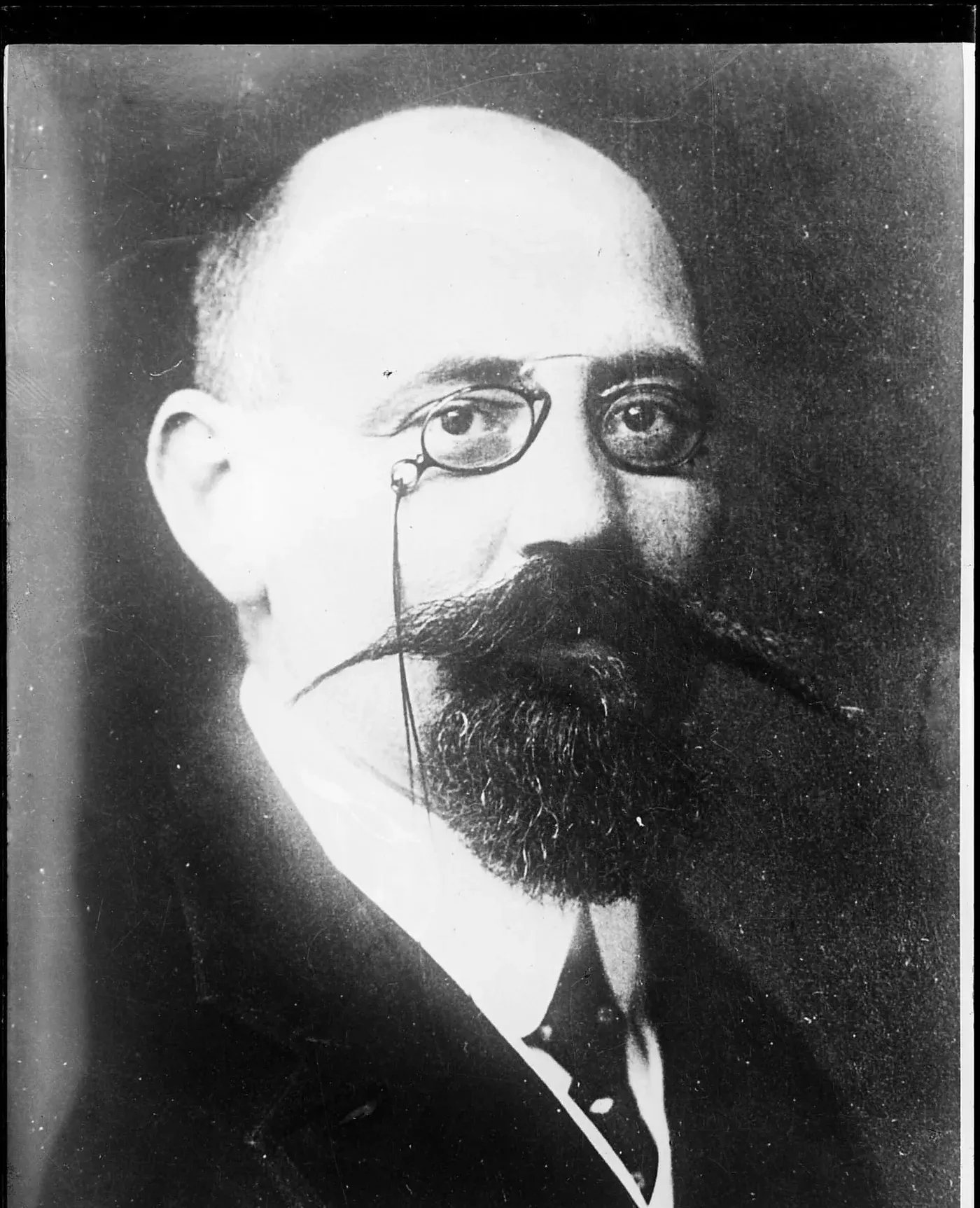
Figure: Karl Renner as Austrian delegate to the Paris Peace Conference (1919) · Public domain, via Wikimedia Commons
Centralized constitutional review is a method where a single, separately established constitutional court takes charge of whether laws fit the constitution. Named after Kelsen, it is also called the Kelsen model or the European model (DOI: 10.62768/tbj/2024/14/1/10). The ruler is kept in one place, and other courts send laws there if they want to measure them.
The constitutional court that Kelsen envisioned is a place that clears unconstitutional laws out of the legal order, and it does not meddle in making new laws (DOI: 10.24144/2307-3322.2026.93.1.37). A negative legislator is a name that Kelsen gave to the constitutional court, meaning an agency that does not make new laws but only does the work of getting rid of laws that violate the constitution. The Austrian Constitutional Court was designed to fit this name, and over the following 90 years, the tasks it took on steadily increased (DOI: 10.1017/cbo9780511994760.011).
The first instance of this model predates Germany. There are studies that cite the constitutional courts of Austria in 1920 and Czechoslovakia in 1921 as Europe's first specialized constitutional adjudication bodies (DOI: 10.24144/2307-3322.2026.93.1.37). Another study groups Austria, Czechoslovakia, and Spain together as the first examples after World War I, summarizing that while systems like legal review or individual petitions were scattered about even in the 19th century, they were generally not very significant (DOI: 10.1093/oso/9780192846693.003.0001). The German Federal Constitutional Court began its work in 1951 (KCI ART002924696).
America handed out the ruler called the constitution to every judge, while Austria gathered that ruler into a single place.
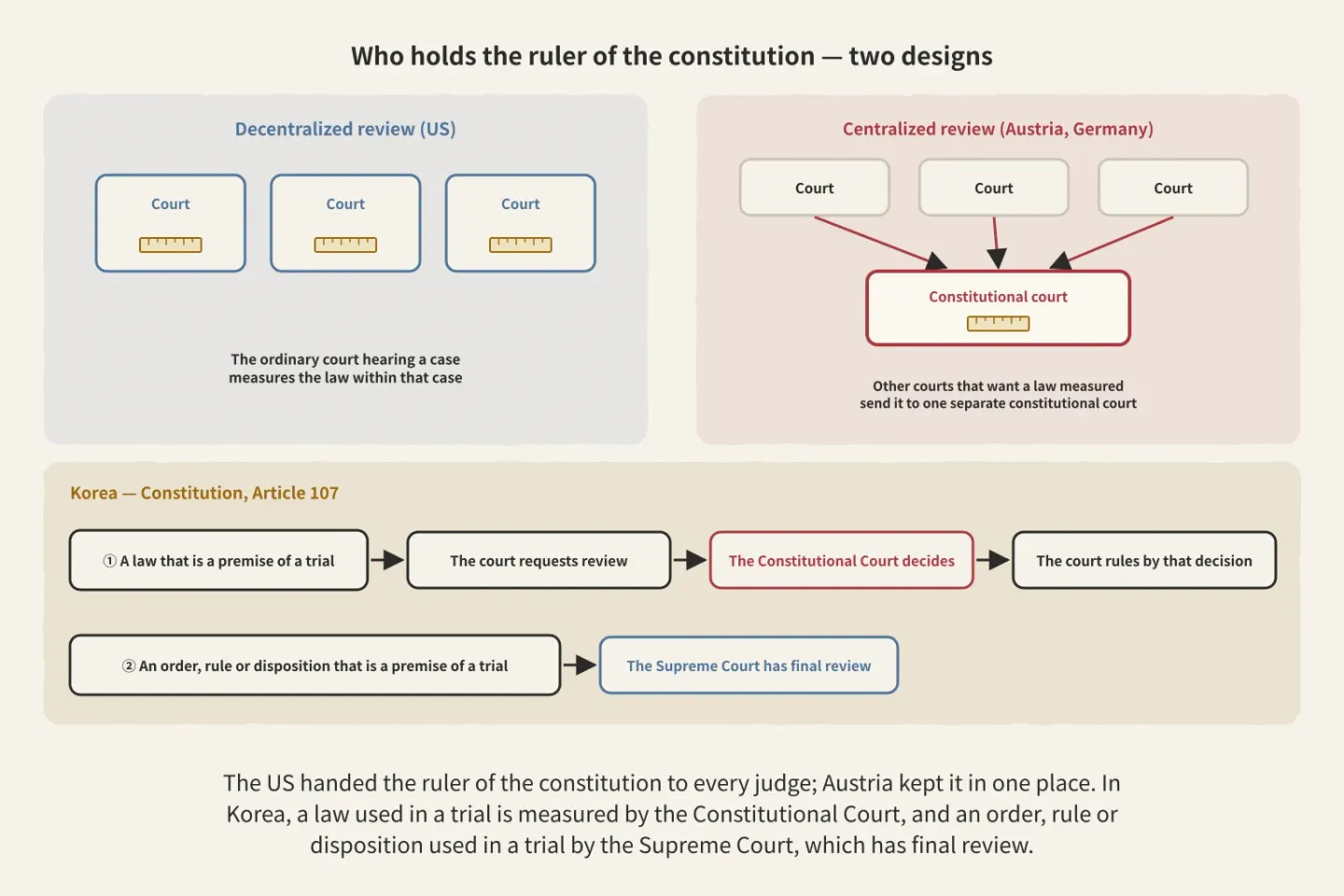
Figure: a diagram Paperis drew using only what the article says
Germany — The Door Citizens Knock on Themselves
According to a paper from Indonesia, among the cases brought to the Federal Constitutional Court of Germany (Bundesverfassungsgericht) from 1951 to 2020, 98% were constitutional complaints, and about 2% of the total decisions were accepted (DOI: 10.30641/ham.2022.13.65-80). The same paper records the number of cases during that period as 240,251.
A constitutional complaint is a proceeding in which a person whose fundamental rights guaranteed by the Constitution have been infringed by an act or omission of state power requests direct relief from the Constitutional Court. It can usually be filed only when there are no other remedies available or after all other remedies have been exhausted (DOI: 10.31078/consrev311). In Germany, from 1951 until the 1990s, this court played a major role in guaranteeing citizens' fundamental rights and advancing democracy, and it has been evaluated that at the center of this was the constitutional complaint filed directly by individual citizens (KCI ART002924696).
There are two other representative paths by which this court examines whether a law complies with the Constitution, alongside the constitutional complaint (DOI: 10.25041/fiatjustisia.v16no1.2419). Abstract normative control is a procedure inซึ่ง the Constitutional Court determines whether a law itself conforms to the Constitution, even without a specific trial. Concrete normative control is a procedure in which, if a question arises during a trial as to whether the law to be applied in that case violates the Constitution, the court presiding over the trial entrusts the judgment to the Constitutional Court. If the fictional person from Section 1 had stood before a German court, one of the paths through which his argument reached the Federal Constitutional Court would be this second path.
A characteristic of the German constitutional complaint is that even court judgments can become the subject of review. A judicial complaint is a constitutional complaint filed with the Constitutional Court on the grounds that a court judgment has infringed fundamental rights. In Germany, judicial complaints account for the largest share of cases in the Federal Constitutional Court (KCI ART001865257).
There are gains won through judicial complaints. There is an analysis that many of the important decisions of the Federal Constitutional Court could not have emerged without judicial complaints, that even when criticisms existed they did not lead to demands to abolish judicial complaints, and that judicial complaints have firmly taken root in the German legal order (KCI ART001865257). The same analysis notes that the price is also small. The boundary between where constitutional issues end and where ordinary legal issues for ordinary courts begin becomes blurred, and criticisms that the court has crossed that line occasionally arise (KCI ART001865257).
The number of cases is also a price. By making even judgments the subject of constitutional complaints, the rule of law was substantially strengthened, but the case burden on the Constitutional Court became correspondingly heavier (DOI: 10.17248/knulaw..80.202301.491). Therefore, Germany established a procedure to filter out constitutional complaints before reviewing them in earnest. The law stipulates that a constitutional complaint should be accepted if it has principled constitutional significance or is appropriate for enforcing fundamental rights (DOI: 10.17007/klaj.2022.71.2.007).
This procedure was heavily inspired by the system through which the US Supreme Court selects cases to review, but it was not copied as is (DOI: 10.17007/klaj.2022.71.2.007). Whereas the US Supreme Court independently chooses which cases to take, in Germany the decision not to accept a case is not left to the court's discretion (DOI: 10.17007/klaj.2022.71.2.007). While this procedure certainly eases the workload considerably, literature also notes the criticism that because the criteria for acceptance are unclear, it is difficult to predict whether one will be able to reach the court (DOI: 10.17007/klaj.2022.71.2.007).
Germany opened the door to the Constitutional Court wide for its citizens, and shouldered the task of managing the line formed in front of that door along with it.

Figure: A door opened wide, and the line in front of it
France — The One Who Applied the Ruler Only Before the Law Appeared
France established the Constitutional Council (Conseil constitutionnel) when drafting the Fifth Republic Constitution in 1958. Korean literature also translates this body as the Constitutional Court or the Constitutional Council (KCI ART001408225). At first, it was used mainly to enforce the division of powers set by the Constitution, especially keeping the boundaries of what the parliament should determine by statute (DOI: 10.61345/1339-7915.2026.2.1).
The time when this body could apply a ruler to a law was fixed. Prior review is a method of checking whether a statute passed by parliament aligns with the constitution before it is promulgated and takes effect. Today, review usually begins after the parliament passes a law and before the president signs it, if requested by the president, prime minister, president of the National Assembly, president of the Senate, or at least 60 members of the National Assembly or the Senate. The Constitutional Council must in principle reach a conclusion within one month (KCI ART001408225). If it rules that a law violates the constitution, the parliament can amend it before the law is promulgated (OpenStax Introduction Political Science 11.6).
The weight of review shifted through case law. In the freedom of association decision of July 16, 1971, the Constitutional Council recognized constitutional effect in the preamble of the 1958 Constitution (DOI: 10.58256/e8b8rw52), and began substantive review centered on protecting fundamental rights (DOI: 10.61345/1339-7915.2026.2.1). The constitutional amendment of 1974 opened the way for opposition members of parliament to request review as well (DOI: 10.61345/1339-7915.2026.2.1).
Still, the only time the ruler could be applied was between voting and promulgation. Laws that had already taken effect were shielded from constitutional review, and the jurisdiction of the Constitutional Council was very narrow compared to other constitutional adjudication bodies in Europe (DOI: 10.1017/s2071832200021222).
With the constitutional amendment of July 23, 2008, France introduced subsequent review (KCI ART001317969). Subsequent review is a method of checking whether a statute already in force aligns with the constitution. That path has a name. The priority preliminary ruling on constitutionality is a procedure in France where, if a party to a trial argues that a law applicable to that trial infringes upon rights and freedoms guaranteed by the Constitution, the Constitutional Council reviews that law after passing through a filtering stage. It is called QPC by taking the initials of its French name, and has been in effect since March 1, 2010 (KCI ART002403409).
Any party to a trial can raise this issue during the proceedings (DOI: 10.24144/2307-3322.2025.90.1.27). The issue is filtered twice. First, the judge handling the case looks at it, and then the Council of State (Conseil d'État), which is the highest administrative court, or the Court of Cassation (Cour de cassation), which is the highest ordinary court, looks at it (DOI: 10.34280/annep/2020.v1i1.6) (KCI ART002403409). There is analysis that this filter and the "seriousness" criterion protect the consistency and effectiveness of review (DOI: 10.61345/1339-7915.2026.2.1).
After the 2008 constitutional amendment, even in France, laws could be reviewed in light of the rights and freedoms guaranteed by the Constitution after they came into force (DOI: 10.1017/s2071832200021222). Prior review gives an opportunity to fix problems before a law comes out, and subsequent review opens a way to contest problems exposed after it takes effect. Following the 2008 constitutional amendment, France uses both paths together (KCI ART001317969) (DOI: 10.61345/1339-7915.2026.2.1).
After 1945, Spread Models and Divergent Shapes
The first experiments in Austria and Czechoslovakia took root after 1945 (DOI: 10.1093/oso/9780192846693.003.0001). As German and Italian constitutional courts settled into place, this model gradually spread to the rest of Europe, a study notes (DOI: 10.1093/oso/9780192846693.003.0001). Kelsen’s centralized model spread across the world after World War II (DOI: 10.1515/icl-2020-0024), and new constitutional courts were established in Eastern Europe after the collapse of the Soviet Union (DOI: 10.1093/oso/9780198726418.003.0016). Indonesia established a constitutional court following a constitutional amendment in 2003 (DOI: 10.22212/jnh.v8i1.940).
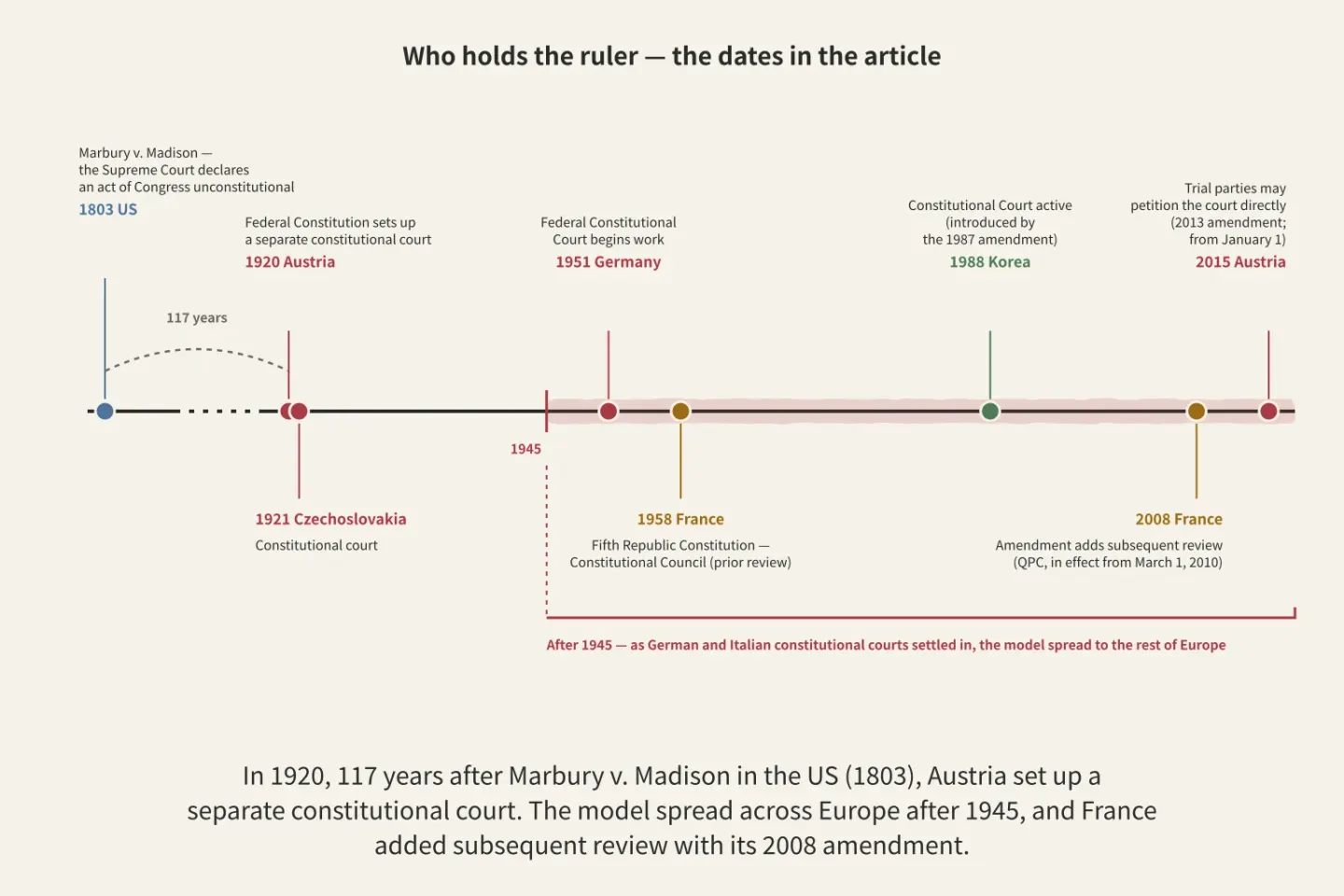
Figure: a diagram Paperis drew using only what the article says
Even when the principle of gathering everything in one place is the same, the shapes vary by country. Through a 2013 constitutional amendment, Austria allowed parties to an ongoing trial to directly petition the constitutional court for a review of a law, and this path opened on January 1, 2015 (DOI: 10.1515/icl-2020-0024). Austria, where Kelsen’s model first appeared, did not remain stuck in its original design.
Some countries mix the two approaches. Italy uses a combination of elements from the Austrian centralized type and the US decentralized type (DOI: 10.1093/law/9780190214555.003.0002). A comparative study indicates that Portugal operates as a mixed type combining the two approaches, while Poland operates as a centralized type (DOI: 10.15804/ppk.2023.04.23). Cyprus initially started out as a centralized type where a single constitutional body conducted reviews, but after the structure jointly operated by the two communities collapsed, it established a new supreme court and decentralized its reviews (DOI: 10.1515/icl-2020-0021).
There are countries with separate constitutional courts, countries without them, and countries that mix the two approaches. Comparative constitutional law notes that alongside the two models, a mixed type exists (DOI: 10.62768/tbj/2024/14/1/10), and a 2024 literature review observes that both classic models have strengths and limitations, leading to a trend of evolving toward mixing elements and growing more similar to each other. The same review highlights issues such as conflicting interpretations, political questions spilling over into the courts, and the challenge of getting decisions actually implemented, concluding that how well any model actually works depends on institutional, political, and cultural factors (DOI: 10.51247/tj.v1i1.909).
This is where the metaphor of the ruler also reveals its limits. A physical ruler has tick marks carved into it, but a constitution has no tick marks to show precisely where a deviation begins. There is a summary noting that in European constitutional adjudication after 1945, constitutional interpretation became the defining feature that settles this work (DOI: 10.1093/oso/9780192846693.003.0001), and the primary function of the Federal Constitutional Court of Germany is likewise explained through interpretation (DOI: 10.25041/fiatjustisia.v16no1.2419). You can decide who holds the ruler, but reading the ruler remains a matter of human interpretation.
The Place of the South Korean Constitutional Court
Article 111 of the Constitution of the Republic of Korea lists five tasks handled by the Constitutional Court: review of the constitutionality of a law upon the request of a court, trials on impeachment, trials on the dissolution of parties, trials on competence disputes between state agencies or local governments, and trials on constitutional complaints as prescribed by law (Constitution of the Republic of Korea, Article 111).
It is evaluated that the model for South Korea's constitutional adjudication system is Germany's constitutional adjudication system (DOI: 10.17248/knulaw..45.201402.39), and comparative studies classify the South Korean Constitutional Court as a Kelsenian model (DOI: 10.1515/icl-2020-0024). Article 107, Paragraph 1 shows this framework. "When the constitutionality of a law becomes a prerequisite for a trial, the court shall request the Constitutional Court and shall try the case based on that ruling." (Constitution of the Republic of Korea, Article 107) A request for the review of the constitutionality of a law is a procedure where a court handling a trial asks the Constitutional Court to rule, stating that the legal provision being used in that trial appears to run counter to the Constitution. The Constitutional Court explains Article 107 as a concrete norm control procedure, and views this procedure as dividing the authority to review laws to the Constitutional Court and the authority to review orders, rules, and dispositions to the Supreme Court (Constitutional Court 96Hun-Ma172). The South Korean Constitutional Court was introduced through the 1987 constitutional amendment and has operated since 1988 (KCI ART001245685).
Paragraph 2 of the same article tells a different story. If whether an order, rule, or disposition violates the Constitution or a law becomes a prerequisite for a trial, the Supreme Court reviews it finally (Constitution of the Republic of Korea, Article 107). The one that measures the laws used in a trial is the Constitutional Court, and the one that measures the orders and rules used in a trial is the court. However, the Constitutional Court holds that there is an open path to contest orders and rules that directly infringe upon fundamental rights through constitutional complaints (Constitutional Court 96Hun-Ma172).
The point where it diverges most significantly from Germany is judgments. In South Korea, general court judgments are in principle excluded from the targets of constitutional complaints (DOI: 10.1515/icl-2020-0024). In a decision on December 24, 1997, the Constitutional Court accepted this principle, stating that one cannot conclude a constitutional complaint must always include court judgments to fit the essence of the system, and that whether to include judgments is a task for the legislature to resolve (Constitutional Court 96Hun-Ma172). However, the same decision ruled that to the extent that it even excludes trials that infringed upon fundamental rights by applying laws that the Constitutional Court ruled unconstitutional, that provision runs counter to the Constitution, and it canceled a Supreme Court judgment (Constitutional Court 96Hun-Ma172). Three justices—Lee Jae-hwa, Go Jung-seok, and Han Dae-hyun—dissented from this conclusion, arguing that the provision is not unconstitutional, and that rather than directly canceling the Supreme Court judgment, the court should merely confirm it as unconstitutional and leave subsequent measures to the court (Constitutional Court 96Hun-Ma172). There are also papers criticizing the exclusion of judgments from the target as running counter to the original intent of the system (KCI ART001245685).
There is a uniquely South Korean path that partially fills that empty space. A constitutional complaint on the unconstitutionality of a law is a constitutional complaint where a party who applied for a court request and was rejected directly petitions the Constitutional Court to review that law. The form is a constitutional complaint, but it is used in practice as a second law-review procedure, is actively utilized statistically, and is analyzed as compensating to some degree for the prohibition of constitutional complaints against judgments (DOI: 10.1515/icl-2020-0024). The same analysis views this path alongside the individual petition introduced by Austria in 2015 as an evolution of the Kelsenian model (DOI: 10.1515/icl-2020-0024).
Abstract norm control is not included in the five items of Article 111 (Constitution of the Republic of Korea, Article 111). A 2014 paper noted that interest in the German system is growing due to debates surrounding whether to introduce abstract norm control and constitutional complaints against judgments (DOI: 10.17248/knulaw..45.201402.39).
The South Korean Constitutional Court is composed of nine justices who hold the qualifications of judges, and all justices are appointed by the President, with three of them appointed from persons elected by the National Assembly and three appointed from persons designated by the Chief Justice of the Supreme Court (Constitution of the Republic of Korea, Article 111). The French Constitutional Council centers on nine members designated three each by the President, the President of the National Assembly, and the President of the Senate, with a single nine-year term. The same literature reports that there is also a system where former presidents enter as ex officio members, and that French academia criticizes this (KCI ART001977466). The point of dividing the nine designated seats into three is the same, but the entities doing the dividing differ.
The Path One Person's Dispute Walks in Four Countries
We place the fictional person from Section 1 in the courts of four countries one after another. During the trial, they argue, "This law violates the constitution."
In an American courtroom, the judge handling the case looks into it directly. However, the judge starts by presuming that the law is constitutional (OpenStax Introduction Political Science 11.6).
In a German courtroom, there is a path of concrete norm control where the court of that trial asks the Federal Constitutional Court to decide (DOI: 10.25041/fiatjustisia.v16no1.2419). If they lose the case and believe the judgment violated their fundamental rights, they can also challenge the judgment itself through a constitutional complaint (KCI ART001865257). At that time, they must pass through a sieve that first screens whether it will be accepted (DOI: 10.17007/klaj.2022.71.2.007).
In a French courtroom, they raise a priority question of constitutionality during the trial. Only after the judge of that case, followed by the Council of State or the Court of Cassation, filters it out does it reach the Constitutional Council (DOI: 10.34280/annep/2020.v1i1.6), and the decision of the Constitutional Council directly affects the trial they were undergoing (DOI: 10.24144/2307-3322.2025.90.1.27). If it had been before March 1, 2010, this path did not exist for laws already in force (KCI ART002403409) (DOI: 10.1017/s2071832200021222).
In a Korean courtroom, they apply to the court for a referral of a constitutional review of a statute. If the court makes the referral, the Constitutional Court decides, and the court conducts the trial according to that judgment (Article 107 of the Constitution of the Republic of Korea). If the court dismisses the application, they can go directly to the Constitutional Court with a constitutional complaint. However, the path to challenging the judgment itself as a constitutional complaint after the trial ends is blocked in principle (DOI: 10.1515/icl-2020-0024). Only exceptions, such as judgments applying statutes that the Constitutional Court has already decided to be unconstitutional, are open (Constitutional Court 96Hun-Ma-172).
The same question walks different paths in the four countries. They are a path where a nearby judge looks right away, a path where a citizen takes even the judgment, a path that reaches after being filtered twice, and a path that goes through the court but goes directly if blocked. Each path has what it gains and what it gives up together.
Where to Look Next
How what the Korean Constitutional Court does actually works in practice is covered in "What the Constitutional Court Does — Five Windows and Six Votes". Why the constitution sits above other laws is the subject of "What Is a Constitution — The Wall You Cannot Simply Knock Down", and the place where the Constitutional Court stands between the legislature, executive, and judiciary is explored in "Separation of Powers — A Country That Splits Its Keys". Where the Supreme Court, which conducts the final review of orders and regulations, fits into the court system can be seen in "Korea's Three-Tier Courts and the Supreme Court — The Three Steps a Case Climbs, and Sometimes Comes Back Down".
Among the other pieces in this series, "The US Constitution and the Supreme Court — The Margins of a Hard-to-Amend Text" looks at how judicial review began in the United States through the Marbury v. Madison case, "Common Law and Civil Law — The Book a Judge Opens First" examines how the two legal families treat case law and codes differently, and "Europe's Two Courts — Who Has the Last Word?" addresses the tension between courts that stand above nations and the courts of individual countries. Which of the two models better protects fundamental rights remains a question that cannot be answered using the evidence in this article.
Source Papers
- "Global Patterns of Constitutional Judicial Review Systems: Two Major Models of Constitutional Judicial Review in the World" (2024) — DOI: 10.62768/tbj/2024/14/1/10 — The 1803 Marbury ruling is considered the starting point of judicial review, and there are ordinary courts' decentralized (US model), specialized constitutional courts' centralized (Kelsenian/European model), and mixed systems.
- "The Constitutional Court of the Republic of Austria 1918–1920" (2003) — DOI: 10.1111/1467-9337.00235 — The Constitutional Court under the 1920 Austrian Federal Constitution established centralized review, and the politician Renner is considered to have conceived the idea while Kelsen led the drafting of the provisions.
- "The Constitutional Courts of Austria and Czechoslovakia as the first institutional model of constitutional justice in Europe" (2026) — DOI: 10.24144/2307-3322.2026.93.1.37 — Viewing the 1920 Austrian and 1921 Czechoslovak Constitutional Courts as Europe's first specialized bodies, this paper analyzes Kelsen's concept of the "negative legislator".
- "AUSTRIA: Constitutional Courts as Positive Legislators" (2011) — DOI: 10.1017/cbo9780511994760.011 — The Austrian Constitutional Court was designed as a centralized body acting as a "negative legislator", and its jurisdiction has expanded over 90 years.
- "The Evolution of Constitutional Adjudication in Europe" (2023) — DOI: 10.1093/oso/9780192846693.003.0001 — Traces 19th-century scattered systems, the first post-WWI cases in Austria, Czechoslovakia, and Spain, post-1945 success and spread in Germany and Italy, and the centralization of interpretation.
- "The Influence of the United States Supreme Court on Judicial Review in Europe" (2020) — DOI: 10.1093/oso/9780198726418.003.0016 — Examines the US decentralized system, Kelsen's centralized model, postwar European constitutional review bodies, France's separate pathway, and post-Soviet Eastern European bodies.
- "Constitutional Review Complaint as an Evolution of the Kelsenian Model" (2020) — DOI: 10.1515/icl-2020-0024 — The Kelsenian model spread globally after World War II, South Korea's Constitutional Court is classified under this model, and South Korea's constitutional complaints and Austria's 2015 individual petition are seen as evolutions of the Kelsenian model.
- "The Role of the German Federal Constitutional Court in Protecting of Fundamental Rights based on the Constitutional Complaints Authority" (2022) — DOI: 10.30641/ham.2022.13.65-80 — From 1951 to 2020, there were 240,251 constitutional complaints (98%), averaging about 6,000 per year, with an acceptance rate of about 2%.
- "Constitutional Complaint and the Protection of Citizens the Constitutional Rights" (2017) — DOI: 10.31078/consrev311 — Constitutional complaints can generally only be filed when no other remedies exist or after all other remedies have been exhausted.
- "독일 연방헌법재판소의 사건부담 경감을 위한 1997년 Benda 위원회 개혁안에 관한 소논문" (2022) — KCI ART002924696 — From its launch in 1951 until the 1990s, it played a major role in protecting fundamental rights centered on constitutional complaints, which consequently increased its case burden.
- "The Basis of Constitutional Adjudication in Germany" (2022) — DOI: 10.25041/fiatjustisia.v16no1.2419 — The primary function of the German Federal Constitutional Court is interpretation, handling abstract norm control, constitutional complaints, and concrete norm control.
- "Die Urteilsverfassungsbeschwerde und das Verhältnis von Verfassungsgericht und Fachgerichten in Deutschland" (2014) — KCI ART001865257 — Judicial complaints make up the largest share of cases in Germany; while criticized for blurring the boundary between the constitution and ordinary laws, this has not led to demands for abolition, and many important decisions have emerged thanks to judicial complaints.
- "독일 헌법재판소 헌법소원의 사전심사 제도 - 미국 연방대법원의 사건선별 절차와 비교를 중심으로-" (2023) — DOI: 10.17248/knulaw..80.202301.491 — Judicial complaints strengthened substantive the rule of law but created a case burden, and the preliminary screening system's practical operation has issues.
- "독일연방헌법재판소의 헌법소원 수리절차" (2022) — DOI: 10.17007/klaj.2022.71.2.007 — Examines admissibility requirements (principle constitutional significance, suitability for enforcing rights), inspirations and differences drawn from US certiorari (not discretionary), and criticisms of unpredictability.
- "프랑스의 헌법재판소에 관한 연구" (2009) — KCI ART001408225 — The Fifth Republic Constitutional Council's ex-ante review, eligible petitioners (President, Prime Minister, presidents of both houses, 60 or more lawmakers), and decision within a rule of 1 month.
- "Introduction to Political Science — 11.6 Judicial Review versus Executive Sovereignty" (2022) — OpenStax Introduction Political Science 11.6 — The presumption of constitutionality in US courts and rare rulings of unconstitutionality (176 federal laws through 2014), alongside the French Constitutional Council's pre-enactment review and parliamentary amendments.
- "Evolution of the Constitutional Council of the French Republic as a guarantor of constitutional rights" (2026) — DOI: 10.61345/1339-7915.2026.2.1 — From power-allocation adjudication to a fundamental rights protection body: the 1971 freedom of association decision, the 1974 parliamentary opposition petition, and the 2008 QPC with filters and the seriousness criterion.
- "The administrative judge and the constitutional judge: Expanded jurisdiction and reciprocal influence in protecting individual rights — a comparative study" (2026) — DOI: 10.58256/e8b8rw52 — The 1971 freedom of association decision granted constitutional effect to the 1958 Constitution's preamble, and the QPC broadened administrative judges' participation in constitutional review.
- "The First Preliminary Reference of the French Constitutional Court to the CJEU" (2015) — DOI: 10.1017/s2071832200021222 — Before the 2008 QPC, the Constitutional Council's jurisdiction was narrow, handling only pre-promulgation ex-ante review; after the QPC, laws currently in force could no longer evade constitutional review.
- "프랑스 헌법재판소의 규범통제" (2009) — KCI ART001317969 — France exclusively used ex-ante norm control until ex-post norm control was introduced via the constitutional amendment on July 23, 2008.
- "프랑스 헌법재판소 결정의 효력- 국사원과 파기원에 대한 효력을 중심으로 -" (2011) — KCI ART002403409 — The "Priority Question of Constitutionality" took effect on March 1, 2010, with the Council of State and the Court of Cassation performing a filtering function by first determining whether to refer the question.
- "“Priority question of constitutionality” vs “constitutional complaint”" (2025) — DOI: 10.24144/2307-3322.2025.90.1.27 — A QPC can be raised by any party during a trial, and the Constitutional Council's decision directly impacts the merits of the case.
- "Filtros processuais de acesso às Cortes Constitucionais" (2020) — DOI: 10.34280/annep/2020.v1i1.6 — The QPC introduced ex-post review, requiring cases to clear a two-stage filter consisting of the trial judge and the supreme courts (Council of State and Court of Cassation).
- "프랑스 사법제도의 특성에 비추어 본 헌법재판소의 구성" (2015) — KCI ART001977466 — 9 justices appointed in groups of 3 by the President, the President of the National Assembly, and the President of the Senate, serving a single 9-year term with one-third renewed every 3 years.
- "I The Constitutional Court, 2 The Constitutional Court: Rules and Model" (2016) — DOI: 10.1093/law/9780190214555.003.0002 — Italy combines elements of both the centralized (Kelsenian) and decentralized (US) models.
- "Comparative Analysis of the Models of Constitutional Review in Portugal and in Poland" (2023) — DOI: 10.15804/ppk.2023.04.23 — Portugal uses a mixed model, while Poland operates on a centralized model despite theories permitting decentralization.
- "Idiosyncratic Constitutional Review in Cyprus: (Re-)Design, Survival and Kelsen" (2020) — DOI: 10.1515/icl-2020-0021 — Cyprus started with a centralized model before shifting to a decentralized model alongside a new supreme court after the bi-communal structure collapsed.
- "CONSTITUTIONAL COURTS AND JUDICIAL REVIEW: LESSON LEARNED FOR INDONESIA" (2017) — DOI: 10.22212/jnh.v8i1.940 — Indonesia established a constitutional court following the 2003 constitutional amendment.
- "The control of constitutionality in comparative perspective: models, scope and challenges in contemporary constitutionalism" (2024) — DOI: 10.51247/tj.v1i1.909 — Both decentralized and centralized models have strengths and limitations, driving evolution toward mixed systems and convergence, with fragmentation of interpretation, judicialization of politics, and implementation remaining challenges.
- "대한민국헌법 제107조" (현행) — Statute Text — ① When the constitutionality of a statute is a prerequisite for a trial, the court shall petition the Constitutional Court; ② Decrees, regulations, and administrative dispositions are subject to final review by the Supreme Court.
- "대한민국헌법 제111조" (현행) — Statute Text — The five matters under the jurisdiction of the Constitutional Court and the composition of its 9 justices.
- "독일 재판소원의 성격과 기능 - 연방헌법재판소와 연방최고법원들 간의 관계를 중심으로 -" (2014) — DOI: 10.17248/knulaw..45.201402.39 — South Korea's constitutional adjudication system models Germany, and discussions on introducing abstract norm control and judicial complaints have heightened interest in the German system.
- "헌법소원에 있어서 가처분절차에 관한 비교법적 연구 - 한국과 독일을 중심으로 -" (2008) — KCI ART001245685 — Introduction of the Constitutional Court through the 1987 constitutional amendment, active since 1988; criticizes the exclusion of court judgments from the scope of constitutional complaints.
- "헌법재판소법 제68조 제1항 위헌확인 등" (1997) — Constitutional Court 96Hun-Ma172 — Excluding judgments is constitutional in principle (a task for the legislature), but unconstitutional to the extent that it excludes trials that violate fundamental rights by applying statutes declared unconstitutional by the Constitutional Court, thereby revoking Supreme Court decision 95Nu11405.
Sources (24)
- Global Patterns of Constitutional Judicial Review Systems: Two Major Models of Constitutional Judicial Review in the WorldDOI 10.62768/tbj/2024/14/1/10
- The Constitutional Court of the Republic of Austria 1918–1920DOI 10.1111/1467-9337.00235
- The Constitutional Courts of Austria and Czechoslovakia as the first institutional model of constitutional justice in EuropeDOI 10.24144/2307-3322.2026.93.1.37
- AUSTRIA: Constitutional Courts as Positive LegislatorsDOI 10.1017/cbo9780511994760.011
- The Evolution of Constitutional Adjudication in EuropeDOI 10.1093/oso/9780192846693.003.0001
- The Influence of the United States Supreme Court on Judicial Review in EuropeDOI 10.1093/oso/9780198726418.003.0016
- Constitutional Review Complaint as an Evolution of the Kelsenian ModelDOI 10.1515/icl-2020-0024
- The Role of the German Federal Constitutional Court in Protecting of Fundamental Rights based on the Constitutional Complaints AuthorityDOI 10.30641/ham.2022.13.65-80
- Constitutional Complaint and the Protection of Citizens the Constitutional RightsDOI 10.31078/consrev311
- The Basis of Constitutional Adjudication in GermanyDOI 10.25041/fiatjustisia.v16no1.2419
- 독일 헌법재판소 헌법소원의 사전심사 제도 - 미국 연방대법원의 사건선별 절차와 비교를 중심으로DOI 10.17248/knulaw..80.202301.491
- 독일연방헌법재판소의 헌법소원 수리절차DOI 10.17007/klaj.2022.71.2.007
- Introduction to Political Science — 11.6 Judicial Review versus Executive Sovereignty
- Evolution of the Constitutional Council of the French Republic as a guarantor of constitutional rightsDOI 10.61345/1339-7915.2026.2.1
- The administrative judge and the constitutional judge: Expanded jurisdiction and reciprocal influence in protecting individual rights — a comparative studyDOI 10.58256/e8b8rw52
- The First Preliminary Reference of the French Constitutional Court to the CJEUDOI 10.1017/s2071832200021222
- Priority question of constitutionalityDOI 10.24144/2307-3322.2025.90.1.27
- Filtros processuais de acesso às Cortes ConstitucionaisDOI 10.34280/annep/2020.v1i1.6
- I The Constitutional Court, 2 The Constitutional Court: Rules and ModelDOI 10.1093/law/9780190214555.003.0002
- Comparative Analysis of the Models of Constitutional Review in Portugal and in PolandDOI 10.15804/ppk.2023.04.23
- Idiosyncratic Constitutional Review in Cyprus: (Re-)Design, Survival and KelsenDOI 10.1515/icl-2020-0021
- CONSTITUTIONAL COURTS AND JUDICIAL REVIEW: LESSON LEARNED FOR INDONESIADOI 10.22212/jnh.v8i1.940
- The control of constitutionality in comparative perspective: models, scope and challenges in contemporary constitutionalismDOI 10.51247/tj.v1i1.909
- 독일 재판소원의 성격과 기능 - 연방헌법재판소와 연방최고법원들 간의 관계를 중심으로DOI 10.17248/knulaw..45.201402.39