
Paperis Articles
The British Constitution — A Shelf Without a Single Book
Parliamentary sovereignty, constitutional conventions, declarations of incompatibility, and the Brexit cases in a country without a codified constitution
Your field's papers, as audio
Pick your fields and journals — Paperis summarizes the key papers and turns them into audio. Listen on your commute.
Start Paperis free →The British Constitution — A Shelf Without a Single Book
A Country Without a Book Titled "Constitution"
In South Korea, there is a document titled the Constitution of the Republic of Korea, and the fundamental rules of the country are contained within that single volume. The United States has such a document as well. The United Kingdom does not. The UK Supreme Court itself wrote in a September 2019 judgment that the UK does not have a single document titled the "Constitution" ([2019] UKSC 41 [39]) (DOI: 10.1093/icon/moac104).
Because of this, people often say that "the UK has no constitution." Whether this statement is correct depends on how one defines a constitution. The meaning used by the Constitution articles in Korea is this: A constitution is the supreme law above all other laws, which establishes the fundamental framework of the country and the basic rights of its citizens. The first half—rules that establish the fundamental framework of the country—exists in the UK. The second half—a single law that stands above all other laws—does not exist in the UK.
This article covers British law, and the comparison with Korea is addressed in the penultimate section. This article is written as of November 2026.
The British constitution is closer to a bookshelf holding multiple books than to a single book. This article looks in turn at what is on that bookshelf, who can put books in and take them out, and what the courts can do in front of it.

Figure: Not a single book but a shelf of many volumes
What Sits on the Shelf
The same judgment immediately continued, noting nevertheless that the UK does have a constitution, and that constitution is “built up historically through common law, statute, custom, and practice” ([2019] UKSC 41 [39]). Here, common law refers less to a branch of law than to the body of law built up by judges through their judgments (OpenStax Introduction Political Science 11.3). The same judgment added that the legal principles of the constitution are not contained solely in statutes, but also include principles nurtured by the common law ([2019] UKSC 41 [40]). In the UK, statutes refer to laws made by Parliament. Both of these sit as books on the shelf, while custom is looked at separately a little later.
A constitution bound in a single volume, like South Korea's, has a name. A codified constitution is one that gathers and binds the basic framework of a country and the rights of its people into a single document named the "Constitution." It is also commonly called a written constitution. Because the UK constitution also contains many written statutes, what the UK lacks is a constitution bound into a single document. The UK Supreme Court similarly noted that the UK constitution has developed pragmatically precisely because it is uncodified ([2019] UKSC 41 [39]). One comparative law report describes the UK constitution as the only uncodified constitution in Europe, portraying it as a historical and largely political constitution amended piece by piece with practical solutions whenever an issue arises (DOI: 10.1007/978-94-6265-273-6_3).
Some argue that the question of whether such a bookshelf can be called a constitution is ultimately a dispute over the meaning of a word (DOI: 10.46692/9781529200638.005). If one defines a constitution as “a collection of laws, institutions, traditions, customs, and practices that embody the way a country is governed”, then the UK does have a constitution. The same writing notes the limitation that defining it so broadly fails to tell us what a constitution ought to do.
The way rights are viewed is also different. In the UK, the freedoms and rights of citizens have been understood as the “remainder” left over in the spaces not blocked by statutes or the common law (KCI ART001472019). Consequently, legal discussions tend to examine the scope of the laws that restrict freedom rather than how far freedom itself extends (KCI ART001472019).
The Hand That Shelves and Reshelves Books: Parliament
The owner of the bookcase is Parliament. Parliamentary sovereignty is the principle that Parliament can make or unmake any law whatever, and that no person or body has a right to override or set aside the legislation of Parliament. The UK Supreme Court also transcribed this definition in the Miller judgment ([2017] UKSC 5 [43]), and this principle is counted among the core principles of the UK constitution (DOI: 10.32625/KJEI.2019.18.77). Courts too must accept the laws made by Parliament as binding law (KCI ART001025699).
Two things follow from this principle. No Parliament can bind a future Parliament. And unless an individual statute specifically allows it, courts cannot review whether a law made by Parliament is lawful (KCI ART002072865). No matter how important a book a previous Parliament shelved, the next Parliament can pull it out, and the courts cannot pull books out.
Who moves that Parliament? A parliamentary system is a form of government where the party that wins a majority in parliamentary elections forms the government, and the prime minister, who is the head of the government, is also the leader inside parliament. The UK Supreme Court wrote that the government does not exist as an institution directly elected by the people, but by the confidence of the House of Commons, and is therefore accountable to Parliament ([2019] UKSC 41 [55]). There is also the evaluation that the UK's constitutional order has rested upon the strong authority of the prime minister and the fusion of parliament and government (KCI ART001508852). Over the hand that puts books into and takes them out of the bookcase, the hand of the majority faction that formed the government is also layered.
Whether this principle remains unchanged today is a matter of divided opinion among scholars. Accession to the European Communities, the devolution of legislative power to regional parliaments, the 1998 statute that brought the European Convention on Human Rights into domestic law, and the creation of the Supreme Court in 2009 are cited as grounds for change, but there is the view that because Parliament can abolish these statutes whenever it wants, parliamentary sovereignty remains intact "at least in theory" (KCI ART002072865). On the other side, there is the argument that courts have in practice read legislation in light of requirements of legality and recognized hidden limits on parliamentary legislative power, and that parliamentary sovereignty itself is a principle of the common law (DOI: 10.1093/icon/mor017). There is the even stronger claim that this rule was already abandoned in the Factortame case (DOI: 10.1093/icon/mor023).
European Union law created an exception to this picture for a while. Before Brexit, UK courts did not apply legislation that conflicted with directly effective European Union law (DOI: 10.1007/978-94-6265-273-6_3). The Supreme Court explained that this too was because Parliament permitted it through the 1972 Act, meaning it was a matter within parliamentary sovereignty ([2017] UKSC 5 [67]). Not applying a law and rendering a law invalid are different things, and the details of that situation are examined in "Europe's Two Courts — Who Has the Last Word?", another installment in this series.
Rules That Do Not Get Shelved
There are also rules that are not shelved on the bookcase. Albert Venn Dicey, a leading scholar of British constitutional law, viewed the British constitution as consisting of two types of norms. One is the law applied by the courts, and the other is a convention that is not subject to judicial review but functions as a norm (DOI: 10.18854/kpsr.2016.50.2.005). A constitutional convention is neither written in statutes nor judgments, nor is it enforced by courts, yet it is a promise that politicians regard as a rule they must keep and follow. The UK Supreme Court also noted in the Miller judgment that a judge is merely an observer, neither the parent nor the guardian of political conventions, and therefore cannot determine their operation and scope through law ([2017] UKSC 5 [146]). At the same time, it added that certain conventions play a fundamental role in the operation of the constitution ([2017] UKSC 5 [151]).

Figure: British constitutional scholar Albert Venn Dicey, painted by Désiré François Laugée (1874) · Public domain, via Wikimedia Commons
The most important conventions are those that bind the monarch's legal powers and govern the relationship between Parliament and the government (KCI ART001472019). How the monarch's powers were bound becomes clear when looking at one particular authority. The royal prerogative is a remnant of the powers from the days when the monarch directly ruled the country, and it can be exercised without the approval of Parliament. Making treaties, declaring war, and deploying troops fall under this category, and today they are exercised by ministers, or by the monarch acting on the ministers' instructions in almost all cases (DOI: 10.1093/icon/mop038). However, the UK Supreme Court noted that the prerogative is bound by the principle of parliamentary sovereignty and that the courts can determine the limits of those powers ([2019] UKSC 41 [41]) ([2019] UKSC 41 [52]).
The force that compels the observance of conventions is primarily the self-restraint of politicians themselves. There is an analysis that in Britain, the self-regulation of the government and politicians takes precedence over checks enforced by the courts (KCI ART001472019), as well as an analysis that extra-legal conventions limit unlimited parliamentary sovereignty (DOI: 10.18854/kpsr.2016.50.2.005).
The bookcase metaphor reaches its limit here. Conventions are rules without a shelved book. Because there is no written document, disputes arise even over what the rule is. The definition of the royal prerogative and the scope of the powers that still remain are rarely agreed upon (DOI: 10.1093/icon/mop038). Regarding the 2016 referendum, the Supreme Court stated that until Parliament acted, its force was political rather than legal ([2017] UKSC 5 [124]). Still, there is an analysis that what place referendums occupy in the constitution remains highly unclear (DOI: 10.1177/0192512121995133).
1998, Two Tools Handed to the Courts
Britain had long delayed enacting legislation to incorporate the European Convention on Human Rights into domestic law. The European Convention on Human Rights is a treaty in which European nations promised to protect people's fundamental rights and freedoms. As Britain frequently lost cases at the European Court of Human Rights, calls for legislation grew, and the Labour Party, which pledged incorporation of the Convention in the May 1997 general election, won a landslide victory. The Human Rights Act was enacted on November 9, 1998 (DOI: 10.35215/jcj.2021.8.2.009). Implementation began in 2000 (KCI ART001477143).
The Human Rights Act is a statute made by the British Parliament in 1998 to allow rights set out in the European Convention on Human Rights to be litigated in British courts. Because the Human Rights Act is also a book on the shelf, Parliament can remove it just like any other statute (KCI ART002072865). The tools this act handed to the courts are two.
The first is a method of reading. Section 3 stipulates that legislation must be read and given effect in a way that is compatible with Convention rights "So far as it is possible to do so" (Human Rights Act 1998 s 3). The duty of interpretation is the duty under Section 3 of the Human Rights Act requiring courts, when reading statutes, to read and apply them with meanings compatible with Convention rights wherever possible. The same section adds that this provision does not affect the validity, continuing operation, and enforcement of any incompatible statute (Human Rights Act 1998 s 3).
Reading has its limits too. British judge Lord Nicholls of Birkenhead stated that if a meaning departing substantially from a fundamental feature of an act is adopted, it is very likely to have crossed the boundary between interpretation and amendment (DOI: 10.1093/iclq/lei042). This is because parliamentary sovereignty draws a limit on Section 3 interpretation and does not permit courts to act like legislators (DOI: 10.1093/iclq/lei042).
The second is the path for when reading is not enough. Section 4 stipulates that if a court is satisfied that a statutory provision is incompatible with a Convention right, it may make a declaration of that incompatibility (Human Rights Act 1998 s 4). A declaration of incompatibility is a declaration by which a court formally states that a statutory provision does not match Convention rights, while leaving the effect of that provision unchanged. This declaration does not affect the validity, continuing operation, or enforcement of the provision in question, and does not bind the parties to the litigation either (Human Rights Act 1998 s 4). The courts permitted to make the declaration are also restricted to higher-level courts such as the Supreme Court, the High Court, and the Court of Appeal (Human Rights Act 1998 s 4).
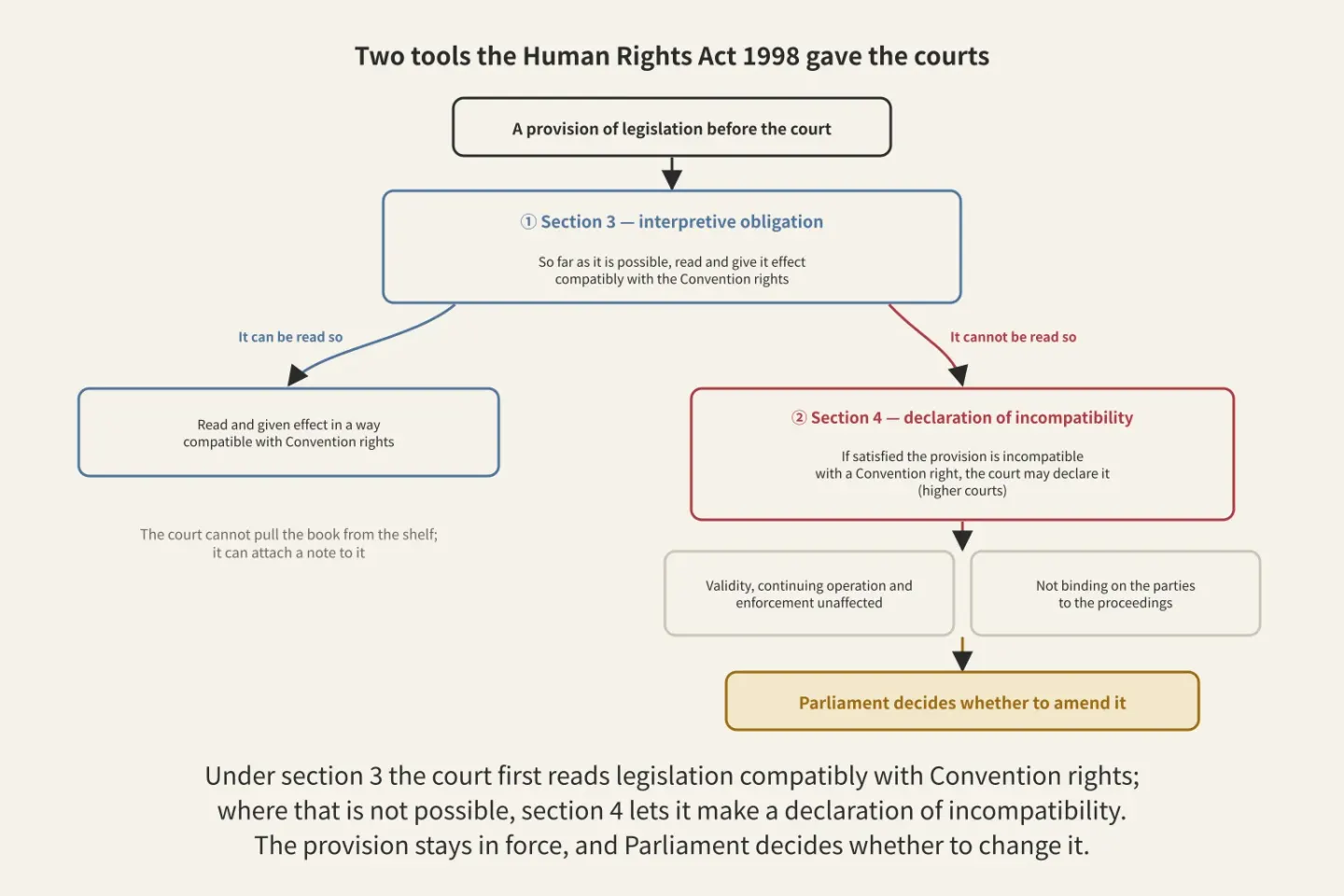
Figure: a diagram Paperis drew using only what the article says
Translated into the bookshelf metaphor, it is this: The courts could not pull out the book, but they became able to attach a note to the book. Whether to read the note and amend the book is decided by Parliament.
The Parliament That Received a Note
The notes were actually attached a few times. One study published in 2013 counted 18 finalized declarations of incompatibility (DOI: 10.5750/dlj.v25i1.748), and an article published in 2015 counts 20 declarations that were not overturned on appeal (DOI: 10.5040/9781474201704.ch-008). They mostly came up regarding Articles 5, 6, 8, and 14 of the Convention, which guarantee liberty and security, the right to a fair trial, respect for private and family life, and the prohibition of discrimination (DOI: 10.35215/jcj.2021.8.2.009). Even though Parliament has no legal obligation to respond to the declarations, in many cases it has accepted them and created new laws (DOI: 10.35215/jcj.2021.8.2.009). However, there was clearly one instance where a declared law was left unchanged without being amended. That was the law completely banning prisoners from voting (DOI: 10.1093/icon/mov063).
Views on reading this outcome are split into two. One side cites the advantages that leaving the final decision to Parliament leaves important social issues to debate between Parliament and citizens, and that the back-and-forth between the courts and Parliament raises the quality of constitutional judgment (DOI: 10.35215/jcj.2021.8.2.009). The other side argues that once a declaration comes out, Parliament has no real freedom to stand up against the court's conclusion (DOI: 10.5750/dlj.v25i1.748). The same study notes that while post-declaration legislation constructively amended policies in some cases, it led to less effective policies in others, and that Parliament has some capacity to address rights issues without the court's prodding (DOI: 10.5750/dlj.v25i1.748). Some scholars criticize that the declaration effectively became a power to invalidate laws (DOI: 10.1111/j.1467-9256.2010.01371.x).
Comparative constitutional law has a name for this approach. Weak-form judicial review is an approach where courts have the power to sort out rights violations in laws, but leave more say over the conclusion of rights issues to the elected parliament. Aileen Kavanagh, a legal scholar who has studied human rights law, criticizes that looking at how it actually operates, the power of UK courts was strong by any standard (DOI: 10.1093/icon/mov063). A paper responding to this criticism agrees with the warning not to exaggerate the difference between the two approaches, but counter-argues that in actual operation, the shares that Parliament and the courts contribute to rights issues differ (DOI: 10.1093/icon/mov063).
It is common to think of the declaration of incompatibility as an idea first created by the UK in the 1990s, but research shows that this concept was already envisioned in the 1940s by a key British figure in the drafting of the European Convention on Human Rights and a scholar who studied ways to bring international bills of rights into domestic laws, and similar ideas were examined even earlier during the founding era of the United States (DOI: 10.1093/icon/mox051). In the 2020s, discussions to amend or change human rights law have continued, and there is an analysis that as legislation cutting the ties of human rights law by policy area increases, the risk of the human rights law system becoming fragmented is growing (KCI ART003314791).
The Highest Court That Sat Inside Parliament
The top of the sticky-note court also spent a long time inside Parliament. For centuries, the highest court in the United Kingdom belonged to the House of Lords, the upper chamber of Parliament. Following the Constitutional Reform Act of 2005, the Supreme Court broke away from Parliament and became independent in October 2009 (KCI ART001970532).
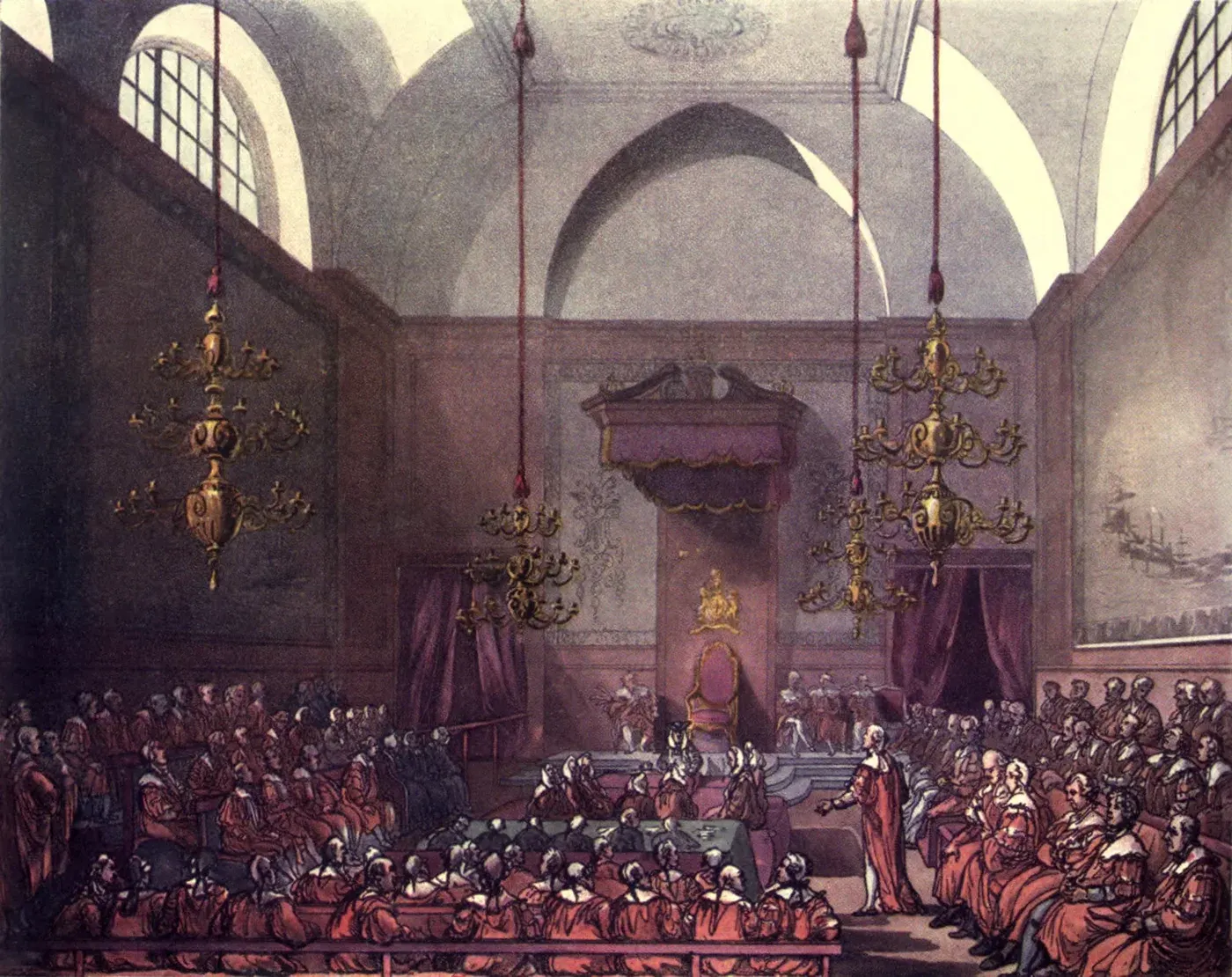
Figure: The House of Lords chamber, a plate from The Microcosm of London (1809) · Public domain, via Wikimedia Commons
Assessments are divided over the weight of this change. Some view it as a momentous constitutional transition, while others evaluate it as amounting to little more than a change in form rather than substance (KCI ART001970532). This paper itself views the independence of the Supreme Court as a turning point that will move the UK toward constitutional democracy (KCI ART001970532). Some studies view the Constitutional Reform Act as signifying the emergence of an institutionally independent judiciary (DOI: 10.1017/cbo9780511933820). The new Supreme Court can issue declarations of incompatibility, but it does not have the power to invalidate statutes (DOI: 10.1007/978-94-6265-273-6_3).
Two Scenes from the Brexit Court
The United Kingdom held a referendum on June 23, 2016, to decide whether to remain in or leave the European Union (DOI: 10.32625/KJEI.2019.18.77), and the leave vote won (DOI: 10.1177/1369148118815409). Afterward, two cases reached the Supreme Court regarding how to proceed with the withdrawal. This article does not deal with the pros and cons of leaving, but only looks at what the court judged.
The first scene is the Miller judgment of January 2017 (DOI: 10.19152/ukscy.719). The government argued that the royal prerogative to make and break treaties also included the power to withdraw from European Union treaties ([2017] UKSC 5 [5]). One issue was that the withdrawal notification would effectively overturn the decisions made by Parliament in the European Communities Act 1972 (DOI: 10.19152/ukscy.719). The Supreme Court majority ruled that for a minister to give notice of withdrawal, there must first be authorization by an Act of Parliament ([2017] UKSC 5 [101]). Changing the law can only be done through the sole method permitted by the British constitution, namely legislation by Parliament ([2017] UKSC 5 [121]). Dissenting opinions from Supreme Court justices who would have ruled in the government's favor were attached to this judgment ([2017] UKSC 5 [282]). Following the ruling, Parliament passed an Act allowing the Prime Minister to give notice, and the notice was delivered on March 29, 2017 ([2019] UKSC 41 [9]).
The second scene is the judgment of September 2019. Prorogation is when the monarch closes a session of Parliament on the advice of the government, preventing Parliament from meeting until the next session opens. During a prorogation, neither House can meet, debate, or make laws ([2019] UKSC 41 [2]) ([2019] UKSC 41 [3]). In late August 2019, as major constitutional changes surrounding the withdrawal were being discussed, the Prime Minister advised the Queen to prorogue Parliament for about five weeks ([2019] UKSC 41 [1]) ([2019] UKSC 41 [61]). The Supreme Court examined this matter in light of the two principles of parliamentary sovereignty and government accountability to Parliament ([2019] UKSC 41 [41]) ([2019] UKSC 41 [46]). It ruled that the Prime Minister's advice was unlawful, that the resulting prorogation was also void and of no effect, and that Parliament had therefore not been prorogued ([2019] UKSC 41 [61]) ([2019] UKSC 41 [69]) ([2019] UKSC 41 [70]). As of 2021, these two cases are the only two instances where the Supreme Court sat with its maximum panel of 11 justices (DOI: 10.17863/cam.75623).
Comparing the two scenes side by side reveals commonalities. In both cases, what the court examined was a government decision, both judgments relied on parliamentary sovereignty, and the 2019 judgment additionally invoked government accountability to Parliament. What the court invalidated was the Prime Minister's advice and the resulting prorogation, and the Supreme Court reaffirmed that legislation made by Parliament is the highest law in British law ([2019] UKSC 41 [41]) ([2019] UKSC 41 [69]). In the Brexit litigation, the Supreme Court examined government decisions on the basis of parliamentary sovereignty and did not invalidate laws made by Parliament.
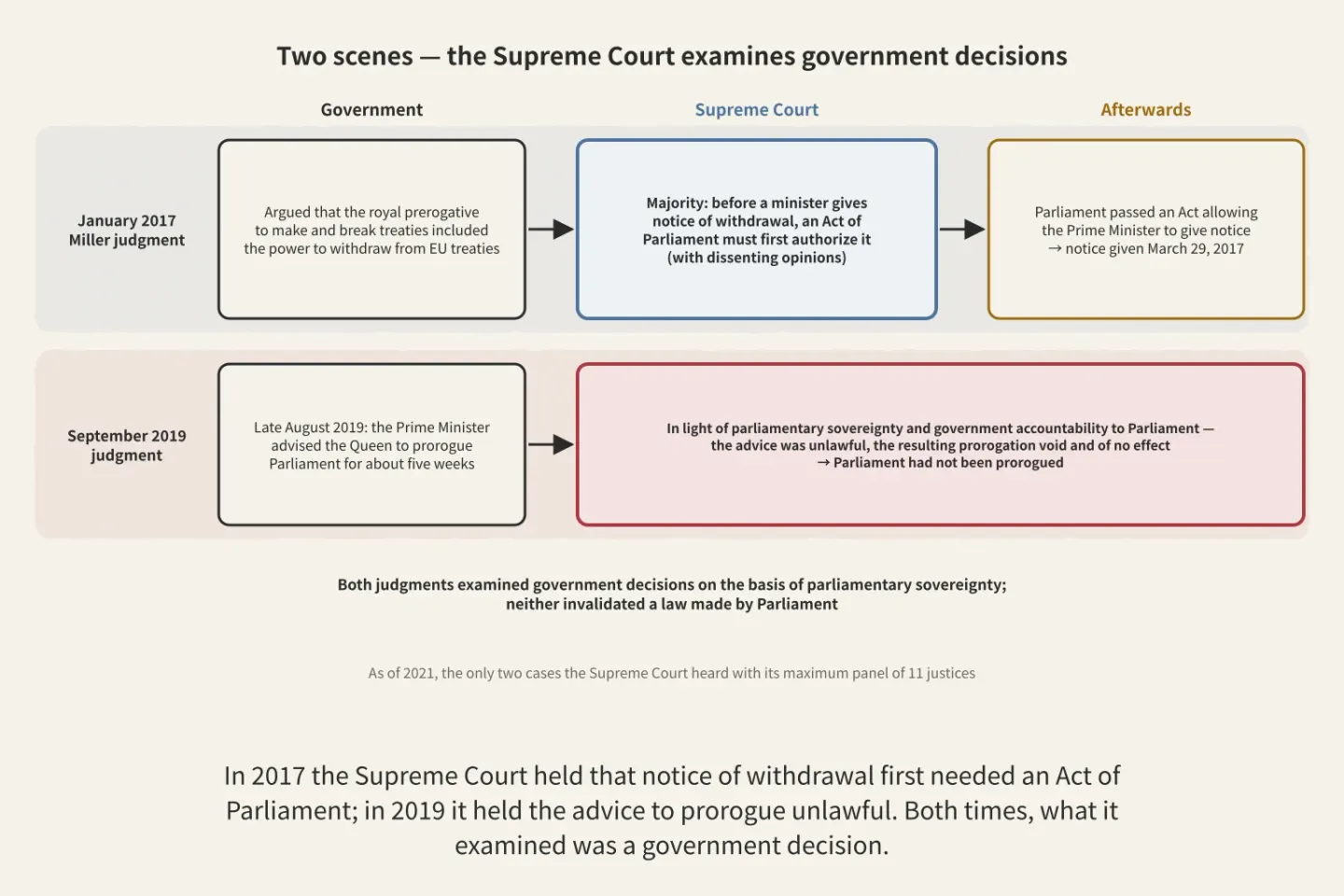
Figure: a diagram Paperis drew using only what the article says
Evaluations of the second judgment are mixed. One study considers that this judgment demonstrates a defensible but contestable view of the constitution, and may remain the high watermark of Supreme Court constitutional jurisprudence for some time (DOI: 10.4324/9781003477068-11). There was criticism that the Supreme Court had waded too far into the realm of “politics”, and another study analyzes that the very line dividing the realm of law from the realm of politics is colored by ideological positions (DOI: 10.1093/icon/moac104).
Placed Side by Side with South Korea
Korean bookshelves are shaped differently. A single copy of the Constitution of the Republic of Korea sits at the very top, with statutes beneath it. The Constitutional Court is the body that determines whether statutes comply with the Constitution and resolves disputes surrounding it. The Constitutional Court adjudicates whether a statute complies with the Constitution when a court submits a referral (Constitution of the Republic of Korea Article 111). Statutory provisions decided to be unconstitutional lose their effect starting from the day of that decision (Constitutional Court Act Article 47). A declaration under the UK Human Rights Act leaves the effect of a provision intact (Human Rights Act 1998 s 4).
There are also decisions whose outer appearances resemble one another. Constitutional incompatibility is a decision where a court judges that a statute runs counter to the Constitution yet does not strip it of effect on the spot, instead giving the legislature an opportunity to amend it. One study placing the UK's declaration of incompatibility and South Korea's decision of constitutional incompatibility side by side views that under both systems, how the legislature responds to the court's judgment determines the success or failure of rights protection (KCI ART003314791). There is also research noting that the standard UK courts use to examine statutes restricting rights converges on the proportionality principle and does not differ greatly from the standard used by the South Korean Constitutional Court, though differences exist in the specific ways it is applied (KCI ART001477143).
The two frameworks differ in what they gain and what they give up. In South Korea, a decision of unconstitutionality binds the courts and other state organs (Constitutional Court Act Article 47), and provisions judged unconstitutional are no longer used even if the legislature does not respond. Instead, the system in which the Constitutional Court causes a statute to lose effect has faced the criticism that a judicial institution with weak democratic legitimacy decides major community problems (DOI: 10.35215/jcj.2021.8.2.009). In decisions that wait for the legislature's hand, such as constitutional incompatibility, analyses point out that South Korea too sees the legislature's response determine success or failure (KCI ART003314791). The British method leaves the final decision to Parliament (DOI: 10.35215/jcj.2021.8.2.009). In exchange, the success or failure of rights protection depends on Parliament's response (KCI ART003314791). And as we saw earlier, analyses suggest that even in the UK, Parliament actually finds it difficult to stand against a declaration (DOI: 10.5750/dlj.v25i1.748).
Where to Look Further
Where Brexit will take the British constitution is an open question. Views that parliamentary sovereignty is reviving, paths where the government's power grows larger than parliament and the courts, and paths advancing further toward democratic constitutionalism are discussed together (DOI: 10.1177/0192512121995133). There is also an analysis that Brexit could instead hand more decision-making power to the courts (DOI: 10.54648/euro2017043).
- What a single bound constitution protects is covered by "What Is a Constitution — The Wall You Cannot Simply Knock Down".
- The path by which the Korean Constitutional Court judges laws and the decision of constitutional incompatibility are covered by "What the Constitutional Court Does — Five Windows and Six Votes".
- The method of measuring laws that restrict rights using the principle of proportionality is covered by "Basic Rights and Their Limits — A Scale Without Markings".
- Korea's arrangement in which parliament, the government, and the courts divide power is covered by "Separation of Powers — A Country That Splits Its Keys".
- How American courts gained the power to invalidate laws is covered by "The US Constitution and the Supreme Court — The Margins of a Hard-to-Amend Text" among the other parts of this series, the European Court of Human Rights and the Court of Justice of the European Union by "Europe's Two Courts — Who Has the Last Word?", the path by which the institution of the constitutional court spread by "Constitutional Courts — Who Holds the Constitution's Measuring Stick?", and what the common law is by "Common Law and Civil Law — The Book a Judge Opens First".
Source Papers
- "Human Rights Act 1998 s 3" (current) — Statute text — Legislation must be read and given effect in a way which is compatible with the Convention rights so far as it is possible to do so, and this section does not affect the validity of incompatible legislation.
- "Human Rights Act 1998 s 4" (current) — Statute text — The Supreme Court, High Court, or Court of Appeal may make a declaration of incompatibility in regard to a provision, and the declaration does not affect the validity, continuing operation, or enforcement of the provision in question and is not binding on the parties to the proceedings.
- "R (Miller) v Secretary of State for Exiting the European Union" (2017) — [2017] UKSC 5 — Ministers require prior authority from an Act of Parliament before giving notice of withdrawal from the EU (majority [101], [121], dissent [282]). Judges are merely observers of political conventions and do not adjudicate their scope as law ([146]). The power of a referendum is political until the machinery of Parliament is set in motion ([124]).
- "R (Miller) v The Prime Minister; Cherry v Advocate General for Scotland" (2019) — [2019] UKSC 41 — While the United Kingdom lacks a single constitutional document, it possesses a constitution built upon common law, statutes, conventions, and practice ([39]). In light of parliamentary sovereignty and government accountability to Parliament, the advice to prorogue for 5 weeks was unlawful, the advice, Order in Council, and prorogation were void, and Parliament has not been prorogued ([41], [46], [61], [69], [70]).
- "Constitution of the Republic of Korea Article 111" (current, in force 1988.2.25) — Statute text — The Constitutional Court shall have jurisdiction over the review of constitutionality of statutes upon the request of the courts.
- "Constitutional Court Act Article 47" (current, in force 2026.3.12) — Statute text — A decision holding a statute unconstitutional binds the courts and other state organs, and statutory provisions determined to be unconstitutional lose their effect from the date of the decision.
- "Introduction to Political Science — 11.3 Types of Legal Systems around the World" (2022) — OpenStax Introduction Political Science 11.3 — The common law fills fields originally lacking codified statutes with judge-made law.
- "Europe's Gift to the United Kingdom's Unwritten Constitution – Juridification" (2019) — DOI: 10.1007/978-94-6265-273-6_3 — The UK constitution is Europe's only uncodified constitution, and the Supreme Court inaugurated in 2009 issues declarations of incompatibility but lacks the power to invalidate statutes. Prior to Brexit, courts were willing to disapply legislation that conflicted with directly effective EU law.
- "Towards a Written Constitution" (2020) — DOI: 10.46692/9781529200638.005 — The question of whether the UK's "unwritten constitution" is truly a constitution is ultimately a semantic problem, and broad definitions suffer from the limitation of lacking normative force.
- "The Nature and Characteristics of the British Constitution" (2010) — KCI ART001472019 — A political constitution operated through statutes, conventions, and judicial precedents. The most important conventions limit royal prerogative and govern the executive-legislative relationship; citizens' freedoms are residual, and political self-regulation takes precedence over legal checks.
- "Brexit and Parliamentary Sovereignty" (2019) — DOI: 10.32625/KJEI.2019.18.77 — Parliamentary sovereignty is the core principle of the British constitution that Parliament can enact or repeal any law whatever, and no person or body can override or set aside its legislation. The referendum took place on June 23, 2016.
- "The Implementation of the Human Rights Act in the UK and Changes in the Principle of Parliamentary Sovereignty" (2005) — KCI ART001025699 — Under parliamentary sovereignty, Parliament holds unlimited legislative power, and courts must accept parliamentary legislation as binding. The Human Rights Act altered the nature of that relationship, though the practical significance of the change remains to be seen.
- "The Doctrine of Parliamentary Sovereignty in the UK: Is Change Visible?" (2015) — KCI ART002072865 — Today's Parliament cannot bind tomorrow's, and courts cannot review the validity of statutes. Despite EU accession, devolution, the Human Rights Act, and the creation of a Supreme Court, Parliament retains the power to abolish them, meaning parliamentary sovereignty is preserved "at least in theory."
- "Trends and Content of British Constitutional Reform: Modern Developments in Parliamentary Government" (2010) — KCI ART001508852 — The British constitution has been built upon formidable primeing-ministerial power and the fusion of executive and legislature, and constitutional reforms are attempts to reinforce checks and balances.
- "Questions of legality and legitimacy: Form and substance in British constitutionalism" (2011) — DOI: 10.1093/icon/mor017 — Courts interpret legislation against the constraints of legality, recognizing implicit limits on parliamentary legislative power, and parliamentary sovereignty itself is argued to be a common law principle.
- "The afterlife of Parliamentary sovereignty" (2011) — DOI: 10.1093/icon/mor023 — The rule of parliamentary sovereignty was discarded in the Factortame case yet enjoys an afterlife in academia.
- "The Constitutional Structure of Guaranteeing Fundamental Rights under the UK Principle of the 'Rule of Law': Parliamentary Sovereignty as a Mediator between Law and Sovereignty" (2016) — DOI: 10.18854/kpsr.2016.50.2.005 — According to Dicey, the UK constitution consists of constitutional laws and constitutional conventions, and unlimited parliamentary sovereignty is checked by non-legal constitutional conventions.
- "United Kingdom: The royal prerogative" (2010) — DOI: 10.1093/icon/mop038 — Prerogative powers are residual powers from the era when monarchs ruled directly, including treaty-making, declarations of war, and troop deployments; they require no parliamentary approval, and there is little agreement on their definition and scope.
- "Brexit and the future of the UK constitution" (2021) — DOI: 10.1177/0192512121995133 — Brexit could lead to several outcomes, including the restoration of parliamentary sovereignty, an executive-dominant "populist" democracy, or democratic constitutionalism, while the constitutional status of the referendum remains highly unclear.
- "Aspects of Norm Control under the UK Human Rights Act — Focusing on the Declaration of Incompatibility —" (2021) — DOI: 10.35215/jcj.2021.8.2.009 — A 1997 Labour Party manifesto pledge, enacted on 1998.11.9. Section 3 interpretation duty and Section 4 declaration; a declaration is not an invalidation. Parliament has generally accepted them without legal obligation, offering the advantage of leaving social issues to parliamentary and public debate.
- "Judicial Control over Parliamentary Legislation in the UK - Changes after the Implementation of the Human Rights Act 2000" (2010) — KCI ART001477143 — Since implementation in 2000, judicial review of parliamentary legislation has also emerged in the UK, with review standards converging on the principle of proportionality, much like the South Korean Constitutional Court.
- "Taking the Strasbourg Jurisprudence into Account: Developing a 'Municipal Law of Human Rights' under the Human Rights Act" (2005) — DOI: 10.1093/iclq/lei042 — Parliamentary sovereignty sets the limit for Section 3 interpretation. Lord Nicholls: meanings that depart radically from a statute's fundamental features risk crossing the boundary from interpretation into amendment.
- "Dialogue and declarations of incompatibility under section 4 of the Human Rights Act 1998" (2013) — DOI: 10.5750/dlj.v25i1.748 — Analysis of 18 final declarations. Some led to constructive policy amendments, others to less effective policies, and following a declaration Parliament lacks practical freedom to reject the court's conclusion.
- "Parliament's Role Following Declarations of Incompatibility under the Human Rights Act" (2015) — DOI: 10.5040/9781474201704.ch-008 — UK courts have made 20 Section 4 declarations that were not overturned on appeal.
- "The Human Rights Act and Juridification: Saving Democracy from Law" (2010) — DOI: 10.1111/j.1467-9256.2010.01371.x — A critique arguing that Section 4, though designed to protect parliamentary supremacy, has become a de facto judicial invalidation power.
- "What's so weak about "weak-form review"? A reply to Aileen Kavanagh" (2015) — DOI: 10.1093/icon/mov063 — Kavanagh criticizes that judicial power under the Human Rights Act has actually been strong, and the author agrees with the warning not to exaggerate differences while countering that the share of elected bodies differs in actual operation.
- "Judicial disapproval as a constitutional technique" (2017) — DOI: 10.1093/icon/mox051 — Declarations of incompatibility are commonly thought to be an invention of 1990s Britain, but they were already conceived in the 1940s.
- "The Transition of Judicial Review Structures Following the Introduction of the Human Rights Act in the UK and Modern Constitutional Tasks" (2026) — KCI ART003314791 — Risk of fragmenting the Human Rights Act framework through legislative exceptionalism that severs judicial review links across policy areas. Compared with South Korea's constitutional non-conformity decisions, the legislature's response determines the success or failure of rights protection.
- "The Independence of the UK Supreme Court and Its Constitutional Implications" (2015) — KCI ART001970532 — In accordance with the Constitutional Reform Act 2005, the Supreme Court became independent from Parliament in October 2009. Evaluations are divided between viewing this as a momentous transition versus a mere formal change.
- "The Separation of Powers in the Contemporary Constitution: Judicial Competence and Independence in the United Kingdom" (2010) — DOI: 10.1017/cbo9780511933820 — The Human Rights Act brought judges closer to political decisions, and the Constitutional Reform Act signifies the emergence of an institutionally independent judiciary.
- "The British constitution resettled? Parliamentary sovereignty after the EU Referendum" (2019) — DOI: 10.1177/1369148118815409 — Argument that parliamentary sovereignty was re-established as it went through parliamentary processes such as triggering Article 50 and voting on withdrawal bills following the leave result of the 2016 referendum.
- "Miller and Northern Ireland: A Critical Constitutional Response" (2016) — DOI: 10.19152/ukscy.719 — The January 2017 Miller judgment rejected the government's claim of unlimited executive power to trigger Article 50 via the royal prerogative. The issue was the implied overturning of the 1972 European Communities Act decision.
- "Brexit and the Common Law Constitution" (2018) — DOI: 10.54648/euro2018039 — The Supreme Court explained EU withdrawal within the framework of parliamentary sovereignty in the Miller judgment.
- "R (on the application of Miller and Cherry) v Prime Minister and Advocate General for Scotland [2019] UKSC 41, Supreme Court" (2020) — DOI: 10.1093/he/9780191897689.003.0054 — A case judging whether the government could lawfully advise a roughly 5-week prorogation, evaluated through the two principles of parliamentary sovereignty and government accountability to Parliament.
- "R (Miller) v Prime Minister [2019] UKSC 41" (2025) — DOI: 10.4324/9781003477068-11 — The 2019 5-week prorogation was unlawful. Defensible yet a contentious constitutional view, and for the time being it may stand at the highest watermark of the Supreme Court's constitutional case law.
- "The Prorogation Case: Re-inventing the Constitution or Re-imagining Constitutional Scholarship" (2021) — DOI: 10.17863/cam.75623 — The two Miller cases mark the only instances to date where the Supreme Court sat with a maximum panel of 11 justices.
- "The UK Supreme Court's Miller II: Keeping the Court out of politics' way?" (2022) — DOI: 10.1093/icon/moac104 — Analyzes the tension in criticisms that the Supreme Court entered the political domain, arguing that the very attempt to divide the realms of law and politics is steeped in ideological stances.
- "The Constitutional Implications of Brexit" (2017) — DOI: 10.54648/euro2017043 — Brexit may fail to restore parliamentary sovereignty and instead hand even more decision-making power to the courts.
Sources (25)
- Introduction to Political Science — 11.3 Types of Legal Systems around the World
- Europe's Gift to the United Kingdom's Unwritten Constitution – JuridificationDOI 10.1007/978-94-6265-273-6_3
- Towards a Written ConstitutionDOI 10.46692/9781529200638.005
- 브렉시트와 의회주권DOI 10.32625/kjei.2019.18.77
- Questions of legality and legitimacy: Form and substance in British constitutionalismDOI 10.1093/icon/mor017
- The afterlife of Parliamentary sovereigntyDOI 10.1093/icon/mor023
- 영국의 '법의 지배' 원칙에 의한 기본권 보장의 헌정 구조 : 법과 주권의 매개로서의 의회주권DOI 10.18854/kpsr.2016.50.2.005
- United Kingdom: The royal prerogativeDOI 10.1093/icon/mop038
- Brexit and the future of the UK constitutionDOI 10.1177/0192512121995133
- 영국 인권법 하에서의 규범통제의 양상 - 불합치선언(Declaration of Incompatibility)을 중심으로DOI 10.35215/jcj.2021.8.2.009
- Taking the Strasbourg Jurisprudence into Account: Developing a 'Municipal Law of Human Rights' under the Human Rights ActDOI 10.1093/iclq/lei042
- Dialogue and declarations of incompatibility under section 4 of the Human Rights Act 1998DOI 10.5750/dlj.v25i1.748
- Parliament's Role Following Declarations of Incompatibility under the Human Rights ActDOI 10.5040/9781474201704.ch-008
- The Human Rights Act and Juridification: Saving Democracy from LawDOI 10.1111/j.1467-9256.2010.01371.x
- What's so weak aboutDOI 10.1093/icon/mov063
- Judicial disapproval as a constitutional techniqueDOI 10.1093/icon/mox051
- The Separation of Powers in the Contemporary Constitution: Judicial Competence and Independence in the United KingdomDOI 10.1017/cbo9780511933820
- The British constitution resettled? Parliamentary sovereignty after the EU ReferendumDOI 10.1177/1369148118815409
- Miller and Northern Ireland: A Critical Constitutional ResponseDOI 10.19152/ukscy.719
- Brexit and the Common Law ConstitutionDOI 10.54648/euro2018039
- R (on the application of Miller and Cherry) v Prime Minister and Advocate General for Scotland [2019] UKSC 41, Supreme CourtDOI 10.1093/he/9780191897689.003.0054
- R (Miller) v Prime Minister [2019] UKSC 41DOI 10.4324/9781003477068-11
- The Prorogation Case: Re-inventing the Constitution or Re-imagining Constitutional ScholarshipDOI 10.17863/cam.75623
- The UK Supreme Court's Miller II: Keeping the Court out of politics' way?DOI 10.1093/icon/moac104
- The Constitutional Implications of BrexitDOI 10.54648/euro2017043