
Paperis Articles
Common Law and Civil Law — The Book a Judge Opens First
Law that starts from earlier rulings and law that starts from a code, two traditions growing closer in some areas, and where Korea stands
Your field's papers, as audio
Pick your fields and journals — Paperis summarizes the key papers and turns them into audio. Listen on your commute.
Start Paperis free →Common Law and Civil Law — The Book a Judge Opens First
Two Judges' Desks
A company negotiated with another company for months to sign a supply contract. Because the other party acted as though they were about to sign, this company rented a warehouse and hired staff in advance. Right before the signing, however, the other party cut off negotiations. The company goes to court, demanding compensation for the money it spent in the meantime. This company and case are fictional, designed to help understanding.

Figure: The warehouse rented and the staff hired in advance of a contract — the signature never came
Let us imagine that the same dispute arrives at a court in London and a court in Berlin. Broadly speaking, the two judges open different books on their desks first. The judge in London opens a collection of rulings that gathers how past judges judged similar disputes. The judge in Berlin opens a thick code of law and starts by finding which article handles this matter.
When dividing the world's laws into two major branches, the London side is called the common law, and the Berlin side is called civil law. Common law is a legal branch that grew in England and spread to countries ruled by Britain, representing a tradition where judges rely on prior rulings to make and refine law. Civil law is a legal branch that grew on the European continent, representing a tradition that starts judgments from systematically compiled legal codes. This picture only shows the starting point. In reality, both judges open both books. This article looks in turn at what the two books look like, why the two branches are growing to resemble each other, and where Korea stands between them. How the two judges would judge this company's dispute is not addressed in this article.
This article is written as of November 2026. It covers the laws of Britain, the United States, and countries on the European continent, and comparison with Korea is touched upon in the final section. It looks at what each branch gains and gives up, exactly as much as the evidence tells.
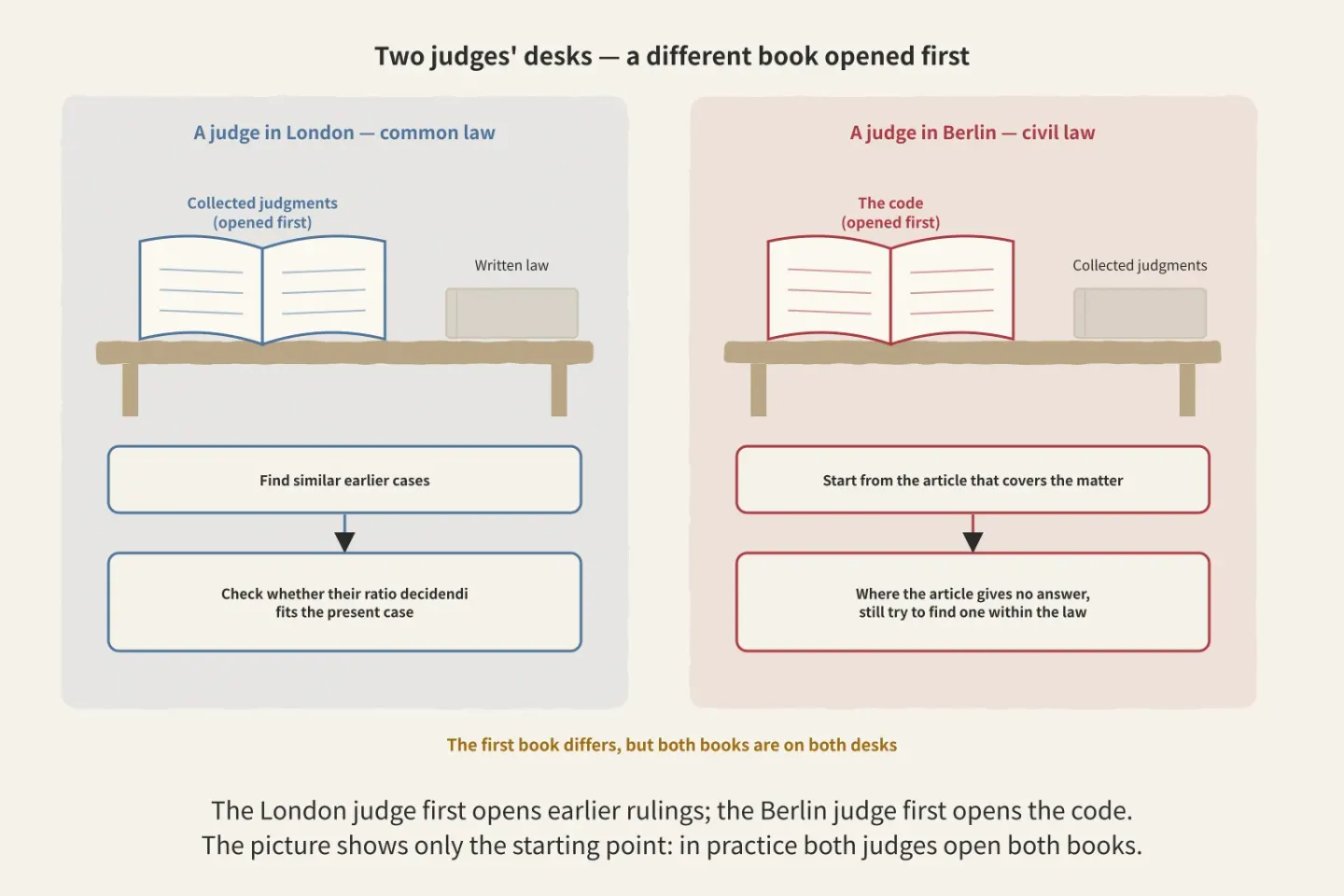
Figure: a diagram Paperis drew using only what the article says
Grouping the Laws of the World by Family
If you color a world map according to what the laws look like in each country, they group into several colors. A legal family is a branch that groups the laws of different countries by how similar they look, and is also called a legal family. They are commonly divided into common law, civil law, religious law, customary law, and a mixed type where two or more are blended, with mixed forms being common today (OpenStax Introduction Political Science 11.3). This article looks at common law and civil law among them.
The habit of dividing the world into these two branches is younger than you might think. The 19th century is commonly considered the time when the opposition between common law and civil law was clearest. Yet, this distinction took root in legal family classifications only in the 20th century. Highly influential classifications were put forward in the 1960s by comparative law scholar René David, and two scholars, Zweigert and Kötz (DOI: 10.5131/ajcl.2012.0010).
Some scholars even doubt the classification itself. New-wave comparative law scholars view that drawing a map of the world's laws is not neutral and is a biased task, and that all classifications and groupings have fundamental flaws (DOI: 10.3406/ridc.2004.19249). Therefore, it is safer to read legal families as a rough guide.
Common Law: Past Rulings Become the Law
We begin with the London judge's desk. The collection of judgments that judge opens was originally a book that filled the space where law was not written down in text. Judges read rules out of earlier rulings and used them for new cases, and law made by judges in that way was the original common law. American law, which emerged from British rule, also belongs to this branch (OpenStax Introduction Political Science 11.3).
A precedent is a judgment made by a court in an earlier case that serves as the standard when judging similar later cases. A large share of common law is not enacted by a parliament. It is something judges have grown over hundreds of years by applying existing rules to new cases (KCI ART001232294).
Stare decisis is the principle that courts must judge similar cases by following the standards set by earlier rulings. In England, this principle began to grow in the king's courts after the reign of King Henry II of England and solidified in the 18th century. It took its current shape after the court hierarchy was established by the Judicature Acts of 1873–1875 (KCI ART001232294).
Once the hierarchy is set, the rule becomes simple. The rulings of higher courts bind lower courts. The House of Lords, which was the highest court at the time, remained bound by its own rulings until 1966 (KCI ART001232294).
Not the entire judgment binds later ones. The ratio decidendi is the reasoning within the judgment that was strictly necessary to reach the conclusion, and it is the part from which the power to bind later cases actually arises. General remarks that a judge added in passing during a judgment are not counted as precedent. When following an earlier precedent as-is would produce an unjust result, a judge can overturn it if that precedent belongs to a lower court. If it belongs to a higher court, the judge points out how the current case differs from the earlier one and works around it (KCI ART001232294).
Therefore, the London judge's work becomes finding similar old cases and comparing whether the ratio decidendi of those rulings fits the current case as well.
There Are Also Many Written Laws in Common Law Countries
Let us move over to the desk of an American judge in the same family. Today in the United States, most laws are written by legislatures. Statutory law is law produced in writing through a formal process by a legislative body such as a legislature. Therefore, the collection of judgments an American judge opens is now also mostly a book compiling how preceding courts have read and applied those writings (OpenStax Introduction Political Science 11.3).
There are also more than two books on the desk. The Constitution is at the very top, and congressional statutes, administrative agency rules, and court judgments together become the laws an American judge relies upon (OpenStax Business Law I Essentials 2e 1.2).
Judges in common law countries like the United States also open written laws and read those provisions in light of the ways preceding judgments have read them. How the Constitution and the Supreme Court operate within this framework in the US is examined in another installment of this series, “The US Constitution and the Supreme Court — The Margins of a Hard-to-Amend Text”.
Civil Law: Starting from the Code
A civil code was published in France in 1804. Often called the Code Napoléon, this code was not the first of its kind. Yet after 1804, it became the benchmark for what a modern legal code should be, and even those who opposed codification used this code as their reference point (DOI: 10.54648/erpl1993004).
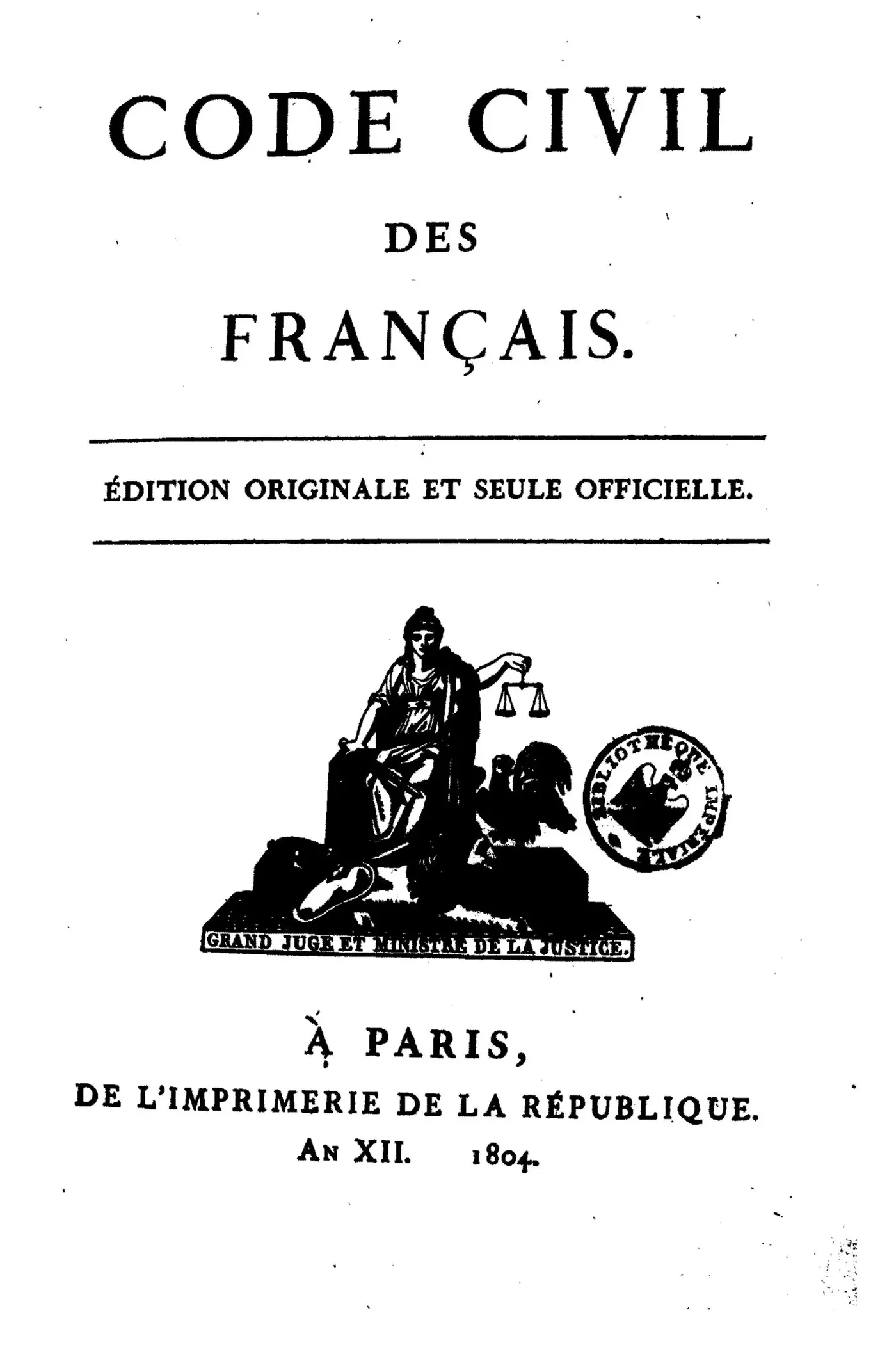
Figure: Title page of the original edition of the French Civil Code (Napoleonic Code) (1804) · Public domain, via Wikimedia Commons
French civil law inherited Roman civil law and stood upon the code of 1804 (DOI: 10.34874/prsm/rmedc-n63.63486).
Codification is the act of gathering scattered rules into a single system and binding them into one code. The task of collecting and bundling rules is very old and widespread. However, in the European tradition, a code in the sense we use today arose during the 18th-century Enlightenment under the influence of legal humanism, rationalism, and natural law theory (DOI: 10.54648/erpl1993004). Austria produced the General Civil Code (ABGB) in 1811, following the Codex Theresianus of 1766. These codes shared the same foundation of natural law theory, which puts human inborn rights front and center (DOI: 10.19195/0524-4544.340.7).
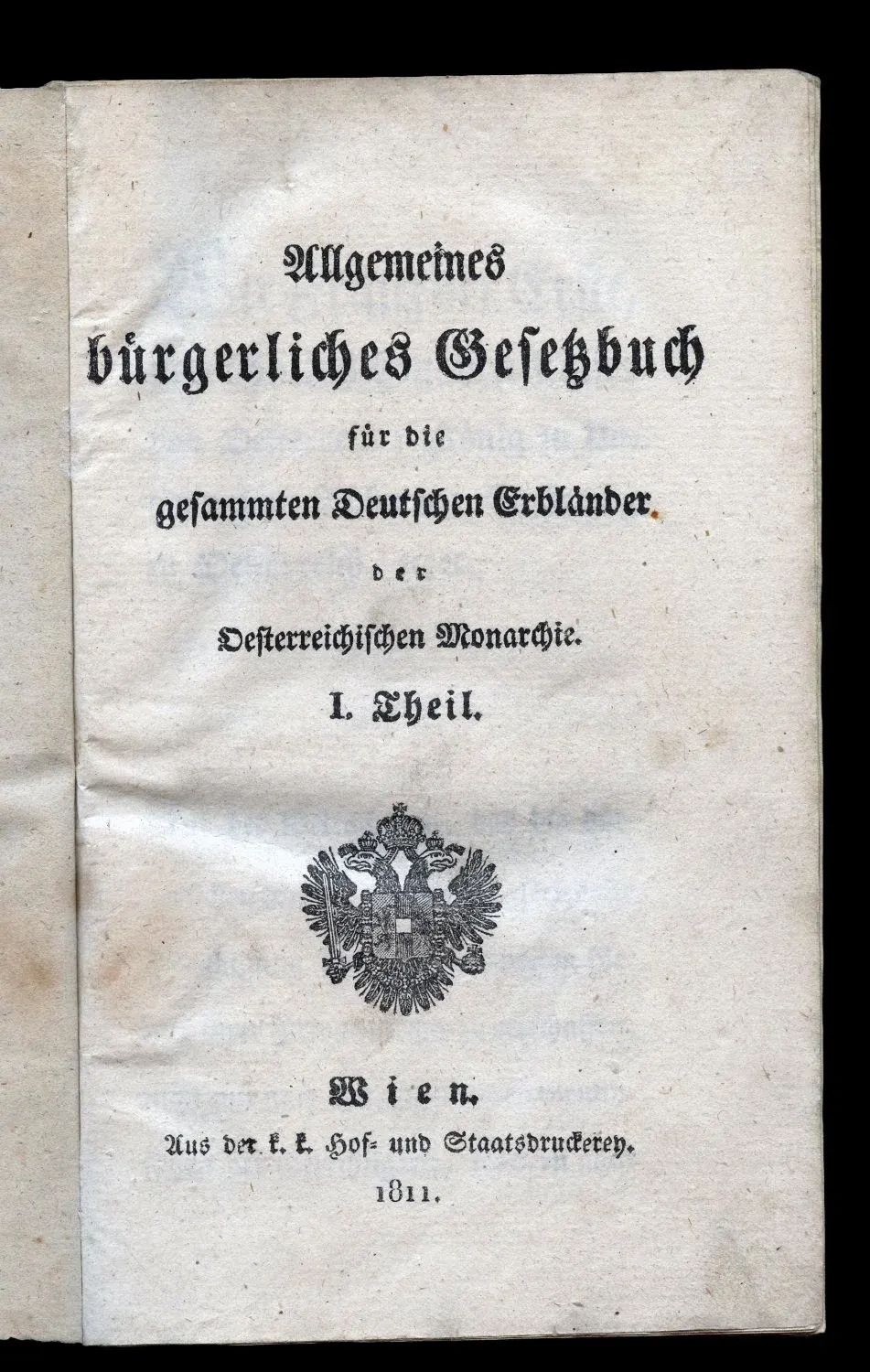
Figure: Title page of volume I of the Austrian General Civil Code (ABGB) (1811) · Public domain, via Wikimedia Commons
Now consider the desk of a judge in Berlin. A civil law jurist's thinking typically starts from deriving conclusions out of statutory provisions. Even in places where the provisions give no answer at all, the judge tries to find that answer from within the legislation (DOI: 10.14712/23366478.2025.153).
What the highest court does also traditionally looks different. The highest court in a common law country mainly takes on the task of choosing cases to hear and creating new precedents. The highest court in a civil law country chiefly corrects errors made by lower courts, and making precedents is closer to a byproduct that comes along with that job (DOI: 10.14712/23366478.2025.153). What divides the two paths is less whether precedents exist, and more whether precedents formally bind and where the judge starts from.
When There Are Blanks in the Legal Code
We return to the Berlin judge from the first section. A dispute that breaks down during negotiations happens before a contract is concluded. In 1861, the legal scholar R. von Jhering argued that a party who causes a contract to become void or to fail due to wrongful conduct during negotiations must compensate the other for the loss. Viewing the liability for simply harming another as too narrow in scope, he proposed imposing obligations akin to a contract even in such cases (KCI ART002004465).
The German Civil Code did not initially have a provision addressing this issue. German courts filled that blank by nurturing this concept through their rulings. Then, when modernizing the law of obligations in 2001, Germany transferred this legal doctrine into the provisions of the code (KCI ART002004465). This case demonstrates that even in civil law, judges can fill blanks in the legal code, and judgments accumulated in that way can later make their way into the code.
France also did not leave its Civil Code of 1804 untouched. Revisions continued from the 1960s, and in 2016, the contract law was extensively rewritten. One researcher views these revisions as demonstrating a redefinition of the civil code's role rather than its decline, assessing that the civil law has kept pace with the times through the flexibility of interpretation (DOI: 10.34874/prsm/rmedc-n63.63486).
The picture of a book a judge opens first reveals its limits here. In Germany, courts filled blanks in the legal code through rulings (KCI ART002004465), and even in civil law countries, precedents guide a judge's reasoning while not formally binding them. If a judge decides differently from a precedent, they must state the reasons why (DOI: 10.14712/23366478.2025.153). Even if the book opened first differs, both books are on the desk.
Where the Two Streams Grow Alike
The US state of Louisiana has a civil code. Located in the southern part of the land bought from France in 1803, this state later compiled its civil law into a code, releasing civil codes in 1825 and a revised version in 1870. Puerto Rico adopted the Spanish civil code of 1889, revised and used it in 1902 and 1930, and replaced it with a new code in 2020 (DOI: 10.1093/ajcl/avac016).
A mixed legal system is a system where two or more legal streams coexist within a single country or region. Because Louisiana and Puerto Rico base their laws governing private disputes on the civil law tradition within the common law-led United States, they fall under the mainstream definition of mixed legal systems (DOI: 10.1093/ajcl/avac016).
The way they handle judicial precedents is also closer than it appears. The underlying idea of the two streams is that common law gives formal binding force to precedents, while civil law does not. Yet their actual attitudes are not far apart. Even in civil law countries, precedents guide a judge's judgment without formally binding them. A judge can rule differently from a precedent, but to do so, they must thoroughly explain why they are not following it (DOI: 10.14712/23366478.2025.153). The author of this paper goes a step further, arguing that civil law countries should also make it explicit when changing precedents to prevent silently overturning them (DOI: 10.14712/23366478.2025.153).
There are also predictions that the two streams are converging into a mixed system. One mathematical model suggests that case law, under the rule of stare decisis, gradually moves toward more efficient and predictable rules. And while society changes, a system where statutory law and judgments complement each other is ideal, leading to the prediction that civil law and common law will gradually converge into a mixed system (DOI: 10.1086/533421). This prediction comes from a mathematical model.
There are also some observations. In an index tracking legal changes in the UK, France, Germany, the US, and India from 1970 to 2005, the laws of the five countries drifted apart until the late 1980s. Over the following 10 to 15 years, they grew somewhat closer, particularly in shareholder protection (DOI: 10.5131/ajcl.2008.0017).
Differences still remain. Even the person who questions witnesses in a trial is different. In German civil trials, the presiding judge questions the witness. In the US, both parties ask questions, and the right of cross-examination—where the opposing side asks follow-up questions—is particularly emphasized (DOI: 10.29305/tj.2024.12.205.253). The role of the jury in determining facts in American trials is examined in another installment of this series, Jury Trials — Twelve Chairs. Although the two streams have grown closer in several respects, differences remain in where judges start and how trials are run.
Which Legal Tradition is Good for the Economy
The World Bank published the Doing Business report, which compares countries and ranks them on how business-friendly their laws are. A 2009 paper noted that this report had the largest circulation among World Bank publications, and even its critics acknowledged that it drove legal reforms in many countries (DOI: 10.5131/ajcl.2008.0022). Around the same time, there was an argument that traditional comparative law scholars rarely addressed, yet it generated hundreds of papers (DOI: 10.5131/ajcl.2008.0022).
Legal origins theory is the claim that which legal family a country's law comes from affects its financial and economic growth. Four researchers, including Rafael La Porta, argued that countries with civil law, especially laws originating from France, have systematically weaker business environments than common law countries (DOI: 10.3386/w10288). Proponents of this argument believe that the legal family determines the quality of shareholder protection, which in turn affects growth by way of how companies raise external funding. Subsequent studies added the argument that common law adapts better to the changing demands of a market economy (DOI: 10.5131/ajcl.2008.0017).
Criticism begins with the shape of the data. The research supporting this claim typically measured laws at a single snapshot in time in the late 1990s. The five indices mentioned earlier tracked how laws changed over time, and raised doubts about legal origins theory given that shareholder protection in civil law countries increased significantly during that period. In terms of worker protection, the results aligned better with legal origins theory. However, even within the same legal family, countries varied widely in the mechanisms they used to regulate labor (DOI: 10.5131/ajcl.2008.0017).
There are also criticisms that trace back through history. A working paper (a paper before formal peer review) comparing French and American corporate organizational forms during the 19th-century industrialization period concluded that the American contracting environment at the time was neither freer nor more flexible than France's. American law offered fewer organizational forms for businesses to choose from, and both countries required new legislation for major changes. It was not until the late 20th century that American corporations gained as much freedom of contract as French corporations had enjoyed for a long time (DOI: 10.3386/w10288).
There are also explanations running in the opposite direction. The mathematical model mentioned earlier accounts for the observed correlation between legal families and economic performance through the evolving nature of case law (DOI: 10.1086/533421). The claim that legal families divide economies was split even among studies in the 2000s, and the picture changes depending on which area of law you look at.
The Books Korean Judges Open
It is known that South Korea's Commercial Act came from Japan's Commercial Act, and Japan's was largely modeled after Germany's Commercial Act (KCI ART001345590). Legal transplantation is when one country adopts the laws or systems of another to make them its own. South Korean law followed the civil law tradition after the Japanese colonial period, and was especially heavily influenced by German law (KCI ART001796667).
American law was layered on top of that. After World War II, during the U.S. military administration period, South Korea introduced common law elements into several fields, including the constitution and criminal law. In the judicial department of the U.S. military administration, legal advisors such as Ernst Fraenkel and Charles Pergler—who had studied both civil and common law—worked there. While it is unclear what they changed one by one, the author believes it is certain they played an important role in the adoption of common law, including in the constitution and criminal law (KCI ART001796667). There are also American traces in corporate law. One study traces this path, noting that when Japan amended its Commercial Act in 1950, it primarily referenced the 1933 Illinois Business Corporation Act of the United States, and South Korea's corporate law modeled that Japanese Commercial Act (KCI ART001345590).
Borrowing laws does not flow in only one direction. There are several cases where U.S. states and the federal government also copied laws from outside countries when amending their corporate laws. One report points out that the assumption which views countries that copy others' laws as lagging behind is a misunderstanding of the nature of imitation (DOI: 10.1093/ajcl/avag023).
There is an assessment that court procedures are closer to the German side. After World War II ended, South Korea introduced a method where both opposing parties take turns questioning witnesses. One study argues that the right of cross-examination, which serves as the foundation for this, was not properly understood, and that cross-examination is not properly carried out in practice either. It then concludes that South Korean civil litigation procedures remain a German-style model even after introducing some common law elements (DOI: 10.29305/tj.2024.12.205.253).
The weight of judicial precedents is also closer to the civil law side. Like other civil law countries, stare decisis is not recognized as a legal principle in South Korea. Therefore, it is commonly explained that judicial precedents do not have legal binding force, but only de facto binding force (KCI ART001332271).
There are places that look like exceptions. The Constitutional Court is an agency that determines whether laws conform to the Constitution and settles disputes surrounding the Constitution. For the Constitutional Court to change an “opinion regarding the interpretation and application” of the Constitution or laws that it previously ruled on, six or more justices must vote in favor (Article 23, Paragraph 2 of the Constitutional Court Act). One study views this provision as presupposing the binding force of precedents, and argues that binding force as a precedent should be recognized for Constitutional Court decisions. As this study sees it, that binding force does not bind citizens or other state agencies, but binds the Constitutional Court itself (KCI ART001332271).
The perspectives of South Korean researchers are also changing. There is an assessment that South Korea's framework of East Asian comparative civil law appears to be shifting from “legal transplantation”, where one accepts another's law, to “legal comparison”, where countries measure themselves against one another (KCI ART002195225). Put into the context of a book, the first thing a South Korean judge opens is the statute book. South Korea is a country that has layered pieces from American law on top of the civil law codes, and the way those pieces have settled differs from field to field.
Where Else to Look
Whether the classification of legal families will remain useful in the future is an open question within comparative law (DOI: 10.1093/oxfordhb/9780199935352.013.26).
- Where and how the reasoning of a judgment is written in a court document is covered in "How to Read a Court Judgment — A One-Line Answer and Its Reasons".
- How the Korean Supreme Court reviews the decisions of lower courts is covered in "Korea's Three-Tier Courts and the Supreme Court — The Three Steps a Case Climbs, and Sometimes Comes Back Down".
- Why the agreement of six justices acts as a threshold is covered in "What the Constitutional Court Does — Five Windows and Six Votes".
- Other installments in this series cover the US Constitution and the Supreme Court, the British constitution, jury trials, Europe's two courts, and the institution of the constitutional court in turn.
Source Papers
- "Introduction to Political Science — 11.3 Types of Legal Systems around the World" (2022) — OpenStax Introduction Political Science 11.3 — Five types of legal systems and the prevalence of mixed systems, the original and current meanings of common law (the accumulation of statutory interpretation), stare decisis, and the rule that only the same court or a higher court can overturn a precedent.
- "Business Law I Essentials 2e — 1.2 Sources and Types of Law" (2026) — OpenStax Business Law I Essentials 2e 1.2 — The sources of US law are the Constitution, case law, federal and state statutes, and administrative law.
- "영미법상의 선례구속의 원칙" (2008) — KCI ART001232294 — Most of the common law was built by judges, stare decisis grew after Henry II, solidified in the 18th century, and took its modern shape after the Supreme Court of Judicature Acts 1873-1875. Only the ratio decidendi becomes a precedent, and higher court precedents are bypassed through distinguishing.
- "The Rise and Decline of Legal Families" (2012) — DOI: 10.5131/ajcl.2012.0010 — The dichotomy between common law and civil law did not exist in legal classification before the 20th century, and today's classification was put forward in the 1960s by David, Zweigert, and Kötz.
- "Classification of Legal Families Today. Is it time for a memorial hymn ?" (2004) — DOI: 10.3406/ridc.2004.19249 — New trends in comparative law view the drawing of legal family maps as non-neutral and argue that classification is fundamentally flawed.
- "La codification" (1993) — DOI: 10.54648/erpl1993004 — The meaning of modern codes arose under the influence of legal humanism, rationalism, and natural law during the Enlightenment, and the 1804 Napoleonic Code, though not the first code, became the standard.
- "Le temps et le droit civil : Dirigeons-nous vers une disparition du droit civil en France ?" (2026) — DOI: 10.34874/prsm/rmedc-n63.63486 — The argument that French civil law, which continues Roman civil law and follows the 1804 Code, is not declining but redefining its functions through amendments since the 1960s and the 2016 contract law reform.
- "Prawo natury w „Allgemeines Bürgerlisches Gesetzbuch" z 1811 roku" (2025) — DOI: 10.19195/0524-4544.340.7 — The 1766 Theresian Code, the 1797 West Galician Code, and the 1811 Austrian General Civil Code shared the same foundation of natural law ideas regarding individual inherent rights.
- "Kontinentální a angloamerický precedent na prahu 21. století" (2025) — DOI: 10.14712/23366478.2025.153 — Civil law judges deduce from statutes and supreme courts mainly correct errors, but precedents carry normative force even without formal binding power, bringing actual practice close to the common law. The author calls for explicit changes in precedent.
- "계약체결상의 과실책임 - 동아시아에서 유럽민사법의 계수와 토착화 -" (2015) — KCI ART002004465 — German courts filled gaps in the civil code using Jhering's 1861 theory of culpa in contrahendo, which entered the code through the 2001 modernization of the law of obligations.
- "Multicultural Populations and Mixed Legal Systems in the United States: Louisiana and Puerto Rico" (2022) — DOI: 10.1093/ajcl/avac016 — Louisiana and Puerto Rico are mixed jurisdictions where private law is based on civil law traditions in civil codes.
- "Case Law versus Statute Law: An Evolutionary Comparison" (2008) — DOI: 10.1086/533421 — Theoretical model: Case law converges on efficient rules under stare decisis, a mix of statute law and judicial rulings is ideal amid social change, and the two branches are predicted to converge into a mixed system.
- "How Do Legal Rules Evolve? Evidence from a Cross-Country Comparison of Shareholder, Creditor, and Worker Protection" (2009) — DOI: 10.5131/ajcl.2008.0017 — Five-country index from 1970 to 2005: Large increases in shareholder protection in civil law countries cast doubt on the legal origins theory, worker protection aligns better with that claim but shows large internal diversity within legal families, and shareholder protection has converged over the last 10 to 15 years.
- "한국의 변론주의에 대한 검토─대륙법계와 영미법계의 비교를 통하여─" (2024) — DOI: 10.29305/tj.2024.12.205.253 — In Germany, the presiding judge examines witnesses, whereas in the US, the parties do. Korea introduced cross-examination but misunderstood the right to cross-examine, concluding that it remains a German-style model.
- "Comparative Law by Numbers? Legal Origins Thesis, Doing Business Reports, and the Silence of Traditional Comparative Law" (2009) — DOI: 10.5131/ajcl.2008.0022 — The legal origins theory has spawned hundreds of papers, and the Doing Business reports are among the World Bank's most read publications, guiding legal reforms in many countries.
- "Legal Regime and Business's Organizational Choice: A Comparison of France and the United States" (2004) — DOI: 10.3386/w10288 — Working paper. The 19th-century US contracting environment was no more free or flexible than France's, and US firms only gained French levels of contractual freedom in the late 20th century.
- "한국과 일본의 미국 회사법 계수 과정에 관하여" (2009) — KCI ART001345590 — Korean commercial law came from Japanese commercial law modeled on German commercial law, and the 1950 amendment to Japanese commercial law referenced the 1933 Illinois Business Corporation Act, passing down into Korean corporate law.
- "미군정기 미법률고문과 대륙법 및 영미법의 교착 -프랭켈, 퍼글러, 오플러를 중심으로-" (2013) — KCI ART001796667 — Korea, which was a civil law jurisdiction under German legal influence, introduced common law elements into its constitution, criminal law, and other areas during the US military government period, with American legal advisors trained in both legal systems active. The specific impact remains unclear.
- "Imitation as a Tool of Legal Change" (2026) — DOI: 10.1093/ajcl/avag023 — US states and the federal government have also imitated foreign corporate laws, and the assumption that imitating countries are laggards misunderstands imitation.
- "헌법재판소법 제23조 제2항" (현행, 시행 2026.3.12) — 법령 원문 — Decisions are made by a majority of participating justices, with proviso item 2 requiring the concurrence of six or more justices when changing a previously expressed opinion on the interpretation and application of the Constitution or statutes.
- "헌법재판소결정의 선례적 구속력" (2009) — KCI ART001332271 — Although it is argued that the principle of stare decisis is not recognized in Korea and precedents have only factual binding force, the six-justice requirement under proviso item 2 of Article 23, Paragraph 2 of the Constitutional Court Act presupposes precedent-based binding force, and that binding force binds only the Constitutional Court.
- "동아시아 비교민법학의 현황과 과제 -'법 계수'에서 '법 비교'로-" (2017) — KCI ART002195225 — The framework of East Asian comparative civil law studies in Korea appears to be shifting from legal reception to legal comparison.
- "The Future of Legal Families" (2016) — DOI: 10.1093/oxfordhb/9780199935352.013.26 — Examines recent criticisms of legal family classification and the potential future utility of legal families.
Sources (16)
- Introduction to Political Science — 11.3 Types of Legal Systems around the World
- Business Law I Essentials 2e — 1.2 Sources and Types of Law
- The Rise and Decline of Legal FamiliesDOI 10.5131/ajcl.2012.0010
- Classification of Legal Families Today. Is it time for a memorial hymn ?DOI 10.3406/ridc.2004.19249
- La codificationDOI 10.54648/erpl1993004
- Le temps et le droit civil : Dirigeons-nous vers une disparition du droit civil en France ?DOI 10.34874/prsm/rmedc-n63.63486
- Prawo natury w „Allgemeines Bürgerlisches GesetzbuchDOI 10.19195/0524-4544.340.7
- Kontinentální a angloamerický precedent na prahu 21. stoletíDOI 10.14712/23366478.2025.153
- Multicultural Populations and Mixed Legal Systems in the United States: Louisiana and Puerto RicoDOI 10.1093/ajcl/avac016
- Case Law versus Statute Law: An Evolutionary ComparisonDOI 10.1086/533421
- How Do Legal Rules Evolve? Evidence from a Cross-Country Comparison of Shareholder, Creditor, and Worker ProtectionDOI 10.5131/ajcl.2008.0017
- 한국의 변론주의에 대한 검토─대륙법계와 영미법계의 비교를 통하여─DOI 10.29305/tj.2024.12.205.253
- Comparative Law by Numbers? Legal Origins Thesis, Doing Business Reports, and the Silence of Traditional Comparative LawDOI 10.5131/ajcl.2008.0022
- Legal Regime and Business's Organizational Choice: A Comparison of France and the United StatesDOI 10.3386/w10288
- Imitation as a Tool of Legal ChangeDOI 10.1093/ajcl/avag023
- The Future of Legal FamiliesDOI 10.1093/oxfordhb/9780199935352.013.26