Paperis Articles
The US Constitution and the Supreme Court — The Margins of a Hard-to-Amend Text
Written in 1787 and kept much as it was ratified for more than two centuries, the US Constitution has had its margins filled by the Supreme Court's interpretations: judicial review, which the text never spells out, Brown's rejection of Plessy in public education, and the debate over the legitimacy of unelected judges.
Your field's papers, as audio
Pick your fields and journals — Paperis summarizes the key papers and turns them into audio. Listen on your commute.
Start Paperis free →The US Constitution and the Supreme Court — The Margins of a Hard-to-Amend Text
A Sentence from May 17, 1954
On May 17, 1954, the United States Supreme Court handed down a ruling. The Supreme Court is the single highest court in the United States federal judiciary, and it mostly reviews cases appealed from lower courts (OpenStax American Government 4e 13.1). These were lawsuits filed on behalf of Black children in four states—Kansas, South Carolina, Virginia, and Delaware—who were barred from attending public schools alongside white children (347 U.S. 483). The ruling concluded with these words: "Separate educational facilities are inherently unequal." (347 U.S. 483)
This sentence discarded a principle the same court had accepted 58 years earlier—the rule that separating people by race was acceptable as long as the facilities were roughly equal. In 1896, the Supreme Court had ruled that a Louisiana law separating Black and white passengers on trains did not violate the Constitution (163 U.S. 537). Looking at the same Constitution, the same court gave the opposite answer for public education.
This article examines the U.S. Constitution and the Supreme Court, with a brief comparison to South Korea at the end. It is written from the perspective of November 2026, and it explains how the system is structured rather than prescribing what should be done in any specific case. To see what happened between those two rulings, we must first examine the kind of document the U.S. Constitution is.
A High Threshold, 27 Amendments
On September 17, 1787, delegates gathered in Philadelphia approved the draft Constitution they had spent months writing by a vote (OpenStax American Government 4e 2.4). That alone did not make it law. The draft Constitution required nine out of the thirteen states to accept it in order to take effect (OpenStax American Government 4e 2.4). Ratification is the approval process by which each state accepts a created Constitution or its amendments to give them effect. The Constitution began to take effect in 1789 (DOI: 10.1093/ajcl/avy019).
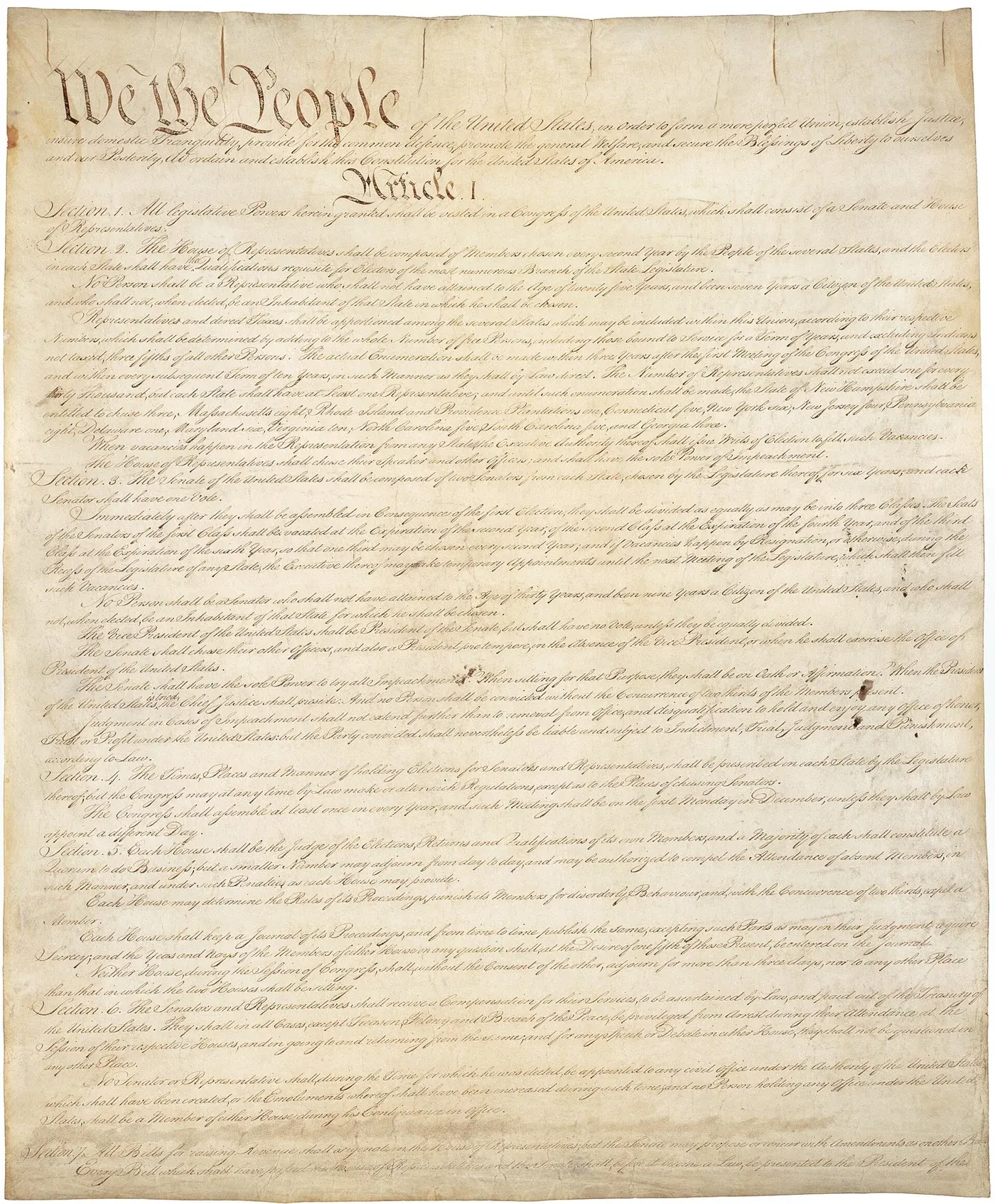
Figure: First page of the original United States Constitution (1787) · Public domain, via Wikimedia Commons
The newly ratified U.S. Constitution did not contain a list spelling out individual rights. Amid criticism that the new government was too strong and failed to protect individual rights, James Madison, a representative from Virginia, drafted 19 amendments, 12 of which passed Congress and were sent to the states, where 10 of them were ratified (OpenStax American Government 4e 2.5). The Bill of Rights is the first 10 amendments added to the Constitution in 1791, serving as a list that protects individual freedoms and rights. These amendments were sent as a package by the first Congress to the states to fulfill a promise made to secure ratification of the Constitution (DOI: 10.1093/ajcl/avy019).
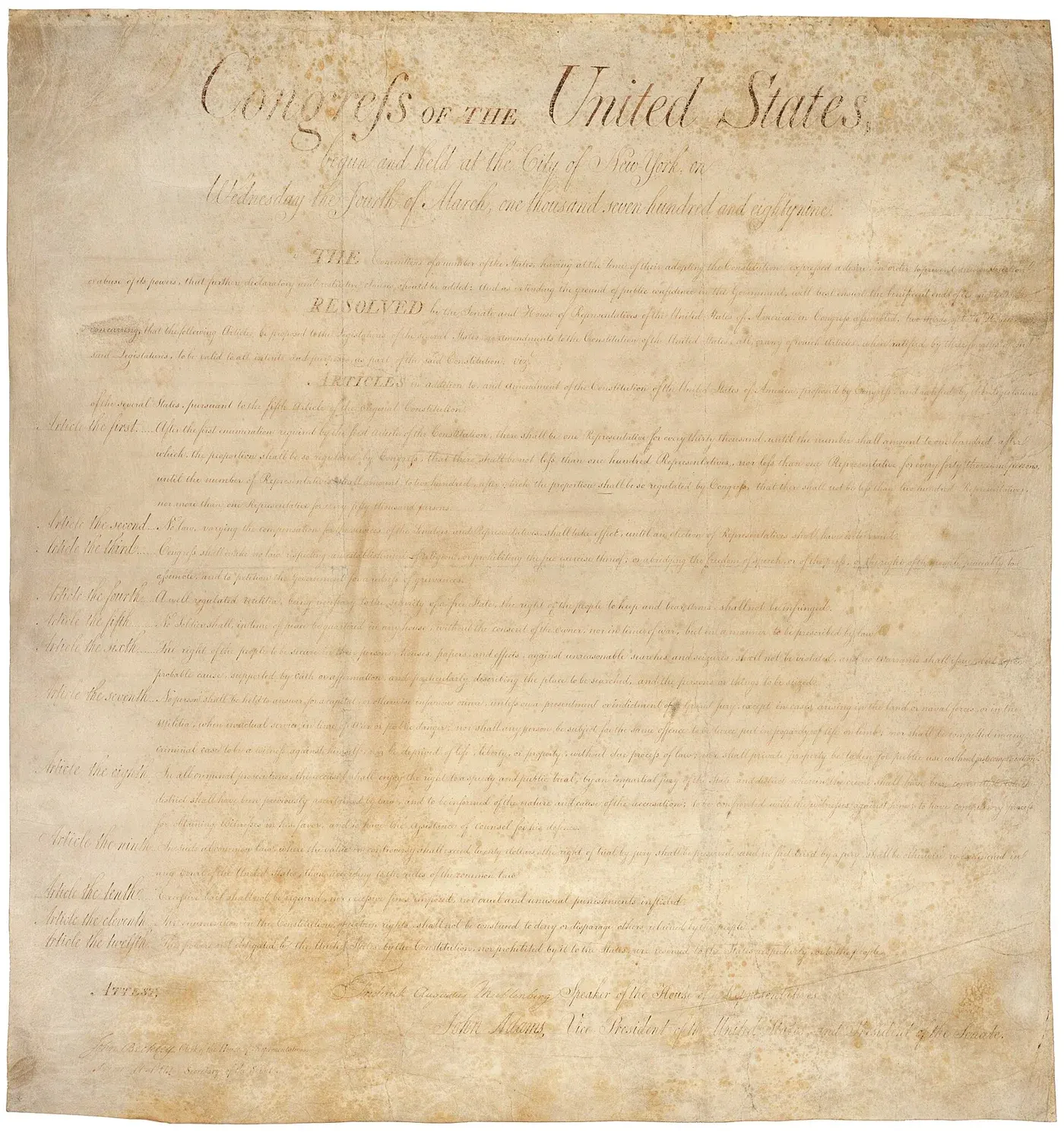
Figure: The Bill of Rights — the original twelve articles of amendment Congress sent to the states (1789) · Public domain, via Wikimedia Commons
An amendment is a clause added as a new provision at the end of the Constitution without rewriting the original text. Madison initially sought to weave the changes into the appropriate places in the body, but the House chose the method of adding them at the end, and all subsequent amendments followed this method (DOI: 10.1093/ajcl/avy019). This is why "Article I" and the "First Amendment" of the U.S. Constitution are different provisions.
Constitutional amendment is the process of revising constitutional provisions by following procedures set by the Constitution. The U.S. Constitution places this procedure in Article V. The Senate and the House of Representatives of the federal Congress must propose an amendment by a two-thirds vote in each, and three-fourths of the states must ratify it. There is also a path where two-thirds of the states petition Congress to call a convention for proposing amendments (OpenStax American Government 4e 2.5). Whichever route is used, an amendment becomes part of the Constitution only when three-quarters of the states ratify it (DOI: 10.1093/ajcl/avy019). All amendments to date have been created through the first path of Congress proposing them (OpenStax American Government 4e 2.5).
From 1789 to the present, there are 27 amendments (OpenStax American Government 4e 2.5). Because the 10 amendments of the Bill of Rights came in all at once, one could also count that the Constitution has actually been amended 18 times (DOI: 10.1093/ajcl/avy019). There is criticism in academia that the procedure in Article V is too difficult and undemocratic, while books argue in response that this very procedure is the way the people govern the Constitution (DOI: 10.5040/9798216498650).
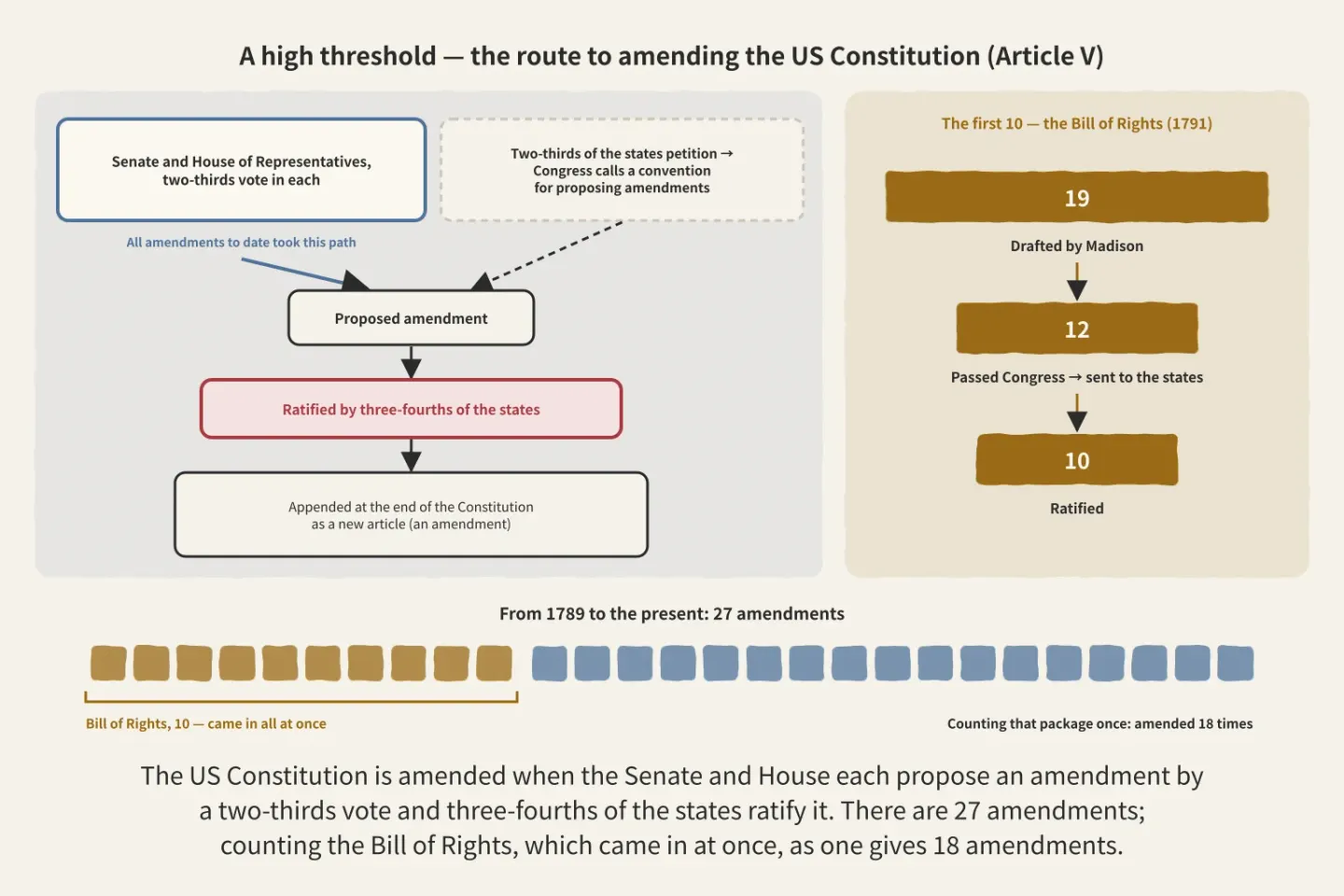
Figure: a diagram Paperis drew using only what the article says
The U.S. Constitution has a high threshold for revision and has preserved its appearance from the time of ratification almost unchanged for over two centuries (DOI: 10.1093/ajcl/avy019). As a result, this document has left broad margins not written in text, and who fills those margins has become the major question of the U.S. Constitution.

Figure: The unwritten margins — the Court has been filling them in
The Divided Structure of Power and the Place of the Court
Separation of powers is the principle of dividing a country's power into making laws, enforcing laws, and judging according to laws, and entrusting them to different institutions. The U.S. Constitution established Congress, the President, and the Court through three articles. Article III, which deals with the Court, is the shortest and least detailed of the three, but it established "one supreme court" and defined the scope of cases that court would handle. Below that, the task of creating courts was left to Congress (OpenStax American Government 4e 13.1).
Power is also divided vertically. Federalism is a structure in which the federal government, which is the government of the entire country, and the governments of each state share power. The Tenth Amendment, the last of the Bill of Rights, defines the powers remaining to state governments (OpenStax American Government 4e 4.4). Laws regulating schools and train seats were also laws made by individual states, not the federal Congress (163 U.S. 537) (347 U.S. 483). The Fourteenth Amendment, added in 1868 after the Civil War, is a provision directly targeting such states (347 U.S. 483). This provision prohibits any state from denying "equal protection of the laws" to anyone within its jurisdiction (163 U.S. 537). Equal protection is the Constitution's promise that the country must protect all people equally. The Plessy and Brown rulings, which we will see later, are both cases that fought over this equal protection (163 U.S. 537) (347 U.S. 483).
Alexander Hamilton, who attended the Constitutional Convention, wrote in Federalist No. 78 that the judiciary, holding neither the sword nor the purse, would be the least dangerous branch, possessing "no influence over either the sword or the purse... It may truly be said to have neither FORCE nor WILL, but merely judgment" (OpenStax American Government 4e 13.1) (DOI: 10.1093/ajcl/avy019).
The task of choosing judges is shared between the other two branches. When the President nominates a federal judge candidate, the Senate votes on whether to accept that person (DOI: 10.35215/jcj.2017.4.2.008). Confirmation is the process by which the Senate approves a person nominated by the President through a vote. Federal judges appointed in this way serve a life tenure and can only be removed through the time-consuming impeachment process of Congress (DOI: 10.35215/jcj.2017.4.2.008). According to tallies in the same paper, fewer than 2% of cabinet nominees have been rejected by the Senate since 1789, but 25% of Supreme Court justice nominees failed confirmation due to rejection, withdrawal, or resignation (DOI: 10.35215/jcj.2017.4.2.008). The paper notes that Supreme Court candidates have received unusually large attention relative to that number.
Powers Not Found in the Constitution — Marbury v. Madison
William Marbury, who had been appointed as a justice of the peace, never received his commission. President John Adams had nominated him near the end of his term and the Senate had even confirmed him, but the incoming President, Thomas Jefferson, decided not to deliver that commission (OpenStax American Government 4e).
Marbury asked the U.S. Supreme Court to issue an order requiring the Secretary of State, James Madison, to deliver his commission. His legal basis was the Judiciary Act of 1789 (OpenStax American Government 4e). Madison, the very man who had helped draft the Bill of Rights, now found himself sitting in the defendant's seat. This case was Marbury v. Madison, and the ruling was handed down in 1803.
The Supreme Court, led by Chief Justice John Marshall, did not issue that order. It did so because it declared a section of the Judiciary Act that Marbury relied upon to be contrary to the Constitution (DOI: 10.12797/9788981380638). The ruling was unanimous, and it acknowledged that Marbury's rights had been violated (OpenStax American Government 4e). Unconstitutional means that a law or government action runs counter to the Constitution.
Judicial review is the power of the courts to examine actions taken by other branches, such as Congress and the President, as well as the states, to determine whether they align with the Constitution (OpenStax American Government 4e 13). Textbooks introduce the Marbury ruling as the decision that established this power and the first time the Supreme Court struck down an act of Congress as unconstitutional (OpenStax American Government 4e 13). Yet, the U.S. Constitution contains no explicit provision establishing the power of judicial review (KCI ART001944251) (DOI: 10.35223/GNULAW.27.1.13). The power of U.S. courts to invalidate laws is a power not written into the text of the Constitution.
Even after this ruling, the Supreme Court was reluctant to use that power, and more than half a century passed before it struck down another act of Congress (OpenStax American Government 4e 11.1).
Scholars debate whether this ruling was truly the starting point. Even before the Constitutional Convention, there were cases where a few state courts addressed whether they could invalidate laws, and based on this, scholars have argued either that judicial review was already established at the framing of the Constitution, or conversely, that the Marbury ruling was a usurpation of power (DOI: 10.2307/3312535). Some papers argue that the text of the Constitution permits judicial review, its structure demands it, and those who debated it during ratification all understood the Constitution to allow it (DOI: 10.2307/1600662), while other studies re-examine the story surrounding the Marbury ruling and Chief Justice Marshall's role, suggesting that myths have been built around them (DOI: 10.26422/rja.2020.0101.gar) (DOI: 10.12797/9788981380638).
When Erasing What Was Written in the Margins — From Plessy to Brown
In 1890, the State of Louisiana passed a law requiring railway companies to provide separate "equal but separate" coaches for white and Black passengers, and seating passengers only in their own race's compartment (163 U.S. 537). According to his petition, a passenger named Plessy sat in a white compartment, refused a demand to move, and was dragged out and detained. He argued that he was seven-eighths white by blood and that this law violated the Constitution (163 U.S. 537).
On May 18, 1896, the majority opinion of the Supreme Court ruled that this law did not violate the Fourteenth Amendment (163 U.S. 537). The majority opinion is the view joined by the greater number of judges participating in the case, which makes up the ruling and its reasons. The majority opinion did not accept the argument that forced segregation stigmatized Black people as inferior, and wrote that if it felt that way, it was not because of the law, but because Black people chose to interpret it that way (163 U.S. 537). Separate but equal is the principle that treating people equally is considered achieved if facilities are divided by race as long as equivalent facilities are provided to each side (347 U.S. 483).
A dissenting opinion is an opinion written and left behind by a judge who did not agree with the conclusion of the judgment, explaining why their thinking differs. Justice Harlan wrote in his dissenting opinion, "Our Constitution is color-blind," and predicted that this ruling would one day reveal itself to be a great harm (163 U.S. 537).
Fifty-eight years later, in the case of Brown v. Board of Education, the lower courts in three of the cases, excluding Delaware, ruled against the Black children's petitions based on the separate-but-equal principle set forth by the Plessy ruling (347 U.S. 483). The lower court in the Kansas case acknowledged that segregation was harmful to Black children, yet dismissed the petition on the grounds that the buildings, curricula, and teacher qualifications of the two schools were substantially equal (347 U.S. 483).
The opinion written by Chief Justice Warren proceeded in three steps. First, it examined the records of when the Fourteenth Amendment was created in 1868, but concluded that those records alone could not settle the question regarding school segregation (347 U.S. 483). Next, it stated that the clock could not be turned back to 1868 or 1896, and that the judgment must be made in light of the place education holds in modern American society (347 U.S. 483). Finally, it concluded that even if visible conditions like buildings and teachers were the same, separating children solely because of their race generates a feeling of inferiority that can affect their minds in irreversible ways (347 U.S. 483).
And the judgment read as follows: "Any language in Plessy v. Ferguson contrary to this finding is rejected." (347 U.S. 483) It then concluded that the separate-but-equal principle had no place in the field of public education (347 U.S. 483). However, how and by when the schools were to be integrated was not decided in this ruling and was deferred to further arguments (347 U.S. 483).
Precedent alteration is when a court discards the legal doctrine of an earlier ruling in a later ruling and establishes a different doctrine. The principle of following earlier rulings is covered by another piece in this series, "Common Law and Civil Law — The Book a Judge Opens First". It is rare for the Supreme Court to overturn its own rulings, with counts indicating fewer than three per term (DOI: 10.1080/23277556.2000.10871279). Nor does precedent alteration move in only one direction. On June 24, 2022, the Supreme Court overturned the 1973 Roe v. Wade ruling and held that the Constitution does not protect abortion, leaving that matter of decision to each state (OpenStax American Government 4e 13.1).
Nor did the world change immediately because of a single line in a judgment. Michael J. Klarman, who studied the social impact of Supreme Court rulings concerning race, concludes that the Brown ruling was more significant in rallying southern white opposition than in encouraging direct-action protests. His interpretation is that the violence sparked by that backlash was transmitted via television, which changed northern public opinion and led to the civil rights legislation of the mid-1960s (DOI: 10.1093/oso/9780195129038.001.0001).
The same court can erase what it wrote in the margins with its own hands, and the path by which those writings reach the world is determined outside the text of the judgment as well.
Judges Who Are Not Elected — The Debate on Legitimacy
The remaining question is who is the person writing in the margins. Federal judges are not elected and serve for life. Can such judges invalidate a law made by an elected legislature?
The counter-majoritarian difficulty is the question of how it fits with democracy when unelected judges invalidate laws made by the will of the majority (DOI: 10.4324/9781315105765). Alexander Bickel, who coined this name, called the Supreme Court a "counter-majoritarian force" within the American political system (DOI: 10.4324/9781315105765) (DOI: 10.1017/s0898588x00000687).
There is also a view from the opposite side. Robert Dahl, cited by researchers who study courts empirically, argued that given the way Supreme Court justices are selected, it is unrealistic to expect a court to long maintain standards that diverge significantly from the rest of the political elite (DOI: 10.1017/s0898588x00000687). The concern that the court opposes the majority and the observation that the court ultimately follows the majority exist together. There are also books arguing that this very framework of a dilemma has empirical and theoretical flaws, and suggesting that we re-evaluate the value of the court by a standard that views democracy as "withstanding domination" (DOI: 10.4324/9781315105765).
What judges base their judgments on is also debated. A book that examined cases from 1946 to 1992 where the Supreme Court overturned prior rulings using an analytical framework called the attitudinal model concluded that the personal ideology of the justices explains their votes (DOI: 10.1017/cbo9780511759215). One domestic paper, while summarizing that the recent Supreme Court has been criticized for ruling based on political and ideological leanings rather than legal doctrine, also analyzes that several conservative-leaning justices attempt to preserve the legitimacy of the institution by showing respect for precedent and judicial restraint (DOI: 10.15821/slr.2025.33.3.004).
Neither the claim that the Supreme Court has always been right nor the claim that it is merely a political body can be concluded on either side based on the evidence gathered here. It was the same court that issued Plessy and issued Brown. The debate surrounding the legitimacy of judicial review ignited in the late 19th century as the court frequently invalidated economic and social legislation (DOI: 10.2307/3312535), and it is a question that continues today.
How It Differs From South Korea
The South Korean Constitution was influenced by the U.S. Constitution from its inception, and the U.S. system of judicial review has also influenced amendments to the South Korean Constitution (KCI ART002254428). The Constitutional Court is the institution that decides whether laws align with the Constitution and resolves disputes surrounding it. In South Korea, if a law that serves as the premise for a trial conflicts with the Constitution, the court petitions the Constitutional Court, which then adjudicates the matter (Article 107 of the Constitution of the Republic of Korea) (Article 111 of the Constitution of the Republic of Korea). The Supreme Court makes the final review of whether orders, rules, and administrative dispositions violate the Constitution or statutes (Article 107 of the Constitution of the Republic of Korea). The United States has the court hearing a case judge right then and there whether a law fits the Constitution, whereas South Korea entrusted that judgment regarding laws to a separate court established for that purpose. How these two models diverged is covered in another part of this series, Constitutional Courts — Who Holds the Constitution's Measuring Stick?.
The ways the two countries handle rights not explicitly written in the Constitution are also worth comparing. The Ninth Amendment of the U.S. Constitution stipulates that the enumeration in the Constitution of certain rights shall not be construed to deny or disparage others retained by the people (OpenStax American Government 4e 4.4). Regarding Article 37, Paragraph 1 of the South Korean Constitution, research suggests that this provision serves less as a basis for inventing brand-new unenumerated rights and more as an interpretive principle confirming that such rights exist. The same research points out that the two countries differ in how they structure their lists of fundamental rights (DOI: 10.21592/eucj.2022.39.249). How each country handles whitespace is structured differently.
The metaphor of whitespace has its limits. Whitespace looks like a blank page where you can write whatever text you please, but courts write while bound by the wording of the Constitution, prior precedents, and legal reasoning. Moreover, the whitespace does not tell you whether what is written on it is right. Plessy and Brown were simply different texts written in the same whitespace.
Where to Look Next
- Why the Constitution sits higher than other laws and is hard to amend is covered in "What Is a Constitution — The Wall You Cannot Simply Knock Down".
- The setup that divides power into three and makes them check each other is covered with a focus on Korea in "Separation of Powers — A Country That Splits Its Keys".
- The procedure for deciding whether a law is unconstitutional in Korea is covered in "What the Constitutional Court Does — Five Windows and Six Votes".
- How to find and read majority and dissenting opinions in a judgment is shown in "How to Read a Court Judgment — A One-Line Answer and Its Reasons".
- As other parts of this series, "Common Law and Civil Law — The Book a Judge Opens First" and "Constitutional Courts — Who Holds the Constitution's Measuring Stick?" follow.
Evidence-Based Papers
- "Brown v. Board of Education" (1954) — 347 U.S. 483 — Separate educational facilities are inherently unequal, the separate-but-equal doctrine has no place in public education, and the contrary language in Plessy is rejected.
- "Plessy v. Ferguson" (1896) — 163 U.S. 537 — A Louisiana law enforcing racial segregation in railway carriages does not violate the Fourteenth Amendment (Harlan, J., dissenting).
- "American Government 4e — 2.4 The Ratification of the Constitution" (2025) — OpenStax American Government 4e 2.4 — The Constitution was approved on September 17, 1787, requiring ratification by 9 out of 13 states to take effect.
- "American Government 4e — 2.5 Constitutional Change" (2025) — OpenStax American Government 4e 2.5 — 27 amendments, 10 in the Bill of Rights (1791), and the proposal and ratification paths under Article V.
- "American Government 4e — 13.1 Guardians of the Constitution and Individual Rights" (2025) — OpenStax American Government 4e 13.1 — Article III is the shortest article, the Supreme Court hears mostly appellate cases, Hamilton's "Least Dangerous Branch", and the 2022 reversal of the Roe ruling.
- "American Government 4e — 4.4 Interpreting the Bill of Rights" (2025) — OpenStax American Government 4e 4.4 — The role of the Ninth and Tenth Amendments (unenumerated rights, powers reserved to the states).
- "American Government 4e — Key Terms (ch.13)" (2025) — OpenStax American Government 4e 13 — The definition of judicial review and the place of the Marbury ruling.
- "American Government 4e — Appendix E Selected Supreme Court Cases" (2025) — OpenStax American Government 4e — The facts and reasoning of Marbury v. Madison (1803).
- "American Government 4e — 11.1 The Institutional Design of Congress" (2025) — OpenStax American Government 4e 11.1 — For over half a century after the Marbury ruling, the Supreme Court did not use that power.
- "Formal and Informal Amendment of the United States Constitution" (2018) — DOI: 10.1093/ajcl/avy019 — There are 27 amendments, but only 18 actual amendment events; the Bill of Rights counts as one batch, and amendments are appended to the end of the text.
- "Perfecting the Constitution: The Case for the Article V Amendment Process" (2013) — DOI: 10.5040/9798216498650 — A book defending the Article V procedure against academic criticisms that it is too difficult and undemocratic.
- "미국 헌법상 인사의 본질" (2017) — DOI: 10.35215/jcj.2017.4.2.008 — Presidential nominations and Senate confirmations, lifetime tenure for the judiciary, and 25% of Supreme Court nominees failing confirmation.
- "미국 연방대법원의 사법심사에서 사법적극주의와 사법소극주의의 전개논의" (2014) — KCI ART001944251 — Because the U.S. Constitution lacks an explicit provision for judicial review, its legitimacy has been examined through theory and interpretation.
- "미국법상 행정기관의 행위에 대한 사법심사" (2019) — DOI: 10.35223/GNULAW.27.1.13 — The term judicial review does not appear in constitutional provisions and is a legal principle established in the Marbury case.
- "The Case of the Prisoners and the Origins of Judicial Review" (1994) — DOI: 10.2307/3312535 — Interpretations have split between views that judicial review was already established in pre-Convention state court cases and views that Marbury was a usurpation of power.
- "The Origins of Judicial Review" (2003) — DOI: 10.2307/1600662 — The constitutional text permits judicial review, the structure demands it, and everyone who discussed it during ratification agreed—arguing that opponents misread the historical sources.
- "Marbury v. Madison y los mitos acerca del control judicial de constitucionalidad" (2020) — DOI: 10.26422/rja.2020.0101.gar — Re-examining the myths surrounding the roles of Marshall and the Marbury ruling in the origins of judicial review.
- "Warta na obrzeżach Konstytucji: Dekonstrukcja mitu założycielskiego amerykańskiej sądowej kontroli konstytucyjności prawa" (2019) — DOI: 10.12797/9788981380638 — A book that views the Marbury ruling as the founding myth of American judicial review and deconstructs it.
- "Norm Violation by the Lower Courts in the Treatment of Supreme Court Precedent: A Research Framework" (2000) — DOI: 10.1080/23277556.2000.10871279 — The Supreme Court rarely overturns its own precedents, doing so fewer than three times per term.
- "From Jim Crow To Civil Rights: The Supreme Court And The Struggle For Racial Equality" (2004) — DOI: 10.1093/oso/9780195129038.001.0001 — The Brown ruling was more important for mobilizing southern white opposition than for encouraging civil rights protests, and that violence changed northern public opinion.
- "The Nonmajoritarian Difficulty: Legislative Deference to the Judiciary" (1993) — DOI: 10.1017/s0898588x00000687 — Comparing Bickel's "counter-majoritarian force" with Dahl's "court that is not out of line with the political elite for long".
- "Judicial Review and Contemporary Democratic Theory: Power, Domination, and the Courts" (2017) — DOI: 10.4324/9781315105765 — Pointing out the empirical and theoretical flaws of the counter-majoritarian difficulty framework and replacing it with a standard of anti-domination democracy.
- "Stare Indecisis: The Alteration of Precedent on the Supreme Court, 1946–1992" (1995) — DOI: 10.1017/cbo9780511759215 — Individual justices' ideologies explain their votes in precedent-altering cases.
- "미국 연방대법원의 정치화와 스윙 보수 대법관의 재등장 가능성" (2025) — DOI: 10.15821/slr.2025.33.3.004 — Amid criticisms of politicization, some conservative justices attempt to maintain institutional legitimacy through adherence to precedent and judicial restraint.
- "Article 107 of the Constitution of the Republic of Korea" (Current, effective February 25, 1988) — Statutory text — Courts request constitutional rulings from the Constitutional Court on laws that form the premise of a trial, while the Supreme Court has final review over orders, rules, and administrative actions.
- "Article 111 of the Constitution of the Republic of Korea" (Current, effective February 25, 1988) — Statutory text — The Constitutional Court has jurisdiction over the constitutionality of laws upon request by the courts, among other matters.
- "미국 사법심사와 한국 헌법" (2017) — KCI ART002254428 — The influence of the U.S. Constitution and judicial review system on the enactment and amendment of the Korean Constitution.
- "미국 헌법상 새로운 기본권 도출의 근거와 판단기준" (2022) — DOI: 10.21592/eucj.2022.39.249 — The Ninth Amendment debate, Article 37, Paragraph 1 of the Korean Constitution, and differences in the fundamental rights listing systems of the two countries.
Sources (22)
- American Government 4e — 2.4 The Ratification of the Constitution
- American Government 4e — 2.5 Constitutional Change
- American Government 4e — 13.1 Guardians of the Constitution and Individual Rights
- American Government 4e — 4.4 Interpreting the Bill of Rights
- American Government 4e — Key Terms (ch.13)
- American Government 4e — Appendix E Selected Supreme Court Cases
- American Government 4e — 11.1 The Institutional Design of Congress
- Formal and Informal Amendment of the United States ConstitutionDOI 10.1093/ajcl/avy019
- Perfecting the Constitution: The Case for the Article V Amendment ProcessDOI 10.5040/9798216498650
- 미국 헌법상 인사의 본질DOI 10.35215/jcj.2017.4.2.008
- 미국법상 행정기관의 행위에 대한 사법심사DOI 10.35223/gnulaw.27.1.13
- The Case of the Prisoners and the Origins of Judicial ReviewDOI 10.2307/3312535
- The Origins of Judicial ReviewDOI 10.2307/1600662
- Marbury v. Madison y los mitos acerca del control judicial de constitucionalidadDOI 10.26422/rja.2020.0101.gar
- Warta na obrzeżach Konstytucji: Dekonstrukcja mitu założycielskiego amerykańskiej sądowej kontroli konstytucyjności prawaDOI 10.12797/9788981380638
- Norm Violation by the Lower Courts in the Treatment of Supreme Court Precedent: A Research FrameworkDOI 10.1080/23277556.2000.10871279
- From Jim Crow To Civil Rights: The Supreme Court And The Struggle For Racial EqualityDOI 10.1093/oso/9780195129038.001.0001
- The Nonmajoritarian Difficulty: Legislative Deference to the JudiciaryDOI 10.1017/s0898588x00000687
- Judicial Review and Contemporary Democratic Theory: Power, Domination, and the CourtsDOI 10.4324/9781315105765
- Stare Indecisis: The Alteration of Precedent on the Supreme Court, 1946–1992DOI 10.1017/cbo9780511759215
- 미국 연방대법원의 정치화와 스윙 보수 대법관의 재등장 가능성DOI 10.15821/slr.2025.33.3.004
- 미국 헌법상 새로운 기본권 도출의 근거와 판단기준DOI 10.21592/eucj.2022.39.249