
Paperis Articles
Haydn — Why Is the Ear Surprised, and When Does Surprise Feel Good?
A loud chord in the middle of a quiet movement, and the research on ears that guess the next note
Your field's papers, as audio
Pick your fields and journals — Paperis summarizes the key papers and turns them into audio. Listen on your commute.
Start Paperis free →Haydn — Why Is the Ear Surprised, and When Does Surprise Feel Good?
1792, London: A Loud Chord at the End of a Quiet Theme
In the spring of 1792, a new symphony by the Austrian composer Joseph Haydn (1732–1809) was performed for the first time in a London concert hall. Haydn had moved to London the previous year and was writing music for the city's concerts. Symphony No. 94 earned the nickname "Surprise" because a loud chord suddenly sounds in the middle of the quiet second movement.
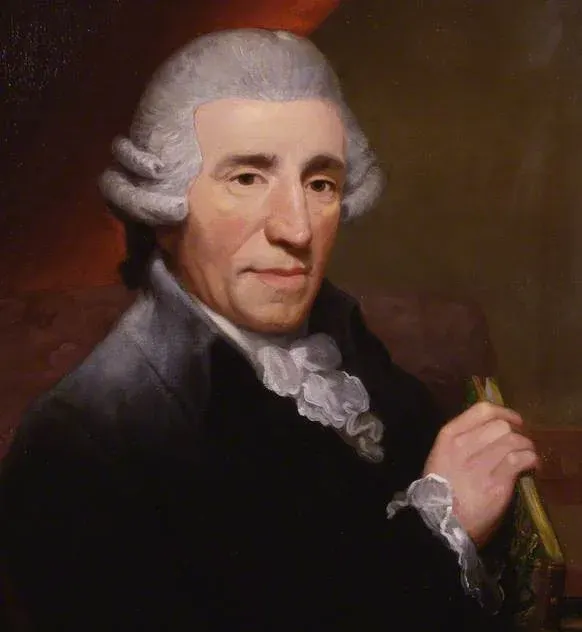
Joseph Haydn · oil painting by Thomas Hardy (1791) · Royal College of Music Museum, London · public domain · Wikimedia Commons
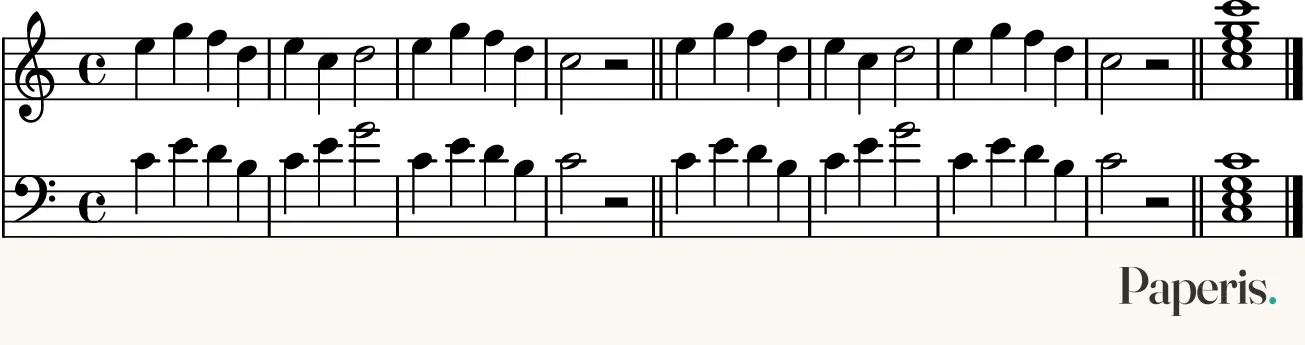
The sound you hear in this episode is a short example we made to show the same principle, and it is a synthesized instrument sound. It does not contain Haydn's music, and the structure of the example below is also decided by us, so it must not be read as the structure of Haydn's sheet music. First, our 4-measure theme plays quietly once, repeats even more quietly once, and then a single very loud chord arrives.
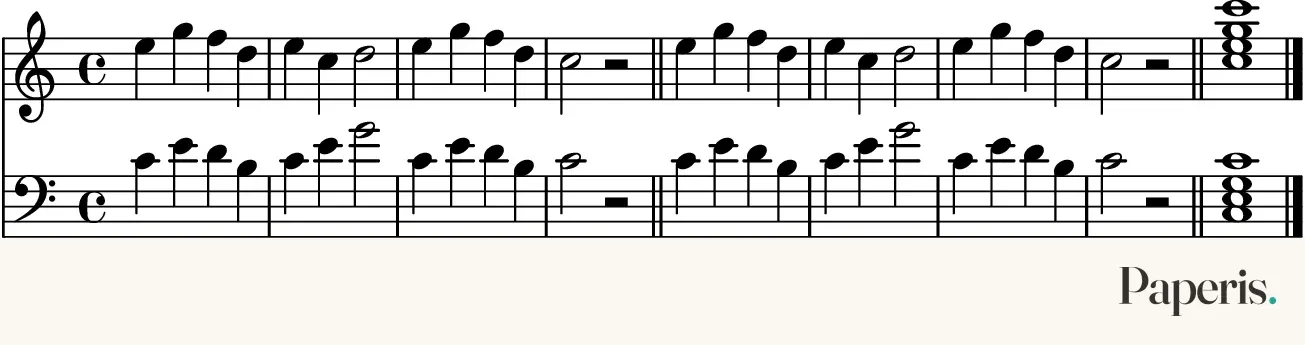
Clip: our example (not Haydn’s music) — a quiet theme twice, then a very loud chord (synthesized strings)
This time, we play the same theme twice with the same notes, but leave the ending as a quiet sound as well.
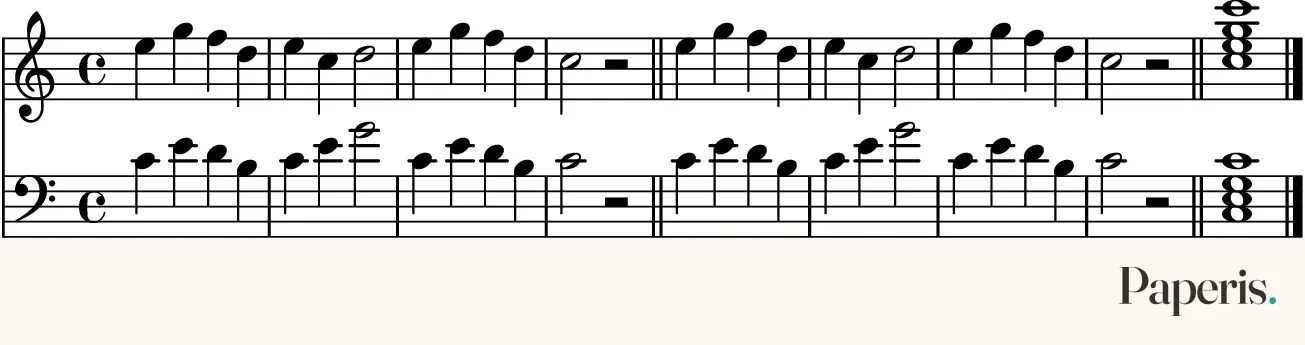
Clip: the same example, final chord also quiet (synthesized strings)
The two examples have the same notes. The only thing different in our example is the volume of the final chord. On the other hand, most of the surprise studies we will examine in this episode changed the type of chord or the pitch of the note.
The questions this episode follows are two: What does the ear get surprised by, and why can surprise be enjoyable? The first thought to take with us is this: The surprise this episode deals with is the surprise when expectations are broken, and for such a surprise to occur, there must first be an expectation to break. In our example, the two quiet times preceding it were structured to build that expectation.
Haydn's Joke Also Lies in Meter and Phrase
In the final decade of the 18th century, the 1790s, the aesthetic category of "humorous music" emerged (DOI: 10.1093/oso/9780197548905.003.0009). This category ranged from wit and parody to the clever imitation of musical awkwardness, and it was frequently discussed in the late 18th and early 19th centuries (DOI: 10.1093/oso/9780195384925.003.0008). According to the same study, the first writing to address this subject was the "Comic" entry in the fourth edition (1792–94) of Sulzer's General Theory of the Fine Arts, an 18th-century German-language art dictionary. The year the "Surprise" Symphony was first performed coincides with the appearance of this entry. However, the abstracts of these two research books do not cite Symphony No. 94 as an example of this category.
Musicology looks for Haydn's jokes in places wider than a single loud bang. One contemporary musicology research book considers that much of Haydn's skill in playing with meter—so-called metric manipulation—is a technique used to achieve "the humorous" (DOI: 10.1093/oso/9780195384925.003.0008). The beat is the steady pulse you match when tapping your foot while listening to music, and the meter is the framework in which beats are grouped into strong and weak beats. A measure is a group of beats, starting from the first beat up until just before the next first beat. Moving up to the layer where several measures group to form a larger chunk, another research book from 2021 analyzes how twisting those chunks in the first movements of Haydn's String Quartets Op.50 No.3 and Op.64 No.1 affects the form of the piece (DOI: 10.1093/oso/9780197548905.003.0009). This book built a model allowing an analyst to follow the effects of such twisting in the order that the music flows, and it sought to organize together how 18th-century theorists explained phrase structure, how composers conceived it, and how audiences perceived it (DOI: 10.1093/oso/9780197548905.001.0001). Both books are musicological analytical texts, not experiments where music was played to people and their reactions measured. The framework of the beat covered in "Rhythm and Beat — Evenly Spaced Stepping Stones, and the Steps That Cross Them" is used here as the material for the joke.
There is also research suggesting that music and jokes use the same shape. The AAB shape—where two similar events are followed by a different event—was more common in music samples of various genres and in repeating-joke samples than AB or AAAB, and in experiments, jokes in the AAB shape elicited the most laughter (PMID 16938077). The researchers' explanation is this: establishing a repeating framework requires at least two times, and once it is established, breaking it immediately has the greatest aesthetic effect. Our example also resembles this shape in that it establishes the same theme twice and then breaks it. However, the spot where the break occurs in our example is the end of the second theme rather than a separate third event. Studies that frame Haydn's pieces with the AAB template are not among the evidence gathered in this article.
How twisting the meter sounds to a listener has also been tested through experiments. A syncopation is when a loud sound is placed on a weak beat or an off-beat, and an off-beat is the space between beats. Syncopation emphasizes the weak beat and softens the strong beat, violating rhythmic expectations. When 35 musicians were asked to evaluate paired phrases with and without syncopation, they generally heard the syncopated phrases as more joyful and brighter. The difference in tension did not come out reliably. The feeling of complexity varied depending on the order: it increased when moving from a simple phrase to a syncopated phrase, but did not change noticeably when moving in reverse. The researchers suggested that composers may take advantage of this asymmetry and prefer forms that progress from simple to complex, and that such a flow is seen in the first parts of forms like theme and variations (PMID 22253676). There is no Haydn among the pieces covered in this study, and the researchers' suggestion remains a suggestion.
Here is what to take away from this section: Haydn's wit has been analyzed more broadly than a single loud chord, as the craft of twisting the framework established by the listener.
The Ear Hears While Guessing What Comes Next
For a pattern to be twisted, the listener must have that pattern inside their head. Musical expectation is the act of subconsciously guessing beforehand what note or chord will come next while listening to music. Where does this expectation come from?
A computational model study gives a clue. This model is not given rules in advance; instead, it reads a lot of musical data and learns on its own which notes tend to follow which. When the model rated the next note using the probabilities it learned that way, there was a strong correlation showing that the lower the probability the model assigned to a note, the more people reported not expecting it (PMID 20005297). The value used in this study is information content. Information content is a value of surprise assigned by a computational model after looking at the preceding notes to rate the probability of the next note, such that the lower the probability of the actually occurring note, the larger the value. This value is a quantity defined by the model. The main point of this study is that this value matches human expectation. The interpretation that human expectation also arises from learning the statistics of incoming music comes from here.
Another value is used alongside this. Uncertainty is the degree to which candidates that can come next are evenly split, making it difficult to guess what will arrive. If information content is “how unexpected it was” rated after a note appears, uncertainty is “how hard it is to guess” before a note appears. The two move separately. In an experiment where 38 undergraduates listened to music by advancing notes themselves, people lingered longer on notes with high uncertainty, and another 31 undergraduates evaluated musical sequences ending in high notes of uncertainty as feeling more “finished”. This effect appeared independently of the information content of those notes (PMID 34409898).
Researchers also measured how far back in the past expectations rely on. In a study that measured brain magnetic field signals while playing several pieces of Western classical music, brain activity about 0.2 seconds, and 0.3 to 0.5 seconds, after a note started tracked the surprise of each note. The surprise was best matched by a model that learned long-term accumulated statistics, whereas a model incorporating only simple perceptual principles performed worse. However, the preceding stretch actually reflected by that surprise was generally a short range of fewer than ten notes (PMID 36562532). This means that long-term listening experience forms the foundation, while just the immediately preceding few notes determine the current guess.
This guesswork exists even in people who have not studied music. In an experiment where chord progressions were played to people without musical training, distinct brainwave responses emerged for chords that broke expectations, and those responses appeared regardless of whether they were related to a task or not. The research team considered this result to support the hypothesis that the human brain possesses implicit musical ability (PMID 10931776). In a study comparing people's evaluations of about 1,000 chords extracted from 739 American Billboard pop songs against four computational models, a model incorporating long-term knowledge of musical structure explained people's perceived surprise more than twice as well as a model incorporating short-term characteristics of the sound itself. The two expectations did not overlap and each contributed to expectations and enjoyment ratings, leading the researchers to conclude that the two play distinct yet complementary roles (PMID 38104601).
What to take away from this section is this: the ear guesses the next note using statistics learned from incoming music, and that guesswork exists even in people who have not learned music.
The Brain and Skin Answer Mismatched Chords
How does the body react when a guess misses the mark? Let us check with the ears first. We play a short chord progression twice. The first one builds on C, A, F, and G chords, then returns to the starting C chord to conclude; the second one has the same first four, but replaces the final single chord with an A-flat major chord that steps outside that key. This is also our own example and uses synthesized piano sounds. A chord is several pitches sounding at the same time.

Clip: our example — the same four chords ending on C, then ending on A-flat major (synthesized piano)
This stretch differs from the previous example. The loudness stays the same and the type of chord changes. This side is what the research we will look at in this section mainly addresses.
There are two tools that measure this response. Event-related potentials are the rising and falling of brain waves that appear at a set time after a single event like a sound occurs, measured with electrodes attached to the surface of the head. Skin conductance responses are the change where the sweat glands on the palm open slightly when the body grows tense or excited, making electricity flow more easily through the skin. The former shows what the brain has noticed, and the latter shows how excited the body is.
There is an experiment where six chorales by Bach (hymn-style four-part choral pieces) were made into three versions with only a single chord altered, and played to 24 people (12 musicians, 12 non-musicians). As the altered chord grew farther from expectation, the tension and intensity of emotion felt by the people increased, and the electrical response of the skin grew along with it. In the brain waves, an early neural response appeared at the unexpected chord, and it was larger at the very unexpected chord. The size of this early response showed no difference between the two groups, and reached its peak earlier in musicians (PMID 16859422). This runs in the same direction as the results for non-musicians in the previous section.
Measurements were also tried with actual pieces instead of laboratory-made chords. When an unexpected chord written right down in the score by the composer in a piano sonata was played, it brought out an early brain wave response (ERAN), a later response than that, and a distinct change in skin conductance response, compared to the expected chord. When comparing a version using a professional pianist's performance to a version with the curves of tempo and loudness removed, the early response was not affected by the expression of the performance (PMID 18612459). Another previous study put a chord transposed by the researchers at the end of piano sonata excerpts from commercial recordings, and an auditory response peaking around 0.25 seconds appeared at that chord (PMID 12048045).
We also went out to the concert hall. This is a study that continuously measured the responses of 50 audience members at an actual concert where six flute solo pieces were performed. High-information passages were marked out in advance using a computational model, and half of the audience was asked to rate how unexpected they were, while the other half continuously rated the emotion. Electrical signals of facial muscles and bodily arousal were measured from all 50 people. Arousal is the degree to which the body and mind are awake and excited. High-information passages led to ratings of unexpectedness, as well as an increase in subjective arousal and activation of the autonomic nervous system (PMID 23605956).
What to take away to this point is this. Notes and chords that stray from expectation leave traces in brain waves and bodily excitement. However, what these studies altered are the type of chord and the pitch of the note. One theoretical framework that divides the paths by which music arouses emotion into eight branches keeps "musical expectancy" separate from other branches like "brainstem reflexes" (PMID 23769678). Studies measuring how much and where a surprise where loudness changes abruptly—like our example—falls among these branches are not among the evidence gathered in this article.
The Path Where Surprise Becomes Joy
When surprised, the body stirs. Yet why can that stirring be a pleasure? Research looks toward the brain's reward circuit. The striatum is a cluster of nuclei deep within the brain that is involved in reward and motivation. In the dopamine system of this striatum, which is involved in tangible rewards, positron emission tomography confirmed that dopamine is released when emotions reach a peak while listening to music. When functional magnetic resonance imaging followed the same people over time while playing the same music, the parts of the striatum that worked harder differed between the moments of waiting for the peak and experiencing the peak (PMID 21217764). The side that worked harder at the moment of experiencing the peak was the nucleus accumbens (PMID 21217764). The nucleus accumbens is a small region in the lower part of the striatum regarded as processing predictions of how rewarding something will be (PMID 31708393). What this study measured was the emotional peak, not surprise itself. The waiting in this study is also waiting for an emotional peak, distinct from guessing the next note. Even so, it is close to this piece's question in that part of the reward circuit moved during the waiting as well.
There is also research directly linking surprise and the nucleus accumbens. In a study that played three actual songs and took functional magnetic resonance images, surprising passages in the songs increased activity in the auditory cortex, insula, and lower striatum compared to unsurprising passages, and also changed emotional ratings. In particular, the more people enjoyed listening to the music, the greater their nucleus accumbens activity in response to surprise was (PMID 30892654). This means that the magnitude of the nucleus accumbens response to surprise went hand in hand with the magnitude of pleasure.
It was also tested whether this circuit is essential for pleasure. After stimulating or inhibiting the frontal brain with magnetic stimulation in 17 people and then having them listen to music, pleasure and the desire to listen more increased when it was stimulated and decreased when inhibited. Changes in nucleus accumbens activity predicted this difference (PMID 33782048). The researchers concluded that the involvement of this circuit, especially the nucleus accumbens, is indispensable for deriving a sense of reward from music. This result moves a step beyond correlation toward causation, but it is a single study of 17 people, and the abstract does not contain a section specifically addressing surprise.
What to take away from here is this. The brain's reward circuit is involved in the pleasure of music, and expectation and surprise are being studied as one of the pathways reaching that circuit.
Is More Surprise Always Better?
If surprise leads to enjoyment, is more surprise always more enjoyable? We play you three short melodies. One repeats the same four-note pattern, one repeats the same pattern except it strays to a different note in just one spot, and one picks notes at random. These are examples we made.
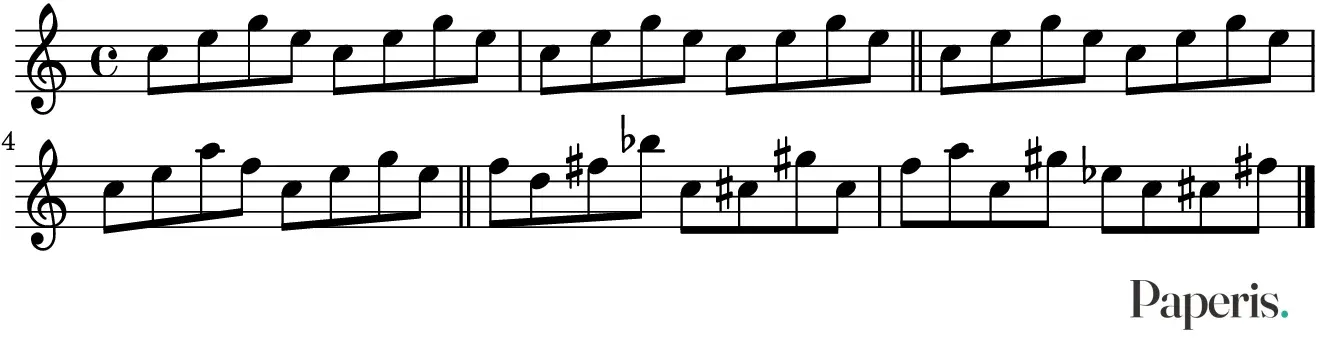
Clip: our example — a repeating tune, a tune with one changed note, a random tune (synthesized piano)
There is a study that measured the complexity of melodies using information content and uncertainty, and asked 43 people for their preferences. The results were repeated in a separate sample of 27 people. Both studies found that people liked music of intermediate complexity—neither too obvious nor too unpredictable—the most. When plotted on a graph, it forms an inverted U-shape with a peak in the middle. When the same stimulus was played back seven times, the degree of liking decreased, but the preference for the middle remained (PMID 31636112). The researchers interpreted these results as fitting the theory that enjoyment is linked to the intrinsic reward of learning. A similar shape is reported in rhythms. A review paper summarizing rhythm research concludes that the pleasurable feeling that makes people want to move their bodies is generally greatest at intermediate rhythmic complexity, and generally weak in rhythms that are too simple and boring or too complex to interpret (PMID 36017431).
Results showing that surprise and uncertainty interlock with each other make this picture a layer more complex. In a study that calculated the uncertainty and surprise of 80,000 chords from US Billboard pop songs using a machine learning model, people enjoyed listening to chords in two cases. One is when they were fairly confident about the next chord but were proved wrong by a large margin (low uncertainty and high surprise), and the other is when what came was as expected in a situation where they did not know what was coming (high uncertainty and low surprise). In the brain, activity in the amygdala, hippocampus, and auditory cortex reflected this interlocking, while the nucleus accumbens reflected only uncertainty (PMID 31708393).
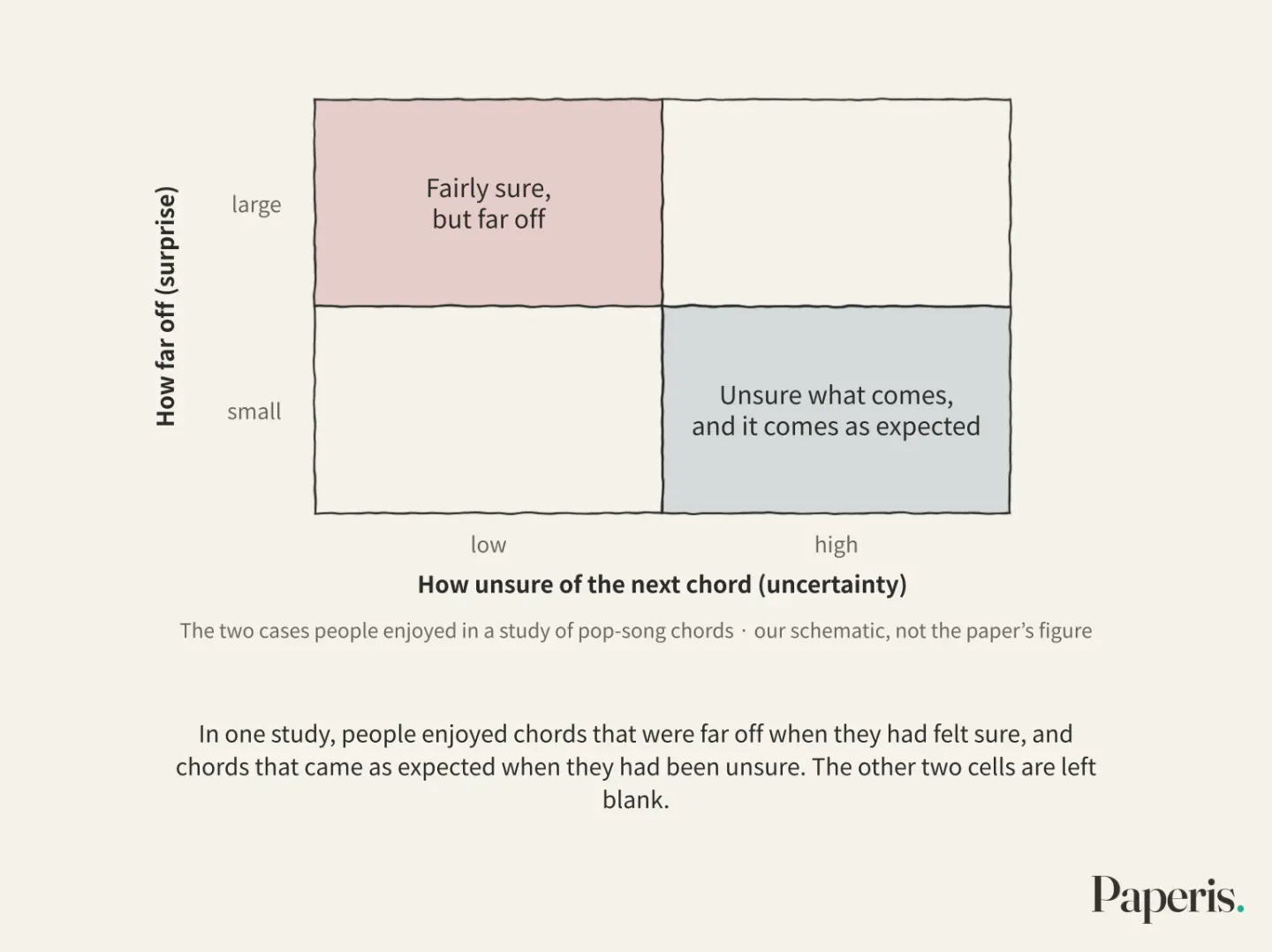
We find ourselves wanting to map the first cell of this study onto our example from earlier. If the listener is quite confident about the ending while a quiet theme plays twice, and that confidence is heavily missed, it might fit into this cell. However, what this study measured was the surprise coming from the types of pop song chords, and what changed in our example was the loudness. Since there is no study measuring Haydn's pieces with this framework among the evidence gathered in this article, saying "Haydn's big chord is enjoyable for that reason" can only be spoken as an assumption.
What we take away is this: Experimental results from multiple studies show that enjoyment is not determined solely by the magnitude of surprise, but changes in relation to what kind of certainty the surprise rests upon. As we will see in the next section, how they interlock varies from study to study.
Still Debated
Even the direction of the coupling varies across studies. The earlier melody study reported a tendency to prefer more predictable options in uncertain contexts (PMID 31636112). In a pop song chord study, since an expected chord sounded pleasurable in a situation where it was uncertain what would come next (PMID 31708393), placing the two abstracts side by side points in the same direction. However, a 2025 study reported in two large samples a coupling where low-uncertainty melodies favored small surprises, and high-uncertainty music favored large surprises. The inverted U-shape itself appeared in this study as well, and the model incorporating the coupling predicted genre preferences for individuals and enjoyment of actual songs (PMID 40663615). Whether this difference stems from different stimuli and tasks cannot be determined from the abstracts alone. The extent to which we can speak right now is that the directions of the two studies are recorded differently.
The location of the nucleus accumbens is also unsettled. While one study reported that nucleus accumbens activity according to surprise increased along with enjoyment (PMID 30892654), the pop song chord study noted that the nucleus accumbens reflected only uncertainty, challenging existing neurocognitive models of musical enjoyment (PMID 31708393). As grounds for this challenge, the research team cited the point that expectation-violation studies across multiple dimensions, such as harmony and melody, have failed to find the nucleus accumbens.
There are also counterarguments against the explanatory framework of "prediction" itself. A 2025 perspective paper proposes that human anticipation of the next musical event stems not from a predictive neural model, but because the dynamics of the brain and body physically embody the structure of music (PMID 40102614). This is a theoretical paper attempting to explain the same phenomenon through a different principle, and contains no new experimental results. Another strand of music theory research raised the problem that expectation and surprise alone cannot explain why the emotions felt while listening to music take on different colors for each person (DOI: 10.1093/oxfordhb/9780199841578.013.0025).
Knowing the structure of the piece in advance also alters the brainwaves of surprise. Under a condition where participants were told only that more context would follow, without being told whether an unexpected chord would appear, the brainwave response to the unlikely chord was actually larger. The researchers interpreted that listeners place greater confidence in their own predictions in such situations (PMID 41118461). This is a different condition from knowing the surprise itself in advance. What is it like when we listen again knowing that a surprise is coming? We play our earlier example for you one more time. Listen for yourself to hear whether it surprises you to the same degree this time.
Clip: the first example again (synthesized strings)
What the evidence gathered by this article says about repetition is limited. Hearing the same melody seven times decreased how much it was liked, but the pattern of preferring moderate complexity remained (PMID 31636112). Studies measuring how bodily responses change when listening while knowing a large surprise is coming are absent from the evidence gathered by this article.
It also varies across individuals and eras. In a Bach chorale study, early responses appeared sooner in musicians, and late responses to very unexpected chords were much larger in musicians (PMID 16859422); early responses to chord progressions ending in dissonance were larger in musicians, and modulation of responses according to the degree of mismatch was seen only in musicians (PMID 31512751). Jazz improvisers liked unexpected chord progressions more in an experiment comparing them with non-improvising musicians and non-musicians (PMID 29028508). 13 individuals who felt less enjoyment from listening to music scored lower on rhythm evaluation than 13 matched controls for musical perceptual ability, but the pattern of most preferring moderate complexity still appeared in them as well (PMID 38652721). Changes over time are also reported. Chords in the top quartile of Billboard chart songs had a higher average surprise than those in the bottom quartile. The researchers noted that this result is consistent with both the hypothesis that surprise itself is pleasurable, and the hypothesis that the contrast between the unexpected and the expected is pleasurable (PMID 28572763). From 1958 to 1991, chord surprise increased over time, and that increase was more pronounced in beloved songs, with a similar increase appearing from 2000 to 2019. The researchers put forward the "surprise inflation" hypothesis, suggesting that expectations formed by yesterday's music are broken by today's music, and today's music becomes tomorrow's standard (PMID 33994972). This is a hypothesis derived from statistical analysis of songs and charts; experimental results measuring the reactions of audiences from those eras are not in the abstract.
So What Did We Learn
We return to that 1792 symphony in London. If today's research is any indication, while the quiet music plays, listeners likely make the following guesses. In studies measuring modern listeners, such guesses relied on the statistics of music heard for a long time and the short context within the previous ten notes (PMID 36562532). Haydn's audience and the research measuring this symphony are not among the evidence gathered in this article. When guesses were wildly off, chord research showed accompanying responses in brainwaves and skin. The brain's reward system is involved in the enjoyment of music, with different parts handling anticipation and the peak within it. In experiments, enjoyment varied not just by the size of the surprise, but by how surprise and certainty interlock, and there is also statistical analysis showing that the chords of top-chart songs were on average more unexpected than those of lower-chart songs (PMID 28572763).
Each link in this chain is found in the research gathered in this article, but no research gathered in this article connects that entire chain to Haydn's single big chord. The surprises measured by these studies were mainly chord types and pitch, whereas what our example showed was a surprise where volume suddenly changes. If the same chain holds true for surprises in volume, the moment where a strong expectation is built up and then broken might be a prime spot for generating enjoyment. This remains a question, and research measuring it is not among the evidence gathered in this article.
Whether what was discussed in the 1790s under the name "humorous music" is another side of the same experience that modern researchers measure through information content and uncertainty remains a question based on the evidence gathered in this article. The jokes and surprises followed by this piece arise upon the expectations built by the listener, and the statistics of music heard for a long time play a major role in those expectations. The short-term characteristics of the sound itself also make a separate contribution (PMID 38104601), and there are dissenting views on the framework of prediction itself. Haydn has been analyzed as a composer skilled at building and twisting those expectations, and science is still piecing together why those twists can be enjoyable.
Source Papers
- "Wit, Comedy, and Metric Manipulations in Haydn's and Mozart's Personal Styles" (2009) — DOI: 10.1093/oso/9780195384925.003.0008 — A chapter from a musicology research monograph. Many of Haydn's metric manipulations are techniques for "the humorous," an aesthetic category first mentioned under the "comic" entry in Sulzer's General Theory of the Fine Arts, 4th edition (1792–94).
- "Beyond Rhetoric" (2021) — DOI: 10.1093/oso/9780197548905.003.0009 — Analysis of the category of "humorous music" that emerged in the 1790s and the impact of higher-level metric manipulations on form in the first movements of Op. 50 No. 3 and Op. 64 No. 1.
- "Hypermetric Manipulations in Haydn and Mozart" (2021) — DOI: 10.1093/oso/9780197548905.001.0001 — A dynamic model tracking higher-level meters in real time, outlining 18th-century theorists', composers', and audiences' perception of phrase structure.
- "Documenting and explaining the common AAB pattern in music and humor: establishing and breaking expectations." (2006) — PMID 16938077 — The AAB shape is more common in music and joke samples than AB or AAAB, and AAB jokes elicit laughter most effectively.
- "Cognitive and affective judgements of syncopated musical themes." (2011) — PMID 22253676 — 35 musicians rated syncopated phrases as more pleasant and brighter, tension differences were uncertain, perceived complexity increased only in the simple-to-complex direction, and researchers proposed a theme-and-variations format.
- "Unsupervised statistical learning underpins computational, behavioural, and neural manifestations of musical expectation." (2010) — PMID 20005297 — Statistical learning models' note probabilities strongly correlate with human-felt degrees of expectation, with low-probability notes showing late brain potentials.
- "Predictive Uncertainty Underlies Auditory Boundary Perception." (2021) — PMID 34409898 — Listeners linger longer on notes with high uncertainty and evaluate endings on those notes as more complete, independent of information amount.
- "Cortical activity during naturalistic music listening reflects short-range predictions based on long-term experience." (2022) — PMID 36562532 — MEG shows that long-term statistical learning models best predict neural surprise, with reflected context spanning fewer than ten notes.
- "Brain indices of music processing: "nonmusicians" are musical." (2000) — PMID 10931776 — Nonmusicians also show ERAN for rule-breaking chords, independent of task relevance, demonstrating implicit musical ability.
- "Cognitive and sensory expectations independently shape musical expectancy and pleasure." (2024) — PMID 38104601 — Across roughly 1,000 pop song chords, cognitive expectation explains more than twice as much surprise as sensory expectation, with both contributing independently.
- "The role of harmonic expectancy violations in musical emotions: evidence from subjective, physiological, and neural responses." (2006) — PMID 16859422 — 6 Bach chorales × 3 editions, 24 participants: unexpectedness increases tension, emotion, and electrodermal activity; early note responses show no magnitude differences between groups and peak earlier in musicians.
- "Effects of unexpected chords and of performer's expression on brain responses and electrodermal activity." (2008) — PMID 18612459 — Unexpected chords in piano sonatas elicit ERAN, N5, and skin conductance responses, with ERAN independent of performance expression.
- "Electric brain responses to inappropriate harmonies during listening to expressive music." (2002) — PMID 12048045 — Inserting a transposed chord at the end of commercial piano sonata excerpts elicits an auditory brain response peaking around 250 ms.
- "Probabilistic models of expectation violation predict psychophysiological emotional responses to live concert music." (2013) — PMID 23605956 — In 50 live flute concert audience members, high-information passages link to unexpectedness ratings, subjective arousal, and autonomic activation.
- "From everyday emotions to aesthetic emotions: towards a unified theory of musical emotions." (2013) — PMID 23769678 — The eight-mechanism framework of musical emotions (BRECVEMA), treating brainstem reflexes and musical expectancies as separate mechanisms.
- "Anatomically distinct dopamine release during anticipation and experience of peak emotion to music." (2011) — PMID 21217764 — Striatal dopamine release occurs at emotional peaks, with the caudate active during anticipation and the nucleus accumbens during peak experience.
- "Uncertainty and Surprise Jointly Predict Musical Pleasure and Amygdala, Hippocampus, and Auditory Cortex Activity." (2019) — PMID 31708393 — Across 80,000 pop song chords, high pleasure occurs when uncertainty is low and surprise is large, or when uncertainty is high and surprise is small, reflecting coupled activity in the amygdala, hippocampus, and auditory cortex, while the nucleus accumbens tracks uncertainty alone.
- "Surprise-related activation in the nucleus accumbens interacts with music-induced pleasantness." (2019) — PMID 30892654 — fMRI across 3 real tracks shows surprise increases activity in auditory areas, the insula, and the ventral striatum, with surprise-related nucleus accumbens activity greater in listeners who enjoyed the music more.
- "Unraveling the Temporal Dynamics of Reward Signals in Music-Induced Pleasure with TMS." (2021) — PMID 33782048 — In 17 participants, frontostriatal excitation increases pleasure and motivation while inhibition decreases them, predicted by nucleus accumbens changes.
- "Predictability and Uncertainty in the Pleasure of Music: A Reward for Learning?" (2019) — PMID 31636112 — 43 participants + 27 participants show intermediate complexity preference (secondary effect), preference for predictable options in uncertain contexts, and reduced preference from repetition while maintaining pattern.
- "The sweet spot between predictability and surprise: musical groove in brain, body, and social interactions." (2022) — PMID 36017431 — An inverted-U relationship between groove and rhythm complexity.
- "Predictive processes shape individual musical preferences." (2025) — PMID 40663615 — Two large samples show an inverted-U shape: low-uncertainty melodies pair with small surprise preferences, high-uncertainty music with large surprise preferences, predicting individual genre preferences.
- "Musical neurodynamics." (2025) — PMID 40102614 — A perspective paper proposing to explain musical expectation through the embodiment of brain-body dynamics instead of predictive neural models.
- "Expectation, Musical Topics, and the Problem of Affective Differentiation" (2014) — DOI: 10.1093/oxfordhb/9780199841578.013.0025 — Raising the problem that expectation and surprise alone cannot explain emotional differentiation, using musical topics as an experimental lens.
- ""Hearing as": Knowledge of Syntactic Structure Affects Event-related Potential Components for Musical Expectation." (2026) — PMID 41118461 — Knowing that a context continues later results in larger E(R)AN, P3a, and P600 components for unlikely chords.
- "Dissonant endings of chord progressions elicit a larger ERAN than ambiguous endings in musicians." (2020) — PMID 31512751 — Dissonant cadences elicit larger ERANs in musicians, with degree-of-violation modulation occurring only in musicians.
- "Jazz musicians reveal role of expectancy in human creativity." (2017) — PMID 29028508 — Jazz musicians show greater preference for unexpected chord progressions.
- "Predictive coding in musical anhedonia: A study of groove." (2024) — PMID 38652721 — Musical anhedonics report lower ratings, but maintain the inverted-U shaped peak at intermediate complexity.
- "A Statistical Analysis of the Relationship between Harmonic Surprise and Preference in Popular Music." (2017) — PMID 28572763 — Harmonic surprise is greater in top quartile Billboard songs than in lower quartiles.
- "What to Expect When the Unexpected Becomes Expected: Harmonic Surprise and Preference Over Time in Popular Music." (2021) — PMID 33994972 — Harmonic surprise increased from 1958 to 1991, more markedly in preferred songs, termed the "surprise inflation" hypothesis.
Sources (30)
- Wit, Comedy, and Metric Manipulations in Haydn's and Mozart's Personal StylesDOI 10.1093/oso/9780195384925.003.0008
- Beyond RhetoricDOI 10.1093/oso/9780197548905.003.0009
- Hypermetric Manipulations in Haydn and MozartDOI 10.1093/oso/9780197548905.001.0001
- Documenting and explaining the common AAB pattern in music and humor: establishing and breaking expectationsPMID 16938077
- Cognitive and affective judgements of syncopated musical themesPMID 22253676
- Unsupervised statistical learning underpins computational, behavioural, and neural manifestations of musical expectationPMID 20005297
- Predictive Uncertainty Underlies Auditory Boundary PerceptionPMID 34409898
- Cortical activity during naturalistic music listening reflects short-range predictions based on long-term experiencePMID 36562532
- Brain indices of music processingPMID 10931776
- Cognitive and sensory expectations independently shape musical expectancy and pleasurePMID 38104601
- The role of harmonic expectancy violations in musical emotions: evidence from subjective, physiological, and neural responsesPMID 16859422
- Effects of unexpected chords and of performer's expression on brain responses and electrodermal activityPMID 18612459
- Electric brain responses to inappropriate harmonies during listening to expressive musicPMID 12048045
- Probabilistic models of expectation violation predict psychophysiological emotional responses to live concert musicPMID 23605956
- From everyday emotions to aesthetic emotions: towards a unified theory of musical emotionsPMID 23769678
- Anatomically distinct dopamine release during anticipation and experience of peak emotion to musicPMID 21217764
- Uncertainty and Surprise Jointly Predict Musical Pleasure and Amygdala, Hippocampus, and Auditory Cortex ActivityPMID 31708393
- Surprise-related activation in the nucleus accumbens interacts with music-induced pleasantnessPMID 30892654
- Unraveling the Temporal Dynamics of Reward Signals in Music-Induced Pleasure with TMSPMID 33782048
- Predictability and Uncertainty in the Pleasure of Music: A Reward for Learning?PMID 31636112
- The sweet spot between predictability and surprise: musical groove in brain, body, and social interactionsPMID 36017431
- Predictive processes shape individual musical preferencesPMID 40663615
- Musical neurodynamicsPMID 40102614
- Expectation, Musical Topics, and the Problem of Affective DifferentiationDOI 10.1093/oxfordhb/9780199841578.013.0025
- Hearing asPMID 41118461
- Dissonant endings of chord progressions elicit a larger ERAN than ambiguous endings in musiciansPMID 31512751
- Jazz musicians reveal role of expectancy in human creativityPMID 29028508
- Predictive coding in musical anhedonia: A study of groovePMID 38652721
- A Statistical Analysis of the Relationship between Harmonic Surprise and Preference in Popular MusicPMID 28572763
- What to Expect When the Unexpected Becomes Expected: Harmonic Surprise and Preference Over Time in Popular MusicPMID 33994972