Paperis Articles
Perspective and Space — The One Footprint a Picture Is Calculated For
A flat picture looks deep because the painter has set down on its surface the depth cues our eyes use. Linear perspective turns one of those cues into geometry, and its calculation assumes a single eye position. Traditions that grew up without that calculation handle space in other ways.
Your field's papers, as audio
Pick your fields and journals — Paperis summarizes the key papers and turns them into audio. Listen on your commute.
Start Paperis free →Perspective and Space — The One Footprint a Picture Is Calculated For
Flat Wall, Deep Picture
A landscape painting hangs on a gallery wall. A tree stands in the foreground, and a path beside it stretches straight, passes a few small houses, and vanishes toward the distant mountains. We often linger in front of such a painting for a few seconds before moving on to the next one.
During those few seconds, our eyes have already done major work. If you touched it, it would be flat cloth, but the eyes read the front and back within it and gauged how far the path goes. In front of a painting, there are two ways of looking: “seeing” the flat surface smeared with paint, and looking “into” that surface. The depth felt when looking into a painting is not actually contained anywhere in the paint, but is something the viewer's eyes and brain have read (DOI: 10.1146/annurev-vision-091517-034250).
This article follows where that depth comes from. As a guide, we take a single footprint along. Some paintings are calculated from the moment they are drawn, factoring in an eye standing somewhere in front of them. The spot where that eye stands is called a footprint in this article. There is no mark on the floor, and it is a footprint that exists only within the calculation used to paint the picture. Some paintings are drawn without such calculations.
Clues by Which the Eye Reads Depth
Look around the room, and we know without separate thought that the chair is closer than the desk and that the window is behind it. Depth cues are clues that the eye and brain use to gauge what is closer and what is farther. In actual space, these cues usually overlap in multiple ways, and often even a single one of them is enough to gauge front and back (DOI: 10.1037/0096-3445.117.2.161).
Let us look first at four cues that have been covered together in depth perception experiments. Interposition is when an object in front blocks part of an object behind it, a cue read as meaning the blocked side is farther away. If objects are the same size, the one that looks smaller is read as being farther. The higher an object placed on the ground appears in the view of the eye, the more it is read as being farther away. The last one comes from movement (DOI: 10.1037/0096-3445.117.2.161). Motion parallax is the difference where, when the viewer moves, close things appear to shift their positions a lot and distant things a little.
How do the eyes use these cues? In an experiment where three computer-made flat plates were arranged front-to-back and people were made to judge depth while turning the four cues on and off, people did not pick and use just a single cue; they added them together. When one cue was missing, another cue usually took its place, and the more cues there were, the more people felt depth strongly (DOI: 10.1037/0096-3445.117.2.161). Because this is a result measured with simple stimuli, it cannot be transferred as-is to a single painting, but the point that depth does not come from a single signal serves as a starting point in paintings too.
There are also cues that tell of distance without a single line. Distant mountains look hazier and more bluish than a nearby hill. That is because of the air trapped between the mountains and us (Sachant et al., Introduction to Art ch. 2.04). Atmospheric perspective is a method of showing distance by painting distant things hazy and bluish.
Here the plight of a painting is revealed. The painter can transfer interposition, size, height, and the blueness of the distant side with paint. Motion parallax cannot be transferred. If you move your head sideways in front of a painting, unlike the scenery outside a window, the front tree and distant mountain within the painting do not trade places with each other. A painting outputs information signaling depth and information signaling flatness all at once. The fact that these two are together on one canvas is what a 1974 theoretical review pointed out as a problem of picture perception (DOI: 10.1037/h0036801). Depth in a painting is what the eye reads from the cues the painter has transferred, and beside it, the signal of flatness is present together.
Where Two Straight Lines of a Road Meet
If you look ahead from the middle of a straight road, two parallel lane lines seem to grow narrower the farther away they get, until they converge at a single point in the distance. They do this even though they are actually the exact same width all the way to the end.
This appearance turned into a rule of drawing is linear perspective. Linear perspective is a method that uses geometry to create depth on a flat surface by drawing parallel lines that recede so that they converge at a single point. It is a rule for transferring the scene of the road lanes straight onto paper.
That single point has a name. The vanishing point is the point in a drawing where parallel lines receding into the distance come together. The height where the vanishing point of lines parallel to the ground is placed also has a name, which is the same as the term used in daily life for the line where the sky and the ground meet. In a drawing, this term can point to a different location than the boundary between the sky and the ground. The horizon line is a line drawn horizontally at the eye level of the viewer within the drawing. Lines that recede parallel to the ground, like a floor, all meet somewhere on this line (Sachant et al., Introduction to Art ch. 2.04).
Yet the angle of perspective felt by the eye was neither equal to the angle formed on the retina nor to the actual angle. In an experiment where four people were asked to judge the angle between two rods placed on a laboratory floor, all four people saw that angle as larger than the actual angle, but smaller than the angle inside the shape formed on the retina (DOI: 10.1177/2041669515593022). The way road lanes appear to meet is just as linear perspective translates it, but how steeply they appear to narrow is not determined by the image formed on the retina alone.
How this cue is used together with other cues in an actual painting can be seen in Woman Holding a Balance painted by the Dutch painter Johannes Vermeer. An article published in the medical journal The Lancet reads the space of this painting like this. The lines of the mirror and the table appear parallel and recede away from us, and these lines converge at a single point beside the woman's right hand. The woman standing in the front blocks part of the room, and the size of the woman's body is in proportion to the objects around her (DOI: 10.1016/s0140-6736(98)10102-2). The vanishing point, overlap, and size are all pointing to the same depth within a single frame.
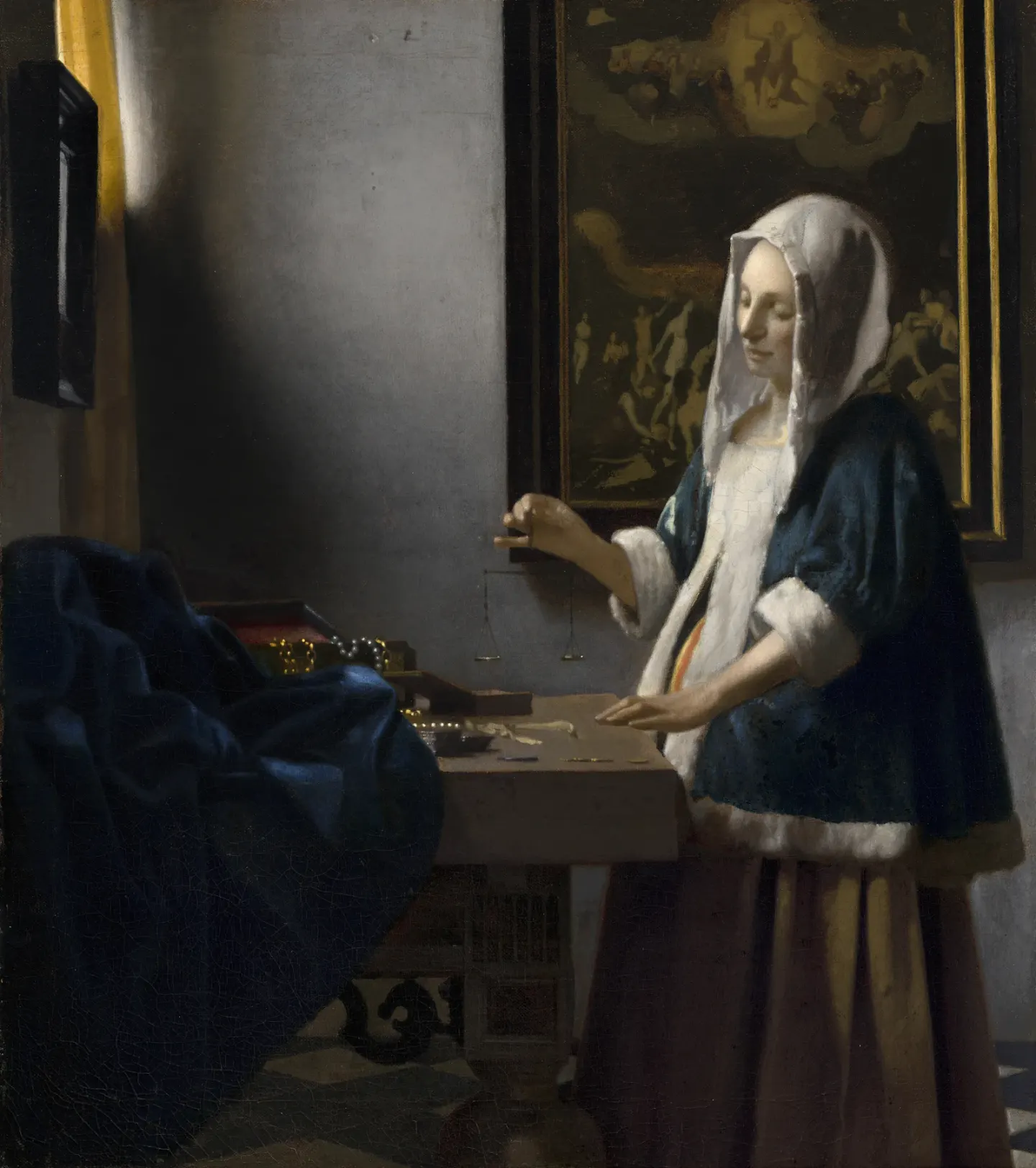
Johannes Vermeer, Woman Holding a Balance (c. 1664) · National Gallery of Art, Washington · public domain (CC0) · Wikimedia Commons
The weight of each cue is not the same. In experiments measured with special optical illusion drawings where front and back appear inverted, the factor that caused the illusion most strongly was how dense the lines of linear perspective were, followed by shading, and then resulting color. The researchers considered this order to be similar to the order when feeling depth in a flat drawing (DOI: 10.1163/156856808784532518). Another paper dealing with the same optical illusion goes a step further, concluding that for depth to be established in a flat drawing, there must be at least three different pictorial cues (DOI: 10.2190/em.26.1.f). This seems to clash with the result seen earlier that "Depth Is Gauged Even with a Single Cue", but gauging the order of front and back and bringing depth to life within a flat drawing are different questions. Shading cues are covered separately in "Light and Shadow — One Apple, and an Eye That Eyes First" from this series. Linear perspective is an arrangement of one of the depth cues using geometry, and within a drawing, it works together with other cues.
Around 1425 in Florence
Early 15th-century Florence is cited as the starting point of linear perspective. One art history essay records its beginning like this. Around 1425, the Florentine architect Filippo Brunelleschi painted the Florence Baptistery on a small panel, having drawn it by applying the geometric rules of its reflection in a mirror. About a decade later, in 1435–36, the humanist Leon Battista Alberti codified this method in a book on painting, replacing Brunelleschi's mirror with a window crossed by a grid (DOI: 10.1590/s0104-59702006000500010). This essay interprets that Brunelleschi's purpose in using a mirror was to reflect the order of faith, whereas Alberti's window turned that purpose toward the world right in front of us (DOI: 10.1590/s0104-59702006000500010).
Alberti's window introduces a new way of looking at a picture. The picture plane is treated as a transparent plate erected between the viewer's eye and the landscape. Alberti thought of this plane as cutting midway through the bundles of lines of sight connecting the eye and the landscape without disturbing them (DOI: 10.3406/rhs.2001.2128).
In this story, the footprint first appears in reality. Brunelleschi's experiment is reported to have consisted of a peephole and a painted panel (DOI: 10.1484/m.techne.5.117720). Making people look through a hole binds the viewer's eye to a single spot. Brunelleschi's demonstration is read as an act of fixing the relationship among the viewer, the painting, and the world at a single viewpoint, and afterward, the viewing position and vanishing point became the conditions of calculation for constructing a painting (DOI: 10.4324/9781042013173-4). Linear perspective is a drawing method that presupposes and calculates the position of a single eye.
There are counterarguments to reading this starting point merely as the invention of a single genius. The art historian Erwin Panofsky positioned Brunelleschi's experiment as the invention of linear perspective in a 1927 study, but recent studies downplay the significance of a single moment occurring at the hands of one person, reading perspective instead within the stream of optical studies extending from the Middle Ages (DOI: 10.1484/m.techne.5.117720). There is also research showing that ancient Greek and Roman paintings included experiential expressions of perspective, though they were not bound into a single, consistent geometric system. The same research suggests that the 11th-century scholar Ibn al-Haytham's optics—the idea that light enters the eye—may have been a precondition that made it possible to conceive of Alberti's window (DOI: 10.3406/rhs.2001.2128). This claim is put forward in the form of a suggestion, not a settled lineage. Linear perspective is a convention formulated through the hands of many people over history.
When Viewed From Outside the Footprint
In an art museum, we almost never stand on that footprint. We approach from the side, walk past at an angle, and look back once from a distance.
Perspective paintings establish a distance where their composition aligns correctly. However, a 1977 paper argues that central perspective does not require a specific position beyond just distance. The same paper points out the distortion where a painting looks different when viewed from a non-frontal spot, and examines what changes when it is viewed from multiple locations (DOI: 10.2307/1573763). What this paper calls a footprint is the viewing spot assumed as a condition by the front-facing calculation that constructs the painting (DOI: 10.4324/9781042013173-4). Following the 1977 paper, that calculation does not demand that the viewer actually stand in that spot. There is also an experiment showing that the more obliquely one looks, the more differently the same cube appears, and we will look at this experiment later alongside Byzantine paintings (DOI: 10.1068/p230005). The problem of viewing a painting from outside the designated spot is also something a 1974 theoretical review identified as one of the core problems of pictorial perception (DOI: 10.1037/h0036801).
There are also studies testing whether a painting acts like a window even when viewed head-on from the footprint. If a painting is truly a window as Alberti's metaphor suggests, the space inside the painting and real space should be perceived with the same shape. The results were different. Real space was perceived more accurately and less ambiguously than the space within the painting, and the difference between the two did not match the shape predicted by the window hypothesis. There were exceptions. When real space was viewed with one eye, the results were similar to those when viewing ordinary pictures. The researchers concluded that Alberti's hypothesis needs to be revised (DOI: 10.1037/a0035396).
Artists have not always strictly followed linear perspective either. A review outlining theories on spatial perception in paintings notes that classical paintings strictly following linear perspective are rare, and puts forward the hypothesis that whenever viewers move their eyes, they read shapes from small parts around their line of sight and stitch them together (DOI: 10.1167/jov.24.4.23). This is a proposed framework that still awaits testing. In a study analyzing the spacing of lined-up columns or trees across 30 paintings and prints from the Middle Ages to the present, painters drew those spacings either according to actual spatial spacing or according to the spacing of an illusionistic space with very shallow depth. Among those who painted using the latter method were renowned masters of linear perspective (DOI: 10.1177/2041669516662666).
What changes and what remains when viewed from outside the footprint cannot be settled into a single answer with the evidence gathered in this article. Linear perspective is a drawing method that assumes the position of a single eye and calculates depth, and there are viewing positions where it diverges from the space the eyes actually feel.
Paintings Outside Linear Perspective
If linear perspective is a system of calculation, there are also painting methods that developed independently of it, and usually grew before it.
The shapes of objects in Byzantine paintings sometimes do not align with linear perspective. One set of experiments asks whether those shapes might match perception when viewed from an angle. When people were asked to view a frame made of glowing rods straight-on, they adjusted the sides of the frame to flare outward in order to see it as a cube. This means that the sides of an actual cube appear to converge inward according to linear perspective. When the frame was moved to the side so it was viewed obliquely, they adjusted the sides to converge inward instead. This means that when viewed obliquely, the sides of the same cube appear to flare out, and the magnitude of that difference was related to the viewing angle (DOI: 10.1068/p230005). Because the paper's title begins with a question mark, it cannot be read as meaning that Byzantine painters intended this.
Traditional Chinese landscape painting traveled a long, separate path. This tradition of painting mountains and water dates back to records from the 4th century (DOI: 10.1080/07256868.2011.584615). Unlike Western painters who, after the Renaissance, focused on perspective converging to a single point and on prominent subjects, pre-mid-19th-century Chinese paintings tended to focus primarily on context (DOI: 10.3389/fpsyg.2016.01596). There is also research suggesting that traditional Chinese landscape painting often uses geometric perspective in reverse (DOI: 10.3389/fpsyg.2019.00798). Because it does not use perspective that converges to a single point, it must be read differently from paintings that presuppose a single footprint.
In the early 17th century, late Ming dynasty literati painter Dong Qichang wrote that while paintings could not match actual mountains and rivers in the splendor of their scenery, actual mountains and rivers could not match paintings in the exquisite charm of brush and ink. One study notes that the role science played in connecting painting and nature in Renaissance Europe was not evident in China, and reads the transmission of European perspective through 17th-century Jesuit missionaries against the backdrop of that difference. The author adds that this contrast does not erase the possibility that Dong Qichang regarded painting as an imitation of nature (DOI: 10.1080/0268117x.2009.10555623).
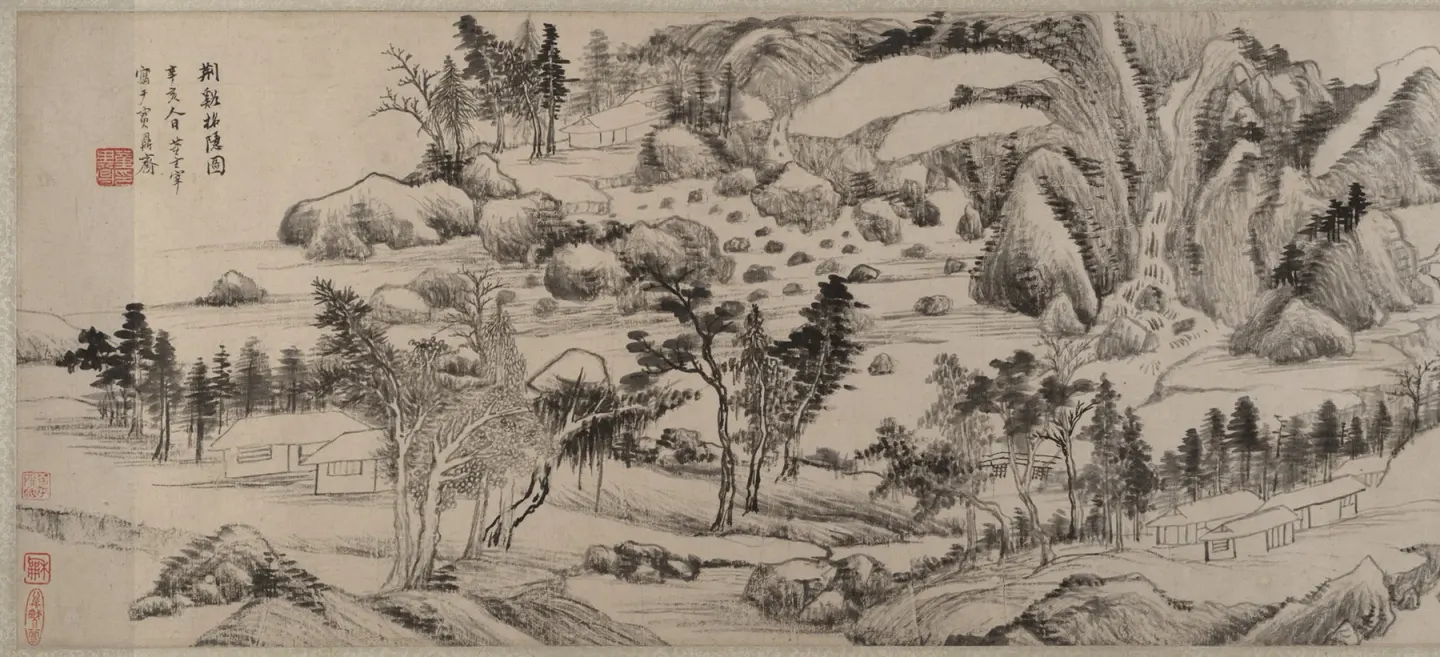
Dong Qichang, Invitation to Reclusion at Jingxi (1611), detail · Metropolitan Museum of Art, New York · public domain · Wikimedia Commons — one example of a painting outside linear perspective
Differences are also captured on the viewer's end. In a study measuring the eye movements of Chinese and Western participants, Chinese participants lingered their gaze on the blank space of ink wash paintings longer than Western participants, and Western participants appeared more sensitive to differences between linear perspective paintings and paintings using other perspective techniques (DOI: 10.1145/2493102.2493111). In experiments asking participants to view and score paintings, Chinese participants gave higher scores to Chinese paintings and Western participants to Western paintings, and both groups preferred landscapes over character scenes (DOI: 10.3389/fpsyg.2016.01596). In the aforementioned 2019 study on the perspective of landscape paintings, brain imaging showed that brain activation was stronger in both groups when viewing landscapes from their own culture. On the other hand, in terms of like and dislike felt while viewing the paintings, only Western participants felt more favorably toward landscapes from their own culture, and that difference did not appear among Chinese participants. The researchers concluded that these results support the influence of culture in uneven patterns across both behavior and the brain (DOI: 10.3389/fpsyg.2019.00798). These are results showing that the culture one grows up in can go hand in hand with how one views paintings, and those patterns vary across studies. Which perspective is more correct was not what these experiments measured, and these are also results derived from the participants of individual experiments.
A single painter would also oscillate between the two methods. A study comparing French painter Paul Cézanne's Mount Sainte-Victoire paintings and Japanese painter Katsushika Hokusai's Mount Fuji series analyzes that both painters used both linear perspective and axonometric projection—geometric rules that both originated in architecture and were adopted by painters—yet frequently broke those rules (DOI: 10.1080/10407410802421874). Paintings that do not use perspective or that break it are paintings that handle space in a different way.
Back in Front of That Painting
We return to the first landscape painting. This time, we extend those few seconds just a little and apply everything we gathered in this article, one by one.
First, we find the vanishing point. Like the two edges of a straight road, if we follow where straight lines that are parallel to the ground and to each other converge, the vanishing point appears. If there are eaves positioned in the same direction as the road, they lead to the same point. The horizontal line passing through that point is the horizon line. If the painting uses linear perspective, where the horizon line and vanishing point are located is one of the questions to ask when reading a space (Sachant et al., Introduction to Art ch. 4.02).
Next are overlap and scale. The tree in the foreground blocks part of the house, and the houses get smaller the farther away they are. If the distant mountain behind them is hazy and bluish, atmospheric perspective adds another layer. Multiple clues are pointing to the same depth.
Finally, we try taking a step to the side. The trees and mountains do not swap places with each other, and we have stepped away from the footprint presupposed by the painter's calculation. The fact that the shapes inside the painting look different when viewed from a spot other than dead center is the extent of what the evidence gathered in this article tells us. If we take a step and directly compare what changes, those few seconds in front of the same painting become different.
Where to Look Next
The article "Hokusai's Great Wave — Same Design, Different Blues" examines one of the prints from Hokusai's Mount Fuji series featured here from the perspective of blocks and blue.
It also connects with other parts of this series. The shading cues that make round things look round are covered by "Light and Shadow — One Apple, and an Eye That Guesses First". Where the eyes actually move in front of a painting is continued by "Composition and Gaze — Stepping Stones the Painting Lays, a Path the Eye Chooses".
Source Papers
- "Geometry of Pictorial Relief" (2018) — DOI: 10.1146/annurev-vision-091517-034250 — Review. The three-dimensional impression in a picture is a visual experience that arises when "peering into" the picture and has no physical counterpart.
- "Minimodularity and the perception of layout." (1988) — DOI: 10.1037/0096-3445.117.2.161 — Computer stimulus experiment turning relative size, height in the picture plane, overlap, and motion parallax on and off. Cues are used additively and can substitute for one another, and the more cues there are, the more strongly depth is revealed.
- "Picture perception: Toward a theoretical model." (1974) — DOI: 10.1037/h0036801 — Overview of picture perception theories. Reviews the coexistence of flatness and depth information, viewing from incorrect locations, and other problem domains (limited to post-Renaissance Western paintings).
- "Perception of Perspective Angles" (2015) — DOI: 10.1177/2041669515593022 — 4 participants. Perspective angles between floor bars judged larger than actual angles and smaller than the angles formed on the retina. Judged from photographs as well.
- "Art and neuroscience: how the brain sees Vermeer's Woman Holding a Balance" (1998) — DOI: 10.1016/s0140-6736(98)10102-2 — Essay. Mirror and table lines that appear parallel converge at a single vanishing point (the white dot in the X-ray photo) beside the woman's right hand, while the woman in the foreground partially obscures a portion of the room and her body size is proportional to the objects.
- "Factors contributing to depth perception: behavioral studies on the reverse perspective illusion" (2008) — DOI: 10.1163/156856808784532518 — Three reverse perspective illusion experiments. Density of the linear perspective grid is strongest, followed by shading, texture, and color. Similar order of contribution to depth perception in flat pictures.
- "On the Visual Cues Contributing to Pictorial Depth Perception" (2008) — DOI: 10.2190/em.26.1.f — Conclusion that the presence of three independent pictorial cues is decisive for depth illusions in flat pictures in general ("triadic cognition").
- "Brunelleschi's mirror, Alberti's window, and Galileo's 'perspective tube'" (2006) — DOI: 10.1590/s0104-59702006000500010 — Essay. Around 1425, Brunelleschi painted a baptistery panel using mirror reflection geometry; in 1435–36, Alberti formalized it and replaced the mirror with a grid window. The shift in purpose is the author's interpretation.
- "Optique et perspective : Ptolémée, Alhazen, Alberti" (2001) — DOI: 10.3406/rhs.2001.2128 — Empirical perspective in Greco-Roman painting was not a consistent geometric system. The picture plane is a surface cutting the visual pyramid. The author's suggestion that Alhazen's optics may have been a prerequisite.
- "The Grid of Reason" (2026) — DOI: 10.4324/9781042013173-4 — Book chapter. Reads Brunelleschi's panel demonstration as viewpoint fixation controlling the relationship between observer, picture, and world, extending to Alberti's window and Dürer's workshop device.
- "Introduction" (2019) — DOI: 10.1484/m.techne.5.117720 — Panofsky's (1927) description of Brunelleschi's viewing-hole-and-panel experiment as an invention; recent research downplays the significance of a single moment by a single individual and reads it within the history of optics.
- "Perception of Perspective Pictorial Space from Different Viewing Points" (1977) — DOI: 10.2307/1573763 — Essay. Argument that central perspective determines the distance for correct projection but does not mandate a specific viewing position. Addresses perceived distortion when viewed from outside the front.
- "A new view through Alberti's window." (2014) — DOI: 10.1037/a0035396 — Two experiments. Real space is more accurate and less ambiguous than pictorial space, the difference is inconsistent with the window hypothesis, and real space viewed with one eye is similar to picture perception. Conclusion that Alberti's hypothesis needs revision.
- "Toward a theory of perspective perception in pictures" (2024) — DOI: 10.1167/jov.24.4.23 — Review and hypothesis. Classical paintings strictly following linear perspective are rare. A two-stage hypothesis where parts are read and integrated with each gaze, and open questions.
- "Equidistant Intervals in Perspective Photographs and Paintings" (2016) — DOI: 10.1177/2041669516662666 — Analysis of 30 paintings and prints. Painters drew equidistant intervals based on physical space or shallow-depth visual space, with renowned perspective masters among the latter.
- "The Perception of Spatial Structure with Oblique Viewing: An Explanation for Byzantine Perspective?" (1994) — DOI: 10.1068/p230005 — Glowing rod frame experiment. To look like a cube, sides had to be set apart frontally and converged when viewed obliquely — in other words, viewed obliquely, a cube appears splayed out. The effect is related to viewing angle. Raises a question mark regarding the explainability of Byzantine perspective.
- "Beingin Traditional Chinese Landscape Painting" (2011) — DOI: 10.1080/07256868.2011.584615 — Earliest mentions of the shanshui (mountains and water) tradition date back to the 4th century. The author's argument that it is an experience of concept rather than vision.
- "Aesthetic Preferences for Eastern and Western Traditional Visual Art: Identity Matters" (2016) — DOI: 10.3389/fpsyg.2016.01596 — Post-Renaissance West features central perspective and prominent subjects, whereas China before the mid-19th century mostly features context-centered (background narrative) art. Higher evaluation of one's own culture's paintings, with both groups preferring landscapes.
- "Aesthetic Experiences Across Cultures: Neural Correlates When Viewing Traditional Eastern or Western Landscape Paintings" (2019) — DOI: 10.3389/fpsyg.2019.00798 — Traditional Chinese landscapes often use inverted geometric perspective and focus on context (Introduction). Brain activation in fMRI favors one's own culture. At the behavioral level, only Western participants show higher emotional response to Western landscapes, while Chinese participants show no such effect — "differential" support for cultural modulation.
- "Chinese Perception of European Perspective: A Jesuit Case in the Seventeenth Century" (2009) — DOI: 10.1080/0268117x.2009.10555623 — Dong Qichang's comparative remarks on painting and landscape (author notes this contrast does not rule out Dong's view on imitation); thesis that unlike the Renaissance's "imitation of nature through science," China did not reveal science playing a role bridging art and nature; transmission of European perspective to China in the 17th century.
- "Culture influence on aesthetic perception of Chinese and western paintings: evidence from eye movement patterns" (2013) — DOI: 10.1145/2493102.2493111 — Chinese participants gaze longer at ink-wash empty space, and Western participants appear more sensitive to differences between linear perspective and scattered perspective paintings.
- "Paintings as Architectural Space: 'Guided Tours' by Cézanne and Hokusai" (2008) — DOI: 10.1080/10407410802421874 — Comparison of Cézanne's Mont Sainte-Victoire and Hokusai's Thirty-six Views of Mount Fuji. Analysis that both used linear perspective and axonometric projection (both geometric standards originating from architecture) but frequently broke them.
- "Introduction to Art: Design, Context, and Meaning — 2.04 Form and Composition" (LibreTexts) — Sachant et al., Introduction to Art ch. 2.04 — The horizon line (in a painting) is the eye-level line, and the vanishing points of lines parallel to the ground lie upon it. Distant scenery becomes hazy and bluish due to the air in between.
- "Introduction to Art: Design, Context, and Meaning — 4.02 FORMAL OR CRITICAL ANALYSIS" (LibreTexts) — Sachant et al., Introduction to Art ch. 4.02 — In formal analysis, if a painting uses linear perspective, one asks the positions of the horizon line and vanishing points.
Sources (24)
- Geometry of Pictorial ReliefDOI 10.1146/annurev-vision-091517-034250
- Minimodularity and the perception of layoutDOI 10.1037/0096-3445.117.2.161
- Picture perception: Toward a theoretical modelDOI 10.1037/h0036801
- Perception of Perspective AnglesDOI 10.1177/2041669515593022
- Art and neuroscience: how the brain sees Vermeer's Woman Holding a BalanceDOI 10.1016/s0140-6736(98)10102-2
- Factors contributing to depth perception: behavioral studies on the reverse perspective illusionDOI 10.1163/156856808784532518
- On the Visual Cues Contributing to Pictorial Depth PerceptionDOI 10.2190/em.26.1.f
- Brunelleschi's mirror, Alberti's window, and Galileo's 'perspective tube'DOI 10.1590/s0104-59702006000500010
- Optique et perspective : Ptolémée, Alhazen, AlbertiDOI 10.3406/rhs.2001.2128
- The Grid of ReasonDOI 10.4324/9781042013173-4
- IntroductionDOI 10.1484/m.techne.5.117720
- Perception of Perspective Pictorial Space from Different Viewing PointsDOI 10.2307/1573763
- A new view through Alberti's windowDOI 10.1037/a0035396
- Toward a theory of perspective perception in picturesDOI 10.1167/jov.24.4.23
- Equidistant Intervals in Perspective Photographs and PaintingsDOI 10.1177/2041669516662666
- The Perception of Spatial Structure with Oblique Viewing: An Explanation for Byzantine Perspective?DOI 10.1068/p230005
- Beingin Traditional Chinese Landscape PaintingDOI 10.1080/07256868.2011.584615
- Aesthetic Preferences for Eastern and Western Traditional Visual Art: Identity MattersDOI 10.3389/fpsyg.2016.01596
- Aesthetic Experiences Across Cultures: Neural Correlates When Viewing Traditional Eastern or Western Landscape PaintingsDOI 10.3389/fpsyg.2019.00798
- Chinese Perception of European Perspective: A Jesuit Case in the Seventeenth CenturyDOI 10.1080/0268117x.2009.10555623
- Culture influence on aesthetic perception of Chinese and western paintings: evidence from eye movement patternsDOI 10.1145/2493102.2493111
- Paintings as Architectural Space: 'Guided Tours' by Cézanne and HokusaiDOI 10.1080/10407410802421874
- Introduction to Art: Design, Context, and Meaning — 2.04 Form and Composition
- Introduction to Art: Design, Context, and Meaning — 4.02 FORMAL OR CRITICAL ANALYSIS