Paperis Articles
Paint and Materials — The Same Powder, Different Doughs
Paint is made when a binder holds a coloring powder together. Whether it is mixed with egg yolk, a wet wall, oil or water changes how a picture is painted, and after it is finished the varnish, pigments and oil keep changing it.
Your field's papers, as audio
Pick your fields and journals — Paperis summarizes the key papers and turns them into audio. Listen on your commute.
Start Paperis free →Paint and Materials — The Same Powder, Different Doughs
Two Spoonfuls of Yellow Powder
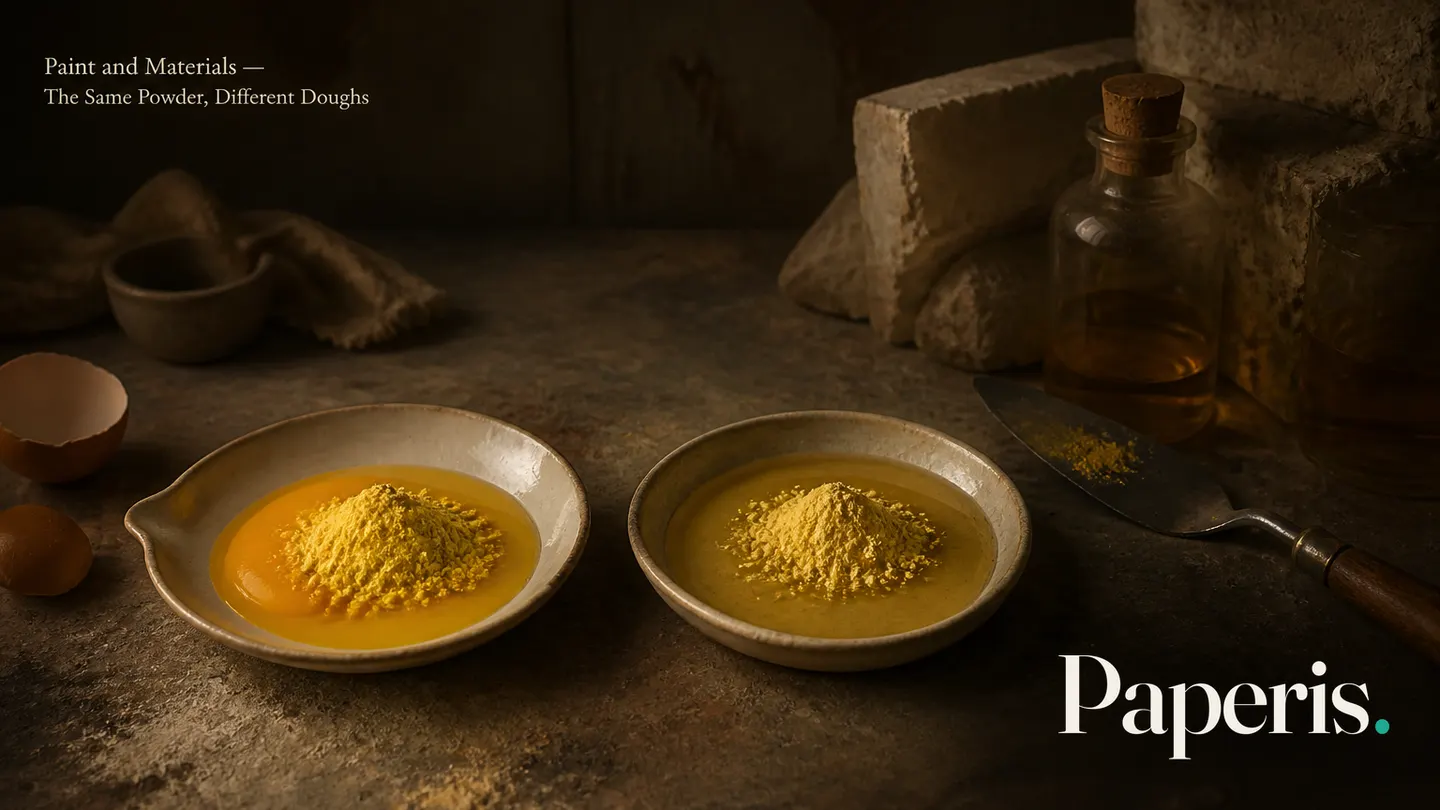
A handful of yellow powder sits on a workbench. We mix one spoonful into egg yolk and another into linseed oil. Both become yellow paints. The one mixed with yolk dries quickly, while the one mixed with oil dries slowly (Sachant et al., Introduction to Art ch. 2.03).
The powder was the same, yet two paints with different properties came out. This article starts from that difference to follow what paint is made of, how painters changed their painting methods for each material, and how paintings continue to change even after they are fully painted.
As a guide, we take only a single piece of dough. The same flour becomes different dough depending on whether it is mixed with water, eggs, or oil. In paint, the powder that produces the color takes the place of the flour, and water, eggs, or oil are what mix with and hold that powder together.
Powder, and What Holds the Powder
First is the powder. Pigments are fine powders that give paint its color. Next is what holds it. A binder is a substance that glues pigment particles to one another and holds them onto the surface; in oil paint, oil pressed from flaxseeds mostly does this job. The insoluble pigment granules are scattered evenly inside the binder, becoming a single sticky, clumping mass (DOI: 10.1016/j.aca.2024.343251).
The two spoonfuls at the beginning had the same powder and only differed in the holding side. What divides types of paint is usually this holding side as well (Sachant et al., Introduction to Art ch. 2.03). The binders used in painting fall broadly into three groups: proteins like egg or glue, oils like linseed oil, and synthetic resins that arrived in the 20th century (DOI: 10.1039/bk9781788010931-00291). Oil painting is a picture painted with pigments mixed into oil. Even the name tells you the binder.
Bearing the weight of choosing a binder, a doctoral dissertation covering 15th-century Italian paintings argues that whether to use egg or oil was inseparable from the painter's technique and a choice as important as which pigment to select (DOI: 10.58088/bwqc-ge96). That is why, in front of a painting, you might well ask not just "What color is this?" but "What was this color mixed in?"
Colors Mixed with Yolk: Tempera
There are three altarpiece panels painted around 1475 by the Italian painter Cosimo Tura. When scanned with near-infrared imaging without removing anything from the panels, the binder differed from place to place within a single painting.
Tempera is a paint made by mixing pigment with egg yolk. As seen in the introduction, yolk paint dries quickly.
In Tura's panels, animal skin glue boiled down was used for the blue sky and the Virgin's blue cloak, while yolk was used for the red garments and the brown landscape. Both appeared in the figures' faces. The results also matched previous analyses that took samples from various locations (DOI: 10.1039/c3an00926b). The painter of these panels chose different mixtures for different colors even within a single screen. However, this is a result from three panels by a single painter.
A Painting Held by the Wall: Fresco
The Italian Renaissance painter Perugino painted on the wall of a church in Trevi in 1521. In paintings done on walls, the wall intervenes in the plaster.
Fresco is a mural technique of painting on wet plaster before it dries, allowing the wall to hold the color as it hardens. (Sachant et al., Introduction to Art ch. 2.03) In terms of dough, the wet wall acts like the kneading here.
Actual murals were not painted using only this single method. A study examining Perugino's mural with infrared light without removing it found two places where touches were added with tempera after the wall had dried (DOI: 10.1366/000370207780220840). Mural paintings from a 12th-century monastery in Cerate, southern Italy, also used fresco and egg tempera together (DOI: 10.1002/jrs.4298). Even a single wall can have more than one mix.
Oil That Hardens by Eating Oxygen: Oil Paint
In "The Descent from the Cross" (Prado Museum, Madrid) by the 15th-century Flemish painter Rogier van der Weyden, there is a study that detached and examined a very tiny piece of the Virgin's blue garment. In the paint layer of that fragment, linseed oil appeared as the binder, and no traces of egg tempera were seen (DOI: 10.1021/ac035201a).
Oil paint mainly uses linseed oil or walnut oil (Sachant et al., Introduction to Art ch. 2.03). A drying oil is an oil that hardens on its own by reacting with oxygen in the air, with linseed oil being a representative example. The drying of a drying oil is a reaction in which oil molecules that have absorbed oxygen interweave with one another to form a net-like mass (DOI: 10.1021/acs.macromol.4c01164; DOI: 10.1021/acsapm.0c01441). In an experiment that observed model paints for up to 24 months, those nets continued to change even after hardening as time passed (DOI: 10.1021/acsapm.0c01441).
Pigments also interfere in this reaction. Lead white is a white pigment made from lead. Lead white acts as a drying agent that helps the oil dry (DOI: 10.1021/ac035201a; DOI: 10.1021/acsapm.0c01441), and many old recipes intentionally mixed lead driers into the oil (DOI: 10.1080/00393630.2016.1232529). In the model paint experiment, the ratio of oxidation and interweaving varied greatly depending on the pair of oil and pigment (DOI: 10.1021/acsapm.0c01441). What is added more to the dough changes even the way it hardens.
In Italian painting, the transition from egg to oil is closer to a long mixing than a single-stroke change. In 1971, there was an interim report of a study that stained and identified the binders of about 500 samples taken from Italian paintings at the Walters Art Museum in the United States. Even in 14th-century paintings, a little oil was used alongside certain green pigments. 15th-century paintings were mostly egg tempera, but layers containing oil became more frequent in places like the underdrawing layer. Even in the 16th century, egg was not pushed out by oil. The two were used interchangeably across layers and spots. Even in the 17th century, when the mixed usage gradually decreased, egg tempera remained on skin and bright highlights (DOI: 10.1179/sic.1971.017). One doctoral dissertation argues that painters in the Veneto region likely knew oil techniques well before 1400, and that early analyses were inaccurate, requiring a re-evaluation of binder determinations for 15th-century Italian paintings (DOI: 10.58088/bwqc-ge96).
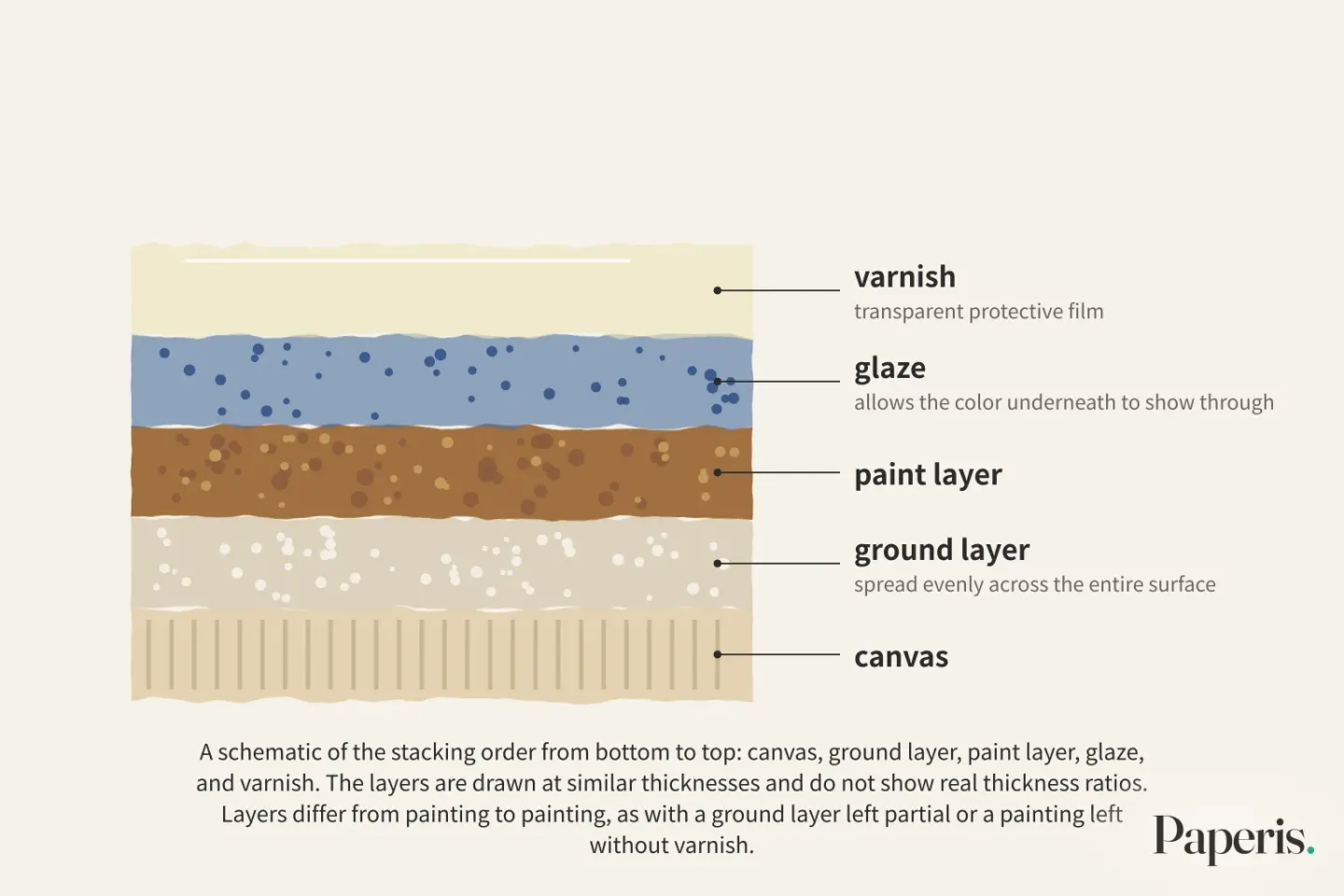
Oil painting is also built by stacking layers. One of the methods of stacking layers is glaze. A glaze is a thin, transparently applied layer of paint that allows the color underneath to show through. A research project that re-examined "Girl with a Pearl Earring" revealed the stages by which Vermeer built up the painting through paint layers and subtle optical effects (DOI: 10.1186/s40494-019-0307-5), and the story of the glaze among those layers is covered in "Girl with a Pearl Earring — Light Built in Layers, a Name Not Asked".
Paints Thinned with Water: Watercolor and Acrylic
Watercolor is pigment mixed with gum arabic, which dissolves in water. Acrylic paint uses synthetic resin in place of the binder, and dries quickly. Both are thinned with water for use (Sachant et al., Introduction to Art ch. 2.03). The synthetic binders used in 20th-century paints can be summarized into four branches, including acrylic, and a review published in 2000 noted that these synthetic resins were still unfamiliar even to art conservators (DOI: 10.1080/01410096.2000.9995156).
The Layer Beneath the Painting: Ground Layer
The 17th-century Flemish painter Cornelis Norbertus Gysbrechts liked to paint trompe-l'œil works that made a painter's studio look real. In those paintings, a dark red ground layer is frequently visible.
The ground layer is the layer spread evenly across the entire surface before painting on a canvas or wooden panel. When 15 of his paintings in the National Gallery of Denmark were examined, most actually had a double ground layer: a red layer laid down at the bottom with a lighter brown or gray layer placed on top (DOI: 10.5092/jhna.2025.17.2.7). The ground layer painted inside the pictures and the ground layer the artist actually laid down were not the same.
Sometimes artists did not even apply the ground layer themselves. The Dutch painter Paulus Potter used unusually large, pre-primed canvases in Amsterdam between 1652 and 1654 (DOI: 10.1038/s40494-026-03025-1). In the ground layers of nine paintings from the 19th-century Danish Golden Age, calcium, lead, and drying oil turned up along with egg, even though few artist manuals from that era suggest adding egg. The researchers think that the parties who made and sold primed canvases may not have followed the artist manuals (DOI: 10.1186/s40494-017-0147-0).
The ground layer is also tied to how a painting ages. In 22 canvas paintings by the Danish portraitist Jens Juel (1745–1802), the ground layer materials and the crack patterns appeared paired together. Paintings created in Denmark (and some in Germany) featured ground layers high in calcium carbonate on tight canvases, and cracked in jagged right angles. Paintings created in France and Switzerland featured ground layers high in lead white with diagonal cracks forming large chunks. Cracks arise when external factors like the environment overlap with the properties of the materials, and what this study found is a correlation between the ground layer material and the crack pattern. The researchers think that ground layers high in lead white would be less vulnerable to cracks caused by the canvas (DOI: 10.1016/j.culher.2024.07.010). In this artist's paintings, the surface crack patterns moved together with the materials of the underlying layer.
Some painters intentionally left out the ground layer. The British painter David Hockney left the ground layer partial in several paintings from the mid-1960s to the early 1970s. An art history paper interprets that he used unprimed raw canvas to render the "wet look" of water, and that this choice changes even the viewer's perception and interpretation (DOI: 10.1163/22134913-bja10015).
A Painting Keeps Changing After It Is Finished
Varnish is a thin, transparent protective film applied over a finished painting. On Amsterdam's "Sunflowers", which Vincent van Gogh left without varnish, multiple layers of later-applied varnish have now turned yellow (DOI: 10.1017/9789048550531.007), and that story is followed in "Van Gogh's Sunflowers — The Shadow Settling on the Yellow".
The pigments themselves also change. Chrome yellow is a yellow pigment made from a compound containing lead and chromium. Chrome yellow can darken when exposed to light, the extent depends on the pigment's composition and crystal structure, and several of Van Gogh's paintings were affected by it (DOI: 10.1021/ac502841g).
The red pigment vermilion (mercuric sulfide) can also turn black when exposed to light. One study proposed the hypothesis that tiny mercury particles accumulate on the surface and cause the darkening (DOI: 10.1021/ac048158f). Arsenic pigments that produce yellow and orange decompose in light, and their decomposition products dissolve in water and move around. In all five samples taken from four paintings and one painted cupboard, arsenic had spread across the entire layer, from the ground supporting the painting to the topmost varnish (DOI: 10.1186/s40494-016-0078-1).
New things can also form as oil and pigment interact. Metal soaps are compounds formed when metals like lead or zinc in the paint combine with fatty acids from the oil. Metal soaps are sometimes interpreted as playing a useful role as a scaffold when paint hardens, and they are also pointed out as the cause of bumps rising on the surface, white crystalline blooms, and darkening (DOI: 10.1080/00393630.2016.1232529). In oil paintings since the 20th century, cases where paint sags just a few years after completion are even reported, and one review names an insufficiently cross-linked oil network during curing as a candidate cause (DOI: 10.1021/acs.accounts.9b00296).
Distinguishing what is deterioration from what is the painter's choice is not easy. This is because the ingredients remaining today can differ greatly from what was originally used, making it difficult to gauge the painter's intent (DOI: 10.1080/00393630.2016.1232529). The process by which researchers concluded that the pararealgar among the arsenic pigments found in Rembrandt's "Night Watch" was deliberately chosen by the painter is followed in "Rembrandt's Night Watch — A Map of Paint, Drawn Inside a Glass Room" (DOI: 10.1186/s40494-024-01350-x). The analysis result for one painting is the answer for that painting alone and cannot be directly transferred to another.
Measuring, Slowing, and Paring Away: Conservation
The way to know that a painting changes is to measure it. Conservation science is the work of measuring what a painting is made of and how it changes, and finding ways to slow that change. We must understand materials and their deterioration to decide how a painting should be cleaned, repaired, and protected (DOI: 10.1111/j.1478-4408.2007.00096.x).
There are broadly two ways of measuring. A cross-section sample is an extremely small piece taken from a painting and cut so that the paint layers can be seen from the side. This is the method used to read the layer of the Virgin's blue robe in a painting by the Flemish painter van der Weyden (DOI: 10.1021/ac035201a). With precious paintings, the very act of taking a sample is frequently forbidden (DOI: 10.1016/j.aca.2024.343251). Non-invasive analysis is an analysis that identifies materials by shining light or X-rays without removing anything from the painting. Sometimes equipment is brought right in front of the painting to measure it (DOI: 10.1021/ar100010t). This is the method used when Tura's panel was scanned with near-infrared light. Yet measuring also has its limits. In a study that aged reproduction paints for a little over ten years, even the indicators for identifying the type of oil were heavily swayed by the age of the accompanying pigments and paint, and the researchers note that more research is needed to determine drying oils in paintings (DOI: 10.1371/journal.pone.0049333).
Cleaning is a conservation treatment that pares away dirt accumulated on the surface of a painting, yellowed varnish, and paint applied later. Cleaning relies on the difference in solubility between the layer to be pared away and the paint beneath it (DOI: 10.7912/c2/2382). Yellowed varnish often mars a painting's appearance long before it fully oxidizes. However, cleaning is tricky because the solubility of the materials used by the artist and those applied later is similar (DOI: 10.4324/9780429399916-36). A text by the Rijksmuseum reporting on the treatment of two pendant portraits painted by Rembrandt in 1634 notes that the varnish layer applied in the 1950s was pared away, and the aged, discolored egg-white varnish was only partially reduced, considerably restoring the details and the original color contrast (DOI: 10.52476/trb.9762).
Treatments leave marks on paintings. In a study comparing two works from 1616 painted by the same artist with the same materials, the side where varnish had been applied and removed multiple times was stiffer throughout its entire thickness than the side that had not. This is presumed to be because resins and solvents seeped into the paint and ground layer (DOI: 10.1002/mrc.4164). Lining is a reinforcement treatment that attaches a new fabric to the back of an aged canvas. When wax-resin lining from the 1920s to 1930s was applied to samples reproducing Van Gogh's ground layer, the ground layer darkened, with the ground layer mixed with glue darkening the most. However, in actual Van Gogh paintings, it is difficult to tell whether the darkening of the ground layer is due to the lining or to the seeping of oil from the paint (DOI: 10.1179/sic.2011.56.2.94).
There are also recommendations to preemptively slow down changes. One study dealing with arsenic pigments advises prioritizing the prevention of decomposition, as decomposition products spread from the ground layer to the varnish, and recommends reducing strong light, large humidity changes, and cleaning using water (DOI: 10.1186/s40494-016-0078-1). A single prescription does not suit all pigments either. Prussian blue is a deep blue pigment—meaning a powder that gives color to paint—created by humans through a chemical reaction using iron. In an experiment where watercolor pigments were exposed to light in an environment with almost no oxygen, many pigments faded less, but Prussian blue fared worse than in the air (DOI: 10.1179/2047058413y.0000000108).
What cleaning aims to pare away is the layer resting on top of the painting. For changes that occur within the pigment, there is no separate layer to pare away. Components detected in paintings today can be very different from what the artist originally used (DOI: 10.1080/00393630.2016.1232529). Research continues to find early signals of varnish aging precisely to stop it before irreversible damage reaches the painting underneath (DOI: 10.1016/j.culher.2025.10.003).
Once Again, Before Two Spoonfuls of Yellow Powder
We return to the first two spoonfuls. The yellow mixed with egg yolk dries quickly, and the yellow mixed with oil absorbs oxygen and slowly weaves into a net. If that yellow is chrome yellow, it can darken when exposed to light. If someone brushed varnish over it after it became a painting, that varnish could also turn yellow, and the material of the underlayer appeared paired with gold shapes across one painter's works.
The guide of dough has two limitations. Kitchen dough usually finishes once it is mixed and baked, but oil paint's reactions continue even after it is fully dry. And in the kitchen we know what went in, but in a painting the components remaining now may differ from what was put in first.
Standing before a painting in an art museum, we can add two questions to "What color is it?" What was the color mixed with, and what else is above and below it?
Where to Look Next
The three pieces pointed to sentence by sentence in the main text — Rembrandt's Night Watch — A Map of Paint, Drawn Inside a Glass Room, Girl with a Pearl Earring — Light Built in Layers, a Name Not Asked, and Van Gogh's Sunflowers — The Shadow Settling on the Yellow — each take a single painting and follow pigment maps, glazes and ultramarine, and chrome yellow and varnish in depth. How Prussian blue was used in prints can be seen in Hokusai's Great Wave — Same Design, Different Blues.
How colors change when you mix paints versus when you mix light is covered by Color — One Dab of Paint, Changed by Its Neighbors among the other parts of this series, while how to create three-dimensionality with light and shadow is covered by Light and Shadow — One Apple, and an Eye That Guesses First.
Source Papers
- "Introduction to Art: Design, Context, and Meaning — 2.03 Art Forms" (LibreTexts) — Sachant et al., Introduction to Art ch. 2.03 — What divides types of paint is usually the binder; yolk paint dries quickly and linseed oil dries slowly; oil (linseed and walnut oils), watercolor (gum arabic, thinned with water), acrylic (synthetic resin, fast-drying), fresco (wet plaster holding pigment).
- "Look but don't touch: Non-invasive chemical analysis of organic paint binders – A review" (2024) — DOI: 10.1016/j.aca.2024.343251 — Binders disperse insoluble pigments evenly and create a sticky mixture; mass spectrometry requires tiny samples but is usually forbidden on precious works, so non-invasive and minimally invasive methods are developing, according to this review.
- "Paints and Binding Media" (2021) — DOI: 10.1039/bk9781788010931-00291 — A book chapter dividing painting binders into proteins, lipids (oils), and synthetic polymers, outlining their structures and analytical methods.
- "From egg to oil: the early development of oil painting during the Quattrocento" (2016) — DOI: 10.58088/bwqc-ge96 — Dissertation: Venetian painters may have known oil techniques well before 1400; whether egg or oil is used is as important as pigment choice; inaccuracies in early analyses require a reassessment of 15th-century binder determinations.
- "Mapping of egg yolk and animal skin glue paint binders in Early Renaissance paintings using near infrared reflectance imaging spectroscopy" (2013) — DOI: 10.1039/c3an00926b — Three panels by Tura (c. 1475): the blue sky and the Virgin's blue robe are glue, the red robe and brown landscape are yolk, and both are on the face; consistent with prior amino acid analyses.
- "Fiber-Optic Fourier Transform Mid-Infrared Reflectance Spectroscopy: A Suitable Technique for in Situ Studies of Mural Paintings" (2007) — DOI: 10.1366/000370207780220840 — Perugino's fresco (1521, Trevi) was examined in situ non-invasively, confirming two types of secco retouched with tempera.
- "The study of the mural painting in the 12th century monastery of Santa Maria delle Cerrate (Puglia‐Italy)" (2013) — DOI: 10.1002/jrs.4298 — Pigments in a 12th-century monastery mural were applied in two methods: fresco and egg tempera.
- "Imaging Secondary Ion Mass Spectrometry of a Paint Cross Section Taken from an Early Netherlandish Painting by Rogier van der Weyden" (2004) — DOI: 10.1021/ac035201a — Linseed oil binder was identified in a single cross-section of the Virgin's blue robe from "The Descent from the Cross", with no traces of egg tempera detected in this section; lead white acted as a natural drier.
- "Comprehensive Characterization of Drying Oil Oxidation and Polymerization Using Time-Resolved Infrared Spectroscopy" (2024) — DOI: 10.1021/acs.macromol.4c01164 — Drying oils like linseed oil harden by forming a mesh structure through free radical polymerization, and lead oxide makes the cross-linking of the mesh uneven.
- "Oxidation and Cross-Linking in the Curing of Air-Drying Artists' Oil Paints" (2021) — DOI: 10.1021/acsapm.0c01441 — Tracked the oxidation, cross-linking, and subsequent temporal changes up to 24 months as oil paint hardens from liquid to film; lead white is a drier that promotes even hardening; the combination of oil and pigment can drastically alter the ratio of oxidation and cross-linking.
- "Lead soaps in paintings: Friends or foes?" (2016) — DOI: 10.1080/00393630.2016.1232529 — Metal soaps are interpreted both as structural anchor points (beneficial) and as causes of protrusions, whitening, and darkening (harmful); many old recipes intentionally mixed oils and lead driers; components detected today may differ significantly from those originally used, making it difficult to judge the artist's intent.
- "METHODS USED FOR THE IDENTIFICATION OF BINDING MEDIA IN ITALIAN PAINTINGS OF THE FIFTEENTH AND SIXTEENTH CENTURIES" (1971) — DOI: 10.1179/sic.1971.017 — Interim report on staining analyses of about 500 samples from the Walters Art Museum: oil used in some green pigments in the 14th century, mostly egg tempera in the 15th but oil layers becoming more frequent, egg not displaced in the 16th and mixed by layer and location, and egg tempera still used for flesh and highlights in the 17th century.
- "From 'Vermeer Illuminated' to 'The Girl in the Spotlight'" (2019) — DOI: 10.1186/s40494-019-0307-5 — The re-examination project of "Girl with a Pearl Earring" reveals the stages and changes over time by which paint layers and optical effects built up the painting.
- "A review of synthetic binding media in twentieth‐century paints" (2000) — DOI: 10.1080/01410096.2000.9995156 — Summarizes 20th-century synthetic binders into four types: acrylic, alkyd, polyvinyl acetate, and nitrocellulose; still unfamiliar to most conservators.
- "Representation versus Reality: Cornelis Norbertus Gijsbrechts's Depiction and Use of Colored Grounds" (2025) — DOI: 10.5092/jhna.2025.17.2.7 — While paintings often depict dark red ground layers, 15 actual examples usually feature a two-layer ground consisting of a light brown or gray layer placed over a red layer.
- "X-radiographic analyses of large canvas paintings by Paulus Potter, and the enlargement of The Bull" (2026) — DOI: 10.1038/s40494-026-03025-1 — Revealed Potter's canvas preparation via thread density analysis of X-rays; unusually wide pre-primed canvases during the Amsterdam period (1652–54).
- "Characterisation of preparation layers in nine Danish Golden Age canvas paintings by SEM–EDX, FTIR and GC–MS" (2017) — DOI: 10.1186/s40494-017-0147-0 — All nine paintings contained calcium, lead, drying oil, and egg in their ground layers; instructional manuals specifying the inclusion of egg are rare, suggesting canvas producers may not have followed manuals.
- "Crack morphology and its correlation with ground materials used in paintings by Danish portrait painter Jens Juel" (2024) — DOI: 10.1016/j.culher.2024.07.010 — Juel's 22 paintings: calcium carbonate grounds produced right-angled, jagged cracks, while lead white grounds produced oblique, large-fragment cracks; grounds richer in lead white would likely be less vulnerable to canvas-induced cracking.
- "Selective Preparation of Canvas as an 'Artistic Device' in David Hockney's Early Paintings (1964–1972)" (2020) — DOI: 10.1163/22134913-bja10015 — Art-historical interpretation that Hockney's partial priming and use of bare canvas to render the wet feel of water alter perception and interpretation.
- "6. Structure and Chemical Composition of the Surface Layers in the Amsterdam Sunflowers" (2019) — DOI: 10.1017/9789048550531.007 — Van Gogh left "Sunflowers" unvarnished, but it now has multiple layers of later-applied varnish that have yellowed.
- "Degradation Process of Lead Chromate in Paintings by Vincent van Gogh … Part 5" (2014) — DOI: 10.1021/ac502841g — The darkening of chrome yellow is triggered by light and varies depending on composition and crystal structure, affecting multiple paintings by Van Gogh; darkened chromium products emerge even inside subsequently applied varnish.
- "Analytical Imaging Studies Clarifying the Process of the Darkening of Vermilion in Paintings" (2005) — DOI: 10.1021/ac048158f — A new hypothesis on the reaction by which vermilion turns black in light (surface mercury nanoparticles and the catalytic role of chlorine).
- "Analytical imaging studies of the migration of degraded orpiment, realgar, and emerald green pigments in historic paintings and related conservation issues" (2016) — DOI: 10.1186/s40494-016-0078-1 — Arsenic migrated across entire layers from ground to varnish in all five samples; recommendation to reduce exposure to strong light, humidity fluctuations, and water washing.
- "Conservation Issues of Modern Oil Paintings: A Molecular Model on Paint Curing" (2019) — DOI: 10.1021/acs.accounts.9b00296 — A review proposing a molecular model connecting the water sensitivity, film formation, and sagging of 20th- to 21st-century oil paintings to less-interwoven oil curing networks.
- "Discovery of pararealgar and semi-amorphous pararealgar in Rembrandt's The Night Watch" (2024) — DOI: 10.1186/s40494-024-01350-x — Identified arsenic sulfide pigments and degradation products in "The Night Watch"; concluded that Rembrandt intentionally mixed pararealgar with lead-tin yellow and vermilion to create orange (similar mixtures by Kalf, review of old literature).
- "Examination, conservation and restoration of painted art" (2007) — DOI: 10.1111/j.1478-4408.2007.00096.x — A review stating that determining cleaning, restoration, and conservation methods requires understanding materials and alteration.
- "In Situ Noninvasive Study of Artworks: The MOLAB Multitechnique Approach" (2010) — DOI: 10.1021/ar100010t — Outlines methods for analyzing pigments and binders without moving artworks using mobile non-invasive equipment.
- "New Insights into the Ageing of Linseed Oil Paint Binder" (2012) — DOI: 10.1371/journal.pone.0049333 — The indicator used to identify drying oils (P/S ratio) depends heavily on the age of the pigment and paint, requiring further research for drying oil determination in paintings.
- "The room temperature evaporation behavior of purported azeotropes used as cleaning solutions in art conservation" (2014) — DOI: 10.7912/c2/2382 — Picture cleaning relies on solubility differences between yellowed varnish, grime, or discolored overpaints and the paint underneath.
- "Aqueous methods for the cleaning of paintings" (2020) — DOI: 10.4324/9780429399916-36 — Cleaning is complicated because the solubilities of original and restoration materials are close; yellowed varnish impairs appreciation long before it is fully oxidized.
- "Characterization of aging and solvent treatments of painted surfaces using single‐sided NMR" (2014) — DOI: 10.1002/mrc.4164 — Two paintings from 1616 by the same artist and materials: the one subjected to repeated varnishing and removal is stiffer throughout its thickness, presumed due to resin and solvent penetration.
- "Colour Change in Sample-Reconstructions of Vincent van Gogh's Grounds due to Wax-Resin Lining" (2011) — DOI: 10.1179/sic.2011.56.2.94 — Wax-resin lining darkens reconstructed ground layers, with glue grounds affected the most; distinguishing causes in actual paintings is difficult.
- "Photochemical colour change for traditional watercolour pigments in low oxygen levels" (2014) — DOI: 10.1179/2047058413y.0000000108 — Many watercolor pigments benefit in low oxygen, and the only one that fares worse than in air is Prussian blue (and greens containing it).
- "An Exceptional Commission" (2018) — DOI: 10.52476/trb.9762 — Treatment of Rembrandt's Portrait of a Couple (1634): a National Gallery report stating that 1950s varnish removal and partial reduction of discolored egg-white varnish substantially restored details and original color contrast.
- "Ageing-induced changes in varnish-coated oil paints: Surface and subsurface multi-technical analysis" (2025) — DOI: 10.1016/j.culher.2025.10.003 — The mechanisms of varnish alteration are not yet fully understood, and finding early signals is a key step to prevent irreversible damage to the painting underneath.
Sources (35)
- Introduction to Art: Design, Context, and Meaning — 2.03 Art Forms
- Look but don't touch: Non-invasive chemical analysis of organic paint binders – A reviewDOI 10.1016/j.aca.2024.343251
- Paints and Binding MediaDOI 10.1039/bk9781788010931-00291
- From egg to oil: the early development of oil painting during the QuattrocentoDOI 10.58088/bwqc-ge96
- Mapping of egg yolk and animal skin glue paint binders in Early Renaissance paintings using near infrared reflectance imaging spectroscopyDOI 10.1039/c3an00926b
- Fiber-Optic Fourier Transform Mid-Infrared Reflectance Spectroscopy: A Suitable Technique for in Situ Studies of Mural PaintingsDOI 10.1366/000370207780220840
- The study of the mural painting in the 12th century monastery of Santa Maria delle Cerrate (Puglia‐Italy)DOI 10.1002/jrs.4298
- Imaging Secondary Ion Mass Spectrometry of a Paint Cross Section Taken from an Early Netherlandish Painting by Rogier van der WeydenDOI 10.1021/ac035201a
- Comprehensive Characterization of Drying Oil Oxidation and Polymerization Using Time-Resolved Infrared SpectroscopyDOI 10.1021/acs.macromol.4c01164
- Oxidation and Cross-Linking in the Curing of Air-Drying Artists' Oil PaintsDOI 10.1021/acsapm.0c01441
- Lead soaps in paintings: Friends or foes?DOI 10.1080/00393630.2016.1232529
- METHODS USED FOR THE IDENTIFICATION OF BINDING MEDIA IN ITALIAN PAINTINGS OF THE FIFTEENTH AND SIXTEENTH CENTURIESDOI 10.1179/sic.1971.017
- From 'Vermeer Illuminated' to 'The Girl in the Spotlight'DOI 10.1186/s40494-019-0307-5
- A review of synthetic binding media in twentieth‐century paintsDOI 10.1080/01410096.2000.9995156
- Representation versus Reality: Cornelis Norbertus Gijsbrechts's Depiction and Use of Colored GroundsDOI 10.5092/jhna.2025.17.2.7
- X-radiographic analyses of large canvas paintings by Paulus Potter, and the enlargement of The BullDOI 10.1038/s40494-026-03025-1
- Characterisation of preparation layers in nine Danish Golden Age canvas paintings by SEM–EDX, FTIR and GC–MSDOI 10.1186/s40494-017-0147-0
- Crack morphology and its correlation with ground materials used in paintings by Danish portrait painter Jens JuelDOI 10.1016/j.culher.2024.07.010
- Selective Preparation of Canvas as an 'Artistic Device' in David Hockney's Early Paintings (1964–1972)DOI 10.1163/22134913-bja10015
- 6. Structure and Chemical Composition of the Surface Layers in the Amsterdam SunflowersDOI 10.1017/9789048550531.007
- Degradation Process of Lead Chromate in Paintings by Vincent van Gogh … Part 5DOI 10.1021/ac502841g
- Analytical Imaging Studies Clarifying the Process of the Darkening of Vermilion in PaintingsDOI 10.1021/ac048158f
- Analytical imaging studies of the migration of degraded orpiment, realgar, and emerald green pigments in historic paintings and related conservation issuesDOI 10.1186/s40494-016-0078-1
- Conservation Issues of Modern Oil Paintings: A Molecular Model on Paint CuringDOI 10.1021/acs.accounts.9b00296
- Discovery of pararealgar and semi-amorphous pararealgar in Rembrandt's The Night WatchDOI 10.1186/s40494-024-01350-x
- Examination, conservation and restoration of painted artDOI 10.1111/j.1478-4408.2007.00096.x
- In Situ Noninvasive Study of Artworks: The MOLAB Multitechnique ApproachDOI 10.1021/ar100010t
- New Insights into the Ageing of Linseed Oil Paint BinderDOI 10.1371/journal.pone.0049333
- The room temperature evaporation behavior of purported azeotropes used as cleaning solutions in art conservationDOI 10.7912/c2/2382
- Aqueous methods for the cleaning of paintingsDOI 10.4324/9780429399916-36
- Characterization of aging and solvent treatments of painted surfaces using single‐sided NMRDOI 10.1002/mrc.4164
- Colour Change in Sample-Reconstructions of Vincent van Gogh's Grounds due to Wax-Resin LiningDOI 10.1179/sic.2011.56.2.94
- Photochemical colour change for traditional watercolour pigments in low oxygen levelsDOI 10.1179/2047058413y.0000000108
- An Exceptional CommissionDOI 10.52476/trb.9762
- Ageing-induced changes in varnish-coated oil paints: Surface and subsurface multi-technical analysisDOI 10.1016/j.culher.2025.10.003