Paperis Articles
Frankenstein — How Far Did Her Husband's Hand Reach?
Published without an author's name in 1818, Frankenstein has long been shadowed by the claim that her poet husband, Percy Shelley, really wrote it. We look in turn at the share Mary Shelley assigned him in her 1831 introduction, written thirteen years after the first edition, the words of Percy's counted in the handwritten drafts, and the scholars who differ over how much weight that hand deserves.
Your field's papers, as audio
Pick your fields and journals — Paperis summarizes the key papers and turns them into audio. Listen on your commute.
Start Paperis free →Frankenstein — How Far Did Her Husband's Hand Reach?
1818, A Novel Published Without an Author's Name
Frankenstein is a novel by the English writer Mary Shelley. It first appeared in London in 1818 as a three-volume book, and at the time, the book bore no author's name. Mary Shelley's name was first attached to the novel in a French translation in 1821 (DOI: 10.1093/llc/fqac061). Mary Shelley's husband was the English poet Percy Bysshe Shelley, and he passed away in 1822. On the title page of the edition republished in 1831, the name "By Mary W. Shelley" appears alongside a note stating that the author had revised the text and added a new preface.
The editions this article compares are two: the 1818 first edition and the 1831 edition. A first edition is the edition in which a book is first printed and released. The first edition of Frankenstein is the 1831 edition. A revised edition is an edition reprinted after revising the text of a previously published book. The 1831 edition is the revised edition, and it is the third edition of this novel (DOI: 10.1353/hlq.2020.0030). For most of the twentieth century, the 1831 edition served as the standard text, but since the edition edited by James Rieger in 1973, many studies and books have once again brought the 1818 first edition to the fore. As Hogette summarizes, many people view the first edition rather than the 1831 edition as a text that better shows the author's thoughts and worldview at that time (DOI: 10.1353/hlq.2020.0030).
According to Mary Shelley's recollection in the 1831 preface, the story began in the summer of 1816. Mary, Percy, and friends gathered near Geneva, and Lord Byron, the English poet who hosted the gathering, proposed that each of them write a ghost story (DOI: 10.1353/hlq.2020.0030; DOI: 10.7551/mitpress/9780262533287.003.0004). This reminiscence has been widely cited ever since (DOI: 10.1353/hlq.2020.0030). The bibliographer Gerald E. Hogette writes that the person who wrote this novel was "eighteen to nineteen years of age" (DOI: 10.1353/hlq.2020.0030).
Questions followed the book published without a name. Both in its contemporary period after publication and recently, claims have repeatedly emerged that her husband Percy actually wrote the novel (DOI: 10.1093/llc/fqac061). There are three places where answers to this question can be found: Mary Shelley's own words, the surviving handwritten manuscript, and research that has read that manuscript and book.
The Words of the Party Involved, Written Thirteen Years Later
At the end of the preface to the 1831 edition, there is a date: "London, October 15, 1831." This is thirteen years after the first edition came out in 1818, and nine years after her husband passed away in 1822. Mary Shelley wrote this preface as a reply to repeated questions about how she, a young woman, had come up with such a horrifying idea and developed it at length (DOI: 10.7551/mitpress/9780262533287.003.0004). Within it, she records what her husband did in three passages.
At first I thought but of a few pages--of a short tale; but Shelley urged me to develope the idea at greater length. — Mary Shelley, Frankenstein, introduction to the 1831 edition
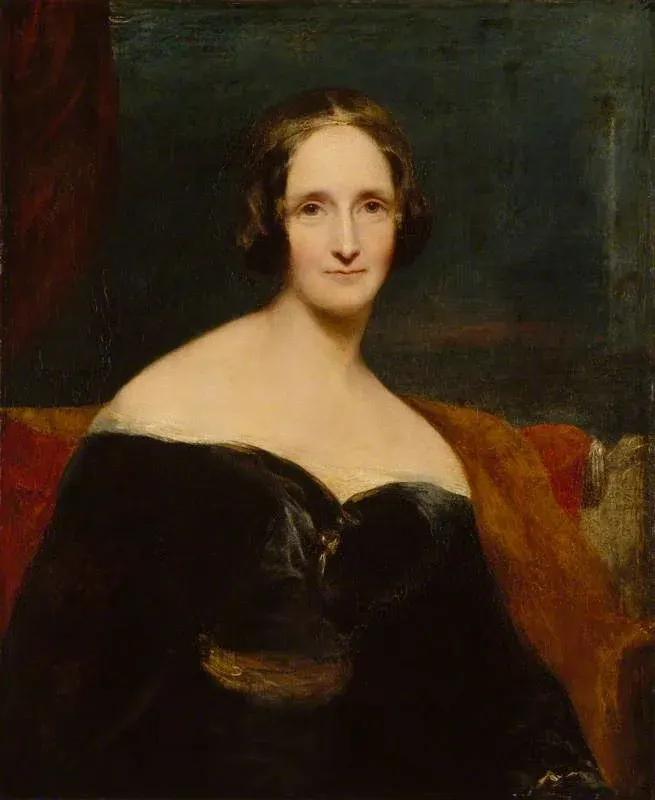 Mary Shelley (painted by Richard Rothwell, 1830s) · Public domain · Wikimedia Commons
Here, "Shelley" is her husband, Percy Bysshe Shelley. The first passage concerns the length of the story. In Mary Shelley's own words, it was her husband's urging that served as the occasion for turning a short tale into a long novel.
I certainly did not owe the suggestion of one incident, nor scarcely of one train of feeling, to my husband, and yet but for his incitement, it would never have taken the form in which it was presented to the world. — Mary Shelley, Frankenstein, introduction to the 1831 edition
The second passage speaks of two directions at once: the claim that she did not owe the suggestion of an incident to her husband, nor scarcely any train of feeling, and the admission that the form of the book would not have come forth without him. On the side of feeling, she herself attached the qualification "scarcely."
From this declaration I must except the preface. As far as I can recollect, it was entirely written by him. — Mary Shelley, Frankenstein, introduction to the 1831 edition
The preface spoken of in the third passage is the short preface attached to the 1818 first edition, which is a different piece of writing from this preface Mary Shelley wrote in 1831. She herself attached the qualification "As far as I can recollect." If we put the three passages together, the share Mary Shelley sketched for her husband is this: the person who urged her to write at length, the person who gave neither the suggestion of incidents nor almost any train of feeling, and the person who wrote the first-edition preface, as far as she could remember. This picture is a memoir written by the person involved thirteen years after the first edition came out, and by then, her husband had already passed away.
In the same preface, Mary Shelley explains that what she revised between the 1818 edition and the 1831 edition was the polishing of the style (DOI: 10.7551/mitpress/9780262533287.003.0004). The bibliographic compilation by Hogle is different. According to Hogle's arrangement, the 1831 edition altered the novel in key passages, and some critics view those revisions as having made the novel less radical (DOI: 10.1353/hlq.2020.0030). The place where the party's words and the researcher's collation diverge lies right within this preface as well. Therefore, even the passage declaring "I did not owe" is best taken simply as one person's account until checked against the manuscript.
There is one more countable clue in the preface. Mary Shelley writes that she began writing with the words "It was on a dreary night of November." That sentence is in the main text of both editions.
It was on a dreary night of November, that I beheld the accomplishment of my toils. — Mary Shelley, Frankenstein, 1818 first edition, vol. 1, ch. 4
Yet this sentence is not the first sentence of the book. In the 1818 first edition, after four letters and three chapters have passed, it is the first sentence of Volume 1, Chapter 4. In the 1831 edition, it is the first sentence of Chapter 5. To the two orders dealt with in "How Stories Are Built — The Order Things Happen and the Order They Are Told", one more is added here: the order set down by the author. If we are to believe Mary Shelley's words, the sentence she wrote first is met by the reader only after a long stretch of reading.
Two Pairs of Hands Left in the Manuscripts
In 2004, the Bodleian Library purchased the Shelley family papers (DOI: 10.1353/hlq.2020.0030). A 2015 chapter addressing the authorship of Frankenstein notes that the most crucial evidence in this debate is the manuscripts (DOI: 10.1002/9781118843109.ch25). The same text adds that the contents of the manuscripts were difficult to grasp properly, and a credible account could only come from an expert deeply familiar with both writers' papers (DOI: 10.1002/9781118843109.ch25). Saying that the manuscripts are evidence also means that there must be someone to read them out.
A draft is a manuscript written by hand before being published as a book. The draft of Frankenstein survives in notebooks, and that manuscript also contains the shares added by Percy (DOI: 10.4324/9781315555294-7). To separate the two shares, transcription must come first. Transcription is the task of reading a handwritten manuscript character by character and copying it into print.
The person who did that work is Charles E. Robinson, a professor emeritus of English at the University of Delaware (DOI: 10.2307/j.ctv2v55gqb). In 1996, he published The Frankenstein Notebooks, which collected the draft notebooks (DOI: 10.1353/hlq.2020.0030). His transcription distinguished and marked the share Percy added to the main text, and organized the process of writing, publishing, and subsequent reading of the novel into a detailed chronology. That 2015 chapter counts this as the first detailed chronology to appear (DOI: 10.1002/9781118843109.ch25). In 2013, the Shelley-Godwin Archive released an edition of these notebooks online as its first public offering, an edition based on Robinson's 1996 book (DOI: 10.18716/ride.a.2.5). A path was opened where one no longer had to go to the library to see the handwriting.
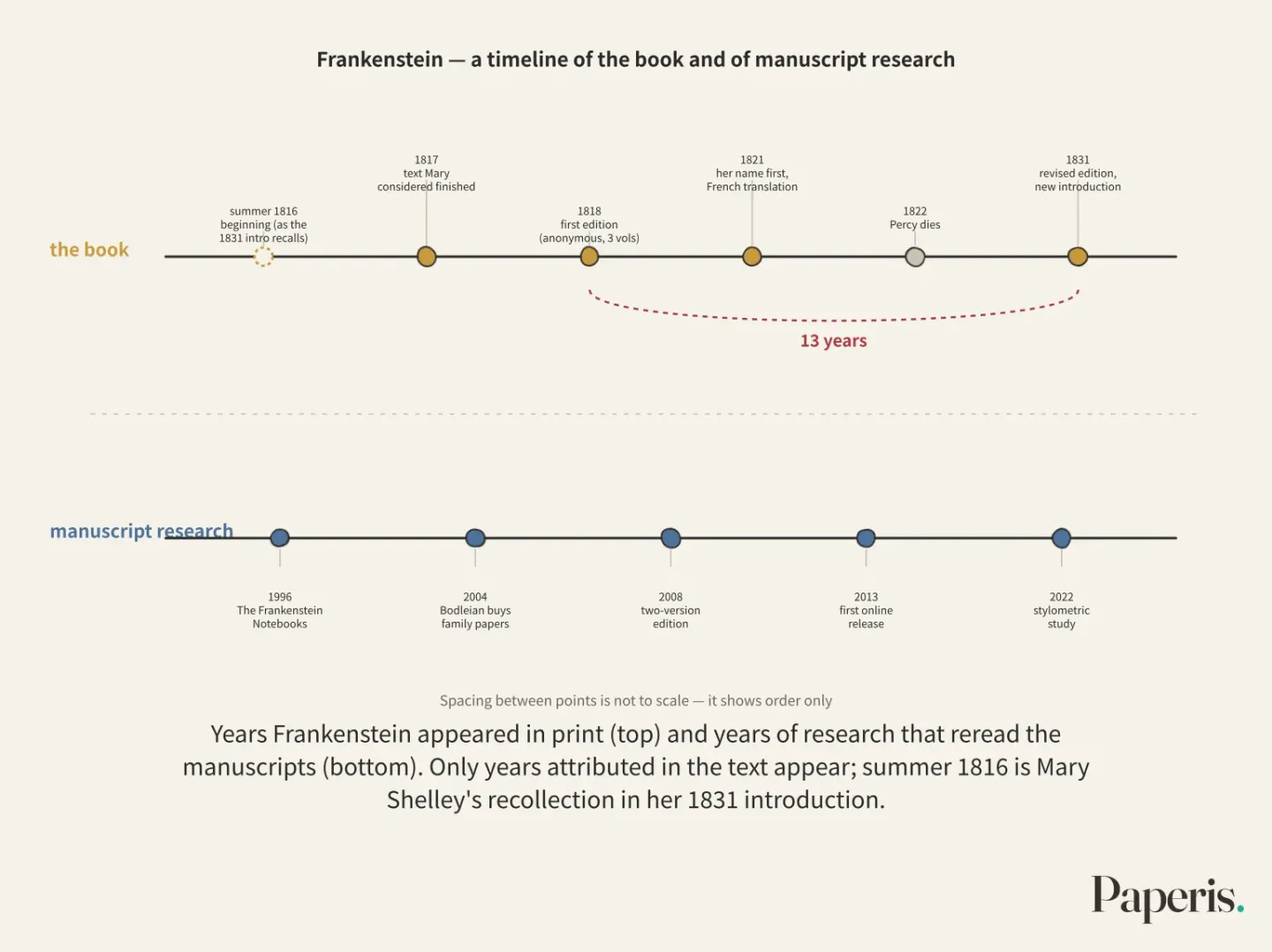
Robinson went a step further in 2008. He published The Original Frankenstein, which drew the main text exclusively from the manuscripts. The 2015 chapter evaluates that thanks to this book, for the first time, the novel just as Mary Shelley wrote it could be read apart from her husband's interference (DOI: 10.1002/9781118843109.ch25). As Hoagwood explains, this book prints the novel twice. Once is in the form Mary Shelley is considered to have finished writing in 1817, and the other is in the form where Percy's revisions are marked in italic type. Putting these two together forms a large portion of the basis for the 1818 first-edition text (DOI: 10.1353/hlq.2020.0030).
I picture a reader opening that book. Toward the front, they read sentences that Mary Shelley is considered to have finished. Finding the same passage again toward the back, italicized letters are mixed into certain spots. Those italicized letters are the places where Percy's hand touched the work. The question "Did her husband write it?" takes on a visible shape right here.
There is also research that counts those hands. A 2016 chapter records that Percy wrote more than 4,000 words out of this novel's 72,000 words (DOI: 10.4324/9781315555294-7). Broken down, that is more than one in every eighteen words. This figure is the count from that single chapter. The verb used in that chapter is "wrote."
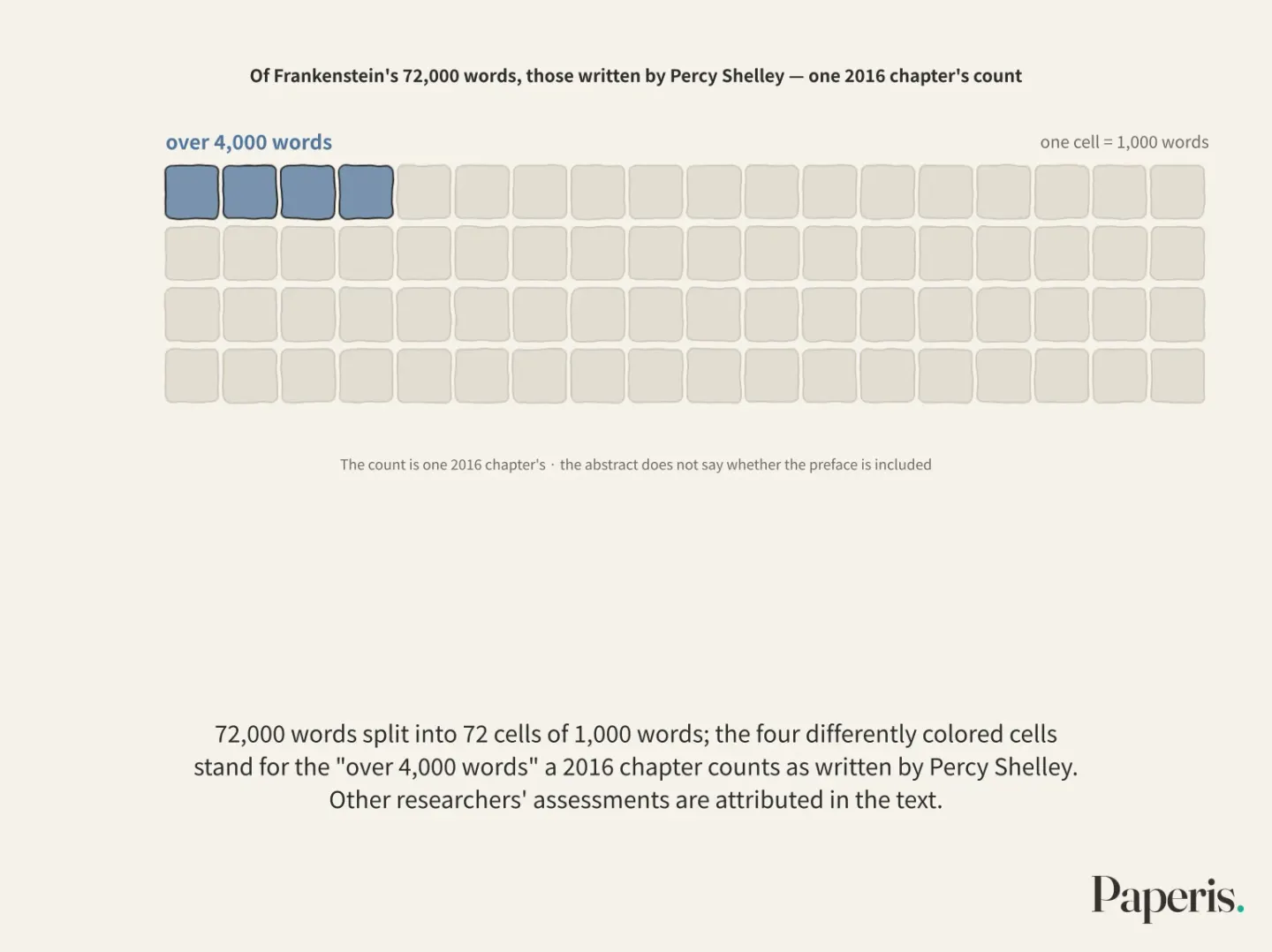
The manuscripts show that Percy's hand actually touched the main text, and a study counts the amount at over 4,000 words out of 72,000.
The Same Manuscript, Different Weights
The chapter from 2016 takes the largest view of Percy's share among the evidence this piece relies on. That chapter writes that Frankenstein can be seen as one of the most "overlooked" of Percy Bysshe Shelley's writings, and that many people would be surprised to know how deeply he was involved (DOI: 10.4324/9781315555294-7). According to the same chapter, Percy also wrote an anonymous review of his wife's anonymously published novel (DOI: 10.4324/9781315555294-7).
There are also writings pointing in the opposite direction. The chapter from 2015, which earlier named the manuscript as the most important evidence, calls "Percy Bysshe Shelley wrote Frankenstein" a "myth" to be shattered right in its title (DOI: 10.1002/9781118843109.ch25).
There are assessments that state no direction. In a 2020 literature review, Hogle evaluates that Robinson's 2008 edition provided an answer to the old question of "how much Percy added and what he changed" (DOI: 10.1353/hlq.2020.0030). Whether that answer views Percy's share as large or small does not appear in this abstract.
There are also answers that come from outside the manuscript. Stylometry is a method that uses a computer to count the habits of word usage left in a text, gauging who wrote it. A study from 2022 applied this method to Frankenstein and concluded that the evidence that Mary Shelley was the author is very strong, and the possibility that Percy played a large role in composing the text is very low (DOI: 10.1093/llc/fqac061). The authors write that this result matches the mainstream view in academia, and state that they are the first to use stylometry on this question (DOI: 10.1093/llc/fqac061). It is a single study, and "first" is the authors' own word.
The calculation that Percy wrote over 4,000 words and the conclusion that the possibility of his playing a large role in composing the text is very low can logically stand together on top of a single novel. What differs is the language used to call Percy's share. The 2016 chapter calls it a surprisingly deep involvement, the 2015 chapter calls "Percy wrote it" a myth to be broken, and the 2022 study views the possibility of a large role as very low. How largely to view Percy's hand as shown by the manuscript differs by researcher, and this piece does not adjudicate that weight.
The very method of reading the manuscript is also a matter of dispute. The draft dealt with in a 2001 paper is contained in Notebook A and Notebook B. This paper suggests that Robinson's book may have presented the order of writing incorrectly. It is easy to think that Notebook A, which contains about the first half of the novel, came first, but this paper argues that there is considerable evidence on the side of Notebook B having generally been written first, with Mary Shelley returning later to rewrite the first half into Notebook A (DOI: 10.1353/esc.2001.0006). The order of writing is contested even for the same notebooks. The manuscript is the most important evidence, but even that evidence only speaks when someone reads it and establishes the order.
Placing Three Passages of the Preface Beside the Manuscript
Now we place three passages written by Mary Shelley in her 1831 preface side by side with what manuscript research has brought to light.
The first passage says that she thought of a short, few-page story and extended it at her husband's urging. The 1818 first edition was in three volumes, and a 2016 chapter counts this novel at 72,000 words (DOI: 10.4324/9781315555294-7). If it was a story conceived as a few pages, as Mary Shelley says, the book shows that the story grew that much. The part that led that growth was her husband's urging is Mary Shelley's word, and among the evidence this piece leans on, there is no sentence independently confirming that urging in the manuscript.
The second passage says that she did not owe the suggestion of one incident to her husband, nor scarcely of one train of feeling. The units being measured diverge here. What Mary Shelley speaks of is the conception—that is, the source of what happens and what characters feel. What the 2016 chapter counts is words. The calculation that Percy wrote over 4,000 words does not state in its abstract whether those words brought in new events or rewrote passages already there. Therefore, that count alone does not settle whether Mary Shelley's second passage is right or wrong. The conclusion spoken of by the abstract of a 2022 study also concerns a role in "making" the main text, and says nothing about the source of the conception (DOI: 10.1093/llc/fqac061).
The third passage says that her husband wrote the preface to the first edition. The preface to the 1818 first edition speaks in the first-person "I" as the author. This preface was carried over into the 1831 edition, and ends with a date of September 1817. If Mary Shelley's word is true, the owner of these sentences written in the author's "I" is her husband. The primer "Speaker and Point of View — "Hearken!": A Voice That Begs to Be Believed" stated that the voice within a poem cannot be assumed to be the same person who wrote the poem. A preface is not a poem, but here the author herself recorded that a piece of writing speaking in the author's "I" was written by someone else. Whether this preface is included in the 4,000 words counted by the 2016 chapter does not appear in the abstract.
The dates of the two editions also enter into this comparison. Much of the 1818 first edition text is based on both the manuscript Mary Shelley is thought to have written entirely and the manuscript containing Percy's revisions (DOI: 10.1353/hlq.2020.0030). The revisions in the 1831 edition have a title page stating it is the author's, and her husband had passed away nine years prior. When asking "How much of Percy's hand is in it?", which edition one opens becomes part of the question.
How Far Does the Tale of "A Wife's Work Credited to Her Husband" Go?
A 2005 paper opens with an observation by Mary Shelley scholar Betty T. Bennett. It notes that, until recently, scholars have largely viewed Mary Shelley as a "product" shaped by her parents, William Godwin and Mary Wollstonecraft, and her husband. This paper records that Mary Shelley has traditionally been treated as an appendix to the literary careers of her parents and her husband (DOI: 10.2307/25601727). It also criticizes biographies that compress her twenty-nine years of life and writing after her husband's death into a barren period (DOI: 10.2307/25601727).
This paper goes a step further, reading the 1831 introduction itself as upholding the myth of the "silent woman." It argues that the introduction weaves a passive pattern both in its sentence structure and in the way it depicts relationships with those close by (DOI: 10.2307/25601727). This researcher reads the very same introduction—from which the earlier passage about not owing the suggestion of incidents to her husband is borrowed—as a piece where the author diminishes herself. Two readings emerge from the same piece of writing.
A 2022 stylometric analysis study also notes that "politics" has traditionally accompanied this question, stating that their analysis serves as an objective basis for detaching the question from a part of it (DOI: 10.1093/llc/fqac061). However, the abstract does not spell out what that "politics" is. In the evidence this article relies upon, there is no sentence directly connecting the claim that "Percy wrote it" to a condescending view of female writers. The scope of what the evidence states reaches only as far as the critique of research history showing that Mary Shelley was long treated as an appendix to her parents and husband.
Editing also flowed in the opposite direction. After Percy died, it was Mary Shelley who gathered and published his writings. She published a volume of her husband's posthumous poems in 1824, and two editions of his collected poems along with collections of prose and letters in 1839 (DOI: 10.1093/oso/9780195077407.003.0003). According to a 1993 chapter discussing this work, she sought to present her husband's writings to the "world" as correctly as possible, lessening the impression that his writing was hard to understand and calming controversies surrounding his conduct and political views (DOI: 10.1093/oso/9780195077407.003.0003). The same chapter sees her as having placed herself in the position of the ideal reader who best understood the poet as an editor (DOI: 10.1093/oso/9780195077407.003.0003). The husband's hand touched the wife's manuscript, and the husband's books were compiled by the wife's hand.
What We Still Do Not Know, and the Shape of the Question
A few loose ends remain based on the evidence this article relies on. As we saw earlier, the abstract does not state whether the 4,000 words include the preface, nor does it show whether the manuscript separately reveals her husband’s urging. A 2001 article challenged Robinson's account of which notebook, A or B, was written first (DOI: 10.1353/esc.2001.0006), and the evidence this piece relies on contains no sentence stating how that matter was subsequently settled. Nor does the abstract examined here tell us whether stylometric analysis can detect the tuning of just a few words.
The shape of the question has changed too. Authorship is the idea of whose work a piece is, and whose hands and mind it came from. A 2018 article argues that the romantic conception of authorship dominant in the early nineteenth century featured individuality, originality, and a unified whole (DOI: 10.1093/fmls/cqy018). The question "Who wrote this?" expects a single person's name. The answers produced by manuscript studies are finer-grained than that. The author line of the 2008 Robinson edition listed in Hoagwood's bibliography reads "Mary Wollstonecraft Shelley, with Percy Bysshe Shelley" (DOI: 10.1353/hlq.2020.0030). Robinson's work is credited with raising awareness of the subtle textures of writing and editing (DOI: 10.2307/j.ctv2v55gqb). Manuscript studies break the answer down into "Who did what?", while a 2022 study answers "Who is the author?" Both questions now stand side by side.
Three things are worth taking away. In the introduction written thirteen years after the first edition, Mary Shelley noted that she did not owe the suggestion of any incident to her husband, nor scarcely any train of feeling; that her husband urged her to write at greater length; and that, as far as she could recollect, the preface to the first edition was entirely written by him. Percy's contributions to the manuscript are real, and one study counts their volume at over 4,000 words out of 72,000. How large one considers those interventions varies by researcher, and one stylometric study leans heavily toward Mary Shelley. To the question "Did the husband write it?", manuscript studies answer with a list of who touched which parts.
Source Papers
- "Did Mary Shelley write Frankenstein? A stylometric analysis" (2022) — DOI: 10.1093/llc/fqac061 — Published anonymously in 1818; Mary's name first appeared on the 1821 French translation. Using stylometric analysis, it concludes that the evidence of Mary's authorship is very strong and that it is very unlikely Percy played a major role in writing the text, aligning with the mainstream view and (the authors claim) being the first application to this question.
- "Myth 25: Percy Bysshe Shelley wrote Frankenstein" (2015) — DOI: 10.1002/9781118843109.ch25 — The most important evidence for the authorship question is the manuscript. Robinson's transcription distinguishes Percy's share and yields the first detailed chronology, enabling readers to read Frankenstein in the original form Mary wrote via The Original Frankenstein.
- "Percy Bysshe Shelley's Text(s) in Mary Wollstonecraft Shelley's Frankenstein" (2016) — DOI: 10.4324/9781315555294-7 — Percy wrote over 4,000 out of 72,000 words; one of Percy's most overlooked pieces of writing; the extent of his involvement will surprise many; Percy's anonymous review.
- "The Shelley-Godwin Archive: the edition of Mary Shelley's Frankenstein Notebooks" (2014) — DOI: 10.18716/ride.a.2.5 — First released in 2013, based on Robinson's 1996 printed edition.
- "Introduction to Frankenstein (1831)" (2018) — DOI: 10.7551/mitpress/9780262533287.003.0004 — Content of the 1831 preface: answering repeated questions; the summer of 1816 and Byron's proposal; Percy's contributions; explaining the 1831 revisions solely as stylistic touch-ups.
- "The 1816–17 Frankensteins: An Alternative Reconstruction of Their Composition" (2001) — DOI: 10.1353/esc.2001.0006 — Challenging the composition order of the Robinson edition; substantial evidence points to Notebook B largely coming first and the front half being rewritten in Notebook A.
- "Important Recent Scholarship on Frankenstein: A Bibliography of the Last Decade" (2020) — DOI: 10.1353/hlq.2020.0030 — The 1831 edition changed the third edition, the 20th-century standard text, and key passages; advocacy for the 1818 text since 1973; the Bodleian acquisition in 2004; Robinson's 2008 edition (with Percy's revisions italicized) evaluated as having solved a longstanding question.
- "Frankenstein and STEAM: Essays for Charles E. Robinson" (2022) — DOI: 10.2307/j.ctv2v55gqb — Robinson (professor emeritus of English at the University of Delaware) shifted his research to The Frankenstein Notebooks and heightened attention to the textures of writing and editing.
- "Editorial Privilege: Mary Shelley and Percy Shelley's Audiences" (1993) — DOI: 10.1093/oso/9780195077407.003.0003 — Mary positioned herself in the seat of the ideal reader by compiling the 1824 posthumous poetry collection, the 1839 collected poems in two volumes, and prose and letters.
- "Authoring Monsters: Mary Shelley, Edgar Allan Poe and Early Nineteenth-Century Figures of Gothic Authorship" (2018) — DOI: 10.1093/fmls/cqy018 — Characteristics of the Romantic idea of the author (individuality, originality, organic whole).
- "Mary Shelley's Editions of 'The Collected Poems of Percy Bysshe Shelley': The Editor as Subject" (2005) — DOI: 10.2307/25601727 — Continuing Bennett's observation, it criticizes how Mary was treated as an appendage to her parents and husband, reading the 1831 preface as upholding the myth of "the silent woman."
Sources (11)
- Did Mary Shelley write Frankenstein? A stylometric analysisDOI 10.1093/llc/fqac061
- Myth 25: Percy Bysshe Shelley wrote FrankensteinDOI 10.1002/9781118843109.ch25
- Percy Bysshe Shelley's Text(s) in Mary Wollstonecraft Shelley's FrankensteinDOI 10.4324/9781315555294-7
- The Shelley-Godwin Archive: the edition of Mary Shelley's Frankenstein NotebooksDOI 10.18716/ride.a.2.5
- Introduction to Frankenstein (1831)DOI 10.7551/mitpress/9780262533287.003.0004
- The 1816–17 Frankensteins: An Alternative Reconstruction of Their CompositionDOI 10.1353/esc.2001.0006
- Important Recent Scholarship on Frankenstein: A Bibliography of the Last DecadeDOI 10.1353/hlq.2020.0030
- Frankenstein and STEAM: Essays for Charles E. RobinsonDOI 10.2307/j.ctv2v55gqb
- Editorial Privilege: Mary Shelley and Percy Shelley's AudiencesDOI 10.1093/oso/9780195077407.003.0003
- Authoring Monsters: Mary Shelley, Edgar Allan Poe and Early Nineteenth-Century Figures of Gothic AuthorshipDOI 10.1093/fmls/cqy018
- Mary Shelley's Editions of 'The Collected Poems of Percy Bysshe Shelley': The Editor as SubjectDOI 10.2307/25601727