Paperis Articles
The Tale of Hong Gildong — Where Does the One Line Naming Heo Gyun Come From?
The claim that Heo Gyun wrote it begins with a single remark by the Joseon official Yi Sik; studies differ on when that remark came to be tied to the Korean-script novel we read today. One places it in the twentieth century; another finds the attribution already known in the eighteenth. In the studies this piece draws on, the dated Korean-script copies come from the mid-nineteenth century onward, and scholars disagree about the gap between the two.
Your field's papers, as audio
Pick your fields and journals — Paperis summarizes the key papers and turns them into audio. Listen on your commute.
Start Paperis free →The Tale of Hong Gildong — Where Does the One Line Naming Heo Gyun Come From?
Hong Gildong, Who Could Not Call His Father Father
The Tale of Hong Gildong is a novel written in Hangul during the Joseon dynasty, commonly known to be the work of the mid-Joseon civil official Heo Gyun. The protagonist Hong Gildong is a son born between the high minister Lord Hong and the maid Chunseom. Therefore, he cannot call his father father, nor his brother brother. In a book transcribed on Wikisource, Gildong laments before his father Lord Hong like this:
"My lifelong sorrow is this: by your lordship's own spirit I was born a proper man, and deep is the grace of being begotten and raised, yet I may not call my father 'father,' nor my brother 'brother'—how can I call myself a person?"
(Original: “쇼인이 평ᄉᆡᆼ 셜운 바ᄂᆞᆫ, 대감 졍긔로 당당ᄒᆞ온 남ᄌᆡ 되여ᄉᆞ오니 부ᄉᆡᆼ모휵지은이 깁ᄉᆞᆸ거ᄂᆞᆯ, 그 부친을 부친이라 못ᄒᆞ옵고, 그 형을 형이라 못ᄒᆞ오니 엇지 사ᄅᆞᆷ이라 ᄒᆞ오리잇가.”)
— "The Tale of Hong Gildong" (Wikisource transcription, no author named; translated by Paperis)
Many people learned this novel at school as "the first Hangul novel written by Heo Gyun." In the phrasing of one study, it is a work "written by Heo Gyun around 1600 and evaluated as the first Hangul novel" (KCI ART002619469), and throughout the 20th century, the authorship of Heo Gyun was regarded as an almost unshakable fact (DOI: 10.15752/itkc.66..202403.37). Yet the Wikisource transcription transcribed above bears no indication of an author. This article is written around the discussions that Korean classical literature researchers have waged over the author of this work.
That single line learned at school actually bundles three claims together. Heo Gyun wrote it, he wrote it in Hangul, and it is the first. "The first Hangul novel written by Heo Gyun" is a sentence binding three claims into one, and the three claims must be examined separately. This article sets out by tracing the source of the first claim.
A Single Line Recording "Heo Gyun Wrote It"
The earliest record pointing to Heo Gyun as the author is a passage left by the Joseon scholar-official Yi Sik (1584–1647). Yi Sik was a prominent stylist who held high office, and his collected writings, Taekdang-jip, were published in 1674 and reprinted several times in the late Joseon period. In those collected writings is the passage "Heo Gyun wrote The Tale of Hong Gildong" (DOI: 10.15859/yscs..36.201212.381). A 2024 study notes this same record as appearing in the Taekdang-byeoljib (Supplementary Collection of Taekdang), summarizing it as the first recorded mention of the title The Tale of Hong Gildong and the earliest record naming Heo Gyun as the author (DOI: 10.15752/itkc.66..202403.37). The theory of Heo Gyun's authorship starts from a single passage left by the Joseon scholar-official Yi Sik. No writing by Heo Gyun himself stating that he authored this novel appears in the sources this text relies upon.
A 2012 study views the connection of this passage to the Hangeul novel we know today as a twentieth-century development. For a long time, the field of Korean literature cited Kim Tae-jun's "History of Korean Fiction," serialized in the Dong-A Ilbo in 1930, as the earliest statement naming Heo Gyun as the author, but according to this study, earlier in 1927, Keijō Imperial University professor Takahashi Tōru cited the Taekdang-jip and identified Heo Gyun as the author. The same study notes that among the Joseon-era readers of the Taekdang-jip, “not a single person” said the author of the Hangeul novel was Heo Gyun, yet Takahashi “linked” the two and named Heo Gyun the author (DOI: 10.15859/yscs..36.201212.381). If this study is correct, the link establishing that the title in the record and the Hangeul novel we read today are the same work originated with a twentieth-century scholar's connection.
A 2024 study presents a different picture of the earlier eighteenth century. This study confirms that the eighteenth-century scholar Hwang Yun-seok knew of "The Tale of Hong Gildong," which was similar in content to the Hangeul novel, and even knew the theory that Heo Gyun was its author. Yet Hwang Yun-seok could find no reliable basis for the record in the Taekdang-byeoljib (DOI: 10.15752/itkc.66..202403.37). Placing the two studies side by side, while people in the eighteenth century had heard the theory, no Joseon-era person who accepted and stated that theory appears in the sources this text relies upon. Even the eighteenth-century scholar who heard the theory could not verify its basis.
The 2024 study also examines Yi Sik, the man who left the record. This study verifies circumstances from "Seohu-japrok," written by Yi Sik in 1637: Yi Sik was close to figures around Heo Gyun, felt a deep sense of crisis during the "Case of the Seven Sons"—in which seven children of concubines were implicated—and Heo Gyun's treason incident, and had to struggle until 1637, the year he wrote that text, to deny his connections to Heo Gyun and the seven sons. That passage in the Taekdang-byeoljib also records a story that Heo Gyun and his close friends enjoyed calling each other by the nicknames of the bandits from Water Margin, but this study raises doubts about the credibility of that story as well, citing points that make it doubtful whether Heo Gyun truly enjoyed reading Water Margin (DOI: 10.15752/itkc.66..202403.37). Along with these circumstances, this study concludes that no grounds can be found at present to believe the record.
The theory of Heo Gyun's authorship was also used outside the country. Marshall Pihl's English translation published in the Korea Journal in 1968 is known as the first annotated English translation of "Heo Gyun's The Tale of Hong Gildong," and the book he translated was the 24-leaf Gyeong-pan edition, which will be discussed later (DOI: 10.22844/its.2020.24.4.97). The fact that a record exists and the fact that the The Tale Of Hong Gildong in that record is the same book as the Hangeul novel we read today are two separate issues.
When Were the Books We Read Written?
The Tale of Hong Gildong survives in many books. Wikisource alone features a 30-leaf Gyeong-pan edition and a 36-leaf Wan-pan edition separately, and researchers compare far more books than that. Variant versions (ibon) are the various individual books that arose when the same work underwent slight textual changes while being copied and carved. A single 2022 study comparing the variant versions of The Tale of Hong Gildong through digital analysis dealt with eight variant versions (DOI: 10.15822/skllr.2022.50.4.221).
Variant versions get their names from how they were made. Handwritten copies (pilsabon) are books that people copied out by hand. Commercial woodblock editions (bangjakbon) are books printed by carving text into wooden blocks to sell them.
The Gyeong-pan edition is a commercial woodblock edition printed in Seoul, and the Wan-pan edition is a commercial woodblock edition printed in Jeonju. The "30-leaf" and "36-leaf" after the names indicate how many leaves the book has. The Jeonju Wan-pan 36-leaf edition was printed multiple times while the same blocks were modified and recarved, and there are studies that compare the appearance of the blocks among printed books to guess the order in which they were printed (KCI ART002832835).
Rental copies (sechaekbon) are books copied and made by rental shops—stores that lent books for a fee—in order to lend them out. Rental copies of The Tale of Hong Gildong were produced differently according to the shop's operations and the readers' tastes, and were rented out accordingly (KCI ART002905378).
The book from which Gildong's lament was quoted earlier is the 30-leaf Gyeong-pan edition on Wikisource. The two variant versions on Wikisource differ starting from the very first sentence. The 30-leaf Gyeong-pan edition begins like this:
Now, in the days of King Sejong of Joseon, there was a high minister (original: 화셜 됴션국 셰종됴 시졀의 ᄒᆞᆫ ᄌᆡ샹이 이시니)
— "The Tale of Hong Gildong" (30-leaf Gyeong-pan edition; translated by Paperis)
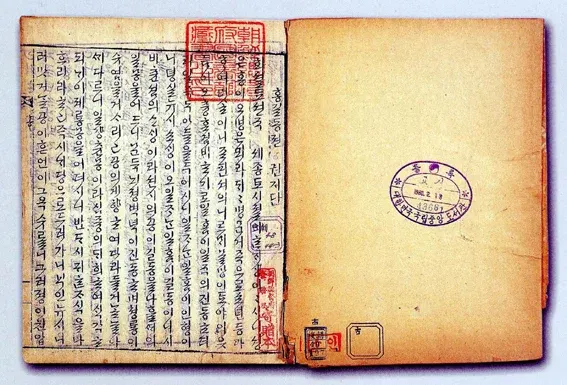 Opening page of one edition of "The Tale of Hong Gildong" (facing page stamped by the National Library of Korea) · Public domain · Wikimedia Commons
The opening word, hwaseol ("Now"), is the word old Korean novels used to begin a story. The Wikisource Wan-pan 36-leaf edition lacks this expression and starts with a different sentence. If we count the letters while removing spacing exactly as in the Wikisource transcription, the Wan-pan 36-leaf edition is about one-third longer than the Gyeong-pan 30-leaf edition. Although this is a rough estimate that counts Old Hangul letters separately, it is clear that even for the same story, the length differs from book to book. The scene where Gildong laments to his father appears in both variant versions, but the words are different. Throughout the entire book, the exact phrase "'brother'—how can I call myself a person" appears three times in the Gyeong-pan 30-leaf edition and twice in the Wan-pan 36-leaf edition. There are also passages where the same sorrow is written down in different words, so we cannot compare the weight of the two books by this count.
Then, when were these books made? A 2021 study comparing three rental copies established that the Joyong-eop copy was copied and circulated in 1850, the Jeong U-rak copy in 1876, and the Toyo Bunko copy in 1901, and revealed that variant versions from earlier periods contain content closer to the "original text" (DOI: 10.33639/ptc.2021..37.015). Interpreting the findings based on previous research, the aforementioned 2022 digital analysis placed the fluid Gyeong-pan edition (1847) and the Joyong-eop copy (1850) into two lineages of branches, and the Wan-pan 36-leaf edition in the year 1857 (DOI: 10.15822/skllr.2022.50.4.221). A 2022 study that newly identified the Hyangmok-dong rental copy confirmed that the Kim Dong-uk 89-leaf copy, which has been evaluated as a good variant among the variants, is a book copied based on the Hyangmok-dong rental copy lineage (KCI ART002905378).
An archetype (mobon) is an earlier book that multiple variant versions trace back to in common, and is what researchers infer by comparing variant versions. The digital analysis study speculates that the archetype of The Tale of Hong Gildong likely had different writing styles in its front and rear sections (DOI: 10.15822/skllr.2022.50.4.221). Regarding what kind of book that archetype was, the study dealing with the Hyangmok-dong rental copy considers that the rental copy and the Gyeong-pan 30-leaf edition branched off from a single archetype, and that that archetype was highly likely a rental copy (KCI ART002905378). A 2021 study addressing the production dates of rental copies considers that the Toyo Bunko copy, a later rental copy of The Tale of Hong Gildong, was influenced by the Gyeong-pan 30-leaf edition, and notes that it is inappropriate to discuss rental copies in general using this Toyo Bunko copy (DOI: 10.33639/ptc.2021..37.015).
Among the Hangul variant versions of The Tale of Hong Gildong whose dates have been pinned down in the studies this article relies on, the earliest is 1847. The span between 1647, when Yi Sik—the source of the authorship theory—passed away, and 1847 is 200 years.
Two Timelines
If we lay out the facts that have appeared so far in two lines, we can see where this debate takes place.
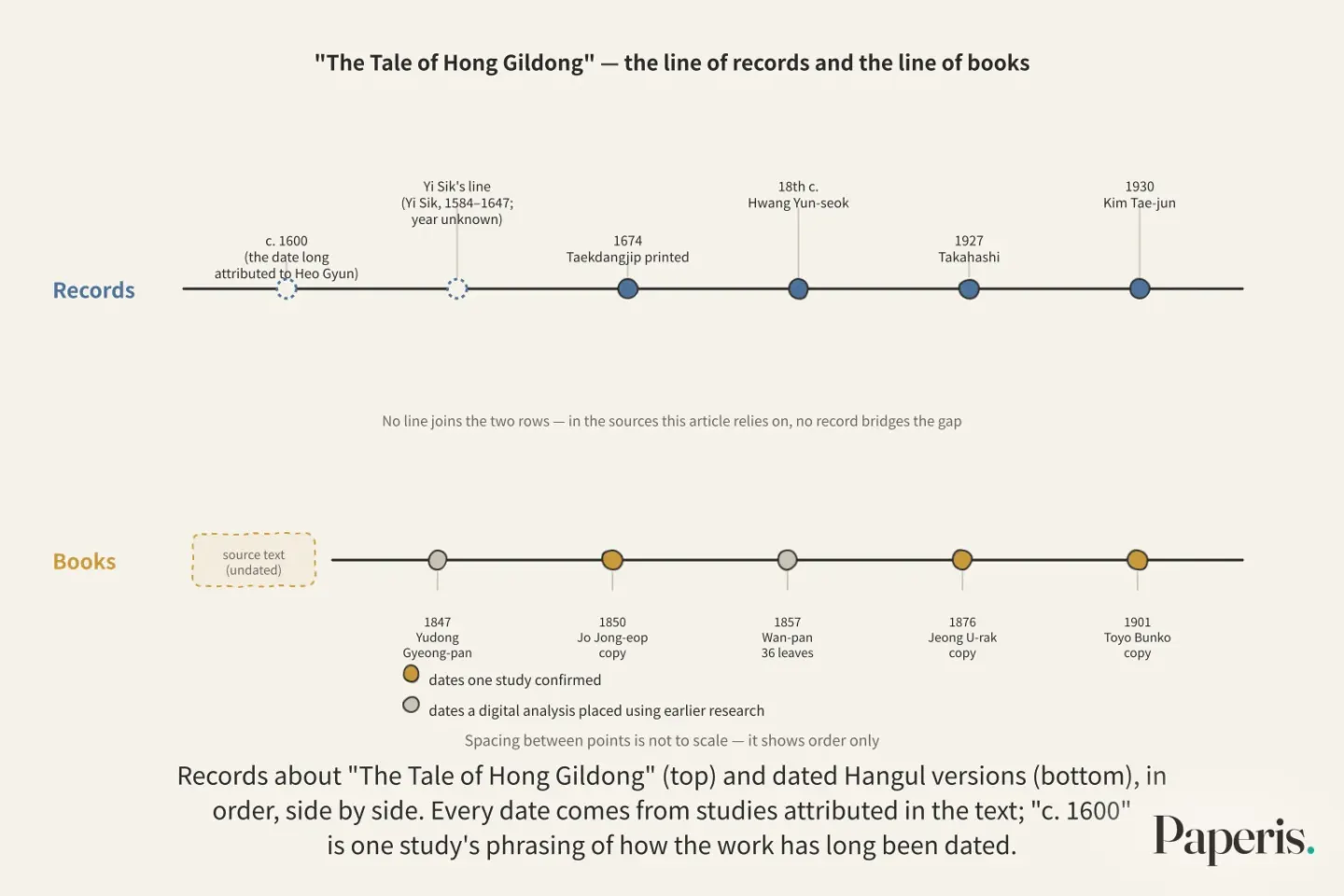
The upper line is the line of records about the author. It begins around 1600, at the point when the work has been evaluated as authored by Heo Gyun, passes through a single passage left by Yi Sik, and the collected writings containing that passage are published in 1674. In the 18th century, Hwang Yun-seok knew of the theory that Heo Gyun was the author, but could find no grounds to believe it. Then, in 1927, Takahashi Tōru and, in 1930, Kim Tae-jun connect that passage to the vernacular novel.
The lower line is the line of the books. There is a parent text guessed at by researchers, followed by the 16-leaf Yudo Gyeong-pan edition of 1847, the 1850 Chojong-eop edition, the 1857 Wan-pan 36-leaf edition, the 1876 Jeong U-rak edition, and the 1901 Toyo Bunko edition. The 30-leaf Gyeong-pan edition that we read on Wikisource also sits somewhere on this line.
Both lines share the title The Tale of Hong Gildong. However, the upper line has no main text of the novel, and the evidence this essay relies on contains no discussion of the authorship notation in the books on the lower line. Whether the The Tale of Hong Gildong on the upper line is the same work as the books on the lower line, and if it was the same work, whether it was in Korean or Classical Chinese, is written nowhere on either line. The blank space between the two lines is where this debate unfolds. Researchers fill in that blank space in different ways.
Where Researchers Differ
The stance of academia is broadly divided into three camps. The first is a total affirmation—"The extant The Tale of Hong Gildong is a Hangeul novel written by Heo Gyun"—the second is a total denial—"The Hangeul novel The Tale of Hong Gildong has no relation whatsoever to Heo Gyun"—and the third is a compromise, positing that Heo Gyun likely wrote The Tale of Hong Gildong, but its wording and content would have differed from today's The Tale of Hong Gildong. These three were categorized by a 2005 study (KCI ART001838707).
Studies that posit Heo Gyun as the author seek the roots of the novel in Heo Gyun's life. A 2005 study deduces that Heo Gyun was very likely the hidden mastermind behind the treason incident of the Seven Men, and concluding that the plot elements of that incident and the narrative elements of The Tale of Hong Gildong overlap heavily, asserts that the incident closely influenced the creation of The Tale of Hong Gildong (KCI ART001119856). Whether this study goes as far as viewing Heo Gyun as having written the present Hangeul novel as is does not appear in the abstract this article relies upon.
The second camp—those who detach the Hangeul novel from Heo Gyun—is represented by a 2012 study. This study views The Tale of Hong Gildong as a typical Hangeul novel popular in the 19th century in both form and content, and its author as an anonymous urban commoner far removed from power or the yangban literati (DOI: 10.15859/yscs..36.201212.381). A 2024 study goes a step further. It concludes not only that Heo Gyun is not the author of the Hangeul novel The Tale of Hong Gildong, but that there is no valid reason to consider him a candidate for the original author of The Tale of Hong Gildong, whether as a short Classical Chinese text recording a single person's deeds or as a Classical Chinese novel (DOI: 10.15752/itkc.66..202403.37).
The third camp assumes that an original work by Heo Gyun existed while guessing at its shape. A 2013 study took inspiration from the fact that the method of titling The Tale of Hong Gildong resembles other jeon written by Heo Gyun. A jeon (전, 傳) is a genre of Classical Chinese writing that records the deeds of a single real person. Because the people Heo Gyun wrote about as jeon were all historical figures verified by historical materials, this study views Heo Gyun's The Tale of Hong Gildong as a jeon and infers that it would have contained five narrative elements: children of concubines, family murder, seizing a Buddhist temple, seizing a government office, and Yuldok Kingdom (KCI ART001838707). Another study from 2020 accepts the argument that the Hangeul novel is the creation of an anonymous author from the early 19th century, while viewing Heo Gyun as the author of a Classical Chinese novel version of The Tale of Hong Gildong. One source this study relies upon is “Nohyeok-jeon”, written by Hwang Il-ho in 1626, in which Hong Gildong is portrayed as the child of a concubine and a secondary wife who coveted wealth, gathered rogues, and acted as a bandit leader who plundered wealth. This study views “Nohyeok-jeon” as showing how the story of "Hong Gildong" around 1620 was being fictionalized and legendized as it was passed down, and infers that Heo Gyun obtained more materials than that and portrayed Gildong as a positive protagonist (KCI ART002619469).
There is also evidence that all three branches must address. Another 2020 study views Gildong's desires in the novel—specifically, passing the civil service examination and ascending to a post like the Minister of War—as demands possible only after the measure in the 1st year of King Jeongjo (1777) that opened high official paths to the children of concubines, and as a feat difficult to imagine given the social conditions of Heo Gyun's lifetime (DOI: 10.17070/aeaas.2020.6.58.35). The point is that the current novel contains realities from much later than Heo Gyun's era. If this point is correct, it is difficult to view the current novel as having emerged directly from Heo Gyun's hands, yet it does not settle whether Heo Gyun's original work existed or not.
The currents of academia mapped by researchers also have a timeframe. A 2012 study noted that while old-novel researchers consider the content of The Tale of Hong Gildong to be distant from what Heo Gyun wrote, they find it difficult to state that Heo Gyun is not the author (DOI: 10.15859/yscs..36.201212.381). A 2013 study observed that the hypothesis that "the extant novel was transformed in later generations, yet bears a deep connection to Heo Gyun's The Tale of Hong Gildong" is maintained by the majority of researchers (KCI ART001838707). A 2024 study notes that opinion is coalescing around the view that the author of the currently transmitted Hangeul novel cannot be called Heo Gyun, and that the "prevailing opinion at present" is the presumption that Heo Gyun's original work was a Classical Chinese novel, and the Hangeul novel was embellished and adapted from it after the 18th century (DOI: 10.15752/itkc.66..202403.37). That study's own conclusion goes a step further than this prevailing opinion to deny Heo Gyun's status as the original author. While the current mapped by researchers has shifted toward the side that "the current Hangeul novel is not a book that came out of Heo Gyun's hands as is," whether Heo Gyun's original work existed remains divided.
When the Author Changes, the Way We Read Changes
Depending on who wrote a piece, the way we read the exact same lamentation changes.
If we place Heo Gyun as the author, the novel becomes a window to read Heo Gyun's perception of reality. Analyzing the narrative strategy of this novel, a 2013 study reads that the author thought a feudal ideal society could be achieved if the abolition of discrimination against illegitimate offspring and the exposure of corrupt magistrates to rescue the poor were realized, while also recognizing that such a society could not be achieved in the reality of Joseon. This study places Heo Gyun as that author and concludes that Heo Gyun seems to have recognized to some extent the role of the common people in the unfolding of history (DOI: 10.17247/jklle.2013..52.309). A 2005 study that looks for Heo Gyun's revolutionary consciousness in the Seven-Man Conspiracy uses the same reading method (KCI ART001119856).
This reading method rests on a single assumption. The narrator is the voice telling the story within the novel (the "Speaker and Point of View — "Hearken!": A Voice That Begs to Be Believed" primer), and the protagonist is a character inside that story. Overlapping the two with the author's voice is the reader's choice. A 2020 study pinpointing 1777 explicitly performed this overlapping read. After "assuming" that the protagonist's voice and mind reflect those of the writer Heo Gyun and organizing the protagonist's bitter grief, it confirms that the most lamentable thing in the household is not being able to call a father 'father' and a brother 'brother,' alongside the family's maltreatment. It then notes that such bitter grief is hard to find in the writings Heo Gyun left about the appointment of talented people, concluding that the gap between the two is severe and warning that this problem in the novel should not be directly linked to the theme of those writings (DOI: 10.17070/aeaas.2020.6.58.35). As counted earlier, in the 30-leaf Gyeong-pan edition, the phrase "my brother 'brother'" appears once more even after the lamentation scene. Whether or not to read that repetition as Heo Gyun's own bitter grief is precisely this fork in the road.
If we set the author as an anonymous urban commoner, the way we read changes again. A 2012 study sees the significance of The Tale of Hong Gildong in how the dreams and hopes of contemporary commoners were revealed in the work through the author's imagination, with readers of the same social stratum leaning on that imagination to dream of a new world. This study acknowledges some merit in the passion of 1930s colonial intellectuals who wanted to connect Heo Gyun to this novel to write a glorious literary history, yet concludes that the time seems to have come to return the work to its original authors and readers (DOI: 10.15859/yscs..36.201212.381).
A third reading looks at individual variant versions rather than a single author. A 2022 study comparing the 24-leaf Gyeong-pan edition and the 36-leaf Wan-pan edition argues that classical novels must be read in units of "variant versions" rather than a "work." According to this study, while content and plot alone cannot determine the chronological order between variant versions, examining language and orthography reveals markers showing time differences coexisting among the variant versions. Moreover, whereas the Gyeong-pan 24-leaf edition maintains a consistent awareness of social inequality throughout the entire work, the Wan-pan 36-leaf edition strongly reveals social desires such as achieving success and bringing honor to one's family, showing a tendency to contribute to system stability rather than system critique (DOI: 10.24008/klle.2022..39.001). The exact same lamentation becomes a passage in a different story depending on which book you read. Who we set as the author and which variant version we hold in our hands make the same lamentation a different story.
Things We Do Not Yet Know
Several things remain unsettled in the sources this article relies upon. Whether Heo Gyun truly wrote The Tale of Hong Gildong depends on how much one trusts the record left by Yi Sik, and there are both studies that say there is no ground to trust that record and studies that try to guess the original work based on it. Even if there was an original work by Heo Gyun, studies differ on whether it was a biography recording a real person's deeds or a fiction in Classical Chinese.
When the Korean-language novel The Tale of Hong Gildong first appeared is also open. The supposition of "embellishment and rewriting after the 18th century" and the argument of "creation by an anonymous author in the early 19th century" sit side by side, and the variant versions whose dates are pinned down in the studies this article relies on start from 1847. What book served as the archetype that both rental-copy books and the 30-leaf Gyeong-pan edition trace back to is only at the stage where one study has raised the possibility that it was a rental-copy book.
The ranking of "the first Korean-language novel" is something this article cannot answer. The sources this article relies on do not compare The Tale of Hong Gildong to other Korean-language novels by date. We can only say that the word "first" stands upon the premise that it was composed in Korean around 1600.
So What Did We Find Out?
We divide the first single line back into three claims. That "Heo Gyun wrote it" starts from a single phrase left by the Joseon scholar Yi Sik, and research is divided on the reliability of that phrase. That "it was written in Korean" is not confirmed in its own right, because the Korean variant dated in the research this text relies upon dates from after the mid-19th century, and what a 2024 study picks as the "leading view at present" is the presumption that Heo Gyun's original work was a classical Chinese novel. The 2024 study itself goes further, declining to see Heo Gyun even as the original author. That it is "the first" stands on the premise that it was written in Korean around 1600, so as that dating and notation waver, it wavers along with them.
So what we can say about this novel now is this. The sentence where Gildong laments that he "may not call my father 'father'" is right there in Wikisource's 30-leaf Gyeong-pan edition. Whether the person who wrote that sentence was Heo Gyun, someone who rewrote Heo Gyun's original, or an anonymous city-dweller unrelated to Heo Gyun is something researchers are arguing over with evidence. The question of the author of The Tale of Hong Gildong is a debate still ongoing between a single 17th-century record and books from the mid-19th century onward.
Source Papers
- "The Tale of Hong Gildong, Heo Gyun, and Yi Sik: The Authorship Problem of The Tale of Hong Gildong" (2024) — DOI: 10.15752/itkc.66..202403.37 — Taekdang Byeoljip contains the earliest record attributing authorship to Heo Gyun. Citing circumstantial evidence regarding the relationship between Yi Sik and people around Heo Gyun, Hwang Yun-seok's doubts, and doubts about the reliability of records related to Water Margin, it concludes that Heo Gyun is not the author of the Korean-script novel, nor does he have any reason to be mentioned as the original author. It introduces "original Classical Chinese novel → embellished adaptation after the 18th century" as the currently leading view.
- "The Genealogy of Discussions on the Authorship of The Tale of Hong Gildong" (2012) — DOI: 10.15859/yscs..36.201212.381 — The basis for the theory of Heo Gyun's creation is a passage in Taekdangjip published in 1674. The claim that Takahashi Toru linked this passage from Taekdangjip to the Korean-script novel in 1927 (predating Kim Tae-jun in 1930). The claim that it is a typical Korean-script novel popular in the 19th century and its author is an anonymous urban commoner.
- "An Inference on the Author and Contents of the Classical Chinese Novel The Tale of Hong Gildong" (2020) — KCI ART002619469 — Accepting the claim that the Korean-script novel was created by an anonymous author in the early 19th century, it views Heo Gyun as the author of the Classical Chinese novel The Tale of Hong Gildong. It confirms the transmission of the Hong Gildong story around 1620 through Nohyeokjeon (1626) and infers the content of the original work.
- "A Study on Variant Versions of Classical Fiction Using Digital Analysis Techniques: Focusing on The Tale of Hong Gildong" (2022) — DOI: 10.15822/skllr.2022.50.4.221 — Correlation and hierarchical analysis of eight variant versions. It estimates that the archetype had different styles in the first and second halves, interpreting lineages such as the fluid Gyeong-pan edition (1847) and Cho Jong-eop edition (1850), and the Wan-pan 36-leaf edition (1857).
- "A Tentative Essay on the Restoration of The Tale of Hong Gildong by Heo Gyun" (2013) — KCI ART001838707 — Organizes academic positions into three: positive, negative, and eclectic. It views Heo Gyun's Tale of Hong Gildong as a biographical record (jeon) and infers five motifs. It introduces "transformed in later times, but deeply connected" as the hypothesis of the majority of researchers.
- "The Character and Significance of the Hyangmok-dong Sachaek-bon (Rental-Book Edition) The Tale of Hong Gildong (Vol. 3): Focusing on the Relationships Among Major Variant Versions of The Tale of Hong Gildong" (2022) — KCI ART002905378 — Rental-book editions were produced and rented out differently depending on the operation of rental bookstores and readers' tastes. The rental-book edition and the Gyeong-pan 30-leaf edition derive from a single archetype (likely a rental-book edition), and the Kim Dong-uk 89-leaf edition is a handwritten copy of the Hyangmok-dong rental-book lineage.
- "Temporality and Regionality Among Variant Versions of Classical Fiction and Their Application to Korean Language Education: Centering on The Tale of Hong Gildong" (2022) — DOI: 10.24008/klle.2022..39.001 — The Gyeong-pan 24-leaf edition maintains the perception of social inequality, while the Wan-pan 36-leaf edition tends toward worldly success and regime stability. An approach centered on "variant versions" rather than "the work" is necessary.
- "Re-examining Heo Gyun's 'Yujaeron' (On Leaving Talent Unused): Also Concerning Its Relation to The Tale of Hong Gildong" (2020) — DOI: 10.17070/aeaas.2020.6.58.35 — It views the protagonist's demand for the position of Minister of Military Affairs as something possible only after the lifting of restrictions on secondary sons (se-eol) in the 1st year of King Jeongjo (1777), making it difficult to conceive during Heo Gyun's lifetime. It concludes that the gap between Heo Gyun's writings and the novel is severe.
- "The Date of Production of the Rental-Book The Tale of Hong Gildong and Its Relationship with the Gyeong-pan Edition: Centering on the 89-Leaf Manuscript, Cho Jong-eop Edition, Jeong U-rak Edition, Gyeong-pan 30-Leaf Edition, and Toyo Bunko Edition" (2021) — DOI: 10.33639/ptc.2021..37.015 — Confirms the transcription dates as 1850 for the Cho Jong-eop edition, 1876 for the Jeong U-rak edition, and 1901 for the Toyo Bunko edition, noting that earlier variant versions are closer to the original. The Toyo Bunko edition was influenced by the Gyeong-pan 30-leaf edition.
- "The Background of the Formation of The Tale of Hong Gildong: Centering on Heo Gyun's Activities and Revolutionary Consciousness" (2005) — KCI ART001119856 — Concludes that Heo Gyun was likely behind the Conspiracy of the Seven Seo, and that incident closely influenced the creation of The Tale of Hong Gildong.
- "Estimating Publication Dates by Observing Differences in Woodblock Printing Characteristics Appearing Across Variant Editions of The Wan-pan Edition of The Tale of Hong Gildong" (2022) — KCI ART002832835 — Compares block images of the Jeonju commercial woodblock Wan-pan 36-leaf edition to estimate recutting and publication chronology.
- "The Narrative Strategy of The Tale of Hong Gildong and the Author's Reality Perception" (2013) — DOI: 10.17247/jklle.2013..52.309 — Interprets that while the author (Heo Gyun) envisioned an ideal society free of discrimination against secondary sons and dedicated to relieving the poor, he recognized that this could not be achieved in the reality of Joseon.
- "An Analysis of Marshall Pihl's Translation of the Gyeong-pan Edition of The Tale of Hong Gildong" (2020) — DOI: 10.22844/its.2020.24.4.97 — Pihl's translation published in the 1968 Korea Journal is known as the first annotated English translation of "Heo Gyun's The Tale of Hong Gildong" (Gyeong-pan 24-leaf edition).
Sources (8)
- 「홍길동전」과 許筠, 그리고 李植 -「홍길동전」의 작자 문제DOI 10.15752/itkc.66..202403.37
- 홍길동전 작자 논의의 계보DOI 10.15859/yscs..36.201212.381
- 디지털 분석기법을 활용한 古典小說의 異本 硏究 –『홍길동전』을 對象으로DOI 10.15822/skllr.2022.50.4.221
- 고전소설 이본 간의 시간성·지역성과 국어교육적 활용 방안 - 〈홍길동전〉을 중심으로DOI 10.24008/klle.2022..39.001
- 허균의 〈유재론(遺才論)〉 재검토 - 〈홍길동전〉과의 연관성 문제를 겸해서DOI 10.17070/aeaas.2020.6.58.35
- 세책 〈홍길동전〉의 제작연대와 경판본의 관계 -필사본89장본, 조종업본, 정우락본, 경판30장본, 동양문고본을 중심으로DOI 10.33639/ptc.2021..37.015
- 〈홍길동전〉의 서사전략과 작가의 현실인식DOI 10.17247/jklle.2013..52.309
- 마샬 필의 〈홍길동전〉 경판본 번역 분석DOI 10.22844/its.2020.24.4.97