Paperis Articles
Motions of the Sky — A Tilted Spinning Teacup, a Lamp Lit in the Middle
Day and night come from Earth's rotation, and the changing seasonal constellations from its revolution. The seasons come from the tilted axis, the Moon's shape from the angle at which we see its lit half, and eclipses from the rare moments when the three line up.
Your field's papers, as audio
Pick your fields and journals — Paperis summarizes the key papers and turns them into audio. Listen on your commute.
Start Paperis free →Motions of the Sky — A Tilted Spinning Teacup, a Lamp Lit in the Middle
Why Does the Sun Rise in the East?
At eight in the evening, note a bright star low in the eastern sky from your balcony. If you go back out at eleven at night, that star has climbed high into the sky, and by dawn it tilts toward the west. It looks as though the star crossed the sky all night, but what moved in the meantime is us, standing on the balcony (OpenStax Astronomy 2e 2.1).
There are three repeating motions in the sky. They are the day and night that come every day, the seasons that come every year, and the shape of the moon that changes every month. Sometimes the blocking of the sun or moon also comes from these same motions. This article explains these four by how the Earth and the Moon spin and travel.
As a guide, we take along just one teacup ride at an amusement park. On a dark night, a single lamp is lit in the middle of a wide playground. A single teacup slowly travels a round path around that lamp, and while doing so, it also spins in place. This teacup travels tilted a bit to one side. The lamp is the Sun, the teacup is the Earth, and the person riding in the teacup is us.
It Is the Ground That Turns
When a teacup spins in place, a lamp moves into view in front of the rider and then vanishes behind their back, and the lights around the yard pass by in turn. The person sits still, but the outside scenery appears to be turning. The sky as seen from Earth is just like that.
This movement has a name. Axial rotation is a celestial body spinning on its own around an axis piercing its own body, and orbital revolution is one celestial body going around the circumference of another. The teacup spinning in place is rotation, and going around the lamp is revolution.
The axis of rotation is an imaginary line connecting the North Pole and the South Pole around which the Earth turns when it rotates. The Earth rotates once a day or so around this axis, which is why the Sun, the Moon, and most stars rise and set every day (OpenStax Astronomy 2e 2.1). East is the name given to the side toward which the Earth rotates (OpenStax Astronomy 2e 4.1). When the Earth turns eastward, the sky appears to turn in reverse, so things in the sky rise in the east and set in the west (OpenStax Astronomy 2e 2.1).
Near the spot where the axis of rotation reaches if extended long out toward the sky, the North Star currently sits. That is why while other stars move their positions by making large circles all night, the North Star barely moves, and seen from the middle latitudes of the Northern Hemisphere, the stars near it go around the North Star without setting (OpenStax Astronomy 2e 2.1). The star you saw from the balcony actually passed by drawing a large circle around the North Star. Day and night occur because the Earth turns on its own.
The Night Sky That Changes with the Seasons
The constellation Orion, which is easily visible on winter nights in the Northern Hemisphere, is hard to find in the summer evening sky (OpenStax Astronomy 2e 2.1). If you follow the path of a teacup circling a yard, the reason becomes clear. When the person in the teacup turns their back to a lamp, that side is night, and toward the night side, they see the scenery outside beyond the fence. While the teacup makes one full trip around the yard, the scenery on the side facing away from the lamp keeps changing.
The Earth revolves around the Sun once a year. Seen from Earth, it conversely looks as though the Sun moves a little bit eastward among the stars each day, making a full circuit of the sky in a year (OpenStax Astronomy 2e 2.1). The ecliptic is the path that the Sun traces out in the sky against the background of stars over the course of a year. During the day, the sunlight is too bright to see the stars behind the Sun. Therefore, the stars we see at night are those on the opposite side of the Sun (OpenStax Astronomy 2e 2.1). Depending on where the Earth is along its orbital path, that opposite side changes, so the stars that rise into the night sky differ from season to season.
When watched day by day, that change is very small. While the teacup makes one rotation in place, its circular path also moves forward a bit, so to face the lamp again it has to turn slightly more. On Earth, that difference is about 4 minutes a day, so by a sun-aligned clock, the same star rises about 4 minutes earlier each day (OpenStax Astronomy 2e 4.3). The one revolution a day mentioned earlier is also measured with the Sun as the standard. This small difference piles up day by day, so when the seasons change, different stars have risen into the sky at the same time.
The names used to find those stars are constellations. A constellation is one of the 88 regions into which the entire sky is divided. Having inherited the names of old drawings, modern constellations are not pictures, but areas within boundaries drawn on the sky (OpenStax Astronomy 2e 2.1).
Although the names of the constellations the ecliptic passes through are also used in astrology—which reads people by the arrangement of stars on their birthday—hundreds of statistical tests examining such astrology have all failed to find evidence of predictive power (OpenStax Astronomy 2e 2.3; DOI: 10.2466/pr0.1990.67.1.163). Constellations are addresses in the sky. The night sky changes with the seasons because the Earth orbits the Sun.
The Seasons That Distance Cannot Explain
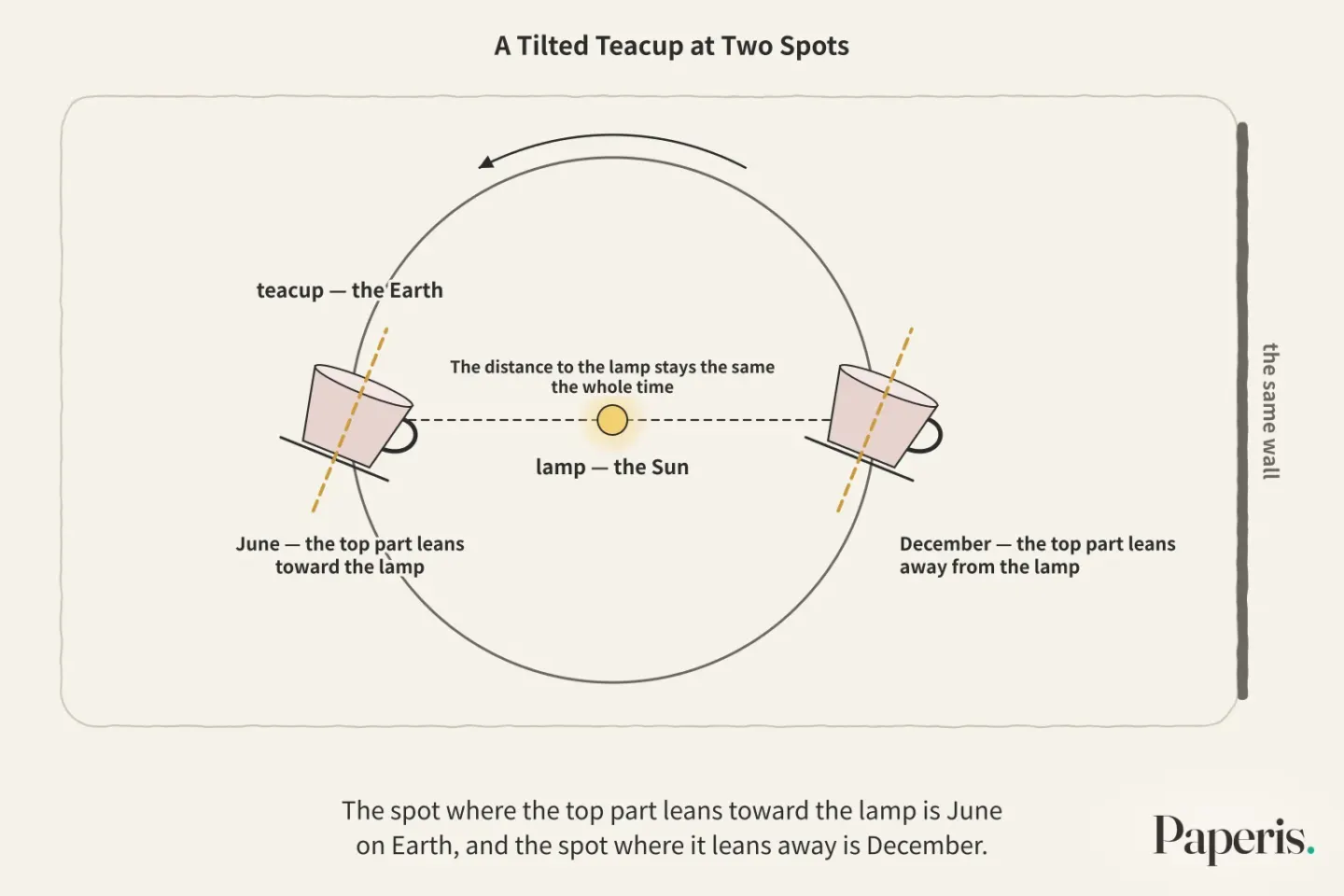
Because the teacup travels in a circular path, its distance to the lamp remains nearly the same throughout. Yet this teacup also has seasons. A commonly thought-of explanation for why summer is hot is that the Earth is closer to the Sun at that time.
In the same June, when the Northern Hemisphere is in summer, the Southern Hemisphere is in winter. If the same Earth is at the same distance from the Sun yet the seasons in the two hemispheres are exact opposites, distance cannot explain the seasons. The time when the Earth gets closest to the Sun is actually January, the dead of winter in the Northern Hemisphere, and the distance varies by only around 3% over the course of a year (OpenStax Astronomy 2e 4.2).
What makes the seasons is the 23.5-degree tilted axis of rotation. This axis points toward the same side of the sky all year long (OpenStax Astronomy 2e 4.2). That is also why the North Star does not change its position from season to season (OpenStax Astronomy 2e 4.2; OpenStax Astronomy 2e 2.1).
Looked at through the teacup, it is like this. Let us say the teacup is tilted toward the same wall of the yard at all times. On one side of the circular path, the top part of the teacup leans toward the lamp, and at the opposite side half a circle away, that same top part leans away from the lamp. The distance to the lamp stays the same the whole time, but which side faces the lamp changes. The spot where the top part leans toward the lamp is June on Earth, and the spot where it leans away is December (OpenStax Astronomy 2e 4.2).
Even outside Earth, tilt and seasons go together. Jupiter's axis of rotation is tilted by only about 3 degrees, and there is almost no difference in seasons (OpenStax Astronomy 2e 11.2). The seasons are determined by which hemisphere leans toward the Sun.
Four Days of the Year
Around June 21 every year, the Northern Hemisphere has its longest day of the year. The summer solstice is the day when the Northern Hemisphere tilts most toward the Sun, giving the Northern Hemisphere its longest day and mid-latitudes their highest midday Sun of the year. The Sun at noon on this day casts its light as vertically as possible during the year (OpenStax Astronomy 2e 4.2).
Why is it hotter when the Sun is high? A single ray of sunlight falling straight down concentrates on a narrow patch of ground, while falling at an angle spreads across a wide patch. The more it spreads, the smaller the share each patch of ground receives, warming the ground less (OpenStax Astronomy 2e 4.2). Moreover, around the summer solstice, the hours the Sun stays up are also long. Taking the United States as an example, the time the Sun is up is roughly 15 hours around June 21, and about 9 to 10 hours around December 21 (OpenStax Astronomy 2e 4.2).
The winter solstice is the day when the Southern Hemisphere tilts most toward the Sun, making the Sun rise at its lowest and the day shortest in the Northern Hemisphere. It is around December 21. On this day, the Southern Hemisphere conversely has its longest day (OpenStax Astronomy 2e 4.2). The names summer solstice and winter solstice are given based on the Northern Hemisphere (OpenStax Astronomy 2e 4.2).
Right in the middle of these two days are two positions where the teacup leans toward neither side. The vernal equinox is around March 21, the day when the Sun comes directly above the equator and day and night become nearly equal at about 12 hours each everywhere on Earth. The autumnal equinox is the day when the same thing happens again around September 21. The dates of the four days shift forward or backward by a day or two depending on the year (OpenStax Astronomy 2e 4.2).
The place where the tilt of the teacup is felt most strongly is the top and the bottom, namely the polar regions. At the North and South Poles, the Sun does not set for six months, followed by six months where it does not rise (OpenStax Astronomy 2e 4.2). The tilted axis changes the height of the Sun and the length of the day, and those two make the seasons.
Why Does the Moon Change Shape?
A crescent moon like a fingernail floats in the evening sky. A child asks, "Why Does the Moon Change Shape?"
The first thing to know is that the Moon does not shine on its own. The Moon shines by reflecting sunlight, and like any ball receiving sunlight, half facing the Sun is always bright and the opposite half is dark (OpenStax Astronomy 2e 4.5).
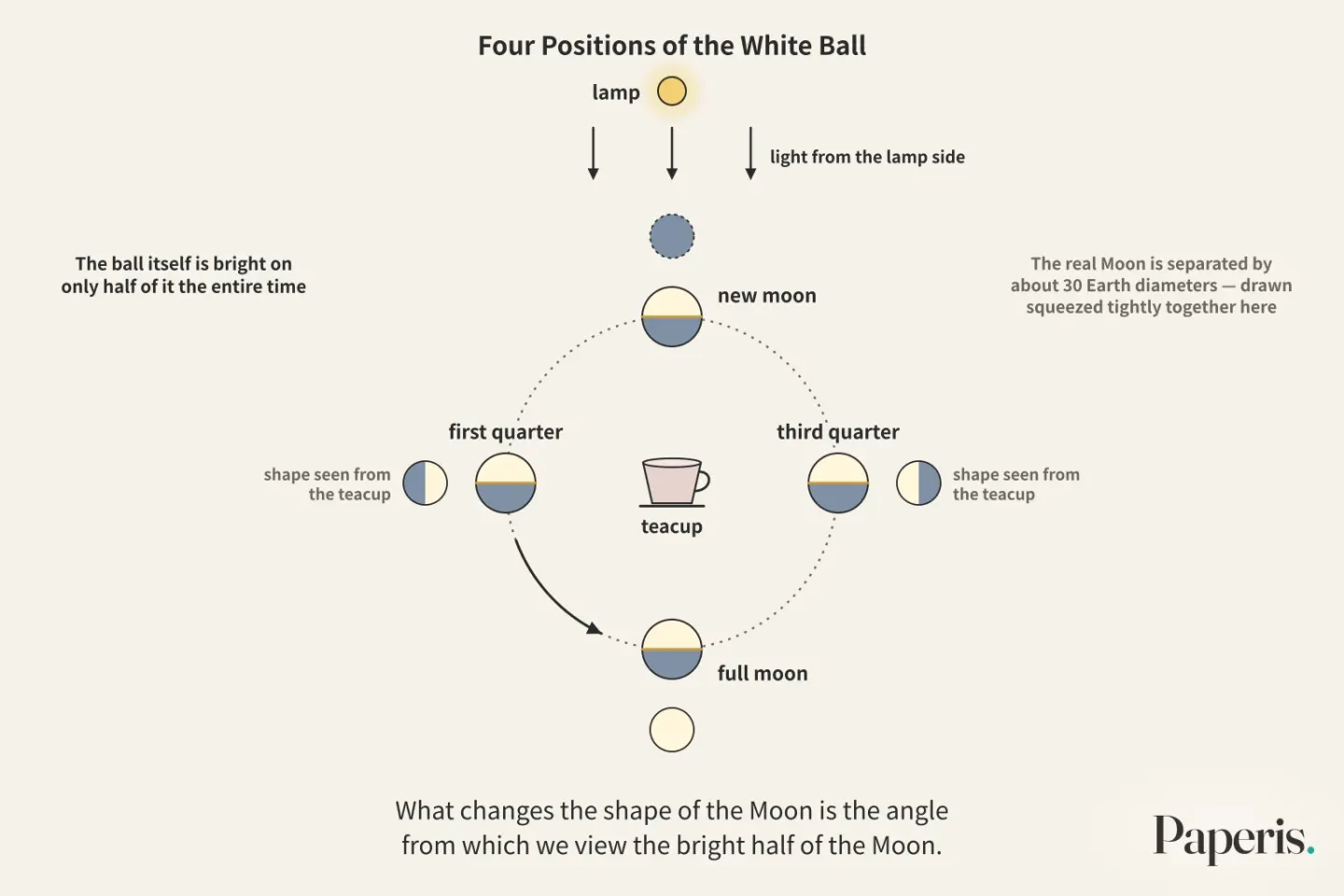
Let us imagine a white ball orbiting a teacup. Half of the ball facing the lamp is always bright. When the ball comes between the lamp and the teacup, the bright side faces the lamp, and only the dark side is visible from the teacup. When the ball goes behind the teacup, to the side opposite the lamp, the bright side is seen entirely from the teacup. The ball itself is bright on only half of it the entire time. What changes is the angle from which we view that bright half (OpenStax Astronomy 2e 4.5). Lunar phases are the shapes in which the bright part of the Moon is revealed when viewed from Earth, changing in a cycle of one month.
Let us place the white ball in four positions. The first position is toward the lamp. New moon is when the Moon is in the same part of the sky as the Sun so that its bright side faces away from Earth, at which time the Moon is not visible. The second position is to the side of the teacup. First quarter is when the Moon has orbited one-quarter of the way around Earth about a week after the new moon, becoming a half moon with half of the visible side bright.
The third position is behind the teacup, opposite the lamp. It is a full moon where the entire side facing the teacup is bright, and since it rises when the Sun sets and sets when the Sun rises, it stays in the sky all night. The fourth position is the other side of the teacup. Third quarter is when the Moon has orbited three-quarters of the way around Earth about a week after the full moon, becoming a half moon with half of the visible side bright again. It takes about 29.5 days for the ball to return to the lamp side and become a new moon (OpenStax Astronomy 2e 4.5).
What changes the shape of the Moon is the angle from which we view the bright half of the Moon.
Where Is Earth's Shadow?
Many people today still think that the Moon's phases are caused by Earth's shadow (OpenStax Astronomy 2e 4.5). Let's test that idea against a half moon. The first quarter moon is at a position one-quarter of the way around Earth. Because Earth's shadow extends in the opposite direction of the Sun, the shadow at this time points in a completely different direction from the Moon. Yet, only half of the Moon is bright.
If the shadow explanation were correct, the full moon on the opposite side of the Sun from us should be blocked by Earth's shadow and be the darkest. In reality, the Moon is brightest in that position. The reason the full moon is usually not buried in Earth's shadow is that the Moon's path is tilted slightly relative to the Sun's path. If you draw them squeezed tightly together like in a picture book, it gets confusing, but the real Moon is separated by about 30 Earth diameters (OpenStax Astronomy 2e 4.5).
The rare times when a shadow actually reaches the Moon have a separate name. A lunar eclipse is an event where the Moon enters Earth's shadow and darkens. The changing phases of the Moon and a lunar eclipse are different events.
When Three Stand in a Line
A full moon rises reliably once a month, but a lunar eclipse, where the Moon is completely submerged in Earth's shadow, happens on average about once every 2 to 3 years. This is because the Sun, Earth, and the Moon must stand in an exact straight line (OpenStax Astronomy 2e 4.7).
A solar eclipse is when the Moon's shadow falls onto Earth, and people inside that shadow see the Sun blocked by the Moon. It occurs only at the new moon phase, when the Moon comes to the same side as the Sun. A lunar eclipse occurs only at the full moon phase, when the Moon is on the opposite side of the Sun (OpenStax Astronomy 2e 4.7).
New and full moons arrive every month, but solar and lunar eclipses are rare. The path the Moon orbits is tilted by about 5 degrees relative to the path Earth orbits around the Sun, so the Moon usually passes above or below that path. The season in which eclipses can happen, aligned with the spot where the two paths meet, occurs twice a year (OpenStax Astronomy 2e 4.7). To put it in terms of a teacup, the path the white ball orbits is tilted slightly against the floor of the yard, so the ball usually passes above or below the line connecting the lamp and the teacup.
The white ball can block the lamp thanks to a coincidence in their sizes and distances: the Sun's diameter is roughly 400 times that of the Moon and it is also roughly 400 times farther away, so the two appear almost the same size in the sky. Even so, the Moon often looks slightly smaller than the Sun, so when a solar eclipse happens then, a ring of light remains around the Moon, and the Sun is completely blocked only when the Moon is closer than average (OpenStax Astronomy 2e 4.7).
Looking directly at sunlight with the naked eye can damage the retina inside the eye, and watching a solar eclipse without protection is a typical case; it is not a common disease and most cases improve over time, but vision loss or blurring in the center of the field of view remains for life in not a few people, and since there is no treatment to fix the cause, not getting hurt is the key (PMID 42608570; PMID 28923583).
A solar eclipse is visible only in some regions where the Moon's shadow reaches, but a lunar eclipse is visible anywhere on Earth on the side where it is night at that time. Even the Moon completely submerged in Earth's shadow does not disappear, and usually looks like a dim, copper-red color. This is because sunlight that has bent and entered the inside of the shadow while passing through Earth's air illuminates the Moon (OpenStax Astronomy 2e 4.7).
As we have come to know the movements of Earth and the Moon accurately, today solar and lunar eclipses are calculated centuries in advance (OpenStax Astronomy 2e 4.7). Solar and lunar eclipses happen only when the Sun, Earth, and the Moon stand in a straight line, and because the Moon's path is tilted, such times are rare.
Back to the Teacup
The teacup analogy was useful up to this point, but it differs from the actual sky in two ways. First, the ride has steel pillars and a floor that hold the teacup and make it travel in a circular path. The sky has no such pillars. What keeps the Earth and the Moon in their paths is covered in "Force and Motion — A Swinging Strap, a Body That Keeps Going". Second, the white ball revolving beside the teacup stays right next to the teacup, but the real Moon, as we saw earlier, is about 30 Earth diameters away. If we forget this distance, it is easy to blame the Earth's shadow for the Moon's phases.
Misconceptions about the sky are persistent. Before children learn about them in school, they come up with their own explanations for what they see in the sky, and those explanations do not change easily, often remaining into adulthood (DOI: 10.1017/s0252921100114964). In a study of 150 students in grades 6 to 11 in Delhi, India, who were asked about seasons and moon phases before and after instruction, overall scores rose after the lesson, but stubborn misconceptions survived the lesson (DOI: 10.1088/1361-6552/ae6c85). Although solar and lunar eclipses seem simple as "the Moon blocks the Sun," astronomy education research repeatedly finds that students have a very hard time reaching a coherent understanding (DOI: 10.1119/1.4981046).
To sum it up: Day and night are made by rotation, and constellations that change by the season are made by revolution. Seasons are made by a tilted axis of rotation. The Moon's shape is determined by the angle at which we see its bright half, and solar and lunar eclipses happen only when the three line up.
Where to Look Next
Why the Earth and Moon orbit without straying from their paths continues in "Force and Motion — A Swinging Strap, a Body That Keeps Going". How starlight reaches us and what it tells us is covered in "Light and Telescopes — A Letter That Arrives Late, a Fingerprint in the Envelope". Other celestial bodies orbiting the Sun and their orbital periods continue in "The Solar System — Bowls Thrown on One Wheel, Crumbs Left on the Floor".
Source Papers
- "Astronomy 2e — 2.1 The Sky Above" (2022) — OpenStax Astronomy 2e 2.1 — Stars rise in the east and set in the west, ancient people believed the sky rotates, the Earth rotates once on its axis in 24 hours making the sun, moon, and stars rise and set, the sky appears to spin opposite to rotation, Polaris stays nearly still because it is close to the celestial north pole, the sun shifts eastward among the stars day by day to complete one circuit a year (ecliptic), background stars behind the sun are known by looking at the opposite side at night, stars near Polaris never set (circumpolar), Orion is a (Northern Hemisphere) winter constellation, constellations are zones dividing the sky into 88 areas.
- "Astronomy 2e — 4.1 Earth and Sky" (2022) — OpenStax Astronomy 2e 4.1 — East is the direction the Earth rotates.
- "Astronomy 2e — 4.2 The Seasons" (2022) — OpenStax Astronomy 2e 4.2 — The two hemispheres have opposite seasons and are closest in January with a distance difference of about 3%, seasons are due to the 23.5° tilt of the rotation axis, the axis points in the same direction all year long, sunlight angle and day length, dates of solstices and equinoxes (varying by a day or two each year), day length in the US is about 15 hours in June and 9 to 10 hours in December, polar regions have 6 months of daylight and 6 months of darkness.
- "Astronomy 2e — 4.3 Keeping Time" (2022) — OpenStax Astronomy 2e 4.3 — A solar day is about 4 minutes longer than a sidereal day, so stars rise 4 minutes earlier each day by the clock.
- "Astronomy 2e — 4.5 Phases and Motions of the Moon" (2022) — OpenStax Astronomy 2e 4.5 — The moon reflects sunlight, phases are created by the angle formed by the sun and the moon, many people believe it is due to the Earth's shadow, new, first quarter, full, and third quarter moons and their rise and set times, 29.5 days, the moon is about 30 Earth diameters away and its orbit is tilted so Earth's shadow usually misses it.
- "Astronomy 2e — 4.7 Eclipses of the Sun and Moon" (2022) — OpenStax Astronomy 2e 4.7 — The sun is about 400 times larger and 400 times farther than the moon so their apparent sizes match, definitions of solar and lunar eclipses, the moon's orbit is tilted by about 5° so most months have no eclipse and there are eclipse seasons twice a year, the moon often looks slightly smaller than the sun leaving a ring of light then (annular solar eclipse), it completely covers the sun only when closer than average, lunar eclipses are visible across the entire night side making them more frequent from any single location, a total lunar eclipse moon is usually coppery due to sunlight bent through the atmosphere, total lunar eclipses occur once every 2 to 3 years on average, eclipses can be predicted hundreds of years in advance through an understanding of gravity and motion.
- "Astronomy 2e — 11.2 The Giant Planets" (2022) — OpenStax Astronomy 2e 11.2 — Jupiter's rotation axis is tilted by only 3°, resulting in almost no seasonal variation.
- "Astronomy 2e — 2.3 Astrology and Astronomy" (2022) — OpenStax Astronomy 2e 2.3 — Astrology uses zodiac symbol names of the zodiac constellations, and in hundreds of tests there was no statistical evidence for the predictive power of natal astrology (star arrangements at birth).
- "Astrology and the Scientific Method" (1990) — DOI: 10.2466/pr0.1990.67.1.163 — Results of testing claims that astrology works using rigorous statistics have been consistently negative.
- "[Solar retinopathy: clinical diagnosis and course : Retrospective analysis at a German university eye clinic]." (2026) — PMID 42608570 — Solar retinopathy is a rare retinal damage caused by directly looking at the sun commonly associated with viewing an eclipse without protection, among 8 cases in Erlangen Germany most improved but symptoms can remain, prevention is key since there is no causal treatment.
- "Sunlight and ultraviolet radiation-pertinent retinal implications and current management." (2018) — PMID 28923583 — The acute prognosis of solar retinopathy is generally good with most patients recovering fully, but a significant proportion is left with lifelong vision loss and central scotomas, and understanding risks and protection is the core of prevention (review).
- "The Influences of the National Curriculum on Children's Misconceptions about Astronomy and the Use of these Misconceptions in the Development of Interactive Teaching Materials" (1998) — DOI: 10.1017/s0252921100114964 — Children explain sky phenomena on their own before formal education, and those ideas persist into adulthood in many cases (summarizing existing research).
- "Identifying and addressing astronomy misconceptions among school students: a diagnostic pre–post assessment study" (2026) — DOI: 10.1088/1361-6552/ae6c85 — 150 students in grades 6 to 11 in Delhi India diagnosed for misconceptions about seasons, moon phases, etc., followed by lessons, showing overall improvement (normalized gain average 0.47) and misconceptions that resist instruction.
- "Addressing students’ misconceptions about eclipses" (2017) — DOI: 10.1119/1.4981046 — Eclipses look simple, but astronomy education research repeatedly shows that students struggle significantly with a consistent understanding.
Sources (14)
- Astronomy 2e — 2.1 The Sky Above
- Astronomy 2e — 4.1 Earth and Sky
- Astronomy 2e — 4.2 The Seasons
- Astronomy 2e — 4.3 Keeping Time
- Astronomy 2e — 4.5 Phases and Motions of the Moon
- Astronomy 2e — 4.7 Eclipses of the Sun and Moon
- Astronomy 2e — 11.2 The Giant Planets
- Astronomy 2e — 2.3 Astrology and Astronomy
- Astrology and the Scientific MethodDOI 10.2466/pr0.1990.67.1.163
- [Solar retinopathy: clinical diagnosis and course : Retrospective analysis at a German university eye clinic]PMID 42608570
- Sunlight and ultraviolet radiation-pertinent retinal implications and current managementPMID 28923583
- The Influences of the National Curriculum on Children's Misconceptions about Astronomy and the Use of these Misconceptions in the Development of Interactive Teaching MaterialsDOI 10.1017/s0252921100114964
- Identifying and addressing astronomy misconceptions among school students: a diagnostic pre–post assessment studyDOI 10.1088/1361-6552/ae6c85
- Addressing students’ misconceptions about eclipsesDOI 10.1119/1.4981046