Paperis Articles
Light and Telescopes — A Letter That Arrives Late, a Fingerprint in the Envelope
Astronomers cannot travel to the stars, so they learn almost everything from the light that reaches us. That light left long ago, telescopes gather as much of the faint light as they can, and spreading it out by color reveals what a star is made of and whether it is coming closer or moving away.
Your field's papers, as audio
Pick your fields and journals — Paperis summarizes the key papers and turns them into audio. Listen on your commute.
Start Paperis free →Light and Telescopes — A Letter That Arrives Late, a Fingerprint in the Envelope
A Letter From a Place We Cannot Go
Countless stars float in the clear night sky. No human has ever visited any of those stars, nor could we bring back even a single piece of one. Yet astronomers know what stars are made of, and whether they are moving toward us or away from us. Almost everything we know about the universe has entered through light that flew in from there (OpenStax Astronomy 2e 1.5).
This article treats that light as a single letter and follows along. A letter takes time between the day it is sent and the day it is received. The wider the mouth of the mailbox, the more of it we can receive. When we open the envelope, there are traces left by the sender. We look in turn at how late the light arrives, why the telescopes that catch that light are made large, and what is revealed when the light is unfolded and read.
Light Also Arrives Late
Light is the fastest thing in the universe. In empty space, light travels about 300,000 kilometers per second, and nothing is faster than this (OpenStax Astronomy 2e 5.1). Still, because its speed has a limit, light coming from far away takes time to arrive.
Light always travels at the same speed, so astronomers use the distance light travels as a ruler to measure distances in the universe (OpenStax Astronomy 2e 1.4). A light-year is the distance light travels in one year; despite its name, it is a unit for measuring distance, not time. Because the word "year" is in the name, it is easy to mistake it for time (OpenStax Astronomy 2e 1.4). That distance is about 9.5 trillion kilometers, and even with such a ruler, the distance to the closest star after the Sun is 4.25 light-years, which is over 40 trillion kilometers (OpenStax Astronomy 2e 1.4).
Most of the stars we see with the naked eye tonight are hundreds to thousands of light-years away (OpenStax Astronomy 2e 1.4). That starlight left the star hundreds, or perhaps thousands, of years ago, and whatever happened to the star in the meantime only reaches us after the light arrives (OpenStax Astronomy 2e 1.5). Like a letter, the postmark on the envelope dates back several centuries. The starlight we see is what the star looked like when the light left it. The farther away we look, the longer ago the light departed (OpenStax Astronomy 2e 1.5). Looking at a distant place through a telescope is, in effect, looking back in time.
What the Eyes See Is a Single Slice of the Ribbon
When sunlight passes through a prism, it splits into a multicolored band (OpenStax Astronomy 2e 5.3). Beyond that band, there is also light that the eyes cannot see.
Light is one branch of a larger family. Electromagnetic waves are waves created when charged particles shake, speed up, or slow down, spreading outward as oscillations of electricity and magnetism. Light is one type of electromagnetic wave, and all electromagnetic waves travel through empty space at the speed of light (OpenStax Astronomy 2e 5.1). The principles of waves are covered in "Waves — Fans Rising in Their Seats, a Wave Circling the Stadium".
What differs among the family members is their wavelength. Wavelength is the distance between two places where a wave repeats the exact same shape, such as from crest to crest. Frequency is the number of times an oscillation repeats in one second, measured in a unit called the hertz. Because all electromagnetic waves travel at the same speed, shorter wavelengths mean higher frequencies (OpenStax Astronomy 2e 5.1).
The color band created by the prism also has a name. A spectrum is a band in which light is spread out and arranged according to wavelength, which means by color. If you extend this band beyond the colors visible to the eye to lay out the entire range of electromagnetic waves, the name changes. The electromagnetic spectrum is an arrangement of electromagnetic waves in a single line ordered by frequency. If a spectrum is a single beam of light spread out, the electromagnetic spectrum is a map of the entire electromagnetic wave family.
The spot on that line that human eyes can see is very narrow. Visible light is the part of electromagnetic waves that can be seen by the human eye, with wavelengths roughly between 400 and 700 nanometers. One nanometer is 1 billionth of a meter. The universe sends out electromagnetic waves over a much wider range than this, and the light visible to our eyes is only a tiny fraction of that (OpenStax Astronomy 2e 5.2). The sky sends many kinds of letters, but our eyes open and read only one kind among them.
Whether the remaining letters reach the ground is determined by the air. Visible light passes easily through the atmosphere as long as there are no clouds (OpenStax Astronomy 2e 5.2). Radio waves are the group of electromagnetic waves with the longest wavelengths, the same kind used for radio and television broadcasting. Much of the radio waves also pass through the atmosphere and can be received on the ground (OpenStax Astronomy 2e 6.4). However, some radio waves are blocked by the electrically charged layer at the top of the atmosphere (OpenStax Astronomy 2e 5.2).
Infrared radiation is electromagnetic radiation with wavelengths longer than the red light of visible light and shorter than radio waves. In 1800, the astronomer William Herschel first discovered it after noticing that a thermometer placed just outside the reddest part of the sunlight band warmed up (OpenStax Astronomy 2e 5.2). Because infrared radiation is absorbed by the abundant water vapor and carbon dioxide in the lower atmosphere, it is better viewed from high mountain peaks, high-flying airplanes, or space (OpenStax Astronomy 2e 5.2). Between infrared radiation and radio waves lie microwaves, which are used in microwave ovens, and microwaves are also absorbed by water vapor (OpenStax Astronomy 2e 5.2).
The side with wavelengths shorter than visible light is almost entirely blocked by the air. Ultraviolet radiation is electromagnetic radiation with wavelengths shorter than the violet light of visible light. Most ultraviolet radiation is blocked by the ozone layer. X-rays are electromagnetic waves with shorter wavelengths and higher energy than ultraviolet radiation. X-rays are blocked by the countless atoms in the air and cannot reach the ground (OpenStax Astronomy 2e 5.2). Gamma rays are electromagnetic waves released when excited atomic nuclei settle into a calm state, typically having shorter wavelengths than X-rays. In astronomy, electromagnetic waves with wavelengths shorter than 0.01 nanometers are called gamma rays. Cosmic gamma rays are produced deep inside stars and emerge from the most violent phenomena such as stellar deaths, and those coming toward Earth are absorbed by the atmosphere before reaching the ground (OpenStax Astronomy 2e 5.2). Therefore, ultraviolet rays, X-rays, and gamma rays can be viewed directly only from space. However, gamma rays can also be observed indirectly from the ground (OpenStax Astronomy 2e 6.5).
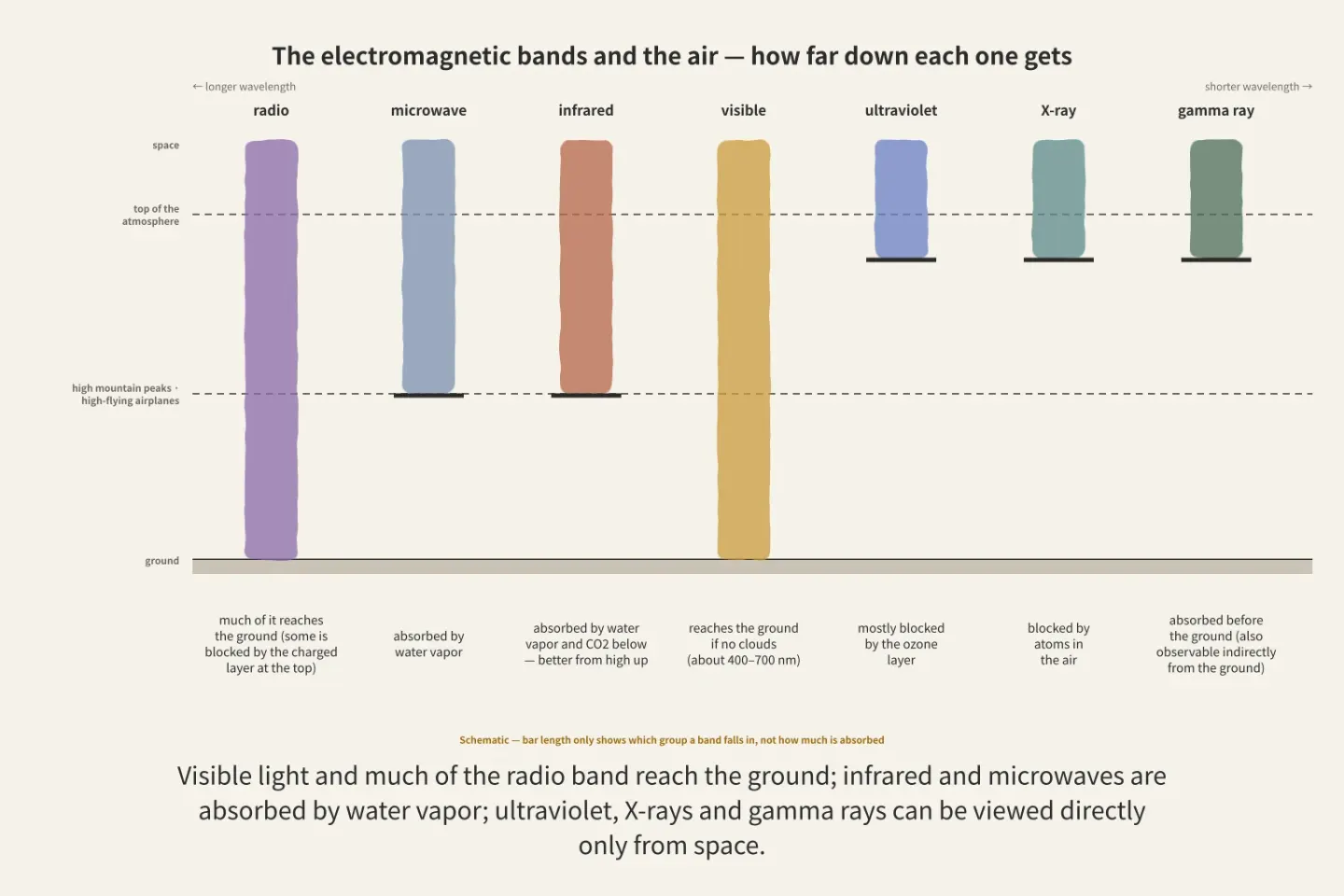
Figure: a diagram Paperis drew using only what the article says
Visible light alone receives only a fraction of the messages sent by the sky.
Why We Make Telescopes Larger
When we think of a telescope, we easily picture a machine that makes distant things look bigger. Magnification is handled by a small lens fitted to the end of the telescope, and changing this lens changes the magnification as well. However, stars look like points of light no matter how much you magnify them, so magnification is of little use for stars. Magnification is helpful for celestial bodies whose features, such as surfaces or shapes, are visible (OpenStax Astronomy 2e 6.1).
The primary job of a telescope is to gather faint light and bring it to a point or an image (OpenStax Astronomy 2e 6.1). When the scientist Galileo Galilei turned a small tube fitted with lenses toward the sky in 1610, it was also to gather more light than the naked eye could (OpenStax Astronomy 2e 6.1). Because the pupil has a small opening, it receives only a tiny fraction of the light sent by a star. A telescope gathers that light together with a wide opening.
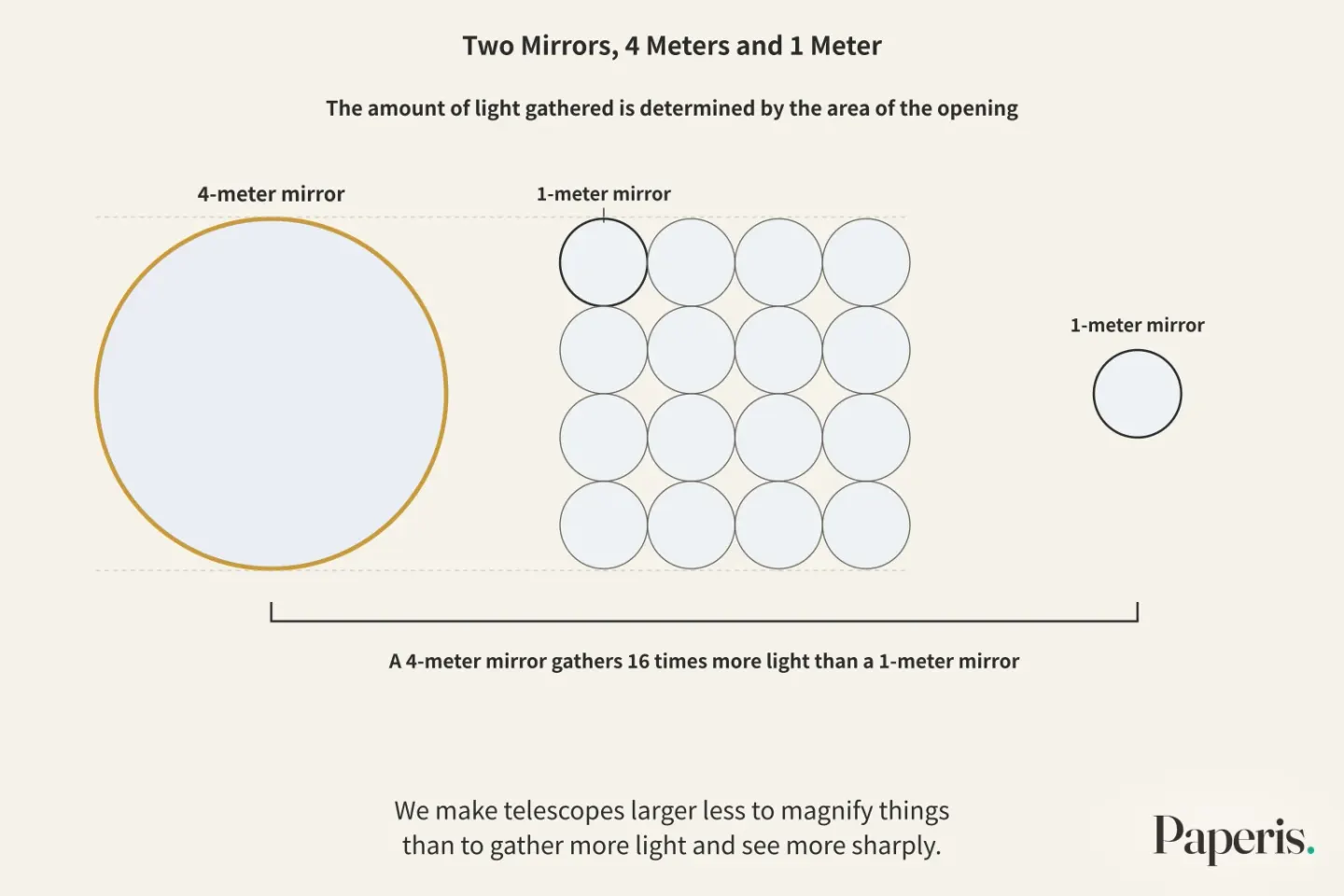
The amount of light gathered is determined by the area of the opening. The larger the diameter of the mirror or lens, the greater the area; a 4-meter mirror gathers 16 times more light than a 1-meter mirror (OpenStax Astronomy 2e 6.1). If you widen a mailbox slot, you can receive even faint letters sent from far away. Because faint celestial bodies are generally farther away, a telescope that gathers more light can receive news from even deeper in the past (OpenStax Astronomy 2e 1.5). We make telescopes larger less to magnify things than to gather more light and see more sharply.
Sharpness also has a name. Resolution is how finely distinct small parts of an image can be told apart. The larger the opening, the sharper the image becomes (OpenStax Astronomy 2e 6.2). What chips away at that sharpness on the ground is the air we breathe. Stars twinkling to the naked eye and stellar images shaking and blurring inside a telescope happen for the same reason. It is because moving air bends starlight this way and that by small amounts (OpenStax Astronomy 2e 6.2).
There are two ways to gather light. A refracting telescope is a telescope that bends light with lenses to gather it at a single point. A reflecting telescope is a telescope that bounces light back with a concave mirror to gather it at a single point. While a large lens can only be supported at its edges and sags under its own weight, a mirror can be supported from behind. Because of this, most astronomical telescopes today are reflecting telescopes (OpenStax Astronomy 2e 6.1). Today's largest telescopes use mirrors 8 to 10 meters in diameter, and even larger ones are currently under construction (OpenStax Astronomy 2e 6.2).
Above the Air, and into Long Radio Waves
Radio waves coming from the universe were first discovered in the early 1930s by Karl Jansky while tracking static in a communications antenna. That static was coming from the sky toward the Milky Way (OpenStax Astronomy 2e 6.4).
A radio telescope is a telescope that collects and receives radio waves from space using a concave metal dish. The dish does the same job as the mirror of a reflecting telescope. Radio waves are electromagnetic waves like light, so they cannot be heard by the ear and are instead received and recorded by electronic equipment (OpenStax Astronomy 2e 6.4). Their weak point is resolution. The longer the wavelength, the harder it is to resolve small details, so even the largest radio dish on the ground by itself cannot see as clearly as a small telescope that collects visible light (OpenStax Astronomy 2e 6.4). Therefore, multiple dishes are electronically linked to work as one. The linked dishes achieve the clarity of a single large dish equal to the distance between them, but the amount of radio waves they collect does not increase by that much (OpenStax Astronomy 2e 6.4).
What if we placed a telescope where there is no air at all? On space telescopes like the Hubble Space Telescope, starlight does not twinkle, so how small of an object can be seen depends solely on the size of the equipment. On the downside, launching them into space costs a lot of money, and it is hard to repair them if they break down (OpenStax Astronomy 2e 6.5).
Names that frequently appear in the news are here. The Hubble Space Telescope, launched in April 1990, uses a 2.4-meter-diameter mirror. The James Webb Space Telescope, launched on December 25, 2021, was built to observe infrared light and uses a 6.5-meter-diameter mirror made of 18 assembled segments at a location about 1.5 million kilometers away from Earth. Chandra, launched in 1999, observes X-rays, and Fermi, launched in 2008, observes gamma rays (OpenStax Astronomy 2e 6.5). The colors in Webb telescope photos are applied by researchers by assigning a color to each observed infrared wavelength. This is because infrared light is invisible to the eye and thus has no inherently assigned color (OpenStax Astronomy 2e 6.5).
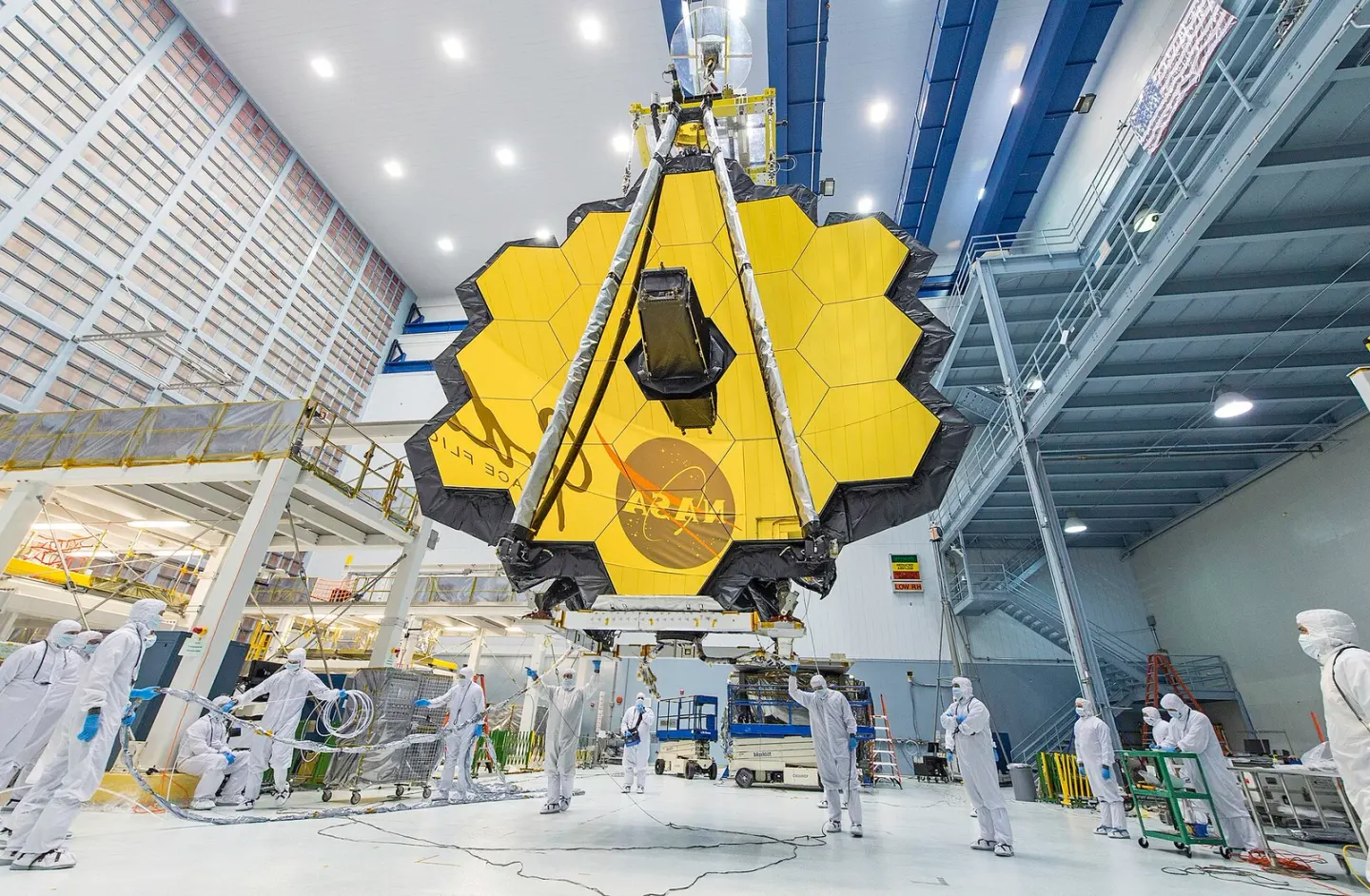
The deployed gold primary mirror of the James Webb Space Telescope, 18 hexagonal segments, during ground testing before launch · NASA/Chris Gunn, 2017 · Goddard Space Flight Center · Wikimedia Commons (public domain)
Depending on which light is to be observed, the placement location and appearance of the telescope vary.
Fingerprints in an Envelope
If a fingerprint is left on an envelope, you can tell who touched it by the pattern of the ridges. Starlight also carries such patterns stamped into it. To read those patterns, you must first spread out the light. Spectroscopy is the act of spreading light into a spectrum and examining how much light is present at each wavelength.
When you examine sunlight carefully, black lines are drawn across the color band in various places. In 1815, the German physicist Joseph Fraunhofer counted roughly 600 black lines where color was missing (OpenStax Astronomy 2e 5.3). A spectral line is a thin line that appears only at a specific wavelength position in a spectrum. An absorption line is a black line created when light of a specific wavelength is missing on top of a continuous spectrum. When continuous light passes through a cool, thin gas, it happens because the gas takes away only its own share of wavelengths. An emission line is a bright line created when a hot, thin gas emits light only of specific wavelengths. The lines of a given element stand at the same wavelength position whether they appear dark or bright (OpenStax Astronomy 2e 5.3).
Why are those positions different for each element? An atom is a particle made of a small nucleus and electrons around it. An element is a substance made of atoms with the same number of protons in their nucleus, which cannot be broken down into simpler substances by chemical change. For each type of atom, the arrangement of positions where electrons can be placed is different, and no two elements share the exact same arrangement. Therefore, each element has its own pattern of lines (OpenStax Astronomy 2e 5.5). Because the positions where spectral lines stand are fixed for each element, looking at the line pattern tells you which elements are present. Just like a fingerprint on an envelope, the line pattern in starlight reveals what elements were present where the light traveled.
The closest example is the Sun. The black lines in sunlight are absorption lines created by the thin, cool outer gas surrounding the Sun. That outer gas layer is not significantly different from the rest of the Sun, so its composition allows us to estimate what the entire Sun is made of (OpenStax Astronomy 2e 5.3). The German physicist Gustav Kirchhoff published an explanation of these black lines in a 1859 paper (DOI: 10.1590/1806-9126-rbef-2025-0131). The following year, in 1860, he detected sodium in the Sun using spectroscopy, confirming an element in the Sun for the first time (OpenStax Astronomy 2e 5.3). Helium was actually discovered in the Sun's spectrum before it was found on Earth (OpenStax Astronomy 2e 5.3).
The light of other stars also has absorption lines, and we find the composition of stars using the same method (OpenStax Astronomy 2e 5.3). Those lines show that stars are celestial bodies similar to the Sun (DOI: 10.1088/1361-6552/aceaca). We learn the composition of very distant star clusters this way as well (OpenStax Astronomy 2e 5.5). Most large telescopes spend more than half of their observing time on spectroscopy (OpenStax Astronomy 2e 6.3).
When the Entire Spectrum Shifts
The siren of an ambulance sounding higher as it approaches and lower as it recedes is a phenomenon we saw in "Waves — Fans Rising in Their Seats, a Wave Circling the Stadium". The Doppler effect is a phenomenon where the frequency received changes when the source and the receiver of a wave move closer together or farther apart. Because light is also a wave, the same thing happens.
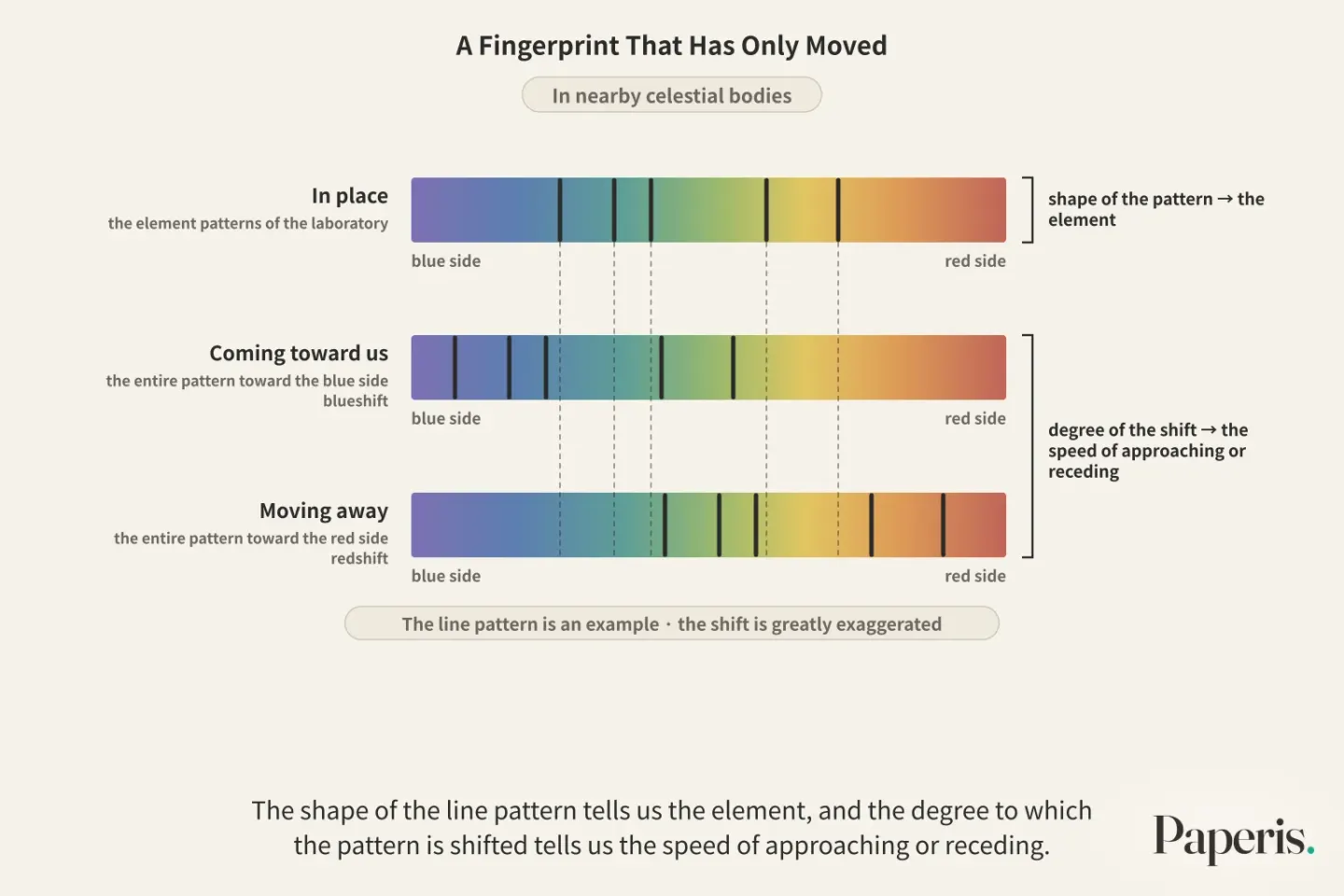
When a light-emitting celestial body approaches, the wave crests crowd together and the wavelength shortens; when it recedes, the space between crests widens and the wavelength lengthens (OpenStax Astronomy 2e 5.6). Redshift is when the spectral lines of light coming from a celestial body appear shifted toward the longer-wavelength side, that is, the red side. Blueshift is when the spectral lines of light coming from a celestial body appear shifted toward the shorter-wavelength side, that is, the blue side. In nearby celestial bodies, this shift is due to motion, and it occurs only in motion coming toward or moving away from us. It does not occur in motion passing by to the side (OpenStax Astronomy 2e 5.6).
The lines of a moving star do not shift one by one; the entire pattern shifts together. Therefore, we read the element from the shape of the pattern and the speed of approaching or receding from the degree of the shift together (OpenStax Astronomy 2e 5.6). The more it shifts, the greater the speed of approaching or receding from us (OpenStax Astronomy 2e 17.4). The shape of the line pattern tells us the element, and the degree to which the pattern is shifted tells us the speed of approaching or receding. It is just like a fingerprint whose pattern stays the same while only the place where it is printed has moved.
Shifting is also used to find things that cannot be seen. A planet is a fairly large celestial body orbiting a star and does not emit light on its own. A star with planets orbits around each other with the planets, repeating the process of approaching and receding from us, and each time the lines of starlight drift back and forth toward the blue side and the red side. By measuring that back-and-forth drift, we can tell that there is a planet we cannot see directly. There are also two papers covering a classroom demonstration that mimics this principle with a sound-producing device (DOI: 10.1088/0031-9120/51/4/044001; DOI: 10.1119/10.0001558).
The redshift coming from celestial bodies in very distant places has one more reason. That story continues in "Galaxies and the Universe — Farmhouses on a Widening Field, Old Light Arriving from Every Side".
Following a Single Letter All the Way
We pick a single star visible to the naked eye and follow its light until it is read by us. Stars visible to the naked eye are usually hundreds to thousands of light-years away (OpenStax Astronomy 2e 1.4), so this light left the star hundreds of years ago, perhaps thousands of years ago. What we receive is news from that time (OpenStax Astronomy 2e 1.5).
The light crosses empty space and reaches Earth's atmosphere. Because it is visible light, it punches down through the atmosphere (OpenStax Astronomy 2e 5.2), but it is bent slightly by the moving air so the star twinkles and the image wavers (OpenStax Astronomy 2e 6.2).
The mirror of a large reflecting telescope catches and gathers this light. A device attached to the telescope separates the gathered light by wavelength, and an astronomer looks at each spread-out line to measure what the celestial body is made of and how fast it is moving (OpenStax Astronomy 2e 6.1). The more finely the light is divided into compartments, the less light goes into each compartment. That is why spectroscopy requires a larger telescope or a much longer observation time, and usually both (OpenStax Astronomy 2e 6.3). To spread out and read light, you must first gather a lot of light, which is another reason we make telescopes large.
Black lines stand on the spread-out band. When that pattern is matched against the element patterns of the laboratory, it reveals what elements are in the outer gas of this star (OpenStax Astronomy 2e 5.3). If the entire pattern is shifted slightly toward the red side, this star is moving away from us (OpenStax Astronomy 2e 17.4). From a single letter, we have read both what was contained inside and whether the sender was moving.
The letter analogy has limits. Stars do not mail light to anyone. Light spreads in all directions, and only a very small fraction of it reaches Earth (OpenStax Astronomy 2e 6.1). And a letter has a sending date written on it, but light does not. When the light departed can be calculated only by separately finding the distance to that star.
Where to Look Further
- How light moves as a wave and how the Doppler effect occurs in sound can be found in "Waves — Fans Rising in Their Seats, a Wave Circling the Stadium".
- That atoms consist of a nucleus and electrons and what gamma rays are lead into "Atoms and Radiation — A Drizzle That Never Stops, a Rain Gauge for How Wet We Get", and what an element is leads into "Elements and Molecules — 118 Pieces of Type, Tens of Millions of Words".
- What the color of starlight tells us about a star's temperature and how elements are forged inside stars are covered in "The Life of Stars — A Star's Arms Holding Up Its Own Weight, the Floor It Falls To".
- The red shift of light coming from distant galaxies and the expansion of the universe are covered in "Galaxies and the Universe — Farmhouses on a Widening Field, Old Light Arriving from Every Side".
Source Papers
- "Astronomy 2e — 1.4 Numbers in Astronomy" (2022) — OpenStax Astronomy 2e 1.4 — A light-year is the distance light travels in one year and its name makes it easy to confuse with time, 1 light-year is roughly 9.46×10¹² km, the closest star is 4.25 light-years away (over 40 trillion km), and stars visible to the naked eye are hundreds to thousands of light-years away (limited to "most" in the main text).
- "Astronomy 2e — 1.5 Consequences of Light Travel Time" (2022) — OpenStax Astronomy 2e 1.5 — Information about the universe arrives almost exclusively via light, the light of distant stars left as long ago as that distance, the farther away we look the farther back in time we see, and faint things are generally distant.
- "Astronomy 2e — 5.1 The Behavior of Light" (2022) — OpenStax Astronomy 2e 5.1 — All electromagnetic waves travel at the same speed in empty space, about 300,000 km per second, which is the fastest speed in the universe.
- "Astronomy 2e — 5.2 The Electromagnetic Spectrum" (2022) — OpenStax Astronomy 2e 5.2 — The band from gamma rays to radio waves (including microwaves), visible light at 400–700 nm, gamma rays below 0.01 nm, Herschel's discovery of infrared, and the degree to which each band passes through the atmosphere.
- "Astronomy 2e — 5.3 Spectroscopy in Astronomy" (2022) — OpenStax Astronomy 2e 5.3 — A prism separates sunlight into colors, about 600 Fraunhofer dark lines exist, gas absorption and emission lines are unique to each element and line up at the same wavelengths, the outer gas layer of the Sun serves as an indicator of the Sun's overall composition, and Kirchhoff studied sodium and helium.
- "Astronomy 2e — 5.5 Formation of Spectral Lines" (2022) — OpenStax Astronomy 2e 5.5 — Each atom has a unique arrangement of electron orbitals producing a unique pattern of lines, which allows us to know the composition of even very distant groups of stars.
- "Astronomy 2e — 5.6 The Doppler Effect" (2022) — OpenStax Astronomy 2e 5.6 — Wavelengths shorten when approaching (blueshift) and lengthen when receding (redshift), occurring only in line-of-sight motion, and the line pattern shifts as a whole, revealing both the elements and the speed.
- "Astronomy 2e — 6.1 Telescopes" (2022) — OpenStax Astronomy 2e 6.1 — The primary jobs of a telescope are gathering light and forming an image, light-gathering power is determined by aperture area so a 4m telescope has 16 times that of a 1m one, stars are points so magnification is of little use, and the difference between refracting and reflecting telescopes (large lenses sag while mirrors are supported from behind).
- "Astronomy 2e — 6.2 Telescopes Today" (2022) — OpenStax Astronomy 2e 6.2 — Today's mirrors are 8–10m in size, and resolution is better with a larger aperture, but flowing air blurs the image and makes stars twinkle.
- "Astronomy 2e — 6.3 Visible-Light Detectors and Instruments" (2022) — OpenStax Astronomy 2e 6.3 — More than half of large telescope observation time is spent on spectroscopy, and the more finely light is divided, the larger the telescope or longer the observation time required.
- "Astronomy 2e — 6.4 Radio Telescopes" (2022) — OpenStax Astronomy 2e 6.4 — Jansky's discovery of cosmic radio waves, radio waves being electromagnetic waves rather than sound, and due to long wavelengths even the largest dish is not as sharp as a small visible-light telescope so multiple dishes are linked together (resolution depends on distance, not light-gathering power).
- "Astronomy 2e — 6.5 Observations outside Earth's Atmosphere" (2022) — OpenStax Astronomy 2e 6.5 — Gamma rays can also be observed indirectly from the ground, space observations have no twinkle but are expensive and hard to repair, Hubble, Webb, Chandra, and Fermi are examples, and the colors in Webb's images are assigned to infrared channels.
- "Astronomy 2e — 17.4 Using Spectra to Measure Stellar Radius, Composition, and Motion" (2022) — OpenStax Astronomy 2e 17.4 — The lines of a receding star shift toward the red side and those of an approaching star toward the blue side, with a larger shift indicating a greater line-of-sight speed.
- "Kirchhoff e os primórdios da espectroscopia: contextualização e tradução comentada de seu artigo de 1859 sobre o problema das Linhas de Fraunhofer" (2025) — DOI: 10.1590/1806-9126-rbef-2025-0131 — Translation and commentary on Kirchhoff's 1859 paper, proposing an interpretation of the Fraunhofer lines and opening the way to determining stellar atmospheric composition through spectra.
- "Revealing the gaps in solar spectrum: a DIY spectrometer for observing Fraunhofer lines" (2023) — DOI: 10.1088/1361-6552/aceaca — A paper on an educational makeshift spectrometer, showing that solar absorption lines are the interaction between solar atmospheric elements and light, and that other stars also show absorption lines, demonstrating that stars are celestial bodies similar to the Sun.
- "A demonstration device to simulate the radial velocity method for exoplanet detection" (2016) — DOI: 10.1088/0031-9120/51/4/044001 — A classroom demonstration mimicking the wavelength shift of starlight orbiting each other with a planet using an audio device.
- "Radial velocity of a sound source in circular motion for illustrating the detection of an exoplanet" (2020) — DOI: 10.1119/10.0001558 — Demonstrating how to find unseen planets by measuring line-of-sight velocity using the Doppler effect with a Bluetooth speaker.
Sources (17)
- Astronomy 2e — 1.4 Numbers in Astronomy
- Astronomy 2e — 1.5 Consequences of Light Travel Time
- Astronomy 2e — 5.1 The Behavior of Light
- Astronomy 2e — 5.2 The Electromagnetic Spectrum
- Astronomy 2e — 5.3 Spectroscopy in Astronomy
- Astronomy 2e — 5.5 Formation of Spectral Lines
- Astronomy 2e — 5.6 The Doppler Effect
- Astronomy 2e — 6.1 Telescopes
- Astronomy 2e — 6.2 Telescopes Today
- Astronomy 2e — 6.3 Visible-Light Detectors and Instruments
- Astronomy 2e — 6.4 Radio Telescopes
- Astronomy 2e — 6.5 Observations outside Earth's Atmosphere
- Astronomy 2e — 17.4 Using Spectra to Measure Stellar Radius, Composition, and Motion
- Kirchhoff e os primórdios da espectroscopia: contextualização e tradução comentada de seu artigo de 1859 sobre o problema das Linhas de FraunhoferDOI 10.1590/1806-9126-rbef-2025-0131
- Revealing the gaps in solar spectrum: a DIY spectrometer for observing Fraunhofer linesDOI 10.1088/1361-6552/aceaca
- A demonstration device to simulate the radial velocity method for exoplanet detectionDOI 10.1088/0031-9120/51/4/044001
- Radial velocity of a sound source in circular motion for illustrating the detection of an exoplanetDOI 10.1119/10.0001558