Paperis Articles
The Solar System — Bowls Thrown on One Wheel, Crumbs Left on the Floor
Almost all of the solar system's mass is in the Sun, and the eight planets orbit in nearly the same plane and the same direction. That arrangement fits the account that the Sun and planets formed together, about 4.5 billion years ago, from a spinning disk of gas and dust.
Your field's papers, as audio
Pick your fields and journals — Paperis summarizes the key papers and turns them into audio. Listen on your commute.
Start Paperis free →The Solar System — Bowls Thrown on One Wheel, Crumbs Left on the Floor
The Solar System on a Single Page of a Picture Book
When you open a children's picture book, the solar system usually fits right on one page. There is a large yellow semicircle on the far left, and next to it, eight colorful balls line up in a row. The space between the balls is about one or two finger joints wide.
If you were to redraw this picture to actual scale, paper would run out. If you shrink every length down to 1 billionth, the sun becomes a ball about 1.5 meters in diameter, and the earth becomes a marble about 1.3 centimeters in diameter, placed 150 meters away from the sun (OpenStax Astronomy 2e 7.1). The outermost ball orbits 30 times farther away than the earth (OpenStax Astronomy 2e 11.2), so at the same scale you would have to walk more than 4 kilometers to reach it. Picture books greatly compress the distances in order to fit the balls side by side on a single page.
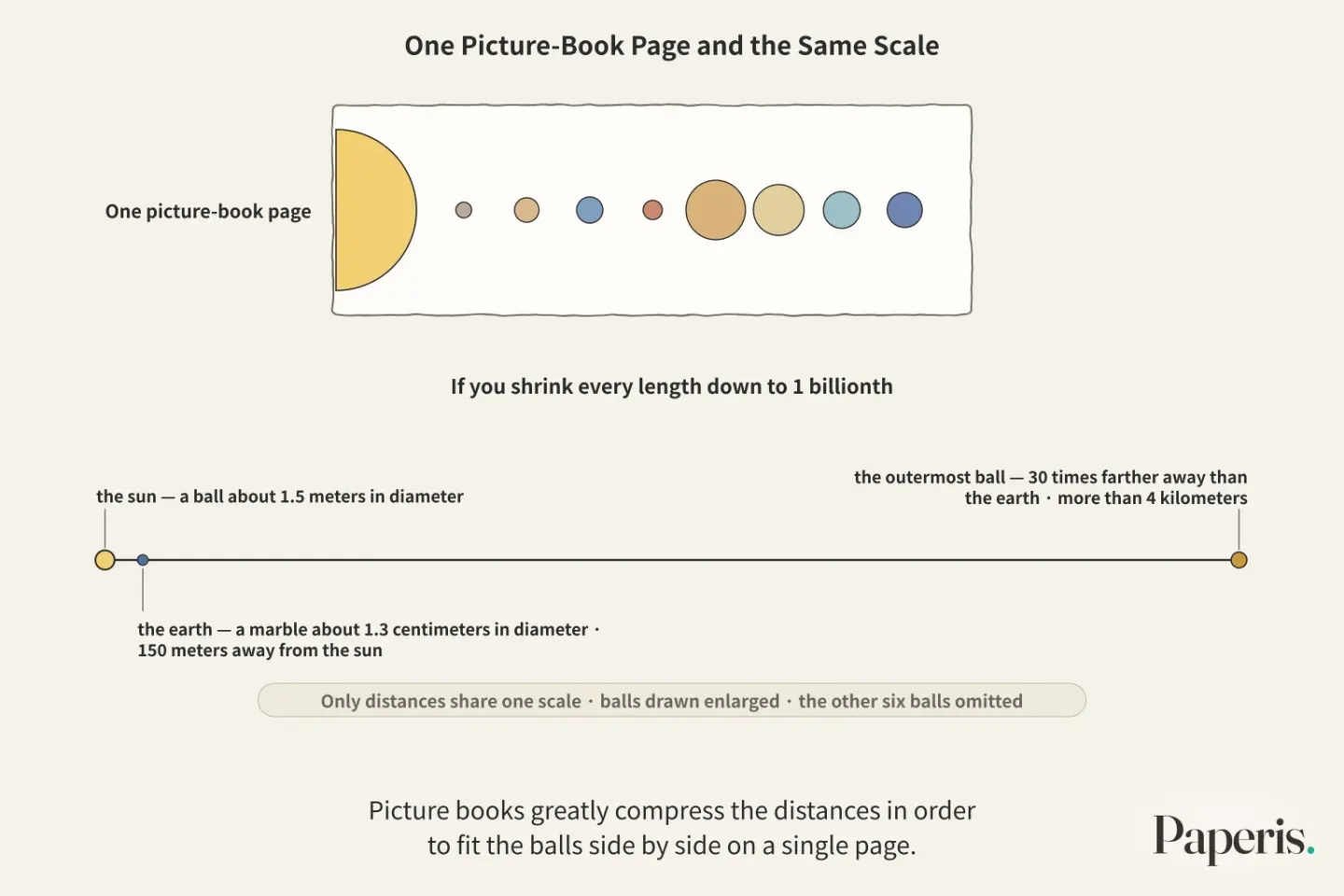
So the first picture to remember from this article is empty space. The solar system is made of one large ball and tiny things placed far apart at very great distances around it.
As a guide, we take along a potter's wheel. The bowls shaped on the wheel all spin in the same direction on the same plate, and when the shaping is done, crumbs of clay are left on the floor. The plot of this article is that the sun, the balls around it, and the small things drifting between them resemble this wheel.
A Star in the Middle, Things Orbiting It
The diameter of the Sun is roughly 1.4 million kilometers (OpenStax Astronomy 2e 7.1). Mass is a value measuring the amount of matter inside an object. 99.8% of the entire solar system's mass is concentrated in the Sun alone (OpenStax Astronomy 2e 7.1). Even if you add up everything else, it is only about 0.2%.
The solar system is the name for the Sun and all celestial bodies held by the Sun's gravity that orbit around it. Countless celestial bodies came into being together with the Sun mostly about 4.5 billion years ago (OpenStax Astronomy 2e 7.1). Gravity is the force by which objects with mass pull on each other. How this force keeps an object locked in a round path is covered in "Force and Motion — A Swinging Strap, a Body That Keeps Going".
There are two ways celestial bodies move in orbits (OpenStax Astronomy 2e 7.1) (OpenStax Astronomy 2e 3.4). Rotation is when a celestial body spins on its own around an axis piercing through its body, and revolution is when one celestial body orbits around another celestial body. An orbit is the path that one celestial body takes as it is drawn by gravity to circle around another celestial body.
Among the celestial bodies orbiting the Sun, the largest ones are planets. A planet is a fairly large celestial body orbiting a star, and it does not shine on its own. This is a broad definition, so it applies just the same to planets orbiting other stars (OpenStax Astronomy 2e 1.6). What should be called a planet within the solar system had its criteria redefined by the 2006 International Astronomical Union General Assembly (DOI: 10.1029/2006eo350002) (DOI: 10.1017/s1743921319000115), and based on those criteria, there are eight planets in the solar system (OpenStax Astronomy 2e 1.6) (OpenStax Astronomy 2e 3.4). The Sun is the star in the middle that shines on its own.
There is a clear rule to the paths of the eight planets. They all orbit the Sun in the same direction and trace paths close to circles (OpenStax Astronomy 2e 7.1). The orbits lie on nearly a single plane, so all eight planets are within 10 degrees of a common plane (OpenStax Astronomy 2e 3.4). The Sun also rotates in the same direction (OpenStax Astronomy 2e 7.4). Like bowls on a potter's wheel, the planets spin in one direction on a single flat plate.
An orbital period is the time it takes for a celestial body to go around its orbit once. Mercury, closest to the Sun, makes one trip in 88 Earth days, and Neptune, the outermost, takes 165 years. The speed of travel is fastest for Mercury on the innermost side and slowest for Neptune on the outermost side (OpenStax Astronomy 2e 3.4).
If you count distances in kilometers, the numbers become too large, so the distance to Earth is used as a ruler (OpenStax Astronomy 2e 7.1) (OpenStax Astronomy 2e). An astronomical unit is a unit of distance setting the distance between Earth and the Sun as 1, which is roughly 149 million kilometers. Measured with this ruler, Jupiter is about 5 times farther from the Sun than Earth is, and Neptune is about 30 times farther (OpenStax Astronomy 2e 11.2). A single Sun is almost everything in the solar system, and the rest orbit in the same direction on nearly a single flat plate.
Four Inside, Four Outside
If we set the size of Earth to 1, Jupiter is 11 times wider in diameter and 318 times heavier in mass (OpenStax Astronomy 2e 11.2). A single Jupiter is heavier than all the other planets combined (OpenStax Astronomy 2e 7.1). The eight planets are divided into two groups by both their size and their appearance.
The inner four make up the first group (OpenStax Astronomy 2e 7.1). Terrestrial planets are small planets with a solid surface made mainly of rock and metal, and Mercury, Venus, Earth, and Mars, which are close to the Sun, belong here.
The outer four, from Jupiter to Neptune, form the second group (OpenStax Astronomy 2e 7.1). Giant planets are large planets made mostly of light gases, liquids, and ice, and they do not have a solid surface. Jupiter and Saturn are made mostly of hydrogen and helium like the Sun, and as you go deeper inside, they are squeezed so that most of the hydrogen exists in a liquid state (OpenStax Astronomy 2e 7.2). Uranus and Neptune have a mass about 15 times that of Earth, making them much smaller than Jupiter, and their materials are fundamentally different from those of Jupiter and Saturn (OpenStax Astronomy 2e 11.2).
Most planets do not orbit alone (OpenStax Astronomy 2e 7.1). A moon is a natural celestial body that orbits another celestial body like a planet. Our Moon is a moon of Earth. Only Mercury and Venus have no moons, and there are about 430 known moons (OpenStax Astronomy 2e 7.1). The inner ones are small and solid, while the outer ones are large and light. This division will later become a clue to asking how the solar system formed.
Small Things Between and Beyond the Planets
Returning to the picture book from Section 1, we often see drawings with small dots drawn in a band between Mars and Jupiter. Those dots are asteroids. Asteroids are chunks of rock orbiting the Sun, and they are much smaller than planets. Most of them are leftover pieces from the original batch that existed before the planets formed (OpenStax Astronomy 2e 7.1).
The asteroid belt is a wide band between Mars and Jupiter where the largest number of asteroids orbit. More than 75% of known asteroids are located here. Even so, because the belt is so wide, the distance between asteroids—measured for those up to 1 kilometer in size—is typically millions of kilometers (OpenStax Astronomy 2e 13.1). The dashed band in the drawing is actually almost empty space.
Farther out, chunks of ice orbit (OpenStax Astronomy 2e 13.3). Comets are chunks a few kilometers in size composed mainly of ice that release gas and dust to form an atmosphere and a tail when they approach the Sun. The ice in comets is frozen water, carbon dioxide, and carbon monoxide, and comets spend most of their time in cold places far from the Sun (OpenStax Astronomy 2e 7.1). Most comets are thought to reside in the Oort cloud, a comet reservoir much farther out than the planets (OpenStax Astronomy 2e 14.3), and there is also a band just outside Neptune where many comets originate (OpenStax Astronomy 2e 13.4) (DOI: 10.1146/annurev.earth.27.1.287).
That band has a name. The Kuiper belt is a wide zone beyond Neptune's orbit where small bodies made of ice and rock gather and orbit. Excluding Pluto, bodies here were first discovered only in 1992 (OpenStax Astronomy 2e 13.4) (DOI: 10.1146/annurev.astro.40.060401.093818), and it is estimated that more than 100,000 objects over 100 kilometers in diameter are spread out as far as roughly 50 times the Earth-Sun distance (OpenStax Astronomy 2e 13.4). Some of the least-heated material in the solar system remains here (DOI: 10.1146/annurev.earth.27.1.287). Many of the comets that frequently return near the Sun are thought to come from this place (OpenStax Astronomy 2e 13.4) (DOI: 10.1146/annurev.earth.27.1.287).
Why Pluto Changed Its Name
On August 24, 2006, the General Assembly of the International Astronomical Union gathered in Prague, Czech Republic, and after several rounds of voting, adopted a new definition of a planet. Pluto did not fit that definition, and Pluto and at least two other celestial bodies were classified as dwarf planets (DOI: 10.1029/2006eo350002). A dwarf planet orbits the Sun and resembles a planet, but is a body that was separated into its own category in the 2006 definition of a planet. The authors of the open astronomy textbook Astronomy 2e define dwarf planets as bodies much smaller than terrestrial planets (OpenStax Astronomy 2e 12.4).
Pluto was discovered beyond Neptune in 1930 and was initially called a planet (OpenStax Astronomy 2e 13.1). It has a diameter of 2,370 kilometers—about 60% that of our Moon—and possesses five moons (OpenStax Astronomy 2e 12.4). Its orbit is tilted by about 17 degrees from the plane of Earth's orbit (OpenStax Astronomy 2e 3.4). From the 1990s onward, similar bodies were found one after another beyond Neptune, among which Eris was nearly identical in size to Pluto (OpenStax Astronomy 2e 12.4). Today, Eris, Makemake, and Haumea are also dwarf planets (OpenStax Astronomy 2e 13.4). Ceres in the asteroid belt was first called a planet, then an asteroid, and is now classified as a dwarf planet (OpenStax Astronomy 2e 13.1).
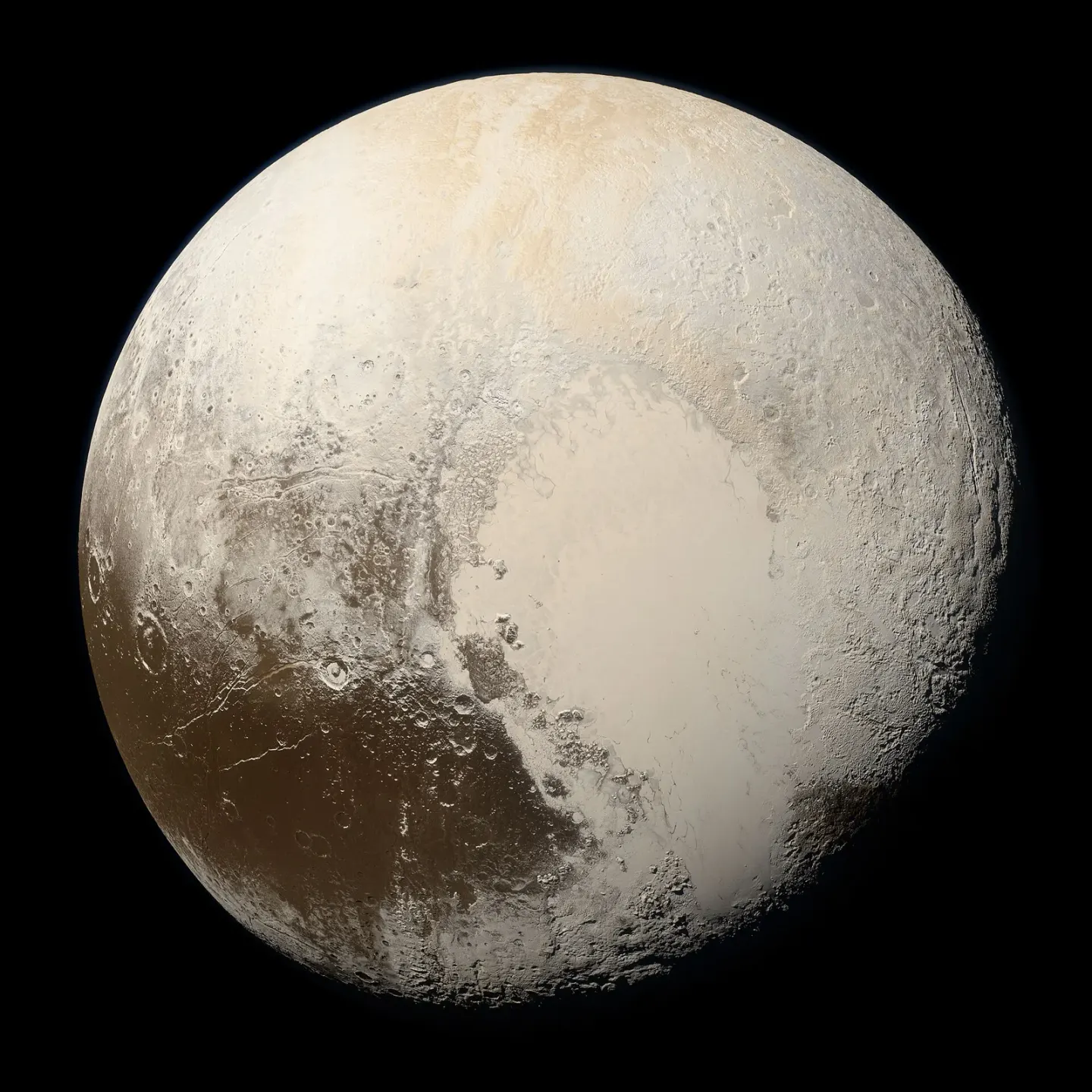
Pluto photographed by NASA's New Horizons in 2015 · NASA/Johns Hopkins APL/Southwest Research Institute, 2015 · Wikimedia Commons (public domain)
The reasoning of those who supported the new definition can be seen in the words of California Institute of Technology astronomer Michael Brown, who found one of the bodies classified as a dwarf planet at this time. He noted that if you look from the outside flying into the solar system, eight very large bodies stand out by themselves, while the rest belong to a vast crowd of much smaller bodies (DOI: 10.1029/2006eo350002). The new definition also sparked controversy and has been studied as a case showing the grounds on which competing scientific definitions contend (DOI: 10.22329/il.v28i2.550). According to recollections from the executive leadership that led the assembly, there was labor over how to conduct the member vote, but the union's procedures worked well and much was learned (DOI: 10.1017/s1743921319000115).
Pluto itself remains the same, but the International Astronomical Union redrew the criteria for a planet, and by those criteria Pluto became a dwarf planet.
From One Potter's Wheel: The Story of How the Solar System Came to Be
You can now watch a potter's wheel in action around other stars. A protoplanet disc is a flattened disc of gas and dust orbiting a newborn star, which is the site where planets form. Nearly all very young stars are wrapped in such discs, and their sizes range from 10 to 1,000 times the distance between the Earth and the Sun (OpenStax Astronomy 2e 21.3). The disc of the young star HL Tauri, seen through the ALMA telescope array, features multiple rings and gaps. Assuming those gaps were carved by objects currently forming, estimates suggest their masses are Jupiter-class or smaller, and the research team added that fully understanding this disc requires further observational and theoretical work (DOI: 10.3847/0004-637x/818/2/158). A review notes that these fine patterns in the disc are likely the scenes where clumps are growing or the traces of a planetary system in the making (DOI: 10.1146/annurev-astro-031220-010302).
Astronomers think our solar system also began from such a disc. The solar nebula is the spinning cloud of gas and dust from which the Sun and planets formed. The rule we saw in Section 2—namely, that planets orbit in the same direction on a single plane and even the Sun rotates in that same direction—is read as the trace of this (OpenStax Astronomy 2e 7.4). It resembles a potter's wheel in that the bowls spin in one direction on a single plate.
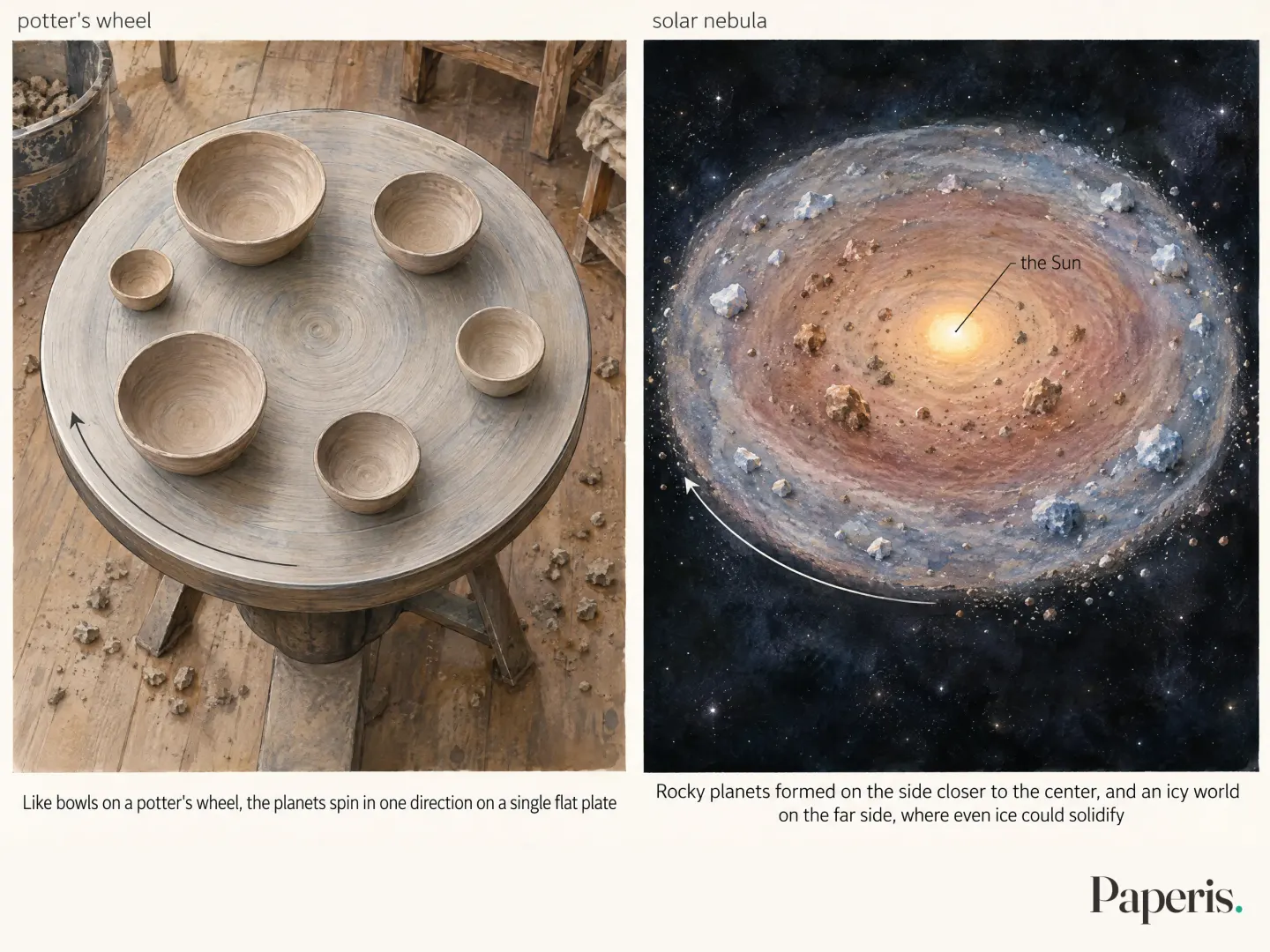
When that time was is revealed by stones that fell from the sky. The most primitive meteorites are about 4.5 billion years old, and this age is taken as the age of the solar system (OpenStax Astronomy 2e 14.3). Nearly all the cloud material gathered in the center to become the Sun, and the planets and other bodies were made from the small remainder (OpenStax Astronomy 2e 7.1). The 99.8% we saw in Section 2 is the result of this.
The clay on the potter's wheel also differed by location. The side closer to the center was too hot for water to freeze, and rocky planets formed in that spot. An icy world formed on the far side, where even ice could solidify (OpenStax Astronomy 2e 7.4). It is thought that there was a threshold for the outer lumps to become giant planets. Calculations show that once a lump exceeds about 10 times Earth's mass, it begins pulling in surrounding hydrogen gas, which requires gas to still remain in the disc (OpenStax Astronomy 2e 21.3).
Some of the remaining lumps ended up in the asteroid belt and the Kuiper belt (OpenStax Astronomy 2e 14.3). Kuiper belt objects can be viewed as ancient relics of the disc that surrounded the Sun (DOI: 10.1146/annurev.astro.40.060401.093818). They are the crumbs left on the floor beneath the potter's wheel.
There are also exceptions. Venus rotates backward and slowly, while Uranus rotates almost lying on its side. Such exceptions are thought to have likely come from giant impacts early in the solar system's history (OpenStax Astronomy 2e 7.4). Among the planetary systems of other stars, there are those where giant planets orbit close to the star, so our solar system's arrangement is not the same everywhere (OpenStax Astronomy 2e 7.4).
The Sun and planets formed together about 4.5 billion years ago from a spinning disc of gas and dust. The same direction, the same plane, the inner rock and outer gas and ice, and the small things left in the two belts all fit this explanation.
Journey of a Crumb
We follow a single comet coming from the Kuiper Belt. There is an icy lump out there. It has orbited that very cold place for billions of years since the solar system formed, changing almost not at all (OpenStax Astronomy 2e 13.4).
If Neptune's gravity pulls on this lump bit by bit, its orbit gradually changes until it can finally fall into the inner region where the planets orbit (OpenStax Astronomy 2e 13.4). A comet's orbit is usually elongated, so it spends most of its time moving slowly in the distant reaches before whipping around quickly near the Sun (OpenStax Astronomy 2e 3.4).
The lump is only a few kilometers across, so its grip on things is weak. When it reaches a little outside Mars's orbit, the ice on its surface warmed by sunlight begins to blow away, and the dust and gas freed together cannot return, spreading around the lump. As it gets closer to the Sun, this cloud commonly grows as big as Jupiter (OpenStax Astronomy 2e 13.3). Now this lump is a comet.
A comet's tail always stretches away from the Sun, no matter which way the comet is heading (OpenStax Astronomy 2e 13.3). There are two tails. The bright dust tail forms as sunlight's pushing force splits the grains apart (OpenStax Astronomy 2e 13.3) (DOI: 10.5194/epsc2026-546), and the faint, straight ion tail forms as it is pushed by the solar wind, which is a stream of electrically charged particles spewed by the Sun (OpenStax Astronomy 2e 13.3).
Comets wear down every time they pass near the Sun. An active comet loses as much as 1 million tons a day, and at this rate, an ordinary comet vanishes after orbiting a few thousand times (OpenStax Astronomy 2e 13.4). When a comet is visible in the night sky, a crumb left over on the floor beneath the potter's wheel long ago is passing near the Sun and wearing down. The famous Halley's Comet returns every 76 years on average, and its next return is in 2061 (OpenStax Astronomy 2e 13.3).
Crumbs Coming Close to Earth
In 2013, a rock roughly 20 meters wide blew up at a height of 30 kilometers in the sky over Chelyabinsk, Russia. No one was hurt by the explosion itself, but about 1,500 people were treated for injuries from glass broken by the shock wave that arrived afterward (OpenStax Astronomy 2e 13.2).
Outside the asteroid belt, there are also asteroids that come close to or cross Earth's orbit. If one wider than 1 kilometer collides, the damage can extend to the entire Earth, so the National Aeronautics and Space Administration began a search in 1998 to find 90% of this size and reached that goal in 2012 (OpenStax Astronomy 2e 13.2). Among the near-Earth asteroids found so far, none are in an orbit to collide with Earth in the foreseeable future (OpenStax Astronomy 2e 13.2).
However, there are still those that have not been found. Near-Earth asteroids smaller than 1 kilometer but capable of destroying a city are far more numerous, and many of them have not been found yet. As of 2025, there are over 38,000 known near-Earth asteroids (OpenStax Astronomy 2e 13.2). Therefore, the search continues, and tests to change orbits have also been conducted. NASA's probe DART collided with Dimorphos, the moon of the asteroid Didymos, 11 months after launch, reducing its orbital period by 32 minutes (OpenStax Astronomy 2e 13.2). Most of the large ones have been found and none of the currently known ones are on a collision orbit, while the small ones are still being searched for.
Where the Potter's Wheel Metaphor Fails
First, the solar system has no hands shaping a bowl. Gravity is what gathered and grew the mass, and collisions between chunks both grew and shattered planets (OpenStax Astronomy 2e 7.4). Second, a potter's wheel spins a plate to turn the clay. The solar nebula had no plate beneath it, and the cloud spun faster on its own as it shrank (OpenStax Astronomy 2e 14.3).
Third, the crumbs on the floor is actually the most precious material. Comets have remained almost unchanged for billions of years, making them likely the most primitive celestial bodies we can study (OpenStax Astronomy 2e 13.4). The material making up the planets and the Sun has undergone various changes in the meantime (OpenStax Astronomy 2e 14.3), and the appearance of the initial clay is most likely to be preserved in the crumbs. Fourth, the boundary between the bowl and the crumbs is not as sharp as a knife cut. Pluto and Ceres are celestial bodies whose names changed at that boundary. Fifth, a potter's wheel spins as a single mass so that all bowls on the plate complete one rotation in the same amount of time, whereas planets spin more slowly the farther out they are, taking much longer to complete one orbit (OpenStax Astronomy 2e 3.4).
Now you can open the picture book again. The yellow semicircle is a star holding nearly all the mass of the solar system, and from the Sun to the outermost ball is an empty space of over 4 kilometers on foot. The balls spin in the same direction on the same plate, and the inner four and outer four differ in material. The bands drawn with dashed lines and the clumps of ice outside the illustration are the clay left over from shaping all of that.
Where to Look Further
The principles of the force holding planets in their orbits can be followed in "Force and Motion — A Swinging Strap, a Body That Keeps Going", and the hydrogen and the helium making up Jupiter and Saturn in "Elements and Molecules — 118 Pieces of Type, Tens of Millions of Words".
Among other parts of this series, "Motions of the Sky — A Tilted Spinning Teacup, a Lamp Lit in the Middle" covers how Earth's rotation and revolution create day, night, and the seasons, along with the Moon's revolution. "Light and Telescopes — A Letter That Arrives Late, a Fingerprint in the Envelope" covers how spreading out light reveals what distant celestial bodies are made of, and "The Life of Stars — A Star's Arms Holding Up Its Own Weight, the Floor It Falls To" covers what stars like the Sun shine with, how they are born, and how they end.
Source Papers
- "Astronomy 2e — 7.1 Overview of Our Planetary System" (2022) — OpenStax Astronomy 2e 7.1 — The composition of the solar system, mostly formed alongside the Sun about 4.5 billion years ago, the Sun's diameter is roughly 1.4 million km and its mass is 99.8%, Jupiter is heavier than all other planets combined, planets move in the same direction on nearly circular orbits, inner four and outer four, roughly 430 moons, the identity of asteroids and comets, the center of the cloud became the Sun, on a 1-in-1,000,000,000 scale the Sun is 1.5m, the Earth is 1.3cm, and they are 150m apart.
- "Astronomy 2e — 1.6 A Tour of the Universe" (2022) — OpenStax Astronomy 2e 1.6 — Planets are fairly large bodies orbiting stars and do not shine by their own light, Earth is one of eight planets orbiting the Sun, planets orbiting other stars have also been discovered.
- "Astronomy 2e — 3.4 Orbits in the Solar System" (2022) — OpenStax Astronomy 2e 3.4 — The meaning of an orbit, eight planets, Mercury takes 88 days and Neptune takes 165 years, planetary orbits lie within 10 degrees of a common plane, Pluto has a 17-degree tilt, comets have elongated orbits.
- "Astronomy 2e — Appendix F Physical and Orbital Data for the Planets" (2022) — OpenStax Astronomy 2e — Earth's semi-major orbital axis is 1.00 AU = 149 million km.
- "Astronomy 2e — 11.2 The Giant Planets" (2022) — OpenStax Astronomy 2e 11.2 — Jupiter is at 5 AU and Neptune is at 30 AU, Jupiter's diameter is 11 times Earth's and its mass is 318 times, Uranus and Neptune have 15 times Earth's mass and different materials, exoplanets the size of Uranus and Neptune and sizes in between are common.
- "Astronomy 2e — 7.2 Composition and Structure of Planets" (2022) — OpenStax Astronomy 2e 7.2 — Jupiter and Saturn are mostly hydrogen and helium, with compressed hydrogen in a liquid state in their interiors.
- "Astronomy 2e — 7.4 Origin of the Solar System" (2022) — OpenStax Astronomy 2e 7.4 — The same plane, same direction, and the Sun's rotation in the same direction are interpreted as evidence that they formed together from the solar nebula, the inner region became rocky planets because it was too hot for water to freeze, the exceptions of Venus and Uranus likely came from giant impacts, other planetary systems may differ from ours, and impacts can both grow and break apart planets.
- "Astronomy 2e — 14.3 Formation of the Solar System" (2022) — OpenStax Astronomy 2e 14.3 — Primitive meteorite ages of roughly 4.5 billion years are taken as the age of the solar system, most comets are in the Oort cloud with more comets also in the Kuiper belt, some leftover chunks remain in the asteroid belt and Kuiper belt, a contracting cloud spins faster, and material in planets and the Sun undergoes various changes.
- "Astronomy 2e — 13.1 Asteroids" (2022) — OpenStax Astronomy 2e 13.1 — The location of the asteroid belt, over 75% of known asteroids are in the belt but spacings are millions of km, Ceres went from being a planet through being an asteroid to a dwarf planet, Pluto was discovered in 1930 and initially called a planet.
- "Astronomy 2e — 13.3 The "Long-Haired" Comets" (2022) — OpenStax Astronomy 2e 13.3 — Comets are ice chunks several km in size, ice starts evaporating just beyond Mars' orbit, gravity is too weak to hold onto gas and dust, the coma is often the size of Jupiter, tails always point away from the Sun, sunlight exerts a pushing force, and ion tails are pushed by the solar wind, Halley's Comet has a 76-year period and will return in 2061.
- "Astronomy 2e — 13.4 The Origin and Fate of Comets and Related Objects" (2022) — OpenStax Astronomy 2e 13.4 — Objects beyond Neptune past Pluto were discovered in 1992, the Kuiper belt is the source of many comets, there are over 100,000 objects larger than 100km reaching out to 50 AU, Neptune's gravity alters orbits, Eris, Makemake, and Haumea are also dwarf planets, comets wear down, and comets may be the most primitive bodies.
- "Astronomy 2e — 12.4 Pluto and Charon" (2022) — OpenStax Astronomy 2e 12.4 — Pluto has a diameter of 2,370km, 60% of the Moon's, and five moons, the discovery of similar bodies beyond Neptune and Eris in the 1990s led authors to describe dwarf planets as planets much smaller than rocky planets.
- "Astronomy 2e — 21.3 Evidence That Planets Form around Other Stars" (2022) — OpenStax Astronomy 2e 21.3 — Very young stars almost all have disks ranging from 10 to 1,000 AU in size, dust grains collide and stick to grow, and calculations show that if an object exceeds roughly 10 Earth masses while gas remains in the disk, it captures hydrogen gas and grows into a giant planet.
- "Astronomy 2e — 13.2 Asteroids and Planetary Defense" (2022) — OpenStax Astronomy 2e 13.2 — Chelyabinsk in 2013, 90% of near-Earth asteroids larger than 1km discovered (2012), none of the known ones are on a collision course, many small city-scale asteroids have yet to be found, over 38,000 known near-Earth asteroids by 2025, and DART reduced Dimorphos's orbital period by 32 minutes.
- "Pluto loses its status as a planet" (2006) — DOI: 10.1029/2006eo350002 — On August 24, 2006, the Prague IAU General Assembly voted to adopt a planet definition that excludes Pluto, classifying Pluto and at least two other bodies as dwarf planets, and Michael Brown explains "eight major bodies".
- "Arguing from Definition to Verbal Classification: The Case of Redefining 'Planet' to Exclude Pluto" (2008) — DOI: 10.22329/il.v28i2.550 — Redefining planets to exclude Pluto sparked controversy and is analyzed as a case of argument using competing scientific definitions.
- "The Prague IAU General Assembly, Pluto and the IAU processes" (2018) — DOI: 10.1017/s1743921319000115 — The planet definition was decided at the Prague General Assembly, member votes on Pluto's status were complicated by bylaws changes, but the IAU structure worked well and left many lessons, as recalled by the executive side.
- "Kuiper Belt Objects: Relics from the Accretion Disk of the Sun" (2002) — DOI: 10.1146/annurev.astro.40.060401.093818 — The Kuiper belt consists of small solid bodies beyond Neptune, discovered in 1992, best viewed as ancient relics of the Sun's disk (review).
- "KUIPER BELT OBJECTS" (1999) — DOI: 10.1146/annurev.earth.27.1.287 — The Kuiper belt contains some of the most primitive and least heat-processed material in the solar system, likely serving as the source of short-period comets (review).
- "Comet dust tails as a tracer for the solar wind." (2026) — DOI: 10.5194/epsc2026-546 — Dust grains emitted from comets are split by radiation pressure to form dust tails (conference abstract).
- "PLANETARY SYSTEM FORMATION IN THE PROTOPLANETARY DISK AROUND HL TAURI" (2016) — DOI: 10.3847/0004-637x/818/2/158 — Assuming gaps in the HL Tauri disk seen in ALMA data were carved by forming bodies, their mass is Jupiter-class or smaller, and fully understanding the images requires further observational and theoretical research (assumption-based estimate).
- "Observations of Protoplanetary Disk Structures" (2020) — DOI: 10.1146/annurev-astro-031220-010302 — An ALMA-led review of disk observations noting that small-scale substructures are likely sites of clump growth or traces of a forming planetary system.
Sources (22)
- Astronomy 2e — 7.1 Overview of Our Planetary System
- Astronomy 2e — 1.6 A Tour of the Universe
- Astronomy 2e — 3.4 Orbits in the Solar System
- Astronomy 2e — Appendix F Physical and Orbital Data for the Planets
- Astronomy 2e — 11.2 The Giant Planets
- Astronomy 2e — 7.2 Composition and Structure of Planets
- Astronomy 2e — 7.4 Origin of the Solar System
- Astronomy 2e — 14.3 Formation of the Solar System
- Astronomy 2e — 13.1 Asteroids
- Astronomy 2e — 13.3 The
- Astronomy 2e — 13.4 The Origin and Fate of Comets and Related Objects
- Astronomy 2e — 12.4 Pluto and Charon
- Astronomy 2e — 21.3 Evidence That Planets Form around Other Stars
- Astronomy 2e — 13.2 Asteroids and Planetary Defense
- Pluto loses its status as a planetDOI 10.1029/2006eo350002
- Arguing from Definition to Verbal Classification: The Case of Redefining 'Planet' to Exclude PlutoDOI 10.22329/il.v28i2.550
- The Prague IAU General Assembly, Pluto and the IAU processesDOI 10.1017/s1743921319000115
- Kuiper Belt Objects: Relics from the Accretion Disk of the SunDOI 10.1146/annurev.astro.40.060401.093818
- KUIPER BELT OBJECTSDOI 10.1146/annurev.earth.27.1.287
- Comet dust tails as a tracer for the solar windDOI 10.5194/epsc2026-546
- PLANETARY SYSTEM FORMATION IN THE PROTOPLANETARY DISK AROUND HL TAURIDOI 10.3847/0004-637x/818/2/158
- Observations of Protoplanetary Disk StructuresDOI 10.1146/annurev-astro-031220-010302