
Paperis Articles
Beethoven — With Ears That Struggled with High Notes, How Did He Keep Composing?
Beethoven noticed his hearing loss around 1798; beginning in his left ear (sources put its onset at 26, at 28, or in his thirties), it made high notes and the words in speech hard to hear. Hypotheses piled up — otosclerosis, syphilis, immune disease, lead, and more recently hepatitis B — yet a 2021 systematic review judged the cause unclear. The 2023 genomic analysis of his hair found no genetic explanation for his deafness, and a 2024 pathography concluded it was lead poisoning. How he kept composing rests on records of hearing devices and on interpretation of documents.
Your field's papers, as audio
Pick your fields and journals — Paperis summarizes the key papers and turns them into audio. Listen on your commute.
Start Paperis free →Beethoven — With Ears That Struggled with High Notes, How Did He Keep Composing?
Around 1798, Vienna
Around 1798, a few years after settling in Vienna, Austria, the German composer Ludwig van Beethoven (1770–1827) noticed that something was wrong with his ears (DOI: 10.1093/actrade/9780190051730.003.0005). He was in his late twenties, performing on stage as a pianist and writing music. The age at which his hearing loss began varies slightly depending on the source; some texts state it began at age 26, others around age 28, and a review paper notes it started in his thirties (DOI: 10.1097/mao.0000000000002755) (PMID 35189464) (DOI: 10.5937/tmg2304102c). Either way, his hearing worsened over several years until he reached a state of near-total deafness (DOI: 10.5937/tmg2304102c).
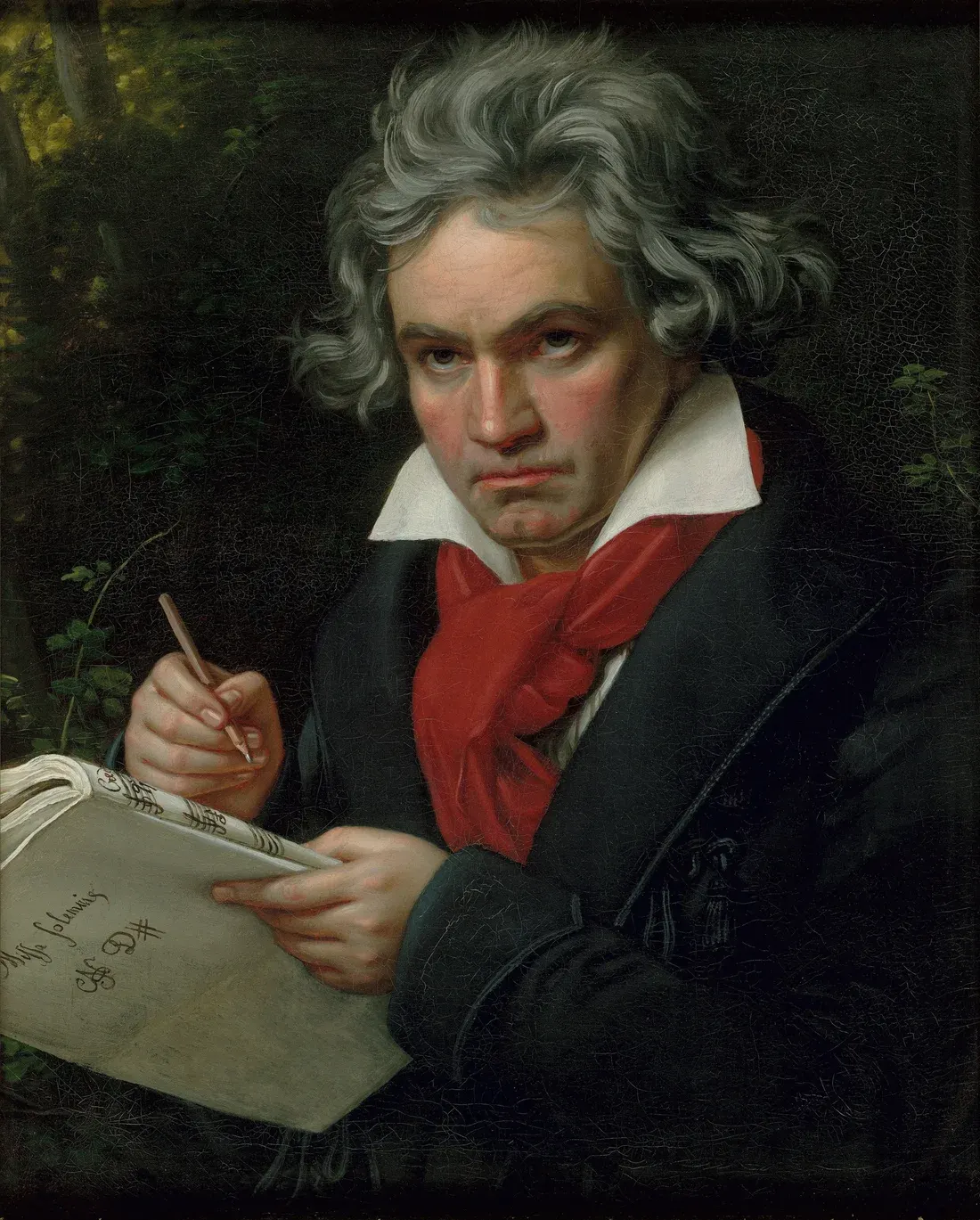
Ludwig van Beethoven · Joseph Karl Stieler, “Beethoven with the manuscript of the Missa solemnis” (1820) · Beethoven-Haus Bonn · public domain · Wikimedia Commons
His symptoms are recorded in Beethoven's own letters. A passage quoted from a letter in a paper about his ears shows that the illness began in his left ear ("the illness in this ear, my left"), making it difficult for him to hear high notes in instruments and voices ("high notes of instruments and voices are not heard") (DOI: 10.1097/mao.0000000000002755). Speech was also a problem. ("At times I cannot hear the words of people speaking quietly. I hear the sound, but not the words.") His ears buzzed day and night, and he could not bear it when anyone shouted (DOI: 10.1097/mao.0000000000002755). The difficulties Beethoven experienced in his left ear, where the illness began, were high notes and parsing speech out of sound. There were times when sound came in, but he could not understand what the words meant.
In the autumn of 1802, after spending several months in the thermal spa village of Heiligenstadt near Vienna, he poured out a mixture of despair and resolve in a written text. This later came to be known as the "Heiligenstadt Testament" (DOI: 10.1093/actrade/9780190051730.003.0005). That same year, he requested that after his death, his illness be described and made known to the world (PMID 36958333). Eventually, he had to give up appearing in public as both a pianist and a conductor. Yet the illness did not stop his composition, and he continued writing music until the end of his life (DOI: 10.1093/actrade/9780190051730.003.0005).
During those exact few years when his hearing began to deteriorate, Beethoven was writing his first six string quartets (Opus 18, 1798–1800). Let us listen to the opening of the fourth one, written in C minor. The sound is a synthesized performance imitating a string quartet, faithfully transcribing the notes written in the score. What to listen for is the cello steadily repeating a low C, while above it, the first violin's melody ascends over the course of eight bars.
Clip: Beethoven, String Quartet in C minor, Op. 18 No. 4, i, bars 1–8 (synthesized strings; score input Mutopia Project, public domain)
This is the opening of the young Beethoven's quartet, where the low, steady repetition of the cello and the melody above move distinctly apart. There is no basis to say that his hearing is contained within this passage. The score simply plays the notes he wrote.
Reading the Ears in a Work
Beethoven's ears are also used as a key to read his works. A musicology book dealing with disability and music interprets that, starting around 1800, composers wove stories of overcoming disability into their pieces by bringing up "problems" of melody or harmony and ultimately resolving them back to normal. That book views this narrative in some of Beethoven's middle-period works as reflecting, along with changes in the view of disability of that era, the traces of Beethoven himself wrestling with deafness (DOI: 10.1093/acprof:oso/9780199766451.003.0003).
This interpretation is a reading in musicology, not an experiment or measurement. This article does not judge the rightness or wrongness of that reading. Instead, it narrows the question. What caused Beethoven's ears to go deaf? And how could a person who became unable to hear continue to write music? Doctors have provided answers to the former question for nearly 200 years, and there are records and interpretations for the latter. The performance clips included in this article merely play the notes written in the score, and do not find Beethoven's ears in those notes.
Two Sites Where Sound Gets Blocked
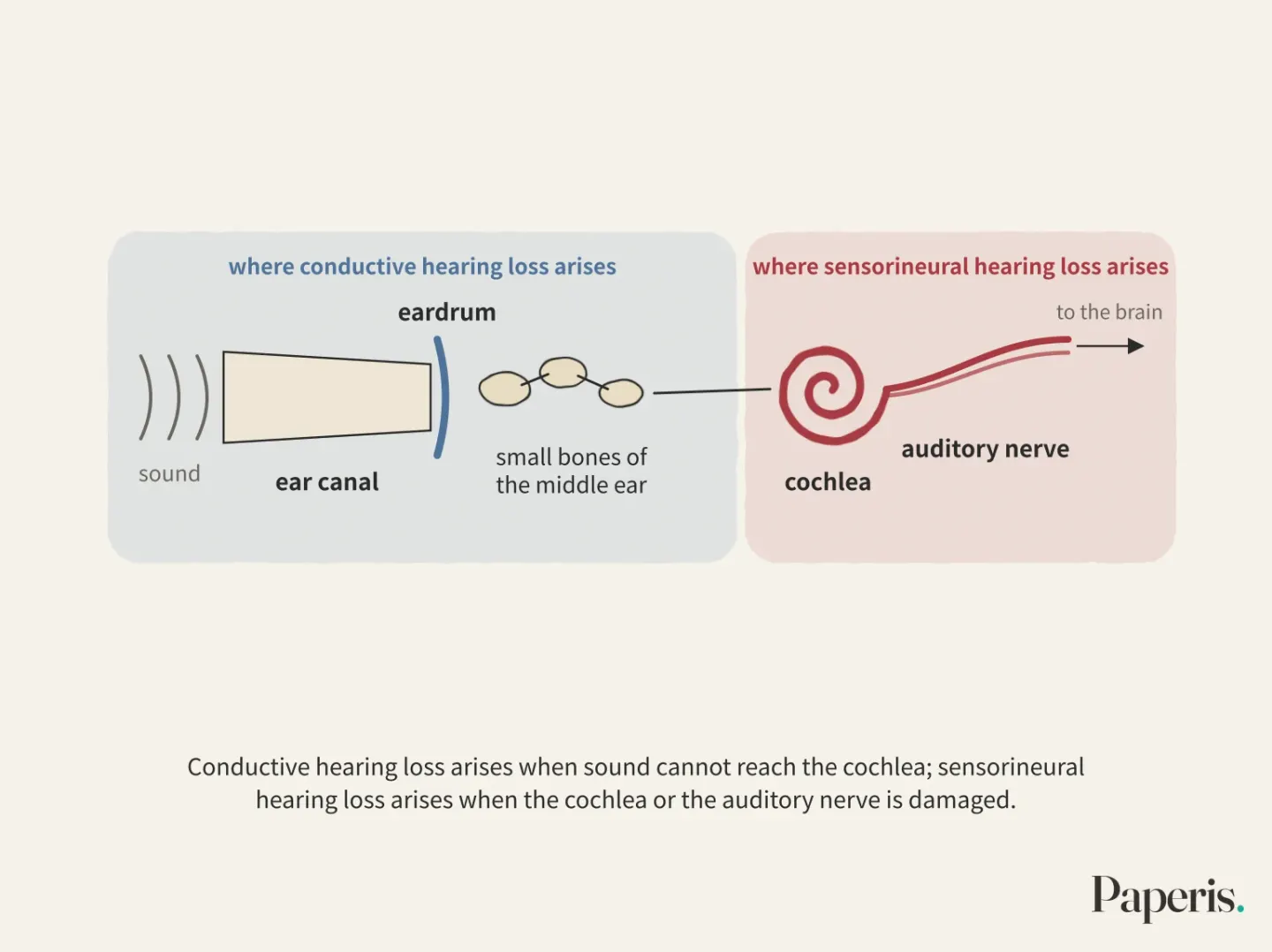
Hearing loss largely occurs at two sites. Conductive hearing loss is hearing loss that happens because sound cannot reach the cochlea deep inside the ear (DOI: 10.1093/med/9780199568741.003.0051). This is when trouble arises somewhere in the ear canal, the eardrum, the middle ear inside the eardrum, or the small bones contained within it. Sensorineural hearing loss is hearing loss that happens because the cochlea or the auditory nerve carrying sound signals from there to the brain is damaged (DOI: 10.1093/med/9780199568741.003.0051). The former is a blockage in the path where sound enters, while the latter is damage to the side that converts or transmits sound into signals even when it enters. Distinguishing whether it is neural hearing loss is important when predicting the outcome of cochlear implant surgery, which plants an electronic device in the cochlea, wrote the authors of a systematic review gathering literature on Beethoven's hearing loss (PMID 33230590).
Among Beethoven's symptoms, the passage "sounds can be heard, but words cannot be understood" is also seen in patients today. In 2018, a 64-year-old woman came to a hospital with abdominal pain, fatigue, and high-frequency hearing loss. She was in a state where losing high-pitched sounds made it extremely difficult to understand speech. The cause was lead that had dissolved into food over many years from a ceramic-coated frying pan with a worn surface (PMID 31904878). The doctors who reported this case considered her symptoms to be very similar to those of Beethoven. It is a case report of a single person, and that similarity is the judgment of authors who re-read Beethoven's letters and autopsy records.
This kind of comparison is precisely retrospective diagnosis. Retrospective diagnosis is the work of retroactively estimating the illness of a person who died long ago using remaining materials such as letters, records, autopsy reports, and remains. For Beethoven, these materials are unusually abundant. Letters, doctor's notes, conversation books where he exchanged written chats with people, autopsy reports, and locks of hair cut off by people after his death remain (PMID 17214130) (PMID 24343178). Still, a patient from 200 years ago cannot be examined directly. This is why doctors have read different diseases based on the same materials. All the hypotheses in the next section are such estimations, which is why who made each claim is attached to every hypothesis.
Causes Proposed Over 100 Years
A 2021 systematic review searched medical literature from the 100 years between 1920 and 2020 across three databases and by hand, finding 48 papers that attempted to identify the cause of Beethoven's hearing loss (PMID 33230590). The most frequently discussed causes were otosclerosis (10 papers) and syphilis (9 papers), followed by Paget's disease, in which bone is abnormally remodeled (6 papers), and sensorineural hearing loss (5 papers). Immune abnormalities accompanied by inflammatory bowel disease, sensorineural hearing loss accompanied by otosclerosis, sarcoidosis, and lead poisoning each appeared in 2 papers, while systemic lupus erythematosus, trauma, inner ear inflammation, and inner ear disease each appeared in 1 paper. From 1920 to 1970, otolaryngologists wrote the most on this topic (67%), and after 1971, 81% of the authors were from other specialties (PMID 33230590). The authors noted that 250 years after his birth, the cause remains unclear. What this tally tells us is that the hypotheses have not converged in a single direction. Below are four among them that have been subject to counterarguments.
Otosclerosis is a disease in which bone grows abnormally around the small bones of the middle ear, blocking the pathway through which sound is transmitted inward. It belongs to the conductive hearing loss side of the two categories we saw earlier. In 1990, the author of an audiologic review, along with the majority of otologists, considered this disease extending to the cochlea to be the most plausible diagnosis for Beethoven's hearing loss (PMID 2240185). The authors of a 2013 literature review advocating the lead hypothesis disagreed with this. They stated that although Beethoven's middle ear was examined carefully with the naked eye during autopsy, no otosclerotic lesions were visible (PMID 23686526).
The syphilis hypothesis is also long-standing. Dismissed for a long time, it has noticeably revived over the past 20 years, according to the 2021 systematic review (PMID 33230590). The counter-evidence runs in two directions. A 2006 review of primary sources dealing with Beethoven's final illness and death concluded that there was almost no clinical or autopsy evidence that Beethoven suffered from syphilis (PMID 17214130). The authors of the 2013 lead hypothesis concluded it was not syphilis based on the fact that syphilis was treated with mercury at the time, yet no mercury was found in Beethoven's hair and bones (PMID 23686526).
The immune hypothesis is an attempt to tie Beethoven's entire body into a single disease. He suffered from repeated severe diarrhea from his late teens and died of cirrhosis at age 57 (PMID 35189464). In 2005, a research team re-read letters and contemporary records, concluding that his abdominal symptoms, which began in his teens, strongly suggested inflammatory bowel disease. This disease is a problem of immune regulation, and it can simultaneously cause sensorineural hearing loss outside the gut and cholangitis that stiffens the liver. Therefore, these authors concluded that Beethoven's hearing loss was an immune disorder accompanying inflammatory bowel disease (PMID 16015189). Another author in 2022 considered this explanation to cleanly connect three things: diarrhea, hearing loss, and cirrhosis (PMID 35189464). A counterargument came from the same 2013 paper. Beethoven's hearing loss worsened slowly over many years, whereas immune-mediated hearing loss worsens rapidly over several months, and he lacked the bloody diarrhea that is almost always present in inflammatory bowel disease (PMID 23686526).
The lead hypothesis was proposed by different authors in 2013, 2021, and 2024. The 2013 literature review argued that the high lead concentrations deep in Beethoven's bones found in earlier analyses pointed to repeated exposure over many years rather than short-term exposure just before death. They stated that the shrunken auditory nerve found at autopsy also matched nerve damage caused by heavy metals like lead. Since Beethoven enjoyed wine and the wine he drank was contaminated with lead, their conclusion was that long-term consumption of lead-laced wine explains his hearing loss better than other causes (PMID 23686526). The fact that lead was illegally added to cheap wine at the time to impart sweetness is also noted by another primary source review (PMID 17214130). The authors of the 2021 frying pan case we saw earlier also weighed various classical hypotheses and concluded that progressive sensorineural hearing loss caused by lead poisoning was the most probable (PMID 31904878).
However, a timing issue attaches to the lead in his hair. A 2013 medical paper summarized from hair analysis that Beethoven was exposed to higher amounts of lead during the final 110 days of his life. As for the cause, they pointed to lead-laced wine, alongside lead-containing medications used to treat pneumonia in the winter of 1826–1827 and wound closure procedures performed after draining fluid from his abdomen four times (PMID 24343178). A 2021 case report analyzing two strands of hair similarly found that lead concentrations in the hair rose and fell along its length, and that those peaks coincided with the timing of his pneumonia treatments and abdominocentesis (PMID 33765204). This means that some of the lead contained in his hair may have come from treatments during his final months. The lead deep in the bone from the 2013 literature review seen earlier was thus interpreted as pointing to a different period—namely, repeated exposure over many years (PMID 23686526). While stating that lead poisoning could explain some of his end-of-life symptoms, the 2006 primary source review conditioned that in order to claim the lead came from wine, body lead must be verified in his skeletal remains (PMID 17214130).
The challenges faced by the four hypotheses differ in nature. Direct counterarguments against the otosclerosis, syphilis, and immune hypotheses came mainly from the single 2013 literature review that advocated the lead hypothesis, with the judgment of the 2006 primary source review added for syphilis. The lead hypothesis carries the questions of when and where that lead entered, along with the condition of skeletal verification. The 2021 systematic review noted that the cause is not clear (PMID 33230590).
Eight Locks of Hair
In 2023, a new kind of data entered this old debate. Genomic analysis is the process of reading a person's entire DNA to find disease-related variants or traces of microorganisms that had entered the body. The researchers refined ancient DNA techniques to read DNA even from very small amounts in old hair. They then collected and analyzed eight locks of hair purported to be Beethoven's from different sources (PMID 36958333).
Five of the eight locks came from one European man, and the researchers considered these five to be almost certainly genuine. They then used that hair to decode Beethoven's genome densely enough to overlap and read it an average of 24 times (PMID 36958333). The results concerning his illness were threefold. First, the researchers found no genetic causes to explain Beethoven's hearing loss or digestive problems. Second, Beethoven had a genetic predisposition making him susceptible to liver disease. Third, when reading the microbial DNA mixed in the hair together, he had been infected with hepatitis B for at least the last few months before his death. The researchers wrote that this predisposition and infection, along with his widely accepted drinking, plausibly explain the severe liver disease that led to his death (PMID 36958333).
Regarding his ears, what this analysis did amounts to "did not find." Finding no genetic cause is different from proving that no such cause exists. Even after this analysis, hypotheses read this result each in their own direction.
A new hypothesis emerged from the hepatitis B side. In 2023, the authors of a review article hypothesized that the hepatitis B found by the genomic analysis might not have been a matter of just the final few months. Based on the jaundice first recorded in the summer of 1821, a second jaundice a few months before his death, and the point that the risk of hearing loss is high in hepatitis B patients, they viewed that he could have been infected in childhood and had chronic hepatitis B with hearing loss beginning around age 28 (PMID 37302659). It is a proposal that the authors themselves call an "alternative hypothesis," and they wrote that more studies looking at hearing loss in chronic hepatitis B patients are needed.
On the lead side, the conclusion became firmer. A 2024 medical history study concluded that Beethoven's hearing loss and gastrointestinal symptoms were due to lead poisoning, drawing on the points that genomic analysis confirmed five genuine locks, and another research team observed unusually high lead in those genuine hairs (PMID 39639436). This abstract did not state which period of life the hair was from.
The published genome was also used on the otosclerosis side. A 2026 preprint not peer-reviewed gathered multiple genetic variants related to otosclerosis, scored them, and compared Beethoven's score to 503 individuals in a modern European reference population. Beethoven was placed at the 96.02nd and 95.83rd percentiles in the two scores, respectively. However, when five loci that heavily influenced the scores were removed, the first ranking dropped to 84.69%, and when nearby genetic loci were removed, the second ranking dropped to 83.90%. The authors themselves concluded that this analysis is an incomplete and unadjusted exploration, and proves neither otosclerosis nor that it played a part in Beethoven's hearing loss (DOI: 10.21203/rs.3.rs-11236063/v1).
There are inherent limits to what can be told from one person's genome. In 2024, another research team calculated a genetic score for Beethoven's "musicality" using the same genome, and used it as an example showing the broader difficulties carried by an individual's genetic prediction (PMID 38531312). That a genome has been read and that one can speak of a person's disease or talent with that genome are different things.
Genomic analysis sorted out whether the hair was real and provided clues to liver disease, but did not determine the cause of his deafness. A 2021 systematic review wrote that the cause is not clear (PMID 33230590). Since then, genomic analysis did not find a genetic cause for his ears, and a 2024 medical history study concluded it was lead poisoning (PMID 39639436). A review that re-collects subsequent studies and judges the cause is not in the data collected by this article. There is also a review article that critically examines these hypotheses by gathering literature from 1958 to 2023 (DOI: 10.5937/tmg2304102c).
How He Wrote Without Hearing
Regardless of the debate surrounding the cause, things are left in the record. Even after his hearing deteriorated, Beethoven did not lose his love for music, and he wrote songs while occasionally using hearing aid devices that were just being developed (DOI: 10.1097/mao.0000000000002755). The technician Johann Nepomuk Mälzel made a trumpet-shaped hearing aid to be held to the ear, and the piano maker Conrad Graf made a soundboard. Both were attempts to help his hearing. The paper also addressed the possibility that he may have used wooden drumsticks to feel the sound of the piano better (DOI: 10.1097/mao.0000000000002755).
From then on, it is interpretation. A 2026 paper read together letters, historical documents, and musicological analysis, and suggested that Beethoven's composition potentially relied on the sense of feeling vibrations, the memory of movements ingrained in his hands, visual clues, and the ability to imagine sound in his head (PMID 43016131). The term pointing to this last ability is musical imagery. Musical imagery is recalling music as if hearing it in your head even when no sound is actually being made. The experience of a line of a song lingering in your head is a common example.
To translate the words of this paper directly, his composition “potentially” relied on these abilities, and his later works “may reflect” a reorganization between senses that occurred without auditory feedback (PMID 43016131). This is an interpretation based on historical documents, and there are no studies that measured the inside of Beethoven's head. The evidence gathered by this article does not even include an abstract of a study that measured musical imagery itself through experiments. Therefore, the statement that “he wrote while hearing it in his head” must be carried along only as a plausible hypothesis.
In 1826, around the time Beethoven was exchanging words with people in conversation books, let's listen to the opening of the String Quartet in C-sharp minor (Opus 131). The sound is a synthesized sound and follows the score as written. What you are about to hear is the first violin singing a melody alone for four measures, with the second violin entering in a lower register in the fifth measure.
Clip: Beethoven, String Quartet in C-sharp minor, Op. 131, i, bars 1–6 (synthesized strings; score input Mutopia Project, CC BY-SA 2.5)
This is the opening where the second violin is added beneath the first violin that started alone. This piece moves directly into the next movement without a pause. The opening of the following second movement is a fast 6/8 time in D major.
Clip: Beethoven, Op. 131, ii, bars 1–12 (synthesized strings; score input Mutopia Project, CC BY-SA 2.5)
Unlike the previous first movement, it was a fast 6/8 time in D major. What these two passages tell us are the notes Beethoven wrote on the score at this time. How he heard those notes in his head is not told by this sound.
Today's Musicians with Hearing Loss
People with sensorineural hearing loss have a hard time understanding speech, and it is even harder when there is background noise. Even if you turn up the sound with a hearing aid, this difficulty remains (PMID 23566981). Though we cannot measure Beethoven himself, there are studies that measure today's people with hearing loss and music. The subjects of these studies are people of today, and if you keep that line, a few things become visible.
A 2013 study compared middle-aged adults with sensorineural hearing loss, dividing them into musicians and non-musicians. While musicians with hearing loss rated themselves as average, their actual ability to understand speech in noise was better than non-musicians who also had hearing loss. Neural responses to sound below the cerebral cortex stage were also clearer and less shaken by noise (PMID 23566981). The researchers interpreted that while hearing loss changes how musicians process sound, the musician advantage in listening to speech in noise is maintained by adaptively strengthening the underlying neural machinery (PMID 23566981). However, because this study compared two groups at a single point in time, this design cannot tell whether music training made that difference.
There is a 2021 systematic review that gathered studies looking at whether training people with hearing loss improves speech perception. Among 13 such longitudinal studies, only 4 had designs that could properly test the causal effect of training, and none of those 4 showed results that music training benefits speech perception (PMID 33634750). Even so, 10 out of the 13 studies claimed a benefit, leading the authors to write that this field has a tendency toward confirmation bias. They recommended designs that can separate the effects of training from the effects of innate perceptual and cognitive abilities (PMID 33634750). The observation that musicians have special ears and the claim that music training made those ears are two different stories.
The side of enjoying music paints a slightly different picture. A 2026 cross-sectional survey compared 201 people with normal hearing, hearing loss without hearing aids, hearing aid users, and cochlear implant users. The worse the hearing, the lower the ability to perceive music, and this was especially true for cochlear implant users. However, how much they participate in music and how much pleasure they derive from it were better explained by music training and age than by hearing status (PMID 42464529). In another 2026 study looking at 85 people aged 60 and older, the more severe the hearing loss, the more music perception and listening frequency decreased, but it was not related to the degree of direct participation in music activities or the overall enjoyment of music. The more music training there was, the higher the perception, participation, and enjoyment all were (PMID 41992140). Because both studies were observations at a single point in time, it remains open here too whether training is the cause.
A 2026 study surveying 116 adults who lost their hearing later in life also shows that hearing loss and assistive devices can deeply conflict with the ability to enjoy music. Among the 75 people included in the comparative analysis, 73% said music was still important, but 48% enjoyed music "always" or "mostly," while 23% "rarely" or "never" enjoyed it (PMID 42041967). Being a musician did not guarantee better enjoyment. However, when enjoyment decreased, musicians held on more stubbornly in the expectation that things would get better (PMID 42041967).
In two cross-sectional studies, more music training meant higher music enjoyment, but another survey showed that being a musician did not guarantee better enjoyment, and showed a tendency to hold on more stubbornly when enjoyment decreased. We do not yet know if training is the cause, or if it was the same for Beethoven. To say that "Beethoven would have been like that too," one needs an additional assumption that the trends shown by today's cross-sectional studies also fit a composer from 200 years ago. There are no studies measuring that assumption.
Let us listen to one more passage from the same late quartet. At the beginning of the fourth movement of Opus 131, two violins alternate passing fragments of a melody back and forth, and the cello repeats the same note. The sound is a synthesized audio, exactly as written in the score.
Clip: Beethoven, Op. 131, iv, bars 1–8 (synthesized strings; score input Mutopia Project, CC BY-SA 2.5)
The melody fragments went back and forth between the two violins. These are the notes he wrote down in the score near the end of his life.
So What Did We Find Out
Beethoven's letters state that he had difficulty hearing high notes and speech in his left ear, where the illness began (DOI: 10.1097/mao.0000000000002755). The cause has been guessed at for nearly two hundred years, and even just looking at the papers included from 100 years of literature in one systematic review, otosclerosis and syphilis were mentioned most often, alongside ten other causes (PMID 33230590). The otosclerosis, syphilis, and immune hypotheses directly received counterarguments mainly from a 2013 lead hypothesis paper, the lead hypothesis carries the question of when that lead entered, and chronic hepatitis B holds the status of an alternative hypothesis as the authors themselves called it. A 2023 genomic analysis sorted out real hairs and provided clues for liver disease and hepatitis B, but stopped at finding no genetic cause for the ears (PMID 36958333). Afterwards, a 2024 medical history study concluded it was lead poisoning (PMID 39639436), and the otosclerosis score is a preprint that the authors themselves call exploratory.
Records and interpretations are split on the question of how he kept composing. Ear trumpets and soundboards are records (DOI: 10.1097/mao.0000000000002755), while vibrations, muscle memory, and hearing in his head are literature-based "potential" interpretations (PMID 43016131). Modern studies on people with hearing loss simultaneously show tendencies where musical training and the enjoyment of music go together, and results that enjoyment is not guaranteed even for musicians, and those studies did not measure Beethoven.
So what this article takes away is this. What Beethoven lost remains in his letters, but why he lost it and how he kept composing are still in the realm of estimation. What securely remains in between is the sheet music he wrote in 1826, and that score still lets us hear every single note as it was.
Source Papers
- "Deafness" (2022) — DOI: 10.1093/actrade/9780190051730.003.0005 — Beethoven first noticed hearing loss around 1798, wrote the Heiligenstadt Testament in 1802, and although he stopped performing and conducting, he composed until the end of his life (a chapter from the primer).
- "Beethoven: His Hearing Loss and His Hearing Aids" (2020) — DOI: 10.1097/mao.0000000000002755 — Quotes letters detailing progressive hearing loss in the left ear starting at age 26, suffering from high pitches, speech, tinnitus, and loud sounds, and discusses Maelzel's ear trumpets, Graf's soundboards, and wooden rods.
- "Beethoven's triad: Diarrhoea, deafness and cirrhosis. A plausible solution to the 195-year-old controversy." (2022) — PMID 35189464 — Diarrhea starting in his late teens, hearing loss around age 28, and death from cirrhosis at 57; suggests ulcerative colitis and its complications link all three through a single autoimmune mechanism.
- "The deafness of Ludwig van Beethoven" (2023) — DOI: 10.5937/tmg2304102c — Severe hearing loss developing from his 30s; a review gathering literature from 1958–2023 to critically examine cause hypotheses.
- "Genomic analyses of hair from Ludwig van Beethoven." (2023) — PMID 36958333 — Five of eight hair locks belonged to a single male (judged authentic), genome sequenced at 24x depth; found no genetic explanation for hearing loss or digestive problems, but confirmed liver disease predisposition and hepatitis B in the months before death.
- "Musical Narratives of Disability Overcome: Beethoven" (2011) — DOI: 10.1093/acprof:oso/9780199766451.003.0003 — Musicological interpretation that composers began crafting "disability overcome" musical narratives around 1800, and that this reflects his struggle with deafness in Beethoven's middle-period works (a chapter from the book).
- "Hearing loss" (2018) — DOI: 10.1093/med/9780199568741.003.0051 — Hearing loss is divided into conductive (sound cannot reach the cochlea) and sensorineural (cochlea and auditory nerve abnormalities) (a chapter from a medical textbook).
- "Aetiology of Ludwig van Beethoven's hearing impairment: hypotheses over the past 100 years - A systematic review." (2021) — PMID 33230590 — 48 papers from 1920–2020: 10 otosclerosis, 9 syphilis, 6 Paget's disease, 5 sensorineural hearing loss, etc.; the cause remains unclear, the syphilis hypothesis has resurfaced, and differential diagnosis of sensorineural hearing loss is clinically important today from a cochlear implant perspective.
- "A Modern Case Sheds Light on a Classical Enigma: Beethoven's Deafness." (2021) — PMID 31904878 — Case report and literature review of a 64-year-old woman with high-frequency hearing loss due to chronic lead poisoning from worn coated frying pans; views lead-induced progressive sensorineural hearing loss as the most plausible cause.
- "Beethoven's terminal illness and death." (2006) — PMID 17214130 — Examination of primary sources (letters, physician reports, conversation books, autopsy, hair toxicity analysis); cause of death was alcoholic cirrhosis, lead poisoning can explain some end-of-life symptoms, and evidence for syphilis is sparse.
- "[Beethoven's ringlets--from a medical point of view]." (2013) — PMID 24343178 — Hair analysis shows increased lead exposure during the last 110 days of life; wine laced with lead, alongside pneumonia treatments and paracentesis wound care, appear to be the causes.
- "The deafness of Beethoven: an audiologic and medical overview." (1990) — PMID 2240185 — Considers cochlear otosclerosis the most plausible diagnosis, alongside the majority of otolaryngologists.
- "Lead and the deafness of Ludwig van Beethoven." (2013) — PMID 23686526 — Literature review: no otosclerosis lesions at autopsy, different from immune-related hearing loss in progression speed, no syphilis due to absence of mercury; concludes lead-laced wine is the best explanation based on deep bone lead and a shrunken auditory nerve.
- "The deafness of Ludwig van Beethoven: an immunopathy." (2005) — PMID 16015189 — Concludes that abdominal symptoms starting in his teens strongly suggest inflammatory bowel disease, and hearing loss was an accompanying immune disorder.
- "Beethoven's death-the result of medical malpractice?" (2021) — PMID 33765204 — Forensic case report showing lead concentrations in two strands of hair rising and falling along their length, with peaks coinciding with the timing of pneumonia treatments and paracentesis.
- "Could chronic HBV infection explain Beethoven's hearing loss? Implications for patients currently living with hepatitis B." (2023) — PMID 37302659 — Alternative hypothesis (review) suggesting early-acquired chronic hepatitis B caused hearing loss around age 28, based on jaundice in 1821 and before death; recommends further research.
- "[The Pathography and Art of Beethoven, Revisited]." (2024) — PMID 39639436 — Concludes that hearing loss and gastrointestinal symptoms were due to lead poisoning, based on high lead levels in authenticated hair.
- "Beethoven's genome shows elevated genetic susceptibility to otosclerosis" (2026) — DOI: 10.21203/rs.3.rs-11236063/v1 — Preprint: otosclerosis genetic score was in the 96th and 95.8th percentiles but dropped to about 84% in sensitivity analysis; authors conclude even otosclerosis does not prove its contribution.
- "Notes from Beethoven's genome." (2024) — PMID 38531312 — Uses the same genome to calculate a musicality genetic score as an example showing the broad difficulties of genetic prediction for a single individual.
- "Beethoven's progressive hearing loss: Neuroplasticity and musical adaptation." (2026) — PMID 43016131 — Synthesizes historical documents, letters, and musicological analysis to interpret that vibratory perception, motor memory, visual feedback, and inner auditory imagery may have potentially supported his composition.
- "Musicians change their tune: how hearing loss alters the neural code." (2013) — PMID 23566981 — Middle-aged musicians with hearing loss performed better on speech-in-noise listening and brainstem responses than non-musicians (cross-sectional comparison).
- "No Evidence That Music Training Benefits Speech Perception in Hearing-Impaired Listeners: A Systematic Review." (2021) — PMID 33634750 — Of 13 longitudinal studies, 4 used designs allowing causal testing, and none showed benefits; 10 claimed benefits, showing a trend toward confirmation bias.
- "Characterizing Music Engagement and Reward in Individuals Across a Spectrum of Hearing Loss and Rehabilitation." (2026) — PMID 42464529 — Cross-sectional survey of 201 people: hearing relates to music perception, but participation and enjoyment are better explained by music training and age.
- "Preserving music reward in age-related hearing loss through training and adaptation." (2026) — PMID 41992140 — Mixed-methods study of 85 adults aged 60 and older: greater hearing loss reduces perception and listening frequency, but overall participation and enjoyment do not decrease, and both are higher with more music training.
- "Tuning in: How Hearing Loss and Assistive Devices Reshape Musical Quality of Life." (2026) — PMID 42041967 — Survey of 116 adults with adult-onset hearing loss: music remains important to 73%, but only 48% enjoy it always or mostly; musicians did not enjoy it more but were more persistent.
Sources (25)
- DeafnessDOI 10.1093/actrade/9780190051730.003.0005
- Beethoven: His Hearing Loss and His Hearing AidsDOI 10.1097/mao.0000000000002755
- Beethoven's triad: Diarrhoea, deafness and cirrhosis. A plausible solution to the 195-year-old controversyPMID 35189464
- The deafness of Ludwig van BeethovenDOI 10.5937/tmg2304102c
- Genomic analyses of hair from Ludwig van BeethovenPMID 36958333
- Musical Narratives of Disability Overcome: BeethovenDOI 10.1093/acprof:oso/9780199766451.003.0003
- Hearing lossDOI 10.1093/med/9780199568741.003.0051
- Aetiology of Ludwig van Beethoven's hearing impairment: hypotheses over the past 100 years - A systematic reviewPMID 33230590
- A Modern Case Sheds Light on a Classical Enigma: Beethoven's DeafnessPMID 31904878
- Beethoven's terminal illness and deathPMID 17214130
- [Beethoven's ringlets — from a medical point of view]PMID 24343178
- The deafness of Beethoven: an audiologic and medical overviewPMID 2240185
- Lead and the deafness of Ludwig van BeethovenPMID 23686526
- The deafness of Ludwig van Beethoven: an immunopathyPMID 16015189
- Beethoven's death-the result of medical malpractice?PMID 33765204
- Could chronic HBV infection explain Beethoven's hearing loss? Implications for patients currently living with hepatitis BPMID 37302659
- [The Pathography and Art of Beethoven, Revisited]PMID 39639436
- Beethoven's genome shows elevated genetic susceptibility to otosclerosisDOI 10.21203/rs.3.rs-11236063/v1
- Notes from Beethoven's genomePMID 38531312
- Beethoven's progressive hearing loss: Neuroplasticity and musical adaptationPMID 43016131
- Musicians change their tune: how hearing loss alters the neural codePMID 23566981
- No Evidence That Music Training Benefits Speech Perception in Hearing-Impaired Listeners: A Systematic ReviewPMID 33634750
- Characterizing Music Engagement and Reward in Individuals Across a Spectrum of Hearing Loss and RehabilitationPMID 42464529
- Preserving music reward in age-related hearing loss through training and adaptationPMID 41992140
- Tuning in: How Hearing Loss and Assistive Devices Reshape Musical Quality of LifePMID 42041967