Paperis Articles
Chopin — Why Doesn't the Music Fall Apart When the Beat Bends?
Chopin wrote a single word meaning 'stolen'—'rubato'—into the scores of fourteen pieces. Studies measuring recordings of Schumann and Beethoven find that slowing gathers at phrase endings and moments of tension, a shared framework with room for individuality inside it; recordings of a Chopin étude show part of that framework shifting over time. Musically trained listeners expected that slowing without knowing it. One study found a fairly wide acceptable range of rubato size; how the bending scales with tempo, and how much training matters, still come out differently from study to study.
Your field's papers, as audio
Pick your fields and journals — Paperis summarizes the key papers and turns them into audio. Listen on your commute.
Start Paperis free →Chopin — Why Doesn't the Music Fall Apart When the Beat Bends?
The Single Word Chopin Wrote on His Scores
The composer and pianist Frédéric Chopin (1810–1849), born in Poland and active in Paris, wrote the word "rubato" on fourteen scores written between 1828 and 1835 (DOI: 10.1093/oso/9780198161691.003.0008). He usually wrote only this single word, with "poco rubato" ("poco" meaning "a little") appearing twice, "sempre rubato" ("sempre" meaning "always") once, and "languido e rubato" ("languido" meaning "languidly") once. He never attached the word "tempo" in front of it. Except for one piece that survives only in manuscript and two published posthumously, these works were published between 1832 and 1836. For Chopin, rubato was also an instruction written directly onto the score.
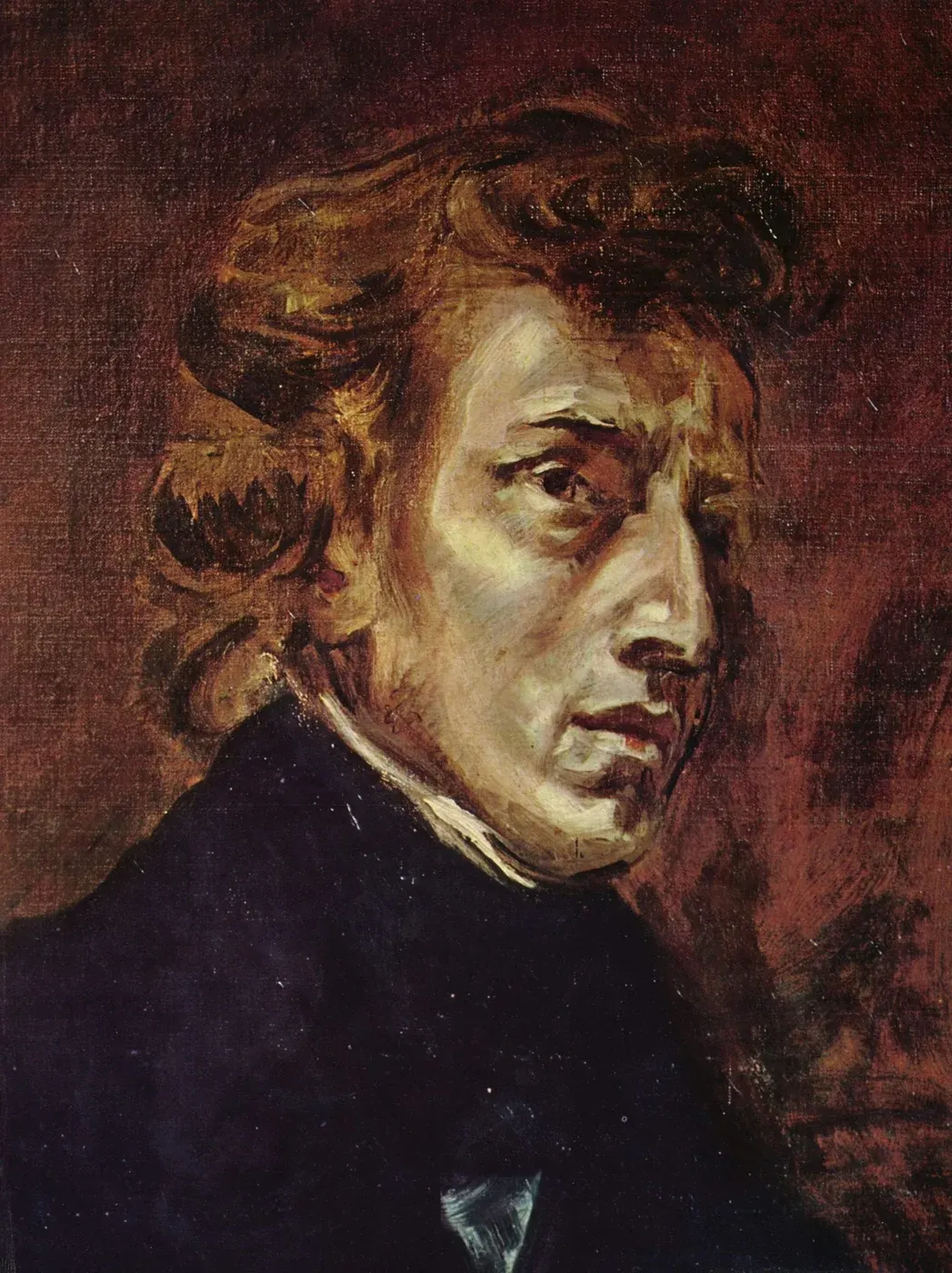
Frédéric Chopin · oil painting by Eugène Delacroix (1838; originally part of a larger painting with George Sand) · Musée du Louvre · public domain · Wikimedia Commons
Tempo rubato is an Italian term meaning "stolen time," a performance practice where notes written with the same length in the score are played while stretching or shrinking time for a moment. The beat is the even pulse you match when tapping your foot while listening to music, and the tempo is the speed at which the beat passes. In the early 18th century when the term was first used, it referred to a practice in Baroque vocal music. The accompaniment strictly keeps the beat, while only the durations of a few notes within the melody are altered for expression (DOI: 10.1093/oso/9780198161691.003.0001). This old rubato persisted in vocal and violin music for a long time into the 19th century, and entered keyboard music in the late 18th century. Over time, the term gradually came to refer not only to the melody but also to the speeding up and slowing down of the entire music. Because two forms overlap within the single word rubato, this article will call the former "rubato that shakes only the melody" and the latter "rubato that shakes the overall tempo."
First, we listen to a sound that will serve as a standard. This is a synthetic piano version of the beginning of Chopin's Nocturne in E-flat major, Op. 9, No. 2, up to the fourth measure where the first phrase of the melody closes, played with even beats exactly as the lengths are written in the score. Not a single curve of tempo has been added.
Clip: Chopin, Nocturne Op. 9 No. 2, opening, even beat as written (synthesized piano; score input Mutopia Project, CC BY-SA 3.0)
The left-hand accompaniment walks at equal intervals, and the right-hand melody clings to that stride without a hair's breadth of deviation. Rubato that shakes only the melody is a method built on this where the accompaniment keeps the beat, and only the durations of a few notes in the right-hand melody are changed. The version below is not an actual performer's recording, but an example we created. We kept the left hand identical to above, and made only the right-hand melody slow down little by little as it moved toward the middle of the measure, meeting the left hand again on the first beat of the next measure.
Clip: same passage, our example — left hand even, right-hand melody lags and rejoins on the next downbeat (synthesized piano; not a recording)
The accompaniment's stride stays the same while only the melody drifts backward toward the middle of the measure and meets the accompaniment again on the first beat of the next measure. In a 1985 experiment assigning the task where one hand must briefly depart from a shared beat, skilled pianists could play rubato, but in this experimental task imitating rubato, not only inexperienced participants but also the two hands of skilled piano performers interfered with each other (DOI: 10.2307/40285314). Both groups performed better when their more capable right hand took charge of rubato, and the researchers noted this as a result supporting the advice of Mozart and Chopin introduced from earlier literature: "Let the right hand take charge of rubato."
While discussions of performance frequently emphasize diversity and artistic freedom, researchers note that interpretation is not something that can be done anyhow and there is general agreement that standards exist by which performances can be gauged (DOI: 10.2307/40285608). One flute instruction book explains rubato as "time stolen and paid back," writing that the tempo is maintained within a single measure while the notes within it are placed slightly earlier or later than the basic beat (DOI: 10.1093/oso/9780195145212.003.0061). This is a performer's description, not a measurement. The questions this article will follow are two: where performers actually slow down and speed up time, and what listeners hear as those curves.
The Same Score, Dozens of Curves
If you mark the moment each note begins in a recording, you can measure the time between the starts of two neighboring notes. That is how numbers reveal that notes written as the same length in a score are actually made fractions of a second longer or shorter. Expressive timing is the practice of playing notes written as equal lengths in the score with slightly different actual lengths. If rubato is the language of the performer and the composer, expressive timing is the language of the researcher measuring that work. The main conclusion of this field is that performers use uneven lengths to convey how notes are grouped and to communicate the framework of the beat, and that conclusion comes primarily from performances of European solo piano music written between 1775 and 1850 (DOI: 10.1093/oxfordhb/9780190454746.013.33). Chopin's music falls squarely within that range.
A phrase is a chunk where a melody continues in a single breath before pausing briefly to catch its breath, corresponding to a clause in speech. In musicology as well, this term is used differently across styles and eras without converging on a single definition, and it has long been discussed in pairing with speech clauses or punctuation marks (DOI: 10.1093/oxfordhb/9780190454746.013.20). Because smaller chunks gather within a phrase to form larger sections, musical groupings are nested in multiple layers (PMID 1479119).
There is a study that measured 28 recordings of the German composer Robert Schumann's piano piece "Träumerei (Dream)" played by renowned pianists (PMID 1479119). Across the broad flow, the tempo curves followed the grouping structure of the piece layer by layer. At the points where large sections ended, the music slowed down markedly, and within short melodic gestures, accented notes were frequently lengthened. The pattern of slowing down within a gesture often traced a parabola, and the different patterns among performers were mostly explained by parabolas modified by just a single adjustment value. The researchers viewed the grouping structure—which determines where a significant slowdown should occur—and the parabolic shape that executes that slowdown naturally as two major constraints followed by pianists. Within those constraints, there was ample room for individual differences, and there were always exceptions to the rules. The distinct personalities of pianists Alfred Cortot and Vladimir Horowitz were also revealed through numbers.
Final ritardando is the practice of gradually lengthening notes and thereby slowing down the tempo as one approaches the end of a phrase. The same pattern was most prominent in recordings of the minuet from the third movement of German composer Ludwig van Beethoven's Piano Sonata Op. 31, No. 3 played by 19 renowned pianists (PMID 2212286). This study sought to find a timing pattern resembling the "Beethoven pulse" mentioned by earlier researchers, but a steady underlying pulse could not be found in any performance. The partial curves could be read either as traces of such an underlying pulse or as stemming from the structure of the piece. Overall, the performers' curves were used to reveal the structure of the piece, with lengthening at phrase boundaries and moments of high melodic and harmonic tension being the most prominent feature.
There are also experiments that directly compared a performer's own thoughts with their curves. When six pianists played the same passage on a keyboard connected to a computer, the rubato pattern was strongest among experienced pianists and weakened when they intentionally tried to play flatly (PMID 2525602). In an experiment where pianists played different passages and wrote down their interpretations on a blank score, the tempo changed most dramatically at the locations they marked as phrase boundaries. The researchers concluded that there are rules for translating thoughts into sound and that the same rules give rise to different interpretations.
There are also studies that directly measured Chopin's music. Chopin's Étude Op. 25, No. 1 is a piece where the performance style has changed relatively little, and its note-onset times were measured by hand in 127 commercial recordings released from 1909 to 2016 (DOI: 10.18061/emr.v15i3-4.7338). Over the span of roughly 100 years, the magnitude of tempo fluctuation neither increased nor decreased, but the locations where rubato was applied shifted. Apart from the tendency for the overall tempo to slow down, the fourth beat of a measure became longer while the second and third beats shortened correspondingly. Several factors worked together in this shift: an increase in final ritardandos, an increase in bowing the tempo across short groupings of a few measures, and a shift toward slightly delaying the arrival at accented dissonances or moments of harmonic change rather than lengthening the melodic intervals containing them. The paper viewed this change as a nearly imperceptible shift in interpretation and noted that some practices long considered the foundation of expressive performance may have been shaped by their eras.
A shared framework and personal individuality blend differently depending on the performer's experience. Ten graduate student pianists played "Träumerei" after a brief practice session, and their performances were comparable to those of renowned performers in average curve shape, slowing profile, and within-performance consistency (PMID 7593927). However, the students were much more similar to one another, whereas the renowned performers varied even in their underlying baseline curves. The researchers interpreted this as experienced performers being less bound by performance norms, resulting in more original and less prototypical performances. If this result holds true for Chopin's nocturnes, two pianists playing a nocturne differently would be the result of choosing different positions within the same framework. However, a study measuring Nocturne Op. 9, No. 2 in this manner is not among the literature referenced in this article.
Now we listen to the beginning of the Nocturne again. This version is also not a recording of an actual performer, but an example we created. Mimicking the common shapes seen above, we pushed the tempo slightly in measures 2–3 and gradually slowed down toward the end of measure 4 where the first phrase closes. Not a single note differs from the first version.
Clip: same passage, our example — slightly pushed in bars 2–3, slowing toward the end of bar 4 (synthesized piano; not a recording)
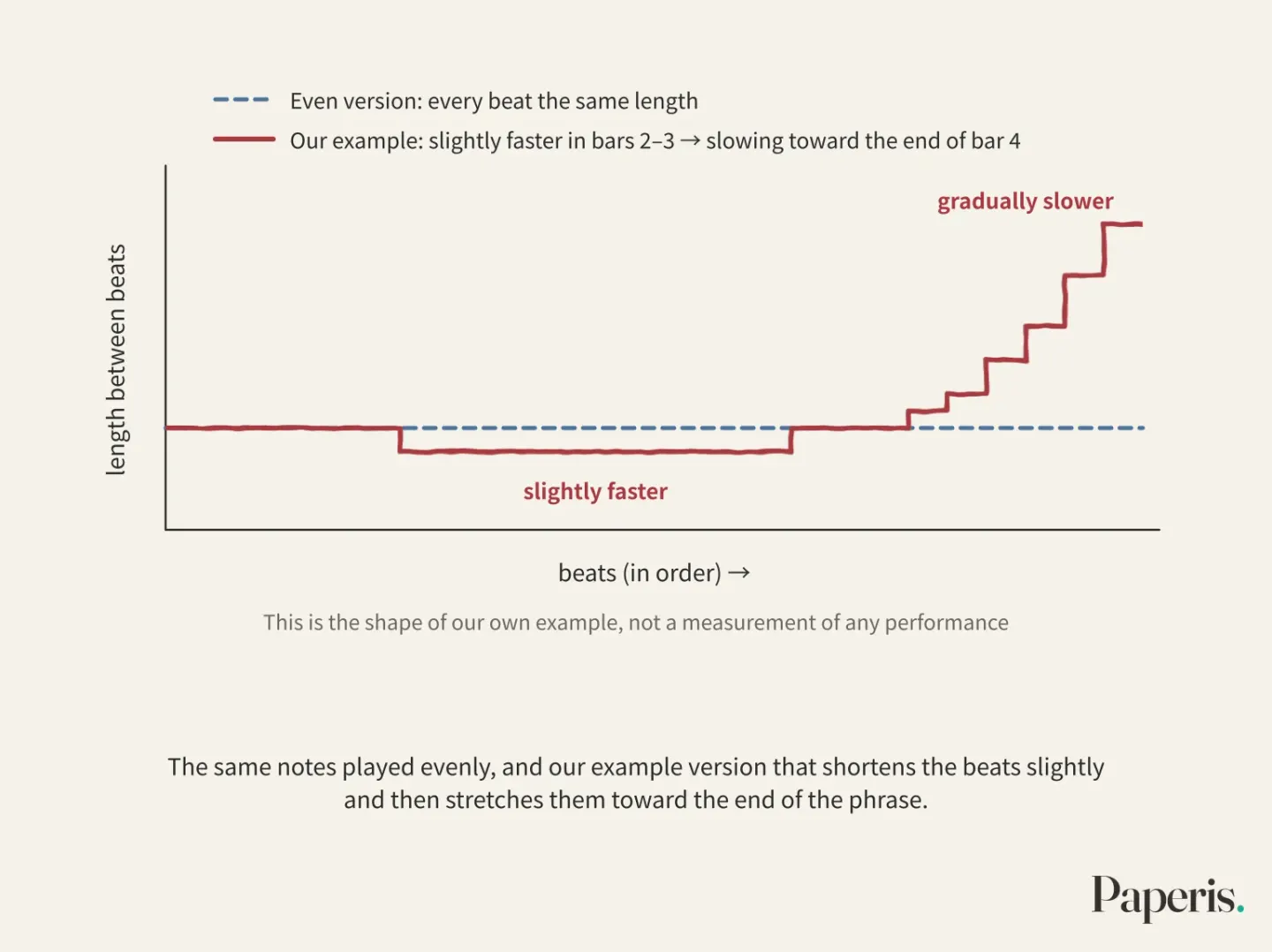
The notes are the same, but measures 2–3 become slightly faster and the pace slows down toward the end of measure 4. There is one takeaway from this section. In the pieces whose recordings were measured, tempo curves concentrated at the ends of phrases and at points of tension, and individuality diverged within that framework. Yet parts of that framework have also shifted over time.
Why Exactly the End of a Musical Phrase?
There is an experiment where pianists were played three short passages and asked to adjust the note intervals themselves so they sounded "even" (PMID 15311655). The resulting intervals were not even and were systematically skewed to one side. One cause came from how the notes were perceived as grouped together, and the other from the effect of sound loudness distorting the sense of time. When the same people intentionally played evenly on the piano, the loudness effect disappeared, and a slight difference created by hand movements according to the groupings remained. Then, when asked to play musically, the change of lengthening the ends of the groups in a layered manner following the grouping structure was added. The researchers concluded that grouping is central to both listening to and creating the rhythm of music. This means that the listener's perception of grouping and the player's lengthening of group ends depend on the same structure.
The fluctuations do not come solely from habits in the fingertips. Six skilled pianists produced their usual tempo fluctuations even when they could not hear their own playing, and they followed those fluctuations quite well with finger taps matched to imagined performances (PMID 11177628). The researchers viewed expressive timing as coming from the mental representation holding the music in the head. Even when asked to play evenly like a metronome, traces of expressive timing remained. These traces stayed the same even when sound was blocked, but they greatly diminished or disappeared when the sensation of pressing the keys with the hands was removed. The researchers interpreted that these remaining traces arise from the physical exchange between the player and the instrument. The main point of this experiment is that both intentionally produced fluctuations and involuntarily remaining fluctuations follow the structure of the musical piece.
In an experiment where chords were advanced one by one by the participants themselves, even people without musical training lingered at the ends of phrases. When participants were made to press keys to advance through Johann Sebastian Bach's chorale one chord at a time, they lingered longer on the chords at phrase boundaries in both the original version and a version altered to remove tonality (DOI: 10.31234/osf.io/52gcp). Even in newly created chord progressions where clues such as meter and melodic contour were controlled, the difference between boundaries and non-boundaries was greater in the tonal version than in the tonality-removed version. Because similar results appeared even in people without musical training, the researchers noted that the lengthening of phrase ends does not rely on musical training and can be elicited solely by chord cues. This study is a preprint released before peer review.
A music box played by turning a handle was tested with the same question. When six participants played a snippet of a piece by American composer Scott Joplin and one by Chopin using the music box, several of them curved the tempo like a bow in accordance with the phrases (DOI: 10.12688/openreseurope.14910.1). Each player had a different habit of swaying the tempo, and the same person showed different habits in the two pieces. It is a small exploratory study measuring six participants, and the paper argued that even with a machine turned by a handle, one can play expressively and in a manner fitting that instrument.
Similar patterns are captured in speech. When American English speakers read sentences aloud, the stressed syllable near the end of a phrase and the final syllable of the phrase became longer, while the weak syllables in between remained unchanged (DOI: 10.1121/1.3655225). This data is a conference presentation abstract, so the weight of the evidence is light. A 1985 computational model produced length structures corresponding to rubato from an analysis dividing musical pieces hierarchically into short and long chunks, and the researcher who built the model noted that the hypothesis that expression is largely determined by musical structure, along with the idea that this structure formally resembles the prosodic structure of speech, received empirical support (DOI: 10.2307/40285321). This is a result derived from the rules set by the model, and the model being correct is not proof that performers think that way. When these measurements are placed side by side, slowing down at the end of a phrase appears to span both the way we perceive groupings and the way we produce sound with our bodies.
The Listening Ear Is Already Waiting for the Slowdown
This time, we look at the listening side. There is an experiment where the spacing between notes in a mechanically steady piece of music is stretched out just a bit in one spot, and listeners are asked if they notice it. In earlier experiments, how easy it was to notice varied by location, and those differences aligned closely with the spots where musicians commonly stretch the music when they perform (PMID 9532960). The researcher interpreted this as listeners expecting the music to be played with expression, and unconsciously compensating for sounds that lacked that expression. Timing expectation is when a listener follows the structure of the music and unconsciously anticipates where the timing will stretch slightly.
Even when played repeatedly with naturally fitting yet non-standard curved performances, these expectations did not change (PMID 9532960). When people only imagined the music in their heads and tried to tap along to a click, the expectation did not appear, but it appeared fully when the click was played layered over actual music. The researcher viewed this expectation as an inevitable result of listening to the structure of music in real time. In another experiment, this pairing of listening and performance appeared regardless of formal music training or the ability to read sheet music, and even when tapping fingers to steadily playing music, the misalignments in the taps wavered in sync with the typical curves of a performance (PMID 10334099). The researcher concluded that the perceived musical structure alters the predictions of the brain's internal timekeeping device, bending the experience of time below the level of consciousness.
There is a study that measured the magnitude of that expectation using a piece by Chopin. In the opening bars of Chopin's Etude in E major, people with musical training had to find small deviations that departed from the typical performance curve (DOI: 10.2307/40285768). When a curve as large as an actual performance was used as the baseline, the biases at the spots that were easy to notice flipped backward, showing that the listener's expectation was smaller than the actual performance curve. So they ran it again with the curve reduced to 25% or 10% of the original, but the bias did not completely disappear. The magnitude of expectation estimated through correlation analysis was about one-fifth of the actual performance curve. This means that the listener's expectation is much smaller than the actual performance curve, at a magnitude that is barely conscious.
There is also an experiment that had people evaluate where slowdowns are placed. When a short melodic gesture that repeatedly appears in "Träumerei" was played with various curves applied to it, the original parabolic curve from the recording analysis received the highest scores from people with musical training, while shifted parabolas or non-parabolic curves scored lower (DOI: 10.2307/40285608). People without musical training could not make consistent judgments. The research team suggested that every melodic gesture has a fitting bundle of time shapes, and people familiar with music know that shape and expect it. They also noted that because that shape is a bundle rather than just one, artistic freedom and individual taste can emerge within it.
This experiment moved the slowdown locations within a single melodic gesture, and we created an example of moving slowdown locations by phrase unit in a nocturne. Again, this is our example, not an actual performance: this time, a slowdown of the same size was placed in the middle of two bars, and the end of the fourth bar—where the first phrase closes—was not slowed down. There are no studies measuring how people evaluate this version.
Clip: same passage, our example — the same amount of slowing placed in the middle of bar 2 (synthesized piano; not a recording)
The amount of the slowdown is the same as the previous example, but the spot where the steps slow down is in the middle of the second bar, and the end of the fourth bar—where the first phrase closes—remains at a steady beat.
EEG studies report that curves helped divide phrase boundaries. Mechanical performance is sound that reproduces the note lengths written in the sheet music just as they are, making them ring with steady beats and no tempo curves. Musicians and non-musicians were played a short two-phrase melody in both a mechanical performance and a version where the boundary between the two phrases was revealed through timing curves (PMID 23383088). The melody was an artificial one that moved up and down like a scale without a key. In the version with curves, the brain's response to the phrase boundaries showed patterns associated with easier processing, whereas without curves, the task appeared more difficult, especially for non-musicians. Even when not paying attention to the sound, responses appeared at boundaries with large pitch jumps, leading the research team to conclude that subtle timing curves draw the listener's attention toward important events and help divide continuous sound into chunks even without focused attention.
Curves are also intertwined with the transmission of emotion. When the timing and loudness of classical piano performances were manipulated and played to listeners, the listeners' expressiveness ratings followed the degree of manipulation in order, and in experiments where timing and loudness were manipulated separately, changes in timing carried more information about expression than changes in loudness (PMID 21261418). The more musical experience one had, the more sensitive they were to these cues. In a brain imaging study where participants listened to a skilled performance and a mechanical performance of the same piece, changes in timing predicted listeners' arousal ratings and real-time brain activity, while responses related to emotion and reward varied depending on musical training (PMID 21179549). The research team noted that these results align with the idea that performances evoke emotion through a type of empathy based on the perception of movement and the mismatch of time expectations relying on beats. Curves alone do not drive bodily responses. In a study where 20 amateur musicians listened to two performances of Chopin's "Tristesse" (Grief), self-rated arousal was strongly tied to sound loudness, while heart rate responded only partially to loudness changes (PMID 23763714). Heart rate changed more in the performance with greater rhythmic tension, leading the research team to conclude that the performer's use of rhythmic tension can also alter bodily responses. Tempo curves help divide phrases and also carry weight in expressiveness ratings and arousal. However, in a study measured using two performances of a Chopin piece, self-rated arousal was strongly linked to sound loudness.
How Much, and for Whom — Still Divided
If music needs a curve to sound like music, just how much of a curve should there be? There is a study that had people listen to the opening phrase of Bach’s Cello Suite No. 3, Bourrée I, created in six different curve sizes (DOI: 10.2307/3345845). The versions ranged from a metronome-straight plate to a plate where the curve from a previous study was magnified fourfold. The version using the curve from the previous study was rated as the most musical, and the next two steps with larger curves were rated slightly less so. The two plates with smaller curves and the four-times-magnified plate were clearly less musical. The researcher interpreted that a performance without rubato does not sound as musical as one with an appropriate curve, and that as long as the flow is kept similar, up to about double the original amount is accepted. The researcher also noted that the flow of the performance may be more important than the exact length of a few milliseconds.
Below is our example adapting this research principle to a nocturne. The piece used in that study was a Bach cello piece, and no study has evaluated the same thing using a nocturne. We magnified the curve of the "Rubato Example" plate four times.
Clip: same passage, our example — the same tempo shape at four times the size (synthesized piano; not a recording)
The shape of the curve is the same, but both the pulling and the lagging have grown four times larger.
Studies have also come to different conclusions about whether the curve moves proportionally when the tempo is changed. In a study where two pianists played "Träumerei" at three tempos, musically trained people had an accuracy barely higher than chance when trying to tell apart the original performance and performances played at different tempos that were artificially stretched or shrunk to match the same length (PMID 8090862). The unique curve of each player was very similar across the three tempos, and there were also statistical differences deviating from perfect proportionality. On the other hand, in a study where "Träumerei" and a piano piece by Debussy were combined across three tempos and five curve depths, and evaluated by skilled pianists, a small but clear tendency emerged in both pieces to prefer relatively shallow curves when the tempo was increased (DOI: 10.2307/40285684). In a study where 307 people were asked to distinguish between original recordings and recordings with only the tempo altered across jazz and classical recordings, the majority correctly identified the original recordings, and the researchers suggested that the relationship between tempo and curve itself could be a clue for recognizing a genuine performance (DOI: 10.1177/0305735607070380). Because the pieces used, the genres used, and the questioning methods differed, it is difficult to line up these results in a single row.
The share of musical training also varies depending on the measurement. Timing expectations where listening and playing are intertwined appeared regardless of formal music education (PMID 10334099), and brainwave responses also appeared in people who had not learned music (PMID 23383088). On the other hand, in the task of evaluating the curve of melodic gestures, people without musical training failed to make consistent judgments (DOI: 10.2307/40285608). One listening experiment conducted on the web had participants compare original recordings of the same piece with recordings where only the tempo was changed; what decided the judgment was not the level of music education, but how much they usually listened to music of that genre (PMID 19170488). The researchers viewed this as evidence that there are musical abilities acquired through simple exposure.
A synthesized sound mimicking the curve does not always sound human. In a study where a violin solo excerpt was synthesized in three ways and participants were asked to choose which one sounded more like a human performance, none of the versions—the plate with the curve predicted by the model, the plate with the curve from an actual expert performance, and the plate with no curve—were consistently picked as sounding human (PMID 31031671). The researchers suggested the possibility that the melody was cut off without a front-and-back context making it difficult to interpret, and the possibility that note articulation or vibrato missing from the model might be the core of what brings expression to the violin. Tempo curves sometimes move together with other acoustic outcomes. In a study analyzing published piano performance data, the Romantic repertoire showed larger tempo curves and wider dynamic ranges than the Baroque repertoire, and fluctuations in tempo were closely intertwined with the width of dynamics (PMID 42597344). In experiments where pianists imitated other people's performances, when they imitated the dynamics, the tempo changed accordingly, making the interval after a loud note longer, but imitating the tempo did not significantly change the dynamics (DOI: 10.2307/40285908).
Interpretations are also divided in studies dealing directly with Chopin's music. According to a commentary published in the same journal, there was a study that measured how well listeners synchronized their beat to performances of Chopin's mazurkas, and that study suggested that performers can manipulate listeners' expectations and suspense using unpredictable tempo curves (DOI: 10.18061/emr.v9i2.4443). The commentary cast doubt on the interpretation linking the state of failing to follow the beat primarily to negative emotions, and proposed an experimental design to separate the effects of tempo and rubato. Because the original study was not in the literature referenced by this article, we convey only as much as the commentary summarized here. In a study where five skilled judges evaluated six expert performances of Chopin's Étude Op. 25, No. 6, the criterion most strongly aligned with overall preference was the right hand's expression and phrasing treatment (DOI: 10.1177/0305735698262004). Tempo was important for distinguishing performances from one another, but did not strongly connect to preference.
Theories explaining tempo curves have not converged into one. Computational theories comparing expressive timing to the laws of physical motion in the real world predict that the shape of the slowdown is independent of the number of notes, rhythmic structure, and overall tempo, but computer simulations using rhythm perception models showed that these factors had a large effect (DOI: 10.1525/mp.2005.23.1.79). The researcher proposed a perception-based model as an alternative. This debate is a comparison between computational models, not a direct measurement of what goes on inside a performer's head. The broad framework of slowing down along with phrases is pointed to by multiple studies. The appropriate size came out across a fairly wide range in one study and also varied depending on the tempo, while the curve when changing tempo and the share of training differ depending on the measurement.
So What Did We Learn
There is something you can try the next time you listen to a Chopin nocturne. It is to listen for whether the steps slow down at the places where a melody finishes a breath and gathers its breath, and how large that slowing is and where it begins for each performer. In the analysis of recordings of "Träumerei" and Beethoven minuets, the slowing concentrated at phrase endings and tension points (PMID 1479119) (PMID 2212286), and in the recordings of 127 Chopin etudes, those locations shifted little by little across eras (DOI: 10.18061/emr.v15i3-4.7338). On the listener's side, a subtle anticipation of that slowing was beneath consciousness (DOI: 10.2307/40285768), and the curves helped the task of parsing phrase boundaries (PMID 23383088). When these measurements are placed side by side, what appears to be the reason music does not fall apart even when the beat is slowed and pulled is that those curves lie upon the skeleton of the phrase that the listener also follows. When the curves became excessively large, they too sounded less musical (DOI: 10.2307/3345845). However, these measurements do not tell us precisely what Chopin desired in the places where he wrote "rubato". The Chopin recording analysis in this article also begins with a 1909 recording.
What a beat is and how humans find that steady pulse were covered in "Rhythm and Beat — Evenly Spaced Stepping Stones, and the Steps That Cross Them". Rubato is the slowing and pulling of the steps crossing those stepping stones, and the studies in this article show that those steps do not hesitate just anywhere. How much hesitation is good came out in a fairly wide range in one study, and how that range varies according to tempo and the listener's experience still comes out differently across studies.
Source Papers
- "Chopin" (Stolen Time, 1995) — DOI: 10.1093/oso/9780198161691.003.0008 — Chopin wrote rubato in 14 pieces written between 1828 and 1835 (poco 2, sempre 1, languido e 1) and never attached a tempo.
- "Introduction" (Stolen Time, 1995) — DOI: 10.1093/oso/9780198161691.003.0001 — rubato = stolen time. In early 18th-century baroque vocal music, accompaniment was strict and only the melody changed, which was old rubato → gradually came to refer to changes in the overall tempo.
- "Performance of a Rubato-like Task: When Two Things Cannot Be Done at the Same Time" (1985) — DOI: 10.2307/40285314 — Skilled performers also experience two-hand interference, and do better when the right hand takes charge of rubato (interpreted by the authors as supporting the recommendations of Mozart and Chopin).
- "A Constraint on the Expressive Timing of a Melodic Gesture: Evidence from Performance and Aesthetic Judgment" (1992) — DOI: 10.2307/40285608 — Parabolic curves of 28 recordings of Träumerei, the original parabola received the highest rating by trained listeners, untrained listeners could not make consistent judgments, flexible constraints.
- "Rubato" (The Simple Flute, 2002) — DOI: 10.1093/oso/9780195145212.003.0061 — Explanation by a flute tutor author: time stolen and then returned, maintaining tempo within the measure.
- "Expressive Timing" (Oxford Handbook of Critical Concepts in Music Theory, 2018) — DOI: 10.1093/oxfordhb/9780190454746.013.33 — Definition of expressive timing, main conclusion is the conveyance of grouping and meter structures, and biased toward European solo piano music from 1775 to 1850.
- "Phrase" (Oxford Handbook of Critical Concepts in Music Theory, 2019) — DOI: 10.1093/oxfordhb/9780190454746.013.20 — A single definition of a phrase is impossible, association with speech clauses and punctuation marks.
- "Diversity and commonality in music performance: an analysis of timing microstructure in Schumann's 'Träumerei'." (1992) — PMID 1479119 — 28 recordings, curves following grouping structure, slowing at the ends of sections, parabolas, individual differences within two constraints, the individuality of Cortot and Horowitz.
- "Patterns of expressive timing in performances of a Beethoven minuet by nineteen famous pianists." (1990) — PMID 2212286 — No steady pulse, lengthening of phrase boundaries and moments of tension are most prominent.
- "Mapping musical thought to musical performance." (1989) — PMID 2525602 — Rubato is strongest in experienced people and weaker when played unmusically, maximum tempo change in places appropriate for phrase boundaries.
- "Historical Trends in Expressive Timing Strategies: Chopin's Etude, Op. 25 no. 1" (2021) — DOI: 10.18061/emr.v15i3-4.7338 — 127 recordings from 1909 to 2016, total amount of curves unchanged, changing places where they are used (lengthening the fourth beat, increased lengthening at phrase endings, etc.), the historicity of convention.
- "Expressive timing in Schumann's 'Träumerei:' an analysis of performances by graduate student pianists." (1995) — PMID 7593927 — 10 graduate students are comparable to masters in average curve but much more homogeneous, masters are less bound by norms.
- "Timing variations in music performance: musical communication, perceptual compensation, and/or motor control?" (2004) — PMID 15311655 — Systematic bias of intervals adjusted to sound even, adding grouping end lengthening in musical performance, central role of grouping.
- "Control of Expressive and Metronomic Timing in Pianists." (1999) — PMID 11177628 — Generation of curves even without auditory feedback (internal representation), traces remaining even in metronomic performance rely on keyboard sensations.
- "Listeners lengthen phrase boundaries in self-paced music" (2017, preprint) — DOI: 10.31234/osf.io/52gcp — Longer dwelling on boundary chords when turning pages of chorales oneself, similar in non-musicians, induced by chord cues.
- "Expressive timing and mechanical instruments: exploring temporal idiomaticity in some music box performances" (2022) — DOI: 10.12688/openreseurope.14910.1 — 6 people performed Joplin and Chopin using music boxes, multiple people playing phrase arches, different tendencies depending on the performer and piece.
- "A biologically inspired neural network for modeling phrase-final lengthening" (2011, conference abstract) — DOI: 10.1121/1.3655225 — Measurement of English phrase-final syllable lengthening and neural network model.
- "A Model of Expressive Timing in Tonal Music" (1985) — DOI: 10.2307/40285321 — Model creating rubato length structures in musical structure, formal similarity to speech prosodic structure.
- "Obligatory 'expectations' of expressive timing induced by perception of musical structure." (1998) — PMID 9532960 — Detectability intertwined with performance curves, unchanged upon repeated exposure, does not appear through imagination alone, inevitable result of structural perception.
- "Detecting deviations from metronomic timing in music: effects of perceptual structure on the mental timekeeper." (1999) — PMID 10334099 — Perception-performance correlation is independent of formal training and sheet music, tap mismatches also show the same curves, subconscious time warping.
- "The Detectability of Local Deviations from a Typical Expressive Timing Pattern" (1998) — DOI: 10.2307/40285768 — Chopin Etude in E major, listener expectations of timing are about one-fifth of the performance curve.
- "Expressive timing facilitates the neural processing of phrase boundaries in music: evidence from event-related potentials." (2013) — PMID 23383088 — Atonal artificial melody, curves help process phrase boundaries, non-musicians have increased load when there are no curves, automatic processing even without attention.
- "Perception of emotional expression in musical performance." (2011) — PMID 21261418 — Temporal changes carry more expressive information than loudness, more sensitive with more experience.
- "Dynamic emotional and neural responses to music depend on performance expression and listener experience." (2010) — PMID 21179549 — Skilled performance versus mechanical performance, temporal changes predict arousal and brain activity, reactions vary according to training.
- "Music, perceived arousal, and intensity: psychophysiological reactions to Chopin's 'Tristesse'." (2013) — PMID 23763714 — 20 people, arousal strongly correlates with sound loudness, greater heart rate changes in performances with high rhythmic tension.
- "Effect of Rubato Magnitude on the Perception of Musicianship in Musical Performance" (2003) — DOI: 10.2307/3345845 — Bach Cello Bourrée, model curves are most musical, up to double is tolerated, zero curves and quadruple are less musical.
- "Relational invariance of expressive microstructure across global tempo changes in music performance: an exploratory study." (1994) — PMID 8090862 — Distinction of performances where only tempo was changed barely exceeds chance level, curves largely maintain proportionality.
- "Quantitative Effects of Global Tempo on Expressive Timing in Music Performance: Some Perceptual Evidence" (1995) — DOI: 10.2307/40285684 — Small but significant interaction where faster means shallower curves are preferred.
- "Is expressive timing relational invariant under tempo transformation?" (2007) — DOI: 10.1177/0305735607070380 — A majority of 307 people identified the original recording, supporting the tempo-specific timing hypothesis.
- "Exposure influences expressive timing judgments in music." (2009) — PMID 19170488 — Timing judgments depend on genre exposure rather than training.
- "Phrase-Level Modeling of Expression in Violin Performances." (2019) — PMID 31031671 — None of the model, expert, or zero-curve synthesized versions consistently come out sounding human.
- "Expressive coupling and textural dissociation in classical piano performance: evidence from the ASAP dataset." (2026) — PMID 42597344 — Romantic repertoire has a greater range of curves and loudness than baroque, coupling of tempo fluctuations and loudness range.
- "Pattern Typicality and Dimensional Interactions in Pianists' Imitation of Expressive Timing and Dynamics" (2000) — DOI: 10.2307/40285908 — Loudness mimicry affects tempo (intervals after loud notes become longer), the reverse has little effect.
- "Expressive Timing, Musical Tension, and Listener-Performer Synchronicity: Commentary on Ohriner" (2014, commentary) — DOI: 10.18061/emr.v9i2.4443 — Commentary on Chopin mazurka synchronization study, questioning negative emotion interpretation, proposing tempo and rubato separation design.
- "The Adjudication of Six Performances of a Chopin Etude: A Study of Expert Knowledge" (1998) — DOI: 10.1177/0305735698262004 — Chopin Op. 25 No. 6, preference is strongest with right-hand expression and phrasing, tempo is important for discrimination but weak for preference.
- "Is There a Perception-Based Alternative to Kinematic Models of Tempo Rubato?" (2005) — DOI: 10.1525/mp.2005.23.1.79 — Kinematic models predict structure- and tempo-independence, perceptual model simulations show large effects, proposing a perception-based alternative.
Sources (36)
- ChopinDOI 10.1093/oso/9780198161691.003.0008
- IntroductionDOI 10.1093/oso/9780198161691.003.0001
- Performance of a Rubato-like Task: When Two Things Cannot Be Done at the Same TimeDOI 10.2307/40285314
- A Constraint on the Expressive Timing of a Melodic Gesture: Evidence from Performance and Aesthetic JudgmentDOI 10.2307/40285608
- RubatoDOI 10.1093/oso/9780195145212.003.0061
- Expressive TimingDOI 10.1093/oxfordhb/9780190454746.013.33
- PhraseDOI 10.1093/oxfordhb/9780190454746.013.20
- Diversity and commonality in music performance: an analysis of timing microstructure in Schumann's 'Träumerei'PMID 1479119
- Patterns of expressive timing in performances of a Beethoven minuet by nineteen famous pianistsPMID 2212286
- Mapping musical thought to musical performancePMID 2525602
- Historical Trends in Expressive Timing Strategies: Chopin's Etude, Op. 25 no. 1DOI 10.18061/emr.v15i3-4.7338
- Expressive timing in Schumann's 'Träumerei:' an analysis of performances by graduate student pianistsPMID 7593927
- Timing variations in music performance: musical communication, perceptual compensation, and/or motor control?PMID 15311655
- Control of Expressive and Metronomic Timing in PianistsPMID 11177628
- Listeners lengthen phrase boundaries in self-paced musicDOI 10.31234/osf.io/52gcp
- Expressive timing and mechanical instruments: exploring temporal idiomaticity in some music box performancesDOI 10.12688/openreseurope.14910.1
- A biologically inspired neural network for modeling phrase-final lengtheningDOI 10.1121/1.3655225
- A Model of Expressive Timing in Tonal MusicDOI 10.2307/40285321
- Obligatory 'expectations' of expressive timing induced by perception of musical structurePMID 9532960
- Detecting deviations from metronomic timing in music: effects of perceptual structure on the mental timekeeperPMID 10334099
- The Detectability of Local Deviations from a Typical Expressive Timing PatternDOI 10.2307/40285768
- Expressive timing facilitates the neural processing of phrase boundaries in music: evidence from event-related potentialsPMID 23383088
- Perception of emotional expression in musical performancePMID 21261418
- Dynamic emotional and neural responses to music depend on performance expression and listener experiencePMID 21179549
- Music, perceived arousal, and intensity: psychophysiological reactions to Chopin's 'Tristesse'PMID 23763714
- Effect of Rubato Magnitude on the Perception of Musicianship in Musical PerformanceDOI 10.2307/3345845
- Relational invariance of expressive microstructure across global tempo changes in music performance: an exploratory studyPMID 8090862
- Quantitative Effects of Global Tempo on Expressive Timing in Music Performance: Some Perceptual EvidenceDOI 10.2307/40285684
- Is expressive timing relational invariant under tempo transformation?DOI 10.1177/0305735607070380
- Exposure influences expressive timing judgments in musicPMID 19170488
- Phrase-Level Modeling of Expression in Violin PerformancesPMID 31031671
- Expressive coupling and textural dissociation in classical piano performance: evidence from the ASAP datasetPMID 42597344
- Pattern Typicality and Dimensional Interactions in Pianists' Imitation of Expressive Timing and DynamicsDOI 10.2307/40285908
- Expressive Timing, Musical Tension, and Listener-Performer Synchronicity: Commentary on OhrinerDOI 10.18061/emr.v9i2.4443
- The Adjudication of Six Performances of a Chopin Etude: A Study of Expert KnowledgeDOI 10.1177/0305735698262004
- Is There a Perception-Based Alternative to Kinematic Models of Tempo Rubato?DOI 10.1525/mp.2005.23.1.79