
Paperis Articles
Schumann — A Stiffening Right Hand and Shifting Moods: How Far Can a Diagnosis Reach?
German composer Robert Schumann's plan to become a concert pianist was thwarted at least partly by a right-hand impairment that began in his early twenties. Focal dystonia has been proposed for that hand, and a 1994 study that analyzed his mood and output concluded that his good moods brought more works but not better ones. An analysis of his Endenich asylum records concluded that the clinical signs strongly point to neurosyphilis, while a 1999 paper judged that, as the cause of death, malnutrition from self-starvation seemed more likely. All of these are retrospective inferences.
Your field's papers, as audio
Pick your fields and journals — Paperis summarizes the key papers and turns them into audio. Listen on your commute.
Start Paperis free →Schumann — A Stiffening Right Hand and Shifting Moods: How Far Can a Diagnosis Reach?
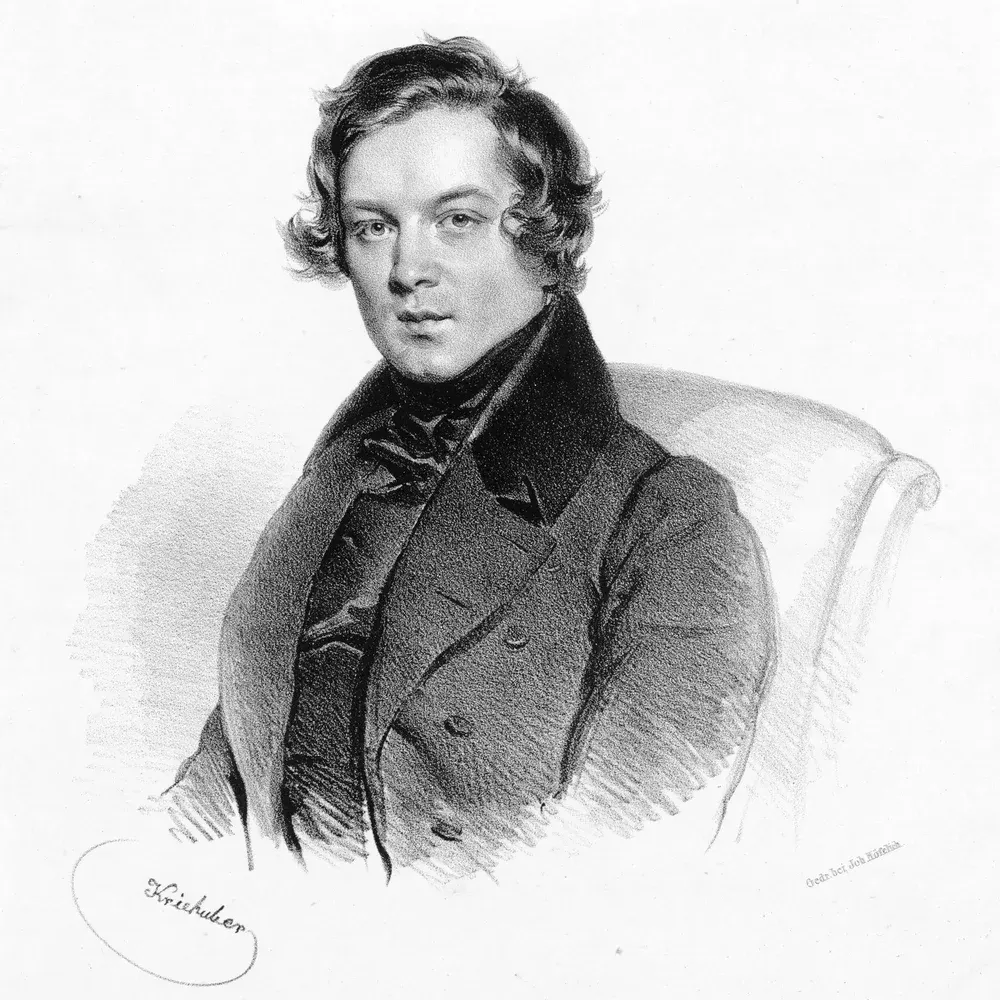
Robert Schumann · lithograph by Josef Kriehuber (1839) · public domain · Wikimedia Commons
A Young Man Who Wanted to Be a Pianist
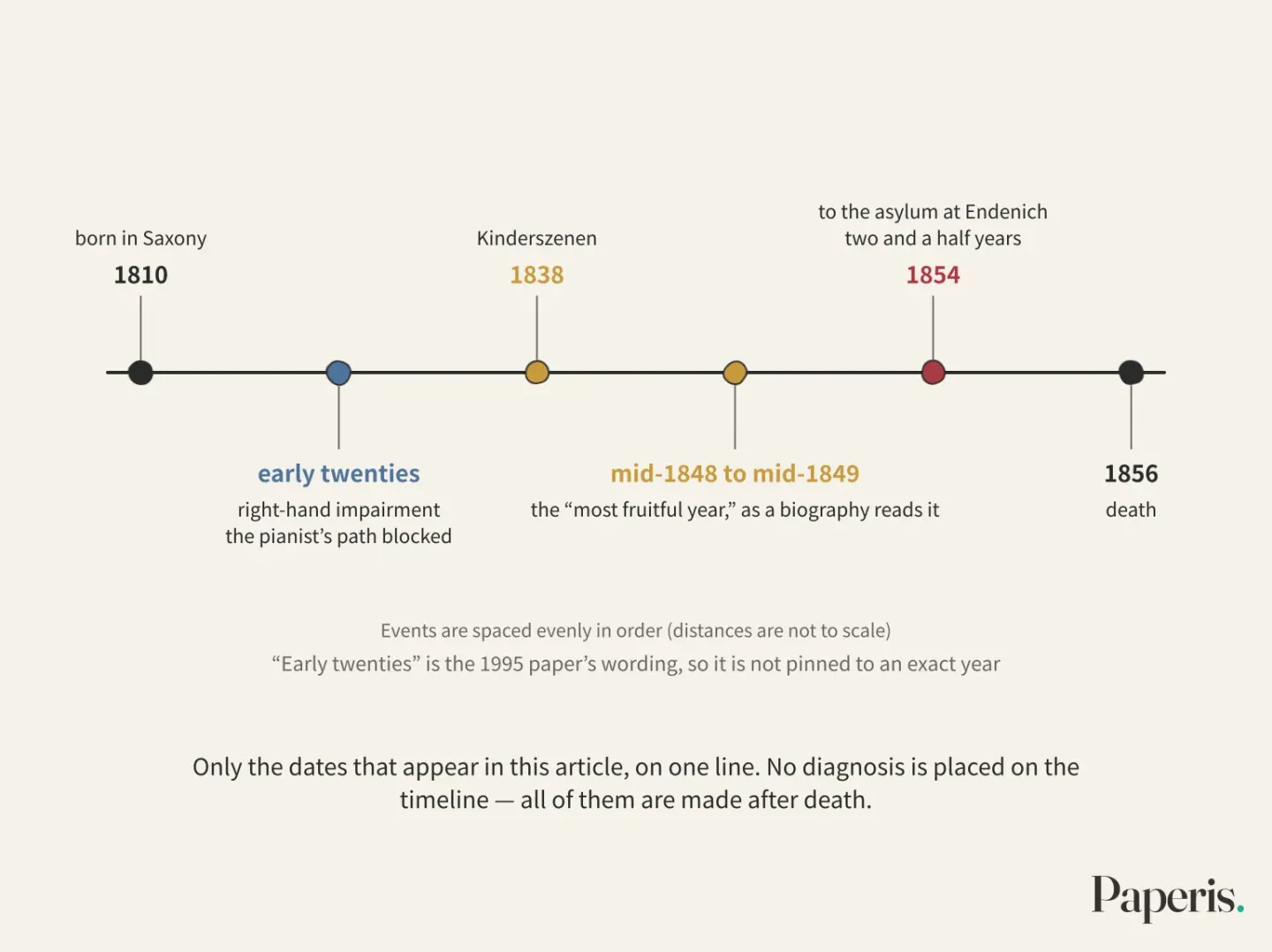
The German composer Robert Schumann was born in Saxony, Germany, in 1810 and passed away in an asylum in July 1856, just past his forty-sixth birthday (PMID 10718523). From an early age, he showed unusual talent in both music and writing, and his initial dream was to be a stage pianist. That dream was derailed, at least in part, by his right hand (PMID 10718523). A neural disorder in his right hand blocked his path as a pianist from his early twenties, and he never received a medical diagnosis during his lifetime (PMID 7565819). He lived as a composer and a writer on music, and he let go of neither pursuit until his final illness struck. His wife was the pianist Clara Wieck, and Clara brought her husband's music to the stage throughout her long performing career (PMID 10718523).
The end was dark. In February 1854, he attempted to take his own life (PMID 10718523), and he spent his last two and a half years in a private psychiatric asylum in Endenich, near Bonn, Germany (PMID 27456194).
This article follows three questions surrounding Schumann. What was the trouble with his right hand, cited as one of the causes that blocked his path as a pianist? How did his moods, which fluctuated throughout his life, intertwine with his works? And what was his final illness? All three questions rest on retrospective diagnosis. Retrospective diagnosis is the work of retroactively estimating the illness of someone who died long ago using surviving materials such as letters, records, autopsy reports, and remains. Among the materials left by Schumann are letters he wrote (DOI: 10.1093/oso/9780195091809.003.0012), letters exchanged by those close to him regarding his illness, and daily records kept by the doctors at the Endenich asylum (PMID 27456194). The disease names appearing below are all estimations by authors who read the surviving materials, and for some, the abstract does not state which materials were read. Where those estimations diverge forms the backbone of this article.
Let us listen to a passage from the music he left behind as a composer. These are the first eight measures of "Of Foreign Lands and People," the opening piece of the 1838 piano suite Kinderszenen (Scenes from Childhood), Op. 15. In G major and 2/4 time, the upper melody begins with "B-G-high G-G," and the shape of the first two measures is repeated identically in measures 3 and 4. Beneath it, a finely divided accompaniment flows without interruption. The sound is a synthesized piano generated from the score, and since the score contains no tempo number, we set it at a quarter note equal to 72.
Clip: Schumann, Kinderszenen, Op. 15 No. 1, “Of Foreign Lands and Peoples,” bars 1–8 (synthesized piano; score input Mutopia Project, public domain)
Symptoms Left in His Right Hand
In Schumann's right hand, his fingers became painful and stiff when playing, and that stiffness spread to other parts of his right arm. It got worse when he was tense and got better when he relaxed his muscles. Writing by hand also became increasingly difficult. A pathography paper published in 1995 summarizes his symptoms like this (PMID 7565819). This paper is classified as a biography and history paper, and which records the symptoms were pulled from does not appear in the abstract. The authors put forward the hypothesis that these symptoms match dystonia (PMID 7565819).
Focal dystonia is a movement disorder where the muscles in one part of the body involuntarily contract excessively, causing the fingers or wrist to stiffen or twist. Among these, the type that usually appears only when playing a musical instrument has its own name. Musician's dystonia is a disease where muscles involuntarily contract specifically during the motion of playing an instrument, making it impossible to freely control long-practiced hand movements.
A 1999 paper reviewing Schumann's life and illness is also cautious. The true nature of his right-hand disorder has long been a subject of much speculation, and the author's conclusion is that, considering the few facts remaining, it may have been focal dystonia (PMID 10718523). A chapter from a 2006 book on music and motor control goes a step further, stating that Schumann developed focal, task-specific dystonia in his right hand, otherwise known as "pianist's cramp". This chapter defines the disease as a painless loss of control over skilled movements (DOI: 10.1093/acprof:oso/9780199298723.003.0016).
There is a slight mismatch here. Schumann's symptoms summarized by the 1995 paper include pain (PMID 7565819). The 2006 chapter defines this disease as painless (DOI: 10.1093/acprof:oso/9780199298723.003.0016), and a study observing patients today also describes the disease as usually painless and generally appearing only in front of the instrument (PMID 37633870). How the authors handle this difference does not appear in the abstract. The 1995 authors built their dystonia hypothesis based on symptoms that included pain. The hand hypothesis for Schumann included in this article's evidence bundle is only dystonia. Other explanations exchanged regarding his hand are not covered in this article because the abstract does not cover them.
The name dystonia attached to Schumann's right hand is a hypothesis by authors who read the descriptions of the remaining symptoms.
Applying Risk Factors to an Individual
The 2006 book chapter notes that all risk factors for musician's dystonia are identified in the young Schumann (DOI: 10.1093/acprof:oso/9780199298723.003.0016). The risk factors listed in that chapter are being male, many cumulative practice hours, extreme demands on the temporal and spatial precision of movement, and an anxious, perfectionistic personality.
These risk factors are statements comparing groups of patients, not a single person. The 2006 chapter does not state the source of the list in its abstract, and the studies below are examples of such comparisons published after that chapter. In a retrospective study gathering the practice habits and family histories of 364 musician's dystonia patients, the male-to-female ratio was about 4 to 1, and the authors suggested that differences in practice habits between sexes rather than genetics might play a role in this difference (DOI: 10.1002/mdc3.14015). Pianists with this condition had practice volumes similar to healthy peers in childhood, but increased their daily practice volumes much more than peers in their teens and twenties. The authors suggested that high daily practice volume can significantly increase risk, while also adding the caveat that when comparing only males, the patient group may not have practiced significantly more (PMID 37633870). In a study comparing 44 professional musicians with the condition against 45 healthy musicians and 44 non-musicians at once, anxiety scores were higher in the patient group, and those scores did not correlate with the duration of the illness. The authors therefore interpreted that anxiety might not be a reaction resulting from the disease (DOI: 10.1002/mds.23607).
What the 2006 chapter did was apply this list to a person's biography. The fact that risk factors match is a comparison, not a measurement. Regarding Schumann's hand, the evidence in this article states two things. A 1995 paper hypothesized that the surviving symptom descriptions match dystonia, and the 2006 book chapter noted that currently known risk factors are all identified in his childhood. Data directly measuring his hand or practice are not in the abstracts gathered by this article.
In the Spring of 1849, a Letter Calling It "The Most Fruitful Year"
Schumann wrote to fellow musician Ferdinand Hiller on April 10, 1849, like this (translating an English translation in a biography into Korean): "I've been very busy for a while. It has been the most fruitful year. The storm outside seemed to turn people inward, and only within that did I find the strength to resist the terrifyingly surging forces from the outside." By the end of the next month, he was staying temporarily with his family in a village to escape the revolution in Dresden, where he lived. One chapter of his biography reads this "most fruitful year" as lasting from the middle of 1848 to the middle of 1849, and notes that calendar-wise, the single year 1849 was even more abundant, with him finishing nearly 40 pieces. Many of those were collections of multiple pieces or large multi-movement works (DOI: 10.1093/oso/9780195091809.003.0012). The same chapter reads that Schumann himself called an earlier period "a recent period of gloomy mood" and placed works like Symphony No. 2 in that period, and that the Schumann of 1849 seemed to have left that period behind (DOI: 10.1093/oso/9780195091809.003.0012).
A 1999 paper sees these ups and downs across Schumann's entire life. The author describes how the number of his works grew and shrank sharply throughout his career, and that this reflected his emotional state to some extent. The same author concluded that Schumann most likely suffered from a major mood disorder of the bipolar type (PMID 10718523). Bipolar disorder is a condition involving at least one episode of mania, where an excessively elevated or irritable mood continues abnormally.
Here, an old story raises its head. It is the idea that mania increases creativity. A 1994 psychology study introduces this idea as first put forward by German psychiatrist Emil Kraepelin, and points out that the evidence supporting it consists of correlations, so it is by no means decisive for the claim that "mania is the cause of creativity" (DOI: 10.1111/j.1467-9280.1994.tb00286.x). So this study analyzed the relationship between mood and work production across the entire career of Schumann, who has been diagnosed as bipolar. Because people cannot be randomly assigned, it used a so-called quasi-experimental design, which is like an experiment done within one person's records.
The results were split in two. When Schumann's mood was good, the quantity of his works increased, but the quality did not. The author's conclusion is that mania did not increase the creativity of the thought process (DOI: 10.1111/j.1467-9280.1994.tb00286.x). How the quality of the works was measured and what records were used to log moods do not appear in the abstract. And this analysis started from the diagnosis that Schumann had bipolar disorder. That diagnosis itself is still contested, as we will see in the next section.
There are studies today looking at the relationship between bipolar disorder and creativity in groups of patients, but those did not measure Schumann. In one study of 219 patients with bipolar disorder, 82% answered that they became more creative during elevated periods, but the authors themselves noted the limitation that those activities were not evaluated for quality or originality (PMID 24084622). Unless you measure feeling "more creative" separately from whether those outputs are actually outstanding, the two stories sound like one.
That he wrote a lot when his mood was good and that he wrote better are different claims, and one study that crunched the numbers on Schumann's career found only the former.
Bipolar or Another Name?
Schumann has been a research subject that psychiatry has held onto for a long time since he was hospitalized in 1854. Famous psychiatrists diagnosed him with syphilis, schizophrenia, bipolar disorder, and personality disorder respectively, and the results analyzing his symptoms still conflict with one another. A 2017 pathography paper summarizes it this way (PMID 29017153). Here, schizophrenia is a disorder that causes major impairments in thought, perception, emotion, and behavior.
A 2018 paper inserts another name into that gap. Schizoaffective disorder is a condition where one experiences both the psychotic symptoms of schizophrenia and the mood symptoms of bipolar disorder. The author views Schumann and the Dutch painter Vincent van Gogh as surprisingly similar in the pattern of how their disease progressed and the symptoms they experienced, and sees neither man as fitting perfectly into the diagnostic criteria for schizophrenia or bipolar disorder. Therefore, the author argues that schizoaffective disorder explains the symptoms of both men better than either condition alone (PMID 30439846). The same author also notes that because this diagnostic name did not exist during the era the two men lived, their doctors could not have considered it. This paper also examines the evidence behind attempts to explain [their conditions] through physical illnesses such as Meniere's disease, tertiary syphilis, acute intermittent porphyria, lead poisoning, a mass in the brain, and temporal lobe epilepsy (PMID 30439846).
Even in the early 20th century, the framework of "Genius and Madness" accompanied the story surrounding the diagnosis. The physician Constance Pascal published a study in 1908 dealing with Schumann's mental illness, and that writing reflects the "Genius vs. Madness" debate of the period concerning the relationship between talented individuals and mental illness. A 2015 paper that translated and introduced this writing evaluates that Pascal looked critically at the theories about his illness available at the time, with a delicate perspective of empathy toward Schumann (PMID 26254133).
The authors of the 2017 paper open this framework in a different direction. They call the ability, motivation, and resilience to transform emotional stress and mental misalignment into unified works of art "creative bipolarity," and read Schumann's life as a tangle of bipolar vulnerability, life events that triggered illness, and sensitive talent (PMID 29017153). This is a concept established by those authors. A 2004 review article published in a non-English language, which gathered biographies and studies of writers and artists, places Schumann on a list of famous artists who "perhaps" showed manic-depressive illness or cyclothymic mood symptoms, and concludes with the general theory that a bipolar temperament can contribute to high artistic achievement (PMID 15462476). This conclusion was made about a group of artists, and is not a result measured on Schumann alone.
The names attached to Schumann's mood disorder have changed depending on the era and the author, and still have not converged into one.
Endenich's Two and a Half Years
The records of the doctors who cared for Schumann at the Endenich hospital came to light in 1991 and were published in 2006. A 20017 study analyzed the daily logs kept by these doctors based on psychopathology and physical signs, and also read the letters exchanged about the illness by those closest to Schumann (PMID 27456194).
In the records, Schumann was initially regarded as having "depression with delusions" and received treatment that was common for the time. This consisted of blocking stimuli, physical treatments, and diet control. Then, the feared actual diagnosis of "general (incomplete) paralysis" became certain as time passed. Beliefs that others were harming him and hallucinations perceiving things that were not there appeared alongside features suggesting brain damage, a state of severe agitation persisted, the sizes of his two pupils became unequal, and speech impairments grew steadily worse (PMID 27456194).
Around the time this diagnosis name entered the records, syphilis was just beginning to be suspected as its cause in medicine, and the term "general paralysis" was coined then as a name to describe this course. Syphilis is a bacterial infection transmitted through sexual contact, and a method to prove syphilis infection was not developed until 1905. Therefore, whether this diagnosis was due to syphilis cannot be proven by the records alone. The author who analyzed the records nevertheless concluded that the clinical signs strongly point to the course of neurosyphilis (PMID 27456194).
Expressed in general definitions, the two names mean this: Neurosyphilis is syphilis in which the syphilis bacterium has entered the nervous system, such as the brain and spinal cord, and general paralysis is a disease in which the syphilis bacterium invades the brain, causing mental symptoms and speech and movement impairments to progressively worsen over several years, representing a form of neurosyphilis. What the above author concluded regarding Schumann goes only as far as stating that the clinical signs strongly point to the course of neurosyphilis.
Other writings have also addressed this question. Viewed in chronological order, the author of a 1999 paper acknowledged that the suspicion that he died of neurosyphilis is widespread and also rational, yet viewed severe malnutrition resulting from self-starvation as more plausible as the cause of death (PMID 10718523). A 2008 review covering composers and musicians who suffered from syphilis placed Schumann among those who "likely" suffered from it (PMID 18592279). A 2018 paper on schizoaffective disorder notes that it examined the basis for physical explanations including tertiary syphilis, but that judgment does not appear in the abstract (PMID 30439846). A 2024 piece published in a non-English language acknowledges that there is no solid evidence that Schumann contracted syphilis. It explains that because syphilis is a stigmatized disease, those who followed Schumann tended to deny the infection itself or to erase evidence of the infection. At the same time, this piece concludes that Schumann "definitely" received a diagnosis of syphilis, based on hospital records that emerged "130 years after death," to use the article's phrasing. The author themselves reveals this piece to be an essay written "as someone who loves Schumann" (PMID 39639435).
The records also touch upon other suspicions surrounding Schumann's final days. A 2017 paper discussing "creative bipolarity" introduces the view, among recent discussions, that his hospitalization was due to professional failure and his wife's desire for separation, and that the financial interests of the psychiatrist who kept him for two years contributed to this (PMID 29017153). The conclusion of the study analyzing hospital records and letters is the opposite. Friends surrounding his wife Clara, along with the composer Johannes Brahms and the violinist Joseph Joachim, cared for him devotedly and suffered under the measure isolating him for treatment. The author concluded that the records and letters do not align with the theory that Schumann was "put away" in a psychiatric hospital, but rather show that everyone worried amid the worsening course of his illness (PMID 27456194).
The Endenich records are the most detailed material left behind regarding Schumann's final days, and authors differ on whether that diagnosis was due to syphilis and what he died of.
So What Did We Learn
Gathering the answers to the three questions again, it looks like this: in his right hand, a 1995 paper that read the symptom descriptions put forward a dystonia hypothesis, a 1999 paper concluded it might have been focal dystonia, and a 2006 book chapter described it that way, noting that risk factors are identified in his childhood. Data directly measuring that hand are absent from the abstracts collected in this article. The relationship between mood and works was quantified by one study, and its author concluded that during times of good mood, the quantity of works increased but the quality did not. The names of the mood disorders are split into bipolar disorder, schizoaffective disorder, and others. The final illness was written in hospital records as "general (incomplete) paralysis," and the author who analyzed the records saw this as strongly pointing to neurosyphilis. There is also a 1999 paper that considered malnutrition more plausible for the cause of death.
All three answers are re-readings of records from more than a century and a half ago, and the disease names attached to them are all retrospective guesses. An article that applied the same method of retrospective diagnosis to another composer's ears is "Beethoven — With Ears That Struggled with High Notes, How Did He Keep Composing?". A 1994 study that examined the story "madness gave birth to music" through the single career of Schumann concluded that while the quantity of works increased during periods of good mood, the quality did not, arguing that mania did not enhance the creativity of thought. This is an analysis by one person premised on the diagnosis viewing Schumann as bipolar.
What his hand condition was and what his final illness was have not yet been settled. What remains are the pieces and letters he wrote, and the records of the doctors who watched over him.
Finally, from the same "Scenes from Childhood," we listen to the beginning of the seventh piece, "Träumerei (Dreaming)." It is in F major in 4/4 time, and a melody starting from a single low C in the anacrusis rises up an octave to F and then comes back down. This sound is also a synthesized piano made from the score, and the tempo was set by us to a quarter note at 60.
Clip: Schumann, Kinderszenen, Op. 15 No. 7, “Träumerei,” opening bars 1–4 (synthesized piano; score input Mutopia Project, public domain)
Evidence-Based Papers
- "Robert Schumann." (1999) — PMID 10718523 — The right-hand impairment is a subject of much speculation and may have been focal dystonia; the number of works somewhat reflects the emotional state; a bipolar-type mood disorder is most likely; concludes that malnutrition from self-starvation is more plausible as a cause of death than neurosyphilis.
- "Did Robert Schumann have dystonia?" (1995) — PMID 7565819 — The hypothesis that a right-hand impairment from his early twenties (pain, stiffness, spreading to the arm, worsening with tension, improving with relaxation, writing impairment) matches dystonia.
- "The end of the song? Robert Schumann's focal dystonia" (2006) — DOI: 10.1093/acprof:oso/9780199298723.003.0016 — A book chapter describing Schumann's right hand as focal and task-specific dystonia (pianist's cramp) and noting that all known risk factors are identified in his childhood.
- "Practice behaviors as trigger factor for the onset of Musicians' Dystonia." (2023) — PMID 37633870 — Patient pianists increased their daily practice amount more in their teens and twenties, and a high amount of practice may increase risk; the difference among males may not have been significant.
- "Gender Differences in Task Specific Dystonia: What Can we Learn from Musician's Dystonia?" (2024) — DOI: 10.1002/mdc3.14015 — Collected practice habits and family history retrospectively of 364 patients, male-to-female ratio about 4:1; concludes that the male predominance may be a difference in practice habits.
- "Musician's dystonia and comorbid anxiety: Two sides of one coin?" (2011) — DOI: 10.1002/mds.23607 — Musician patients have higher anxiety scores, which are independent of the duration of the illness.
- "Unbounded Creativity" (1997) — DOI: 10.1093/oso/9780195091809.003.0012 — A chapter from a Schumann biography. The “most fruitful year” in an 1849 letter, nearly 40 works that year, preceded by a “period of depressed mood”.
- "Genius and Madness?: A Quasi-Experimental Test of the Hypothesis That Manic-Depression Increases Creativity" (1994) — DOI: 10.1111/j.1467-9280.1994.tb00286.x — The quantity of Schumann's works increased during times when his mood was good, but the quality did not; concludes that mania did not enhance the creativity of thought.
- "Self-reported creativity in bipolar disorder: prevalence, types and associated outcomes in mania versus hypomania." (2013) — PMID 24084622 — 82% of 219 patients answered that they were more creative during elated periods; a limitation is that quality and originality were not evaluated.
- "Bipolar Disorder and/or Creative Bipolarity: Robert Schumann's Exemplary Psychopathology" (2017) — PMID 29017153 — Diagnoses of syphilis, schizophrenia, bipolar, and personality disorder have varied; introduces views surrounding the circumstances of hospitalization; the authors' concept of “creative bipolarity”.
- "Does Schizoaffective Disorder explain the mental illnesses of Robert Schumann and Vincent Van Gogh?" (2018) — PMID 30439846 — Argues that schizoaffective disorder explains it better than either schizophrenia or bipolar alone, as it fits neither perfectly; also examines the basis for physical illness explanations (the determination is not in the abstract).
- "[Artistic creativity and bipolar mood disorder]." (2004) — PMID 15462476 — A review paper stating that bipolar mood disorder is common in writers and artists; places Schumann in a list of artists who “perhaps” showed manic-depressive or cyclothymic symptoms, and concludes generally that a bipolar temperament can contribute to high artistic achievement.
- "'Robert Schumann's mental illnesses. (Genius and madness)', by Mlle Dr Pascal (1908a): Introduction and translation by Felicia Gordon." (2015) — PMID 26254133 — Pascal's 1908 study reflects the contemporary genius versus madness debate and critically views existing theories.
- "[Robert Schumann in the psychiatric hospital in Endenich near Bonn]." (2017) — PMID 27456194 — Analysis of Endenich doctor's logs and letters; a course in which general paresis becomes certain; concludes that clinical signs strongly point to neurosyphilis; does not match the theory that he was “swept aside”.
- "[Robert Schumann and Neurosyphilis]." (2024) — PMID 39639435 — An essay written as an enthusiast. Concludes that a syphilis diagnosis is certain based on hospital records, even while stating there is no solid evidence.
- "Syphilis in composers and musicians--Mozart, Beethoven, Paganini, Schubert, Schumann, Smetana." (2008) — PMID 18592279 — A review covering the biographies of musicians thought to have suffered from syphilis.
Sources (16)
- Robert SchumannPMID 10718523
- Did Robert Schumann have dystonia?PMID 7565819
- The end of the song? Robert Schumann's focal dystoniaDOI 10.1093/acprof:oso/9780199298723.003.0016
- Practice behaviors as trigger factor for the onset of Musicians' DystoniaPMID 37633870
- Gender Differences in Task Specific Dystonia: What Can we Learn from Musician's Dystonia?DOI 10.1002/mdc3.14015
- Musician's dystonia and comorbid anxiety: Two sides of one coin?DOI 10.1002/mds.23607
- Unbounded CreativityDOI 10.1093/oso/9780195091809.003.0012
- Genius and Madness?: A Quasi-Experimental Test of the Hypothesis That Manic-Depression Increases CreativityDOI 10.1111/j.1467-9280.1994.tb00286.x
- Self-reported creativity in bipolar disorder: prevalence, types and associated outcomes in mania versus hypomaniaPMID 24084622
- Bipolar Disorder and/or Creative Bipolarity: Robert Schumann's Exemplary PsychopathologyPMID 29017153
- Does Schizoaffective Disorder explain the mental illnesses of Robert Schumann and Vincent Van Gogh?PMID 30439846
- [Artistic creativity and bipolar mood disorder]PMID 15462476
- 'Robert Schumann's mental illnesses. (Genius and madness)', by Mlle Dr Pascal (1908a): Introduction and translation by Felicia GordonPMID 26254133
- [Robert Schumann in the psychiatric hospital in Endenich near Bonn]PMID 27456194
- [Robert Schumann and Neurosyphilis]PMID 39639435
- Syphilis in composers and musicians — Mozart, Beethoven, Paganini, Schubert, Schumann, SmetanaPMID 18592279