Paperis Articles
Mozart — One Winter at Thirty-Five: Why Did the Same Testimony Become So Many Diagnoses?
After Mozart died in Vienna in December 1791, a 2011 paper counts around 150 diagnoses attributed to him by the medical community. Alongside them run a poisoning rumour and competing hypotheses about his final illness, from kidney disease to rheumatic fever, trichinosis and head injury. Eyewitness reports of swelling, his physician's diagnosis, Vienna's register of deaths, a skull whose owner is uncertain: we separate the layers of evidence one by one.
Your field's papers, as audio
Pick your fields and journals — Paperis summarizes the key papers and turns them into audio. Listen on your commute.
Start Paperis free →Mozart — One Winter at Thirty-Five: Why Did the Same Testimony Become So Many Diagnoses?
December 1791, Vienna
On December 5, 1791, the composer Wolfgang Amadeus Mozart passed away at the age of thirty-five in Vienna, Austria (PMID 19687494). Born in Salzburg in 1756, he toured Europe as a performer from childhood, and spent his final decade settled in Vienna writing operas, concertos, and symphonies. He left behind his unfinished "Requiem," a mass for the dead. His death was a mystery from day one, prompting wild speculation and bold claims (PMID 23883091).
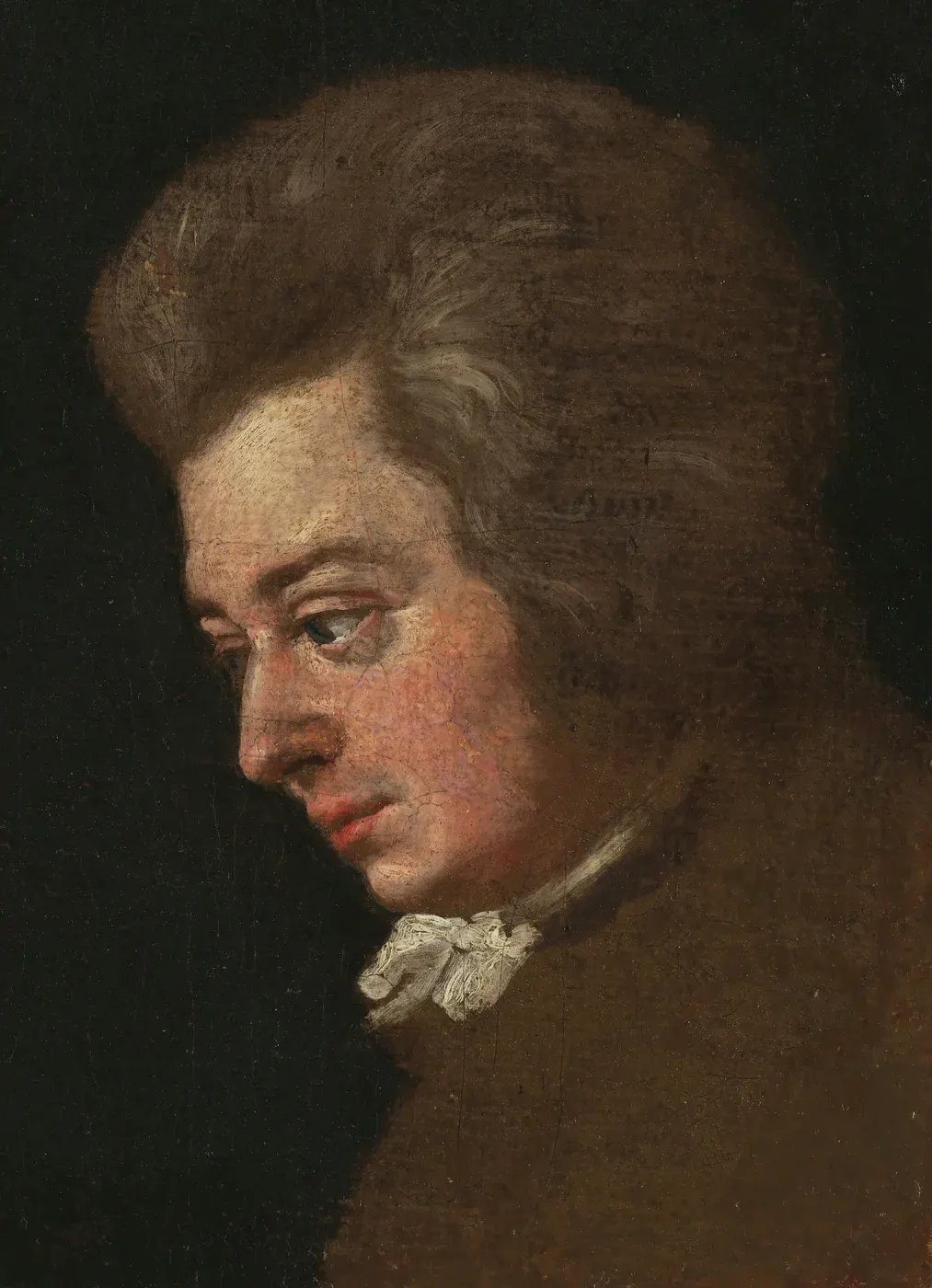
Wolfgang Amadeus Mozart · unfinished oil portrait by Joseph Lange (1782–1783) · Mozart’s Birthplace, Salzburg · public domain · Wikimedia Commons
Let us first listen to a passage from the Requiem he left behind. These are the first eight measures of the "Dies Irae," where from the very first measure, the four vocal parts of the chorus and the orchestra rush together in rapid chords. The sound is a synthesized orchestra and synthesized chorus, and the chorus sings without lyrics, making only "ah" sounds with their voices. The tempo was chosen by us. The score is the 1877 Breitkopf edition, a finalized version where another person completed the draft left by Mozart. Therefore, this sound cannot distinguish which notes in this passage came from Mozart's own hand.
Clip: Mozart, Requiem, K. 626, “Dies irae,” bars 1–8, 1877 Breitkopf completed edition (synthesized orchestra and choir; score input Mutopia Project, public domain)
What we just heard is a fast chorus in D minor, 4/4 time, with the soprano opening on "D-A, E-A, E-A." This article inquires into the final weeks of the person who left this piece.
Diagnosing those weeks today is the work of retrospective diagnosis. Retrospective diagnosis is the work of tracing and estimating the illness of someone who died long ago using surviving materials such as letters, records, autopsy reports, and remains. For Mozart, those attempts were exceptionally numerous. A 2010 literature review noted that writings on Mozart's illness and death outnumber those for any other composer, and found 136 Mozart-related entries in a single performing arts medicine bibliography (PMID 20795332). A 2011 paper records that the medical community has attached around 150 diagnoses to Mozart (PMID 21648330). The abstract records this not as the number of cause-of-death hypotheses, but as the number of "diagnoses" attached to him.
There is a reason why diagnoses have piled up to this extent. A 2011 paper explains that medical knowledge during Mozart's lifetime relied mostly on subjective observation, lacking standardized medical terminology or methodologies. Consequently, a wide open space remained to build hypotheses regarding his health and cause of death (PMID 21648330). A 1997 paper notes in advance that because there are no records acceptable by today's scientific standards, any conclusion leaves ample room for debate (PMID 9158697). The question this article follows is singular. How did so many different disease names emerge from several records of the same period regarding his final illness alone, and what can be filtered out among them?
Where Did the Poisoning Rumors Come From?
Rumors that Mozart was poisoned emerged immediately after his death and have survived to this day (PMID 23883091). A 2013 paper lists three accused parties. The abstract calls them "his physician" van Swieten, the Freemason lodge to which Mozart belonged, and Antonio Salieri, the court kapellmeister of the Vienna imperial court (PMID 23883091). The same content appears with the same conclusion in a 2006 German-language paper (PMID 16369845).
There are also stories that added to the legend. A 2006 paper notes that the legend was further fueled by the story of a tall stranger in gray who visited to commission a Requiem, as well as the circumstances surrounding the funeral (PMID 16977403). That paper summarizes that, alongside poisoning, it has long been debated whether he died because of the medicine he took himself or the treatments he received.
The conclusion of that paper is as follows. Gathering all known facts, there is no evidence that Mozart was murdered, and the exact cause of death remains unclear (PMID 16977403). One hypothesis related to poison was handled separately by another paper. It is the hypothesis that he had syphilis and suffered an overdose while receiving mercury treatment (syphilis itself is the premise of this hypothesis), but a 2002 paper considered this unlikely (PMID 12534101). A 1992 review article examined the evidence for the hypotheses of head trauma, poisoning, heart disease, and kidney failure side by side, and concluding that it was not comprehensive in itself, summed up that very few conclusions can be drawn (PMID 1498274).
How long the name Salieri has been attached to this story, and whether there is evidence to support that story, are two different questions. Among the abstracts read by this article, none present evidence supporting poisoning. Records remain of when the rumors started and who they pointed to, but the fact that the rumors survived for a long time does not become the basis for the rumors.
The Remaining Testimony: A Swollen Body and the Primary Doctor's Diagnosis
Strip away the rumors, and what remains are the words of those who witnessed his final illness firsthand. The feature that most clearly characterizes Mozart's final illness in the accounts of witnesses was severe edema (PMID 19687494). Edema is the swelling of hands, feet, or the face caused by water pooling between body tissues. A 2002 paper records that the edema was in his hands and feet, and that there was no record of shortness of breath (PMID 12534101).
According to the same paper, the treatment was aggressive. Enemas were given, bloodletting to draw blood was performed multiple times, and drugs that induced diarrhea were used (PMID 12534101). Several hypotheses we will look at later suggest that this very bloodletting may have hastened his death.
There is also the diagnosis left by his attending physician, Closset. It is the period diagnosis written by the physician, spelled "hitsiges Frieselfieber" as transcribed in the 2002 paper. That paper merely notes that this illness may have stemmed from one of several infectious diseases common at the time (PMID 12534101).
To this are added family letters. A 2013 paper reconstructed his medical history using letters exchanged with his father Leopold and sister Nannerl, alongside reports from doctors and contemporaries (PMID 23883091). However, judgments on whether he was sickly throughout his life vary from paper to paper.
- The 2013 paper read his short life as an endless chain of discomfort, fatigue, anxiety, and illness (PMID 23883091).
- A 1991 paper, after reviewing the letters, stated that while there is no doubt he suffered successive infectious diseases common in 18th-century Europe during his childhood, the widespread belief that his final years were plagued by chronic illness lacks clinical basis (PMID 1960696).
- The 2002 paper viewed him as not an exceptionally sickly child and as generally healthy after reaching adulthood. He suffered a life-threatening illness at age nine, which the paper surmises was likely typhoid fever (PMID 12534101).
- A 2006 paper noted that most recorded illnesses were minor, and that the tremendous volume of work he accomplished instead demonstrates an extraordinary capacity for work (PMID 16977403).
A 2007 paper records that at age eleven in 1767, he contracted smallpox, and a story is passed down that he was temporarily unable to see because of it (PMID 17539792). The fact that he was ill in childhood and how one interprets that—whether as "he was sickly all his life" or "he suffered from common illnesses of that era"—are matters of different layers. What to take away from this section is the material that the abstracts read by this article record regarding his final illness: the severe edema reported by witness testimony, the period diagnosis left by the attending physician, and treatment records including bloodletting.
Same Testimony, Multiple Diagnoses
Different diseases emerged from these records depending on the author. A 1993 paper notes that his death has traditionally been explained by infection, chiefly rheumatic fever or post-streptococcal glomerulonephritis (PMID 7864907). Streptococcus is a bacterium that commonly causes pharyngitis, tonsillitis with a swollen, sore throat, and scarlet fever. Among the complications where the body's immune response attacks the wrong places after being infected by this bacterium, two appear frequently in this article. Glomerulonephritis is a disease where inflammation develops in the glomeruli—the tiny clusters of blood vessels in the kidneys that filter blood—ruining their filtering function.
Rheumatic fever is a disease where an immune response following a streptococcal throat infection attacks the joints and heart, causing fever and joint pain.
A 1983 paper built a multi-step chain. The abstract did not state what data was examined. It claims that Mozart suffered from frequent tonsillitis throughout his life, developed Henoch-Schönlein syndrome following a streptococcal infection in 1784, which led to chronic glomerulonephritis and chronic renal failure. Henoch-Schönlein purpura is a disease where small blood vessels become inflamed, causing red spots to appear on the skin and potentially damaging the kidneys. That paper concluded that this purpura was also his final disease, that he died of cerebral hemorrhage and bronchopneumonia, and that bloodletting may have contributed to his death (PMID 6352940).
A 1997 paper reviewed various interpretations up to that point and looked toward the brain. The proposal is that the final cause of death was cerebral hemorrhage or stroke, complicated by bronchopneumonia, accompanied by renal failure resulting from glomerulonephritis and sclerosing changes in the glomeruli (PMID 9158697). However, that is the very proposal for which the same abstract noted earlier that "there are no records acceptable by today's scientific standards and the conclusions are highly debatable."
A 2013 paper concluded that he died of chronic kidney disease and, finally, uremia—a condition where waste products that the kidneys should filter out accumulate in the blood. Those authors explain that when kidney damage reaches its limit, a single minor burden causes collapse, and this typically happens in one's thirties (PMID 23883091). This picture had been widely spread beforehand, and an earlier 1991 paper argued that the belief that he suffered from chronic illness for his final years and died of renal failure lacked clinical basis, viewing instead that he died of an acute epidemic disease (PMID 1960696).
A 2011 paper chose a different path. Looking at the remaining medical and historical records, he likely contracted an infectious disease, most likely followed by a recurrence of rheumatic fever, accompanied by a strong immune response in his final days (PMID 21648330). Conversely, a 2002 paper placed both Henoch-Schönlein purpura and the sequelae of acute rheumatism in the implausible category (PMID 12534101).
There is one more hypothesis introduced by that 2002 paper. It is trichinosis, caused by parasites in meat such as pork. Introducing this as a recently emerged hypothesis, this paper wrote that it matches his final symptoms and the fact that Mozart liked pork (PMID 12534101). The final sentence of the same abstract returns to his attending physician Closset's diagnosis, leaving one of the many common infectious diseases of that time as a possibility.
| Hypothesis | Arguing Paper | Cited Evidence | Different Judgment in Other Papers (Regardless of Year) |
|---|---|---|---|
| Henoch-Schönlein purpura → chronic renal failure, ending in cerebral hemorrhage and bronchopneumonia | 1983 (PMID 6352940) | No data mentioned in abstract — frequent tonsillitis throughout life as the starting point of the chain | 2002: Implausible |
| Cerebral hemorrhage and stroke + bronchopneumonia + glomerulonephritic renal failure | 1997 (PMID 9158697) | Review of existing interpretations, caveat that "records fall short of scientific standards" | — |
| Chronic kidney disease → uremia | 2013 (PMID 23883091) | Letters from family and himself, reports by doctors and contemporaries | 1991: No clinical basis for chronic illness and renal failure |
| Recurrence of rheumatic fever following infection | 2011 (PMID 21648330) | Surviving medical and historical records | 2002: Sequelae of acute rheumatism are implausible |
| Trichinosis | Introduced as a "recent hypothesis" by 2002 (PMID 12534101) | Final symptoms, fondness for pork | — |
| Acute epidemic disease | 1991 (PMID 1960696) | Letters from himself and family | 2013: Chronic kidney disease |
All conclusions in the table belong to the authors of that respective row. Given records from the same period, different authors chose different organs as the culprit, and papers with conflicting conclusions sit side by side within the literature read by this article. As the 1997 paper itself states, conclusions reached through this method are open to major debate (PMID 9158697).
Building a City Instead of a Person
A 2009 study changed the question. Instead of re-reading the body of Mozart alone, it counted who died of what and with what in Vienna during the winter he died. The data the researchers opened was Vienna's official death register (PMID 19687494). A death register is an official ledger where a city writes down the age and cause of death of people who died every day. Looking at groups rather than one person like this is epidemiology. Epidemiology is the science of counting how much, when, where, and to whom a disease occurs by looking at groups.
The researchers analyzed all deaths recorded in November and December 1791 and January 1792, comparing them with the same season in the preceding and following years—specifically, the same periods in 1790–1791 and 1792–1793. Across the three winters, the deaths of 5,011 adults were recorded, consisting of 3,442 men and 1,569 women. The average age at death was 45.5 years for men and 54.5 years for women (PMID 19687494).
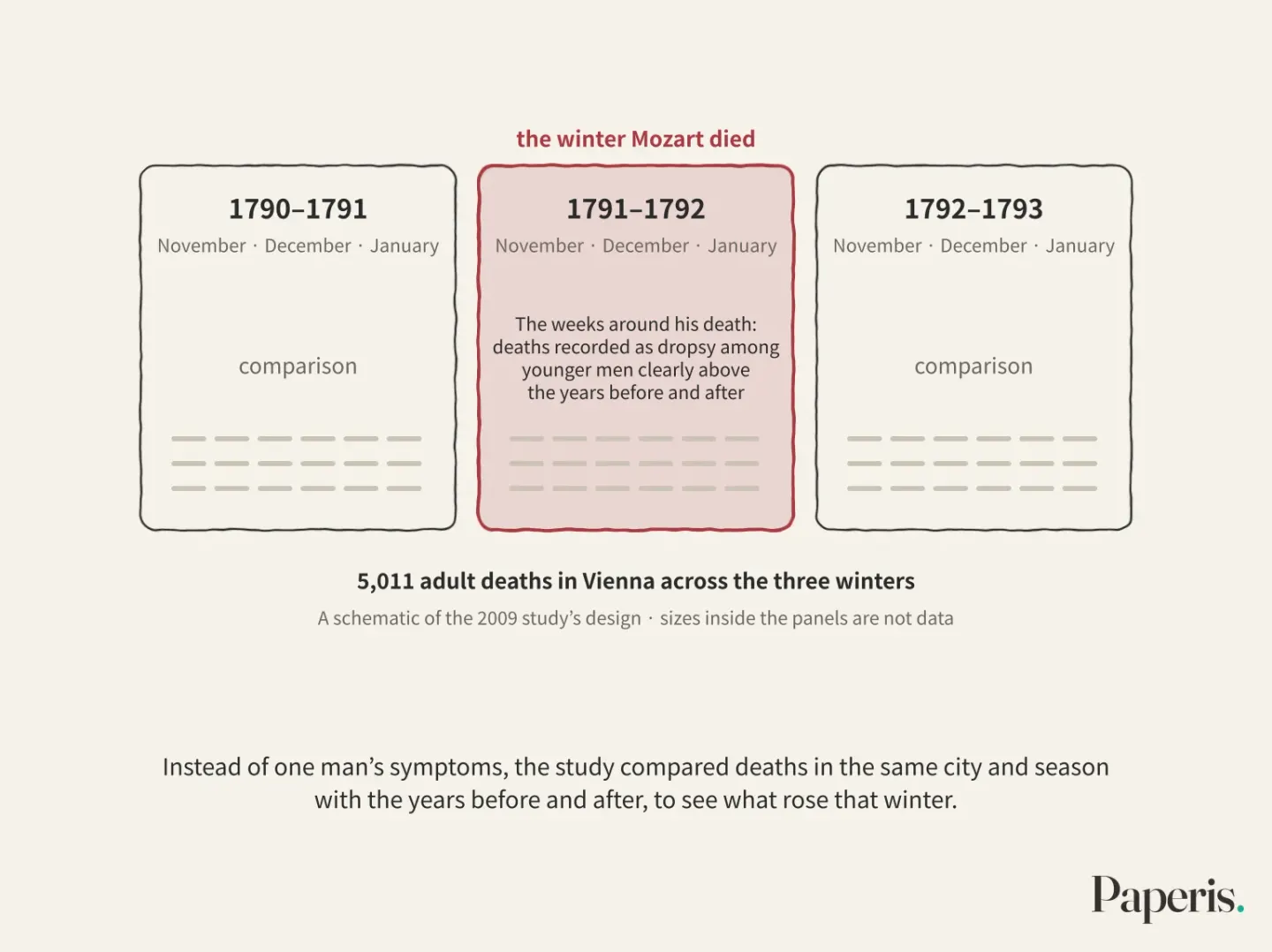
Among the causes of death, the most common were tuberculosis and its associated conditions, the second was cachexia and malnutrition involving physical wasting, and the third was edema (PMID 19687494). The researchers used this ledger as a framework to verify eyewitness accounts. The characteristic of his final illness conveyed by the testimony was severe edema.
Out of that pattern, one group stood out: In the weeks around the time Mozart died, deaths recorded as dropsy in the registry among young men were noticeably higher than in the years just before and after (PMID 19687494). The researchers suggested this small epidemic may have started in a military hospital. The abstract did not state the age range of the "young men," and the abstract also does not state what Mozart himself was recorded as in the registry.
The researchers' conclusion is cautious. Their analysis stated that Mozart's final illness and death match the development of glomerulonephritis following a streptococcal infection, leading to acute nephritic syndrome, a condition where the kidneys suddenly become inflamed and the body swells (PMID 19687494). They added that scarlet fever, being the same disease in terms of its cause, is less likely. The word "match" is different from "revealed". The death register does not show Mozart's body again; it merely provides a framework to place eyewitness testimonies upon the background of that Vienna winter. This study is what observed which hypothesis sits naturally upon that framework.
The 1991 paper that read the letters concluded that he died of an acute epidemic (PMID 1960696). The materials and the wording of the conclusions differ from the 2009 study. One side is family letters, and the other is city registers. What to take away from this section is that when disputes do not end with a single person's symptom records alone, thousands of deaths in the same city during the same period make room to place those symptoms.
Skull: Starting from Whose It Is
There were also attempts to look at the body itself instead of testimonies. In the Mozarteum Foundation in Salzburg, there is a skull believed to be Mozart's (PMID 17429616). The problem is that the starting point is already shaky. A 2002 paper writes that he was buried in an unmarked grave (PMID 12534101). A 1993 paper writes that the burial site in Vienna's St. Marx Cemetery was known, that when clearing the graves about 10 years later a successor of the gravedigger who had handled his burial kept one skull, and that it went through the anatomist Josef Hyrtl and the city of Salzburg to the Mozarteum (PMID 7864907). A 1989 paper cited a 1906 medical journal article stating that Mozart's skull was excavated from a Vienna cemetery in 1801 (PMID 2670708).
Judgments are divided on whether this skull is truly Mozart's.
- A 1989 paper stated that the dimensions and shape of the bone matched data known about Mozart, and that when superimposed on portraits, the facial features matched (PMID 2670708).
- A 1992 French-language paper premised that the owner of the skull was still controversial, and then concluded that their comparisons supported the side that it was likely Mozart's (PMID 1296510).
- A 2002 paper considered that this skull was not his. The reason is that not a single tooth matched the dental abscess he was known to have suffered from, namely a pus pocket at the tooth root (PMID 12534101).
- According to a 2007 paper, this skull and remains believed to be relatives excavated from the Mozart family grave in Salzburg underwent scientific investigation to determine their authenticity, but DNA analysis failed to reveal the relationship between the remains, making it practically impossible to determine who was who (PMID 17429616).
The same 2007 study analyzed bone, teeth, and hair recorded as Mozart's by using a laser to detach microscopic amounts and measure elements. In the bones of 18th-century people, lead reached up to 7 to 8 times today's samples, and the researchers attributed this to lead in food or drink. In the tooth enamel of the "Mozart skull," antimony was significantly higher than in other tooth samples, and the researchers suggested the possibility that he ingested antimony in early childhood (PMID 17429616). The abstract connected these results to childhood, and sentences connecting them to death are not in the abstract. And who the owner of that tooth is remains undetermined.
There are also cause-of-death hypotheses derived from the skull. A 1989 paper reported finding marks of a hardened epidural hematoma on the inner surface of the left temporal and parietal regions of the skull (PMID 2697695). An epidural hematoma is blood pooled between the skull and the outer membrane covering the brain, and a subdural hematoma is blood pooled inside that membrane. A 1993 paper cited a fracture of the left temporal bone to propose a chronic subdural hematoma, and considered that this matched several falls in 1789 and 1790 and may have caused the weakness, headaches, and fainting of 1790–1791. That paper also argued that aggressive bloodletting suspected of rheumatic fever may have broken down that injury (PMID 7864907). A 2006 paper viewed a chronic epidural hematoma, presumably resulting from a head injury in childhood, as the cause of death (PMID 17294913), and a 2019 editorial wrote that since the fracture showed signs of healing, it likely occurred a few months before his death, suggesting that his illness most likely stemmed from head trauma and his final illness may have been post-concussion syndrome following a hardened chronic epidural hematoma (PMID 31010444).
The same thing repeats regarding the shape of the skull. A 1989 paper stated that a cranial shape abnormality caused by the early fusion of the suture line in the middle of the forehead appeared together in the portrait and the skull (PMID 2651556), and a 1994 paper countered recent claims that there were signs of such a cranial shape abnormality in the skull and portrait by measuring them closely and stating that those features fell within the normal variation range (PMID 8085616). A 2011 paper described this fracture as a fracture of the skull "said to be Mozart's" (PMID 21648330). Hypotheses built on top of the skull inherit the uncertainty about whose the skull is. If this skull is not Mozart's, then those fracture and hematoma marks become someone else's story. A 2011 paper reviewing neurological hypotheses concluded that it is more reasonable to view his neurological symptoms as stemming from the severity of an infectious disease rather than a primary neurological disorder (PMID 21648330).
What Remains
It has not yet been decided what Mozart died of. The conclusion of a 1992 review editorial was "few conclusions can be drawn" (PMID 1498274), and the conclusion of a 2006 paper was "the exact cause of death remains unclear" (PMID 16977403). Several authors have written their own answers in confident sentences, but the very fact that those sentences point to different illnesses reflects our current state.
Instead of choosing a disease name, a question remains that we can use beforehand. On which layer of evidence does that hypothesis stand? The closest layer is the testimony of people who saw his final illness close up, and its core was severe edema. Next are the disease name and treatment records left by his personal physician. Authors are divided on whether he was sickly throughout his life. Even among papers that used letters as material, one from 2013 read them as an endless chain of illnesses, while one from 1991 saw no basis for chronic illness in his final few years. The death register provides the urban background against which to place that testimony. The skull looks closest to the body, but even whose owner it is has not been determined, and the hair is noted by the abstract as a sample "recorded as Mozart's." Rumors of poisoning left records down to the timing and the named individuals, but the evidence supporting them was not in the abstracts read by this article.
The same structure is seen outside the cause of death. A 2011 paper notes that elements of circulatory disorders, epilepsy, and Tourette syndrome appear in the records, yet concludes, as we saw earlier, that his neurological symptoms did not stem from a primary neurological disease (PMID 21648330). Diagnoses such as Tourette syndrome, autism, and attention deficit hyperactivity disorder have been attached to Mozart's eccentric behavior, but a 2007 paper found that none of those diagnoses have sufficient evidence (PMID 17940168). A 2015 book chapter re-read that behavior within the environment he lived in, putting forward the hypothesis that the sense of play, rather than a neuropsychiatric disorder, was central to how his talent operated (PMID 25684294). A 2011 paper writes that medicine at the time relied on subjective observation, leaving wide gaps for hypotheses, and goes on to count around 150 diagnoses (PMID 21648330). And as a 2010 review states, more has been written about his illness and death than about any other composer (PMID 20795332).
"The Mozart Effect — Ten Minutes in the Earphones Before the Test", which deals with whether test scores rise after listening to Mozart's music, shares only its name with this article and is a completely different topic. What to take away from this article is not a single disease name, but the habit of asking about the layer of evidence laid beneath each disease name. The ledgers and eyewitness testimonies of Vienna in the winter of 1791 are still in the same place, and the hypotheses trying to sit upon them are still contending.
Source Papers
- "The death of Wolfgang Amadeus Mozart: an epidemiologic perspective." (2009) — PMID 19687494 — Analyzed 5,011 adult deaths in Vienna burial registers across three winters from 1790 to 1793, finding an increase in edema deaths among young men around the time of Mozart's death, which “fits” post-streptococcal glomerulonephritis while scarlet fever is less likely.
- "Wolfgang Amadeus Mozart: the death of a genius." (2013) — PMID 23883091 — Reconstructed through letters and doctor reports, pointing to targets of poisoning rumors (van Swieten, Freemasons, Salieri), concluding with chronic kidney disease and uremia.
- "[Wolfgang Amadeus Mozart. A urological pathography]." (2006) — PMID 16369845 — A German-language paper with the same content and conclusions as above.
- "[Illness and death of Wolfgang Amadeus Mozart (1756-1791)]." (2006) — PMID 16977403 — Most recorded illnesses were trivial, the story of the Requiem commissioner and the funeral fueled the legend, with no evidence of murder and an unclear cause of death.
- "Wolfgang Amadeus Mozart--controversies regarding his illnesses and death: a bibliographic review." (2010) — PMID 20795332 — More literature than for any other composer, with 136 entries in performing arts medicine bibliographies.
- "Could a neurological disease be a part of Mozart's pathography?" (2011) — PMID 21648330 — About 150 diagnoses, limits of medicine at the time, elements of circulatory disorder, epilepsy, and Tourette's in records, with a recurrent rheumatic fever following infection being most likely, and neurological symptoms attributable to the severity of the infection rather than a primary neurological disease.
- "Did Mozart die of kidney disease? A review from the bicentennial of his death." (1992) — PMID 1498274 — A review editorial. Head trauma, poisoning, heart disease, and renal failure hypotheses reviewed, concluding that virtually no conclusion can be drawn with the caveat that it is not comprehensive.
- "[Health and death of Wolfgang Amadeus Mozart]." (2002) — PMID 12534101 — Generally healthy, no records of hand and foot edema or dyspnea, enemas, bloodletting, and laxatives used, attending physician Dr. Closset's diagnosis (hitsiges Frieselfieber), skull is not his, low possibility of mercury, purpura, or rheumatic sequelae, with trichinosis a recent hypothesis.
- "The pathobiography and death of Wolfgang Amadeus Mozart: from legend to reality." (1997) — PMID 9158697 — No records meeting scientific standards, proposing cerebral hemorrhage or stroke + bronchopneumonia + glomerulonephritic renal failure.
- "Mozart's illnesses and death." (1983) — PMID 6352940 — Frequent tonsillitis, post-streptococcal Henoch-Schönlein purpura in 1784 leading to chronic renal failure, cerebral hemorrhage or bronchopneumonia, with bloodletting possibly contributing.
- "The medical history and death of Mozart." (1991) — PMID 1960696 — Letter review, suffered successive infectious diseases in childhood, died of an acute epidemic, no clinical basis for chronic disease or renal failure.
- "History of individuals of the 18th/19th centuries stored in bones, teeth, and hair analyzed by LA-ICP-MS--a step in attempts to confirm the authenticity of Mozart's skull." (2007) — PMID 17429616 — DNA failed to clarify skeletal relationships, 18th-century bone lead up to 7 to 8 times higher, high antimony in teeth of the “Mozart skull” (possible childhood ingestion).
- "Mozart's chronic subdural hematoma." (1993) — PMID 7864907 — Cause of death traditionally explained by rheumatic fever or post-streptococcal glomerulonephritis, transmission path of the skull, left temporal bone fracture and chronic subdural hematoma hypothesis, with the possibility that bloodletting worsened it.
- "Did Mozart have a chronic extradural haematoma?" (1989) — PMID 2697695 — Hard epidural hematoma marks on the inner surface of the skull.
- "Identification of the cranium of W.A. Mozart." (1989) — PMID 2670708 — 1801 excavation records, dimensions and portrait superimposition match the same person.
- "Craniofacial dysmorphism in Mozart's skull." (1989) — PMID 2651556 — Claim of head shape abnormalities due to early fusion of the coronal suture.
- "Brief communication: the skull attributed to Mozart--craniosynostosis or not?" (1994) — PMID 8085616 — Refuted by arguing that the feature falls within the range of normal variation.
- "[No, Mozart was not trigonocephalic]." (1992) — PMID 1296510 — Concluded that while ownership remains controversial, it is highly likely to be Mozart's.
- "The skull of Wolfgang Amadeus Mozart predicates of his death." (2006) — PMID 17294913 — Sees chronic extradural hematoma following childhood head trauma as the cause of death.
- "A different aspect of the unexpected death of Mozart at the age of 35 years." (2019) — PMID 31010444 — Editorial. About 150 diagnoses, signs of fracture healing, head trauma “probably” the cause.
- "Mozart's movements and behaviour: a case of Tourette's syndrome?" (2007) — PMID 17940168 — Insufficient evidence for neurobehavioral disorder diagnoses such as Tourette's.
- "Mozart at play: the limitations of attributing the etiology of genius to tourette syndrome and mental illness." (2015) — PMID 25684294 — Reevaluated behavior within the environmental context of the era, hypothesizing that play is central to talent.
- "Mozart and smallpox." (2007) — PMID 17539792 — Smallpox at age eleven in 1767, reported to have involved temporary blindness.
Sources (23)
- The death of Wolfgang Amadeus Mozart: an epidemiologic perspectivePMID 19687494
- Wolfgang Amadeus Mozart: the death of a geniusPMID 23883091
- [Wolfgang Amadeus Mozart. A urological pathography]PMID 16369845
- [Illness and death of Wolfgang Amadeus Mozart (1756-1791)]PMID 16977403
- Wolfgang Amadeus Mozart — controversies regarding his illnesses and death: a bibliographic reviewPMID 20795332
- Could a neurological disease be a part of Mozart's pathography?PMID 21648330
- Did Mozart die of kidney disease? A review from the bicentennial of his deathPMID 1498274
- [Health and death of Wolfgang Amadeus Mozart]PMID 12534101
- The pathobiography and death of Wolfgang Amadeus Mozart: from legend to realityPMID 9158697
- Mozart's illnesses and deathPMID 6352940
- The medical history and death of MozartPMID 1960696
- History of individuals of the 18th/19th centuries stored in bones, teeth, and hair analyzed by LA-ICP-MS — a step in attempts to confirm the authenticity of Mozart's skullPMID 17429616
- Mozart's chronic subdural hematomaPMID 7864907
- Did Mozart have a chronic extradural haematoma?PMID 2697695
- Identification of the cranium of W.A. MozartPMID 2670708
- Craniofacial dysmorphism in Mozart's skullPMID 2651556
- Brief communication: the skull attributed to Mozart — craniosynostosis or not?PMID 8085616
- [No, Mozart was not trigonocephalic]PMID 1296510
- The skull of Wolfgang Amadeus Mozart predicates of his deathPMID 17294913
- A different aspect of the unexpected death of Mozart at the age of 35 yearsPMID 31010444
- Mozart's movements and behaviour: a case of Tourette's syndrome?PMID 17940168
- Mozart at play: the limitations of attributing the etiology of genius to tourette syndrome and mental illnessPMID 25684294
- Mozart and smallpoxPMID 17539792