
Paperis Articles
Paganini — Did an Extraordinary Hand Make That Playing?
A 1978 paper argued that Paganini's virtuosity came from musical genius and stage flair together with the long fingers and lax joints of Marfan syndrome. Later writers proposed Ehlers-Danlos syndrome or joint hypermobility syndrome; the materials a 2015 paper drew on are contemporary physicians' examinations preserved in letters, a post-mortem cast of his right hand, and portraits. Every diagnosis is retrospective. In a 1993 study of 660 musicians, those with hypermobile wrists reported fewer wrist symptoms while hypermobile knees and spines came with more — but that study measured symptoms, and it did not include Paganini.
Your field's papers, as audio
Pick your fields and journals — Paperis summarizes the key papers and turns them into audio. Listen on your commute.
Start Paperis free →Paganini — Did an Extraordinary Hand Make That Playing?
From Genoa to Nice, the Hand of a Violinist
The Italian violinist Niccolò Paganini was born in 1782 in Genoa, a port city in northwestern Italy today, and passed away in 1840 in Nice, located in the south of France today (PMID 29465865). A 2021 review article published on an arts research posting platform rather than a peer-reviewed journal counts him among the archetypes of violin playing and figures representing instrumental music of the Romantic era, and cites the “24 Caprices” as one of his best-known collections of works (DOI: 10.22501/rc.1304079). Because of his exceptional skill shown on stage, he even earned the nickname "the Devil's Violinist" (PMID 18949172).
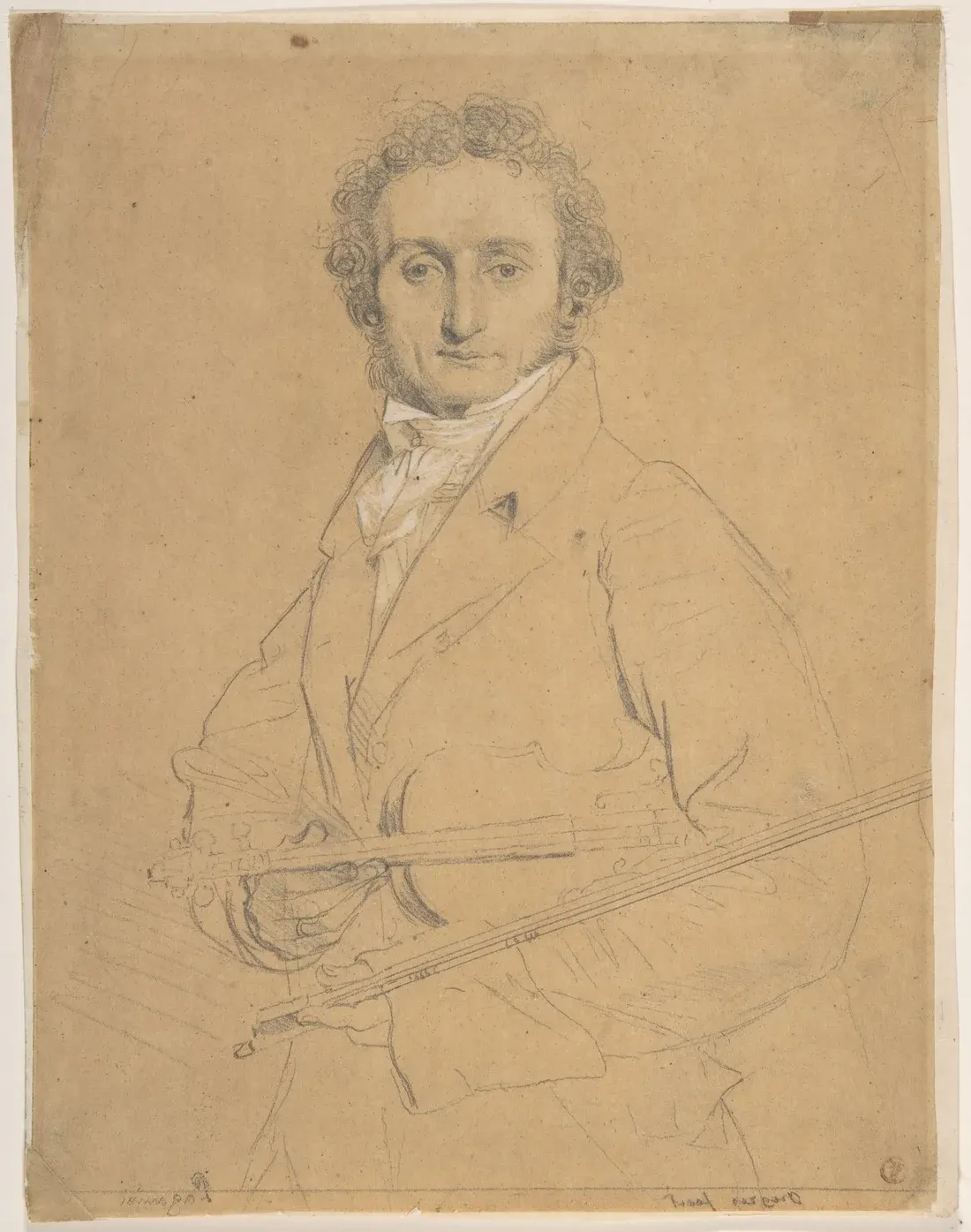
Niccolò Paganini · pencil drawing by Jean-Auguste-Dominique Ingres (between 1818 and 1831) · Metropolitan Museum of Art · CC0 · Wikimedia Commons — not one of the images the diagnostic papers examined
There is a single question that this article holds onto until the end: Did Paganini's unusual hand create that playing? A 1978 paper saw his long fingers and excessively stretchable joints as a sign of an inherited disease (PMID 336919), and the same 2021 article summarizes that several authors formulated the hypothesis that he had a hereditary disease passed down to him (DOI: 10.22501/rc.1304079). We will follow in turn what grounds that hypothesis rests on, and what modern research on performers can and cannot add to it.
First, we meet the music he left behind with our ears. This is the opening theme of the 24th Caprice in A minor, the final piece of the “24 Caprices”. A single unaccompanied violin begins with "La-La-La-Do-Si-La", followed by a short pattern oscillating between high Mi and low Mi. The first four bars are repeated as-is in the next four bars, and from the ninth bar onward, the same pattern continues as it steps down one notch at a time. The sound we hear here is the original sheet music translated into a synthesized violin, and the tempo was determined by us.
Clip: Paganini, 24 Caprices, Op. 1 No. 24 in A minor, theme, bars 1–16 (synthesized violin; score input Mutopia Project, CC BY-SA 4.0)
A single short pattern repeats and shifts its position, driving the piece forward. The question thrown by medical literature regarding the hand of the violinist who left this piece is the starting point of this article.
The Hypothesis of 1978 — The Hands of the "Magician of Music"
The earliest among the papers examined in this article that links the hand to a disease is a 1978 case paper. It is an article that traces back the illness of a historical figure, calling Paganini the "Magician of Music" in its title and asking whether he was a "mutation" of a genetic disease (PMID 336919). To understand that disease, two words are needed.
Connective tissue is tissue that binds and supports the body, providing the structural framework of the body like tendons, ligaments, skin, and blood vessel walls. When abnormalities occur in the genes of proteins such as collagen and fibrillin that make up connective tissue, inherited connective tissue disorders appear (DOI: 10.1093/med/9780199642489.003.0159_update_004). Marfan syndrome is an inherited disease caused by abnormalities in the genes for proteins that make up connective tissue, characterized by long fingers, hypermobile joints, and the risk of the aorta enlarging and tearing (PMID 336919; DOI: 10.1093/med/9780199642489.003.0159_update_004). This is precisely the disease questioned by the title of the 1978 paper.
The author of this paper calls Paganini the "greatest violin virtuoso in history" and puts forward the claim that his incomparable skill was the result of three factors accidentally overlapping. They are soaring musical talent, a temperament that enjoys the dramatic and flamboyant, and the manual dexterity given by the long fingers and excessively flexible joints of Marfan syndrome (PMID 336919).
The author of the 1978 paper wrote that, just this once, Marfan syndrome left a legacy that would remain for countless generations to come (PMID 336919). That manual dexterity was one of the three factors that made his performance possible is the claim of this paper's author, and that Paganini had Marfan syndrome is also a postmortem conjecture by this author. The abstract does not state what evidence was used to arrive at that diagnosis (PMID 336919).
What Evidence Was Used for the Diagnosis?
Paganini died in 1840, and the papers examining this hand hypothesis all appeared well over a century after his death. Therefore, this question is a retrospective diagnosis from the start. A retrospective diagnosis is the task of tracing back the illness of someone who died long ago using surviving materials like letters, records, autopsy reports, and remains. With no living body to examine, what remains determines the scope of the diagnosis.
A historical paper published in 2015 lays out these materials one by one (PMID 25948024). This paper starts from the premise that Paganini suffered from several illnesses and, according to two preceding researchers, may also have had Marfan syndrome. There are three materials. First, reports left by contemporary doctors who examined him, recorded in private letters. Second, a cast made of his right hand after his death. Third, several paintings by Lyser, his dedicated portraitist. The researchers compared the hand cast and paintings with hand images of a renowned musician suffering from Marfan syndrome whom they had treated (PMID 25948024).
What that comparison showed is not written as a concluding sentence in the abstract. The phrase used in the abstract goes only up to "may also have had Marfan syndrome" (PMID 25948024). The 2021 review article we saw earlier organized the physical characteristics of Paganini based on doctors' records and descriptions by contemporary musicians (DOI: 10.22501/rc.1304079). The materials revealed by the two articles are examination records in letters, the hand cast, paintings, and descriptions by contemporary musicians. Measurements of the actual hand are not written in the abstract.
Let us listen to an example of the kind of passage this hypothesis points to. These are the first six measures of the "24 Caprices," Op. 1, in E major. It is a pattern where the notes forming a chord are stepped through four at a time, going up and then stepping back down through the same notes. In measures 1 to 4, a single pattern moves within roughly one octave, at most two octaves, while in measures 5 to 6, a single pattern spans more than two octaves from low G-sharp to high E. The sound is a synthesized violin and the tempo is set by us.
Clip: Paganini, 24 Caprices, Op. 1 No. 1 in E major, bars 1–6 (synthesized violin; score input Mutopia Project, CC BY-SA 3.0)
The pitch range spanned by a single pattern widens as it goes on. However, this sheet music tells us nothing about Paganini's hand. Sheet music only records notes, not the lengths of the fingers that produced those notes.
Second Hypothesis — Bending Joints Easily
Marfan syndrome is not the only hypothesis that has been raised. A 2008 review saw another connective tissue disease in Paganini's physique. Ehlers-Danlos syndrome is a group of inherited disorders of connective tissue in which joints bend excessively and the skin easily develops bruises and scars, and it has several types (DOI: 10.1093/med/9780199642489.003.0159_update_004). That review noted that Paganini's physique points to this disease, and that this disease may have given him the special anatomical conditions that allowed him to reach his astonishing skill (PMID 18949172).
There is a trait common to both hypotheses. Joint hypermobility is a trait in which joints bend backward and flex more widely than usual. The author of this 2021 overview article summarized that several researchers have put forward the two possibilities of Marfan syndrome and Ehlers-Danlos syndrome, and then judged that while having suffered from "joint hypermobility syndrome" seems fairly well-founded, its exact identity remains in the realm of speculation, and among those possibilities, weight can be placed on the hypermobile type of Ehlers-Danlos syndrome (DOI: 10.22501/rc.1304079). This author concluded that the condition affected him throughout his life but also contributed to making him an unrivaled violinist (DOI: 10.22501/rc.1304079). This is also this author's conclusion.
The Ehlers-Danlos side of the hypothesis refers to a condition that is not easy to diagnose even in living patients. Hypermobile Ehlers-Danlos syndrome and joint hypermobility syndrome are considered mostly the same condition in clinical practice, and its molecular-level cause is not yet known (DOI: 10.1002/ajmg.c.31432). A 2017 study noted that there is not yet a test to confirm this condition (DOI: 10.1002/ajmg.a.38106). In a study asking doctors for the criteria to diagnose these conditions, opinions gathered on the types of tests to use, but the testing maneuvers varied greatly from doctor to doctor, and the consensus on which items are important for diagnosis fell short of the level required for clinical judgment (DOI: 10.1002/ajmg.a.36402).
The tool most commonly used to measure hypermobility is the Beighton score. The Beighton score is a joint hypermobility screening test scored out of 9 points by looking at how far the pinky fingers, thumbs, elbows, and knees bend backward and whether the palms touch the floor with the knees straight. This score also does not have a single fixed threshold, so in a review gathering 64 sports injury and function studies that used the Beighton score, the studies mostly regarded 4 or more points or 5 or more points as hypermobility (DOI: 10.1002/ars2.70000). In a study measuring 460 South African elementary school students (ages 6 to 11), the item of putting palms on the floor did not help in screening for hypermobility (DOI: 10.5152/eurjrheum.2020.19185).
Now we apply this yardstick to Paganini. Numerical figures recording how many degrees his pinkies bent backward or whether his palms touched the floor with his knees straight do not appear anywhere in the abstracts this article reviewed. The materials revealed by the abstracts are examination records in doctors' letters, a post-mortem right-hand model, portraits, and descriptions by contemporary musicians (PMID 25948024; DOI: 10.22501/rc.1304079). To make a diagnosis for a person from some 180 years ago that modern-day doctors cannot agree on even for a patient sitting across from them, that much more must be left to interpretation. Whether Marfan or Ehlers-Danlos, Paganini's diagnosis is still a hypothesis.
Modern Performers — Where Were Joint Symptoms More Common?
There is research measuring whether flexible joints go hand in hand with joint symptoms in modern groups of performers. What the research below measured is not performance skill, but how common painful and stiff joint symptoms are. And the research that follows from here is entirely research measuring groups of modern performers, and is not research measuring Paganini.
A 1993 study interviewed 660 musicians (300 women, 360 men) to ask about work-related symptoms like joint pain and swelling, used a set procedure to test for joint hypermobility, and looked at whether flexible joints went hand in hand with symptoms in those joints (PMID 8371729). Among the 96 people with hypermobile wrists, 5 people (5%) had pain and stiffness in the wrist, while among the 564 people without hypermobile wrists, 100 people (18%) did. Conversely, among the 132 people with hypermobile knees, 6 people (5%) reported knee symptoms (the case count is small), while among the 528 people with average knees, 1 person (less than 1%) did. Among the 198 people with hypermobile spines, 46 people (23%) reported lower back symptoms, which was more than the 50 people (11%) out of the 462 people with average ones. For elbows, there was no statistically meaningful difference, with 1 person among the 208 hypermobile people and 7 people among the 452 average people (PMID 8371729).
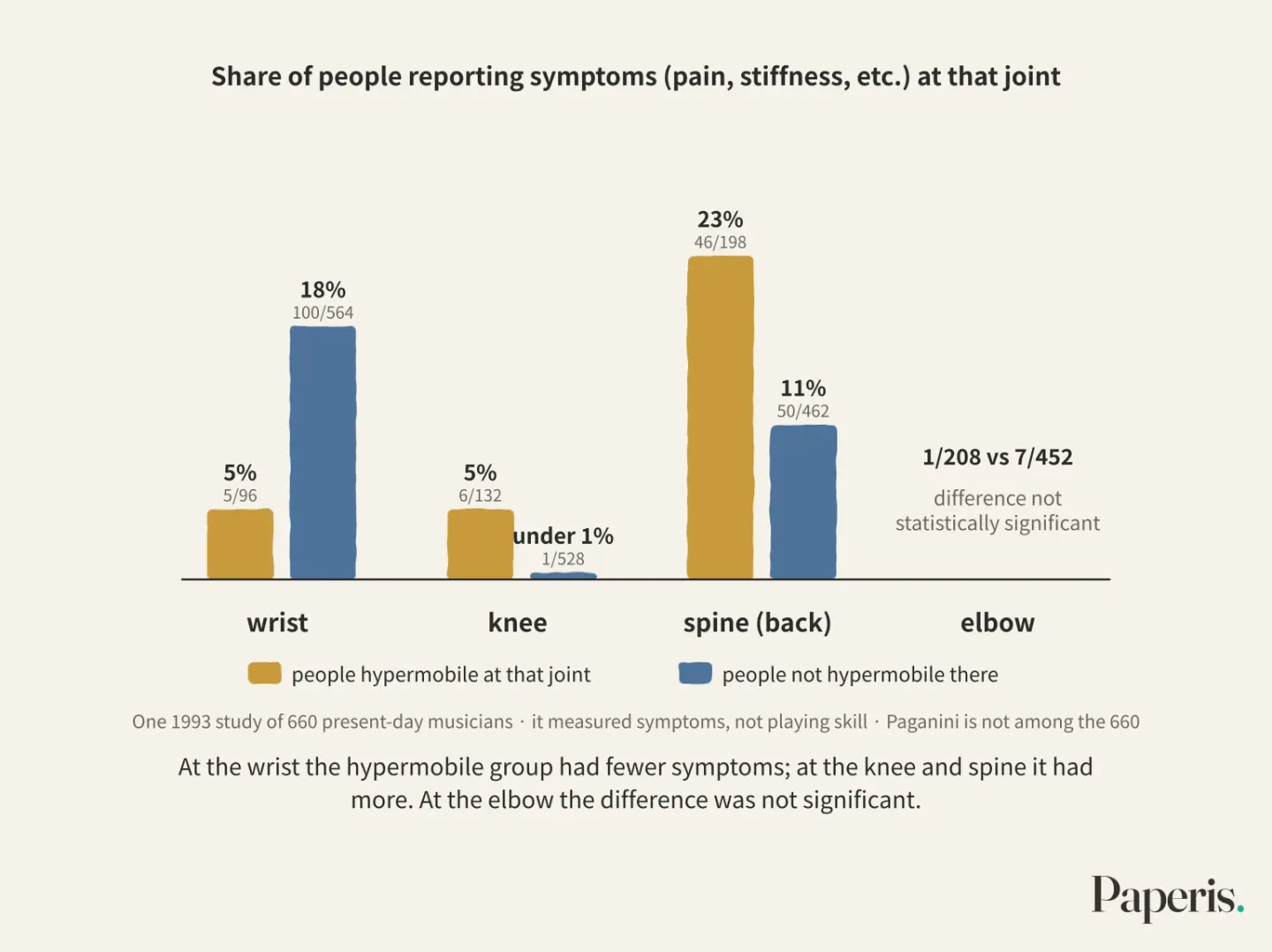
Based on symptoms, the researchers concluded this: For musicians playing instruments that require repetitive motions, hypermobility in frequently moving joints like wrists and elbows may be an asset, while hypermobility in less-moving joints like knees and spines may be a burden (PMID 8371729). The conclusion includes "may be", and elbows, which the conclusion grouped together on the asset side, showed no statistically meaningful difference in this data. Here, "asset" means that symptoms in that joint were fewer, and it is not a result measuring performance skill.
In medical literature written about the general non-musician population, the perspective shifted toward risk. A 2015 special feature in a medical genetics journal noted that non-syndromic generalized joint hypermobility and hypermobile Ehlers-Danlos syndrome had for decades been treated as a clinician's curiosity or even as an "asset" to the person, but are now recognized as risk factors for various chronic conditions and organ disorders (DOI: 10.1002/ajmg.c.31432). Connective tissue diseases commonly present with joint and spine pain and instability, susceptibility to injury, and widespread chronic pain (DOI: 10.1093/med/9780199642489.003.0159_update_004).
Evidence narrowed down exclusively to performers is still thin. A scoping review published as a preprint in 2025 was conducted as a master's thesis, and data extraction was handled by a single person (DOI: 10.1101/2025.08.13.25333390). This review found 165 relevant sources, of which 79 had primary data on hypermobility, 30 focused primarily on hypermobility, and 55% of the sources with primary data were anecdotal reports. Although 72% of all sources concluded that hypermobility is harmful to musicians, the review found that the empirical studies had inconsistent results and conflicted with anecdotal reports, revealing weaknesses in research methods. The author noted that because it was a scoping review, the quality of the data was not assessed, and therefore the conclusions cannot be generalized (DOI: 10.1101/2025.08.13.25333390). Hypermobility itself is also not rare. In a meta-analysis pooling 17 studies, generalized joint hypermobility was estimated at 9.5% for women and 5.2% for men, but the authors noted that variations across studies were large and should be read with caution (DOI: 10.1007/s00296-026-06346-3).
When these group studies are placed alongside Paganini, the question splits in two. If Paganini was truly hypermobile, under the framework of that research he might have had fewer symptoms in his wrists, but it might have been a load for his knees and spine. However, that framework measured symptoms, which is a different question from how well he played. But even whether he was hypermobile to begin with is an interpretation of records, and Paganini is not among the 660 people in the 1993 study.
Let us listen to a passage from the later variation of Caprice No. 24. Double stops on the violin involve drawing the bow across two strings simultaneously to produce two notes at once. Measures 84 to 88 are double stops producing two notes together at an interval of a third, and measures 89 to 94 are double stops where the distance between the two notes is mostly over an octave, widened to a tenth. It ends on a low A in measure 96. This is likewise a synthesized violin, and the tempo is set by us.
Clip: Paganini, Caprice Op. 1 No. 24, later variation, bars 84–96, double stops in thirds and tenths (synthesized violin; score input Mutopia Project, CC BY-SA 4.0)
Two notes sound close together, then sound together separated by more than an octave. The hand playing this passage is not what the studies examined in this article talk about.
The Body Beyond the Hands — Mercury and Hair
Paganini was a man who suffered from multiple illnesses (PMID 25948024), and the diagnoses left behind for parts of his body other than his hands must be read in the same way. He died in Nice after a long, severe illness (PMID 22448466). A 2012 hair analysis paper noted that there is no dispute he received mercury treatments for suspected syphilis and that those treatments caused him to lose all his teeth in 1828 (PMID 22448466). What follows diverges. According to the same paper, most authors of the literature viewed his late-stage symptoms and death as due to tuberculosis, and the hypothesis that he died of mercury poisoning was rejected for lack of supporting information (PMID 22448466). A 2008 review left the hypotheses of having suffered from syphilis and tuberculosis as speculation, while separately noting the possibility of treatment-induced mercury poisoning (PMID 18949172). A 2008 review collecting syphilis in musicians and composers treated Paganini as one of the musicians likely to have suffered from syphilis (PMID 18592279).
The researchers of the 2012 paper examined Paganini's hair under a microscope and analyzed its composition. The hair had grown between one and three years before his death, the structural damage pointed to heavy metal poisoning during that period, and the mercury concentration came out high at an average of 15.4 micrograms per gram (PMID 22448466). The researchers concluded that information not yet considered in the literature supports the syphilis diagnosis, and that this mercury concentration completely and clearly explains his death (PMID 22448466). This is the conclusion of these researchers, and it differs in degree of certainty from the 2008 review viewing syphilis as speculation.
The material of hair is dogged by the question of whether it truly belongs to the person. A 2016 research team compared a lock of hair put up for auction in 2009, said to have been given by Paganini to a lady with a personal dedication, against hair preserved by the Paganini family using a microscope (PMID 29465865). The researchers determined that even rare features broadly matched so that there was no reasonable doubt it belonged to the same person, and they critically examined what trace evidence like hair can prove (PMID 29465865).
Mercury, syphilis, tuberculosis, Marfan, Ehlers-Danlos. Regarding the exact same person, the degree of certainty varies from paper to paper, ranging from "remains speculation" to "clear explanation." Whether it is hands or hair, we must look at what material that certainty came from together to gauge the weight of a diagnosis.
So — The Hand is a Piece of the Question
We return to the first question. Did an extraordinary hand create Paganini's playing? The scope of what we can say with the evidence seen so far is narrow.
The materials revealed by a 2015 paper that examined his hand again are medical examination records in the letters of contemporary doctors, a post-mortem hand cast, and a portrait (PMID 25948024). The basis of the 1978 paper that proposed the Marfan hypothesis is not in the abstract (PMID 336919). Whether it was Marfan syndrome or Ehlers-Danlos syndrome was estimated differently from article to article (PMID 336919; PMID 18949172). The result that symptoms were rather fewer in well-bending wrists came from a musician group in 1993, and in the same study, knees and spines had more symptoms on the hypermobile side, and studies of musician hypermobility as a whole still have uneven results (PMID 8371729; DOI: 10.1101/2025.08.13.25333390).
The 1978 paper that put forward the hand hypothesis did not end the explanation with the hand alone. That paper placed manual dexterity as one of three factors, side by side with musical talent and stage temperament (PMID 336919). Training was mentioned by only one 2021 post among the evidence reviewed by this article that is not a peer-reviewed academic journal, and that post attributed his extraordinary qualities to innate ability along with genetic factors and training (DOI: 10.22501/rc.1304079). How much of a role innate things and training each play connects to the question covered in "Ten Thousand Hours — What the Practice Diary Doesn't Record".
What illness Paganini suffered from, and how much that hand helped his playing, are still open. The three passages of the Caprices heard today are the music he left behind, and do not answer this question. The score still transmits every single note as it is, and about the hand that produced those notes, letters, casts, and paintings are speaking in its place.
Evidence-based Papers
- "Nicolo Paganini. Musical magician and Marfan mutant?" (1978) — PMID 336919 — The claim that Paganini's skill was the result of a combination of musical talent, dramatic temperament, and the manual dexterity provided by Marfan syndrome's long fingers and hyper-extensible joints (pathography/case paper).
- "Niccolò Paganini: the hands of a genius." (2015) — PMID 25948024 — Comparing contemporary doctor's examination records in letters, a post-mortem cast of the right hand, and Lyser's drawing with the hands of a Marfan patient musician. The abstract goes up to “may also have suffered from Marfan”.
- "Niccolo Paganini: Life, illnes and virtuosity" (2021, posted on Society for Artistic Research, an artistic research publishing platform · not a peer-reviewed academic journal) — DOI: 10.22501/rc.1304079 — Summarizing the two hypotheses of Marfan and Ehlers-Danlos, joint hypermobility syndrome seems grounded but its identity is a guess and leans toward the hypermobile type of Ehlers-Danlos, attributing aptitude to genetics, ability, and training (overview article).
- "[Niccolo Paganini: medical aspects of his life and work]." (2008) — PMID 18949172 — The nickname “devil's violinist”, syphilis and tuberculosis hypotheses are guesses, suggesting therapeutic mercury poisoning, body type suggesting Ehlers-Danlos (review).
- "Benefits and disadvantages of joint hypermobility among musicians." (1993) — PMID 8371729 — 660 musicians, wrist and elbow hypermobility can be an asset while knees and spine can be a burden.
- "Generalized joint hypermobility, joint hypermobility syndrome and Ehlers‐Danlos syndrome, hypermobility type" (2015) — DOI: 10.1002/ajmg.c.31432 — Hypermobility was long considered an asset but is now recognized as a risk factor for chronic disease and disability, hypermobile EDS and joint hypermobility syndrome are clinically the same condition, molecular cause unknown.
- "Refining patterns of joint hypermobility, habitus, and orthopedic traits in joint hypermobility syndrome and Ehlers–Danlos syndrome, hypermobility type" (2017) — DOI: 10.1002/ajmg.a.38106 — There is no definitive test yet for this condition (descriptive study of 189 patients).
- "Lack of consensus on tests and criteria for generalized joint hypermobility, Ehlers–Danlos syndrome: Hypermobile type and joint hypermobility syndrome" (2014) — DOI: 10.1002/ajmg.a.36402 — There is consensus on the types of tests, but no clinical-judgment-level consensus on test movements and diagnostic criteria.
- "Hypermobility syndromes" (2013, Oxford Textbook of Rheumatology) — DOI: 10.1093/med/9780199642489.003.0159_update_004 — The range and symptoms of inherited connective tissue diseases caused by gene abnormalities in connective tissue proteins such as collagen and fibrillin (textbook chapter).
- "Beighton Scoring System Use in Generalized Joint Hypermobility Studies Has Greater Scientific Rigor Than Joint‐Specific or Arthroscopy Joint Hypermobility Studies" (2026) — DOI: 10.1002/ars2.70000 — 64 studies, Beighton score threshold is usually 4 or more or 5 or more.
- "Does the item 'hands on floor' add value to the Beighton score in identifying joint hypermobility?" (2020) — DOI: 10.5152/eurjrheum.2020.19185 — 460 children, the item of placing palms flat on the floor adds no value.
- "Hypermobility and Injury Among Instrumental Musicians: A Scoping Review" (2025, preprint/master's thesis) — DOI: 10.1101/2025.08.13.25333390 — 165 materials, 72% negative conclusions, methodological weaknesses due to uneven empirical results.
- "Prevalence of generalized joint hypermobility, hypermobility spectrum disorders and Ehlers-Danlos syndrome: systematic review and meta-analysis" (2026) — DOI: 10.1007/s00296-026-06346-3 — Generalized joint hypermobility is 9.5% in women and 5.2% in men, caution needed due to high heterogeneity.
- "[Illness and death of the violin virtuoso Nicolò Paganini--interpretation based on new hair investigations]." (2012) — PMID 22448466 — Mercury treatment suspected for syphilis and tooth loss in 1828 are undisputed, hair mercury 15.4 µg/g, researchers conclude it is a clear explanation for syphilis diagnosis and death.
- "Nicolò Paganini's hair lock for Signora Chatterton - morphological hair investigations using digital light microscopy." (2016) — PMID 29465865 — Comparing an auctioned hair lock with family-owned hair, judged to be from the same person, discussing the probative value of trace evidence.
- "Syphilis in composers and musicians--Mozart, Beethoven, Paganini, Schubert, Schumann, Smetana." (2008) — PMID 18592279 — Biographical review of composers thought to have suffered from syphilis.
Sources (16)
- Nicolo Paganini. Musical magician and Marfan mutant?PMID 336919
- Niccolò Paganini: the hands of a geniusPMID 25948024
- Niccolo Paganini: Life, illnes and virtuosityDOI 10.22501/rc.1304079
- [Niccolo Paganini: medical aspects of his life and work]PMID 18949172
- Benefits and disadvantages of joint hypermobility among musiciansPMID 8371729
- Generalized joint hypermobility, joint hypermobility syndrome and Ehlers‐Danlos syndrome, hypermobility typeDOI 10.1002/ajmg.c.31432
- Refining patterns of joint hypermobility, habitus, and orthopedic traits in joint hypermobility syndrome and Ehlers–Danlos syndrome, hypermobility typeDOI 10.1002/ajmg.a.38106
- Lack of consensus on tests and criteria for generalized joint hypermobility, Ehlers–Danlos syndrome: Hypermobile type and joint hypermobility syndromeDOI 10.1002/ajmg.a.36402
- Hypermobility syndromesDOI 10.1093/med/9780199642489.003.0159_update_004
- Beighton Scoring System Use in Generalized Joint Hypermobility Studies Has Greater Scientific Rigor Than Joint‐Specific or Arthroscopy Joint Hypermobility StudiesDOI 10.1002/ars2.70000
- Does the item 'hands on floor' add value to the Beighton score in identifying joint hypermobility?DOI 10.5152/eurjrheum.2020.19185
- Hypermobility and Injury Among Instrumental Musicians: A Scoping ReviewDOI 10.1101/2025.08.13.25333390
- Prevalence of generalized joint hypermobility, hypermobility spectrum disorders and Ehlers-Danlos syndrome: systematic review and meta-analysisDOI 10.1007/s00296-026-06346-3
- [Illness and death of the violin virtuoso Nicolò Paganini — interpretation based on new hair investigations]PMID 22448466
- Nicolò Paganini's hair lock for Signora Chatterton - morphological hair investigations using digital light microscopyPMID 29465865
- Syphilis in composers and musicians — Mozart, Beethoven, Paganini, Schubert, Schumann, SmetanaPMID 18592279