
Paperis Articles
Handel — As His Sight Failed, What Did the Records Keep?
Handel, who produced his own operas and oratorios in London, suffered recurring palsies, and in 1752 a newspaper reported that his sight was failing. Some pathographies held that he suffered from mental illness or rheumatism, others read his palsies as the aftermath of strokes, and recent reports named lead poisoning as the main source of his illness; his eyes have been read as the cataract diagnosed in his day or, in a 1993 interpretation, a vascular eye disease complicated by cataract. Several papers judge that cerebrovascular disease may be the most plausible explanation, yet say no definite diagnosis can be proven from the original sources. None of his three couching operations had a lasting effect. About his last years, as his sight was failing, the abstracts say little beyond a change in his concert practice.
Your field's papers, as audio
Pick your fields and journals — Paperis summarizes the key papers and turns them into audio. Listen on your commute.
Start Paperis free →Handel — As His Sight Failed, What Did the Records Keep?
A London Composer and Impresario
In February 1719, George Frideric Handel, a German-born composer living in London, wrote a letter to his brother-in-law back home in Halle to bring up "an unavoidable matter." That matter, on which his future hung, was founding a new opera company at the King’s Theatre in London's Haymarket, and the company's first performance was held only in April 1720 (DOI: 10.1093/oso/9780198166498.003.0006). Handel was born in Halle, Germany, on February 23, 1685 (DOI: 10.1093/oso/9780198166498.003.0001). Between 1720 and 1733 alone, he wrote 18 new operas (DOI: 10.1093/oso/9780198166498.003.0007).
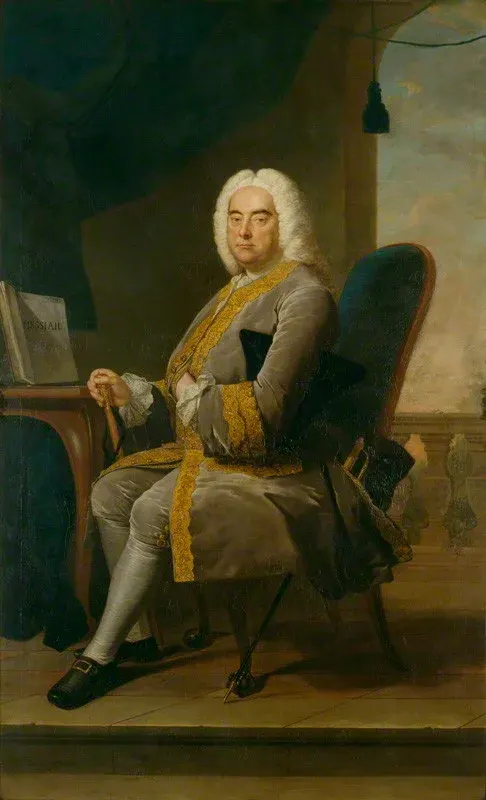
George Frideric Handel · oil painting by Thomas Hudson (1756) · National Portrait Gallery, London · public domain · Wikimedia Commons
All of Handel's London theater performances until April 1732 were Italian operas. After 1741, he never staged an Italian opera in London again, putting on English works in the manner of oratorios instead (DOI: 10.1093/oso/9780198166498.003.0008). A 2004 paper discussing his illness introduces him as perhaps the first composer to directly manage and promote his own works (PMID 15026616). This means he was both the person who wrote the music and the person who ran the theater.
Handel suffered from recurrent paralysis, and went blind in his final years (PMID 15026616). This piece follows two things: what people have suggested that illness was, and how much is left in the records of what he did around the time his vision blurred and in his later years. The basis for this is surviving records and papers that re-read those records. Handel passed away in 1759.
"Messiah" is a piece written before his vision became blurred
An oratorio is a large vocal work that tells a biblical-style story through soloists, choir, and orchestra, presented like a concert without stage acting or costumes. Handel's most famous oratorio, "Messiah," was written in 1741. The chapter covering 1741 to 1745 in the biography of Handel by researcher Donald Burrows begins with this quotation: "Handel says he will do nothing next winter, but I hope to persuade him to set another collection of Scripture-words I have gathered for him… The subject is the Messiah" (DOI: 10.1093/oso/9780198166498.003.0011). These are the words of the person who gathered the Bible verses for Handel.
Charles Jennens, the librettist of "Messiah," sometimes sharply criticized the way Handel set music to his lyrics in letters exchanged with Edward Holdsworth. Handel's performance scores retain many places where Jennens revised the text, and this criticism is particularly relevant to the first London performances of 1743 and 1745 (DOI: 10.1093/ml/gcad035). Even in a single work like "Messiah," the traces of the exchanges between composer and librettist remain in scores and letters.
The most widely known passage in "Messiah" is the "Hallelujah" chorus. Of the first eight measures in D major, 4/4 time, the first three measures are played by the orchestra alone, and in the fourth measure, the four voice parts of the choir enter together to repeat a short phrase in harmony. Below is the sound of those first eight measures, roughly 18 seconds, synthesized with orchestra and choir straight from the score. The words are not heard, and we set the tempo.
Clip: Handel, Messiah, HWV 56, “Hallelujah” chorus, bars 1–8 (synthesized orchestra and choir; score input Mutopia Project, public domain)
The year 1741 when this piece was written is a little over a decade before 1752, when newspaper reports noted that his eyesight was failing. "Messiah" is a piece he wrote before his vision deteriorated.
Various Explanations for Handel's Illness
Retrospective diagnosis is the practice of tracing and guessing the illness of someone who died long ago using surviving materials like letters, records, autopsy reports, and remains. Among the papers on Handel's medical history covered in this article, the 1996 and 1993 papers are literature interpretations that re-read primary sources to deduce his illness (PMID 11618747) (PMID 8264215).
Several explanations have been put forward regarding Handel's illness. As a 2004 paper summarizes, some medical history studies written by authors in various fields viewed that he suffered from psychiatric disorders such as cyclothymia or mania where his mood repeatedly rose and sank, or rheumatic diseases such as arthritis. Other authors interpreted his repeated paralysis as the typical aftereffects of a stroke caused by a blocked blood vessel in the brain (PMID 15026616). A 2015 paper adds one more to this. It notes that recent reports proposing lead poisoning as the main cause of Handel's illness have emerged and drawn the attention of the music world and the general press (PMID 25684296). These abstracts do not state what evidence the authors who proposed psychiatric disorders, rheumatism, and lead poisoning based their claims on.
A stroke is a disease where a blood vessel going to the brain is blocked or bursts, damaging the brain beyond it, and cerebrovascular disease is a collective term for diseases where the blood vessels supplying blood to the brain narrow, block, or burst. After reviewing Handel's risk factors and stroke symptoms using primary sources, the 1996 paper concluded that "although there is no definitive evidence," it seems most likely that he suffered from cerebrovascular disease, leading to two or three mild strokes and vision weakening in his later years (PMID 11618747). The 2004 paper also viewed that "although a definitive diagnosis cannot be drawn from the original materials," cerebrovascular disease may be the most plausible explanation for the paralysis and visual impairment (PMID 15026616).
Here, "most plausible" is the judgment of the authors of the 1996 and 2004 papers. What the medical history studies viewing that he suffered from psychiatric or rheumatic diseases and the reports viewing lead poisoning as the main cause of the illness based their claims on are not in these abstracts. Handel's illness is not definitively determined with the materials remaining today.
1752, Eyes in the Newspaper
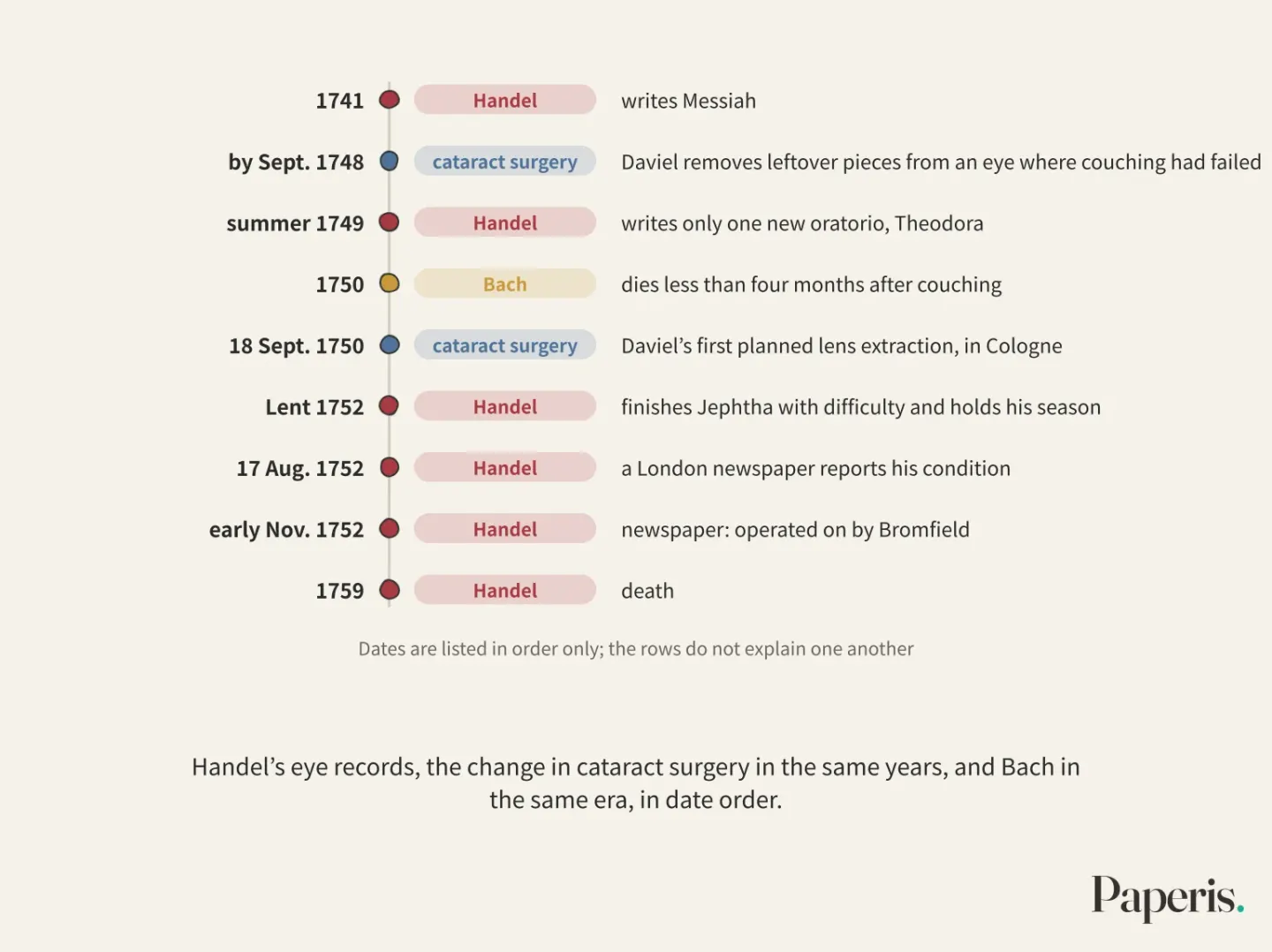
The record of his eyes has a clear date. According to Burrows' biography, Handel finished his oratorio Jephtha with difficulty in Lent 1752 and played his usual oratorio season. Burrows estimates that his impairment would already have been noticeable at the concert hall back then. On August 17, 1752, a London newspaper made his condition known to the world, and the same newspaper reported in early November that Handel had undergone surgery by William Bromfield, surgeon to the Princess of Wales, and that there was some hope of recovering his eyesight (DOI: 10.1093/oso/9780198166498.003.0015). The basis for this scene is the contemporary newspaper report conveyed by Burrows' biography.
A cataract is an eye disease where the lens becomes cloudy so that light cannot pass through properly. Couching is an old cataract operation where a needle is inserted into the eye to push the clouded lens down into the back interior of the eye, clearing it out of the path where light travels. According to papers from 2004 and 2015, Handel's blindness was interpreted in his era as being due to cataracts, and so he underwent couching three times, but none had a lasting effect (PMID 15026616) (PMID 25684296). Whether Bromfield's surgery was one of those three cannot be pieced together from these abstracts.
"Cataracts" was the judgment of the era. A 1993 paper re-analyzed Handel's eye disease using primary sources and, while stating that the disease "cannot be determined with certainty," concluded that it is best interpreted as an age-related common cataract or post-traumatic cataract overlapping with central vascular diseases, such as degeneration of the retina or a lack of blood flow in the nerve bundles inside the brain where visual signals pass and their relay areas (PMID 8264215). The macula is a small part in the exact center of the retina, responsible for recognizing things you look straight at, like letters or faces, in detail. This paper reported that, given Handel's risk factors, vascular degeneration of the macula or damage to the vascular layer behind the retina is most likely, and wrote that his eye disease should be viewed together with cerebrovascular disease (PMID 8264215).
So, the explanation tying paralysis and eyes together is an interpretation put forward by this lineage of papers. A 2015 paper suggested that the paralysis and visual impairment could rely on "a single context" of cerebrovascular disease, while adding in the same sentence that a definite diagnosis cannot be proven with the original materials (PMID 25684296).
The Era of Couching
In the mid-18th century, as Handel was losing his sight in his later years, a different way of treating cataracts was just beginning. Lens extraction is a cataract surgery where the eye is cut open and the clouded lens is removed from the eye.
A 2025 historical paper reviewed contemporary books, newspapers, and manuscripts to pinpoint its beginnings by date. By September 1748, Jacques Daviel, an ophthalmologist from Marseille, France, was removing leftover cataract fragments from eyes where couching had failed. In the first week of July 1750, three Parisian surgeons, including Daviel, began developing lens extraction, and the first planned extraction surgery confirmed by contemporary records was performed by Daviel on a clergyman in Cologne on September 18, 1750 (PMID 40861321). November 1752, when news of Handel's surgery was published in the newspaper, was two years after that. We can place the two dates side by side, but these dates do not explain the method of the surgery Handel received or the reason for it.
The reason the new surgery pushed out the old surgery is also not simple. A 2026 paper analyzing 18th- and 19th-century French debates argues that couching was abandoned not primarily because the new method was better, but because the new method became intertwined with the 18th-century trend of surgery separating from internal medicine and the 19th-century recognition of ophthalmology as a specialized field (PMID 42885745). This is the argument of the paper, focusing on France.
Bach in the Same Era
Another composer born in Germany in the same year underwent the same type of surgery. According to a 2013 paper, the German composer Johann Sebastian Bach (1685–1750) began losing his eyesight at the age of 64. Old biographies recorded that this was due to straining his eyes in dim light. At the urging of friends, he had both eyes operated on by a traveling English oculist, and that surgery was cataract couching. Following the surgery, Bach went completely blind, unable to play the organ, write music, or conduct choirs and orchestras, and he spent his days lying in bed amidst intense pain in his eyes and body, passing away less than four months after the surgery (PMID 22339937).
Glaucoma is a disease in which pressure inside the eye rises, damaging the optic nerve and causing a loss of the visual field. This 2013 paper suggests viewing Bach's case as uncontrollable glaucoma that followed a blocked pupil or intraocular inflammation caused by lens matter (PMID 22339937). This is also a retrospective guess and the paper's proposal.
In the same era, the same type of surgery happened to two composers. Bach went completely blind after surgery, and none of the three couching surgeries Handel received had any lasting effect (PMID 22339937) (PMID 15026616). Bach's music itself is covered in "Bach — Music Written by Mathematics, or Music That Mathematics Can Measure?".
If we line up the dates of this section and the previous section in a single row, it looks like this. By September 1748, Daviel had extracted the remaining fragments after a failed couching surgery. In the first week of July 1750, three surgeons in Paris began developing lens extraction, and on September 18, Daviel's first planned extraction took place in Cologne (PMID 40861321). In Lent 1752, Handel ran the season of "Jephtha", his condition was reported in newspapers in August, and Bromfield's surgery was reported in November (DOI: 10.1093/oso/9780198166498.003.0015). Within the same span of years, Bach underwent couching surgery and passed away in 1750, less than four months later (PMID 22339937). The fact that the old surgery and the new surgery overlapped within the exact same few years is what these dates tell us.
When His Vision Was Fading and His Final Years
Let us look at the records from before the newspaper announcement of August 1752. In the summer of 1749, unlike the previous two summers when he wrote two new oratorios each, Handel wrote only one, "Theodora." He began it on June 28 and finished it on July 31. Burrows writes that this was not necessarily a sign of diminished creative power (DOI: 10.1093/oso/9780198166498.003.0014). This passage does not speak of illness. And as we saw in the previous section, during Lent in 1752, he finished "Jephtha" with difficulty and carried out the oratorio season. Burrows speculates that his impairment would have already been noticeable during those performances (DOI: 10.1093/oso/9780198166498.003.0015). This happened before his condition appeared in the newspapers in August of that year.
Regarding the marks that illness left on his music, medical history papers have reached a conclusion. A 1993 paper stated that the stroke Handel most likely suffered, along with his blindness, were very important events in his life and are reflected in his works. At the same time, the 1993 paper concluded that neither condition fundamentally affected his creative power. Only a few pieces mention the loss of sight, and aside from changes in performance practices in his final years, his eye disease did not directly affect his musical compositions (PMID 8264215). A 1996 paper also noted that no direct effects of the illness can be found in Handel's musical works, while adding that there are a few traces of his medical history flowing indirectly into his works, especially "Messiah" (PMID 11618747). What those indirect traces are and how performance practices changed are not in the abstracts.
Whether he played instruments himself after losing his sight, wrote new pieces, or how he was involved in "Messiah" performances are also not in the abstracts gathered by this article. Regarding his final years—the last few years when he was losing his sight—what the abstracts tell us is limited to the single phrase from the 1993 paper that "performance practices changed in his final years," and that paper's judgment that the two conditions did not fundamentally break his creative power.
So What Did We Learn
The August 1752 newspaper notice and the November surgical report are records with dates. What broke in his eyes is an interpretation, not a record. Papers dealing with Handel's illness write down their own limitations. The 2004 and 2015 papers stated that "a definitive diagnosis cannot be drawn from the raw data," and the 1993 paper stated that the eye condition "cannot be determined with certainty" (PMID 15026616) (PMID 25684296) (PMID 8264215). The 2004 and 2015 papers considered that explaining the paralysis and visual impairment as cerebrovascular disease may be the most plausible explanation. Other medical history studies reviewed by those papers viewed that he suffered from psychiatric or rheumatic diseases, and reports introduced by the 2015 paper put forward lead poisoning as the main cause of the illness. The 2004 paper also noted that the story of Handel's life and illness is full of myths invented and embellished by various biographies (PMID 15026616).
The same method of retrospective diagnosis continues in "Beethoven — With Ears That Struggled with High Notes, How Did He Keep Composing?".
What Handel lost remains in newspapers and biographies, but why he lost it is still in the realm of estimation, and what he did after losing it can only be known as much as the abstract tells us.
Source Papers
- "Germany, 1685-1706" (2001) — DOI: 10.1093/oso/9780198166498.003.0001 — A chapter from Donald Burrows, "Handel" (Oxford, 2001). Hereafter, chapters from the same book begin with DOI 9780198166498. Born in Halle on February 23, 1685, baptism record.
- "The 'Academy' Years, 1720-32" (2001) — DOI: 10.1093/oso/9780198166498.003.0006 — Letter sent to his brother-in-law in London in February 1719, new opera company at the King's Theatre, first performance in April 1720.
- "The Music of the 'Academy' Years" (2001) — DOI: 10.1093/oso/9780198166498.003.0007 — 18 new operas from 1720 to 1733.
- "The Transitional Decade I: Competition, 1732-7" (2001) — DOI: 10.1093/oso/9780198166498.003.0008 — Italian operas only until April 1732, English works in an oratorio format without Italian operas after 1741.
- "The Oratorio Composer I: Dublin And London, 1741-5" (2001) — DOI: 10.1093/oso/9780198166498.003.0011 — Letter excerpt reading "The subject is Messiah".
- "Correcting the 'grossest faults': Charles Jennens and the Composition of Handel's Messiah" (2023) — DOI: 10.1093/ml/gcad035 — Criticism by librettist Jennens and lyric revisions in the performance score, London premieres in 1743 and 1745.
- "The Final Decade I: The Last Major Works, 1749-51" (2001) — DOI: 10.1093/oso/9780198166498.003.0014 — A single work "Theodora" in the summer of 1749, judged not to be a sign of declining creative power.
- "The Final Decade II: A Career Completed" (2001) — DOI: 10.1093/oso/9780198166498.003.0015 — The 1752 "Jephtha" and Lent season, newspaper notice on August 17, report of surgery in Bromfield in November.
- "Georg Friedrich Händel's strokes." (2004) — PMID 15026616 — Summary of mental illness, rheumatism, and stroke interpretations, three couching surgeries had no effect, definitive diagnosis impossible with cerebrovascular disease being most plausible.
- "Georg Friedrich Händel: a case of large vessel disease with complications in the eighteenth century." (2015) — PMID 25684296 — Addition of media attention regarding lead poisoning reports, linking paralysis and vision impairment to cerebrovascular disease, definitive diagnosis unprovable.
- "Georg Friedrich Handel's strokes." (1996) — PMID 11618747 — Without definitive evidence, cerebrovascular disease and two or three mild strokes are most plausible, no direct impact on works with indirect traces in Messiah.
- "[Georg Friedrich Händel's eye disease]." (1993) — PMID 8264215 — Unconfirmable, interpretation as central vascular disease plus cataract, possibility of macular vascular degeneration and choroidal vascular damage, no fundamental impact on creative power.
- "Jacques Daviel (1696-1762) and the Competition to Extract Cataracts: A Reappraisal." (2025) — PMID 40861321 — Extraction attempts by three Paris surgeons in July 1750, Daviel's first planned extraction in Cologne on September 18, 1750.
- "The end of cataract couching: controversies around the decline, resurgence, and demise of a surgical practice in early modern and modern France." (2026) — PMID 42885745 — Argument that the exit of couching surgery was due to the combination of surgical independence and ophthalmological specialization rather than the superiority of the new method.
- "Blindness of Johann Sebastian Bach." (2013) — PMID 22339937 — Vision decline at age 64, couching surgery on both eyes by a traveling British oculist, complete blindness following surgery and death 4 months later, glaucoma interpretation proposed.
Sources (15)
- Germany, 1685-1706DOI 10.1093/oso/9780198166498.003.0001
- The 'Academy' Years, 1720-32DOI 10.1093/oso/9780198166498.003.0006
- The Music of the 'Academy' YearsDOI 10.1093/oso/9780198166498.003.0007
- The Transitional Decade I: Competition, 1732-7DOI 10.1093/oso/9780198166498.003.0008
- The Oratorio Composer I: Dublin And London, 1741-5DOI 10.1093/oso/9780198166498.003.0011
- Correcting the 'grossest faults': Charles Jennens and the Composition of Handel's MessiahDOI 10.1093/ml/gcad035
- The Final Decade I: The Last Major Works, 1749-51DOI 10.1093/oso/9780198166498.003.0014
- The Final Decade II: A Career CompletedDOI 10.1093/oso/9780198166498.003.0015
- Georg Friedrich Händel's strokesPMID 15026616
- Georg Friedrich Händel: a case of large vessel disease with complications in the eighteenth centuryPMID 25684296
- Georg Friedrich Handel's strokesPMID 11618747
- [Georg Friedrich Händel's eye disease]PMID 8264215
- Jacques Daviel (1696-1762) and the Competition to Extract Cataracts: A ReappraisalPMID 40861321
- The end of cataract couching: controversies around the decline, resurgence, and demise of a surgical practice in early modern and modern FrancePMID 42885745
- Blindness of Johann Sebastian BachPMID 22339937