
Paperis Articles
The Carbon Cycle — Jars Buried in the Yard, a Winter Room with Sealed Door Gaps
Carbon is never lost; it only moves among the air, the ocean, living things and soil, and rock. It travels a fast path run by living things and a slow path run by rock, sea and volcanoes, and the small amount of greenhouse gas in the air keeps Earth warm enough to live on. Humans have strengthened that effect by digging buried carbon out and adding it to the air.
Your field's papers, as audio
Pick your fields and journals — Paperis summarizes the key papers and turns them into audio. Listen on your commute.
Start Paperis free →The Carbon Cycle — Jars Buried in the Yard, a Winter Room with Sealed Door Gaps
Once a Briquette Burns Down
When a single coal briquette burns down in a winter hearth, only pale ash remains. Most of the carbon that made the briquette black has drifted away into the air along with smoke. That carbon came from a body made by a plant with sunlight long ago, and coal is that body buried underground and changed over millions of years (OpenStax Biology 2e 46.3).

Illustration: Paperis
The carbon that went out into the air does not stop there. Some of it enters a tree leaf, some dissolves in seawater, and a tiny fraction eventually becomes rock. This article follows where carbon stays on Earth, the paths it travels, and why the carbon in the air warms the planet. The principles apply everywhere on Earth, and a few examples are drawn from the forests and seas of the Korean Peninsula.
As a guide, we bring an old house along. There is a small rice chest next to the kitchen, a large storehouse across the courtyard, and a jar buried deep in the ground in the backyard, kept like a kimchi crock. Just as grain moves between these spaces, carbon moves among Earth's various places. And in the winter room of this house, wind-blocking paper is pasted over every gap in the doors.
Where Carbon Stays
The ocean contains roughly 45 times more carbon than the air does (Steven Earle, Physical Geology, 2nd Edition ch. 19.01). If you only think of carbon dioxide in the air, it might seem like carbon is mostly in the sky, but the air is a small bowl compared to the ocean or rocks.
The carbon cycle is the process by which carbon moves among the air, ocean, living things, soil, and rocks while changing its form. The materials that make up the bodies of living things do not vanish and are used over and over in this way (OpenStax Biology 2e 46.3). A carbon reservoir is a place where carbon stays for a long time, and the air, ocean, ocean-bottom sediments, soil, underground sediments, and Earth's interior fall into this category (OpenStax Biology 2e 46.3).
Each room of an old house holds carbon in a different form. In the air, which is like the rice chest next to the kitchen, it exists as carbon dioxide. In the ocean, which is like the barn across the yard, almost all the carbon exists as dissolved ions in water, and that share exceeds 90% of the ocean's carbon (OpenStax Biology 2e 46.3). In the bodies of living things and in the soil, it resides inside matter created by organisms. In the crock buried in the backyard, there are rocks like limestone as well as coal and oil (OpenStax Biology 2e 46.3).
The fact that the rice chest is small means that even when the same amount goes in and out, the scale on the side of the air moves by a large amount first. Carbon does not disappear; only its location changes.
Quick Path: Leaves, Breath, and Fallen Leaves
The forests of Uljin in Gyeongsangbuk-do and Samcheok in Gangwon-do suffered a massive wildfire in 2022. The forest touched by fire turned for a while into land that releases more carbon than it takes in (KCI ART003326820). To see what the forest lost, we must first look at what the forest usually does.
Photosynthesis is the process by which plants and some microorganisms use the energy of sunlight to make sugars from carbon dioxide and water, releasing oxygen. The carbon in the air becomes part of living bodies through this work (OpenStax Biology 2e 46.3). Animals eat those bodies to get carbon, and breathe it back into the air (OpenStax Biology 2e 46.3). Cellular respiration is the process by which cells slowly oxidize nutrients like glucose with oxygen, pulling out the energy inside little by little. Plants respire too, and respiration turns the carbon in living bodies back into carbon dioxide (OpenStax Biology 2e 46.3).
Even after living things die, carbon moves. Decomposition is the process by which decomposers like bacteria and fungi break down the bodies of dead organisms, returning the carbon inside to the soil and air. Carbon in the soil comes from these decomposed organisms and from broken rock, and it also goes into rivers and oceans, washed by rainwater (OpenStax Biology 2e 46.3). Photosynthesis, respiration, and decomposition are the fast tracks that circulate carbon among living things (OpenStax Biology 2e 46.3).
In places without oxygen, decomposition releases a different gas. Methane is a gas with four hydrogen atoms attached to one carbon atom, produced when bacteria break down the remains of living things in places without oxygen. Waterlogged land like rice paddies is such a place (OpenStax Biology 2e 44.5).
In the forest, these inputs and outputs overlap and happen every day. In data measuring the flow of air above towers built in Korea's forests and agricultural lands, the carbon taken in over a year (or the growing season for crops) was greater than the carbon released (DOI: 10.14249/eia.2017.26.2.127). A carbon sink is a place that takes in more carbon than it releases, removing carbon from the air and storing it away.
Right after the fire, the Uljin and Samcheok forest saw a sharp drop in the carbon taken in through photosynthesis, and the balance of inputs and outputs flipped backward. The difference between inputs and outputs returned close to the pre-fire level by 2025, but the total amount of photosynthesis still had not recovered to its pre-fire level by then. These are values estimated using satellite data and machine learning (KCI ART003326820). The name "sink" is determined moment by moment by the difference between inputs and outputs.
The Slow Path: Shells and Volcanoes
Shells we pick up on the beach are mostly calcium carbonate, and their carbon is carbon that was dissolved in seawater. When shells pile up and harden on the sea floor, they become limestone, and this limestone is the reservoir that holds the most carbon on Earth (OpenStax Biology 2e 46.3). Carbonate rocks are rocks whose main component is carbon compounds like calcium carbonate, such as limestone. Among the jars buried in the earth of an old home, this is the largest jar.
There is one more path toward rocks. Weathering is the process by which rocks break down and dissolve as they meet rain and air. When rainwater with dissolved carbon dioxide dissolves rocks, that carbon becomes ions dissolved in water and travels down rivers to the sea (DOI: 10.1002/rog.20004). When the land rises and mountains grow taller, weathering speeds up so that more carbon dioxide from the air is used, and this process has even played a part in slowly cooling the Earth over tens of millions of years (Steven Earle, Physical Geology, 2nd Edition ch. 19.01).
There is also a way for the jar to open again. When a tectonic plate drags sea-floor sediments deep into the earth, that carbon comes back out into the air as carbon dioxide via volcanoes (OpenStax Biology 2e 46.3). However, for volcanic carbon dioxide to warm the climate, volcanic activity stronger than usual must continue for at least tens of thousands of years (Steven Earle, Physical Geology, 2nd Edition ch. 19.01).
There is another carbon buried at the end of the slow path. Fossil fuels are coal, oil, and natural gas created over millions of years as the remains of organisms that grew through photosynthesis long ago decomposed underground and beneath the sea without oxygen (OpenStax Biology 2e 46.3; OpenStax Astronomy 2e 8.4). Because it takes millions of years to be made, they are not refilled as fast as we use them (OpenStax Biology 2e 46.3). The underground jar is a jar that, once buried, does not open for millions of years.
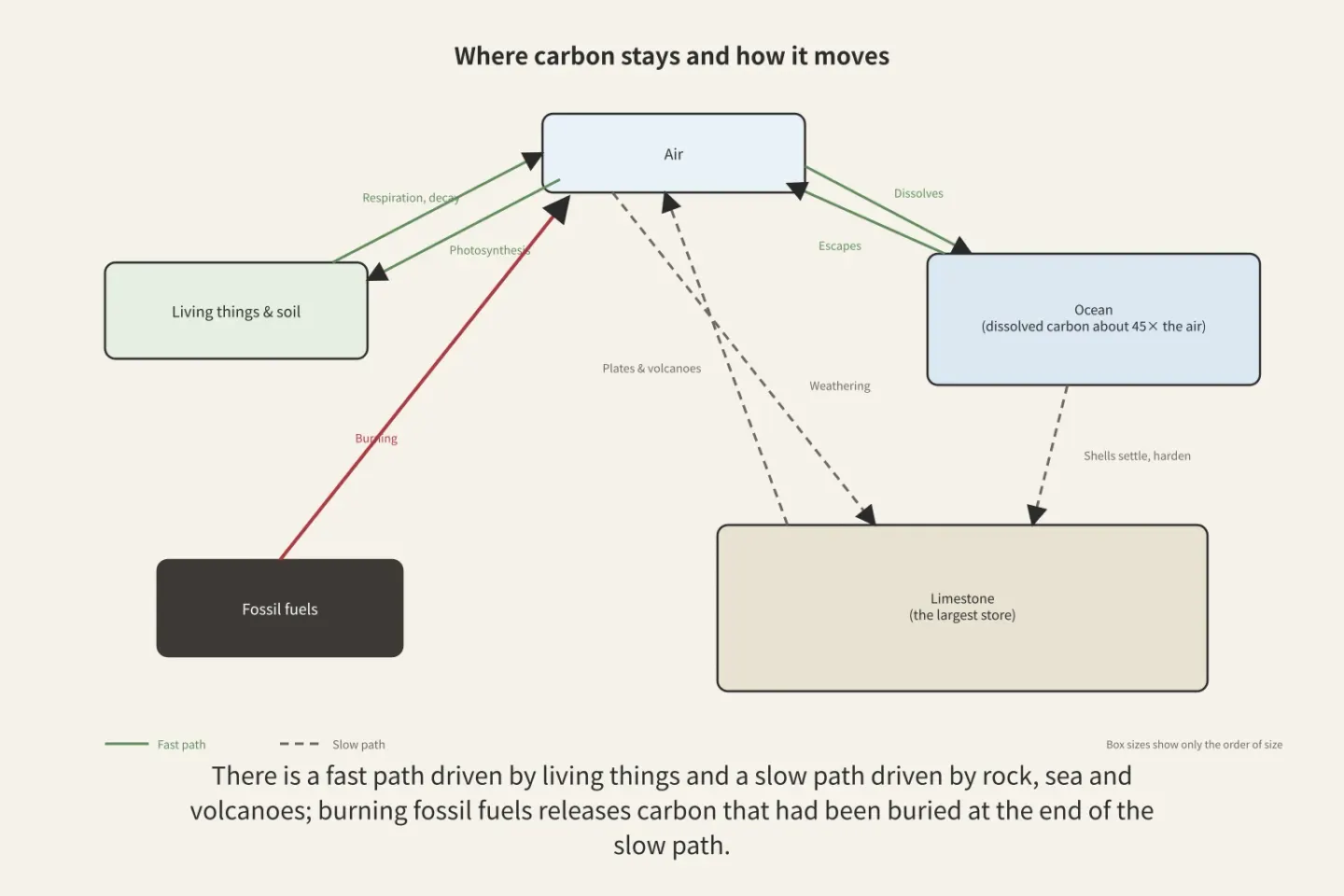
Figure: a diagram Paperis drew using only what the article says
Incoming Light, Outgoing Heat
Even after the sun goes down, if you bring your hand close to a brick wall that soaked up the sun during the day, you can feel warmth. That is because the wall is sending back out as heat the sunlight it received during the day. The entire planet does the same thing. The ground, warmed by sunlight, sends that energy back out as infrared radiation (OpenStax Astronomy 2e 8.4). Infrared radiation is an electromagnetic wave with a longer wavelength than the red light of the visible spectrum and a shorter wavelength than radio waves.
What in the air catches that infrared? Nitrogen and oxygen, which make up most of the air, are two-atom molecules and cannot catch infrared. What catches it are molecules with three or more atoms, such as water vapor, carbon dioxide, and methane. These molecules can vibrate in ways that bend, and those vibrations match the rhythm of infrared. So when they receive infrared, they shake harder, warm the surrounding air, and send the infrared back out in all directions so that some of it returns to the ground (Steven Earle, Physical Geology, 2nd Edition ch. 19.01). Incoming visible light passes straight through the air (OpenStax Astronomy 2e 8.4).
The greenhouse effect is the process where certain gases in the air absorb the infrared leaving the ground and send it back out in all directions, making the ground and the air above it warmer than they would be without those gases. Greenhouse gases are gases that absorb and re-emit infrared in this way, with water vapor, carbon dioxide, and methane being the main examples. Nitrous oxide and ozone are also included here (OpenStax Biology 2e 44.5).
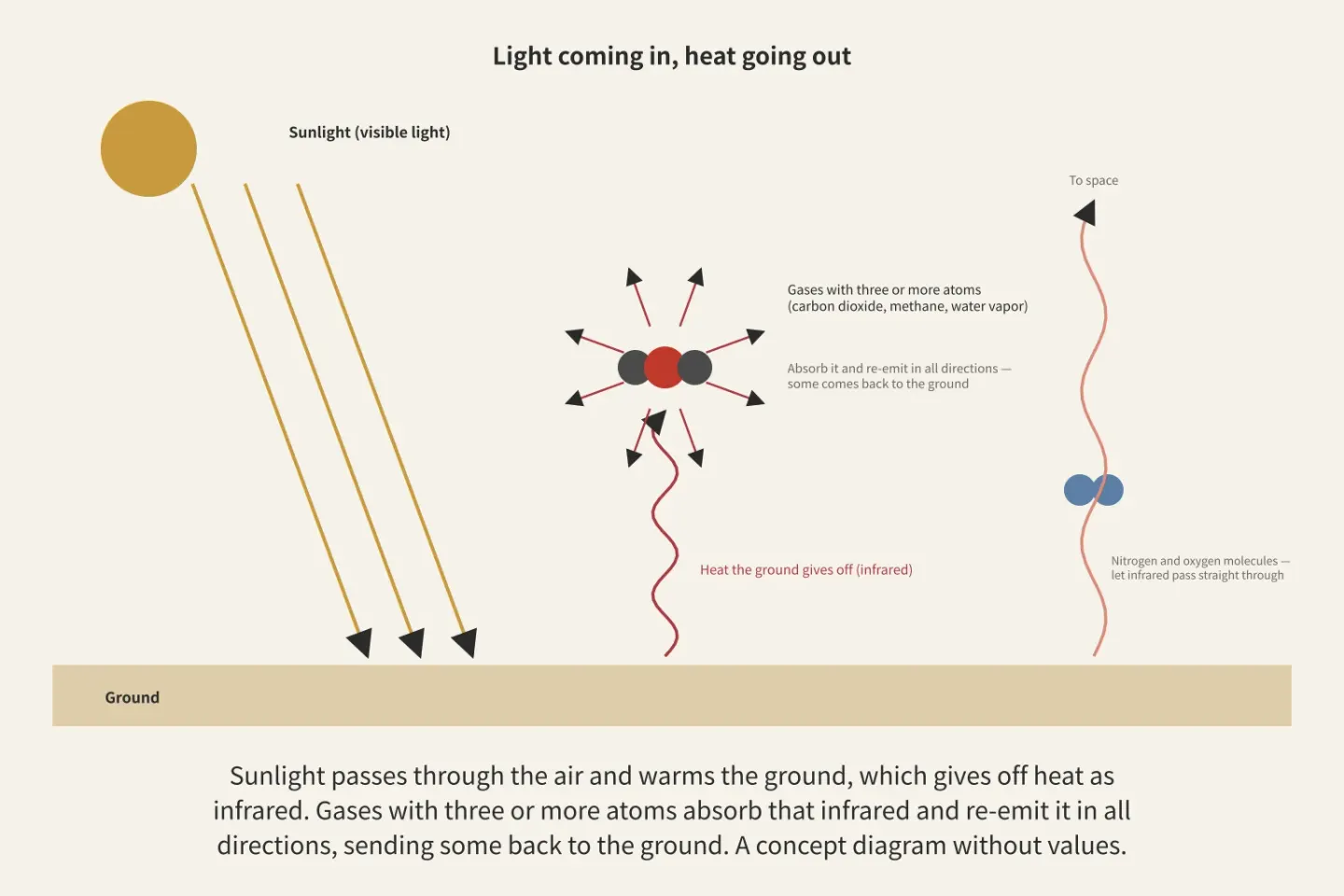
Figure: a diagram Paperis drew using only what the article says
If you think of a winter room in an old house, the stove fire stays the same, but putting paper strips over the cracks in the door makes the room warmer. A room stops getting warmer at the temperature where the heat leaking out equals the heat the stove puts in, and the paper strips push that temperature upward. The analogy holds only up to this point. Paper strips block the wind, but greenhouse gases do not block the flow of air; instead, they absorb heat, which is infrared, and send it back out in all directions (Steven Earle, Physical Geology, 2nd Edition ch. 19.01). The greenhouse in the name is the same, so the principle that makes a real greenhouse warm is not the same as the atmospheric greenhouse effect (KCI ART001024191).
The balance on Earth is struck in the same way. The balance is reached at the temperature where the energy the Earth sends out into space equals the energy it receives from the sun, and the more carbon dioxide there is, the higher that temperature becomes (OpenStax Astronomy 2e 8.4). The Earth sends out as much as it receives, but the more greenhouse gases there are, the higher the temperature at which it strikes that balance.
If There Were No Greenhouse Effect, and If the Amount Were So Small
Without the greenhouse effect, the average temperature of Earth's surface would drop well below freezing, and the entire planet would be trapped in an ice age (OpenStax Astronomy 2e 8.4). Without the greenhouse effect of water vapor, current life could not live on Earth (OpenStax Biology 2e 44.5). The greenhouse effect itself is the condition that keeps Earth at a livable temperature. What has changed is the magnitude of that effect. In its Fifth Assessment Report published in 2014, the Intergovernmental Panel on Climate Change (IPCC) assessed that it is clear greenhouse gases increased by humans have greatly amplified the greenhouse effect, and that the force pushing to warm the climate continues to grow. The same assessment noted that tiny particles in the air offset part of that force, and that the uncertainty of the total human-made force comes mainly from these particles (DOI: 10.1017/cbo9781107415324.018).
There is a misconception on the other side, too. PPM is a unit that counts how many of those gas molecules there are out of 1 million air molecules (DOI: 10.5194/essd-15-5301-2023). Carbon dioxide amounts to only several hundred ppm (Steven Earle, Physical Geology, 2nd Edition ch. 19.01). One might ask what impact such a small amount could have.
As we saw earlier, nitrogen and oxygen, which make up most of the air, cannot catch infrared radiation. Because most of the air simply lets infrared radiation pass through, the job of catching it falls to greenhouse gases, which are small in amount. Earth's long history shows that the amount of greenhouse gases in the air has governed Earth's temperature. The Sun has become about 40% brighter than when Earth was formed, and during that time, the air changed from being centered on carbon dioxide to today's air where carbon dioxide is only several hundred ppm, allowing Earth to maintain a livable temperature (Steven Earle, Physical Geology, 2nd Edition ch. 19.01). Life and geological activity together cleared away most of the carbon dioxide in the air, and without life, Earth's air would likely have been dominated by carbon dioxide like Mars or Venus (OpenStax Astronomy 2e 8.4).
Our neighboring planet Venus shows what happens when the amount is large. Venus is wrapped in a carbon dioxide atmosphere much thicker than Earth's, and its surface temperature exceeds 400 degrees Celsius. It is hundreds of degrees higher than the temperature that can be explained by the extra sunlight it receives simply by being a bit closer to the Sun (OpenStax Astronomy 2e 10.3).
Following carbon dioxide is methane, which we saw on the fast track. Methane has the second-largest power to warm the climate among greenhouse gases influenced by humans, after carbon dioxide. Its time staying in the air is short, but the warming power of the same amount is stronger. Why the speed at which methane in the air increased changed during the decade leading up to 2017 was still debated even at the time of a 2020 synthesis (DOI: 10.5194/essd-12-1561-2020). The feedback where water vapor increases and decreases depending on air temperature is not covered in this article.
The Person Opening the Jars in the Ground
Carbon released into the air from fossil fuel and cement production in the single year of 2022 is estimated at 9.9 gigatons. A gigaton is 1 billion tons, and this is the 2023 edition value from the Global Carbon Budget (GCB) compiled annually by an international research team (DOI: 10.5194/essd-15-5301-2023). Among these, the carbon from fossil fuels is pulled out by burning materials that photosynthesis made very long ago (OpenStax Astronomy 2e 8.4). Humans open jars in the ground that have been buried for millions of years every year, adding the extracted carbon to the air.
Volcanoes on the slow track also release carbon, but textbooks note that carbon dioxide produced by burning fossil fuels is roughly 100 times the amount volcanoes emit (OpenStax Astronomy 2e 8.4). Carbon atoms contain a mix of types with slightly different weights, and measuring their ratio in the carbon dioxide added to the air reveals a fingerprint showing that this carbon came mainly from fossil fuels (OpenStax Astronomy 2e 8.4).
At the Mauna Loa Observatory in Hawaii, carbon dioxide in the air has been measured with continuous meters since March 1958, and records up to 2003 were compiled into a data collection. Air was also gathered in bottles at various locations from 82 degrees north latitude to the South Pole, and the samples were analyzed using infrared light (DOI: 10.3334/cdiac/atg.ndp001).
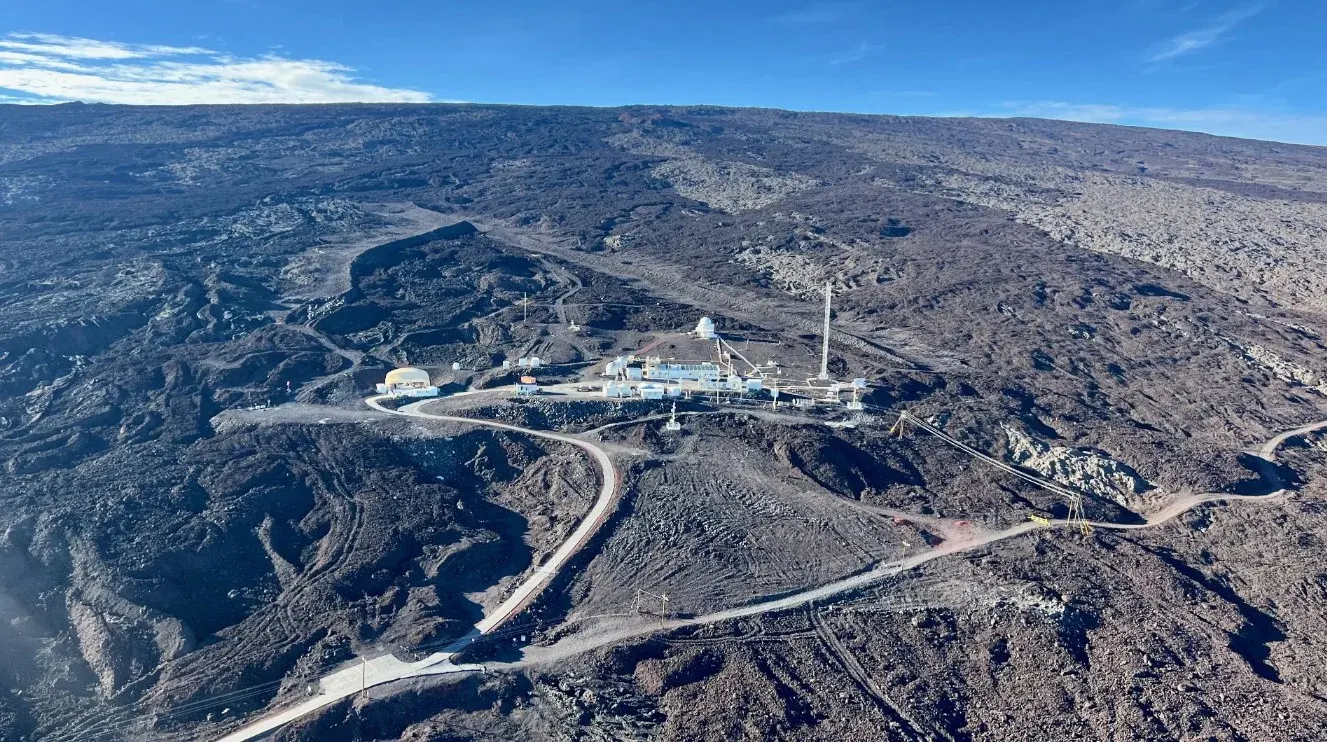
Mauna Loa Observatory, Hawaii · NOAA · Wikimedia Commons (public domain)
Looking at the global average from the GCB, which pools multiple observations, carbon dioxide in the air averaged 417.1 ppm in 2022. The GCB sets the pre-industrial level around 1750 at roughly 278 ppm (DOI: 10.5194/essd-15-5301-2023).
Carbon released by humans in 2022 is estimated at 11.1 gigatons, including amounts from changing land use such as cutting down forests. Of that, 4.6 gigatons remained in the air (DOI: 10.5194/essd-15-5301-2023). The amount remaining in the air is calculated directly from how much the concentration rose each year (DOI: 10.5194/essd-15-5301-2023).
The rest was taken in by carbon sinks. It is estimated that the oceans accepted 2.8 gigatons and land organisms 3.8 gigatons (DOI: 10.5194/essd-15-5301-2023). The ocean value is estimated using models and observational data, the land value is estimated mainly through vegetation models, and significant uncertainty remains for the amount coming from land-use changes (DOI: 10.5194/essd-15-5301-2023). Carbon pulled out by humans is divided and accumulates in the air, oceans, and land, and the share remaining in the air amplifies the greenhouse effect.
The Share Accepted by the Ocean
The ocean is estimated to have absorbed 2.8 gigatons of the carbon humans emitted that year. Over the past decade, the magnitude of the amount received by the ocean still diverges depending on the estimation method (DOI: 10.5194/essd-15-5301-2023). When the ocean takes up carbon, seawater changes as well. Carbon dioxide dissolved in seawater forms carbonic acid, shifting the water toward the acidic side, while carbonate ions used to build shells decrease (DOI: 10.2777/66906).
Ocean acidification is the process where the ocean dissolves and absorbs carbon dioxide from the air, causing seawater to shift toward the acidic side. The fact that ocean acidification is occurring itself is an uncontested truth (DOI: 10.2777/66906). pH is a scale indicating whether something dissolved in water leans toward the acidic or basic side, with smaller numbers representing the acidic side and larger numbers representing the basic side. Acidification is a name indicating a direction — that this scale is moving toward smaller numbers.
As seawater moves further toward the acidic side, calcium carbonate dissolves more easily, making coral skeletons vulnerable to dissolution (OpenStax Chemistry 2e 15.3). The ability to build shells is directly affected in pteropods, small floating sea mollusks, foraminifera, small shelled organisms, and some benthic invertebrates living on the ocean floor (DOI: 10.1093/icesjms/fsn048). However, because there are few studies at concentrations likely to actually occur, it is difficult to predict what will happen to the food web as a whole (DOI: 10.1093/icesjms/fsn048). The understanding of what those consequences will be is still in its infancy (DOI: 10.2777/66906). At the same time, the aforementioned researchers concluded that acidification has a high potential to combine with other pressures imposed by humans and broadly alter marine ecosystems (DOI: 10.1093/icesjms/fsn048).
Experiments in Korean waters show the same picture. An experimental setup was placed on the seabed of the southern coastal area of the East Sea to raise olive flounder juveniles for 43 days. There was no difference in mortality rates between the group with elevated carbon dioxide and the control group left in natural conditions, but the rate of increase in body size and weight was lower in the elevated group (KCI ART001832007).
The seawater in the group with elevated carbon dioxide had a pH of 7.63 (KCI ART001832007). Because this value is higher than 7, which is neutral, the seawater that shifted toward the acidic side was still on the basic side. This experiment used conditions with higher carbon dioxide than the natural ocean and is the result of observing a single species over a short period (KCI ART001832007).
Geological records also contain events where carbon dioxide increased and the ocean shifted toward the acidic side. Researchers who reviewed such events from roughly the past 300,000,000 years noted that acidification can lead to severe consequences for marine ecosystems and that some events coincided with the extinction or major turnover of shell-building marine life. At the same time, they concluded that while there are similarities, no past event is an exact match for the fluctuations in ocean chemistry projected for the future. This is because the current rate at which carbon dioxide is being released is unprecedentedly fast (DOI: 10.1126/science.1208277).
Back in the Old House
We follow a single carbon atom from a briquette. When the briquette burns, that carbon becomes carbon dioxide and enters the bin, which is to say, the air. When oak leaves photosynthesize in the spring, that carbon becomes sugars in the leaf, and when the leaves fall in autumn, decomposers break them down and return them to the soil or the air. The carbon returned to the air may also dissolve in seawater. The carbon in seawater becomes a clam shell, and when the shell accumulates on the ocean floor, it becomes limestone after a long time. When tectonic plates drag that sediment down into the earth, it eventually comes back out into the air through a volcano. The first few steps happen while living things live and die, while the later steps take vast geological ages.
There is one more way the old-house analogy differs from the real Earth. The storage bin and the barn sit separately when their doors are closed, but the air and the ocean constantly exchange carbon so that when one changes, the other changes as well (OpenStax Biology 2e 46.3).
There are three things to take with us. Carbon is never destroyed; it only changes its location among the air, the ocean, living things, soil, and rocks. There is a fast route driven by living things and a slow route driven by rocks, oceans, and volcanoes, and fossil fuels are carbon that was buried at the end of the slow route. A small amount of greenhouse gases in the air warms the Earth to a habitable level, and as humans have dug up that carbon and added it to the air, the greenhouse effect has grown. How much the Earth has actually warmed and how the causes are sorted out are continued in another part of this series, "Climate Change — Witnesses Questioned Apart, Suspects Checking Their Alibis".
Where to Read More
The idea that photosynthesis and respiration are reactions in which electrons are passed back and forth continues from Oxidation and Reduction — A Hand That Calls the Thrown Ball, a Ball Sent the Long Way Around, and the radiation by which the ground emits heat through infrared rays continues from Heat and Temperature — Water That Only Flows Downhill, a Pump That Lifts It Back Up. The wavelengths and colors of light are in Light and Telescopes — A Letter That Arrives Late, a Fingerprint in the Envelope, and the task of measuring time with carbon is in Dating with Carbon — Radiocarbon Dates, Read with an Hourglass and Tree Rings and Atoms and Radiation — A Drizzle That Never Stops, a Rain Gauge for How Wet We Get. An article that applies those methods to an actual historical problem is When Did the Thera Volcano Erupt? — The Century Between Carbon and Pottery.
Within this series, Plate Tectonics — Ice Floes That Jostle, and the Rock That Flows Beneath covers the places where one plate dives beneath another and where volcanoes stand, and Weather and Climate — Today's Roll, the Shape of the Die covers the layers and flows of the air.
Source Papers
- "Biology 2e — 46.3 Biogeochemical Cycles" (2018) — OpenStax Biology 2e 46.3 — Matter is conserved and reused, the carbon cycle consists of both rapid exchanges among organisms and long-term geological cycles, photosynthesis turns CO2 into organic carbon while respiration returns it, reservoirs include the atmosphere, oceans, marine sediments, soil, underground sediments (including fossil fuels), and the Earth's interior; the atmosphere and oceans influence each other, over 90% of ocean carbon is bicarbonate ions, calcium carbonate shells lead to sedimentation and limestone (the largest reservoir), soil carbon comes from decomposition and weathering and enters water via runoff, fossil fuels are plant remains decomposed without oxygen underground and under the sea floor over millions of years making them a non-renewable resource consumed faster than they are produced, and subducted carbon returns as CO2 through volcanoes and hydrothermal vents.
- "Biology 2e — 44.5 Climate and the Effects of Global Climate Change" (2018) — OpenStax Biology 2e 44.5 — Greenhouse gases include CO2, methane, water vapor, nitrous oxide, and ozone; without the greenhouse effect of water vapor, life could not inhabit the Earth today; fossil fuels include gasoline, coal, and natural gas; and methane is produced when bacteria decompose organic matter in oxygen-free conditions such as rice paddies and the guts of herbivores.
- "Astronomy 2e — 8.4 Life, Chemical Evolution, and Climate Change" (2022) — OpenStax Astronomy 2e 8.4 — Life and geological activity have scrubbed away most atmospheric CO2 (otherwise the atmosphere would resemble those of Mars and Venus), sunlight is absorbed by the ground and reradiated as infrared radiation, the atmosphere lets visible light pass while absorbing infrared, surface temperature rises until outgoing energy equals incoming energy with higher CO2 levels resulting in a higher equilibrium temperature, without the greenhouse effect the average temperature would sit well below the freezing point causing a global ice age, fossil fuels are energy-rich materials produced by photosynthesis tens of millions of years ago and burning them releases this energy, fossil fuel CO2 is 100 times that of volcanoes, and the isotopic signature of the added CO2 points primarily to fossil fuels.
- "Astronomy 2e — 10.3 The Massive Atmosphere of Venus" (2022) — OpenStax Astronomy 2e 10.3 — Venus features a much thicker CO2 atmosphere, a surface temperature exceeding 700 K, and remains hundreds of degrees hotter than expected from incoming sunlight alone due to the greenhouse effect.
- "Chemistry 2e — 15.3 Coupled Equilibria" (2019) — OpenStax Chemistry 2e 15.3 — Rising atmospheric CO2 increases seawater acidity, and more acidic conditions cause calcium carbonate to dissolve more readily, making it easier for coral skeletons to dissolve.
- "Physical Geology, 2nd Edition — 19.01 What Makes the Climate Change?" (2026) — Steven Earle, Physical Geology, 2nd Edition ch. 19.01 — Nitrogen and oxygen (molecules with 2 atoms) are not greenhouse gases while molecules with 3 or more atoms (water vapor, CO2, CH4) are, bending vibrations match infrared radiation allowing them to absorb it and warm their surroundings before radiating it in all directions, the Sun has grown 40% brighter yet a shift in the atmosphere from being dominated by CO2 to hundreds of ppm of CO2 has maintained a habitable temperature, uplift-accelerated weathering consumes CO2 and contributes to cooling over tens of millions of years, volcanic CO2 causes warming only when above-average activity persists for tens of thousands of years, and ocean carbon is roughly 45 times that of the atmosphere.
- "Anthropogenic and Natural Radiative Forcing" (2014) — DOI: 10.1017/cbo9781107415324.018 — IPCC Fifth Assessment Report: It is unequivocal that human-induced increases in well-mixed greenhouse gases have greatly amplified the greenhouse effect and this forcing continues to grow, while aerosols partially offset this and dominate the uncertainty of total anthropogenic forcing.
- "Global Carbon Budget 2023" (2023) — DOI: 10.5194/essd-15-5301-2023 — In 2022, fossil emissions were 9.9±0.5 GtC (including carbonation absorption in cement) and land-use change contributed 1.2±0.7, for a total of 11.1±0.8 GtC; atmospheric growth was 4.6±0.2, ocean uptake 2.8±0.4, and land uptake 3.8±0.8 GtC; the 2022 average concentration was 417.1±0.1 ppm compared to about 278 ppm in preindustrial times (1750); atmospheric concentrations are measured directly while ocean and land sinks are estimated based on models and observations; large uncertainties persist in land-use emissions; discrepancies among methods remain for the magnitude of ocean uptake over the past decade; ocean uptake is estimated using ocean models and observation-based products while land uptake is estimated using vegetation models; and ppm stands for parts per million.
- "Atmospheric CO2 Concentrations - Mauna Loa Observatory, Hawaii, 1958-2003" (2004) — DOI: 10.3334/cdiac/atg.ndp001 — Scripps Institution of Oceanography data: bottle samples from 10 locations spanning 82 degrees north to 90 degrees south latitude analyzed using infrared detection, with continuous weekly average measurements at Mauna Loa starting in March 1958.
- "The Global Methane Budget 2000–2017" (2020) — DOI: 10.5194/essd-12-1561-2020 — Methane is the second most important human-influenced greenhouse gas after carbon dioxide, possessing a short atmospheric lifetime and a high global warming potential, and the causes of changes in its atmospheric growth rate over the past decade remain debated.
- "Guide to best practices for ocean acidification research and data reporting" (2011) — DOI: 10.2777/66906 — Ocean acidification is an undisputed fact, dissolved CO2 forms carbonic acid which increases acidity and decreases carbonate ion concentration, and understanding of the consequences remains in its early stages.
- "Impacts of ocean acidification on marine fauna and ecosystem processes" (2008) — DOI: 10.1093/icesjms/fsn048 — The ability of pteropods, foraminifera, and certain benthic invertebrates to form calcareous skeletons is directly affected by seawater CO2 chemistry, but a shortage of studies at relevant concentration levels makes predicting food web impacts difficult, leading to the conclusion that ocean acidification carries a high potential to induce widespread changes in marine ecosystems.
- "The Geological Record of Ocean Acidification" (2012) — DOI: 10.1126/science.1208277 — A review of CO2 increase, warming, and acidification events over the past roughly 300 million years shows some coinciding with the extinction and turnover of calcifying organisms; acidification can produce severe consequences for marine ecosystems; and although similarities exist, no past event matches the future outlook precisely because the current rate of CO2 release is unprecedentedly fast.
- "해양산성화가 넙치의 초기발달에 미치는 영향:현장 메조코즘(mesocosm) 실험" (2013) — KCI ART001832007 — In a field mesocosm experiment in the coastal southern East Sea lasting 43 days with olive flounder larvae under treatment conditions of pH 7.63±0.13 and a control of 8.07±0.05, mortality showed no difference while growth was higher in the control, demonstrating that high CO2 can exert a significant negative impact on early growth.
- "Enhanced chemical weathering as a geoengineering strategy to reduce atmospheric carbon dioxide, supply nutrients, and mitigate ocean acidification" (2013) — DOI: 10.1002/rog.20004 — Chemical weathering forms part of the rock and carbon cycles, where silicate minerals dissolve and convert dissolved CO2 into bicarbonate, with a substantial fraction transported to coastal zones and oceans (cited here solely for the principles of weathering).
- "대형 산불 발생 이후 산림 탄소흡수능력의 단기 변화: 2022년 울진⋅삼척 산불 사례" (2026) — KCI ART003326820 — Pre- and post-wildfire analysis using MODIS satellite data and domestic machine learning carbon flux data regarding the 2022 Uljin-Samcheok wildfire shows a sharp drop in GPP and a shift of NEE to positive values (weakened absorption capacity) immediately afterward, with GPP failing to recover to pre-wildfire levels by 2025 while NEE normalized close to baseline levels in 2025.
- "에디 공분산 기반의 플럭스 타워 관측자료를 이용한 국내외 산림과 농업 생태계 탄소 흡수량 분석" (2017) — DOI: 10.14249/eia.2017.26.2.127 — Carbon uptake in domestic forests (-31 to -362 gC/m² annually) and agricultural lands (-210 to -248 gC/m² during the growing season) analyzed through net ecosystem exchange observations from eddy covariance flux towers.
- "온실 효과에 대한 바른 개념 고찰" (2006) — KCI ART001024191 — The thermal insulation of an actual greenhouse and the greenhouse effect of the atmosphere do not share the same mechanism, and explaining the phenomenon using the term "greenhouse" leads to conceptual confusion.
Sources (15)
- Biology 2e — 46.3 Biogeochemical Cycles
- Biology 2e — 44.5 Climate and the Effects of Global Climate Change
- Astronomy 2e — 8.4 Life, Chemical Evolution, and Climate Change
- Astronomy 2e — 10.3 The Massive Atmosphere of Venus
- Chemistry 2e — 15.3 Coupled Equilibria
- Physical Geology, 2nd Edition — 19.01 What Makes the Climate Change?
- Anthropogenic and Natural Radiative ForcingDOI 10.1017/cbo9781107415324.018
- Global Carbon Budget 2023DOI 10.5194/essd-15-5301-2023
- Atmospheric CO2 Concentrations - Mauna Loa Observatory, Hawaii, 1958-2003DOI 10.3334/cdiac/atg.ndp001
- The Global Methane Budget 2000–2017DOI 10.5194/essd-12-1561-2020
- Guide to best practices for ocean acidification research and data reportingDOI 10.2777/66906
- Impacts of ocean acidification on marine fauna and ecosystem processesDOI 10.1093/icesjms/fsn048
- The Geological Record of Ocean AcidificationDOI 10.1126/science.1208277
- Enhanced chemical weathering as a geoengineering strategy to reduce atmospheric carbon dioxide, supply nutrients, and mitigate ocean acidificationDOI 10.1002/rog.20004
- 에디 공분산 기반의 플럭스 타워 관측자료를 이용한 국내외 산림과 농업 생태계 탄소 흡수량 분석DOI 10.14249/eia.2017.26.2.127