Paperis Articles
Rembrandt's Night Watch — A Map of Paint, Drawn Inside a Glass Room
What the Rijksmuseum's Operation Night Watch measured in its paint and canvas with light, X-rays, tiny paint samples and heat-based structural checks, and what those measurements leave unanswered
Your field's papers, as audio
Pick your fields and journals — Paperis summarizes the key papers and turns them into audio. Listen on your commute.
Start Paperis free →Rembrandt's Night Watch — A Map of Paint, Drawn Inside a Glass Room
1642 Amsterdam, a group portrait 4.5 meters wide
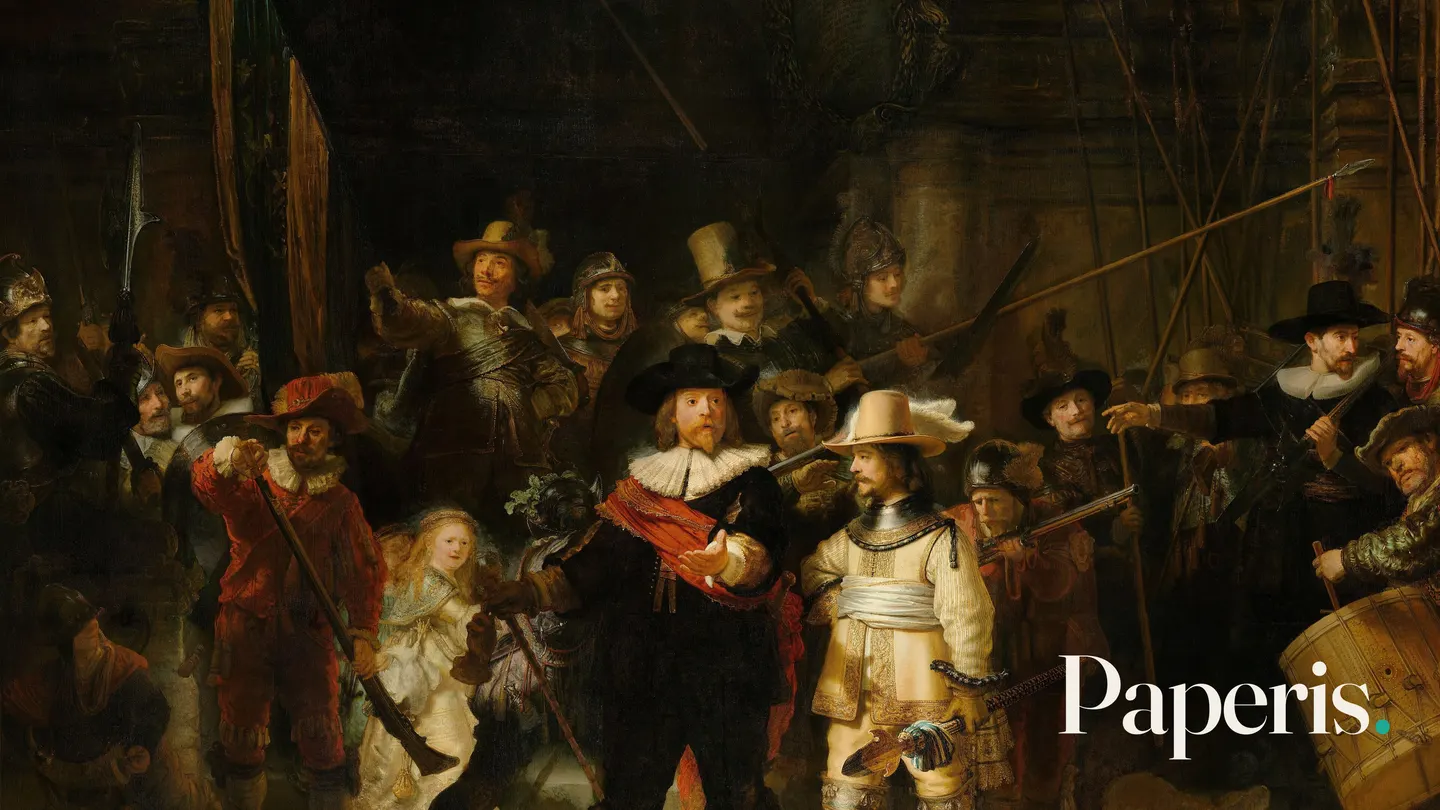
In 1642, Amsterdam, Netherlands. Dutch painter Rembrandt van Rijn completed a large group portrait. This is the painting we call The Night Watch. In the center of the canvas stands Captain Frans Banning Cocq, and to his right is Lieutenant Willem van Ruytenburch (DOI: 10.1186/s40494-024-01350-x). Behind the two men stand armed members grouped together. It is a painting depicting a unit of the Amsterdam civic militia formed by citizens.
This painting currently hangs in Amsterdam's national museum, the Rijksmuseum, and is counted among Rembrandt's most famous works (DOI: 10.1002/anie.202216478). The size of the canvas is 3.78 meters high and 4.53 meters wide (DOI: 10.3390/s21206855). Its height is more than twice a person's height.
In 2019, the Rijksmuseum launched a large-scale investigation into this painting called "Operation Night Watch" (DOI: 10.1186/s40494-024-01350-x). The research team participating in the investigation notes that this is the largest among the research projects conducted by the museum (DOI: 10.3390/s21206855). The investigation was carried out in the exhibition hall "Hall of Fame" where the painting hangs, inside a glass room erected around the painting, in front of watching visitors (DOI: 10.1117/12.2591937).
There were four things the investigation sought to find out. What conservation treatments the painting has undergone, what its current condition is, what materials Rembrandt used and how he painted it, and based on those results, how future conservation treatments should be handled (DOI: 10.1117/12.2591937; DOI: 10.3390/s21206855). This article follows what was measured inside that glass room, what came out of it, and how far those results speak.
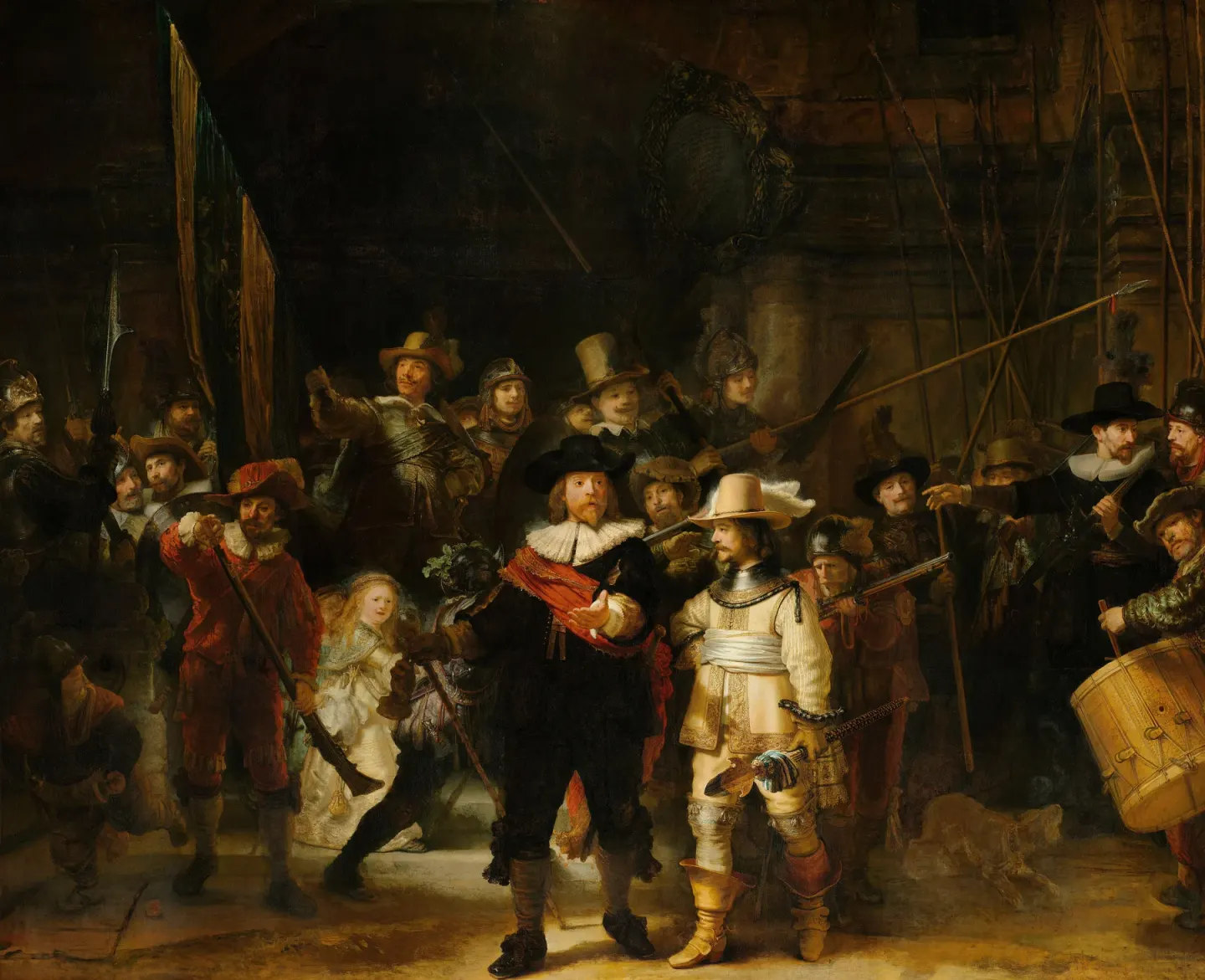
Rembrandt van Rijn, The Night Watch (1642) · Rijksmuseum, Amsterdam · public domain · Wikimedia Commons
A Map Drawn Inside a Glass Room
Inside the glass room, two cameras moved back and forth in front of the painting. A computer-controlled frame carried both the cameras and the lighting across the surface of the painting, and a distance sensor measured the gap to the painting to keep the focus from blurring (DOI: 10.3390/s21206855). By stitching together 200 images taken in this strip-like fashion, a complete record of the entire painting was created.
What these cameras did is reflectance hyperspectral imaging. Reflectance hyperspectral imaging is a method that shines light onto a painting and records the returning light, split into finely divided colors, at every point on the screen. One camera handled light visible to the eye through slightly longer infrared light (400 to 1,000 nanometers), while the other camera took charge of longer infrared light (900 to 2,500 nanometers), scanning the entire painting at 0.2-millimeter intervals (DOI: 10.1117/12.2591937). Because different pigments reflect light back in different ways, this record left at every point makes it possible to figure out which pigment is where. In their first analysis, the research team confirmed several pigments used and how those pigments were spread across the screen (DOI: 10.3390/s21206855).
The same record shone beneath the paint as well. An underdrawing is the outline of the composition captured on the surface before applying paint in earnest. Right beneath the exterior of a painting, such underdrawings, undercoats, and places where the artist made corrections can remain, and conservators have used infrared photography and X-ray photography as standard methods to find them (DOI: 10.1021/ar900248e). In The Night Watch, the longer infrared-side images made the underdrawing and the places where the composition was repainted much easier to see (DOI: 10.3390/s21206855). However, this is the result of a preliminary analysis published by the research team in 2021, and its abstract does not go so far as to write down what was drawn in which spot.
Placed beside the map of light was a map of elements. An X-ray fluorescence map is a map that measures the light returning differently from each element when X-rays are beamed at it, drawing where which element is located in the painting. Because different pigments contain different elements, this map shows how pigments are spread out within the paint layer (DOI: 10.1021/ar900248e). The research team for The Night Watch added to this a map that distinguishes even the types of crystals using X-rays. That map points out by name chemical compounds that cannot be told apart by elements alone (DOI: 10.63028/10067/2206780151162165141).
Reflectance hyperspectral imaging redrew the entire painting by color, and the X-ray maps redrew various spots of the painting by elements and crystals. The research team notes that if these maps are layered on top of each other and combined with the analysis of a tiny sample taken from the paint, we will come to understand Rembrandt's materials and techniques most completely (DOI: 10.3390/s21206855). The maps lay out "where what is" across the wide screen, and the sample looks deeply into that single point. The paint discoveries below emerged by moving back and forth between these two things.
Eyes Go to the Person Painted Brightly
In the center of the canvas, standing to the right of the captain, Lieutenant Willem van Ruytenburch is the figure who receives exceptionally bright light in the painting (DOI: 10.1038/s40494-025-01874-w). The squad members around him are mostly plunged in darkness. The way Rembrandt created this contrast is chiaroscuro. Chiaroscuro is a technique that draws form and light by strongly contrasting bright and dark areas.
A 2025 study asked how Rembrandt painted the light on one of this lieutenant's outfits (DOI: 10.1038/s40494-025-01874-w). The researchers mapped the pigments Rembrandt used with reflectance hyperspectral imaging and two X-ray maps. The resulting pigments were lead white, lead-tin yellow, ochre, vermilion, an arsenic-containing pigment, red lake pigment, a blue pigment made by grinding cobalt-containing glass (smalt), and the blue mineral azurite (DOI: 10.1038/s40494-025-01874-w; DOI: 10.1021/acs.analchem.5c07178).
Rembrandt bundled these pigments in groups of several and used them repeatedly in a consistent pattern, and the researchers believe those groupings were intended to tie the entire canvas together as a whole. The researchers note that an arsenic-containing pigment was used in the spots where the gold threads of the clothing reflect a warm light (DOI: 10.1038/s40494-025-01874-w). This means that even across a single unusually bright outfit, several pigment bundles were used repeatedly from place to place.
The same question arose regarding red. Red lake pigment was used broadly across The Night Watch, but it is a tricky pigment to analyze. A 2026 study showed that reflectance hyperspectral imaging can distinguish whether this red pigment was applied as a thin film covering vermilion paint or mixed together with vermilion. That identification was confirmed by comparison against replica paints and sample cross-sections (DOI: 10.1038/s40494-026-02569-6). One more way has been added to read the painting technique without having to detach samples from the artwork.
Then what does that light actually do to the viewer? A 2022 study had 21 people stand in front of The Night Watch for 5 minutes each, recording their eye movements with wearable eye-tracking devices while asking them to speak their arising thoughts aloud (DOI: 10.1177/03010066221122697). Gazes gathered mainly in three places: the faces of the two central figures, the brightly lit girl, and details like the attire of key figures. As the 5 minutes passed, gazes gradually shifted from the faces of the main figures to other elements of the scene.
The researchers note that these results match the theory that Rembrandt caught the viewer's gaze with light and texture. They repeated the same experiment in front of a smaller reproduction, confirming that the measurement method did not waver (DOI: 10.1177/03010066221122697). "Matches" is a weaker word than "proved," and these results are the gazes shown by 21 people in front of a single painting.
The paint maps answer which pigments Rembrandt bundled and how he used them to paint the light, and the gaze records show that the eyes of 21 people gathered mainly on the faces of the two central figures, the bright girl, and clothing details before gradually shifting elsewhere. "Rembrandt caught the gaze with light and texture" is a single theory, and the gaze researchers merely wrote that their results match that theory. Placing the paint maps and gaze records side by side is this article's task, and measurements do not measure as far as what the painter intended.
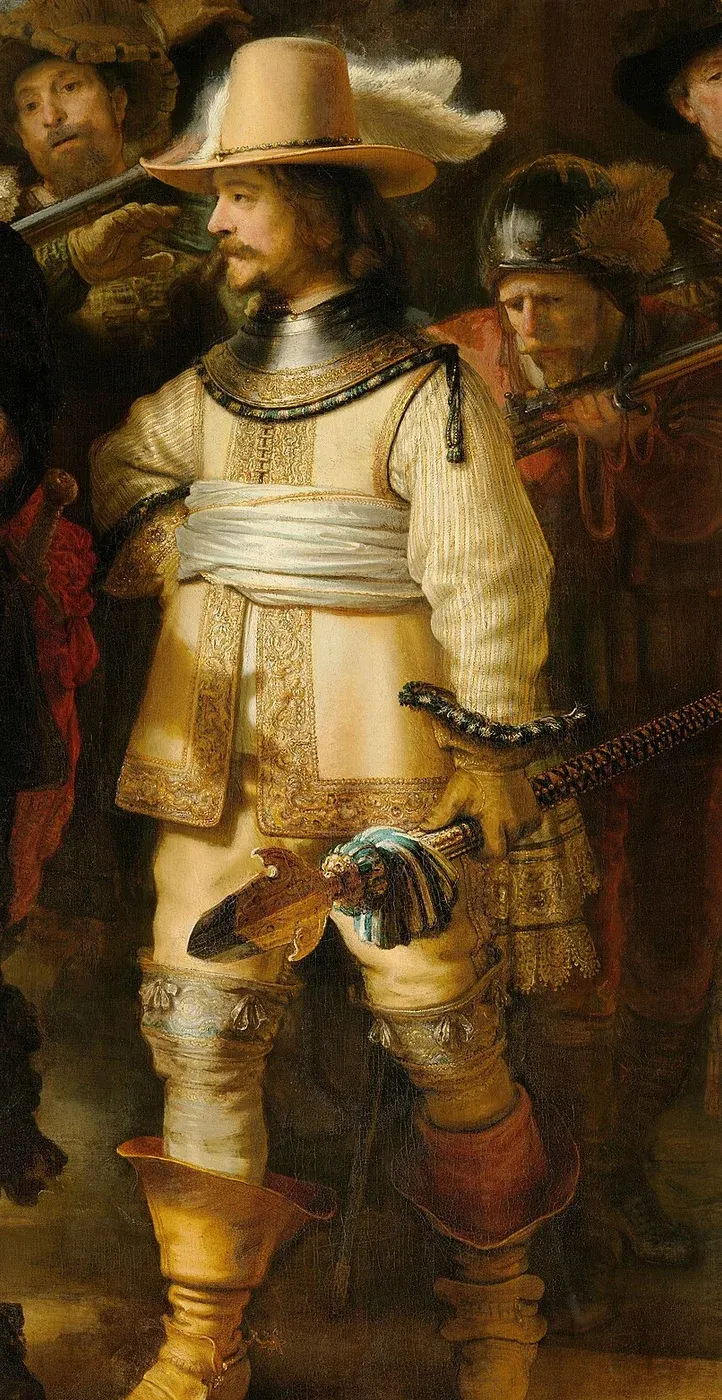
Detail: Lieutenant van Ruytenburch’s clothing · Rembrandt van Rijn, The Night Watch (1642) · Rijksmuseum, Amsterdam · public domain · Wikimedia Commons
The Unexpected Yellow Particles
From that bright garment, mapping pinpointed pigments made of arsenic and sulfur. On Lieutenant Van Ruytenburch's sleeve and the hem of his embroidered leather jerkin, X-ray fluorescence mapping, X-ray diffraction mapping, and reflectance hyperspectral imaging together detected pigments made of arsenic and sulfur alongside substances formed as those pigments degraded (DOI: 10.1186/s40494-024-01350-x).
The researchers detached two tiny paint samples from this area. Under the microscope, the samples showed a mixture of large particles with sharp edges and flat shapes, and the particles were of two types: yellow ones, and ones tinged from orange to red. Elemental analysis using an electron microscope confirmed that both types of particles contained arsenic and sulfur. Finally, another spectroscopic measurement that reads a material's structure by shining light gave them names. The yellow particles were pararrealgar, and the orange-red particles were poorly crystalline pararrealgar (DOI: 10.1186/s40494-024-01350-x). Pararrealgar is a yellow compound made of arsenic and sulfur. When the samples were examined with synchrotron X-rays, various degradation products related to the arsenic pigments were also revealed to be spread throughout the paint layer.
The researchers write that this discovery is a new addition to Rembrandt's list of pigments (DOI: 10.1186/s40494-024-01350-x). A doctoral dissertation from the same research project lists the unexpected finding of arsenic pigments in The Night Watch as one of its results (DOI: 10.63028/10067/2136770151162165141).
The measurements answered "what is there," and the researchers searched through relevant historical literature to form hypotheses on "why, how, and where it was acquired." Those documents showed that various types of arsenic-based pigments made by people at the time were in circulation, suggesting that the arsenic pigments available in 17th-century Amsterdam may have been more diverse than previously thought. This is supported by the point that a very similar pigment mixture was used in paintings by Willem Kalf, an artist active in Amsterdam during the same period (DOI: 10.1186/s40494-024-01350-x).
The researchers reach a conclusion by combining this literature search, Kalf's paintings, and the condition of the particles inside the paint cross-sections as evidence. Their conclusion is that Rembrandt deliberately chose pararrealgar and poorly crystalline pararrealgar, mixing them with lead-tin-yellow and vermilion to create an orange paint (DOI: 10.1186/s40494-024-01350-x).
That pararrealgar is there is a measurement, and that Rembrandt deliberately chose it is the researchers' conclusion reached by adding historical literature, Kalf's paintings, and the particle condition to that measurement. Kalf's paintings, being different works by a different artist, do not replace the results for The Night Watch, but instead add the context that such pigments were used in the same era. And the fact that degradation products emerged together in the same sample leads to the next story: that orange paint may not remain looking the way it did on the day it was applied.
An Unexpected Compound Emerge from the Painting
X-ray maps sorting out crystals found an unexpected compound in several spots of The Night Watch. It is lead formate (DOI: 10.1002/anie.202216478). Lead formate is a compound formed when lead combines with formic acid. According to the researchers, this compound had never been reported in old oil paintings before.
What did it look like? The researchers hypothesized and tested one possible pathway. Following a 17th-century recipe, they heated linseed oil with lead oxide—which helps paint dry well—to recreate paint materials, and examined them using synchrotron X-rays and infrared microscopy. In that replicated sample, lead formate and a related lead compound were confirmed to have formed together (DOI: 10.1002/anie.202216478).
This result is from an experiment with replicated paint. The researchers offer this as a new clue regarding how lead dryers react with oil in old paintings, and do not conclude that the lead formate in The Night Watch actually formed through this exact route. Because the tested pathway involves heating oil and lead oxide during the paint-making stage, this abstract also does not determine whether it formed when making the paint or inside the painting after it was applied. The Rijksmuseum has made public the X-ray map data of this compound painted in several areas of The Night Watch (DOI: 10.82382/rijks_rd/pvyd0a).
There are more unexpected compounds and degradation products besides lead formate. In the map depicting Lieutenant van Ruytenburch’s uniform, three degradation products related to the original pigment were also identified: mimetite, weddellite, and palmierite (DOI: 10.1038/s40494-025-01874-w). A doctoral dissertation notes that examining the area of The Night Watch that suffered an acid vandalism attack using the same X-ray maps confirmed the newly formed lead sulfate crystals (anglesite) in the upper paint layer (DOI: 10.63028/10067/2206780151162165141). This is a result published in the dissertation abstract.
The blue sections are not simple either. When three samples containing cobalt glass powder pigment were examined in 3D using synchrotron X-rays, the particles varied significantly in size and elemental composition (DOI: 10.1021/acs.analchem.5c07178). The researchers note that the differences could stem from variations in the cobalt ore, the glass-making process, mixing different types of pigments, or degradation occurring within the painting. This abstract does not determine which of the four it is.
These maps show where unexpected compounds and degradation products are located in the painting, but these abstracts did not measure when they formed, how fast they increase, or how much they threaten the painting. The researchers apply these findings to understand the current condition of the painting and choose conservation methods (DOI: 10.1038/s40494-025-01874-w; DOI: 10.1021/acs.analchem.5c07178). The presence of degradation products means that part of the paint in The Night Watch has changed since it was applied, and those traces can now be seen on a map.
When You Layer Maps on Top of a 5-Minute Gaze
Let us suppose a visitor stands in front of "The Night Watch." Just as the gaze of 21 people did, his eyes are drawn mainly to the faces of the two central figures, the bright girl, and the details of the clothing, and over time they may move to other places (DOI: 10.1177/03010066221122697). This is what emerged from a study that measured 21 people. One of those details is the bright coat of Lieutenant Willem van Ruytenburch.
We try layering the maps we have seen so far onto that coat one by one. The first sheet is the map of pigments. Rembrandt grouped pigments in sets of several and used them repeatedly across positions, and the researchers note that he used an arsenic-containing pigment in the spots where gold thread reflects (DOI: 10.1038/s40494-025-01874-w). The second sheet is the map of arsenic pigments. The map pointed out pigments made of arsenic and sulfur and their degradation products in the sleeve and the embroidered leather doublet, and in two samples taken from those spots, yellow pararealgar particles and orange and red particles were mixed. The researchers view this as an orange paint that Rembrandt made by mixing lead-tin yellow and vermilion (DOI: 10.1186/s40494-024-01350-x). Whether the arsenic pigment in the gold thread spot is the same as this pararealgar is not stated by the two abstracts. The third sheet is the map of change. In the map depicting the same coat, three degradation products related to the original pigments appeared, and in the paint layer of the sample where pararealgar was found, degradation products related to the arsenic pigment were spread (DOI: 10.1038/s40494-025-01874-w; DOI: 10.1186/s40494-024-01350-x).
What the visitor sees for 5 minutes is the light that Rembrandt painted, and inside the paint where that light is placed, the pigment that Rembrandt painted and the degradation products related to that pigment exist together. Layering the spots where the gaze gathers and the spots where the degradation products appeared in this way is what this article has done, and it was not measured together by the two studies. To what extent among the brightness reaching the visitor's eyes right now is the color originally painted and from where it is the changed color has not been separated by these pieces of evidence.
Lead beneath the Ground Layer
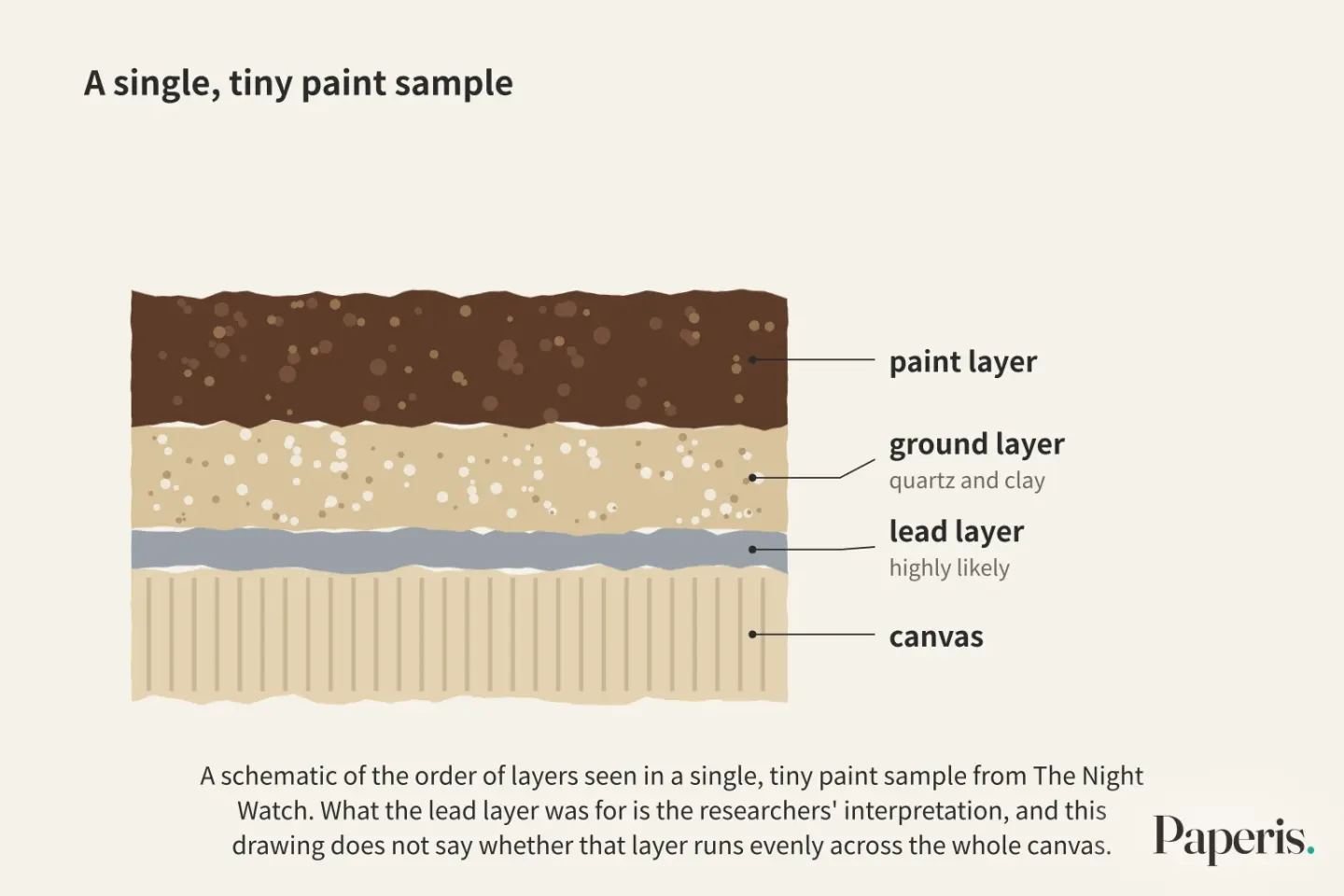
This time, it is a single, tiny paint sample. The researchers imaged this single sample in 3D by pairing two synchrotron X-ray methods. One is X-ray fluorescence, which measures elements, and the other is a method that reconstructs the structure inside the sample using the patterns of scattered X-rays (DOI: 10.1126/sciadv.adj9394). The latter method makes it possible to reveal and quantify organic components and quartz, which are not caught by X-ray fluorescence.
In that imaging, a previously unknown layer containing lead appeared. Its location was between the canvas and a ground layer made of quartz and clay. The ground layer is the primer evenly spread on the canvas before applying paint. The researchers view it as highly likely that this lead layer was a protective treatment soaked into the canvas first before applying the ground layer (DOI: 10.1126/sciadv.adj9394).
This layer offers a candidate answer to one mystery. The Night Watch has small protrusions where lead in the paint has clumped and risen to the surface, and among them are protrusions in spots entirely devoid of other lead components. The researchers write that this lead layer beneath the ground layer might explain such protrusions (DOI: 10.1126/sciadv.adj9394). "Highly likely" and "might explain" are hedges directly attached by the researchers.
The researchers write that this is the first time these two methods have been used together on an old paint sample, and they evaluate this method as a tool that helps better interpret large maps capturing the entire painting from the outside (DOI: 10.1126/sciadv.adj9394). The large maps look at the surface of the entire painting, and the small sample looks at the depth of a single point. The results for this lead layer also came from a single sample, and this abstract does not state whether that layer is evenly present across the entire canvas.
Re-measuring the knife marks of 1975
In 1975, the canvas of "The Night Watch" was slashed twelve times with a serrated table knife. Several long knife marks were inflicted on the breeches of Captain Banning Cocq (DOI: 10.1117/12.2673263). The conservation treatment of 1975–76 repaired those knife marks, and replaced a previously patched piece of canvas near the drum on the right side of the painting with a new one (DOI: 10.1016/j.culher.2025.02.002).
This painting has also undergone damage and repairs on several other occasions, and has been lined three times with an adhesive mixed from wax and resin (DOI: 10.1016/j.culher.2025.02.002). Lining is a reinforcement treatment in which a new fabric is attached to the back of an aged canvas. Therefore, today's "The Night Watch" is a painting that has gone through multiple repairs and three linings.
In 2021, the conservation team was preparing for a new structural treatment. This involved re-tensioning the canvas, which means stretching it tightly back onto its frame. Before doing so, they needed to find out whether the repaired knife mark area from 1975 and the patched piece near the drum could withstand it, and whether the lined fabric was still securely attached (DOI: 10.1016/j.culher.2025.02.002).
What was used for this was 3D shearography. This is an inspection that measures how minutely the surface stretches and warps—both along the surface and outward from it—when the painting is warmed ever so slightly. Before applying it to "The Night Watch," the researchers tested it first on a mock-up painting prepared with linings and containing benchmark lifted areas and repaired spots in the same manner. They confirmed that raising the temperature by just 1 to 2 degrees could reliably detect such areas, and established a safe heating procedure for the painting (DOI: 10.1016/j.culher.2025.02.002).
In November 2021, the researchers measured the back of "The Night Watch" in the museum gallery. The targets were two locations. These were the repaired knife mark area on the captain's breeches (0.5×1 meters) and the patched piece near the drum (0.2×0.5 meters) (DOI: 10.1016/j.culher.2025.02.002). In the breeches area, no serious structural problems emerged either in the place where the knife marks were repaired or in the condition where the lined fabric was attached. In the patched piece near the drum, the fluctuations in deformation were greater, and the researchers explained this reason as being because the quality of the patched canvas was lower than that of the breeches repair (DOI: 10.1117/12.2673263; DOI: 10.1016/j.culher.2025.02.002).
These results led to a decision. According to the 2023 announcement, the results from the breeches area relieved the worries that conservators had harbored regarding the adhesion of the lining fabric and the stability of the previous repair, and the shearography inspection provided the confidence to proceed with the planned canvas re-tensioning while reducing risk (DOI: 10.1117/12.2673263). This is a case that runs in a single line from the question to the mock-up painting, on-site measurements, results, and decision.
What shearography measured is the state before re-tensioning the canvas, and how the painting fared after the stretching is not in these pieces of evidence. The scope of confidence provided by this measurement extends up to "the 1975 repair and lining adhesion in the two zones will hold up well enough to undergo the treatment."
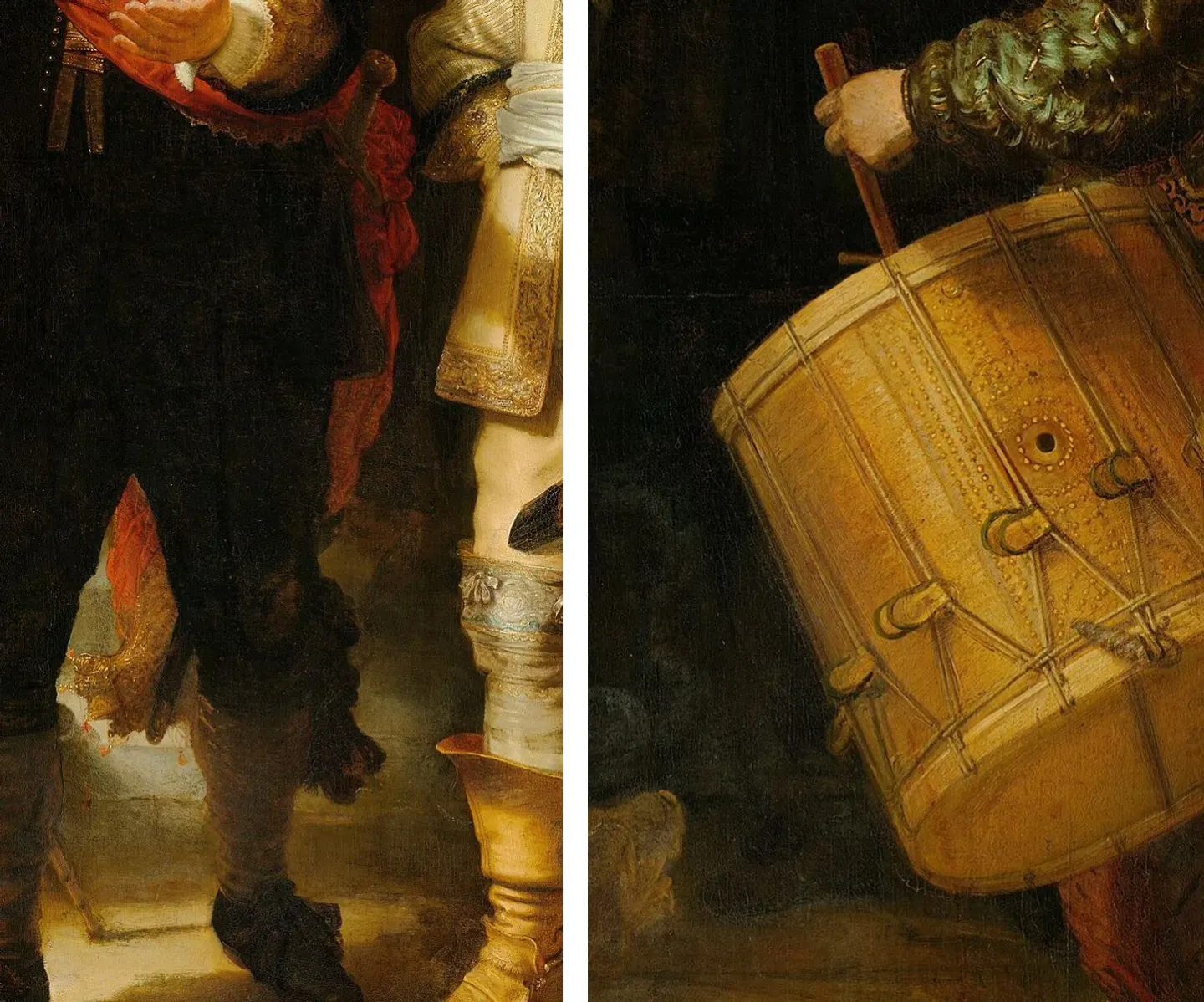
Two details: on the left the captain’s breeches, on the right the drum — shearography measured the back of the painting at these two areas; the exact outlines of the measured regions are not marked · Rembrandt van Rijn, The Night Watch (1642) · Rijksmuseum, Amsterdam · public domain · Wikimedia Commons
What the Map Does Not Tell Us
If we divide the results that came out of the glass room into three layers, they look like this. First is measurement. This includes where a pigment is, where compounds like pararealgar and lead formate came from, whether there is a lead-containing layer beneath the ground layer, and how much the knife-cut spot warps when heated. Second is the researchers' conclusion adding other evidence to that measurement. That Rembrandt intentionally used pararealgar, that the lead layer was likely a protective treatment, and the judgment that the canvas can be re-tensioned belong here. Third is interpretation. The idea that Rembrandt captured the viewer's gaze with light and texture is a theory that the gaze researchers wrote fits their results, but there is no measurement that gauged the painter's mind.
There is a commonly heard explanation about where the dark parts of The Night Watch came from, but among the evidence gathered by this article, there is no study that measured it.
What Operation Night Watch left behind is a map of paints, and tiny samples that became the keys to reading that map. They show what paints Rembrandt bound together and how to paint light, where and into what those paints have changed, and in two zones, how well the 1975 knife-cut repair spot and the lining hold up. If you want to see more, the X-ray map data released by the Rijksmuseum can be a starting point, and the next question is how fast that change is.
Source Papers
- "Discovery of pararealgar and semi-amorphous pararealgar in Rembrandt's The Night Watch: analytical study and historical contextualization" (2024) — DOI: 10.1186/s40494-024-01350-x — Operation Night Watch began in 2019; arsenic sulfides and decomposition products were identified on Lieutenant Willem van Ruytenburch's sleeve and leather vest from two samples; pararealgar (yellow) and semi-amorphous pararealgar (orange to red) were confirmed, newly added to Rembrandt's pigment list; conclusion that it was intentionally used to make orange, matching old literature and a similar mixture by Willem Kalf, mixed with lead-tin yellow and vermilion.
- "Lead(II) Formate in Rembrandt's Night Watch: Detection and Distribution from the Macro‐ to the Micro‐scale" (2023) — DOI: 10.1002/anie.202216478 — Painted in 1642, Rijksmuseum, Rembrandt's most famous work; lead formate detected in multiple locations using X-ray diffraction maps; never before reported in old oil paintings; explored one possible pathway in a recreated paint from a 17th-century recipe (linseed oil + heated lead oxide).
- "Correlated x-ray fluorescence and ptychographic nano-tomography on Rembrandt's The Night Watch reveals unknown lead "layer"" (2023) — DOI: 10.1126/sciadv.adj9394 — Nano-tomography of a single sample revealed a lead-containing "layer" beneath the quartz and clay ground layer; likely a protective impregnation layer; a candidate to explain lead soap protrusions; combining these two methods is a first, acting as a tool for large-scale image interpretation.
- "Application of shearography with thermal loading for the structural inspection of Rembrandt's Night Watch" (2023) — DOI: 10.1117/12.2673263 — Cut twelve times with a serrated table knife in 1975; three wax-resin linings; no major deformation in the pants area; large deformation in the added corner piece (canvas texture); confirmation to proceed with re-tensioning.
- "Assessing the structural integrity of the wax-resin lining of The Night Watch using 3D shearography" (2025) — DOI: 10.1016/j.culher.2025.02.002 — Safety procedures established with 1–2 degree heating on test paintings; on-site backside measurements in November 2021 (pants 0.5×1m, corner 0.2×0.5m); no serious issues found with knife-cut repairs or lining adhesion.
- "How do people distribute their attention while observing The Night Watch?" (2022) — DOI: 10.1177/03010066221122697 — 21 people, 5 minutes, mobile eye-tracking + think-aloud; attention directed to the faces of the two central figures, the bright girl, and clothing details; shifts to other elements over time; consistent with the theory that light and texture draw the eye; replicated with a small replica painting.
- "Reflectance Imaging Spectroscopy (RIS) for Operation Night Watch: Challenges and Achievements of Imaging Rembrandt's Masterpiece in the Glass Chamber at the Rijksmuseum" (2021) — DOI: 10.3390/s21206855 — 3.78×4.53m, the museum's largest research project; two cameras, 3-axis frame, focal distance sensing; 200 strip images; preliminary analysis confirmed pigments and their distribution; short-wave infrared shows underdrawings and compositional changes better.
- "Technical aspects and data processing of reflectance imaging spectroscopy for Operation Night Watch" (2021) — DOI: 10.1117/12.2591937 — Investigation in front of visitors in the Gallery of Honor glass room; research goals (basis for conservation history, current state, technique, materials, and conservation plan); 400–1,000nm and 900–2,500nm; 0.2mm resolution.
- "Illuminating Rembrandt's Chiaroscuro in The Night Watch: the painting process of Van Ruytenburch's costume" (2025) — DOI: 10.1038/s40494-025-01874-w — Chiaroscuro of the brightly lit lieutenant's costume, pigment list, systematic use in bundles (visual unity), arsenic pigments for gold thread reflections, decomposition products mimetite, weddellite, and palmierite, implications for conservation.
- "Unveiling Rembrandt's use of red lake pigments in The Night Watch by bi-modal imaging spectroscopy approach" (2026) — DOI: 10.1038/s40494-026-02569-6 — Red lakes widely used throughout the painting; overpainting or mixing over vermilion distinguishable by reflectance imaging spectroscopy (compared with recreated paints and cross-sections).
- "Visualizing and Quantifying Rembrandt's Smalt Mixtures in The Night Watch in Three Dimensions Using μ-X-ray Fluorescence Tomography" (2026) — DOI: 10.1021/acs.analchem.5c07178 — Smalt is cobalt-containing potash glass powder, three samples, high heterogeneity in particle size and composition; four candidate causes (ore, manufacturing, multiple types, in-situ degradation) undetermined; understanding needed for choosing conservation methods.
- "Photon-Based Techniques for Nondestructive Subsurface Analysis of Painted Cultural Heritage Artifacts" (2010) — DOI: 10.1021/ar900248e — Subsurface underdrawings, priming, and modifications; infrared reflectography and X-ray photography are standard methods; X-ray fluorescence scanning measures pigment distribution within layers (not measuring The Night Watch, general method).
- "Underneath the surface: advanced synchrotron techniques for the study of 17th century oil paint in three dimensions" (2025, doctoral dissertation) — DOI: 10.63028/10067/2136770151162165141 — Unexpected arsenic pigments discovered in The Night Watch, lead impregnation layer beneath the ground layer.
- "Decoding paintings through their materials: enhancing Macro X-ray Powder Diffraction for artworks" (2025, doctoral dissertation) — DOI: 10.63028/10067/2206780151162165141 — Confirmed anglesite formation in the upper paint layer at the site of acid damage attacks.
- "MA-XRPD of selected areas of Rembrandt's The Night Watch with a focus on lead formate" (2026, public dataset) — DOI: 10.82382/rijks_rd/pvyd0a — Distribution images of crystal components for several areas (focusing on lead formate).
Sources (15)
- Discovery of pararealgar and semi-amorphous pararealgar in Rembrandt's The Night Watch: analytical study and historical contextualizationDOI 10.1186/s40494-024-01350-x
- Lead(II) Formate in Rembrandt's Night Watch: Detection and Distribution from the Macro‐ to the Micro‐scaleDOI 10.1002/anie.202216478
- Correlated x-ray fluorescence and ptychographic nano-tomography on Rembrandt's The Night Watch reveals unknown leadDOI 10.1126/sciadv.adj9394
- Application of shearography with thermal loading for the structural inspection of Rembrandt's Night WatchDOI 10.1117/12.2673263
- Assessing the structural integrity of the wax-resin lining of The Night Watch using 3D shearographyDOI 10.1016/j.culher.2025.02.002
- How do people distribute their attention while observing The Night Watch?DOI 10.1177/03010066221122697
- Reflectance Imaging Spectroscopy (RIS) for Operation Night Watch: Challenges and Achievements of Imaging Rembrandt's Masterpiece in the Glass Chamber at the RijksmuseumDOI 10.3390/s21206855
- Technical aspects and data processing of reflectance imaging spectroscopy for Operation Night WatchDOI 10.1117/12.2591937
- Illuminating Rembrandt's Chiaroscuro in The Night Watch: the painting process of Van Ruytenburch's costumeDOI 10.1038/s40494-025-01874-w
- Unveiling Rembrandt's use of red lake pigments in The Night Watch by bi-modal imaging spectroscopy approachDOI 10.1038/s40494-026-02569-6
- Visualizing and Quantifying Rembrandt's Smalt Mixtures in The Night Watch in Three Dimensions Using μ-X-ray Fluorescence TomographyDOI 10.1021/acs.analchem.5c07178
- Photon-Based Techniques for Nondestructive Subsurface Analysis of Painted Cultural Heritage ArtifactsDOI 10.1021/ar900248e
- Underneath the surface: advanced synchrotron techniques for the study of 17th century oil paint in three dimensionsDOI 10.63028/10067/2136770151162165141
- Decoding paintings through their materials: enhancing Macro X-ray Powder Diffraction for artworksDOI 10.63028/10067/2206780151162165141
- MA-XRPD of selected areas of Rembrandt's The Night Watch with a focus on lead formateDOI 10.82382/rijks_rd/pvyd0a