Paperis Articles
Oxidation and Reduction — A Hand That Catches the Thrown Ball, a Ball Sent the Long Way Around
Oxidation is losing electrons and reduction is gaining them, so when one side loses, the other gains. Rust, flame and browning are all this exchange; send the electrons around a wire and you have a battery; plants store energy by photosynthesis and living things spend it by respiration.
Your field's papers, as audio
Pick your fields and journals — Paperis summarizes the key papers and turns them into audio. Listen on your commute.
Start Paperis free →Oxidation and Reduction — A Hand That Catches the Thrown Ball, a Ball Sent the Long Way Around
A Nail, Firewood, and an Apple
An iron nail left outside for a long time rusts and becomes rough. Firewood put into a hearth flares up in flames and leaves only ashes. The cut surface of a peeled apple turns brown before long. The nail takes a long time, the firewood happens in an instant, and the apple is somewhere in between.
Though the three differ in speed and appearance, chemistry groups them together. This is because the same gas from the air interferes in all three, and the same kind of give-and-take happens in all of them. This article follows in turn what that give-and-take is, and how the same event becomes electricity inside a battery and the power to live in plants and our bodies.
As a guide, we take only a single ball. When two people pass a ball back and forth, when one person lets go of the ball, the other person receives that ball. Since the released ball does not vanish in midair, if there is someone letting go, there is also someone receiving. In this article, the ball is a tiny particle, and the side letting go of the ball and the side receiving it are two substances that have met each other.
From Oxygen to Electrons
The name oxidation contains oxygen. At first, only reactions that actually involve oxygen were called that, but now the term covers a group that even includes reactions happening without oxygen (OpenStax Chemistry 2e 4.2). The string that binds that group together lies within the particles making up matter. An atom is a particle made of a tiny nucleus and electrons around it. An electron is a very light particle with a negative (−) electric charge, located in the wide empty space around the nucleus.
An atom's electrons can move over to another atom, and the two words point right to this transfer. Oxidation is a substance losing electrons, and reduction is gaining electrons. Reactions where electrons do not cross over entirely but only crowd toward one side are also counted in the same group (OpenStax Chemistry 2e 4.2; OpenStax Chemistry 2e 17.1).
Sodium chloride (NaCl), the main component of table salt, forms when sodium (Na) and chlorine gas (Cl₂) meet. At this time, each sodium atom gives up one electron, and each chlorine atom receives one electron. Sodium has been oxidized and chlorine reduced (OpenStax Chemistry 2e 4.2). Sodium, which gave away an electron, and chlorine, which received one, are no longer electrically balanced. An ion is an atom or a cluster of atoms that has gained or lost electrons and thus carries an electric charge. Salt is a solid where positively (+) charged sodium ions and negatively (−) charged chloride ions gather (OpenStax Chemistry 2e 17.1).
Sodium and chlorine becoming salt is a chemical reaction. A chemical reaction is when atoms break their bonds and reconnect in new ways, creating substances different from the start. Among them, reactions where electrons are transferred have a separate name. A redox reaction is a chemical reaction where oxidation and reduction happen together, with one substance gaining the electrons lost by another substance. The side losing electrons and the side gaining them form a pair within a single reaction (OpenStax Chemistry 2e 4.2). Even inside a cell, an electron that has broken away does not wander alone but moves to another substance, so oxidation and reduction usually happen together (OpenStax Biology 2e 7.1). In terms of a ball, the person who lets go of the ball is oxidized, and the person who receives that ball is reduced.
There is not a single atom of oxygen in this reaction. Even so, sodium lost an electron, so it was oxidized. Even without oxygen, losing electrons is oxidation. The reaction where hydrogen and chlorine meet to become hydrogen chloride is one such example, and here the electrons do not cross over entirely to one side (OpenStax Chemistry 2e 4.2).
The electron-based definition can remain confusing even after learning it. In a study surveying 63 high school freshmen in Indonesia, the misconception rate for questions viewing oxidation and reduction as gaining and losing oxygen was 16.67%, but for questions viewing it as gaining and losing electrons, it was higher at 39.68% (DOI: 10.33752/ns.v2i2.5603). In this survey, the new meaning was harder than the old oxygen-based one.
The Giver and the Receiver
If you place a copper wire into a solution of dissolved silver, silver attaches to the copper wire and the liquid turns blue. This happens because copper atoms give up electrons, become copper ions, and dissolve into the water, while silver ions in the water take those electrons and become solid silver (OpenStax Chemistry 2e 4.2). The copper is oxidized and the silver ions are reduced.
There are also names for the roles these two substances play in this reaction. A reducing agent is a substance that gives electrons to another, reducing it while being oxidized itself. An oxidizing agent is a substance that takes electrons from another, oxidizing it while being reduced itself. Copper is a reducing agent that reduces silver ions, and the silver ions are an oxidizing agent that oxidizes copper (OpenStax Chemistry 2e 4.2). The names are easy to confuse. The name "oxidizing agent" means it oxidizes others, so the oxidizing agent itself is reduced. In terms of a ball, the one who lets go of the ball is the reducing agent, and the one who catches it is the oxidizing agent.
Oxygen, which makes up about 20% of the air, is a famous oxidizing agent (OpenStax Chemistry 2e 4.2). Oxygen reacts directly with very many elements, including common metals like iron and copper. Some reactions happen at room temperature, while others require heating (OpenStax Chemistry 2e 18.9). The gas in the air that crept into the nail, the firewood, and the apple from the beginning is precisely this oxygen.
Fire: Rapid Oxidation
Gas stove flames, candle flames, and campfires are all rapid versions of the same reaction. Combustion is a redox reaction in which fuel reacts rapidly with an oxidizing agent and releases a large amount of heat, often accompanied by a visible flame. The side giving up the ball is the fuel, and the side receiving it is usually the oxygen in the air. However, the oxidizing agent in combustion is not always oxygen (OpenStax Chemistry 2e 4.2).
Where a campfire has gone out, only ash remains, making the firewood seem lighter. But while it burns, the oxygen in the air also joins the reaction (OpenStax Chemistry 2e 4.2). Accounting for the weight of what goes in and what comes out continues in "Chemical Reactions — The Hill to Climb, the Road Traveled Both Ways".
Where does the heat produced by fire come from? Energy is the ability to do work. Chemical energy is energy stored within substances and released during chemical reactions, such as when fuel burns. Burning firewood releases the solar energy that a plant captured while growing into wood, and burning coal and oil also releases the solar energy stored in ancient organisms (OpenStax Chemistry 2e 5.1). In a car engine, part of the energy released by the reaction of gasoline and oxygen escapes as heat, while another part pushes the pistons to move the car (OpenStax Chemistry 2e 5.3).
Firewood only starts to burn when you touch a match to it. The threshold that must be crossed for a reaction to begin continues in "Chemical Reactions — The Hill to Climb, the Road Traveled Both Ways".
Rust and Browning: Slow Oxidation
We return to the iron nail from the beginning. Corrosion is a process where a metal gradually deteriorates due to a spontaneous redox reaction with its surrounding environment. Both the rust on iron and the blue-green patina on copper are corrosion. The two differ in more than just appearance. Iron rust flakes off, exposing fresh iron underneath so that once rusted iron keeps rusting, whereas copper's patina clings to the surface and covers and protects the metal beneath it (OpenStax Chemistry 2e 17.6).
What must be present for rust to form? Iron rusts when oxygen and water are both present, and oxygen is constantly in the air (DOI: 10.1108/eb006993). Along the way, the iron gives up electrons and is oxidized, oxygen accepts those electrons and is reduced, and in the end, hydrated iron oxide—that is, rust—is produced (OpenStax Chemistry 2e 17.6).
The browning of a cut apple is also oxidation. An enzyme is a molecule that helps chemical reactions inside a cell happen more easily, and almost all of them are proteins. In damaged tissue of fruits and vegetables, a copper-containing enzyme oxidizes compounds called phenols (DOI: 10.5958/0974-4479.2018.00001.1). The oxidizing agent here is oxygen in the air (DOI: 10.13005/ojc/390405). Those oxidized compounds are then thought to link up with one another without the enzyme to become dark pigments, though this later stage is much less understood than the earlier stage driven by the enzyme (PMID 37954915).
When you place the three side by side, firewood burns all at once with flames, iron slowly rusts upon meeting water and oxygen, and an apple turns brown through multiple steps with the help of an enzyme. The rusted nail, burning firewood, and brown apple are all redox reactions where something gives up electrons and oxygen accepts them, and what differs is the speed and what assists the reaction.
When You Take the Ball on a Long Detour
When you turn on a flashlight, giving and taking happens inside the battery too. But if the ball is handed directly from hand to hand, you cannot make that ball do any work. If you separate the two people and leave only a long passage between them, the ball must cross through that passage, and you can make it do work on top of the passage.
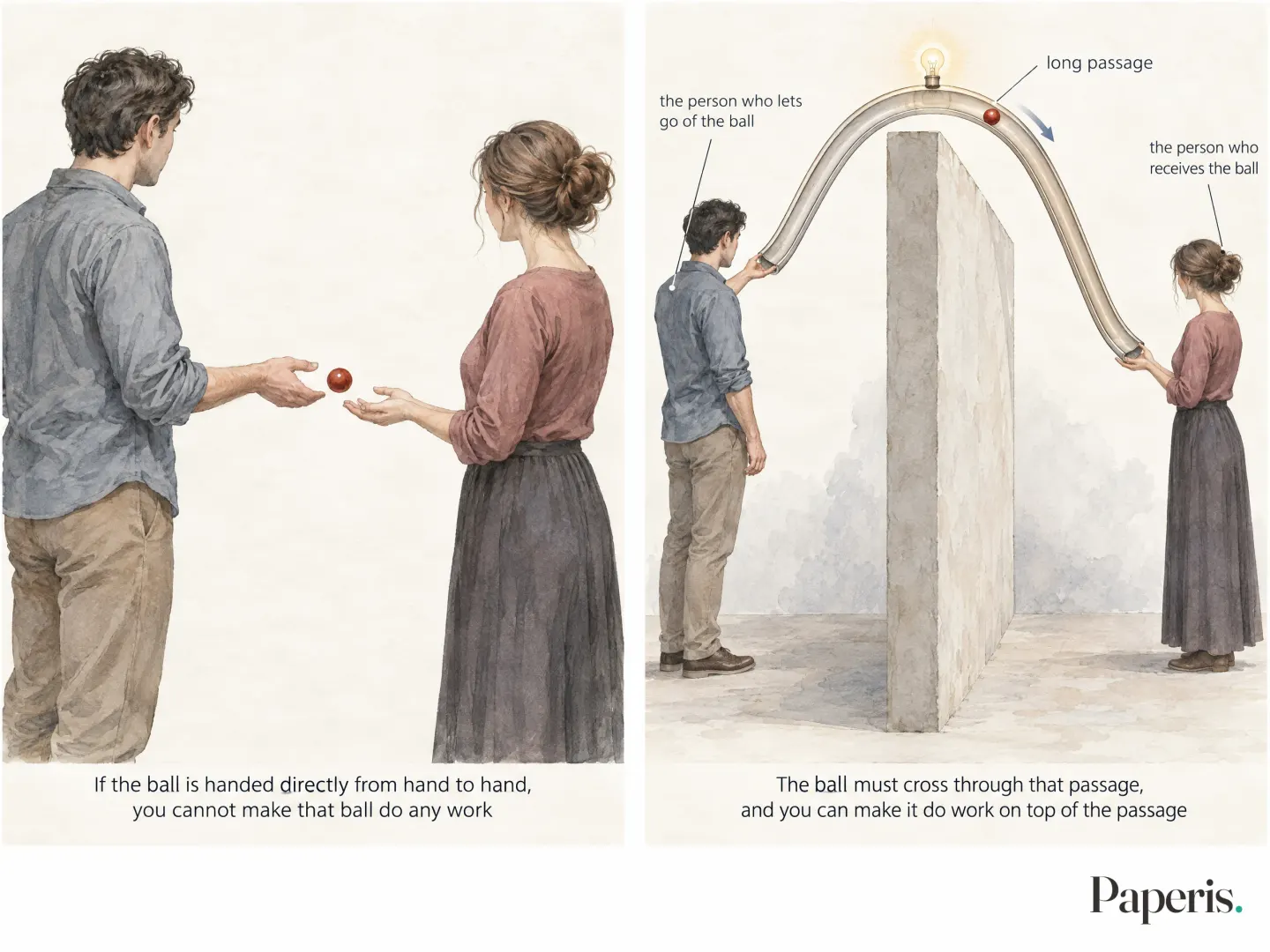
This is what a battery does. A battery is a device that separates two substances undergoing a redox reaction, making electrons cross only through an external wire. Because the two substances cannot touch, the electrons must cross by going around the wire (OpenStax Chemistry 2e 17.2), and we use that flow as electricity. An electrode is the solid part connected to the wire inside a battery where oxidation or reduction takes place. Oxidation occurs at one electrode, and reduction occurs at the other electrode (OpenStax Chemistry 2e 17.2).
The batteries in a flashlight are also made to easily use this kind of cell (OpenStax Chemistry 2e 17.5), and the side that releases the ball inside them is zinc. The electrons released as zinc is oxidized travel through the external wire to the opposite electrode (OpenStax Chemistry 2e 17.5). A rechargeable battery runs this giving and taking in reverse using an external power source (OpenStax Chemistry 2e 17.5). "The Battery Cell — A Rocking Chair Between Two Electrodes" covers what goes back and forth inside it and how.
Zinc on a Scratch
On a rain-soaked bicycle, paint may flake off and rust can form on the exposed spots (OpenStax Chemistry 2e 17.6). That is because the iron in those spots meets moisture and oxygen. So the path to preventing rust splits in two. One is to cover the iron so moisture cannot reach it (DOI: 10.1108/eb006993), and the other is to replace the side that gives up electrons with a metal other than iron.
The latter path is galvanization. Galvanization is the process of applying a thin coat of zinc, which oxidizes more easily than iron, over the surface of iron. Even if water enters through a scratched gap, the side that gives up the ball first is zinc. When iron and zinc get wet together, a small battery forms between them, and since the side that oxidizes is the zinc, the iron can remain unrusted (OpenStax Chemistry 2e 17.6). The ball that oxygen takes comes from the zinc side, not the iron.
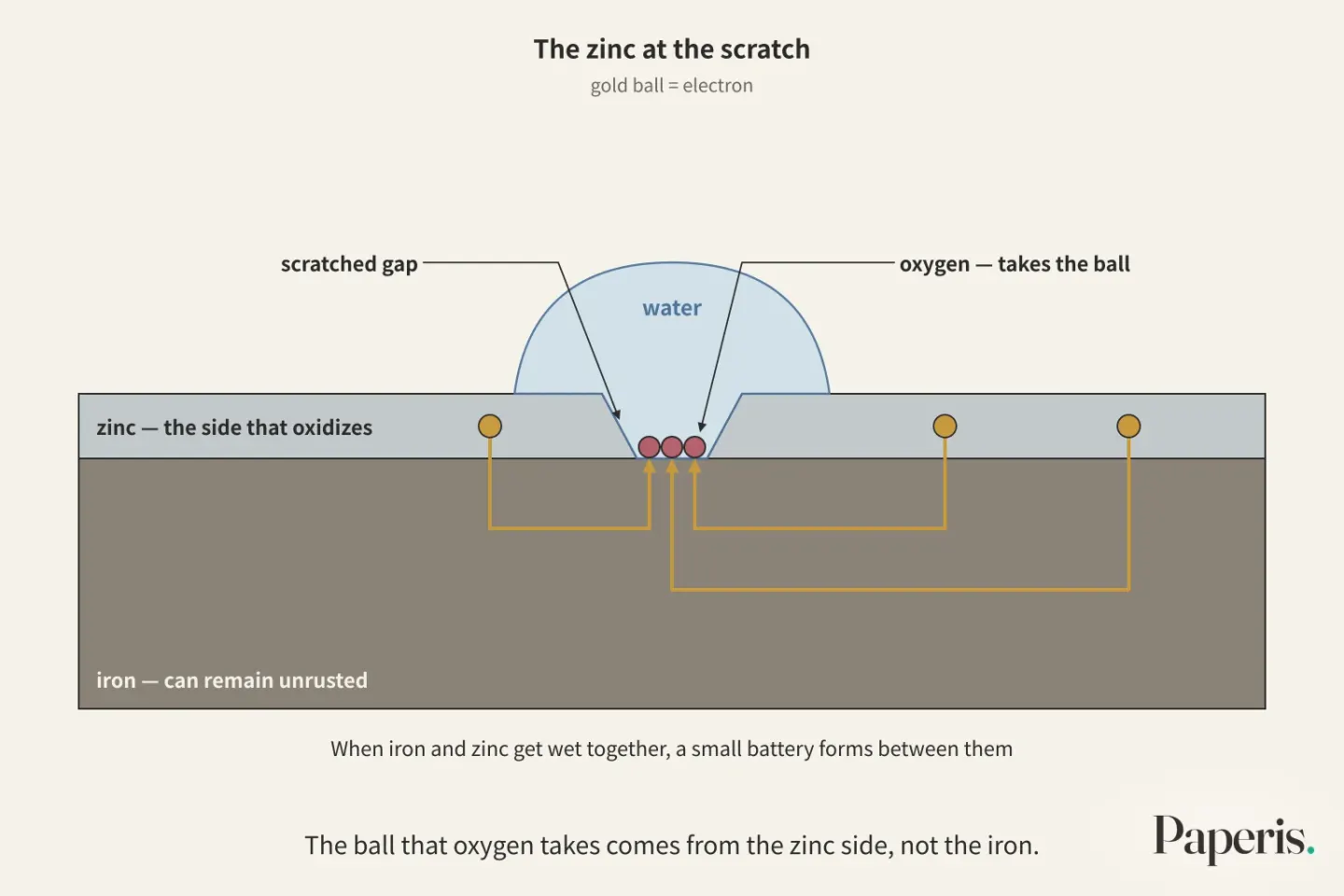
Roughly half of the zinc produced in the world is used this way to protect iron and other metals from rust (OpenStax Chemistry 2e 18.1).
Captured by Sunlight, Extracted by the Body
The energy in the coal and oil we burn today is sunlight that photosynthesis captured a very long time ago (OpenStax Biology 2e 8.1). This is because these fuels are ancient organisms that have turned into fossils (OpenStax Chemistry 2e 5.1). Photosynthesis is the process by which plants and some microorganisms use the energy of sunlight to make sugars from carbon dioxide and water, releasing oxygen. The only living things that do this work are plants, algae, and a group of bacteria called cyanobacteria (OpenStax Biology 2e 8.1).
Photosynthesis involves reduction. The energy of sunlight is first loaded onto electrons, and that energy is stored within the bonds that make up sugar (OpenStax Biology 2e 8.1). One of the steps in building carbon dioxide into sugar is reduction (OpenStax Biology 2e 8.3), and substances that gain electrons and become reduced—like the carbon in carbon dioxide—gain energy (OpenStax Biology 2e 7.1).
Respiration is the process that extracts and uses that sugar. Cellular respiration is the process by which cells slowly oxidize nutrients like glucose using oxygen, extracting the energy within them little by little. The energy required for the body to live comes from the slow oxidation of nutrients, and the oxidizing agent that finally accepts electrons in this reaction is oxygen. Carbon dioxide and water are produced at the end of it (OpenStax Chemistry 2e 18.9). Electrons are transferred through multiple steps before finally reducing oxygen to make water, and most of the ATP that cells use is made right in this final step (OpenStax Biology 2e 7.4). ATP is a molecule that stores the energy a cell needs to use right away.
The amount of energy released by this slow oxidation inside the body is the same as when the same food is burned outside the body (OpenStax Chemistry 2e 18.9). The difference is the speed. Cells transfer electrons through many steps in small increments, and receive and use the energy released at each step (OpenStax Biology 2e 7.1). What a bonfire releases all at once, the cell receives broken down into small pieces.
When the two processes are placed side by side, their materials and products trade places. Photosynthesis takes in carbon dioxide and water and releases sugar and oxygen (OpenStax Biology 2e 8.1), while cellular respiration takes in nutrients and oxygen and releases carbon dioxide and water (OpenStax Chemistry 2e 18.9). The carbon dioxide that plants use to build sugar is gas released by the respiration of microorganisms, fungi, animals, and the plants themselves (OpenStax Biology 2e 8.3). Plants respire, too. Photosynthesis uses reduction to store sunlight's energy in sugar, and cellular respiration uses oxidation to extract and use that energy (OpenStax Biology 2e 8.3). To put it in terms of a ball, photosynthesis is handing a ball to carbon dioxide using the power of sunlight, and cellular respiration is passing that ball to oxygen at the end.
The Word "Antioxidant"
Browning on a cut section of an apple can be slowed down. In one food study, when ascorbic acid, known as vitamin C, was used alongside certain other substances, browning dropped significantly in both apple juice and cut sections. Yet other combinations only worked in the juice, and a substance that prevented browning in the juice actually encouraged browning on the cut section (DOI: 10.1111/j.1365-2621.1989.tb07931.x). One plant ingredient put into potato juice failed to stop browning and instead made it deeper (DOI: 10.3390/foods11040577). There were even cases where the exact same substance acted in completely opposite ways depending on where it was placed.
There is a name for substances that slow down oxidation like this. An antioxidant is a substance that prevents or slows down the oxidation of other substances. However, while the substance that slows down food browning and the substance said to slow down oxidation inside the body are called by the same word, results seen in one cannot be carried over directly to the other.
Oxidation exists inside the body as well. Oxidative stress is a state in which reactive oxygen species generated inside the body become too numerous for antioxidant defenses to handle. One review outlines that this state damages the fats, proteins, and genetic material of cells and is intertwined with diseases such as cancer, neurodegeneration, cardiovascular disease, and diabetes. The same review points out that antioxidant substances can actually promote oxidation when present alongside certain metal ions, for example (PMID 25942353).
Another review from 2015 noted that a major share of the body's antioxidant defense is carried out not by small-molecule antioxidants, but by enzymes the body makes, and pointed out that the phrase "oxidative stress" is sometimes used carelessly without a clear relationship to actual redox chemistry (PMID 25588755).
Trial results do not converge on one side either. A 2008 review noted that the results of trials in which people were given large amounts of antioxidant vitamins to prevent cardiovascular disease were "very disappointing." The same review added that while consensus gathers around diets rich in fruit and vegetables protecting against cardiovascular disease and cancer, the reason might not lie in antioxidant substances (PMID 18412995).
In a 2005 meta-analysis gathering data from 19 clinical trials and 135,967 people, when the trials were pooled, there were 39 more deaths from any cause per 10,000 people among those who took high-dose vitamin E supplements of 400 IU or more per day. However, the margin of that estimate was wide, ranging from 3 to 74 per 10,000 people, and low-dose trials showed no clear difference. While concluding that high-dose supplements can increase mortality and should be avoided, the authors noted that high-dose trials were mostly small and targeted people with chronic illnesses, leaving it uncertain whether the findings apply directly to healthy adults (PMID 15537682).
For specific groups, there is also evidence pointing to benefits. Age-related macular degeneration is a disease occurring in people over 50 where the back of the eye slowly deteriorates. A 2023 Cochrane systematic review pooling 26 randomized trials in people who already have this disease concluded that supplements combining vitamins C and E, beta-carotene, and zinc probably slow down worsening to late-stage macular degeneration (certainty of evidence: moderate). The benefit was greater in people whose disease had progressed to an intermediate stage, because their risk of worsening to the late stage was that much higher. The same review also confirmed that beta-carotene increased the risk of lung cancer primarily in people who used to smoke (PMID 37702300).
The results diverged into "falling short of expectations," "potentially harmful," and "probably beneficial for people with this disease." "Antioxidant" is a chemistry term meaning that it slows down oxidation, whether it is good for the body is a different question, and the answer differs depending on the substance, the amount, and the person taking it.
Once Again in Front of Nails, Firewood, and Apples
The ball analogy has two limits. First, a person chooses and throws a ball, but which way the electrons move is determined by the properties of the two materials. The reason zinc gives up electrons before iron lies in the property of being a metal that oxidizes more easily (OpenStax Chemistry 2e 17.6). Second, reactions where electrons do not cross over entirely but only skew toward one side are also counted in the same group (OpenStax Chemistry 2e 17.1). In terms of balls, even if you do not hand over a ball but only pull it toward yourself, it counts as giving and receiving.
This concept can be confusing even after learning it, and there are people who are confident while being confused. In a study surveying two samples of college students who learned oxidation-reduction in a general chemistry class and even took a test, a group of students with low scores but high confidence appeared in both samples (DOI: 10.1039/c4rp00129j).
A rusted nail, burning firewood, a browned apple, a battery inside a flashlight, and even the breath you are taking right now are the same giving and receiving where one side gives up electrons and the other receives them. If one side loses electrons, the other side invariably gains them, and depending on where and how those electrons cross over, they become rust, a flame, electricity, and breath.
Where to Look Further
The way atoms that have exchanged electrons become ions and hold onto each other is continued in "Chemical Bonds — A Rope Held Together, a Rope Pulled to One Side", and the threshold where a reaction begins, the heat and work involved in a reaction, and the weight of what goes in and comes out when something burns are continued in "Chemical Reactions — The Hill to Climb, the Road Traveled Both Ways".
To look deeper inside a battery, move on to "The Battery Cell — A Rocking Chair Between Two Electrodes", and measuring electricity flowing through a wire is covered in "Voltage, Current, Power — What Goes All the Way Around Undiminished". The story of chemical energy changing shape into heat and work is covered in "Energy — Money That Doesn't Shrink When Exchanged, Odd Coins Scattered in Your Pockets".
What kind of place a cell where cellular respiration takes place is, is covered in "What Is a Cell? — A Small Village Inside a Wall, a Village That Splits in Two", and the process by which food is broken down small enough to reach cells is covered in "How Does Digestion Work? — A Tube Through the Body, and a Wall Only Small Pieces Can Cross".
Source Papers
- "Chemistry 2e — 4.2 Classifying Chemical Reactions" (2019) — OpenStax Chemistry 2e 4.2 — Oxidation originally meant reactions with oxygen but was broadened to the wider family of redox; about 20% of the air is oxygen; in the sodium-chlorine reaction, oxidation is losing electrons and reduction is gaining electrons; reducing agents and oxidizing agents; reactions like hydrogen and chlorine where electrons do not explicitly cross are put in the same family using oxidation states; oxidation and reduction are paired processes; combustion (fuel = reducing agent, oxidizing agent is often oxygen but not necessarily so, heat, light, flame); silver is deposited on a copper wire in a silver solution and the solution turns blue.
- "Chemistry 2e — 17.1 Review of Redox Chemistry" (2019) — OpenStax Chemistry 2e 17.1 — Redox is defined by changes in oxidation state; NaCl is made of Na⁺ and Cl⁻; oxidation numbers are assigned by assuming 100% electron pull on the O−H bonds of water.
- "Chemistry 2e — 17.2 Galvanic Cells" (2019) — OpenStax Chemistry 2e 17.2 — A setup where reactants are separated so that electrons cross only through an external circuit (galvanic cell); the solids connected to the circuit are electrodes, with oxidation on one side and reduction on the other.
- "Chemistry 2e — 17.5 Batteries and Fuel Cells" (2019) — OpenStax Chemistry 2e 17.5 — Batteries are galvanic cells built for a specific use; the zinc can of a dry cell serves as both the container and the oxidation electrode; a battery is charged by a reversible reaction.
- "Chemistry 2e — 17.6 Corrosion" (2019) — OpenStax Chemistry 2e 17.6 — The definition of corrosion (rust on iron, patina on copper); iron rust flakes off to expose fresh iron, whereas copper patina forms a protective layer; corrosion can happen where paint is scratched; galvanizing can protect iron even if the coating breaks (zinc oxidizes instead).
- "Chemistry 2e — 18.1 Periodicity" (2019) — OpenStax Chemistry 2e 18.1 — About half of zinc production is used to prevent corrosion in iron and other metals (sacrificial anodes, thin films); galvanized steel.
- "Chemistry 2e — 18.9 Occurrence, Preparation, and Compounds of Oxygen" (2019) — OpenStax Chemistry 2e 18.9 — The body's energy comes from the slow oxidation of compounds with oxygen as the final oxidizing agent, and the end products are carbon dioxide and water; the energy released is the same as when burning outside the body; at room temperature or high temperatures, oxygen reacts directly with every element except noble gases, halogens, and some low-reactivity metals (iron rust is an example); oxygen readily accepts electrons.
- "Chemistry 2e — 5.1 Energy Basics" (2019) — OpenStax Chemistry 2e 5.1 — Plants capture sunlight energy via photosynthesis, burning wood releases that energy, and coal and oil release stored sunlight energy as fossilized plants and animals.
- "Chemistry 2e — 5.3 Enthalpy" (2019) — OpenStax Chemistry 2e 5.3 — In an internal combustion engine, some of the energy released by the reaction of gasoline and oxygen becomes heat, and some does the work of pushing pistons.
- "Biology 2e — 7.1 Energy in Living Systems" (2018) — OpenStax Biology 2e 7.1 — Most cellular energy conversions are oxidation-reduction combinations that usually happen together; electrons do not remain alone in the cytoplasm but move to other compounds; reduction (gaining electrons) is accompanied by an increase in potential energy; cells use energy step by step in small amounts through electron transfer.
- "Biology 2e — 7.4 Oxidative Phosphorylation" (2018) — OpenStax Biology 2e 7.4 — In glucose breakdown, most ATP comes from electron transport via redox reactions, and electrons ultimately reduce oxygen to make water.
- "Biology 2e — 8.1 Overview of Photosynthesis" (2018) — OpenStax Biology 2e 8.1 — Photosynthesis uses sunlight energy to power up electrons and store them in sugar bonds, making carbohydrates from carbon dioxide and water while releasing oxygen; only plants, algae, and cyanobacteria perform photosynthesis; the energy in coal and oil is sunlight captured and stored by ancient photosynthesis.
- "Biology 2e — 8.3 Using Light Energy to Make Organic Molecules" (2018) — OpenStax Biology 2e 8.3 — The Calvin cycle has three stages: fixation, reduction, and regeneration; the product is reduced carbon; that carbon dioxide is waste from the respiration of microbes, fungi, plants, and animals; photosynthesis builds carbohydrates using light energy, and cellular respiration metabolizes carbohydrates with oxygen to release energy.
- "MISCONCEPTIONS ON REDOX REACTIONS USING THE FOUR TIER TEST" (2023) — DOI: 10.33752/ns.v2i2.5603 — 63 tenth-grade students at a high school, average redox misconception rate of 33.45%, oxygen-based subconcept 16.67%, electron-based 39.68%, application 52.38% (country not in the abstract, but the school name MAN 3 Hulu Sungai Selatan indicates Indonesia).
- "Measuring meta-ignorance through the lens of confidence: examining students' redox misconceptions about oxidation numbers, charge, and electron transfer" (2014) — DOI: 10.1039/c4rp00129j — In two samples of General Chemistry 1 and 2 students who learned redox and took a test, a "low-score, high-confidence" group appeared in both samples (interpreted by the authors as matching the Dunning-Kruger effect).
- "Enzymatic Activity of Polyphenol Oxidase: A Laboratory Experiment in Flexible Learning" (2023) — DOI: 10.13005/ojc/390405 — Polyphenol oxidase catalyzes browning where oxygen in the air reacts with phenolic compounds (educational lab report).
- "Plant Polyphenol Oxidase: Biochemical Properties and Browning of Fruits and Vegetables" (2018) — DOI: 10.5958/0974-4479.2018.00001.1 — Polyphenol oxidase, a copper-containing metalloprotein, oxidizes phenolic compounds into quinones in damaged tissue to create brown pigments (review).
- "Enzymatic browning: The role of substrates in polyphenol oxidase mediated browning." (2023) — PMID 37954915 — Enzymatic browning is thought to begin mainly with the oxidation of phenols by PPO, followed by enzyme-free reactions that turn them into melanin pigments, but this later stage is much less understood (review).
- "A new way to fight corrosion" (1975) — DOI: 10.1108/eb006993 — Iron becomes hydrated iron oxide when oxygen and water are present, and does not rust without both; some iron oxides form a loose crust that offers no protection.
- "Control of Enzymatic Browning in Apple with Ascorbic Acid Derivatives, Polyphenol Oxidase Inhibitors, and Complexing Agents" (1989) — DOI: 10.1111/j.1365-2621.1989.tb07931.x — The combination of ascorbic acid and acidic polyphosphates had a strong browning-inhibitory effect in both apple juice and cut surfaces; cinnamic acid and benzoates inhibited browning in juice but caused it on cut surfaces.
- "The Effect of p-Coumaric Acid on Browning Inhibition in Potato Polyphenol Oxidase-Catalyzed Reaction Mixtures" (2022) — DOI: 10.3390/foods11040577 — p-Coumaric acid inhibited browning in model reaction solutions but acted as an alternative substrate in actual potato juice, actually increasing browning.
- "The role of antioxidants in the chemistry of oxidative stress: A review." (2015) — PMID 25942353 — Oxidative stress is an excess of reactive oxygen species that antioxidant action fails to offset (along with a disruption of redox balance), causing damage to lipids, proteins, and nucleic acids, and linked to cancer, neurodegeneration, cardiovascular disease, diabetes, and kidney disease; classification of antioxidants; transition metal ions can act to promote oxidation (review).
- "Oxidative stress: a concept in redox biology and medicine." (2015) — PMID 25588755 — The pros and cons of the oxidative stress concept; the term can be used indiscriminately without a clear connection to redox chemistry; the main drivers of antioxidant defense are antioxidant enzymes rather than small-molecule antioxidant compounds (review).
- "Antioxidants and CVD." (2008) — PMID 18412995 — LDL oxidation is important in atherosclerotic plaques, but the results of interventional studies with high-dose antioxidant vitamins were very disappointing; while there is agreement that a diet rich in fruits and vegetables prevents cardiovascular disease and cancer, the reason may not lie in antioxidant substances (review).
- "Meta-analysis: high-dosage vitamin E supplementation may increase all-cause mortality." (2005) — PMID 15537682 — 19 randomized trials involving 135,967 people; in high-dose (≥400 IU/day) vitamin E trials, the all-cause mortality risk difference was 39 per 10,000 (3–74), low doses were −16 (not significant), with a dose-response increase above 150 IU/day; high-dose trials were small and involved chronically ill participants, so generalizability to healthy adults is uncertain; the authors' conclusion is that high doses may increase mortality and should be avoided.
- "Antioxidant vitamin and mineral supplements for slowing the progression of age-related macular degeneration." (2023) — PMID 37702300 — Cochrane systematic review, 26 trials involving 11,952 people; AREDS antioxidant vitamin and mineral supplementation in patients with macular degeneration probably slows progression to the late stage (moderate certainty); intermediate-stage patients have a higher risk of progression, making the potential benefit greater; beta-carotene confirmed an increased risk of lung cancer primarily in past smokers.
Sources (26)
- Chemistry 2e — 4.2 Classifying Chemical Reactions
- Chemistry 2e — 17.1 Review of Redox Chemistry
- Chemistry 2e — 17.2 Galvanic Cells
- Chemistry 2e — 17.5 Batteries and Fuel Cells
- Chemistry 2e — 17.6 Corrosion
- Chemistry 2e — 18.1 Periodicity
- Chemistry 2e — 18.9 Occurrence, Preparation, and Compounds of Oxygen
- Chemistry 2e — 5.1 Energy Basics
- Chemistry 2e — 5.3 Enthalpy
- Biology 2e — 7.1 Energy in Living Systems
- Biology 2e — 7.4 Oxidative Phosphorylation
- Biology 2e — 8.1 Overview of Photosynthesis
- Biology 2e — 8.3 Using Light Energy to Make Organic Molecules
- MISCONCEPTIONS ON REDOX REACTIONS USING THE FOUR TIER TESTDOI 10.33752/ns.v2i2.5603
- Measuring meta-ignorance through the lens of confidence: examining students' redox misconceptions about oxidation numbers, charge, and electron transferDOI 10.1039/c4rp00129j
- Enzymatic Activity of Polyphenol Oxidase: A Laboratory Experiment in Flexible LearningDOI 10.13005/ojc/390405
- Plant Polyphenol Oxidase: Biochemical Properties and Browning of Fruits and VegetablesDOI 10.5958/0974-4479.2018.00001.1
- Enzymatic browning: The role of substrates in polyphenol oxidase mediated browningPMID 37954915
- A new way to fight corrosionDOI 10.1108/eb006993
- Control of Enzymatic Browning in Apple with Ascorbic Acid Derivatives, Polyphenol Oxidase Inhibitors, and Complexing AgentsDOI 10.1111/j.1365-2621.1989.tb07931.x
- The Effect of p-Coumaric Acid on Browning Inhibition in Potato Polyphenol Oxidase-Catalyzed Reaction MixturesDOI 10.3390/foods11040577
- The role of antioxidants in the chemistry of oxidative stress: A reviewPMID 25942353
- Oxidative stress: a concept in redox biology and medicinePMID 25588755
- Antioxidants and CVDPMID 18412995
- Meta-analysis: high-dosage vitamin E supplementation may increase all-cause mortalityPMID 15537682
- Antioxidant vitamin and mineral supplements for slowing the progression of age-related macular degenerationPMID 37702300