Paperis Articles
Chemical Reactions — The Hill to Climb, the Road Traveled Both Ways
Atoms only change partners, and even heat-releasing reactions must first climb a hill — a first step into equations, the law of conservation of mass, activation energy, catalysts and equilibrium
Your field's papers, as audio
Pick your fields and journals — Paperis summarizes the key papers and turns them into audio. Listen on your commute.
Start Paperis free →Chemical Reactions — The Hill to Climb, the Road Traveled Both Ways
Why Is the Ash Left Behind So Light?
If you burn an armful of firewood all night at a campsite, what remains in the morning is a mere handful of ash. Where did all that wood go? Paper in a desk drawer will not burn on its own even if left for years, yet a single match turns it into flames in an instant. Side dishes left out on the dining table spoil in a single day, but dishes put in the refrigerator last for days.
All three scenes are stories of chemical reactions. This article follows in turn what remains unchanged when a substance turns into another, why certain reactions do not start on their own, and what determines how fast a reaction goes.
As our guide, we carry a single hill. There is a hill between two villages, and to go from one village to the other, one must cross that hill. The starting village is the substance before the change, and the destination village is the substance after the change. The two villages are at different heights, and the hill between them can be high or low. This ups and downs answers the questions of the three scenes in turn.
Atoms Only Change Their Seats
In the blue flame of a laboratory gas burner, a gas called methane burns by meeting oxygen in the air (OpenStax Chemistry 2e 5.3). After passing through the flame, methane and oxygen decrease, and carbon dioxide and water appear in their place (OpenStax Chemistry 2e 4.1).
We look at this event through the eyes of tiny particles. An atom is a particle made of a small nucleus and electrons around it. A molecule is a particle where two or more atoms are tightly bound by chemical bonds and move as a single lump.
There is also a name for what holds molecules together. A chemical bond is an attraction that holds atoms or ions together. An ion is an atom or a group of atoms that has gained or lost electrons and thus carries an electric charge. How bonds form and what kinds exist continues in "Chemical Bonds — A Rope Held Together, a Rope Pulled to One Side".
Now we can call what happened in the flame by its name. A chemical reaction is an event where atoms break their bonds and reconnect anew, producing substances different from the beginning. The unravelling of old bonds and the linking of new ones happen as the electrons of colliding particles trade places (OpenStax Chemistry 2e 12.5).
A chemical reaction has a side that goes in and a side that comes out. Reactants are substances that are present at the start of a reaction and change into other substances. In the gas burner, methane and oxygen are the reactants. Products are substances newly created by the reaction. Here, carbon dioxide and water are the products (OpenStax Chemistry 2e 4.1).
Chemists write this event in a single line. A chemical reaction equation is an expression showing a reaction by writing reactants with element symbols on the left of an arrow and products on the right. Reading the gas burner reaction in words gives "one methane molecule and two oxygen molecules meet to become one carbon dioxide molecule and two water molecules," and in symbols it is CH₄ + 2O₂ → CO₂ + 2H₂O (OpenStax Chemistry 2e 4.1). C is carbon, H is hydrogen, and O is oxygen.
Let us count the atoms on both sides of the arrow. On the left, there are one carbon, four hydrogens, and four oxygens, and on the right, there are also one carbon, four hydrogens, and four oxygens. A reaction equation is correctly written only when the number of atoms for each element is equal on both sides (OpenStax Chemistry 2e 4.1). A reaction equation is an accounting ledger of atoms, and across the reaction, atoms merely change partners without being created or destroyed. (OpenStax Chemistry 2e 4.1)
Since the atoms remain the same, the weight remains the same too. Mass is a value measuring the amount of matter contained in an object. When we compare this amount, measurable with a scale, before and after a reaction, a law emerges. The law of conservation of mass is the law that, even if a chemical reaction occurs, the sum of the masses of the substances involved in the reaction does not change. When beer is bottled, glucose turns into alcohol and carbon dioxide, but the total mass of the matter does not change (OpenStax Chemistry 2e 1.2).
Then why did the firewood become lighter? It is because a significant portion of the products formed during burning was gas and dispersed into the air. Just as oxygen was on the left side of the arrow in the gas burner reaction, for anything to burn, oxygen from the air must enter as a reactant (OpenStax Chemistry 2e 1.2). The combined mass of the firewood and the entering oxygen equals the combined mass of the ash and the flown-away gas. A handful of ash is simply the share that did not become gas.
In laboratories, when a substance made only of carbon and hydrogen is completely burned in oxygen, only carbon dioxide and water are produced, and an analysis method that catches these gases in a trapping vessel and weighs the increased weight is actually used (OpenStax Chemistry 2e 4.5). At a bonfire outside the laboratory, it is hard to gather everything produced and thus difficult to verify with a scale, but the law itself remains the same (OpenStax Chemistry 2e 1.2).
The person counted as first uncovering this law is the 18th-century French chemist Antoine Lavoisier. He studied gases to turn chemistry into a science that deals in numbers, clarified the role oxygen plays when substances burn, and was executed during the French Revolution in 1794. His wife, Marie-Anne Paulze Lavoisier, who worked with him in the laboratory, illustrated the experimental apparatus and played a major role in getting her husband's major treatises published after his execution (OpenStax Chemistry 2e 9.3).
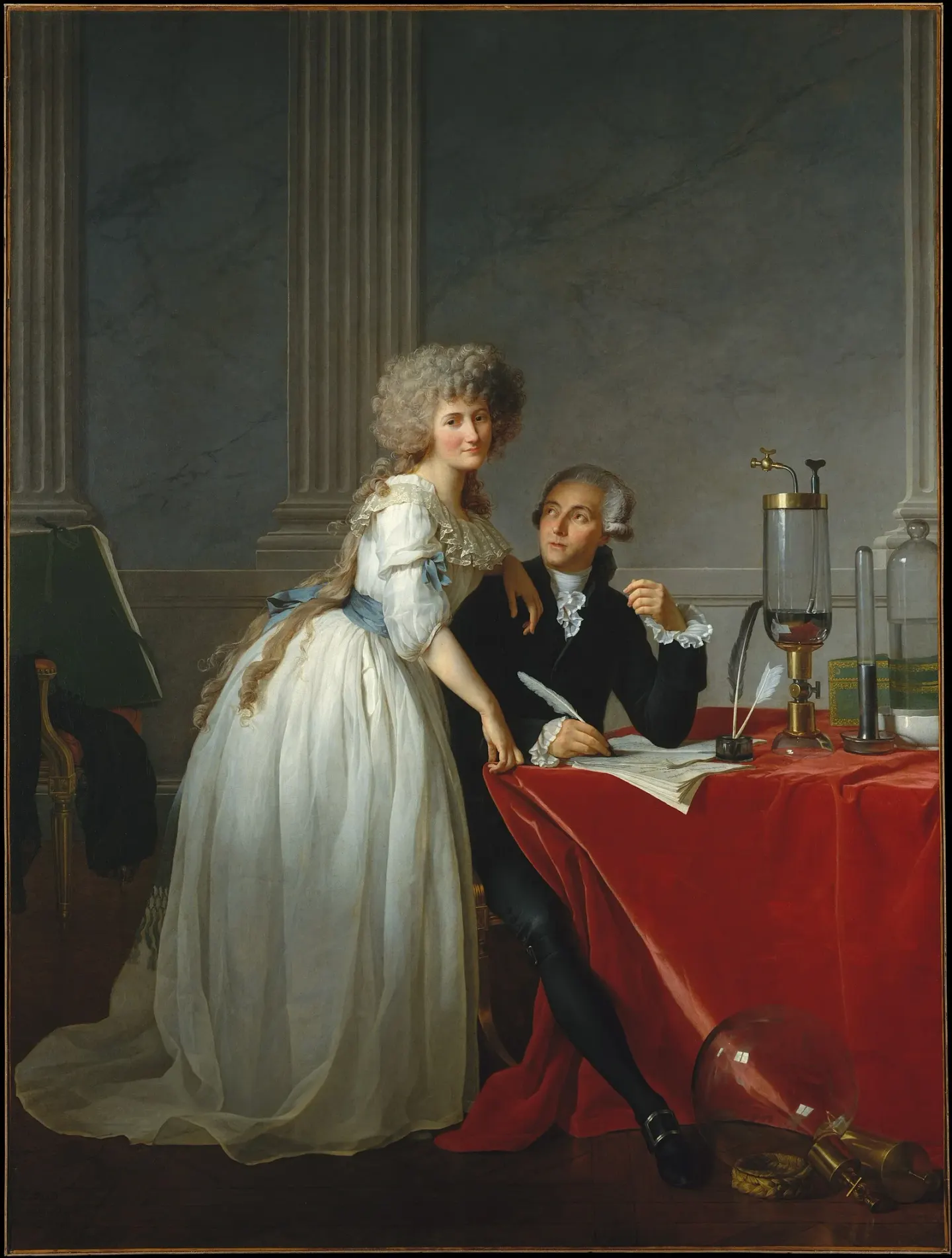
Jacques-Louis David's portrait of Antoine Lavoisier and Marie-Anne Paulze Lavoisier with laboratory apparatus · Jacques-Louis David, 1788 · The Metropolitan Museum of Art · Wikimedia Commons (public domain)
One paper in the history of chemistry considers that the idea that mass is conserved started in ancient Indian Jain philosophy and passed down to Greek philosophers. There was also a debate in the 1960s over how much Russia's Lomonosov contributed (DOI: 10.70359/bhc2026v051p099).
To translate the ledger into actual quantities of matter, one more counting unit is needed. This is because atoms and molecules are far too small to count directly one by one (OpenStax Chemistry 2e 4.3). A mole is a unit that counts atoms or molecules in bundles of 6.022×10²³ each. This is a number roughly equivalent to a 6 followed by twenty-three zeros, and thanks to this bundle, the mass measured with a scale and the number of particles can be linked to each other (OpenStax Chemistry 2e 3.1). Just as we count eggs by the carton, we count molecules by the mole. Because the numbers in front of a reaction equation are ratio counts, whether you count molecules one by one or in mole units, the 1 to 2 to 1 to 2 remains the same (OpenStax Chemistry 2e 4.1).
Reactions That Give Off Heat, Reactions That Take In Heat
Both the flame of a gas burner and a burning log heat up their surroundings. Conversely, there are changes that make their surroundings cold. The difference between the two is the direction in which energy moves in and out. Energy is the capacity to do work. When substances change into other substances, energy also always changes from one form to another, and that energy usually moves in and out as heat (OpenStax Chemistry 2e 5.1).
Heat is energy transferred between two objects with different temperatures. Here, temperature is a value indicating how actively, on average, the particles making up a substance are moving.
An exothermic reaction is a reaction that gives off heat to its surroundings. The reaction in which a substance burns is of that kind (OpenStax Chemistry 2e 5.1). An endothermic reaction is a reaction that takes in heat from its surroundings. The reason an instant cold pack becomes cold is also because a change that takes in heat occurs inside it, and this is a process where a solid dissolves in water rather than a reaction producing a new substance (OpenStax Chemistry 2e 5.2).
Where does that heat come from? The answer lies in bonds. Breaking bonds between atoms always requires energy, and the stronger the bond, the more it requires. When new bonds form, energy comes out in reverse. If the bonds of the products are stronger than the bonds of the reactants, the energy released upon forming them is greater than the energy required to break them, so the leftover share comes out as heat, and that reaction is an exothermic reaction. If the bonds of the products are weaker, it is an endothermic reaction (OpenStax Chemistry 2e 7.5). The heat released when fuel burns is the leftover share remaining as stronger new bonds form. (OpenStax Chemistry 2e 7.5)
If you run the same reaction in reverse, the exotherm and endotherm are also swapped (OpenStax Chemistry 2e 5.3). Speaking in terms of hills, the path going down from a high village to a low village is an exothermic reaction, and the path going up from a low village to a high village is an endothermic reaction. Heat goes out or comes in by as much as the height difference of the villages. Either way, energy is neither newly created nor destroyed (OpenStax Chemistry 2e 5.1). That principle is covered in "Energy — Money That Doesn't Shrink When Exchanged, Odd Coins Scattered in Your Pockets".
Here, one boundary is placed on the law of conservation of mass from the previous section. The energy moving in and out of a chemical reaction is relatively small, so the change in mass is also too small to measure. In nuclear reactions where atomic nuclei change, the energy moving in and out is roughly a million times larger, so the change in mass is actually measurable (OpenStax Chemistry 2e 5.1). That side of the story is covered in "Atoms and Radiation — A Drizzle That Never Stops, a Rain Gauge for How Wet We Get".
Reactions That Release Heat Must First Cross a Hill
Paper releases heat as it burns. In terms of our village analogy, that is the downhill side. Yet paper sitting in a drawer does not catch fire on its own, even after years.
The molecules in paper and the oxygen molecules in the air collide constantly. Even so, not every collision causes a reaction. Only collisions that bring the atoms that will newly bond into contact and carry enough energy create new bonds (OpenStax Chemistry 2e 12.5). Activation energy is the minimum energy required for reactant particles to collide and turn into products. This value is the height of the hill.
The energy that particles possess is tied to temperature. The higher the temperature, the more actively the particles move on average. When the activation energy is much higher than the average energy of the particles, collisions with enough energy are rare, so the reaction happens slowly. When the hill is much lower than the average energy of the particles, many particles cross it, making the reaction fast (OpenStax Chemistry 2e 12.5).
Paper in a drawer is an example of the former case. Applying a match flame greatly raises the temperature at a single point, and as the temperature rises, the fraction of particles with enough energy to cross the hill increases (OpenStax Chemistry 2e 12.5). The match flame gives the paper in the drawer the initial energy to cross the hill.
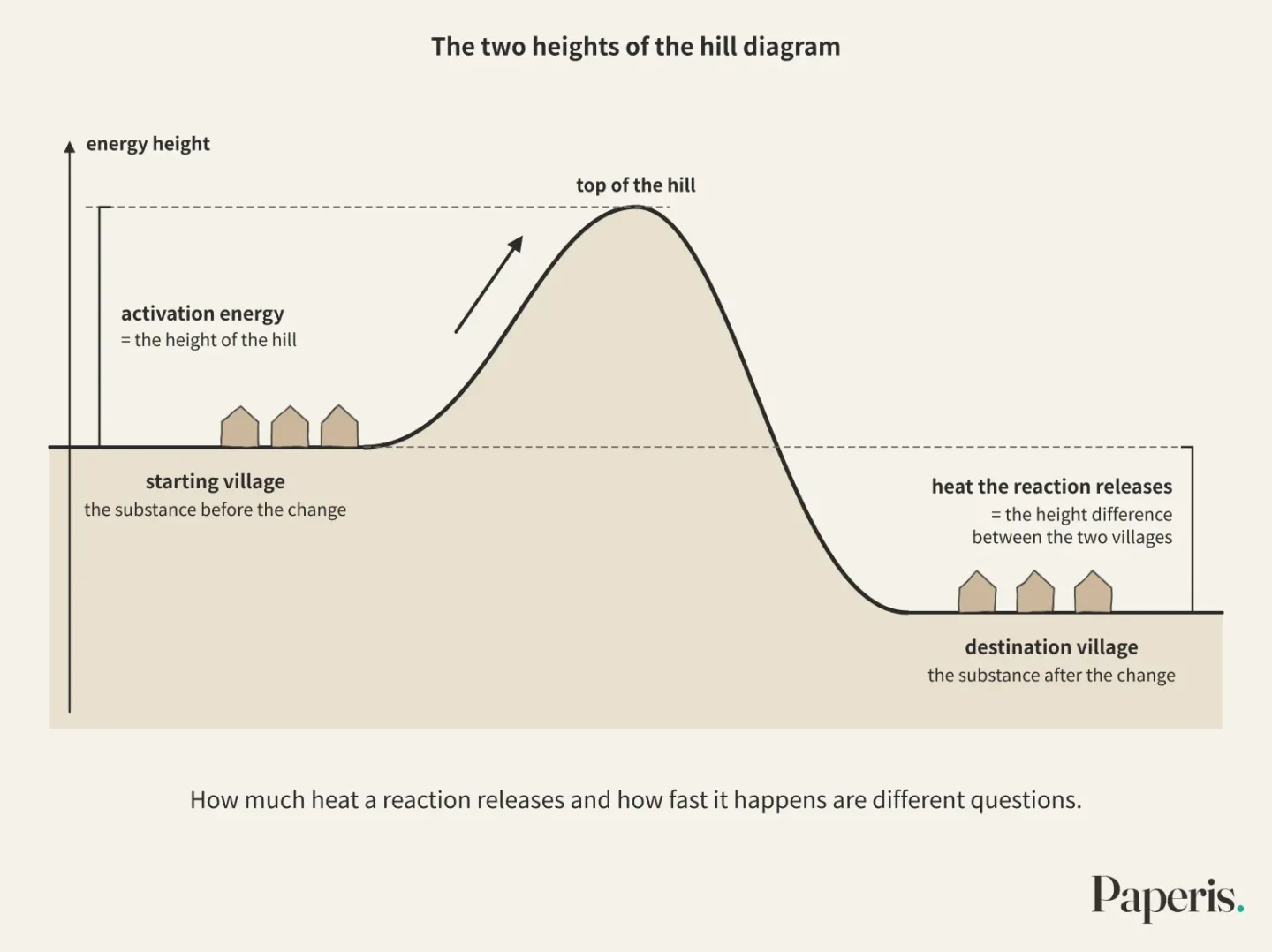
The hill diagram has two heights. The height from the starting village to the top of the hill is the activation energy, and the height difference between the two villages is the heat that the reaction releases or absorbs. The two are different values (OpenStax Chemistry 2e 12.5). How much heat a reaction releases and how fast it happens are different questions. Even a reaction that goes down a long way is slow if its hill is high.
What Determines the Speed
In an experiment where the same ground beef was kept at various temperatures and the spoiling point was measured, the time it took to spoil, as measured by volatile nitrogen compounds coming off the meat, was 168 hours at 4 degrees, 60 hours at 15 degrees, and 24 hours at 25 degrees (DOI: 10.13050/foodengprog.2010.14.3.229). Beef that lasted a week at refrigerator temperature spoiled in just a single day in a warm room.
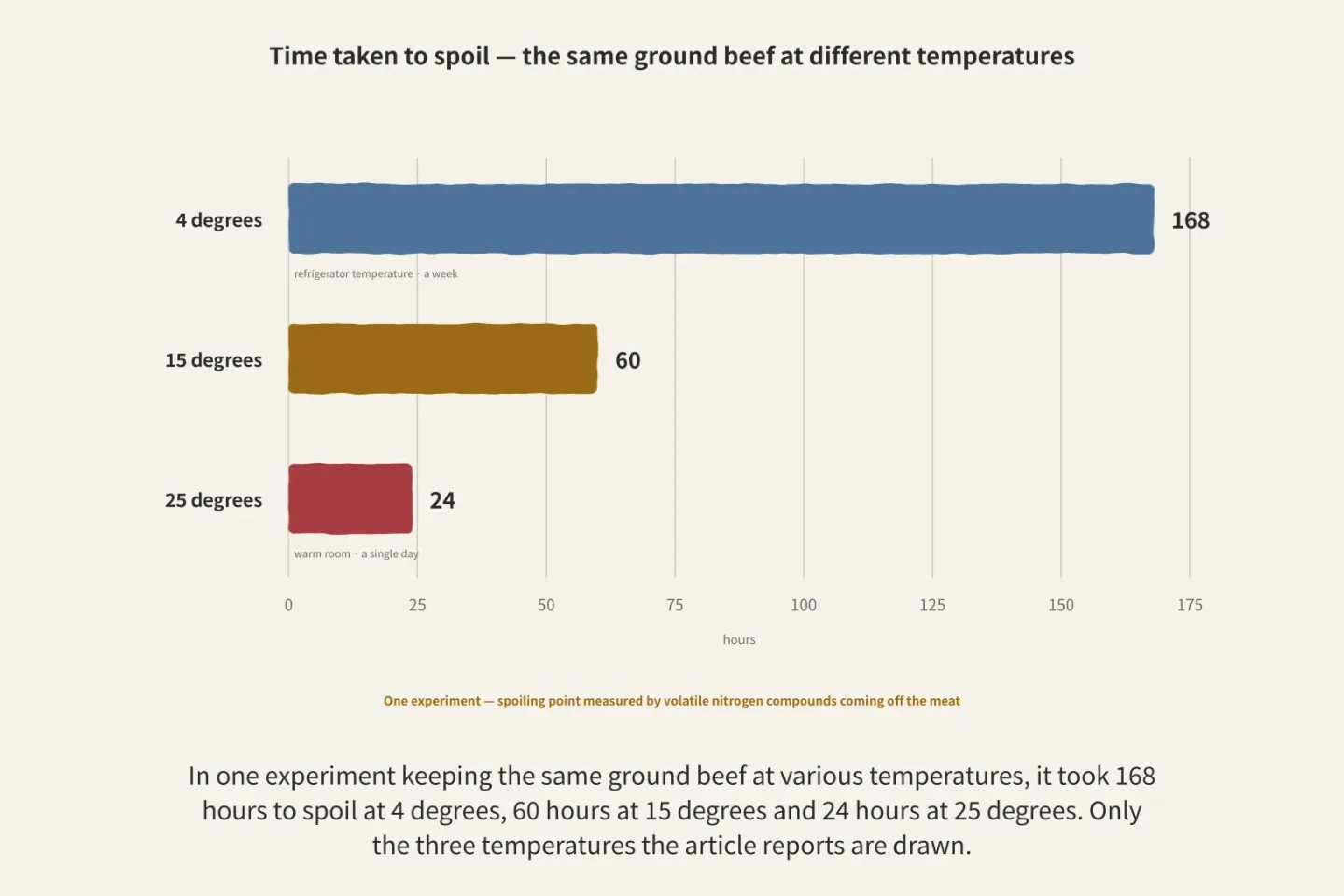
Figure: a diagram Paperis drew using only what the article says
Reaction rate is a value representing how much reactants decrease or products increase during a given amount of time (OpenStax Chemistry 2e 12.1). The refrigerator changes precisely this value. Chemical reactions are generally faster when warmer, and in many reactions, a 10-degree rise in temperature roughly doubles the speed (OpenStax Chemistry 2e 12.2). The spoiling of meat is not a single reaction but a overlap of multiple changes, and those changes also slow down as the temperature gets lower (OpenStax Chemistry 2e 12.2). If we view each individual reaction as a hill, cooling it does not change the height of the hill, but it decreases the fraction of particles with enough energy to cross over the hill (OpenStax Chemistry 2e 12.5).
What besides temperature is there? Because particles must meet first in order to react, the more reactants gathered in one place, the faster the reaction. This is because having more particles in the same volume increases the chances of them colliding (OpenStax Chemistry 2e 12.5).
If it is a solid, how finely it is broken up also matters. This is because solids react only at the surface where they touch other substances. Even with the same wood, sawdust has a much larger surface in contact with the air, so while a thick log burns slowly while smoking, sawdust burns explosively (OpenStax Chemistry 2e 12.2).
What substance is reacting also dramatically changes the speed (OpenStax Chemistry 2e 12.2).
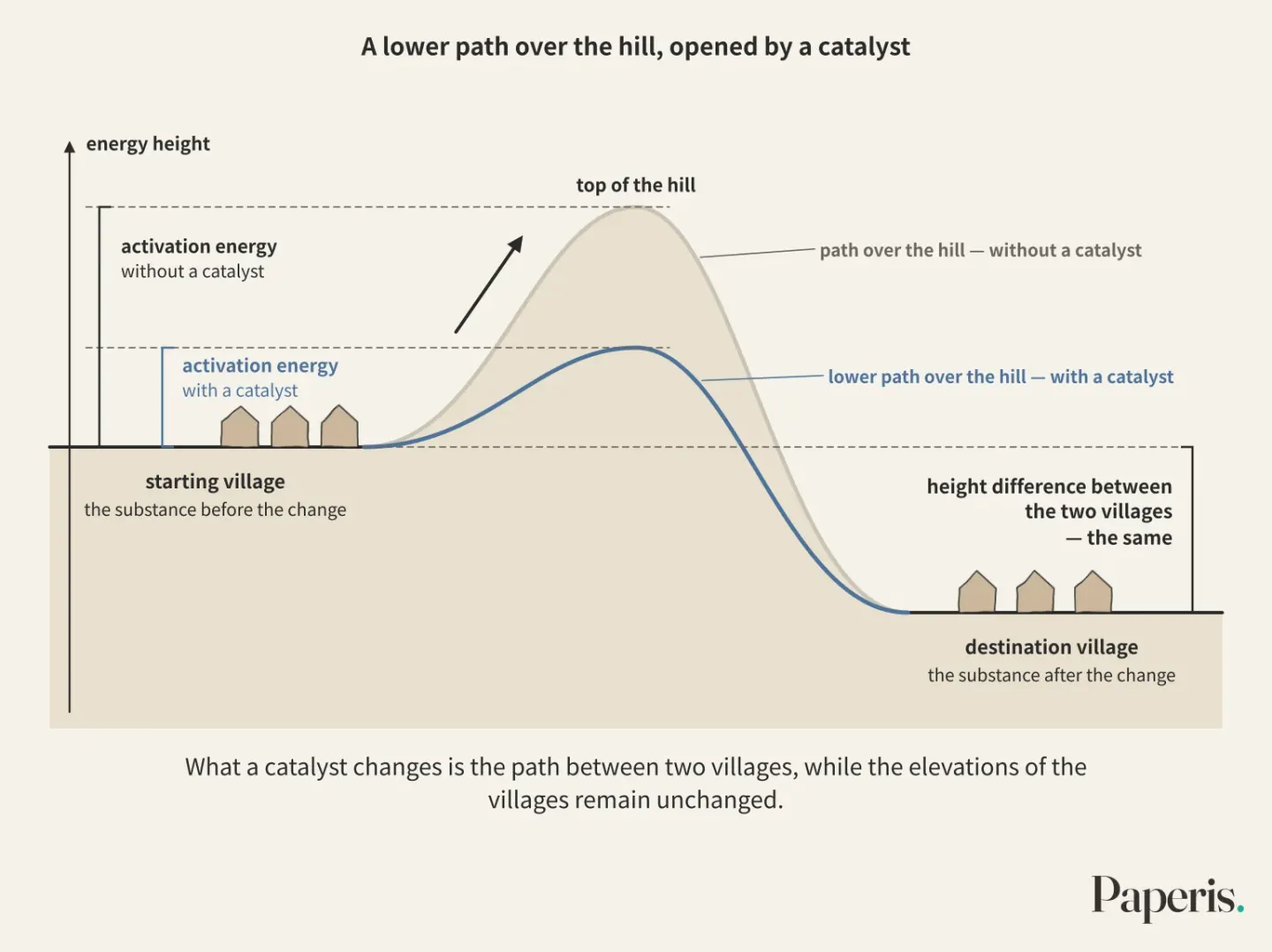
Temperature, concentration, and particle size change the number of particles crossing the hill in the same amount of time while leaving the path over the hill as it is. There is one more thing that changes the speed (OpenStax Chemistry 2e 12.2). A catalyst is a substance that makes a reaction happen faster while remaining unchanged after the reaction ends. A catalyst changes the path over the hill itself (OpenStax Chemistry 2e 12.7).
Catalysts Open a Lower Path over the Hill
When you pour dilute hydrogen peroxide onto a wound, it bubbles up. Hydrogen peroxide is a substance that breaks down into water and oxygen; in the bottle, this happens very slowly, but substances inside the tissue of the wound greatly speed it up so that oxygen comes rushing out all at once (OpenStax Chemistry 2e 12.2).
A catalyst is something that speeds up a reaction, just like that substance in the wound. A catalyst makes the reaction fast by providing a different reaction pathway with a lower activation energy. Whether a catalyst is present or not, the reactants and products are the same, and the energy difference between the two is also the same (OpenStax Chemistry 2e 12.7). What a catalyst changes is the path between two villages, while the elevations of the villages remain unchanged. Therefore, the heat that the reaction releases or takes in is the same regardless of the catalyst (OpenStax Chemistry 2e 12.7).
A catalyst steps into the reaction and then returns to its original form in the final step. Because of this, the same catalyst can do the same job over and over again (OpenStax Chemistry 2e 12.7). That repetition is not always welcome. High up in the ozone layer, chlorine atoms broken off from human-made gases act as catalysts, allowing a single chlorine atom to destroy thousands of ozone molecules. Fortunately, most chlorine in the atmosphere exists in forms that do not work as catalysts (OpenStax Chemistry 2e 12.7).
The catalytic converter attached to the exhaust pipe of a gasoline car coats its surface with metals like platinum and rhodium, turning carbon monoxide and unburned fuel from exhaust gases into carbon dioxide and water vapor, and converting nitrogen oxides back into nitrogen and oxygen (OpenStax Chemistry 2e 12.7). However, this device requires a certain temperature for the reaction to take place, so it cannot work properly before the exhaust gases warm up (DOI: 10.1115/icef2005-1339). Methods of preheating it with an electric heater are also used (OpenStax Chemistry 2e 12.7). Two conference papers from 2005 reported that more than three-quarters of the unburned hydrocarbons emitted during a drive occur within 2 minutes right after startup, and under a US test driving standard, nearly 80% of emissions are released within the first 3 minutes (DOI: 10.1115/imece2005-80696) (DOI: 10.1115/icef2005-1339). Because a catalyst only lowers the hill rather than eliminating it, reactions with a catalyst are still affected by temperature.
In our bodies, enzymes take charge of this job. Enzymes are molecules that help chemical reactions inside cells happen more easily, and almost all of them are proteins. An enzyme has a binding site shaped to fit only its matching reactant, so one enzyme usually helps with only a single reaction (OpenStax Chemistry 2e 12.7).
It looks stopped, but goes back and forth
When a reaction takes place inside a tightly stoppered bottle, reactants decrease and products increase at first, but after a certain moment no outward change is visible. The reaction looks as if it has finished (OpenStax Chemistry 2e 13.1).
A reversible reaction is a reaction that can proceed both forward and backward. Imagine it as a hill. At first, people are only in the starting village, so everyone is just crossing over. As people increase in the destination village, the people coming back also increase, and as the starting village empties out, the people crossing over decrease. When the two flows become equal, the populations of the two villages no longer change (OpenStax Chemistry 2e 13.1).
Chemical equilibrium is a state where the forward reaction and the backward reaction occur at the same speed, so the amounts of reactants and products no longer change. A reaction that has reached equilibrium has not stopped; it continues to occur back and forth at the same speed (OpenStax Chemistry 2e 13.1). People keep going back and forth over the hill without resting even after that. However, the populations of the two villages at equilibrium are not necessarily equal. In some reactions, almost everyone lives in the destination village, and in some reactions, almost everyone remains in the starting village (OpenStax Chemistry 2e 13.1).
This passage is a place where learners frequently stumble. Misconceptions identified in a sample of British secondary students broadly touched on what state equilibrium is, what the reactants and products are like at equilibrium, and what conditions and catalysts do to equilibrium (DOI: 10.29311/ndtns.v18i1.3900). An analysis gathering 14 papers dealing with misconceptions in chemical equilibrium also frequently showed the idea that "even at equilibrium, the speeds of the forward reaction and the backward reaction are different" (DOI: 10.1088/1742-6596/1806/1/012197).
What role do catalysts play at equilibrium? Because catalysts lower the hill, both the way forward and the way back become easier together. Therefore, both reactions speed up, and equilibrium is reached faster, but the amounts of reactants and products at equilibrium remain the same (OpenStax Chemistry 2e 13.3). A catalyst only reduces the time it takes to reach equilibrium; it does not increase the share of products at equilibrium. (OpenStax Chemistry 2e 13.3)
Something else changes the share at equilibrium. If you change the amount of reactants or products in a reaction at equilibrium, or change the temperature, the balance of the forward and backward speeds breaks and is then readjusted. For example, if you remove products, the backward reaction slows down, and the forward side gets ahead for a while (OpenStax Chemistry 2e 13.3).
The factory that makes ammonia, a raw material for fertilizer, uses these two things separately. Continuously removing the generated ammonia to slow down the backward reaction is a matter of changing the share at equilibrium, and the catalyst changes the speed by lowering the hill (OpenStax Chemistry 2e 13.3). Temperature changes both. In this heat-releasing reaction, the lower the temperature, the greater the share of ammonia at equilibrium, but the slower the speed, so the two sides cross paths (OpenStax Chemistry 2e 13.3).
Back in Front of the Ashes
We return to the first three scenes. The ash of firewood is light because a large fraction of the wood's atoms met oxygen in the air and left as gas, and not a single atom vanished. Paper in a drawer does not burn because even though the burning side is downhill, there is a hill in front of it, and a match flame gives the first energy to cross the hill. A refrigerator does not raise the hills of the reactions involved in spoiling, but reduces the share of particles that have enough energy to cross the hill.
The hill analogy diverges from reality in two places. First, the hill is not of ground, but of energy height. Particles do not struggle to cross the hill, and only those that collide this way and that and happen to collide with sufficient energy and the right direction cross it (OpenStax Chemistry 2e 12.5). Second, although this article drew the path over the hill as a single one, actual reactions often go through multiple steps in sequence, and a reaction equation does not show what those steps are like (OpenStax Chemistry 2e 12.6).
Where to Read More
The principle that energy only changes shape without shrinking during reactions is covered in "Energy — Money That Doesn't Shrink When Exchanged, Odd Coins Scattered in Your Pockets", and the difference between heat and temperature in "Heat and Temperature — Water That Only Flows Downhill, a Pump That Lifts It Back Up". The side where mass changes in nuclear reactions leads to "Atoms and Radiation — A Drizzle That Never Stops, a Rain Gauge for How Wet We Get".
The process by which enzymes are made of proteins can be found in "From Gene to Protein — A Copy Read Three Letters at a Time, and the Pages Each Cell Opens", and the scene of enzymes in the body chopping food into small pieces in "How Does Digestion Work? — A Tube Through the Body, and a Wall Only Small Pieces Can Cross". What happens when the heat of a heat-releasing reaction cannot escape, raising the temperature, and the increased temperature makes the reaction faster inside a battery is covered by "Thermal Runaway — A Staircase Climbed on Its Own Heat".
Among other parts of this series, the story of atoms gathering to become matter is covered in "Elements and Molecules — 118 Pieces of Type, Tens of Millions of Words", and the strings holding atoms together in "Chemical Bonds — A Rope Held Together, a Rope Pulled to One Side". Reactions where acids and bases meet are continued in "Solutions, Acids and Bases — Guests Melting into a Crowded Square, Ushers Who Take the Hats", and what actually goes back and forth when matter burns in "Oxidation and Reduction — A Hand That Catches the Thrown Ball, a Ball Sent the Long Way Around".
Source Papers
- "Chemistry 2e — 4.1 Writing and Balancing Chemical Equations" (2019) — OpenStax Chemistry 2e 4.1 — Reactants on the left and products on the right of the arrow, an example where 1 methane and 2 oxygen become 1 carbon dioxide and 2 water, stoichiometric coefficients represent ratios of quantities that can be read as either molecule counts or moles, and the number of atoms of each element must match on both sides to align with the conservation of mass.
- "Chemistry 2e — 1.2 Phases and Classification of Matter" (2019) — OpenStax Chemistry 2e 1.2 — The law of conservation of mass (no measurable change in the total amount of matter during a chemical change), total mass remains unchanged even when glucose turns into ethanol and carbon dioxide during beer bottling, oxygen is required for fuel to burn, and verification examples are rare outside the laboratory because it is difficult to collect all resulting matter.
- "Chemistry 2e — 4.5 Quantitative Chemical Analysis" (2019) — OpenStax Chemistry 2e 4.5 — Combustion analysis, where complete combustion of a hydrocarbon yields only carbon dioxide and water, and components are determined from the weight increases of devices that absorb each.
- "Chemistry 2e — 5.1 Energy Basics" (2019) — OpenStax Chemistry 2e 5.1 — Energy changes when matter changes and usually flows in and out as heat, changes that release heat (exothermic, combustion) versus those that absorb it (endothermic), conservation of energy, and the fact that mass changes in chemical reactions are too small to measure whereas nuclear reactions have energies about a million times larger, making their mass changes measurable.
- "Chemistry 2e — 5.2 Calorimetry" (2019) — OpenStax Chemistry 2e 5.2 — Instant cold packs operate via an endothermic process where ammonium nitrate dissolves in water.
- "Chemistry 2e — 5.3 Enthalpy" (2019) — OpenStax Chemistry 2e 5.3 — Methane burning in a gas burner, where reversing the reaction direction swaps exothermic and endothermic behavior.
- "Chemistry 2e — 7.5 Strengths of Ionic and Covalent Bonds" (2019) — OpenStax Chemistry 2e 7.5 — Breaking bonds always costs energy and costs more the stronger they are, with product bonds being stronger yielding an exothermic process and weaker ones yielding an endothermic process.
- "Chemistry 2e — 9.3 Stoichiometry of Gaseous Substances, Mixtures, and Reactions" (2019) — OpenStax Chemistry 2e 9.3 — Lavoisier transformed chemistry into a quantitative science through gas research, elucidated the conservation of mass, the role of oxygen in combustion, and the composition of air, was executed by guillotine in 1794, and his wife Marie-Anne Paulze Lavoisier contributed through illustrations, translations, and publishing his works.
- "Chemistry 2e — 4.3 Reaction Stoichiometry" (2019) — OpenStax Chemistry 2e 4.3 — Mass is used because directly counting numbers of atoms and molecules is not easy.
- "Chemistry 2e — 3.1 Formula Mass and the Mole Concept" (2019) — OpenStax Chemistry 2e 3.1 — The mole is a unit of quantity that counts 6.022×10²³ particles as a single bundle, bridging mass and particle count.
- "Chemistry 2e — 12.5 Collision Theory" (2019) — OpenStax Chemistry 2e 12.5 — Reaction requires collisions with the correct orientation and sufficient energy, activation energy is the minimum energy required to form products, reactions are slow if this is much larger than average energy, higher temperatures increase the fraction of particles exceeding this threshold, more particles increase collisions and speed up the reaction, and activation energy and reaction heat are different values.
- "Chemistry 2e — 12.1 Chemical Reaction Rates" (2019) — OpenStax Chemistry 2e 12.1 — Reaction rate is a measure of the amount of reactant consumed or product formed over a given time interval.
- "Chemistry 2e — 12.2 Factors Affecting Reaction Rates" (2019) — OpenStax Chemistry 2e 12.2 — Reaction rate depends on the type of substance, degree of subdivision, temperature, concentration, and catalysts, illustrated by sawdust versus large wood and low temperatures slowing food spoilage, roughly doubling every 10 degrees, and hydrogen peroxide foaming on a wound.
- "Chemistry 2e — 12.7 Catalysis" (2019) — OpenStax Chemistry 2e 12.7 — Catalysts are substances that increase reaction rates without being consumed by providing an alternative pathway with lower activation energy, starting and ending energies are identical, catalysts are regenerated in the final step, a single chlorine atom destroys thousands of ozone molecules (most atmospheric chlorine exists in inactive forms), platinum-rhodium catalytic converters use electric preheating, and enzymes bind only to specific substrates and typically catalyze a single reaction.
- "Chemistry 2e — 12.6 Reaction Mechanisms" (2019) — OpenStax Chemistry 2e 12.6 — Reactions often occur in multiple steps, and overall reaction equations do not show this underlying process.
- "Chemistry 2e — 13.1 Chemical Equilibria" (2019) — OpenStax Chemistry 2e 13.1 — Reversible reactions reach equilibrium when forward and reverse reaction rates become equal, resulting in constant concentrations; equilibrium is dynamic rather than stopped, and the ratio of products to reactants at equilibrium varies greatly from one reaction to another.
- "Chemistry 2e — 13.3 Shifting Equilibria: Le Châtelier's Principle" (2019) — OpenStax Chemistry 2e 13.3 — Changes in concentration and temperature shift equilibrium, catalysts speed up both forward and reverse reactions equally to reach equilibrium faster without altering the equilibrium constant, temperature changes the equilibrium constant, and industrial ammonia plants continuously remove products while using catalysts to maintain speed.
- "The Law of Conservation of Matter: Lomonosov and Lavoisier" (2026) — DOI: 10.70359/bhc2026v051p099 — The concept of the conservation of matter originated in Jain philosophy and among Greek philosophers, addressing Lomonosov's contribution and the controversies of the 1960s.
- "Use of Commercial Enzymatic Time Temperature Integrator for Monitoring Spoilage of Ground Beef" (2010) — DOI: 10.13050/foodengprog.2010.14.3.229 — Ground beef using volatile basic nitrogen (VBN) as an index of spoilage takes 168, 114, 60, 48, and 24 hours to spoil at 4, 10, 15, 20, and 25 degrees.
- "A Simplified Catalytic Converter Model for Automotive Coldstart Control Applications" (2005) — DOI: 10.1115/imece2005-80696 — Over three quarters of unburned hydrocarbon emissions in a typical driving cycle are emitted during the first 2 minutes immediately after startup (the cold-start phase).
- "Simulation of an Automotive Catalytic Converter Internal Flow" (2005) — DOI: 10.1115/icef2005-1339 — Catalytic converters require a certain temperature (light-off) before reactions occur, designs mounting them close to the engine are proposed, and FTP-75 tests show that nearly 80% of emissions occur within the first 3 minutes after a cold start.
- "Students' Misconceptions in Chemical Equilibria and Suggestions for Improved Instruction" (2023) — DOI: 10.29311/ndtns.v18i1.3900 — Misconceptions about chemical equilibrium among a sample of British secondary students include the nature of dynamic equilibrium, reactants and products at equilibrium, and the effects of conditions and catalysts (sample size is not provided in the abstract).
- "Potency to overcome misconceptions by using multiple representations on the concept of chemical equilibrium" (2021) — DOI: 10.1088/1742-6596/1806/1/012197 — Analysis of 14 papers addressing chemical equilibrium misconceptions reveals that a frequently found misconception is that "the speeds of the forward reaction and the reverse reaction are not equal."
Sources (23)
- Chemistry 2e — 4.1 Writing and Balancing Chemical Equations
- Chemistry 2e — 1.2 Phases and Classification of Matter
- Chemistry 2e — 4.5 Quantitative Chemical Analysis
- Chemistry 2e — 5.1 Energy Basics
- Chemistry 2e — 5.2 Calorimetry
- Chemistry 2e — 5.3 Enthalpy
- Chemistry 2e — 7.5 Strengths of Ionic and Covalent Bonds
- Chemistry 2e — 9.3 Stoichiometry of Gaseous Substances, Mixtures, and Reactions
- Chemistry 2e — 4.3 Reaction Stoichiometry
- Chemistry 2e — 3.1 Formula Mass and the Mole Concept
- Chemistry 2e — 12.5 Collision Theory
- Chemistry 2e — 12.1 Chemical Reaction Rates
- Chemistry 2e — 12.2 Factors Affecting Reaction Rates
- Chemistry 2e — 12.7 Catalysis
- Chemistry 2e — 12.6 Reaction Mechanisms
- Chemistry 2e — 13.1 Chemical Equilibria
- Chemistry 2e — 13.3 Shifting Equilibria: Le Châtelier's Principle
- The Law of Conservation of Matter: Lomonosov and LavoisierDOI 10.70359/bhc2026v051p099
- Use of Commercial Enzymatic Time Temperature Integrator for Monitoring Spoilage of Ground BeefDOI 10.13050/foodengprog.2010.14.3.229
- A Simplified Catalytic Converter Model for Automotive Coldstart Control ApplicationsDOI 10.1115/imece2005-80696
- Simulation of an Automotive Catalytic Converter Internal FlowDOI 10.1115/icef2005-1339
- Students' Misconceptions in Chemical Equilibria and Suggestions for Improved InstructionDOI 10.29311/ndtns.v18i1.3900
- Potency to overcome misconceptions by using multiple representations on the concept of chemical equilibriumDOI 10.1088/1742-6596/1806/1/012197