Paperis Articles
Elements and Molecules — 118 Pieces of Type, Tens of Millions of Words
All matter is made of atoms, and atoms with the same number of protons make up one element. Atoms join into molecules and compounds, and a compound behaves differently from the elements it is made of. The periodic table lists the elements in order of atomic number, with elements of similar properties stacked in the same column.
Your field's papers, as audio
Pick your fields and journals — Paperis summarizes the key papers and turns them into audio. Listen on your commute.
Start Paperis free →Elements and Molecules — 118 Pieces of Type, Tens of Millions of Words
Three Things in the Kitchen Cupboard
Take the salt shaker and the sugar jar out of the kitchen cupboard, pour a glass of water, and line them up on the dining table. But what is salt made of? What about sugar and water?
The beverage bottle sitting nearby says "No Chemical Substances Added." Reading this phrase makes it sound like chemical substances are something bad for the body, and salt or water have nothing to do with them. This article starts from what the three things on the table are made of, and goes all the way to rereading that phrase.
As a guide, we will bring along the movable type and words of an old print shop. A piece of type is a small piece of metal carved with a single character, and even a thick book is made by repeatedly arranging type of a few dozen kinds of characters. A single character has no meaning, but when characters are connected they become words, and each word gets a meaning. The substances of the world are also made by connecting a hundred-odd kinds of small particles.
What the Number of Protons Determines
The particles that make up all matter are atoms. Because the inside of an atom was covered in "Atoms and Radiation — A Drizzle That Never Stops, a Rain Gauge for How Wet We Get", we only restate here what is needed for this article. An atom is a particle made of a small nucleus and electrons around it. The nucleus is a tiny mass in the exact middle of an atom, and nearly all of the atom's mass is gathered here (OpenStax Chemistry 2e 2.3).
An electron is a very light particle with a negative (−) electric charge, located in the wide empty space around the nucleus. There are two kinds of particles inside the nucleus, and one of them decides what kind of atom it is. A proton is the positively (+) charged particle among those making up the nucleus, and its count determines which element it is (OpenStax Chemistry 2e 2.3).
The atomic number is the count of protons inside the nucleus. Any atom with six protons is carbon, no matter how many other particles are in the nucleus or how many electrons are around it, and the atomic number of carbon is 6 (OpenStax Chemistry 2e 2.3). Just as "A" is "A" whether written large or small, six protons make carbon.
An element is a substance made of atoms with the same number of protons in their nucleus, which cannot be broken down into simpler substances by a chemical change. A chemical change is a change where a new substance is created that is different from what was there at first. Iron, gold, copper, oxygen, and sulfur are all elements (OpenStax Chemistry 2e 1.2). The atoms of a single element have the same chemical properties (OpenStax Chemistry 2e 2.1). In terms of movable type, each cast metal block of the letter "A" is an atom, and the character "A" itself is the element.
There are 118 known elements so far, and some of them were artificially made by humans (DOI: 10.1093/actrade/9780198842323.003.0002). Among the elements found in abundance on Earth, the heaviest is uranium, which has 92 protons. Elements number 93 through 98 exist only in tiny amounts, and the rest do not occur naturally on Earth (DOI: 10.1093/actrade/9780198718635.003.0006). The types of type that spell out the world's matter are 118 in total, and twenty of them—numbers 99 through 118—are letters that do not exist in Earth's nature (DOI: 10.1093/actrade/9780198718635.003.0006; DOI: 10.1093/actrade/9780198842323.003.0002). However, this does not mean all elements up to number 98 are abundant in nature, so textbooks count the elements found in Earth's nature as about 90 (OpenStax Chemistry 2e 1.2).
When You Join Type, You Get Words
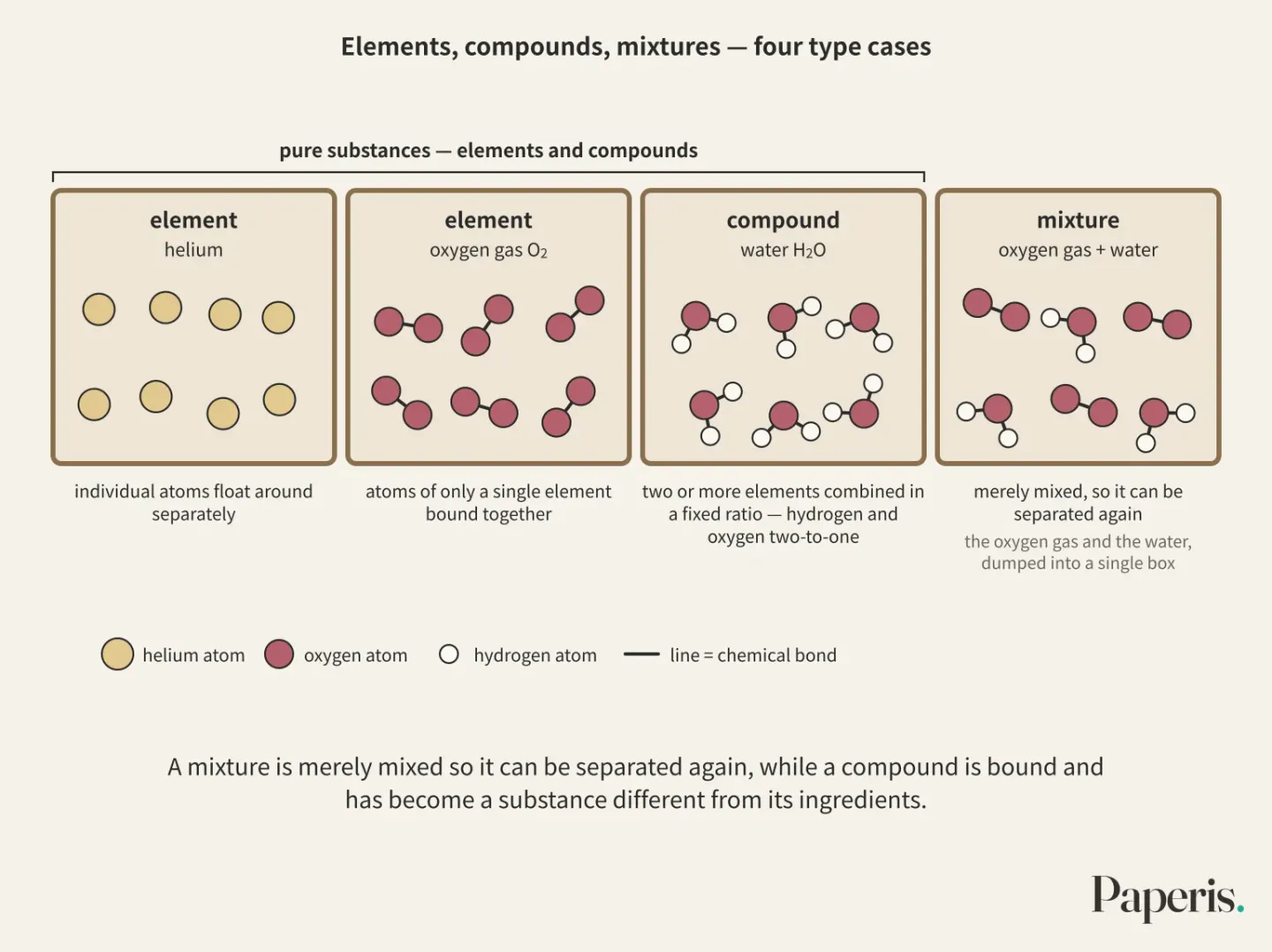
The water in a cup on the dinner table is made of tiny grains called water molecules. A single water molecule is a single chunk made of two hydrogen atoms and one oxygen atom bound together (H₂O) (OpenStax Chemistry 2e 1.2).
A molecule is a particle in which two or more atoms are tightly bound by chemical bonds and move as a single chunk. Just as a few pieces of type joined together to form a word are read as a single unit, the three atoms in a water molecule move together as one chunk. Even when atoms of only a single element bind together, they form a molecule. The oxygen gas we breathe is a molecule made of two oxygen atoms bound together (O₂) (OpenStax Chemistry 2e 2.4).
There is also a name for what keeps atoms bound together. A chemical bond is an attraction that holds atoms or ions together (OpenStax Chemistry 2e 2.4). An ion is an atom or group of atoms that has gained or lost electrons and thus carries an electrical charge (OpenStax Chemistry 2e 2.3; OpenStax Chemistry 2e 2.6). We will meet ions again later when we look at salt. How that attraction arises is covered in "Chemical Bonds — A Rope Held Together, a Rope Pulled to One Side".
A compound is a substance formed when two or more elements are chemically combined in a fixed ratio. Water is like that. In any water molecule, hydrogen and oxygen are in a two-to-one ratio, and within a given compound, the ratio of the numbers of atoms of each element is always the same (OpenStax Chemistry 2e 2.1). There are just over a hundred elements, but the compounds those elements form by swapping partners number in the tens of millions (OpenStax Chemistry 2e 1.2). This is much like how there are only a few dozen letters, yet countless words.
The method for writing down these words is the chemical formula. Every element has a symbol, and most are one or two letters, so hydrogen is H, oxygen is O, and carbon is C (OpenStax Chemistry 2e 2.3). A chemical formula uses element symbols and small numbers to write down the kinds and ratio of atoms that make up a substance. If a substance is made of molecules, the formula records the number of atoms in a single molecule, and the number is attached only when there are two or more of the same atom. That is why the oxygen molecule is O₂ and water is H₂O (OpenStax Chemistry 2e 2.4). For compounds that are not made of molecules, such as salt, the formula records the ratio of the numbers of atoms (ions) contained within it (OpenStax Chemistry 2e 2.4). Because symbols are just name tags, you do not need to memorize them to follow along with this article.
The Meaning of a Word Is Not in the Type
Sodium is a soft, shiny solid, and chlorine is a yellowish-green gas. When the two combine, they form white crystals of salt (NaCl) (OpenStax Chemistry 2e 1.2). Neither the shiny solid nor the yellowish-green gas can be found in the salt on a dinner table.
Sugar is the same. White crystal sugar is a compound made of carbon, hydrogen, and oxygen joined together. Carbon exists on its own as a black solid, while hydrogen and oxygen are colorless gases when they are apart (OpenStax Chemistry 2e 1.2).
Water is a compound in which hydrogen and oxygen combine in a 2-to-1 ratio. When electrical energy is put into liquid water, it splits into hydrogen gas and oxygen gas; hydrogen catches fire very easily, and oxygen does not burn on its own, but is a gas necessary for fuel to burn (OpenStax Chemistry 2e 1.2). Water in a cup looks and behaves entirely differently from those two gases.
A compound has different properties from the elements that make it up (OpenStax Chemistry 2e 1.2). Just as none of the letters "s," "e," and "a" holds the meaning of the sea on its own, but the combination "sea" does.
There is one more thing to add. Salt is a compound, but it is not made of molecules. It is a compound woven together by positively charged ions and negatively charged ions pulling on each other (OpenStax Chemistry 2e 18.1). Compounds are divided into those made of molecules and those made of ions in this way (OpenStax Chemistry 2e 2.6). Therefore, the expression "salt molecule" is incorrect. How ions form is continued in "Chemical Bonds — A Rope Held Together, a Rope Pulled to One Side".
Merely Mixed Versus Bound
No matter where sugar is obtained, by weight it is made of 42.1% carbon, 6.5% hydrogen, and 51.4% oxygen, and its melting temperature, color, and sweetness are also identical (OpenStax Chemistry 2e 1.2). A pure substance is matter that always has the same composition and properties, no matter which piece you take off to look at. Elements and compounds are pure substances (OpenStax Chemistry 2e 1.2). In terms of print, it is a page filled with copies of just a single word.
However, once you dissolve that sugar in water, the story changes. Whether you mix in one spoonful or three spoonfuls, sugar water is still sugar water, and if you let the water fly away, the sugar remains behind again (OpenStax Chemistry 2e 1.2). A mixture is something in which two or more substances are mixed together, the mixing ratios can vary, and it can be separated back apart by a physical change. A physical change is a change in which only properties like a substance's shape or state change, while the substance itself does not change into a different substance (OpenStax Chemistry 2e 1.3). Evaporating water is such a change (OpenStax Chemistry 2e 1.2).
The way things are mixed also comes in two forms. There are mixtures that are mixed evenly wherever you sample them, like saltwater, and mixtures that are uneven, like a salad dressing where the oil and vinegar stay apart (OpenStax Chemistry 2e 1.2). "Solutions, Acids and Bases — Guests Melting into a Crowded Square, Ushers Who Take the Hats" discusses the separate name given to the evenly mixed side. Compounds are different. They must go through a chemical change to be split back into elements or other compounds (OpenStax Chemistry 2e 1.2). A mixture is merely mixed so it can be separated again, while a compound is bound and has become a substance different from its ingredients. A mixture is like dumping several word cards into a single box so you can pick the cards out again. A compound is a word forged by linking metal type, so turning it back into individual type requires melting down the plate.
This distinction is not easy even for students who are learning it. In problems distinguishing elements, compounds, and mixtures at the atomic level, 31.0% of students showed the misconception of confusing identical atoms and different atoms. This is the result of investigating 41 third-year middle school students in Malang, Indonesia, through diagnostic tests and interviews (DOI: 10.29303/jppipa.v11i2.10052).
Type Cases with Blank Spaces Left Behind
In 1869, Russian chemist Dmitri Mendeleev published a table arranging the elements known up to that point in order of atomic weight. The following year, German chemist Lothar Meyer independently released a similar table. Both men recognized that there is a repeating relationship among the properties of the elements (OpenStax Chemistry 2e 2.5). That repetition is regular, but the intervals are not always the same, and the properties are only roughly alike (DOI: 10.1093/actrade/9780198842323.003.0002).
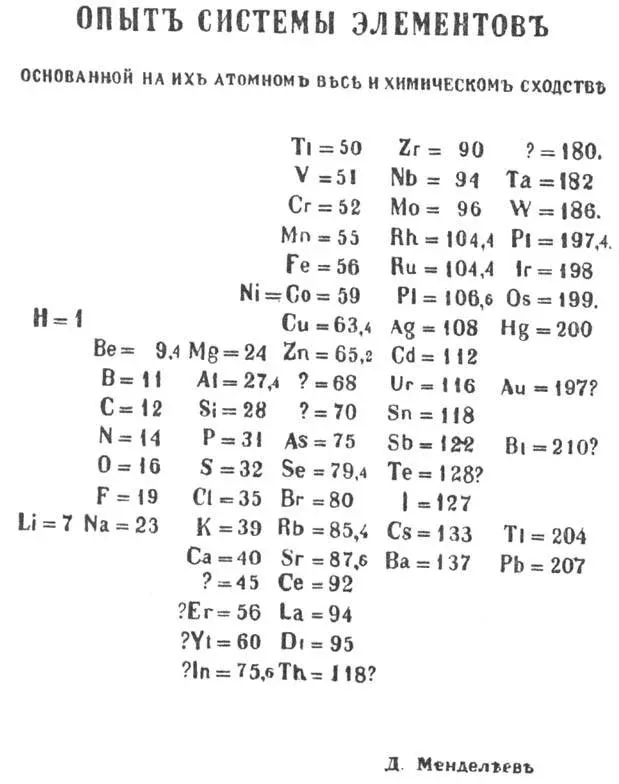
Mendeleev's first periodic system, 'An Attempt at a System of Elements', 1869 · Dmitri Mendeleev, 1869 · Wikimedia Commons (public domain)
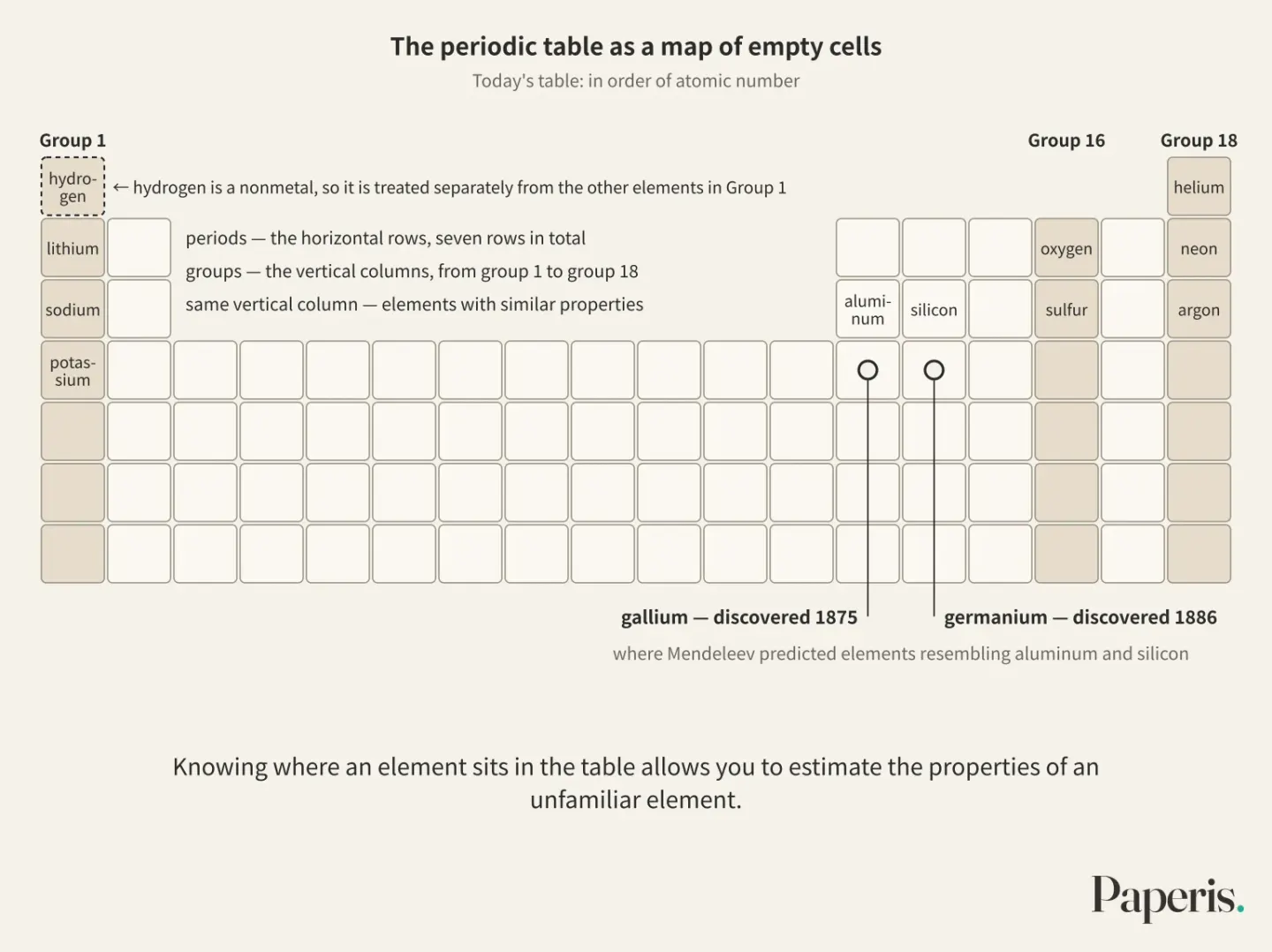
Mendeleev went a step further. Using the table, he predicted that there must be elements no one had found yet and that their properties would resemble aluminum and silicon. With the discovery of gallium in 1875 and germanium in 1886, those predictions strongly backed up his table. Even after the table became widely accepted, blank spaces for undiscovered elements still remained (OpenStax Chemistry 2e 2.5).
Not all of his predictions were correct. When Eric Scerri, who wrote a book on the history and philosophy of the table, carefully examined most of Mendeleev's predictions, at most half of them were right (DOI: 10.1093/oso/9780190914363.003.0010). There were also elements that the table failed to foresee. Gases that barely react did not easily fit into the table after being isolated for the first time in 1894, and only found their place in 1900 (DOI: 10.1093/actrade/9780198842323.003.0005).
Mendeleev was not the only person who made a table. In the 1860s, five or six people put forward similar systems on their own at nearly the same time (DOI: 10.1093/oso/9780190914363.003.0008). Among them, Mendeleev's system left the biggest impact. Scerri gives three reasons for this: his system was more complete, he worked longer to get people to accept the system, and he publicly demonstrated that the system was correct by predicting unknown elements far ahead of other discoverers. What Scerri questions is not the fact that he made predictions, but the widespread story that the system was accepted because those predictions turned out to be right. Because the power of predictive success to make people accept a theory is a long-debated issue in the philosophy of science, he writes that this story is not a settled conclusion either (DOI: 10.1093/oso/9780190914363.003.0010).
Entering the 20th century, it became clear that what determines the order in which properties repeat is atomic number rather than atomic weight (OpenStax Chemistry 2e 2.5).
The periodic table is a table that arranges elements in order of atomic number, breaking lines so that elements with similar properties fall into the same vertical column (OpenStax Chemistry 2e 2.5). It is like a printer's type case where pieces of type are laid out in serial order, and whenever a piece resembling one in the previous row appears, a new line is started to place it directly underneath.
Periods are the horizontal rows of the periodic table, totaling seven rows. Groups are the vertical columns of the periodic table, running from group 1 to group 18 from left to right (OpenStax Chemistry 2e 2.5).
The Same Column Looks Alike
Group 1 elements like lithium, sodium, and potassium are all shiny, conduct heat and electricity well, and have similar chemical properties (OpenStax Chemistry 2e 2.5).
At the far right, Group 18 elements like helium, neon, and argon are gases where individual atoms float around separately (OpenStax Chemistry 2e 1.2). Neon hardly reacts with other substances, making it a nearly risk-free gas (OpenStax Chemistry 2e 1.3).
The table's positions also broadly divide elements into metals and nonmetals. Metals are elements that are shiny, flatten instead of shattering when struck, and conduct heat and electricity well. Nonmetals are elements that usually lack luster and do not conduct heat and electricity well. There are also a few elements tucked in between with properties of both (OpenStax Chemistry 2e 2.5). Hydrogen, which is sometimes placed in the Group 1 spot, is a nonmetal, so it is treated separately from the other elements in Group 1 (OpenStax Chemistry 2e 18.1).
Elements in the same group often behave similarly in chemical reactions (OpenStax Chemistry 2e 6.5). This resemblance was even used to make medicines. Gertrude Elion, who studied drugs, took advantage of the fact that sulfur and oxygen, positioned one above the other in Group 16, bond in similar ways; she made a sulfur compound shaped like a DNA building block molecule to halt cell multiplication. This work led directly to a leukemia treatment (OpenStax Chemistry 2e 2.5). Yet there are limits to this resemblance. Even within Group 16, oxygen at the very top is a colorless gas, while elements further down look more and more like metals (OpenStax Chemistry 2e 6.5).
Knowing where an element sits in the table allows you to estimate the properties of an unfamiliar element (OpenStax Chemistry 2e 2.5). That was also what Mendeleev did when he sketched out elements that had not yet been found.
Three Pots
Water is ice in the freezer, liquid in a cup, and water vapor above a kettle. The state of matter refers to whether a substance is in the form of a solid, liquid, or gas. These three states are the ones commonly seen on Earth. A piece of ice keeps its own shape no matter what cup you put it in, water takes the shape of whatever cup it is poured into, and water vapor fills its container completely whether the container is big or small (OpenStax Chemistry 2e 1.2).
A phase change is when a substance changes from one state to another, such as from solid to liquid, or liquid to gas. The heat that enters and leaves while a state changes is covered in "Heat and Temperature — Water That Only Flows Downhill, a Pump That Lifts It Back Up".
Phase changes are on the physical change side of the physical and chemical changes defined earlier. The water vapor condensing into droplets on the inside of a boiling pot's lid is also a physical change because no new substance is formed. Cooking food in a pot and iron rusting are chemical changes (OpenStax Chemistry 2e 1.3).
Two paths branch out from three pots in the kitchen. First, the ice in the first pot melts into water, and when that water boils, it becomes water vapor. Its appearance changed in two steps into three forms, but the substance is water from beginning to end. Even when ice melts, water molecules remain water molecules (OpenStax Chemistry 2e 1.3). This is like how a word is the same whether it is printed in large type or small type.
This section is a place where children often stumble. In a study observing two fourth-grade elementary school classes, there were children who thought that when a substance melts, its molecules melt too, or that molecules move so they cannot exist inside a solid (DOI: 10.61998/forskul.v14i1.58725).
The saltwater in the second pot boils down as the water turns into vapor and flies away, leaving salt at the bottom. This is separating a mixture through a physical change (OpenStax Chemistry 2e 1.2). This is like picking out a specific card from a box of mixed-up word cards.
When the sugar in the third pot is heated for a long time, it turns brown and begins to become caramel. If you block the air in a laboratory and heat the sugar further, it eventually breaks apart into carbon and water, and caramel is that first step (OpenStax Chemistry 2e 1.2). This is a chemical change because a substance that was not there at first is created. In a chemical change, atoms are neither newly created nor destroyed, but simply rearranged (OpenStax Chemistry 2e 2.1). It is like breaking up a printing plate and setting the type into different words. How atoms are rearranged is continued in "Chemical Reactions — The Hill to Climb, the Road Traveled Both Ways", and the rusting of iron is continued in "Oxidation and Reduction — A Hand That Catches the Thrown Ball, a Ball Sent the Long Way Around".
Re-reading "Chemical-Free"
We return to the three items on the dinner table. Water is a compound of hydrogen and oxygen, salt is a compound of sodium and chlorine, and sugar is a compound of carbon, hydrogen, and oxygen (OpenStax Chemistry 2e 1.2). In the sense that they are substances made of elements and compounds, all three are chemicals. If you read "chemical-free" literally, it means even water was not added.
There is a reason for this phrase. One article addressing misunderstandings in food chemistry notes that an indiscriminate fear of chemicals has grown through sensational media coverage, misleading advertisements, and poor education, and that phrases in food ads like "chemical-free" or "100% natural" reflect and amplify that fear (DOI: 10.3390/app15116104).
This fear overlaps with a gap in knowledge. In a study combining interviews and a large-scale online survey in German-speaking Switzerland, most laypeople did not know that natural and synthetic chemicals share several basic principles of toxicity, and most of what they associated with the word "chemical" was negative. A relationship also appeared where people who better understood the basic principles of toxicity feared chemicals less (DOI: 10.1111/risa.13375).
Flammability, toxicity, and reactivity are all chemical properties, so the degree of danger varies from substance to substance. Nitroglycerin explodes easily and is extremely hazardous, while neon barely reacts and poses almost no danger (OpenStax Chemistry 2e 1.3). A book on chemistry and nature writes that chemicals are not good or bad in themselves, and that a substance's impact on society depends on how and how much it is used (DOI: 10.1039/9781839162404-00129).
The label "chemical" alone does not tell you whether a substance is dangerous. The book explains that the degree of danger varies by substance, and also depends on how and in what quantity it is used. When you see the phrase "free," you can simply ask first what it is that has been left out.
Where the Type Metaphor Falls Short
The type metaphor diverges from reality in three places. First, while pieces of type print as the same letter even inside words, sodium does not remain a shiny metal inside salt. This is because atoms change their properties when they give, take, or share electrons during bonding (OpenStax Chemistry 2e 2.6).
Second, although the order of type is a human convention, atomic numbers are determined by nature because they count the protons in an atomic nucleus. Third, while words consist of type arranged in a single line, atoms in a molecule have a three-dimensional arrangement along with how they are connected to one another (OpenStax Chemistry 2e 2.4).
Still, this metaphor can answer our initial question. Salt, sugar, and water on the dinner table are three words woven from five types—sodium, chlorine, carbon, hydrogen, and oxygen—out of the 118 kinds of type. Here, a single piece of type refers to a single element. This is a different metaphor from the gene stories that compare DNA to letters.
Where to Look Further
Atomic nuclei and electrons inside atoms, and atomic nuclei changing on their own to become different elements, are covered in "Atoms and Radiation — A Drizzle That Never Stops, a Rain Gauge for How Wet We Get". The method of measuring age with carbon that has the same number of protons but a different number of other particles inside the atomic nucleus continues in "Dating with Carbon — Radiocarbon Dates, Read with an Hourglass and Tree Rings". The heat that enters and leaves while ice melts and water boils is covered by "Heat and Temperature — Water That Only Flows Downhill, a Pump That Lifts It Back Up".
Digestion, an example of chemical change happening inside the body, is covered in "How Does Digestion Work? — A Tube Through the Body, and a Wall Only Small Pieces Can Cross", and proteins, the molecules that do most of the work inside cells, are covered in "From Gene to Protein — A Copy Read Three Letters at a Time, and the Pages Each Cell Opens".
Why atoms bind is continued by "Chemical Bonds — A Rope Held Together, a Rope Pulled to One Side", and how bound atoms unbind and are rearranged is continued by "Chemical Reactions — The Hill to Climb, the Road Traveled Both Ways". Mixtures mixed evenly like salt water are covered by "Solutions, Acids and Bases — Guests Melting into a Crowded Square, Ushers Who Take the Hats", and iron rust and fire are covered by "Oxidation and Reduction — A Hand That Catches the Thrown Ball, a Ball Sent the Long Way Around".
Source Papers
- "Chemistry 2e — 1.2 Phases and Classification of Matter" (2019) — OpenStax Chemistry 2e 1.2 — Properties of solids, liquids, and gases; pure substances have constant composition and properties (mass composition, melting point, color, and sweetness of sugar); elements cannot be broken down into simpler substances by chemical change, and about 90 occur naturally on Earth; compounds can be broken down by chemical change (heating sugar without air yields carbon and water, with caramelization as the first step); the properties of compounds differ from their elements (sodium + chlorine yields salt; carbon, hydrogen, and oxygen yield sugar); mixtures can have varying proportions and be separated by physical changes like evaporation (salt water is uniform, dressing is nonuniform); there are about 100 elements and tens of millions of compounds; helium, neon, and argon consist of single atoms; definition of a molecule; a water molecule has two hydrogens and one oxygen; water is decomposed electrically into hydrogen and oxygen, where hydrogen is flammable and oxygen is required for combustion.
- "Chemistry 2e — 1.3 Physical and Chemical Properties" (2019) — OpenStax Chemistry 2e 1.3 — Physical changes are changes in state or properties without altering chemical identity (condensation of water vapor); flammability, toxicity, and reactivity are chemical properties, with nitroglycerin being extremely dangerous because it explodes easily, and neon having almost no reactivity and thus negligible danger; chemical changes produce different substances (rusting, cooking).
- "Chemistry 2e — 2.1 Early Ideas in Atomic Theory" (2019) — OpenStax Chemistry 2e 2.1 — Dalton's atomic theory: atoms of a given element have identical chemical properties; compounds combine atoms of elements in small whole-number ratios, and that ratio is always constant; atoms are neither created nor destroyed during a chemical change, but are rearranged.
- "Chemistry 2e — 2.3 Atomic Structure and Symbolism" (2019) — OpenStax Chemistry 2e 2.3 — Atoms consist of a small nucleus (protons and neutrons) surrounded by electrons, with mass concentrated in the nucleus; atoms gain or lose electrons to become electrically charged ions; atomic number is the number of protons and defines the element (six protons means carbon, regardless of the number of neutrons or electrons); chemical symbols consist of one or two letters, some originating from names in other languages.
- "Chemistry 2e — 2.4 Chemical Formulas" (2019) — OpenStax Chemistry 2e 2.4 — Molecular formulas use element symbols and subscripts to show the types and numbers of atoms in a molecule, with subscripts used only when there are two or more; structural formulas and models show atomic connectivity and spatial arrangement; hydrogen, oxygen, and nitrogen are diatomic molecules (O₂); chemical bonds are attractive forces holding atoms or ions together in molecules or crystals; empirical formulas show the ratio of numbers of atoms (ions) in a compound.
- "Chemistry 2e — 2.5 The Periodic Table" (2019) — OpenStax Chemistry 2e 2.5 — Similar properties of lithium, sodium, and potassium; Mendeleev (1869) and Meyer (1870) independently discovered periodic relationships ordered by atomic mass; Mendeleev predicted undiscovered elements resembling aluminum and silicon, supported by the discoveries of gallium (1875) and germanium (1886); atomic number became the standard in the 20th century; 7 periods and 18 groups; properties of metals, nonmetals, and metalloids; Elion's research utilizing similarities between group 16 sulfur and oxygen, leading to leukemia treatments; element properties are predicted by table position.
- "Chemistry 2e — 6.5 Periodic Variations in Element Properties" (2019) — OpenStax Chemistry 2e 6.5 — Elements in the same group show similar chemical behavior, but metallic character increases down a group (Group 16: oxygen is a gas, selenium is a semiconductor, polonium is a conducting solid).
- "Chemistry 2e — 18.1 Periodicity" (2019) — OpenStax Chemistry 2e 18.1 — Hydrogen is placed in Group 1 but treated separately because it is a nonmetal; table salt is an ionic compound composed of positive and negative ions.
- "Chemistry 2e — 2.6 Ionic and Molecular Compounds" (2019) — OpenStax Chemistry 2e 2.6 — In typical chemical reactions, atomic nuclei (and thus elements) remain unchanged, while the transfer and sharing of electrons govern element chemistry; there are also ions composed of multiple atoms (polyatomic ions); compounds are divided into ionic compounds and molecular (covalent) compounds based on their bonding.
- "2. A quick overview of the modern periodic table" (2019) — DOI: 10.1093/actrade/9780198842323.003.0002 — The ordering criterion for elements shifted from equivalent weight to atomic weight to atomic number; periodicity means properties roughly repeat at regular yet varying intervals; the synthesis of artificial elements has brought the known number of elements to 118.
- "6. Beyond the periodic table" (2015) — DOI: 10.1093/actrade/9780198718635.003.0006 — Uranium (92 protons) is the heaviest naturally abundant element on Earth; numbers 93 through 98 exist in trace amounts, and the rest do not occur naturally on Earth.
- "5. The Russian genius" (2019) — DOI: 10.1093/actrade/9780198842323.003.0005 — Mendeleev's table contained many accurate predictions but also mistakes; noble gases, first isolated in 1894, did not fit the table well at first but were accommodated by 1900.
- "Discoverers of the Periodic System" (2019) — DOI: 10.1093/oso/9780190914363.003.0008 — The periodic system was discovered almost simultaneously by five or six people in the 1860s.
- "Prediction and Accommodation: The Acceptance of Mendeleev's Periodic System" (2019) — DOI: 10.1093/oso/9780190914363.003.0010 — Mendeleev's system was more complete, he campaigned longer for its acceptance, and he pioneered the public demonstration of the system's validity through predictions, leaving the greatest impact; predictions of germanium, gallium, and scandium are widely celebrated, but the common notion that predictive success drove acceptance is not a settled conclusion, and a close look at most of his predictions shows at most half were correct.
- "Analyzing Students' Misconceptions Based on Submicroscopic Level Representation in Elements, Compounds, and Mixtures" (2025) — DOI: 10.29303/jppipa.v11i2.10052 — 41 ninth-grade middle school students in Malang, Indonesia (three-tier diagnostic test and interviews); 31.0% of students held misconceptions when determining same/different atoms when distinguishing elements, compounds, and mixtures.
- ""Marsianen och Jordingen" – ett redskap för elevers utforskande av materiens partikelnatur" (2026) — DOI: 10.61998/forskul.v14i1.58725 — Observation of two fourth-grade elementary school classes revealed notions such as molecules melting along with melting substances, or molecules being in motion and therefore unable to exist inside a solid.
- "Addressing Chemophobia: Bridging Misconceptions in Food Chemistry" (2025) — DOI: 10.3390/app15116104 — Irrational fear of chemicals has grown due to sensationalist reporting, misleading marketing, and inadequate education, and food advertising terms like "chemical-free" and "100% natural" reflect and reinforce that fear.
- ""Chemophobia" Today: Consumers' Knowledge and Perceptions of Chemicals" (2019) — DOI: 10.1111/risa.13375 — German-speaking Swiss interviews and large-scale online survey; most ordinary people are unaware of the similarities between natural and synthetic chemicals in several toxicity principles, the association with "chemicals" is mostly negative, and basic toxicological knowledge is negatively correlated with chemical fear.
- "Fighting Chemophobia" (2021) — DOI: 10.1039/9781839162404-00129 — Chemicals are not inherently good or bad, and their impact on society depends on how and how much they are used.
Sources (19)
- Chemistry 2e — 1.2 Phases and Classification of Matter
- Chemistry 2e — 1.3 Physical and Chemical Properties
- Chemistry 2e — 2.1 Early Ideas in Atomic Theory
- Chemistry 2e — 2.3 Atomic Structure and Symbolism
- Chemistry 2e — 2.4 Chemical Formulas
- Chemistry 2e — 2.5 The Periodic Table
- Chemistry 2e — 6.5 Periodic Variations in Element Properties
- Chemistry 2e — 18.1 Periodicity
- Chemistry 2e — 2.6 Ionic and Molecular Compounds
- 2. A quick overview of the modern periodic tableDOI 10.1093/actrade/9780198842323.003.0002
- 6. Beyond the periodic tableDOI 10.1093/actrade/9780198718635.003.0006
- 5. The Russian geniusDOI 10.1093/actrade/9780198842323.003.0005
- Discoverers of the Periodic SystemDOI 10.1093/oso/9780190914363.003.0008
- Prediction and Accommodation: The Acceptance of Mendeleev's Periodic SystemDOI 10.1093/oso/9780190914363.003.0010
- Analyzing Students' Misconceptions Based on Submicroscopic Level Representation in Elements, Compounds, and MixturesDOI 10.29303/jppipa.v11i2.10052
- Marsianen och Jordingen\DOI 10.61998/forskul.v14i1.58725
- Addressing Chemophobia: Bridging Misconceptions in Food ChemistryDOI 10.3390/app15116104
- Chemophobia\DOI 10.1111/risa.13375
- Fighting ChemophobiaDOI 10.1039/9781839162404-00129