Paperis Articles
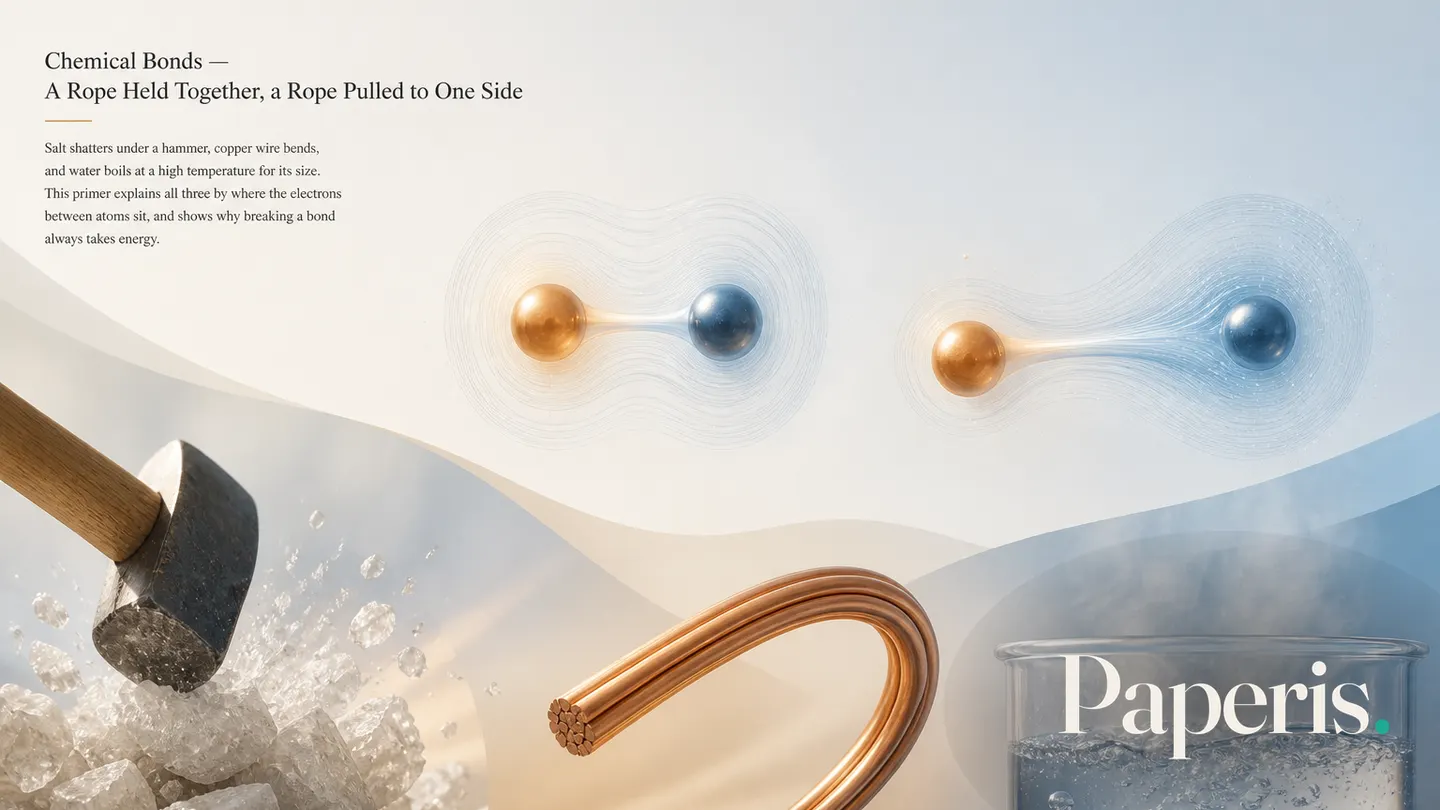
Chemical Bonds — A Rope Held Together, a Rope Pulled to One Side
What holds atoms together is their outermost electrons. Handing electrons over makes ions that attract, sharing them makes a covalent bond, and in metals the electrons roam the whole piece. The bonds inside a molecule and the attractions between molecules are different forces.
Your field's papers, as audio
Pick your fields and journals — Paperis summarizes the key papers and turns them into audio. Listen on your commute.
Start Paperis free →Chemical Bonds — A Rope Held Together, a Rope Pulled to One Side
Salt, Water, and Copper Wire
Three things sit side by side on a dining table: a pinch of salt, a cup of water, and a strip of stripped copper wire. Salt grains are solid, but smash them with a hammer and they shatter. Water is a flowing liquid, and at normal atmospheric pressure, it boils when it hits 100 degrees. Copper wire does not break when you bend it by hand, and it conducts electricity well.
All three are made of particles too small to see, stuck together. This article follows in turn what holds those particles together, how the binding method differs among the three, and why that difference reveals itself as shatterable salt and bendable copper.
As our guide, we take a tug-of-war. Two teams face each other and pull on a single rope. If their strengths are similar, the rope stays in the middle; if one side is stronger, the rope is pulled toward it; and if the difference in strength is very large, the rope crosses over entirely to one side. These three scenes will later become the three faces of bonding.
The Furthest-Out Electron Does the Gluing
All matter is made of atoms. An atom is a particle made of a small nucleus and electrons around it.
The nucleus is a tiny lump right in the middle of the atom, holding almost all the atom's mass. The nucleus carries a positive (+) electrical charge (OpenStax Chemistry 2e 8.1). Electrons are very light particles carrying a negative (−) electrical charge, sitting in the wide empty space around the nucleus. The setup of an atom itself is covered by "Atoms and Radiation — A Drizzle That Never Stops, a Rain Gauge for How Wet We Get".
Opposite electrical charges pull on each other (OpenStax Chemistry 2e 2.6). Like charges push apart, so if two positively charged nuclei get too close, they push each other away (OpenStax Chemistry 2e 7.2). Gluing atoms together is also this electrical pull (OpenStax Chemistry 2e 2.6).
A chemical bond is a pull that holds atoms or ions stuck to one another. What creates that pull is the electron sitting on the very outside of the atom (OpenStax Chemistry 2e 7.1). An atom's electrons sit in layers around the nucleus (OpenStax Chemistry 2e 7.1), and the outermost electron is the electron in the furthest layer from the atom's center, also called a valence electron. Passing or sharing this outermost electron between atoms creates the two types of bonds we will see next (OpenStax Chemistry 2e 7.3).
A molecule is a particle where two or more atoms are tightly bound by chemical bonds and move as a single lump. A drop of water is an uncountable collection of such water molecules. In terms of a tug-of-war, the rope is the outermost electron, and the force with which the teams pull the rope is how strongly the nuclei pull on the electrons.
Passed Over and Drawn In: Salt
The ingredients of salt are sodium and chlorine. Sodium is a metal that reacts violently when it touches water. Chlorine is a toxic gas. When these two ingredients play tug-of-war, the chlorine side pulls away one of sodium's outer electrons entirely. The result of that tie-up is the white salt that comes to the dinner table (OpenStax Chemistry 2e 7.1).
Only a single electron has moved over, but the two atoms now carry an electric charge (OpenStax Chemistry 2e 2.6). An ion is an atom or a group of atoms that has become electrically charged by losing or gaining electrons.
Ions are divided into two groups depending on the charge they carry. A cation is an ion that has lost electrons and carries a positive (+) charge. An anion is an ion that has gained electrons and carries a negative (−) charge. Sodium becomes a cation, and chlorine becomes an anion (OpenStax Chemistry 2e 7.1).
The two carrying opposite charges pull on each other. An ionic bond is a bond where cations and anions stick together by pulling on each other with opposite charges. This kind of bond usually forms between a metal atom and a nonmetal atom. This is because many metal atoms easily lose outer electrons, and nonmetal atoms readily accept electrons (OpenStax Chemistry 2e 7.1). What holds the two together after the rope is taken away is their opposite electricity.
Inside a grain of salt, this tug-of-war happens simultaneously in all directions. Because each ion is pulled equally by all surrounding ions of the opposite charge, there is no such thing as an isolated "salt molecule." The symbol written for salt, NaCl, is simply the ratio showing that sodium and chlorine are present in a 1-to-1 proportion (OpenStax Chemistry 2e 7.1).
Because the pull is tangled in all directions, it is hard to pull apart. Unlike ice, which melts at 0 degrees, salt has to reach over 800 degrees to melt (OpenStax Chemistry 2e 2.6). Salt grains are solid, but they tend to break easily (OpenStax Chemistry 2e 7.1). When melted so that the ions can move around, they also conduct electricity (OpenStax Chemistry 2e 7.1).
Holding the Same Rope: Water and Oxygen
Water molecules are made of two hydrogen atoms and one oxygen atom (H₂O). Unlike salt, these three atoms stick firmly together and move as a single unit without entirely giving and taking electrons.
The simplest case is the hydrogen molecule, where two hydrogen atoms stick together. When two hydrogen atoms approach, each one's electrons are pulled by both nuclei, which lowers their energy. If they get too close, the two nuclei repel each other instead, so the two settle at the distance where their energy is lowest (OpenStax Chemistry 2e 7.2). Between the two atoms, two electrons sit together as a pair (OpenStax Chemistry 2e 8.1).
A covalent bond is a bond where two atoms share a pair of electrons, and two nuclei pull on that electron pair together to stick. Covalent bonds are commonly formed between non-metal atoms (OpenStax Chemistry 2e 7.2). The oxygen in water forms one covalent bond with each of the two hydrogens (OpenStax Chemistry 2e 7.3), and the oxygen in the air we breathe is also a molecule where two oxygen atoms are bound (O₂) (OpenStax Chemistry 2e 2.4). In tug-of-war terms, this is when two teams hold onto a single rope together and do not let go.
Here, we often hear that "atoms want eight outer electrons." That statement is based on the octet rule. The octet rule is a rule of thumb that many atoms tend to form bonds until they have eight outer electrons. The oxygen in water also fills up to eight with two covalent bonds. However, hydrogen is an exception to this rule because its outer shell is full with two, and the transition elements—a large group among metals—also do not follow it (OpenStax Chemistry 2e 7.3).
This rule carried exceptions from the start. According to a review revisiting Lewis's ideas, Gilbert Lewis, the chemist who laid the foundation for this idea, also knew of several exceptions and viewed the pairing of electrons in twos as more important than the rule. The same review concludes that while the idea of the electron-pair bond is still used today, the octet rule is considered much less important than was once believed (DOI: 10.1002/jcc.20545).
The reason atoms stick together is the electrical attraction and the energy lowered by that attraction. "Wanting eight" is a translation of that outcome into human desires. One case study interviewed the same students twice: after finishing middle school and in the first year of high school. Properly understanding bonding as electrical attraction in middle school did not prevent less accurate ideas from growing in high school. The authors conclude that teachers' capacity to handle the principles explaining bonding must be developed during preservice and in-service training (DOI: 10.1039/c8rp00110c).
The Force It Takes to Pull Apart
To pull apart two people holding the same rope, someone has to exert force. Bonds are the same, so to break them you must put in energy from the outside, and conversely when the same bond forms again, as much energy comes out as was spent to break it (OpenStax Chemistry 2e 7.2). How strong a bond is is also measured by the energy it takes to break that bond (OpenStax Chemistry 2e 7.5).
Yet the idea that "energy comes out when a bond breaks" is common. The bond of the molecule ATP inside the body, which is called a "high-energy bond" in biology class, is a characteristically confusing spot. When a study gave students multiple-choice questions about ATP splitting upon meeting water, only 26% got it right at first, and after leading them to the correct conclusion with a web survey lasting around 5 minutes, 77% got it right. How many students participated and what kind of students they were are not stated in the abstract (DOI: 10.1333/s00897102318a).
Energy comes out in a reaction when the newly formed bonds are stronger than the broken bonds (OpenStax Chemistry 2e 7.5). The tally of the energy spent on the breaking side and the energy coming out on the forming side is continued by "Chemical Reactions — The Hill to Climb, the Road Traveled Both Ways". The word energy itself is covered by "Energy — Money That Doesn't Shrink When Exchanged, Odd Coins Scattered in Your Pockets".
When the Rope Pulls to One Side
In a molecule called hydrogen chloride (HCl, one hydrogen and one chlorine), the two atoms share a pair of electrons. But those electrons spend more time near the chlorine. As a result, the chlorine side takes on a slight negative charge, and the hydrogen side a slight positive charge (OpenStax Chemistry 2e 7.2).
Electronegativity is a value representing how strongly a bonded atom pulls the electrons in a bond toward itself. Shared electrons lean toward the atom with the greater electronegativity, and the greater the difference between the values of the two atoms, the more they lean. This value is a relative scale from 0 to 4 first assigned by 20th-century chemist Linus Pauling by comparing the energies required to break various bonds, with the largest value being fluorine's 4.0. In general, metals have small values, and nonmetal atoms have large values (OpenStax Chemistry 2e 7.2).
Polarity is the property where electrons lean to one side within a bond or molecule, making one side slightly negative and the other slightly positive. Nonpolarity is the property where electrons are spread evenly or the leans cancel each other out, so neither end carries an independent electrical charge. A hydrogen molecule or a chlorine molecule made of two identical atoms shares electrons equally and is nonpolar (OpenStax Chemistry 2e 7.2).
Shape also determines whether a molecule as a whole is polar. In a water molecule, both bonds between oxygen and hydrogen have electrons leaning toward the oxygen, but because the water molecule has a bent shape, the two leans do not cancel out. Therefore, water is a polar molecule with the oxygen side slightly negative and the hydrogen side slightly positive. Carbon dioxide (CO₂) also has bonds that are each polar, but because it has a straight, linear shape, the two leans cancel each other out, making the molecule as a whole nonpolar (OpenStax Chemistry 2e 7.6).
Now we can place real atom pairs onto three scenes of the tug-of-war. Hydrogen and hydrogen have the same strength, so the rope stays in the middle, and their electronegativity difference is 0. Hydrogen and chlorine have a difference of 0.9, so the rope is pulled toward the chlorine. Sodium and chlorine have a difference of 2.1, so the rope goes entirely over to the chlorine. The rope can rest anywhere from the middle to the end (OpenStax Chemistry 2e 7.2). Covalent bonds and ionic bonds are the two ends of a single continuous strip.
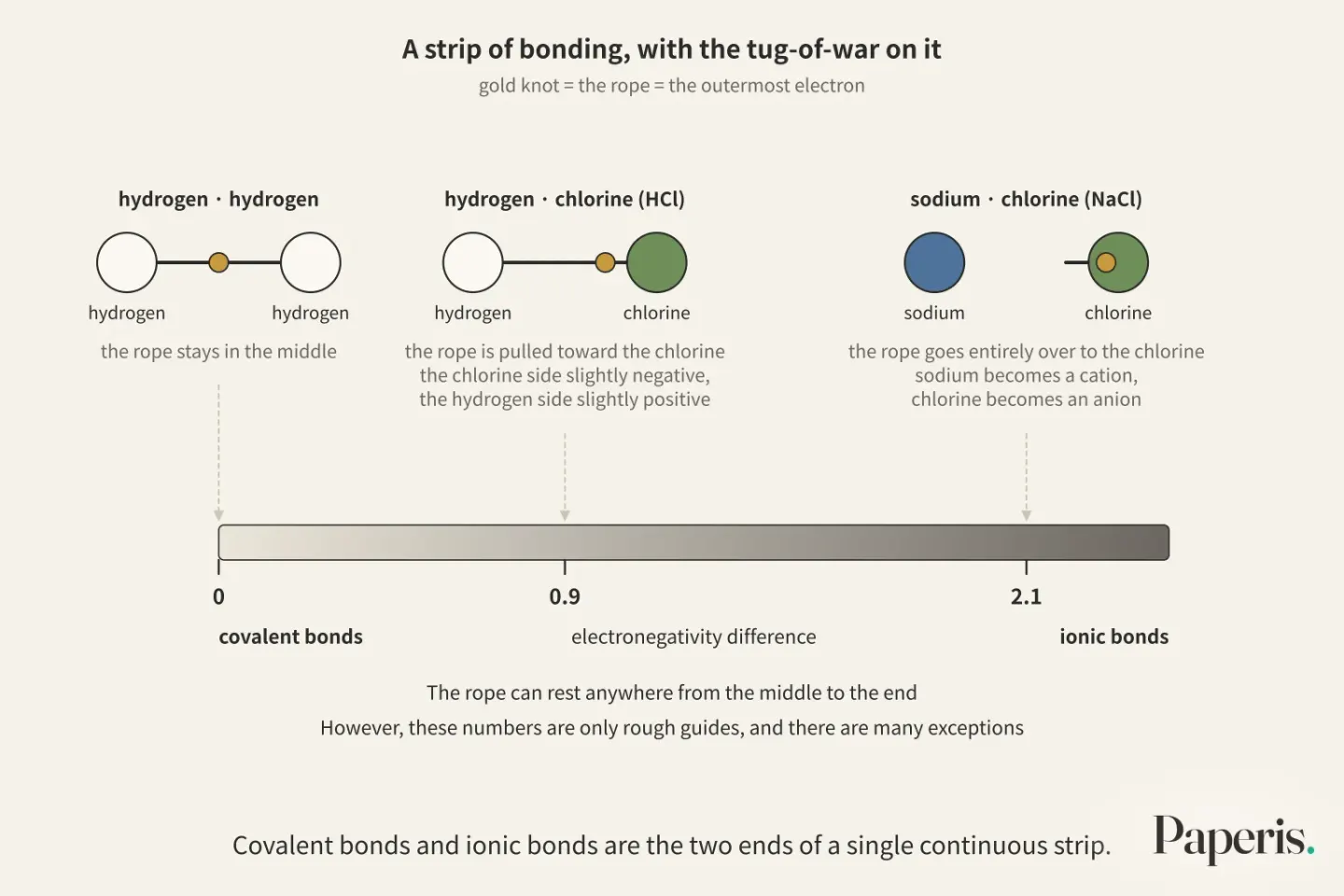
However, these numbers are only rough guides, and there are many exceptions. Which atoms are bonded to each other is a better guide. Nonmetal atoms bonded together are usually covalent bonds, and bonds between metal and nonmetal atoms are commonly ionic bonds (OpenStax Chemistry 2e 7.2).
Bent Copper, Shattered Salt
If you hit a grain of salt with a hammer, it shatters, but if you hit a copper plate, it flattens. Ionic solids are hard, but tend to break rather than bend (OpenStax Chemistry 2e 10.5), whereas metals merely change shape when hammered without breaking. This is because metals are bound together in a different way.
Lumps of metal like copper, aluminum, and iron are often pictured as having electrons that are not tied to any single atom filling the spaces between a neat arrangement of atomic nuclei like a "sea" (OpenStax Chemistry 2e 10.5). We can view this as metal atoms giving up their outer electrons, leaving the remaining positive ions to line up regularly while the detached electrons fill the spaces between them (DOI: 10.1093/hesc/9780198700951.003.0001). Metallic bonding is a bond in which the outer electrons given up by metal atoms do not stay tied to any single atom but wander throughout the whole, binding the electrons and the remaining positive ions together through mutual attraction.
This bond gives rise to the useful properties of metals. All metals conduct heat and electricity well, have a luster, and flatten when hammered. Because they do not break, they are used as materials for building structures (OpenStax Chemistry 2e 10.5). The properties of flattening and stretching long when hammered stem in large part from the orderly arrangement in which identical atoms line up regularly (OpenStax Chemistry 2e 10.6).
The strength of metallic bonding varies greatly from metal to metal. Mercury is liquid at room temperature, and metals in the sodium family melt below 200 degrees, but some metals require temperatures over 1000 degrees to melt (OpenStax Chemistry 2e 10.5). These very properties are also why the copper wire on your table can conduct electricity and bend without snapping.
Inside Molecules and Between Molecules
Water droplets form on the outside of a cold glass on a summer day. Water molecules floating in the air are cooled by the cold glass, held by forces pulling on each other, and become a liquid (OpenStax Chemistry 2e 10.1). This pull is a force different from the covalent bond binding oxygen and hydrogen within a water molecule.
Forces between molecules are forces where molecules pull on each other, distinct from the bonds that tie atoms together inside a molecule. This force also comes from electrical attraction. The degree to which this force fights the movement of particles (temperature) determines whether a substance is a gas, liquid, or solid (OpenStax Chemistry 2e 10.1).
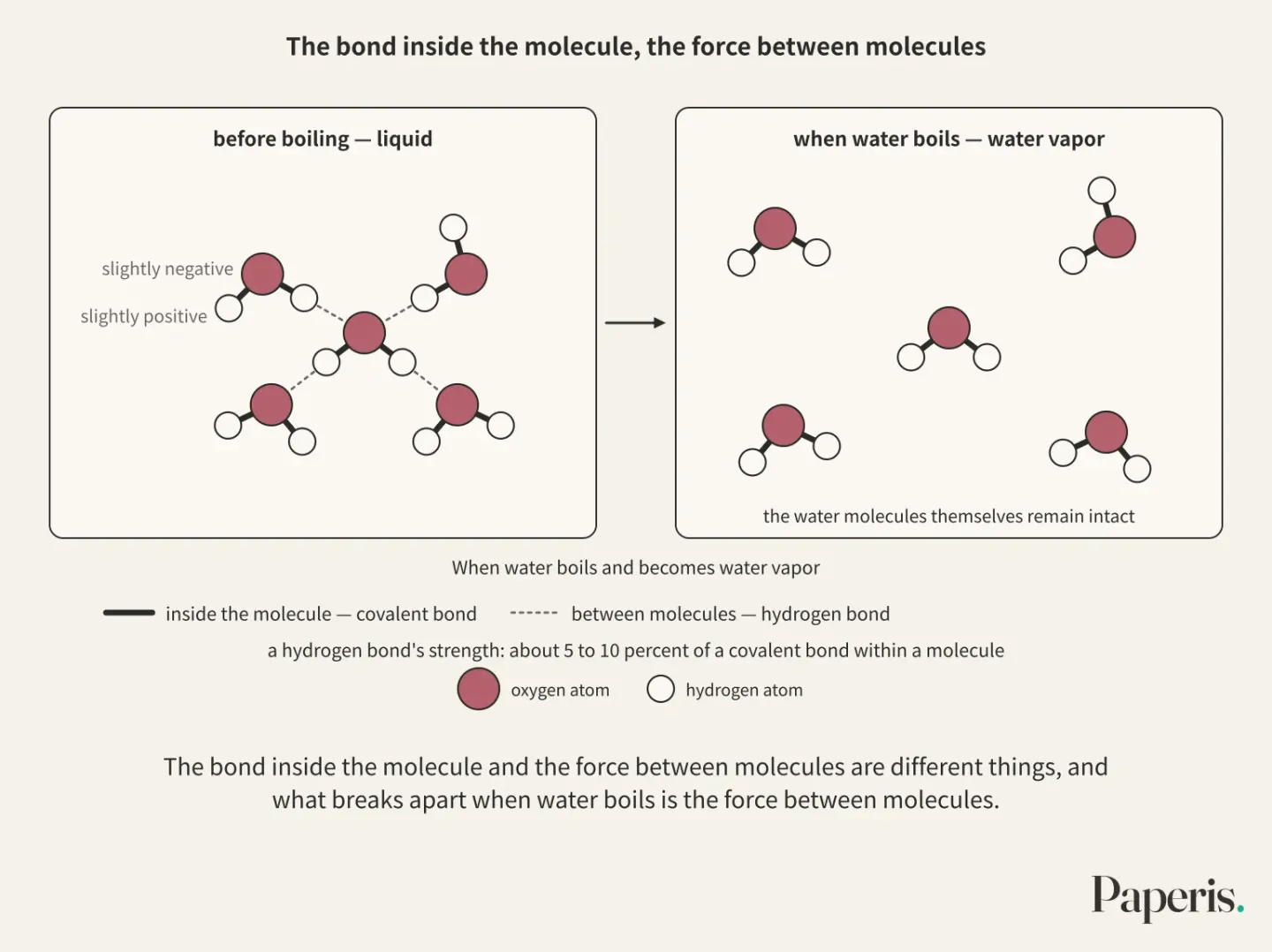
In small molecules, the sizes of the two forces are usually very different. The energy it takes to change hydrogen chloride from a liquid to a gas is about one-twenty-fifth of the energy it takes to break the bonds inside the molecule in the same amount of hydrogen chloride (OpenStax Chemistry 2e 10.1). When water boils and becomes water vapor, what gets pulled apart is the attraction between molecules, and the water molecules themselves remain intact (OpenStax Chemistry 2e 10.1). Why the temperature pauses while boiling is covered by "Heat and Temperature — Water That Only Flows Downhill, a Pump That Lifts It Back Up".
The forces between molecules have different branches. Between polar molecules, the slightly positive end of one molecule and the slightly negative end of a neighboring molecule pull on each other. Even between nonpolar molecules, there is a weak pull created when electrons briefly bunch up on one side, and this pull is stronger the larger and heavier the molecule is (OpenStax Chemistry 2e 10.1). Even among molecules made of two atoms of the same group, fluorine and chlorine are gases at room temperature, while larger bromine is a liquid, and iodine is a solid (OpenStax Chemistry 2e 10.1).
Why Water is Different
Water molecules are very small and light. Molecules with a similar build boil at higher temperatures the heavier they are, and if we fit water into that trend, it should boil around minus 80 degrees (OpenStax Chemistry 2e 10.1). Water on the dinner table boils at 100 degrees (OpenStax Chemistry 2e 2.6). That difference of 100 degrees and minus 80 degrees means that water molecules hold on to each other much more tightly (OpenStax Chemistry 2e 10.1).
That attraction starts at the hydrogen. When hydrogen attaches to an atom with a very high electronegativity like oxygen, nitrogen, or fluorine, the electrons pull strongly toward it, and positive electricity gathers on the small hydrogen side (OpenStax Chemistry 2e 10.1). A hydrogen bond is the force by which hydrogen attached to oxygen, nitrogen, or fluorine is attracted to the oxygen, nitrogen, or fluorine of a neighboring molecule, and it is exceptionally strong among forces between molecules. A single water molecule forms hydrogen bonds with several surrounding water molecules at the same time (OpenStax Chemistry 2e 10.1). In terms of a tug-of-war, because the oxygen team pulls the rope hard, the hydrogen side holding the end of the rope becomes slightly positive and gets pulled by the oxygen of the neighboring team.
A hydrogen bond is not a rope held together by two teams inside a single molecule, but a force of attraction between teams in neighboring molecules; its strength is much weaker, about 5 to 10 percent of a covalent bond within a molecule, but among forces between molecules it is usually much stronger (OpenStax Chemistry 2e 10.1). It is because of these hydrogen bonds that water boils at an unusually high temperature (OpenStax Chemistry 2e 10.1).
If you pour cooking oil into a cup of water, layers form. Water molecules strongly attract each other through hydrogen bonds (OpenStax Chemistry 2e 10.1). For another substance to mix into water, it must wedge itself between these water molecules that are holding onto each other, and energy is required to break apart that attraction (OpenStax Chemistry 2e 11.1). Oil does not mix with water because it is a nonpolar substance with little electron pulling (OpenStax Chemistry 2e 11.3). Polar liquids dissolve polar substances better, and nonpolar liquids dissolve nonpolar substances better (OpenStax Chemistry 2e 7.6). What dissolves, how much, and why will be continued in "Solutions, Acids and Bases — Guests Melting into a Crowded Square, Ushers Who Take the Hats".
Hydrogen bonds also go to work when water freezes. As it freezes, water molecules settle into positions slightly farther apart from one another than when they are liquid, held by hydrogen bonds, which is why ice is less dense than water and floats on it (OpenStax Biology 2e 2.2). Liquid water also has unusual features. Liquid water behaves like an ordinary liquid when hot, but as it cools near room temperature, it behaves increasingly differently from ordinary liquids. One review article summarizes that these properties are connected to the point where water molecules can clearly form up to four hydrogen bonds with neighbors to form various local structures (DOI: 10.1038/ncomms9998). Still, water's unusual properties are not yet fully understood, and a computational study in a pre-peer-reviewed manuscript (preprint) argues that clusters of low-density water molecules with a specific shape explain even why water's density is highest at 4 degrees (DOI: 10.26434/chemrxiv-2022-q5hf7-v2).
Back at the Dining Table
The tug-of-war illustration departs from reality in three ways. First, teams pull to win, but atoms want nothing. Electricity just pulls and energy stays on the lower side. Second, the team that loses the rope scatters, but the sodium ion that gave up its electron is instead pulled toward and sticks to the chlorine ion that took the electron. Third, metal electrons are scattered across the entire lump and shared by everyone, so they cannot be drawn as a single rope held between two teams.
We return to the three substances on the table. Salt is rigid because ions with opposite charges pull each other in all directions, but it shatters when hit with a hammer. Copper is bound by metallic bonds, conducts electricity, and flattens when hammered. Water is a small molecule bound by covalent bonds between oxygen and hydrogen, held together unusually strongly between molecules by hydrogen bonds, which is why it boils only at 100 degrees. The bond inside the molecule and the force between molecules are different things, and what breaks apart when water boils is the force between molecules.
Where to Look Next
The structure of atoms itself is covered in "Atoms and Radiation — A Drizzle That Never Stops, a Rain Gauge for How Wet We Get", and the talk of energy moving in and out when bonds are broken and formed is in "Energy — Money That Doesn't Shrink When Exchanged, Odd Coins Scattered in Your Pockets". Why the temperature stops while water is boiling is followed up in "Heat and Temperature — Water That Only Flows Downhill, a Pump That Lifts It Back Up".
Among the other pieces in this series, how metals and non-metal atoms are split by their properties is covered in "Elements and Molecules — 118 Pieces of Type, Tens of Millions of Words", the event where bonds break and form to create new substances in "Chemical Reactions — The Hill to Climb, the Road Traveled Both Ways", and what it means to melt in "Solutions, Acids and Bases — Guests Melting into a Crowded Square, Ushers Who Take the Hats". Reactions where electrons are transferred, like sodium losing an electron, are continued in "Oxidation and Reduction — A Hand That Catches the Thrown Ball, a Ball Sent the Long Way Around".
How the movement of ions to carry electricity is actually used inside machines continues into "The Battery Cell — A Rocking Chair Between Two Electrodes".
Source Papers
- "Chemistry 2e — 2.4 Chemical Formulas" (2019) — OpenStax Chemistry 2e 2.4 — Hydrogen, oxygen, and nitrogen exist as molecules made of two atoms (H₂·O₂·N₂).
- "Chemistry 2e — 2.6 Ionic and Molecular Compounds" (2019) — OpenStax Chemistry 2e 2.6 — Ionic bonding is the attraction of opposite electrical charges, sodium gives up one electron and chlorine receives one, salt melts at 801 degrees and water boils at 100 degrees.
- "Chemistry 2e — 7.1 Ionic Bonding" (2019) — OpenStax Chemistry 2e 7.1 — Ionic bonding is the attraction between positive and negative ions, positive and negative ions are formed by losing or gaining outer-shell electrons, sodium is a metal that reacts violently with water, chlorine is a toxic gas, and the two combine to form salt, many metals easily lose electrons and nonmetals receive them well, ions are evenly attracted to all surrounding opposite ions so there is no NaCl "molecule", ionic solids are hard yet tend to shatter and conduct electricity when melted.
- "Chemistry 2e — 7.2 Covalent Bonding" (2019) — OpenStax Chemistry 2e 7.2 — When two hydrogens approach, energy decreases, and if they get too close, the atomic nuclei push them apart, energy must be put in to break a bond and the same amount is released when it forms, in HCl electrons are pulled toward chlorine, definition of electronegativity and the Pauling scale (0 to 4, fluorine 4.0), bands from even to not at all for differences of 0, 0.9, and 2.1, the numbers are rough estimates and the type of atom is a better guide.
- "Chemistry 2e — 7.3 Lewis Symbols and Structures" (2019) — OpenStax Chemistry 2e 7.3 — Ionic and covalent bonding involve sharing or handing over outer-shell electrons, the octet rule is the tendency to form bonds until there are eight, hydrogen and transition elements are exceptions, group 16 atoms fill to eight with two covalent bonds.
- "Chemistry 2e — 7.5 Strengths of Ionic and Covalent Bonds" (2019) — OpenStax Chemistry 2e 7.5 — Bond strength is measured by the energy it takes to break it, a reaction becomes heat-releasing when the bonds of the products are stronger than the bonds of the reactants.
- "Chemistry 2e — 7.6 Molecular Structure and Polarity" (2019) — OpenStax Chemistry 2e 7.6 — Water is bent so the pulls of its two bonds do not cancel out, making it polar, CO₂ is straight, making it nonpolar, polar solvents dissolve polar substances better, and nonpolar solvents dissolve nonpolar substances better.
- "Chemistry 2e — 8.1 Valence Bond Theory" (2019) — OpenStax Chemistry 2e 8.1 — Covalent bonds are formed when two positively charged atomic nuclei pull together on an electron pair shared by two atoms.
- "Chemistry 2e — 10.1 Intermolecular Forces" (2019) — OpenStax Chemistry 2e 10.1 — Distinction between forces between molecules and forces within molecules, states are determined by the relative size of intermolecular forces and kinetic energy, intermolecular forces are generally weak in small molecules (HCl about 1/25th), droplets on a cold cup, dispersion forces get stronger as molecules get larger (states of halogens), definition and strength of hydrogen bonding (5 to 10% of a covalent bond), following the trend, water should boil around −80 degrees.
- "Chemistry 2e — 10.5 The Solid State of Matter" (2019) — OpenStax Chemistry 2e 10.5 — Ionic solids tend to break rather than bend, metals are often pictured as atomic nuclei in a "sea" of electrons and show thermal and electrical conductivity, luster, and malleability, with varying melting points (mercury is liquid, alkali metals are below 200 degrees, and some are above 1000 degrees).
- "Chemistry 2e — 10.6 Lattice Structures in Crystalline Solids" (2019) — OpenStax Chemistry 2e 10.6 — The malleability and ductility of metals largely stem from the regular arrangement of identical atoms.
- "Chemistry 2e — 11.3 Solubility" (2019) — OpenStax Chemistry 2e 11.3 — Nonpolar liquids like oil do not mix with water.
- "Biology 2e — 2.2 Water" (2018) — OpenStax Biology 2e 2.2 — When freezing, water molecules form crystals held together by hydrogen bonds and sit farther apart from each other than in liquid, making ice less dense than water so it floats.
- "Chemistry 2e — 11.1 The Dissolution Process" (2019) — OpenStax Chemistry 2e 11.1 — To dissolve, the attractions between solvent molecules must be pulled apart, and that work costs energy.
- "Simple bonding schemes" (2016) — DOI: 10.1093/hesc/9780198700951.003.0001 — Three main types of bonding (covalent, ionic, and metallic), metals can be viewed as a regular array of positive ions that have given up their outer electrons, with a "sea" of electrons filling the spaces between them.
- "Gilbert N. Lewis and the chemical bond: The electron pair and the octet rule from 1916 to the present day" (2006) — DOI: 10.1002/jcc.20545 — The concept of electron pair bonding is still used today, but the octet rule is considered much less important than first believed, Lewis also knew of exceptions and viewed the electron pair (the "rule of two") as more important.
- "The challenges of learning and teaching chemical bonding at different school levels using electrostatic interactions instead of the octet rule as a teaching model" (2018) — DOI: 10.1039/c8rp00110c — A case study interviewing the same students after junior high school and in the first year of high school, concluding that properly learned understanding of electrostatic models did not prevent subsequent less accurate ideas, and that teachers' pedagogical content knowledge must be improved through preservice and in-service training.
- "Continued Misconception Concerning Bond Breaking and Making" (2010) — DOI: 10.1333/s00897102318a — Students frequently misunderstand bond breaking and making and energy (the "high-energy" bond in ATP), correct answers on an ATP hydrolysis question went from 26% to 77% after a 5-minute web survey (sample size and participant count not in the abstract).
- "The structural origin of anomalous properties of liquid water" (2015) — DOI: 10.1038/ncomms9998 — A review stating that as liquid water cools near room temperature, it deviates from normal liquids, and those properties are linked to the ability to clearly form up to four hydrogen bonds to create various local structures.
- "The Shape of Water – how cluster formation provides a unifying explanation of water's anomalous properties" (2022) — DOI: 10.26434/chemrxiv-2022-q5hf7-v2 — A computational chemistry preprint arguing that water's unusual properties are not yet fully understood and that low-density water molecule clusters explain the density maximum at 4 degrees.
Sources (20)
- Chemistry 2e — 2.4 Chemical Formulas
- Chemistry 2e — 2.6 Ionic and Molecular Compounds
- Chemistry 2e — 7.1 Ionic Bonding
- Chemistry 2e — 7.2 Covalent Bonding
- Chemistry 2e — 7.3 Lewis Symbols and Structures
- Chemistry 2e — 7.5 Strengths of Ionic and Covalent Bonds
- Chemistry 2e — 7.6 Molecular Structure and Polarity
- Chemistry 2e — 8.1 Valence Bond Theory
- Chemistry 2e — 10.1 Intermolecular Forces
- Chemistry 2e — 10.5 The Solid State of Matter
- Chemistry 2e — 10.6 Lattice Structures in Crystalline Solids
- Chemistry 2e — 11.3 Solubility
- Biology 2e — 2.2 Water
- Chemistry 2e — 11.1 The Dissolution Process
- Simple bonding schemesDOI 10.1093/hesc/9780198700951.003.0001
- Gilbert N. Lewis and the chemical bond: The electron pair and the octet rule from 1916 to the present dayDOI 10.1002/jcc.20545
- The challenges of learning and teaching chemical bonding at different school levels using electrostatic interactions instead of the octet rule as a teaching modelDOI 10.1039/c8rp00110c
- Continued Misconception Concerning Bond Breaking and MakingDOI 10.1333/s00897102318a
- The structural origin of anomalous properties of liquid waterDOI 10.1038/ncomms9998
- The Shape of Water – how cluster formation provides a unifying explanation of water's anomalous propertiesDOI 10.26434/chemrxiv-2022-q5hf7-v2