Paperis Articles
Solutions, Acids and Bases — Guests Melting into a Crowded Square, Ushers Who Take the Hats
What dissolving means, where sourness comes from, a pH scale that counts in tenfold steps, and how blood holds its pH steady
Your field's papers, as audio
Pick your fields and journals — Paperis summarizes the key papers and turns them into audio. Listen on your commute.
Start Paperis free →Solutions, Acids and Bases — Guests Melting into a Crowded Square, Ushers Who Take the Hats
Where Did a Spoonful of Sugar Go?
A cup of water stirred with a spoonful of sugar soon leaves the white powder invisible. Yet the water remains sweet. Whether you drink from the top of the cup or the bottom, the sweetness is the same. The sugar is still inside the cup, just scattered too finely to be seen.
The kitchen holds other questions, too. Why are lemons and vinegar sour? How does the medicine we take when our stomachs burn soothe that sourness? What does "alkaline," so often seen in advertisements, mean? Starting from the word "dissolve," this article follows in turn the substances that create sourness and their opposites, a scale that measures both with a single number, and the body's mechanisms that keep that number steady.
As our guide, we will use a crowded public square. A cup of water is a square crowded with people. Sugar is a guest who enters the square and disperses among the crowd. Later, we will count how many people wearing red hats and blue hats there are among the crowd in the square, and ushers who accept those hats will also appear.
What It Means to Dissolve
Where did the sugar go when it disappeared from sight? Both sugar and water are made of tiny particles invisible to the eye, so even when they scatter, they remain inside the cup. An atom is a particle made of a small nucleus and electrons surrounding it. The pull that binds atoms together is covered in "Chemical Bonds — A Rope Held Together, a Rope Pulled to One Side".
A molecule is a particle in which two or more atoms are tightly bound by chemical bonds and move as a single mass. A water molecule is made of two hydrogen atoms and one oxygen atom (H₂O). The sugar on a spoon is a solid formed by much larger sugar molecules clumping together (OpenStax Chemistry 2e 11.1).
When that solid breaks down inside the cup, the sugar molecules scatter between the water molecules, taking positions entirely surrounded by water molecules (OpenStax Chemistry 2e 11.1). In terms of a public square, this is like guests mixing into a crowd and standing at the same proportion anywhere in the square.
A solution is a mixture where one substance is evenly dispersed and mixed into another substance at the particle level. The sweetness being the same no matter where you scoop in the cup is because the mixing ratio is uniform everywhere. Even if you leave the cup overnight, the water near the bottom does not become sweeter. This is because dissolved sugar does not settle (OpenStax Chemistry 2e 11.1).
In sugar water, the side doing the dissolving is water, and the side being dissolved is sugar. The solvent is the part of a solution that dissolves and holds another substance, usually the component present in the greatest amount. The solute is the substance that has dissolved into the solvent. In sugar water, water is the solvent and sugar is the solute (OpenStax Chemistry 2e 3.3).
Salt put into soup also becomes invisible. Unlike sugar, salt is not a solid made of molecules. An ion is an atom or group of atoms that has gained or lost electrons and thus carries an electric charge. Salt is a solid formed by positive (+) ions and negative (−) ions pulling on each other, so in water, the ions separate and scatter between the water molecules (OpenStax Chemistry 2e 11.1).
Dissolution is the process by which a solute disperses into a solvent at the particle level to become a solution. If they are a matching pair that dissolves into each other, they dissolve on their own without stirring, and stirring only speeds up the process (OpenStax Chemistry 2e 11.1).
The dissolved sugar remains as it is; it has merely scattered among the water molecules.
Like with Like, Up to a Point
Water and oil soon separate into two layers even when mixed. Water molecules hold onto each other so tightly that oil cannot squeeze in between them (OpenStax Chemistry 2e 11.3).
Water molecules are molecules whose electricity is slightly biased to one side, and molecules with that kind of bias mix well in water. Oil, which has almost no bias, mixes with oil. Chemistry abbreviates this as "like dissolves like" (OpenStax Chemistry 2e 11.3). Where that bias comes from is covered in "Chemical Bonds — A Rope Held Together, a Rope Pulled to One Side".
If they are a dissolving pair, the next question is how much is contained. How sweet a beverage is is determined by the amount of sugar in it (OpenStax Chemistry 2e 3.3). Concentration is a value indicating how much solute is contained in a solution. A solution with little solute is called dilute, and one with a lot is called concentrated (OpenStax Chemistry 2e 3.3). In terms of a public square, it is how many guests are mixed into the crowd.
If sugar continues to be added to that cup from the beginning, from a certain spoonful onwards white powder remains piled at the bottom. There is a limit to the amount of sugar water can hold (OpenStax Chemistry 2e 11.3). A saturated solution is a solution in which the solute is dissolved up to the limit of what can dissolve under those conditions, so that adding more does not dissolve it. Where the limit lies depends mainly on the strength of the force pulling the particles together (OpenStax Chemistry 2e 11.3).
That limit also shifts depending on temperature. Solids like sugar generally dissolve better in warm water, though there are exceptions. Gases go the opposite way. Gases dissolved in water generally dissolve less the warmer it is, and dissolve more the higher the pressing pressure is (OpenStax Chemistry 2e 11.3).
Carbonated beverages are made using those two conditions. Carbon dioxide is dissolved under high pressure and sealed in, but when the cap is opened and the pressure escapes, bubbles rise, and over time the fizz goes flat (OpenStax Chemistry 2e 11.3). Lukewarm soda can hold less gas than a cold one. The same thing happens when river water is warmed, reducing the oxygen dissolved in the water and in severe cases causing fish to die in groups (OpenStax Chemistry 2e 11.3).
The Identity of Sour Taste
Lemons and vinegar are both sour. Sourness has long been a marker for recognizing acids. According to the record of textbooks, as early as 1680 there was a record that acids lose their properties when they touch a substance called an alkali, and in the 18th century it was known that acids produce a sour taste and give off gas when they touch limestone (OpenStax Chemistry 2e 14.1).
The key to that property was hydrogen. In the early 19th century, it was discovered that hydrogen is the core component of acids, and modern chemistry explains acids and bases as the exchange of hydrogen ions (OpenStax Chemistry 2e 14.1). A hydrogen ion is an ion in which a hydrogen atom has lost one electron and acquired a positive (+) electrical charge.
An acid is a substance that gives away hydrogen ions. When an acid dissolves in water, it passes hydrogen ions to water molecules, which is why hydrogen ions in water do not float around alone but are attached to water molecules (OpenStax Chemistry 2e 14.1). To put it in terms of a public square, an acid is a guest who enters the square and hands out red hats, and the red hats are the hydrogen ions.
Now for the opposite side. In chemistry, a base is a substance that takes away hydrogen ions, which is different from the bases of DNA. The alkali mentioned earlier was a term referring to bases. Acids and bases are thus defined as the side that gives away hydrogen ions and the side that receives them, and the meeting of an acid and a base is the crossing of hydrogen ions from the acid to the base (OpenStax Chemistry 2e 14.1).
A hydroxide ion is an ion (OH⁻) bound by one oxygen atom and one hydrogen atom, carrying a negative (−) electrical charge. Among common bases, many directly release hydroxide ions when dissolved in water. Sodium hydroxide, known as lye, is such a base (OpenStax Chemistry 2e 4.2). Hydroxide ions accept hydrogen ions to become water molecules (OpenStax Chemistry 2e 14.1). Kitchen baking soda (sodium bicarbonate) is also a base (OpenStax Chemistry 2e 4.2). To put it in terms of the square, a hydroxide ion is a blue hat, and a base is a guest who collects red hats or releases blue hats.
Not all acids give out hats to the same degree. Hydrogen chloride (HCl), a component of stomach acid, has almost all of its molecules give up hydrogen ions when dissolved in water. Acetic acid, which is the main component of vinegar, and the acid that plays a part in creating the tart taste of tangerines and lemons, have only some of their dissolved molecules give up hydrogen ions, while most remain just as they were at first (OpenStax Chemistry 2e 4.2). A strong acid is an acid in which almost all molecules dissolved in water give up hydrogen ions, and a weak acid is an acid in which only some of them do. Weak acids are common in nature and far more numerous than strong acids, and common strong acids are few in number. Bases also have strength, and lye—which splits apart almost completely to release hydroxide ions when dissolved in water—is a strong base (OpenStax Chemistry 2e 4.2).
Strong and weak are different terms from concentrated and dilute. When dissolved at the same concentration, a stronger acid releases more hydrogen ions (OpenStax Chemistry 2e 14.3). Strength and weakness refer to how many of the dissolved molecules release hydrogen ions, while concentration refers to how much has been dissolved.
Pure water also contains a very tiny amount of both hats. Water molecules exchange hydrogen ions with one another, so that one side becomes a water molecule with a hydrogen ion attached and the other side becomes a hydroxide ion. In pure water at 25 degrees Celsius, such split molecules number about 2 out of every 1 billion water molecules (OpenStax Chemistry 2e 14.1). Water is a substance that can either give up or receive hydrogen ions (OpenStax Chemistry 2e 14.1).
pH, A Scale That Counts Backwards
Even though rainwater looks clean, it is slightly more acidic than pure water. Because carbon dioxide in the air dissolves in rainwater to become carbonic acid, normal rainwater has a pH between 5 and 6 (OpenStax Chemistry 2e 14.2).
pH is a scale that indicates whether something dissolved in water is on the acidic side or the basic side, with smaller numbers meaning more acidic and larger numbers meaning more basic. What this scale measures is the concentration of hydrogen ions in the solution (OpenStax Chemistry 2e 14.2). To put it in terms of a public square, it is a number that records how common red hats are among the crowd.
Neutrality is a state where hydrogen ions and hydroxide ions are present in equal amounts, and at 25 degrees Celsius, it is pH 7. At 25 degrees, if hydrogen ions are more numerous than hydroxide ions, it is acidic so the pH is less than 7, and if fewer, it is basic so it is greater than 7. The neutral number varies slightly depending on temperature, and unless stated otherwise, pH is recorded based on 25 degrees (OpenStax Chemistry 2e 14.2).
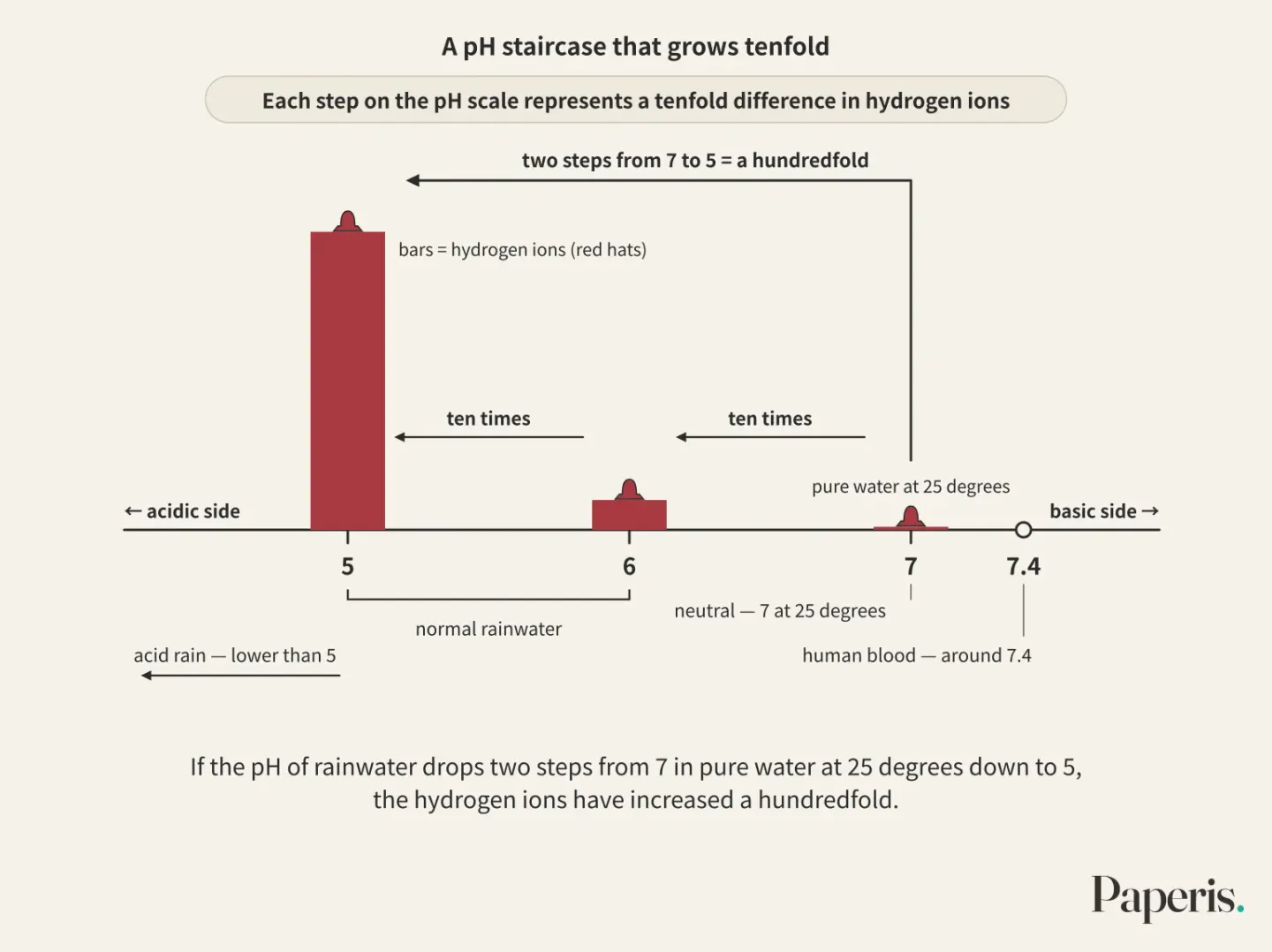
Each step on the pH scale represents a tenfold difference in hydrogen ions. Water with a pH of 6 contains ten times as many hydrogen ions at 25 degrees as pure water with a pH of 7, and water with a pH of 5 contains a hundred times as many (OpenStax Chemistry 2e 14.2). If the pH of rainwater drops two steps from 7 in pure water at 25 degrees down to 5, the hydrogen ions have increased a hundredfold.
The reason the numbers go backward is that pH does not record the concentration as it is. The hydrogen ion concentration of pure water is a tiny value where the first non-zero digit only appears at the seventh decimal place, and pH roughly records that decimal place (OpenStax Chemistry 2e 14.2). When hydrogen ions become ten times more abundant, that number moves forward by one place, so the pH becomes smaller by one step.
The symbol pH was first used in 1909 by Danish biochemist S.P.L. Sörensen to mean "potential of hydrogen," and in the 10 to 20 years that followed, it spread widely into physiology, biochemistry, medical research, and industrial chemistry (DOI: 10.1007/s10698-025-09532-6).
A few points on the scale are as follows. Acid rain is rain with a pH lower than 5, where sulfur and nitrogen compounds in the air have dissolved to create not just carbonic acid, but also sulfuric acid and nitric acid (OpenStax Chemistry 2e 14.2). Human blood is around pH 7.4, which is slightly on the basic side of 7, the neutrality point at 25 degrees (OpenStax Chemistry 2e 14.6).
pH is a stumbling block for students learning it as well. In a study surveying a high school 11th-grade science class, the rates of misconception for questions asking about the degree of acidity (pH) and for identifying strong acids were each 79%, the highest among the surveyed items (DOI: 10.29303/jppipa.v8i4.2092).
They Erase Each Other Upon Meeting
When you squeeze lemon juice or vinegar onto grilled fish, the fishy smell is reduced. This is because the odor-causing compounds in the fish flesh are bases, and the acids in the lemon juice and vinegar react with them to turn them into substances that do not easily evaporate (OpenStax Chemistry 2e 4.2).
Neutralization is when an acid and a base meet, and the base accepts the hydrogen ions given up by the acid, erasing each other's properties. The event we saw earlier where “acids lose their properties when touching alkalis” is precisely this (OpenStax Chemistry 2e 14.1). When acids and bases meet, water is often produced along with salts, which are substances in the same family as table salt (OpenStax Chemistry 2e 4.2). In terms of a public square, if a red hat and a blue hat meet and combine into one, they become an ordinary person in the square, namely a water molecule. However, not all neutralization looks like this. Some bases directly accept the red hat, like the odor-causing compounds in fish (OpenStax Chemistry 2e 4.2).
Antacids used when you have heartburn also perform neutralization. Antacids are bases that neutralize stomach acid (OpenStax Chemistry 2e 4.2).
Neutralization also happens in the kitchen. Baking soda meets acids like lemon juice in the dough to create carbon dioxide bubbles, and those bubbles make the dough rise (OpenStax Chemistry 2e 4.2).
It is also difficult to divide acids as dangerous and bases as mild. The acids in vinegar and lemon are weak acids used in food, and there is a strong acid inside the stomach. On the base side, there are strong bases like lye (OpenStax Chemistry 2e 4.2). Inside the body, trouble arises if it tilts toward either side. The pH of blood normally shifts by less than 0.1, but if it changes by 0.4 or more, life can be in danger (OpenStax Chemistry 2e 14.6). Danger is not determined solely by whether something is an acid or a base; how strong it is and how far it tilts decide it together.
Solutions That Hold Their Ground
When you run up the stairs, an acid called lactic acid is produced in your leg muscles and flows into your blood. Your blood has a mechanism to take in acid that enters this way, so the blood's pH stays within a narrow range as we saw earlier (OpenStax Chemistry 2e 14.6).
A buffer solution is a solution that holds its ground so that the pH hardly changes even if a little acid or base enters. Inside it, a side to donate hydrogen ions and a side to accept them are paired up in generous amounts. When acid enters, the accepting side steps up, and when base enters, the donating side steps up, turning what entered into a much weaker acid or base. That pair can be formed from the weak acid side or the weak base side (OpenStax Chemistry 2e 14.6).
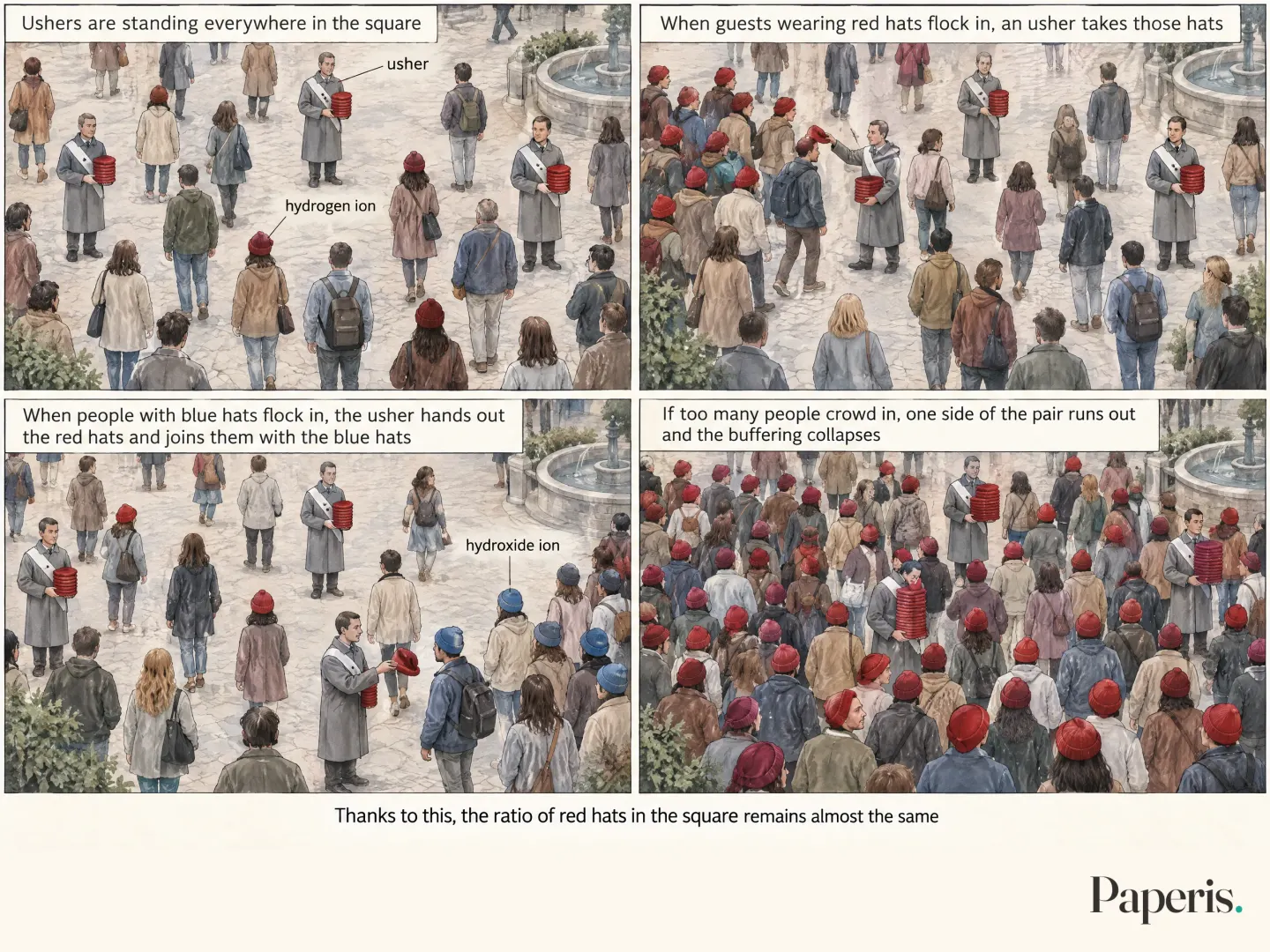
To put it in terms of a public square, ushers are standing everywhere. When guests wearing red hats flock in, an usher takes those hats, and when people with blue hats flock in, the usher hands out the red hats they were holding and joins them with the blue hats. Thanks to this, the ratio of red hats in the square—in other words, the pH—remains almost the same. There is a limit to the number of ushers. If too many people crowd in, one side of the pair runs out and the buffering collapses (OpenStax Chemistry 2e 14.6).
Blood is such a buffer solution, and its main pair is carbonic acid and bicarbonate ions. The lactic acid produced when climbing stairs is taken in by the bicarbonate ions in the blood (OpenStax Chemistry 2e 14.6). Buffering is the first line of defense, and behind it, the lungs and kidneys expel acid out of the body (PMID 11345941). That story is continued by "The Balance of Acid and Base — Two Hands on a Seesaw, the Quick Lungs and the Slow Kidneys".
Does an Alkaline Diet Change Your Blood?
Advertisements for diets and water that "turn your body alkaline" are common. There are no reviews covering commercial "alkaline ionized water" itself in the basis of this article. Below are reviews covering diets, bicarbonate mineral water, and acid-base treatments.
A 2011 review examining the claim that milk makes the body acidic summarizes that an alkaline diet changes the pH of urine but not the whole-body pH, and that whole-body pH is not affected by diet. It also notes that even if urine comes out acidic, it does not mean the body has tilted toward acidity or that there is a health problem. This review considers that the amount of acid the kidneys excrete does not have an important effect on calcium metabolism, and that dietary phosphate also does not have a bad effect on calcium metabolism, noting that the latter contradicts the so-called acid-ash hypothesis (PMID 22081694).
According to this review's summary, the pH of blood does not move significantly through diet.
The water-side evidence comes from a 2025 narrative review covering mineral water containing more than 1,300 milligrams of bicarbonate per liter. This review starts from the premise that acid-base balance is heavily influenced by diet and that Western diets create excess acid. It summarizes that the water raises urine pH, greatly reduces the acid excreted by the kidneys, stabilizes pH in the blood, and increases bicarbonate ions to raise the whole-body buffering capacity. Regarding kidney stones, citing results where the excretion of stone-related components—including magnesium and citrate, which prevent stones along with calcium and oxalate—decreased and was linked to a lowered stone risk, and regarding bones, citing results where a marker showing the extent of bone resorption decreased, it views it as "promising" while noting that stricter and larger studies are needed to recommend it for the long term (PMID 40732916). The two reviews differ from the start on the premise of whether diet governs the body's acid-base balance, and their conclusions on bones also diverge.
A 2012 review examining both medical papers and popular books concludes that an alkaline diet "may" be worth considering for reducing illness and death from chronic diseases, while adding that more research is needed (PMID 22013455). Both reviews discussing whether it benefits the body conclude that more research is needed.
Claims also circulate on the internet that baking soda, lemon juice, and apple cider vinegar cure everything from cancer to COVID-19. A 2021 review views these claims as baseless. The same review notes that the very act of regulating the body's acid-base balance is the basis for treatments approved by the U.S. Food and Administration for constipation, epilepsy, metabolic acidosis, and stomach ulcers, and notes that some of the treatments covered in this review actually administer baking soda (sodium bicarbonate) (PMID 33039418). What this review talks about is the treatment of specific diseases, and it is not evidence supporting panacea claims.
Back to the Square
The square metaphor diverges from reality in two places. First, a square stops accepting guests when all the empty seats are filled, but the limit a solution can hold is not determined by empty seats. That limit is mainly determined by the strength of the attractive forces between particles, and it also shifts depending on temperature and pressure (OpenStax Chemistry 2e 11.3). Second, the usher deliberately steps forward to take a hat, but the molecules in a buffer solution have no intentions. Accepting or releasing hydrogen ions happens according to the properties of that substance.
Let us recall a cup of sugar water once more. The sugar is scattered between water molecules and remains as it is, and when lemon juice enters that cup, hydrogen ions increase and the pH drops. What is dissolved remains scattered as it is, acids and bases give and take hydrogen ions, and the pH is a scale that counts those hydrogen ions by tens.
Where to Read Next
How the body defends the pH of blood using the lungs and kidneys is covered next in "The Balance of Acid and Base — Two Hands on a Seesaw, the Quick Lungs and the Slow Kidneys". The path of how food is broken down in the body continues in "How Does Digestion Work? — A Tube Through the Body, and a Wall Only Small Pieces Can Cross". Atoms and electrons, which are the foundation of ions, are covered in "Atoms and Radiation — A Drizzle That Never Stops, a Rain Gauge for How Wet We Get", while the very concept of temperature is covered in "Heat and Temperature — Water That Only Flows Downhill, a Pump That Lifts It Back Up".
Other parts of this series continue as well. Why the electricity of a water molecule is tilted to one side is covered in "Chemical Bonds — A Rope Held Together, a Rope Pulled to One Side", and the foundation of the words elements and molecules is covered in "Elements and Molecules — 118 Pieces of Type, Tens of Millions of Words". How fast reactions occur is covered in "Chemical Reactions — The Hill to Climb, the Road Traveled Both Ways", and another pair that exchanges electrons is covered in "Oxidation and Reduction — A Hand That Catches the Thrown Ball, a Ball Sent the Long Way Around".
Source Papers
- "Chemistry 2e — 11.1 The Dissolution Process" (2019) — OpenStax Chemistry 2e 11.1 — A solution is a homogeneous mixture where components are dispersed at the molecular level and surrounded by solvent, and it does not settle out; sugar is a solid made of sugar molecules, ionic compounds break apart into ions as they dissolve; air is also a solution, and solutions can form spontaneously with stirring only speeding up the process.
- "Chemistry 2e — 3.3 Molarity" (2019) — OpenStax Chemistry 2e 3.3 — Concentration is the relative amount of solution components, the solvent is the medium in which other components are dispersed and usually the most abundant component, the solute is the less abundant component, dilute versus concentrated, and the sweetness of a beverage is determined by the amount of sugar.
- "Chemistry 2e — 11.3 Solubility" (2019) — OpenStax Chemistry 2e 11.3 — The limit of what can dissolve and a saturated solution, with the limit primarily determined by the strength of attraction between solute and solvent; gases dissolve less as they get warmer and more at higher pressures, leading to reduced oxygen in warmed river water and mass fish die-offs, as well as the bubbles and loss of fizz in carbonated drinks; "like dissolves like", water and oil do not mix, and solids generally dissolve more as they get warmer (with exceptions).
- "Chemistry 2e — 14.1 Brønsted-Lowry Acids and Bases" (2019) — OpenStax Chemistry 2e 14.1 — Records of acid properties from 1680 and the 18th century (losing properties when touching alkalis, sour taste, limestone), hydrogen as the core component of acids, acids as substances that donate hydrogen ions and bases as those that accept them, hydrogen ions in water attaching to water molecules, water being able to both donate and accept, and 25-degree pure water having roughly 2 out of 1 billion molecules ionized.
- "Chemistry 2e — 4.2 Classifying Chemical Reactions" (2019) — OpenStax Chemistry 2e 4.2 — Hydrogen chloride is a strong acid that ionizes nearly 100%, there are only a few common strong acids with weak acids being far more numerous, acids playing a part in citrus flavor and vinegar's acetic acid being weak acids, strong bases like sodium hydroxide (lye), baking soda being a base, the products of neutralization commonly being salt and water, stomach acid and heartburn and antacids, baking soda and dough, and the neutralization of lemon or vinegar sprinkled on fish.
- "Chemistry 2e — 14.3 Relative Strengths of Acids and Bases" (2019) — OpenStax Chemistry 2e 14.3 — Acid strength is the degree of ionization in water, and at the same concentration, a strong acid yields more hydrogen ions.
- "Chemistry 2e — 14.2 pH and pOH" (2019) — OpenStax Chemistry 2e 14.2 — The definitions of neutral, acidic, and basic, the relationship between pH and hydrogen ion concentration, a neutral pH of 7 at 25 degrees which varies with temperature, and typical rainwater pH of 5 to 6 and the cause of acid rain (below 5).
- "Chemistry 2e — 14.6 Buffers" (2019) — OpenStax Chemistry 2e 14.6 — A buffer solution consists of a weak acid-base conjugate pair (a weak acid or weak base and its conjugate) that resists pH changes against small amounts of acid or base up to a limit, the primary buffer pair in blood is carbonic acid and bicarbonate ion, blood pH is roughly 7.4 with normal fluctuations under 0.1 and changes of 0.4 or more potentially fatal, and lactic acid during exercise is neutralized by bicarbonate ions.
- "S.P.L. Sørensen, the pH concept and its early history" (2025) — DOI: 10.1007/s10698-025-09532-6 — pH was introduced in 1909 by Danish biochemist Sørensen as a symbol for the "hydrogen ion exponent," and 10 to 20 years later it was widely accepted in physiology, biochemistry, medical research, and industrial chemistry.
- "Effectiveness of Cognitive Conflict-Based Chemistry Learning in Reducing Students' Misconceptions of Acid-Base Materials" (2022) — DOI: 10.29303/jppipa.v8i4.2092 — A single-group pre-post comparison of one 11th-grade science class where misconceptions about the degree of acidity (pH) and strong acid identification items were highest at 79% each, and after cognitive conflict instruction, misconceptions decreased from 53.95% to 15.49% (country not specified in the abstract).
- "Acid-base physiology." (2001) — PMID 11345941 — Intracellular and extracellular buffering is the first line of defense against acid-alkali loads, and the lungs (volatile acids) and kidneys (fixed acids) excrete acids.
- "Milk and acid-base balance: proposed hypothesis versus scientific evidence." (2011) — PMID 22081694 — Milk does not produce acid in metabolism, whole-body pH is not affected by diet, an alkaline diet only changes urine pH, acidic urine does not imply metabolic acidosis or health abnormalities, net acid excretion is not a major influence on calcium metabolism and runs counter to the acid-ash hypothesis.
- "Hydration Meets Regulation: Insights into Bicarbonate Mineral Water and Acid-Base Balance." (2025) — PMID 40732916 — Assuming excess acid in the Western diet, a narrative review stating that mineral water with over 1300 mg/L of bicarbonate raises urine pH, reduces net acid excretion, stabilizes blood pH, and increases bicarbonate ions, and citing reduced excretion of stone-related components (including inhibitors), lower stone risk, and decreased bone resorption markers as promising, though long-term recommendations require more rigorous research.
- "The alkaline diet: is there evidence that an alkaline pH diet benefits health?" (2012) — PMID 22013455 — A review examining both PubMed and popular books, concluding that an alkaline diet may be worth considering for reducing morbidity and mortality from chronic diseases and that additional research is needed.
- "The therapeutic importance of acid-base balance." (2021) — PMID 33039418 — Claims that baking soda, lemon juice, and apple cider vinegar are a cure-all lack evidence, but the regulation of acid-base balance is the foundation of FDA-approved treatments for constipation, epilepsy, metabolic acidosis, and peptic ulcers, and several of the correction methods for imbalance covered in this review involve sodium bicarbonate administration.
Sources (15)
- Chemistry 2e — 11.1 The Dissolution Process
- Chemistry 2e — 3.3 Molarity
- Chemistry 2e — 11.3 Solubility
- Chemistry 2e — 14.1 Brønsted-Lowry Acids and Bases
- Chemistry 2e — 4.2 Classifying Chemical Reactions
- Chemistry 2e — 14.3 Relative Strengths of Acids and Bases
- Chemistry 2e — 14.2 pH and pOH
- Chemistry 2e — 14.6 Buffers
- S.P.L. Sørensen, the pH concept and its early historyDOI 10.1007/s10698-025-09532-6
- Effectiveness of Cognitive Conflict-Based Chemistry Learning in Reducing Students' Misconceptions of Acid-Base MaterialsDOI 10.29303/jppipa.v8i4.2092
- Acid-base physiologyPMID 11345941
- Milk and acid-base balance: proposed hypothesis versus scientific evidencePMID 22081694
- Hydration Meets Regulation: Insights into Bicarbonate Mineral Water and Acid-Base BalancePMID 40732916
- The alkaline diet: is there evidence that an alkaline pH diet benefits health?PMID 22013455
- The therapeutic importance of acid-base balancePMID 33039418