
Paperis Articles
What Is Society? — A Path Worn by Many Feet, and the Steps That Choose It
Even choices that feel entirely our own, like a college application, form patterns when many are put together. Norms, status and role, institutions, socialization, and the power people have to change those frameworks.
Your field's papers, as audio
Pick your fields and journals — Paperis summarizes the key papers and turns them into audio. Listen on your commute.
Start Paperis free →What Is Society? — A Path Worn by Many Feet, and the Steps That Choose It
Nineteen-Year-Old College Applications
In the winter of their third year of high school, a student fills out college applications. They thought long and hard about which school and department to apply to, and the person who wrote their name at the end was themselves. Since nobody chose it for them, this matter appears to be entirely the student's choice.
If we change the question slightly, something else becomes visible. Why nineteen years old of all ages? Why are many among the students in the same class filling out applications that same winter? Things that are invisible when looking at just one person emerge like a pattern when we place many people of the same age in the same year side by side.
This article deals with how to read that pattern. The examples are mainly taken from South Korea, and the concepts apply in any country.
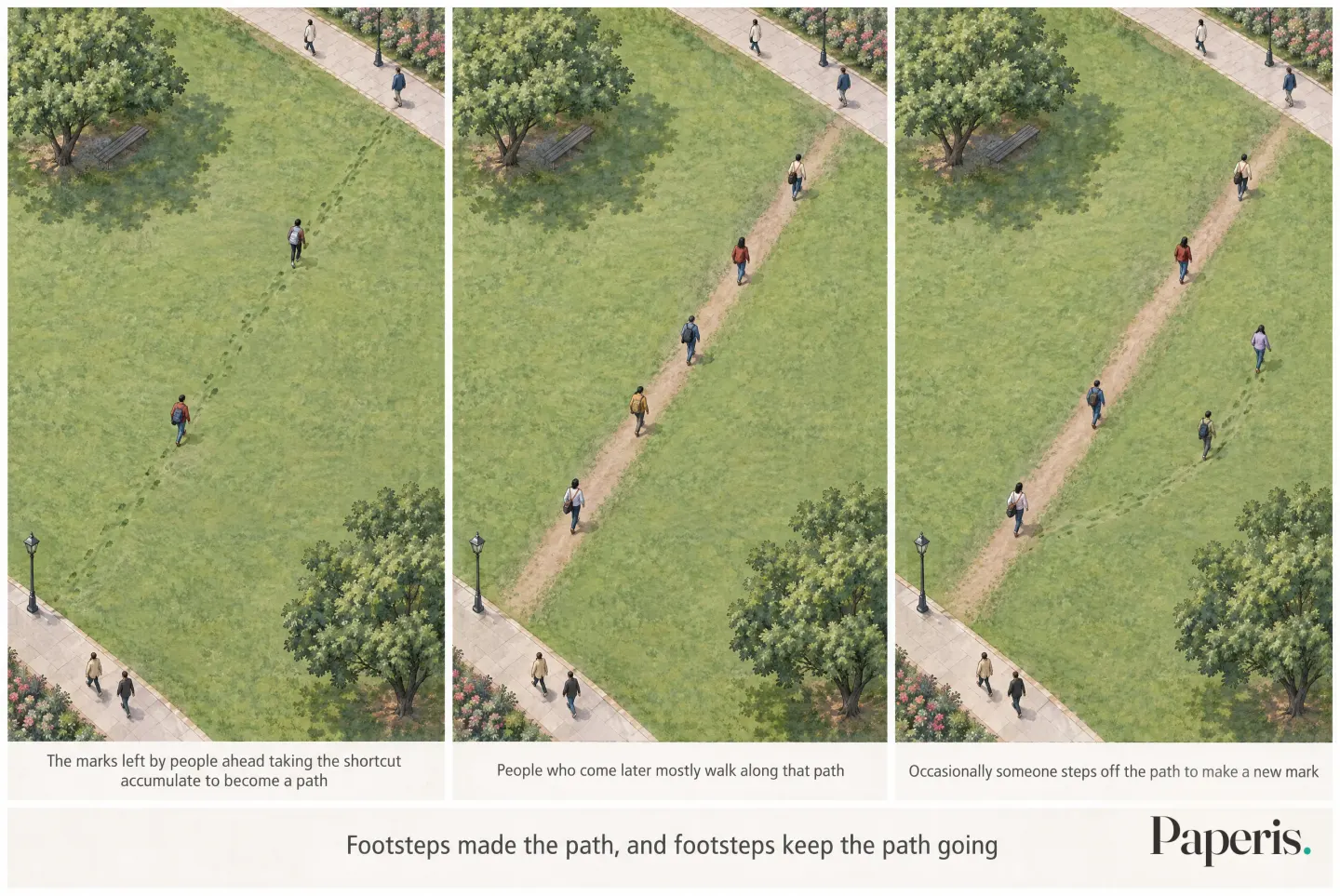
We use a single picture as a guide. It is the appearance of a dirt path running across a park lawn. No one paved that path. The marks left by people ahead stepping and passing as a shortcut accumulated to become a path, and people who come later mostly walk along that path. Even so, each person walking walks on their own two feet, and occasionally steps off the path to make a new mark. This article follows that path and those footsteps together.
A Pattern Stamped on One Person's Affairs
If you look at a single application, you see one student's worries. If you spread out many applications written in the same year all at once, you see where those worries bunch up and where spaces are left empty. If the former is a footstep, the latter is a path worn into a lawn.
Let us first settle the term that corresponds to the lawn in this article. Society is a group of people who live in a defined area, interact with one another, and share a common culture. Sociology is the systematic study of human groups and their interactions, ranging from small groups to entire nations. In terms of applications, sociology looks less at a single sheet and more at the shapes that repeat across the pile (OpenStax Introduction Sociology 3e 1.1).
The American sociologist C. Wright Mills started from the observation that people today increasingly feel as though their lives are caught in a trap. Mills's proposal was to figure out whether that trap truly belongs to the person alone, or whether it stems from the forces of a broader society and history (DOI: 10.1002/9781405165518.wbeoss205). Sociological imagination is the ability to connect a person's behavior and experiences to the broader society and history that shaped their choices and thoughts. (OpenStax Introduction Sociology 3e 1.1)
In terms of the lawn, sociological imagination is the act of placing the footstep and the path viewed from above into a single frame. The author of a sociology class report suggests that this perspective is gained less by memorizing definitions and more by repeatedly practicing rewriting one's own life in the language of society (DOI: 10.1177/0092055x0903700404).
Even things that look like individual choices reveal a pattern when many are gathered together, and the eye that reads that pattern is the sociological imagination.
Facts Outside a Single Person
Suicide is often considered the most personal of matters. In his 1897 book, the French sociologist Émile Durkheim asked whether there was a collective pattern to that occurrence. When he gathered a large amount of data on Europeans, he found that Protestants died by suicide at a higher rate than Catholics (OpenStax Introduction Sociology 3e 1.3). Durkheim explained that difference not by psychological causes like a state of mind, but by social causes like differences in religion, and he is considered the first person to separate these two causes in research (OpenStax Introduction Sociology 3e 5.1).
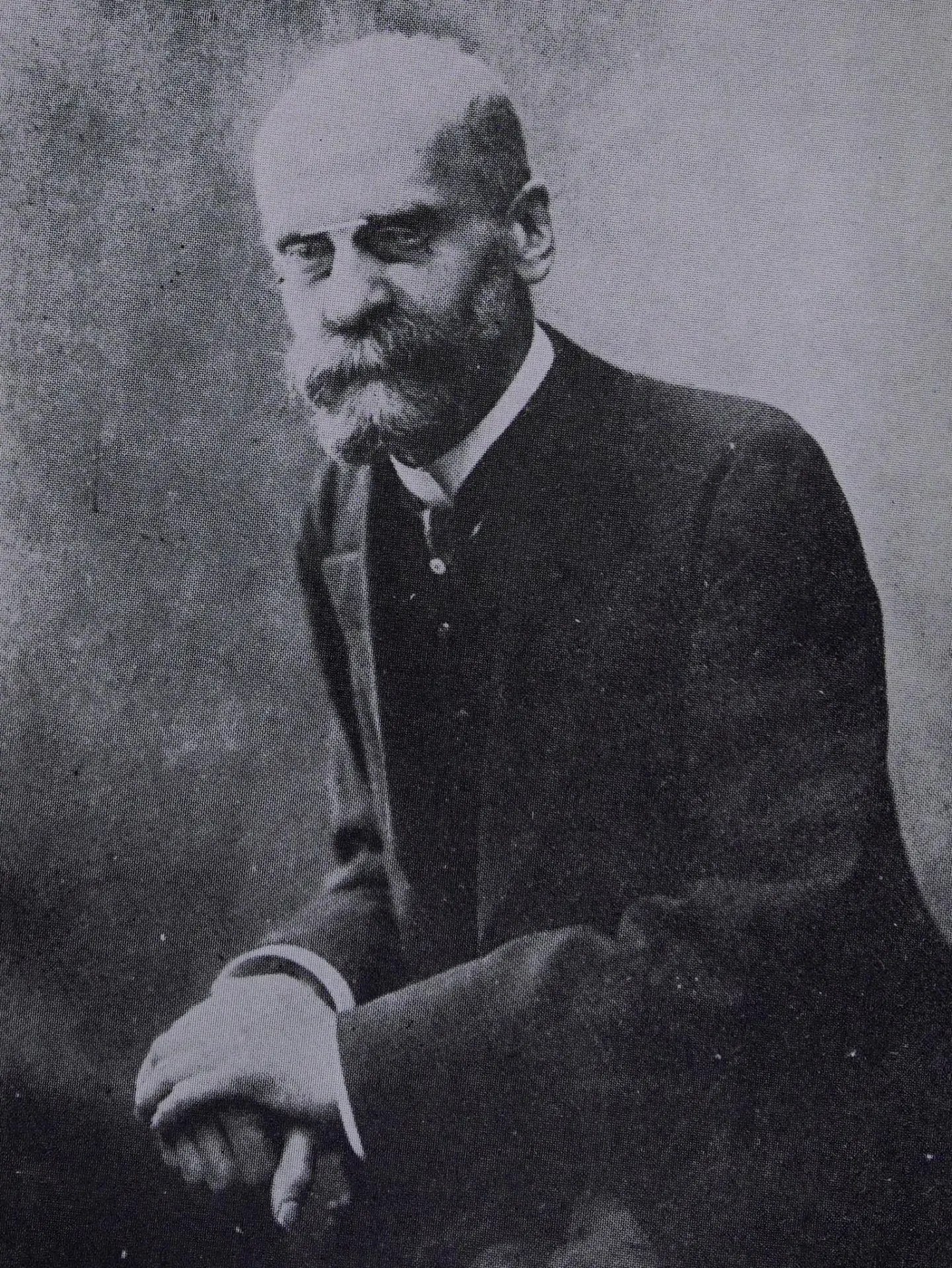
Émile Durkheim · unknown photographer, before 1917 · Wikimedia Commons (public domain)
Durkheim believed that group behavior should be studied separately from the behavior of a single person (OpenStax Introduction Sociology 3e 4.2). A social fact is a rule and power of society that, like laws, morals, customs, and trends, exists outside a single person and guides the lives of many people. Durkheim argued that this power must be treated as something that actually exists outside the individual (OpenStax Introduction Sociology 3e 1.3) (OpenStax Introduction Sociology 3e 4.2).
Clothing shows this power. If people dress while ignoring the customs of their own country and class, they become objects of ridicule and are ostracized, and Durkheim wrote that this has an effect similar to a punishment, however mild (OpenStax Introduction Sociology 3e 4.2). This is one reason why most people dress similarly even though no one sets clothing rules by law.
However, the numbers in this classic work are still debated today. A study that re-examined the data from Prussia, Switzerland, and the Netherlands around the same time as Durkheim found no evidence that suicide was lower among Catholics. That study suggests that the tendency in Catholic areas to record suicides as accidental deaths or deaths of unknown causes may have created the difference, and that this casts doubt on other theories explaining suicide by social causes (DOI: 10.1177/0038038587021003009). Another paper re-reading Durkheim's data argues that it is actually common for suicides to be higher among people whose ties to a group are strong (DOI: 10.2105/ajph.2004.053314). A psychiatric review evaluates that Durkheim's unfounded dismissal of mental illness as a major cause greatly weakens his argument, while still considering a few of the suicide types he categorized useful as tools for understanding trends in suicidal behavior today (DOI: 10.1080/j.1440-1665.2006.02305.x).
Therefore, what this classic leaves behind to this day is the direction of the question and a few concepts. It is that we can ask whether even the most personal matter has different rates across different groups. What causes those rates, and how much of it is due to social causes, is still under debate.
Rules We Expect of Each Other
For example, when getting on an elevator, people usually turn toward the door and avoid making eye contact with strangers. Nobody wrote it down, but if someone turns and faces the back wall, everyone feels awkward.
Norms are rules that dictate how people should behave in line with what a society considers right and important. Because they are a common and expected pattern of behavior within a group, most people follow them, are expected to follow them, and expect others to follow them, so they try to follow them themselves (DOI: 10.1093/oso/9780198959052.003.0001). While many norms are written down like laws or company regulations, unwritten ones are far more common. Unwritten norms are learned by watching and imitating others (OpenStax Introduction Sociology 3e 3.2).
Rewards and punishments follow behind norms. Sanctions are reactions that make people follow norms by giving rewards for keeping them and punishments for breaking them. A word of thanks and a smile, a glare and a scolding, fines and imprisonment are all sanctions. Such sanctions help most people follow norms even when an authority like the police is not nearby (OpenStax Introduction Sociology 3e 3.2).
The biggest job norms do is allow a group of people to anticipate each other's behavior and move in sync. If you compare cultures, the tendency to strongly follow norms is found everywhere (DOI: 10.1093/oso/9780190846466.003.0004). If everyone stands facing the same way in an elevator, no one has to worry about where to look.
Norms also have less visible sides. Because everyone follows them, things look overly uniform on the surface, which hides what people individually want underneath. Surviving for a long time even after outside circumstances change is another feature of norms (DOI: 10.1093/oso/9780198959052.003.0001). To use the path across the lawn, just because everyone walks that path does not mean everyone likes it.
Norms are expectations that let us guess each other's behavior, and the fact that everyone follows them does not mean everyone wants them.
The mental movement of following along with what others do is covered in "The Social Mind — A Rope Pulled from Both Ends, the Hands We Don't See". This article looks at how those expectations take root and persist among people.
Social Positions and the Expectations Attached to Them
Let us follow the day of a forty-year-old person as an example. In the morning, they are a parent packing a child's bag; from nine o'clock, they are a manager in charge of five team members; in the evening, they are the treasurer of an alumni reunion. It is the same person, but every time their position changes, the behavior people expect of them changes.
A status is the position a person occupies in society, and the responsibilities they take on and the shares they enjoy are determined by that position. Statuses sometimes have a top and a bottom, like a manager and team members. A role is the behavior expected of a person in a given status. The status of manager comes with the role of dividing work and looking after the results (OpenStax Introduction Sociology 3e 4.3).
When there are multiple positions, expectations sometimes clash. As the treasurer of an alumni reunion, you need to collect overdue membership fees, but the person who hasn't paid might be your closest friend. Role strain occurs when two or more roles a person holds conflict with each other. The role of treasurer calls for pressure, while the role of friend calls for leniency (OpenStax Introduction Sociology 3e 4.3). Whichever side you choose, that dilemma stems from the positions the person holds.
We can also examine how those positions were acquired. An ascribed status is a position given to someone without them choosing it. Being the oldest or youngest child in a family is like that. An achieved status is a position obtained through one's own choices. Being a manager or a reunion treasurer is like that (OpenStax Introduction Sociology 3e 4.3). A person's day contains both unchosen and chosen positions, and these two lead to the stories of structure and choice we will see later.
Long-Set Frameworks
Let us return to the textbook. The procedure by which a university accepts applications and screens new students is not decided by a single test-taker, but is an agreement that people have established and inherited. Although it is an agreement made by people, that agreement actually determines a student's winter (OpenStax Introduction Sociology 3e 4.3).
Social institutions are the frameworks of belief and behavior that society has long solidified to accomplish essential tasks, such as families, schools, markets, and nations. Examples of institutions raised by sociology textbooks are government, education, family, healthcare, religion, and the economy (OpenStax Introduction Sociology 3e 1.3). Institutions like the military or schools are supported by written norms (OpenStax Introduction Sociology 3e 3.2).
Social structure is the enduring web of relationships and institutions that binds people's behavior into a consistent framework. The tradition stemming from Durkheim compared structure to the skeleton of a body or the framework of a building. It viewed that there are patterned ways of acting, thinking, and feeling that spread throughout a society and constrain its members from the outside (DOI: 10.1002/9781405165518.wbeoss293.pub2). As widely as the term is used, it has also been pointed out that social structure lacks a single, precise definition within sociological theory (DOI: 10.1111/1467-9566.00344).
To put it in terms of a lawn, the paths beaten down by footsteps are institutions and structures. Even when it rains, the path remains in place, and newcomers walk along it without knowing how long that path has been there. There is also a point where the analogy falls short. A path on a lawn forms by itself, whereas institutions are sometimes intentionally designed by people and written into law, and stepping outside the law brings sanctions like fines or imprisonment (OpenStax Introduction Sociology 3e 3.2).
Laws and unwritten norms do not always point in the same direction. Laws sometimes solidify existing norms, but conversely they can also push out existing norms or lose their strength when pushed back by norms (DOI: 10.1093/oxfordhb/9780199684267.013.032).
Institutions and structures are agreements made by people, but once they harden, they actually bind the people within them.
The Process of Becoming Embedded
No child is born knowing how to bow and greet an adult they are meeting for the first time. Yet a few years later, that greeting becomes second nature, and the head bows without any conscious thought.
Socialization is the lifelong process by which individuals learn the norms, values, and ways of behaving of the society to which they belong. It does not end just once in childhood; we learn anew every time we enter a new position (OpenStax Introduction Sociology 3e 5.4).
University student-athletes in Korea show that turning point. After joining athletic departments, the athletes internalized effort and responsibility within a rigidly structured daily routine. However, the study finds that at the turning point of leaving the athletic department ahead of graduation, supporting policies are absent, leaving the task of adapting to a new life entirely to the individual (a survey of 55 university athletes who trained for over 10 years and interviews with 6) (KCI ART002870453).
The ones who first teach greetings are usually family, followed by peers (OpenStax Introduction Sociology 3e 5.3). Society is maintained across generations precisely because newcomers learn that way of life. From the perspective of the individual, learning to speak and seeing oneself through the eyes of others take place through socialization itself (OpenStax Introduction Sociology 3e 5.2).
Media outlets such as newspapers also take charge of socialization. A domestic study analyzed the old children's corner "Uri-chaji" in a daily newspaper, showing that this corner presented norms of modern society such as manners, thrift, and hygiene, divided into the joy of a "good child" and the reprimands or ridicule received by a "bad child." The study suggests that this structure was crafted to make young readers accept norms as if they had chosen them themselves (KCI ART003356187).
Socialization continues throughout life, and through that process, external norms become bodily habits that emerge without conscious thought.
Steps That Change the Path
Foot-binding in China and dueling in Europe exacted a heavy toll on individuals yet persisted for a long time. The social pressure to follow them was that strong. Yet some of these norms stood unchanged for hundreds of years only to collapse suddenly, while others slowly wore away (DOI: 10.1093/oso/9780198959052.003.0007). Once norms cross a certain threshold, they can tip all at once to the other side (DOI: 10.1093/oso/9780198959052.003.0001).
So who changes the well-trodden path? Sociologists Peter Berger and Thomas Luckmann viewed society as something formed when habits that people keep repeating harden into a mold. People often accept that mold just as it is because those who came before them built it (OpenStax Introduction Sociology 3e 4.3). Footsteps made the path, and footsteps keep the path going.
Agency is the power of a person to judge for themselves and choose their actions even within a given mold, and to influence the mold through those actions. Each person goes about things in their own way, but cannot simply do as they please, having to account for the reality of structure. The relationship between these two is a long-contested issue in sociological theory (DOI: 10.1002/9781405165518.wbeos0764). At one end lies the tradition originating from Durkheim, which holds that structure constrains people from the outside. At the other end is the German sociologist Max Weber, who considered terms like "society" or "group" to ultimately point to nothing more than individuals and their actions (DOI: 10.1002/9781405165518.wbeoss293.pub2).
There are studies that illuminate the space between these two extremes. In two low-income neighborhoods in Detroit, USA, residents who wanted to be physically active devised in-home exercise routines, avoided dangerous-looking paths, or traveled outside the neighborhood to find facilities. The neighborhood structure placed conditions on their choices without dictating them, and the power to choose itself partly varied depending on those conditions and cultures (interviews with 47 African American residents) (DOI: 10.15453/0191-5096.4309). An analysis of visiting art museums suggests that the behavior cannot be explained by structure alone nor by individual choice alone, but can only be explained by incorporating both together (DOI: 10.1177/1749975507073926).
There is also a perspective that views structure as a web made of people, organizations, and the relationships between them. The relationships in this web are formed, repaired, and severed through give-and-take. Therefore, in this view, both structure and agency arise from that give-and-take, and in turn shape that give-and-take (DOI: 10.1177/00380385211020231).
Let us recall the college athletes we looked at earlier. In the sections where institutions were present, daily life was woven by institutions, whereas in the sections where institutions were absent, individual choice and responsibility stood out (KCI ART002870453). Looking only at the former section makes it easy to conclude that "everything is society's fault," while looking only at the latter makes it easy to conclude that "everything is individual choice."
People choose within structures, and those accumulated choices change structures. Explaining through only one side is wrong.
Back Before the Application Form Again
Let us return to the student from the beginning. Now, several layers are visible in a single application form.
The timing, the winter of a nineteen-year-old, is something people have established. There are written norms like admissions requirements (OpenStax Introduction Sociology 3e 3.2), and there is the unwritten expectation that filling out an application is normal at that age.
The school receiving applications is an institution, the applicant is a status within that institution, and filling out the application is a role attached to that status. What to hope for is also learned, in part, from family. Differences due to household circumstances continue in "Inequality and Social Stratification — This Month's Allowance, the Piggy Bank Handed Down".
Still, the blanks on the application form are filled out differently by each person in the same classroom. Even on the same path, steps vary from person to person, and someone decides not to submit an application that year. When several such steps gather, the path of the next year can change slightly.
Therefore, if we call this application "purely my choice," the lawn becomes invisible, and if we call it "what society made me do," the footsteps become invisible. Sociological imagination is the eye that reads both together in a single application form.

Where to Look Further
The movement of the mind where behavior changes to follow others—namely conformity and group pressure—continues from "The Social Mind — A Rope Pulled from Both Ends, the Hands We Don't See". Which society's people have been measured when measuring the human mind is covered by "Who Was Being Measured — Who "People" Meant When Psychology Said It". Before reading a difference in proportions between two groups as a cause, like Durkheim's differences in religion, what must be checked is in "If People Who Take It Live Longer, How Were They Different to Begin With? — Confounding".
Other pieces in this series write more deeply into the concepts of this article along different branches. Social class and social mobility are covered in "Inequality and Social Stratification — This Month's Allowance, the Piggy Bank Handed Down", birth and aging in "Population — A House Divided into Floors by Age, and the People Who Move Up One Floor Each Year", households and gender roles in "Family — The Table We Share Every Night, and the Big Table We Set for the Holidays", and urbanization and regional disparities in "Cities and Regions — Gathered Around the Fire, Seats Beyond Its Light".
Source Papers
- "Introduction to Sociology 3e — 1.1 What Is Sociology?" (2021) — OpenStax Introduction Sociology 3e 1.1 — The definitions of sociology and society, Mills's sociological imagination, and how sociology looks for general patterns in large groups.
- "Introduction to Sociology 3e — 1.3 Theoretical Perspectives in Sociology" (2021) — OpenStax Introduction Sociology 3e 1.3 — Durkheim's finding in European data that Protestant suicide rates were higher than Catholic ones, social facts (laws, morals, values, customs, fashions, etc.), and social institutions as frameworks of beliefs and behaviors tailored to social needs (e.g., government, education, family, healthcare, religion, economy).
- "Introduction to Sociology 3e — 3.2 Elements of Culture" (2021) — OpenStax Introduction Sociology 3e 3.2 — Norms are behaviors that follow what a culture determines is good, right, and important; written norms (laws, college entrance requirements, etc.) and the much larger set of unwritten norms (learned through observation and imitation), with formal norms supporting institutions, and sanctions being both positive and negative, encouraging most people to comply even without formal authority.
- "Introduction to Sociology 3e — 4.2 Theoretical Perspectives on Society" (2021) — OpenStax Introduction Sociology 3e 4.2 — Durkheim: collective behavior must be studied separately from individual behavior, the mockery and isolation invited by norm-violating attire are like mild punishments, and social facts are forces existing independently outside the individual.
- "Introduction to Sociology 3e — 4.3 Social Constructions of Reality" (2021) — OpenStax Introduction Sociology 3e 4.3 — Berger and Luckmann: society forms as repeated actions solidify and are accepted as having been made by those who came before, institutions are real even when created by consensus, and status (hierarchical positions), roles, ascribed status, achieved status, and role conflict.
- "Introduction to Sociology 3e — 5.1 Theories of Self-Development" (2021) — OpenStax Introduction Sociology 3e 5.1 — Durkheim was the first to separate the two by explaining differences in suicide rates through social causes (religious differences) rather than psychological ones.
- "Introduction to Sociology 3e — 5.2 Why Socialization Matters" (2021) — OpenStax Introduction Sociology 3e 5.2 — Societies persist by teaching culture to new members, and individuals acquire a self through social interaction and language.
- "Introduction to Sociology 3e — 5.3 Agents of Socialization" (2021) — OpenStax Introduction Sociology 3e 5.3 — Family is the primary agent of socialization, followed by peers.
- "Introduction to Sociology 3e — 5.4 Socialization Across the Life Course" (2021) — OpenStax Introduction Sociology 3e 5.4 — Socialization is a lifelong process that does not end once and is repeated whenever entering a new role.
- "Sociological Imagination" (2007) — DOI: 10.1002/9781405165518.wbeoss205 — Blackwell Encyclopedia of Sociology. Mills's sociological imagination is a promise to help discern whether a private "trap" is truly private or stems from broader social and historical forces.
- "Practicing Sociological Imagination Through Writing Sociological Autobiography" (2009) — DOI: 10.1177/0092055x0903700404 — Classroom report. Results support the premise that the sociological imagination is a disposition acquired through practice rather than through teaching assumptions.
- "Durkheim on Religion and Suicide - A Demographic Critique" (1987) — DOI: 10.1177/0038038587021003009 — Prussian, Swiss, and Dutch data provide no evidence that Catholic suicide rates are lower, and the difference can be explained by a tendency in Catholic areas to register suicides under other causes, casting doubt on other suicide etiologies relying on the sociological framework.
- "The Limits of Social Capital: Durkheim, Suicide, and Social Cohesion" (2005) — DOI: 10.2105/ajph.2004.053314 — Argues that a careful reading of Durkheim's data leads to the opposite conclusion, where suicide is often most frequent where social integration is high.
- "Books Reconsidered: Emile Durkheim, Le Suicide" (2006) — DOI: 10.1080/j.1440-1665.2006.02305.x — A psychiatric reassessment. Unsubstantially dismissing mental illness as a major determinant greatly weakens Durkheim's arguments, but the concepts of anomic, egoistic, and altruistic suicide provide tools for understanding recent suicide trends.
- "What Are Social Norms?" (2026) — DOI: 10.1093/oso/9780198959052.003.0001 — Norms are common and expected patterns of behavior within a group, where excessive uniformity of behavior masks differences in individual preferences, persisting even when external conditions change and shifting abruptly at a tipping point.
- "On the Human Addiction to Norms" (2019) — DOI: 10.1093/oso/9780190846466.003.0004 — The primary function of norms is effective, cooperative, and predictable behavior within groups, and a strong norm orientation is universal in cross-cultural studies.
- "Costly Norms" (2026) — DOI: 10.1093/oso/9780198959052.003.0007 — Norms that are costly to individuals, such as European dueling or Chinese foot binding, persist for a long time due to social pressure before suddenly collapsing or gradually wearing away hundreds of years later, with the pattern depending on how deviation is interpreted.
- "Law and Social Norms" (2017) — DOI: 10.1093/oxfordhb/9780199684267.013.032 — Laws sometimes reinforce existing norms, but they can also push them out (crowd them out) or be defeated by them.
- "Structure and Agency" (2015) — DOI: 10.1002/9781405165518.wbeoss293.pub2 — Blackwell Encyclopedia of Sociology. Structure is a fixed and enduring aspect likened to a skeleton or framework, the Durkheimian tradition emphasized ways of acting, thinking, and feeling that constrain members from the outside, and Weber rejected the idea that "society" or "group" refers to a reality outside individuals and their actions.
- "The determinants of health: structure, context and agency" (2003) — DOI: 10.1111/1467-9566.00344 — Social structure is a primary component of the social sciences, yet it lacks a precise technical definition within general sociological theory.
- "Agency–Structure Relationship" (2017) — DOI: 10.1002/9781405165518.wbeos0764 — Blackwell Encyclopedia of Sociology. The agency-structure dilemma and the history of its debate, wherein actors accomplish things in their own ways but cannot do as they please and must respect the reality of structure.
- "Physical Activity in Two Low-Income Detroit Neighborhoods: Disentangling Human Agency from Social Structure" (2020) — DOI: 10.15453/0191-5096.4309 — In-depth interviews with 47 African American residents. Structural factors conditioned but did not determine residents' actions, and human agency was partially constituted by structural conditions, culture, and other factors.
- "Cultural Consumption Analysis: Beyond Structure and Agency" (2007) — DOI: 10.1177/1749975507073926 — Museum visits are explained neither by structural conditions alone nor by individual choice alone, but by a combination of the two.
- "A Dependent Structure of Interdependence: Structure and Agency in Relational Perspective" (2021) — DOI: 10.1177/00380385211020231 — Structure is a network of actors (people and organizations) and their relations, with relations formed, modified, and severed through interaction, and both action and structure emerge from interaction while shaping it in return.
- "Internalization of Social Norms and the Mediating Role of Care in the Chosun Ilbo's 'Our Charge' Column" (2026) — KCI ART003356187 — The children's column "Our Charge" acted as a medium of socialization constructed to make modern social norms such as etiquette, thrift, and hygiene accepted as voluntary choices through the representation of "good children" and "bad children."
- "Policy Gaps Appearing in the Socialization Process of Student Athletes" (2022) — KCI ART002870453 — Survey of 55 college student athletes with over 10 years of sports experience and interviews with 6 of them. Within athletic teams, socialization into institutionalized daily routines internalized effort and responsibility, whereas in the resocialization phase approaching graduation, policy gaps leave the outcomes of socialization as an individual responsibility.
Sources (24)
- Introduction to Sociology 3e — 1.1 What Is Sociology?
- Introduction to Sociology 3e — 1.3 Theoretical Perspectives in Sociology
- Introduction to Sociology 3e — 3.2 Elements of Culture
- Introduction to Sociology 3e — 4.2 Theoretical Perspectives on Society
- Introduction to Sociology 3e — 4.3 Social Constructions of Reality
- Introduction to Sociology 3e — 5.1 Theories of Self-Development
- Introduction to Sociology 3e — 5.2 Why Socialization Matters
- Introduction to Sociology 3e — 5.3 Agents of Socialization
- Introduction to Sociology 3e — 5.4 Socialization Across the Life Course
- Sociological ImaginationDOI 10.1002/9781405165518.wbeoss205
- Practicing Sociological Imagination Through Writing Sociological AutobiographyDOI 10.1177/0092055x0903700404
- Durkheim on Religion and Suicide - A Demographic CritiqueDOI 10.1177/0038038587021003009
- The Limits of Social Capital: Durkheim, Suicide, and Social CohesionDOI 10.2105/ajph.2004.053314
- Books Reconsidered: Emile Durkheim, Le SuicideDOI 10.1080/j.1440-1665.2006.02305.x
- What Are Social Norms?DOI 10.1093/oso/9780198959052.003.0001
- On the Human Addiction to NormsDOI 10.1093/oso/9780190846466.003.0004
- Costly NormsDOI 10.1093/oso/9780198959052.003.0007
- Law and Social NormsDOI 10.1093/oxfordhb/9780199684267.013.032
- Structure and AgencyDOI 10.1002/9781405165518.wbeoss293.pub2
- The determinants of health: structure, context and agencyDOI 10.1111/1467-9566.00344
- Agency–Structure RelationshipDOI 10.1002/9781405165518.wbeos0764
- Physical Activity in Two Low-Income Detroit Neighborhoods: Disentangling Human Agency from Social StructureDOI 10.15453/0191-5096.4309
- Cultural Consumption Analysis: Beyond Structure and AgencyDOI 10.1177/1749975507073926
- A Dependent Structure of Interdependence: Structure and Agency in Relational PerspectiveDOI 10.1177/00380385211020231