Paperis Articles
Debussy's Clair de lune — Asked to Pick a Color for a Sound, What Do We Follow?
The score names no color. In experiments asking people to pick colors for music, the choice appears to run mostly through emotion
Your field's papers, as audio
Pick your fields and journals — Paperis summarizes the key papers and turns them into audio. Listen on your commute.
Start Paperis free →Debussy's Clair de lune — Asked to Pick a Color for a Sound, What Do We Follow?
A Musical Score Without Color Names
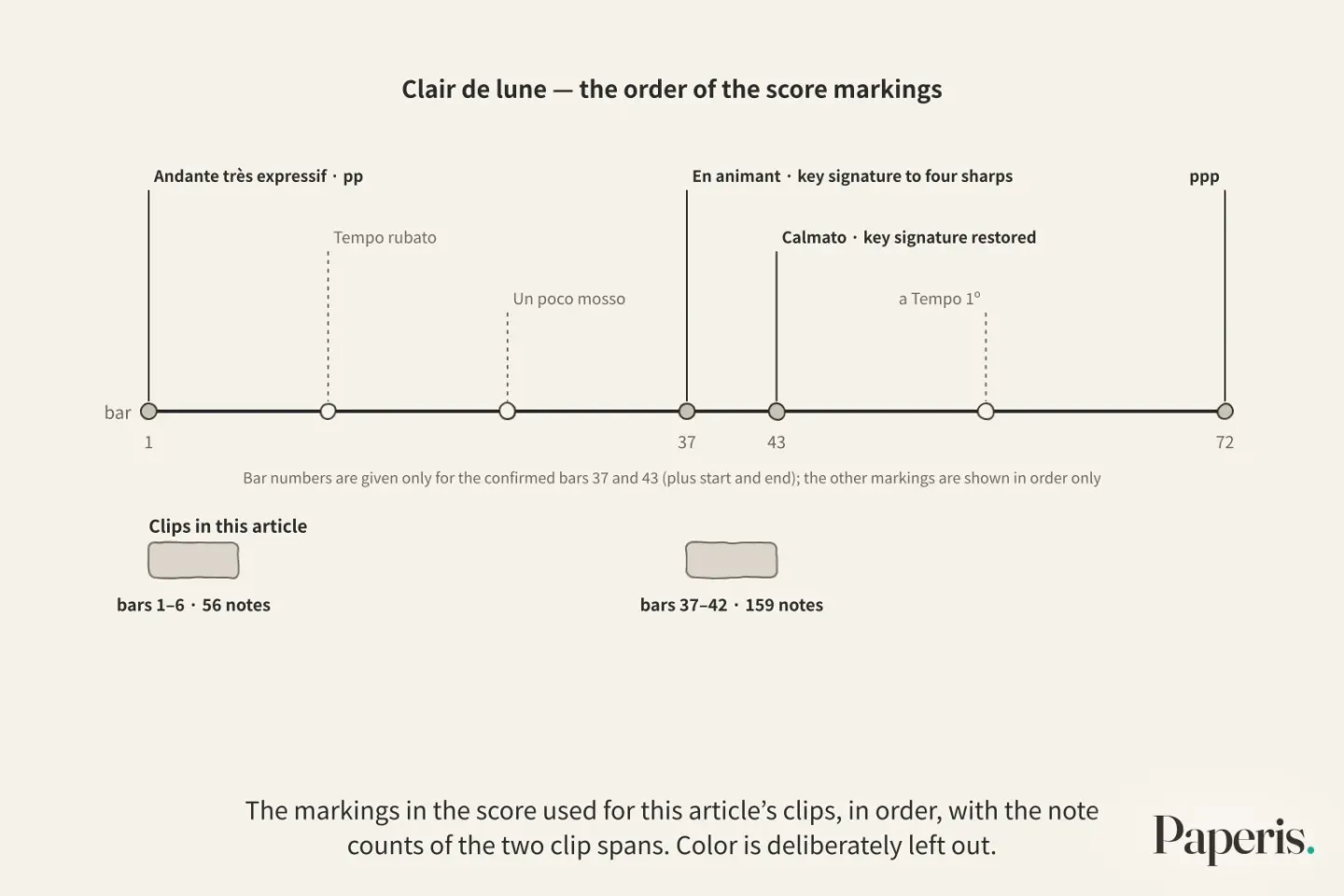
"Clair de lune" is a piano piece by the French composer Claude Debussy, and it is the third movement of the four-movement "Suite bergamasque". The sound brought to you by this article comes from the 1905 Fromont edition of the score. The piece is 72 measures long, and the opening bears the markings "Andante très expressif" (slowly, with much expression), "pp" (pianissimo, very softly), and "con sordina" (with the damper pedal depressed).
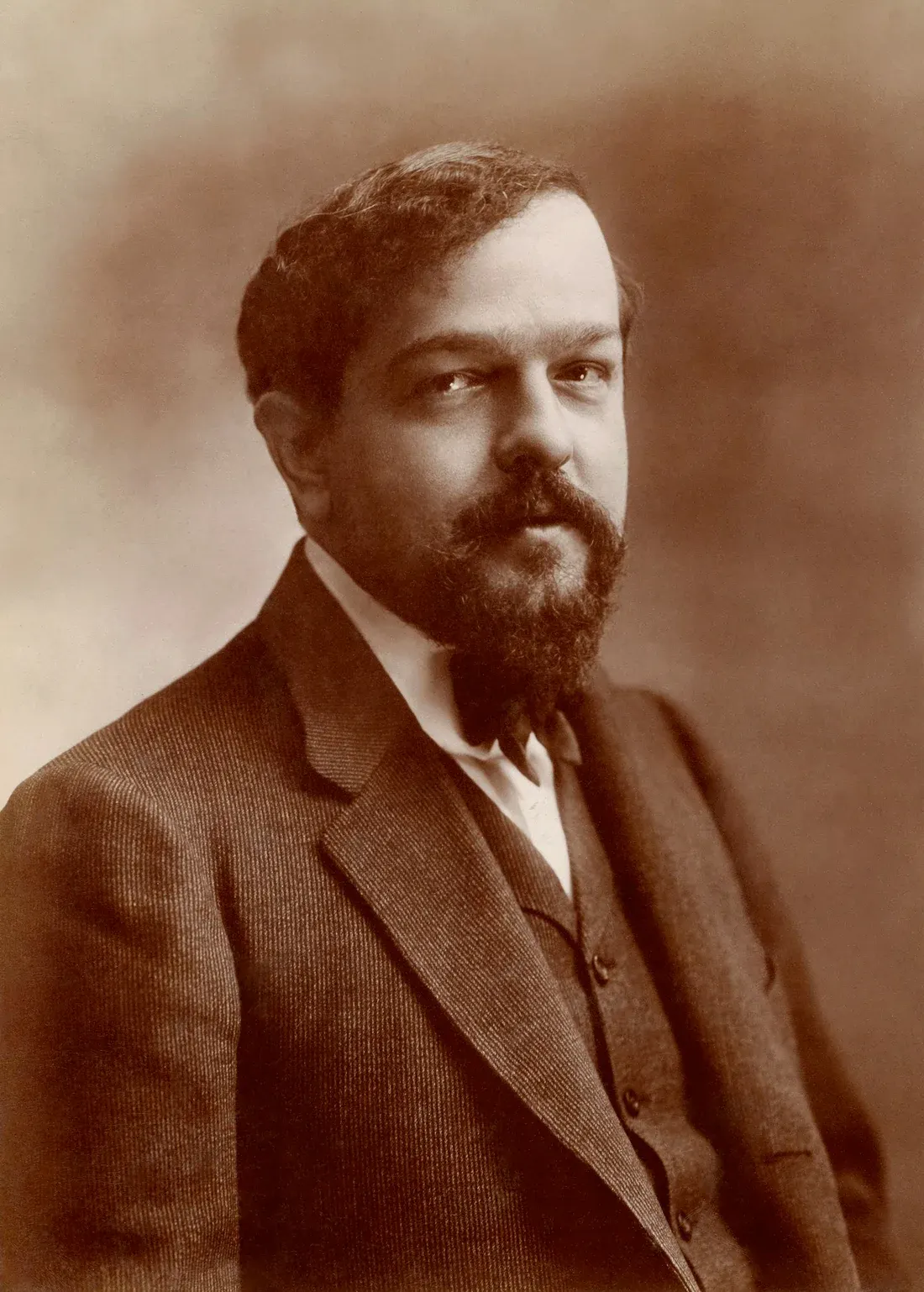
Claude Debussy · photograph by Atelier Nadar (1890–1910) · public domain · Wikimedia Commons
First, we listen to the opening six measures. The sound is a synthesized piano, and we chose the tempo.
Clip: Debussy, Clair de lune, bars 1–6 (synthesized piano; 1905 Fromont edition; score input Mutopia Project, public domain)
There are 56 notes in these six measures. Beyond this, the score passes through "Tempo rubato" and "Un poco mosso", encounters the marking "En animant" (with animation) at measure 37, and the key signature changes to four sharps. At measure 43, "Calmato" (calmed), the key signature returns to normal, and after passing through "a Tempo 1º", the piece ends with a final "ppp" (as softly as possible).
We listen to six measures starting from measure 37. The tempo for this passage was also chosen by us, and we set it slightly faster than the first passage.
Clip: Debussy, Clair de lune, bars 37–42 (En animant) (synthesized piano; 1905 Fromont edition; score input Mutopia Project, public domain)
The same six measures contain 159 notes, nearly three times as many as the first passage. Because the two clips were played at the same volume, the difference between the "pp" in the score and the dynamics that follow cannot be heard when comparing the clips.
Neither in the title nor anywhere in the score's markings are there color names. Yet the question of whether sound and color resemble each other goes back at least to the English physicist Isaac Newton, the German writer Johann Wolfgang von Goethe, and the German physicist Hermann von Helmholtz (PMID 35572076). Studies that translate this question into experiments generally use the same method. They play music and have participants choose matching colors.
One study that actually played "Clair de lune" serves as a basis for this article, but what is written in the abstract is a questionnaire asking about emotional responses rather than colors. When this piece was played for 125 South Korean university students and their emotional responses were collected via questionnaire, 8.29% of the responses corresponded to aesthetic emotions, and the researcher interpreted this as meaning that most of the students did not have an aesthetic experience (DOI: 10.30832/jmes.2023.57.227). Therefore, the sentences tested against "Clair de lune" below are all hypotheses transferred from research conducted with different music.
When People Are Asked to Match Colors to Music
Experiments that have people choose colors generally use two main yardsticks. Lightness describes how bright or dark a color is. Saturation describes how vivid a color is. Added to these are the types of color, such as yellow or blue.
Participants in the United States and Mexico listened to 18 orchestral pieces by Bach, Mozart, and Brahms, and chose the color that fit each piece best and the color that fit it least. In both countries, faster and major-mode music was matched with colors that had higher saturation, higher lightness, and more yellow, while slower and minor-mode music was matched with lower-saturation, darker, and bluer colors (PMID 23671106). The fact that the same direction appeared in both countries is a clue that this pairing might not just be a habit of people in a single nation. However, only two countries were compared.
Orchestral pieces differ in instruments, tempo, and harmony all at once, making it hard to tell which factor changed the color choice. So the next study made the sounds simpler. They took four Mozart melodies and combined them by varying tempo, note density, major/minor mode, and pitch—two levels for each—to create 64 single-line piano melodies, and had participants choose the three most fitting colors out of 37 choices. Faster and major-mode melodies were matched with brighter, more vivid, and more yellow (warm) colors than slower and minor-mode melodies were, repeating the result of the orchestral music experiment (PMID 27311295). This study also varied note density, but the abstract does not report on that effect separately.
An experiment using film music used a different way of choosing colors. 22 people listened to 27 film music tracks while continuously moving the color and size of color fragments on a tablet screen to match the music. Yellow was placed for happy music, large red fragments for music containing anger, and small, deep blue-leaning fragments for sad music (PMID 26642050).
At a university in Turkey, 151 students from the faculty of education listened to three piano pieces. They were a fast major-mode piece by Mozart, a fast minor-mode piece by Beethoven, and a slow minor-mode piece by Chopin, and the students chose three close colors and three close emotions from 37 color cards for each piece. The distribution of chosen colors and emotions varied depending on the piece's major/minor mode and tempo, and the researchers reported that this distribution overlapped with those of previous studies (DOI: 10.51576/ymd.1343504). This study used only descriptive statistics, and the author's conclusion is only to the extent that it “can be said” to support the emotion-mediation hypothesis.
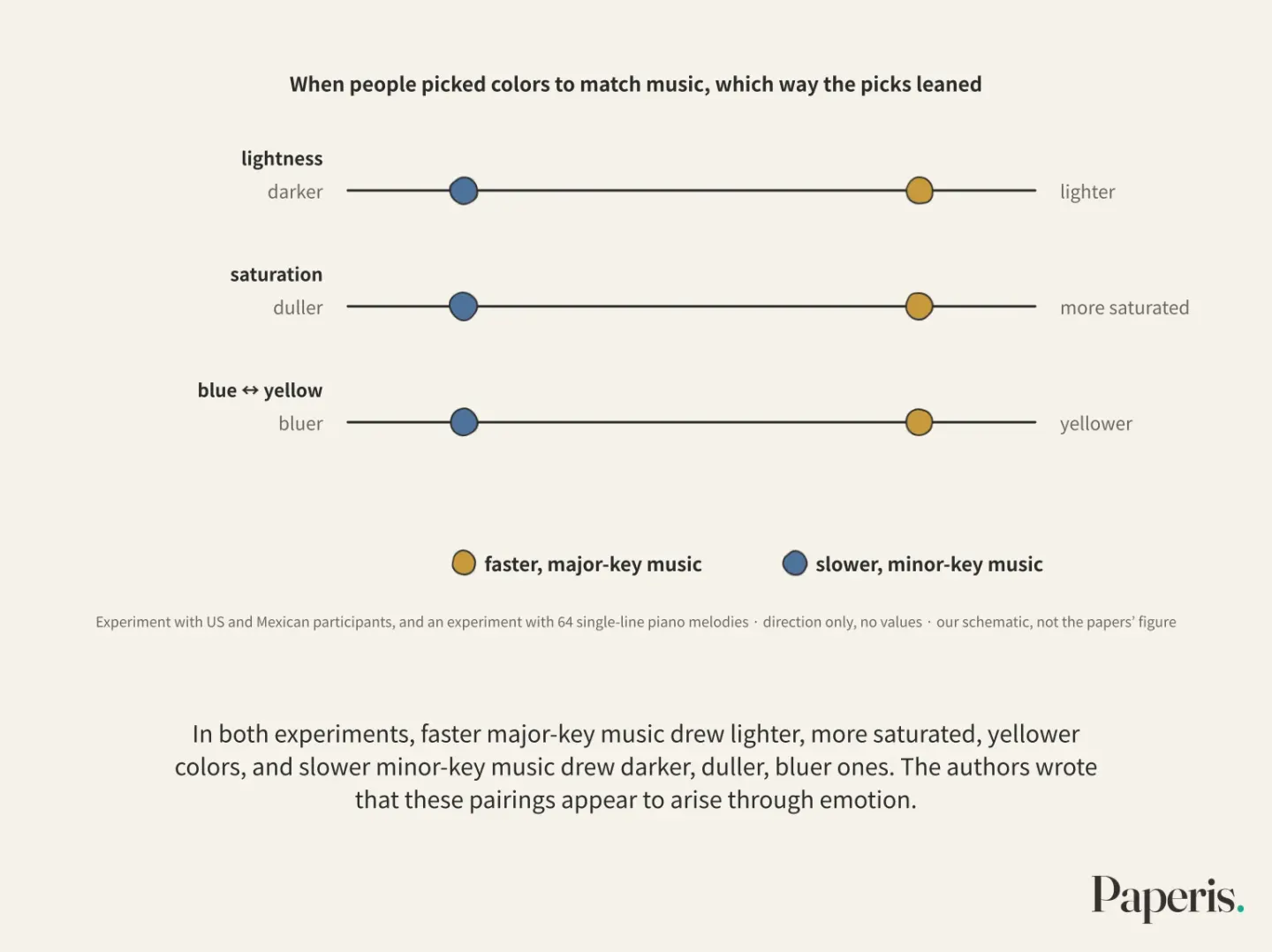
Even when the music, participants, and selection methods changed, the colors chosen in the experiments that reported a direction leaned toward the same side. The Turkish study reported that the distribution overlapped with previous studies instead of a direction. This is the direction of the average gathered from many people's choices, and it does not mean that every single person always chooses that way. And in all of these choice experiments, the participants were explicitly asked to listen to the music and pick matching colors.
The Emotions Standing Between the Hands That Choose Colors
A leading explanation for why color associations exist is the emotion-mediation hypothesis. The emotion-mediation hypothesis proposes that when people choose colors for music, they pick colors that evoke the same emotions the music conveys.
Experiments in the United States and Mexico tested this hypothesis with numbers. The correlation between the emotional scores participants gave to music and the emotional scores of the colors they chose for that music was very high, ranging from 0.89 to 0.99 (PMID 23671106). The same study obtained similarly clear pairings in experiments matching emotional facial photographs to colors and music to faces, and the authors viewed these results as supporting emotion mediation. In a study of piano melodies, the same correlations were also high: 0.92 for happiness and sadness, 0.85 for strength and weakness, 0.82 for anger and non-anger, and 0.70 for excitement and calmness (PMID 27311295).
In a report replicating the earlier music-color experiment with 49 Mexican participants, fast and major-mode music was rated as happier and stronger, while slow and minor-mode music was rated as sadder, weaker, and calmer. The correlation between the emotion of the music and the emotion of the chosen color was highest for happiness and sadness at 0.97 and lowest for anger and calmness at 0.68 (DOI: 10.1075/z.191.24pra). The sequence painted by the emotion-mediation hypothesis is that music is heard with a certain emotion, and a color matching that emotion is chosen afterward. However, this sequence was deduced from correlations and interviews, not confirmed by directly altering emotions.
High correlation alone is not enough to prove that emotion acts as a bridge. This is because acoustic features, such as loudness, might be directly linked to color. An experiment using 34 tracks across various genres—including blues, salsa, and heavy metal—examined this point separately. Noisey, hard-hitting, and distorted music generally elicited darker, redder, and more saturated colors, but once the statistical share of musical emotion was removed, all significant correlations between acoustic features and color disappeared (PMID 30479734). In a separate factor analysis, two axes of emotion—arousal level and pleasantness level—emerged as the factors mediating this pairing, leading the authors to conclude that participants primarily paired music and color through a shared emotion.
In a film music experiment, among models that predicted color patches using acoustic features and emotional evaluations, a concise model incorporating emotion explained 60% to 75% of the variance in each color patch variable, and participant interviews also revealed a tendency for people to choose colors tailored to the emotions they heard in the music (PMID 26642050).
A 2026 study manipulated tempo and major-minor modes separately. Eighty participants without musical training listened to 30-second excerpts drawn from 18th-century Neapolitan music and other sources at their original tempo, a version 60 beats per minute slower, and a version 60 beats per minute faster; they then wrote down their felt emotions freely and chose colors. The researchers converted the written words into pleasantness and arousal scores using an emotional dictionary. Major-mode excerpts were tied to higher pleasantness, and minor-mode excerpts were tied to higher arousal, with the abstract noting that this arousal increased at faster tempos. Darker colors were chosen for minor-mode excerpts. Emotion predicted color: greater pleasantness predicted more saturated and brighter colors, and greater arousal predicted darker colors, a relationship that held even after controlling for major-minor mode and tempo (PMID 42818575). The authors noted that these results align with the emotion-mediation explanation and show that listeners form flexible pairings connected to emotion.
These results cannot be combined with the U.S.–Mexico experiments into a simple rule like "fast equals bright" or "excited equals dark." The U.S.–Mexico experiments grouped tempo and major-minor modes together for comparison, whereas the 2026 study manipulated the two separately and used a different method for asking about emotions.
Pairing works in reverse, too. In an experiment where participants evaluated music while room lighting colors were manipulated, music and lighting with similar emotional scores were rated as fitting together better when presented simultaneously, and under red lighting, the same music was rated as more powerful than under green or blue lighting (PMID 35985652). Portions of the lighting's properties carried over into the music evaluations.
Other research has examined emotions on the color side independently. In an analysis where 40 colors were displayed and participants wrote down the emotion words that came to mind, the main divisions followed the warmth or coolness of the colors, whereas pairings such as white with lack of emotion and purity, or blue with depression, appeared to be secondary pairings derived from cultural conventions or personal experience (DOI: 10.1002/col.22171). This study's design did not involve music. However, if some color-emotion pairings stem from cultural conventions or personal experience, such pairings may also be mixed into the color-side half of the bridge connecting music and color. This is our own inference by bringing the two studies together.
There is also a conference abstract reporting that emotional similarity played the largest role in pairings among children. For 9- and 13-year-olds, sounds and patterns with similar valence (goodness-badness) and arousal levels were paired together most frequently (DOI: 10.1163/187847612x647603).
Across experiments asking people to choose colors for music, the colors chosen by participants generally matched the emotions contained in the music, and the authors interpreted those pairings as arising through emotion. A review paper summarizing the relationship between sound and color over a long history similarly concluded that, for now, explaining the attraction most people feel between music and color through emotion mediation appears the most parsimonious (PMID 35572076).
Holding It Up Against "Clair de Lune"
From here on, it is an assumption. Among the experiments above, none state in their abstracts that they asked about colors using "Clair de Lune".
What the US and Mexico experiments compared was a bundle of "fast, major-key music" and "slow, minor-key music". "Clair de Lune" is in D-flat major, and the opening section is marked "slowly". At measure 37, the "lively" section, the key signature changes to one with four sharps. The key signature alone does not determine whether this section was written in a major or minor key, and this article does not judge that. Therefore, this article also does not determine which way the results of this experiment should be applied to the two sections.
In the 2026 study, darker colors were chosen for minor-key excerpts (PMID 42818575). If the measure 37 section sounds minor, these results can be applied to it, but this article has not verified the key of that section, and no study checking colors with this piece is in the evidence this article relies on.
How distinctly people separate major and minor keys also varies from person to person. In an experiment where pure-tone chords were played, shifted little by little from minor to major, only people who categorically separated major and minor chose similar colors for chords in the same category and different colors for chords in different categories (PMID 40393316). If we apply these results to "Clair de Lune", what people hear when the key signature changes at measure 37 may vary from person to person, and whether the colors they choose change accordingly may also vary. Since this article does not even judge whether measure 37 is a section where the major or minor key changes, this too is an assumption.
If the emotion-mediation hypothesis is correct, colors are chosen via the emotions perceived in the music. According to the abstract, a survey of 125 South Korean university students who listened to "Clair de Lune" asked about emotional and affective responses, and the abstract does not mention asking about colors. Among the responses, those based on the listener's own internal emotions were reported to be the most prominent (DOI: 10.30832/jmes.2023.57.227). We cannot say whether the colors chosen for this piece would be scattered based on this survey, and the possibility that they might be scattered is an assumption.
Volume is also left out. In experiments across various genres, darker colors were chosen for loud music (PMID 30479734), but the clip in this article was played at a consistent loudness, so the softness given by the $pp$ in the score is not included in the clip.
Out-of-Emotion Pairs: High Sounds, Bright Colors
There are also pairs that seem to bypass emotion. Cross-modal correspondence is the tendency for most people to pair the properties of different senses in similar directions. People consistently pair high sounds with small, bright, and high-placed objects (PMID 21264748).
This pairing also appears in reaction times. While rapidly distinguishing light or color, when a matching sound—specifically, a high sound accompanying a bright light—was presented together, responses were faster and more accurate (PMID 2958587). In an experiment where 16 people were asked to choose which of two lights each sound resembled more, both pitch and loudness were paired with brightness, the pitch effect was larger for most participants, and the pairings were heavily influenced by relative values compared against other sounds rather than the absolute value of the sound (PMID 2527964).
Does the ear pass along even the type of color, then? In a study that broke this down across 22 consecutive experiments using the Implicit Association Test (which measures pairings through reaction times), pitch and loudness were paired with the lightness and saturation of colors, with pitch pairing particularly with lightness and loudness pairing with the distinctiveness of the color. However, among colors with the same lightness and saturation, the type of color was not tied to any of the sound characteristics tested, with only a weak tendency to pair high sounds with blue rather than yellow appearing (PMID 30547381). In this experiment, what paired with sound characteristics was the brightness and vividness of the color, and within the same brightness and vividness, there was only one weak pairing with the type of color. The yellow-blue choice in the previous section and this result are separate experiments, and a review seen earlier categorized and summarized sound-color pairings into those originating from perception and those originating from emotion (PMID 35572076).
It is not just the pitch of a single note that pairs with brightness. When a tonic note of a piece was played first followed by one additional note, notes closer to the tonic that sounded more stable were paired with brighter circles, a result that appeared in both musicians and non-musicians, and in both conscious choice tests and reaction time tests (PMID 33706266).
Timbre is the property of a sound that makes two sounds with the same pitch, loudness, and duration sound different from each other. What timbre is was covered in "Timbre — Same Pitch, Same Loudness, a Different Face". In two experiments where scales were played via instrument recordings and participants were asked to choose matching colors, scores rating timbre with words like "bright", "dark", and "warm" predicted the lightness and saturation of the chosen colors. This was true even in experiments where the pitch range was fixed. However, the relationship between "warm-cold" evaluations and the warmth-coolness of colors was weak and appeared in only one of the two experiments, and the authors noted that such pairings may apply only to certain instruments (PMID 39839933). In an online experiment involving 119 participants, smooth timbres were paired with blue, green, and light gray rounded shapes, while rough timbres were paired with red, yellow, and dark gray angular shapes (PMID 24910604). In an online experiment involving 189 participants, the brightness of timbre interfered with pitch judgments, and showed the possibility of interfering with the brightness judgments of gray squares as well (PMID 39090510).
Thoughts also interfere with this pairing. In a study examining pairings between pitch and five visual characteristics including loudness, height, and brightness, all pairings underwent both bottom-up processing coming from the senses and top-down processing coming from thought (PMID 29486377). An experiment published in a high school science journal tested whether the blue-minor and yellow-major pairings operate at the perceptual level but found no effect, interpreting these pairings as being formed at a higher level of thought (DOI: 10.64336/001c.28170).
Language is also intertwined. In online evaluations of 178 and 160 Japanese adults, the pairings fell into two groups. One group consisted of pairs called by the same word in Japanese, such as loudness and size, and pitch and up-and-down; the other group consisted of pairs without such shared words, such as pitch and brightness (PMID 37963160). Expressions borrowing words from one sense for another, like "bright sound", largely matched their meanings with cross-modal correspondences, and matched better on emotion-laden scales like good-bad. However, commonly used and fossilized expressions sometimes deviated from the correspondence (PMID 42054531).
Whether this pairing is innate or learned remains open. One review argued that evidence supporting the claim that pitch-brightness pairings are remnants of sensory synesthesia in infancy is weak, and that it is better to view them as learned (PMID 23603186). In a preregistered replication experiment, the pitch-brightness pairing emerged again in humans but did not appear in baboons (PMID 38475662). A preprint not yet peer-reviewed reports that Hermann's tortoises chose a white wall after hearing high sounds and a black wall after hearing low sounds (DOI: 10.1101/2025.01.24.634651).
People to Whom Colors Truly Rise
The participants in the experiments we have looked at so far chose colors. Some people say that colors genuinely rise up when they hear sounds. Synesthesia is an experience where the feeling of another sense arises automatically when one sense is stimulated, in a shape fixed for each individual. Chromesthesia is a type of synesthesia where colors rise together when hearing sounds.
A handbook chapter covering musical performance notes that synesthesia is a rare neurological condition, appearing more frequently in artistic professions (DOI: 10.1093/oxfordhb/9780190056285.013.27). A percentage figure showing just how rare it is is not present in the sources this article relies on.
Synesthetes pair things differently. Compared to non-synesthetes, synesthetes who see colors in music showed greater consistency over time in the colors they assigned to notes, paired pitch and color brightness more delicately, and used a different pool of chosen colors, featuring more brown and less green (DOI: 10.1177/03057356241250020). The same study reported, via self-report questionnaires, that these synesthetes leaned more toward reflective and complex genres than non-synesthetes and other types of synesthetes, and engaged more actively with music. Musical sophistication was tied to synesthesia as a whole. The participant count is not in the abstract.
The difference also lies in the nature of the pairings. In research literature, cross-sensory correspondences are often described as relative pairings. This works by pairing the higher of two sounds with the smaller of two objects, for instance. In the same literature, it is explained that synesthetic pairings tend to be absolute, meaning a specific sound calls up a specific color. One review examining this distinction noted that it is not as neat as it seems, and the answer can vary depending on which correspondence you look at (DOI: 10.1163/22134808-20191407). Another historical review concluded that most vivid pairings among synesthetes differed from person to person, and neither sound-to-color translations based on them nor translations matching pitch and hue structures yielded pairings that people agreed on (PMID 37803233).
Whether synesthesia is one end of a tendency present in everyone or a separate condition is under debate. One chapter summarizes this into the view seeing it as a continuum, the view dividing synesthetes and non-synesthetes, and the view seeing it as multiple kinds (DOI: 10.1093/oso/9780199688289.003.0002). The author of another chapter chooses to view synesthesia as a condition on the outer edge (DOI: 10.1093/oso/9780199688289.003.0003). There is also a suggestion that a low-level form of synesthesia exists even in non-synesthetes, though it remains unexpressed (DOI: 10.1590/s1980-57642015dn91000004). This is a proposal from a review.
Remaining Questions
In experiments asking people to choose colors for music, the colors chosen generally matched the emotions held by the music, and the pairing appears to be mediated by emotion. In experiments separately measuring sound features and color pairings, what was paired was mainly the brightness and vividness of colors, while pairings with specific hue types were weak. And the experience of colors spontaneously arising belongs to synesthetes, who paired them differently and more consistently.
There are four remaining questions. First, a study playing "Clair de Lune" and asking for colors is not among the evidence this article relies on. All applications in the previous section are assumptions. Second, the experiments that had people listen to music and choose colors were all situations where participants were asked to pick colors. In experiments measured by reaction time without being asked, pairings of high pitches with bright lights and colors appeared (PMID 2958587; PMID 30547381), but a high school science journal report found no effect at the perceptual level for yellow-major and blue-minor pairings (DOI: 10.64336/001c.28170). Whether emotion-mediated music-color pairings arise without being asked is not settled by this evidence. Third, whether tempo and arousal make colors bright or dark does not line up neatly across studies with different designs. Fourth, whether the pairing of high pitches and bright colors is innate, and whether synesthesia is connected to everyone's tendency, remains open.
The question of whether music paints scenes was covered in Vivaldi's "Spring" — Birdsong Written in the Score, but What Does the Ear Picture?. If people are asked to choose colors for the first six measures of "Clair de Lune," what they choose may vary from listener to listener, and what research can tell us goes only as far as what people generally follow when choosing those colors.
Source Papers
- "Music-color associations are mediated by emotion." (2013) — PMID 23671106 — US and Mexican participants, 18 orchestral pieces; fast and major → high saturation, bright, and yellow, slow and minor → opposite; music-color emotion correlation 0.89–0.99; emotion mediation supported.
- "Music-to-Color Associations of Single-Line Piano Melodies in Non-synesthetes." (2016) — PMID 27311295 — 64 piano melodies made from Mozart melodies, three out of 37 colors; 2013 results reproduced, emotion correlations 0.92, 0.85, 0.82, 0.70.
- "Colour Association with Music Is Mediated by Emotion: Evidence from an Experiment Using a CIE Lab Interface and Interviews." (2015) — PMID 26642050 — 22 people, 27 film score pieces; happiness = yellow, anger = large red, sadness = small dark blue; emotion-inclusive model explains 60–75%.
- "Color, Music, and Emotion: Bach to the Blues." (2018) — PMID 30479734 — 34 pieces across various genres; removing the emotion share causes all perceptual feature-color correlations to disappear; arousal and valence two factors.
- "Colored tones of emotions: the relationship between music, emotions and color." (2026) — PMID 42818575 — 80 people without music training, three tempos; joy → vivid and bright colors, excitement → dark colors, minor → dark colors; consistent with emotion mediation explanation.
- "MÜZİK- RENK ve MÜZİK-DUYGU ÇAĞRIŞIMI" (2023) — DOI: 10.51576/ymd.1343504 — 151 Turkish university students, Mozart, Beethoven, and Chopin piano pieces, 37 color cards; descriptive statistics, emotion mediation support "can be said".
- "Bach to the blues" (2014) — DOI: 10.1075/z.191.24pra — 49 Mexican participants replication; fast and major = happy/strong, correlations happy/sad 0.97, angry/calm 0.68.
- "Correspondence analysis of color–emotion associations" (2017) — DOI: 10.1002/col.22171 — 40 colors-emotion words; dimensions 1 and 2 are color temperature, blue-depression etc. are secondary pairings coming from culture and experience.
- "Categorical tonality perception modulates crossmodal correspondences between musical chords and colors." (2025) — PMID 40393316 — minor-to-major transformed chords; only listeners who hear categorically select colors according to the category.
- "Crossmodal Correspondence between Music and Ambient Color Is Mediated by Emotion." (2022) — PMID 35985652 — lighting color and music; when emotion scores are similar, they match better, music under red lighting rated as more forceful.
- "Coloured hearing, colour music, colour organs, and the search for perceptually meaningful correspondences between colour and sound." (2022) — PMID 35572076 — historical review after Newton, Goethe, and Helmholtz; distinguishing perceptual and emotional correspondences; for the majority, emotion mediation is the most concise explanation.
- "Sensory translation between audition and vision." (2024) — PMID 37803233 — synesthetes' pairings are mostly idiosyncratic, no approach produces agreed-upon pairings.
- "Analysis of College Students' Aesthetic Musical Experiences through Debussy's “Clair de Lune”" (2023) — DOI: 10.30832/jmes.2023.57.227 — 125 college students given "Clair de Lune"; aesthetic emotion responses 8.29%, inner emotion-based responses most prominent.
- "Crossmodal correspondences: a tutorial review." (2011) — PMID 21264748 — consistent pairing of high sound ↔ small, bright, and high-positioned objects.
- "On cross-modal similarity: auditory-visual interactions in speeded discrimination." (1987) — PMID 2958587 — when matching sounds and lights are presented together, responses are faster and more accurate.
- "On cross-modal similarity: the perceptual structure of pitch, loudness, and brightness." (1989) — PMID 2527964 — 16 people; both pitch and loudness pair with brightness, pitch usually greater, influenced by relative values.
- "Implicit associations between individual properties of color and sound." (2019) — PMID 30547381 — 22 experiments; pitch ↔ lightness, loudness ↔ saliency; only one weak color type is high sound-blue.
- "Crossmodal Correspondence Between Tonal Hierarchy and Visual Brightness: Associating Syntactic Structure and Perceptual Dimensions Across Modalities." (2020) — PMID 33706266 — more stable notes equal brighter circles, musicians and non-musicians, explicit and implicit tests.
- "Color and tone color: audiovisual crossmodal correspondences with musical instrument timbre." (2024) — PMID 39839933 — timbre rating scores predict lightness and chroma of matched colors; warmth-coldness is weak and in only one experiment; may apply to only some instruments.
- "Audiovisual correspondence between musical timbre and visual shapes." (2014) — PMID 24910604 — 119 people online; smooth timbre ↔ blue, green, bright gray round shapes, rough timbre ↔ red, yellow, dark gray angular shapes.
- "Timbral brightness perception investigated through multimodal interference." (2024) — PMID 39090510 — 189 people online; timbre brightness interferes with pitch judgment, perhaps also visual brightness judgment.
- "Questioning the automaticity of audiovisual correspondences." (2018) — PMID 29486377 — all five correspondences go through both bottom-up and top-down processing together.
- "Exploring perceptual associations between color and music" (2021) — DOI: 10.64336/001c.28170 — high school science journal; blue-minor, yellow-major have no perceptual-level effect, interpreted as higher-order cognition (sample size not in abstract).
- "How many categories are there in crossmodal correspondences? A study based on exploratory factor analysis." (2023) — PMID 37963160 — 178 and 160 Japanese adults; two factors: pairs mediated by language and pairs not.
- "The Meanings of Synesthetic Metaphors Closely Align With Crossmodal Correspondences." (2026) — PMID 42054531 — meanings of expressions like "bright sound" largely align with correspondences, match better on emotion scales.
- "Are we all born synaesthetic? Examining the neonatal synaesthesia hypothesis." (2013) — PMID 23603186 — weak reason to view pitch-brightness pairing as neonatal synesthesia evidence, argument that learning explanation is better.
- "Humans (Homo sapiens) but not baboons (Papio papio) demonstrate crossmodal pitch-luminance correspondence." (2024) — PMID 38475662 — preregistered replication; humans replicate, baboons show no effect.
- "Crossmodal pitch-luminance association in tortoises" (2025) — DOI: 10.1101/2025.01.24.634651 — preprint; tortoise behind high sound white wall, low sound black wall.
- "Evaluative similarity hypothesis of crossmodal correspondences: A developmental view" (2012) — DOI: 10.1163/187847612x647603 — conference abstract; 9 and 13-year-olds, sounds and patterns with similar valence and arousal paired most often.
- "Synesthesia and Music Performance" (2022) — DOI: 10.1093/oxfordhb/9780190056285.013.27 — handbook chapter; synesthesia is a rare condition, more frequent in artistic professions (no numbers).
- "Synaesthesia is linked to differences in music preference and musical sophistication and a distinctive pattern of sound-color associations" (2024) — DOI: 10.1177/03057356241250020 — music-color synesthetes: more consistent, pitch-brightness more delicate, palette with more brown and less green.
- "On the Relative Nature of (Pitch-Based) Crossmodal Correspondences" (2019) — DOI: 10.1163/22134808-20191407 — distinction that correspondence=relative, synesthesia=absolute is not as clean as thought.
- "Synesthesia, Then and Now" (2017) — DOI: 10.1093/oso/9780199688289.003.0002 — organization of continuous (monism), dualism, and pluralism stances.
- "Synesthesia vs. Crossmodal Illusions" (2017) — DOI: 10.1093/oso/9780199688289.003.0003 — author tends to view synesthesia as an outward state.
- "Synesthesia and music perception" (2015) — DOI: 10.1590/s1980-57642015dn91000004 — proposal of latent synesthesia in non-synesthetes (review).
Sources (35)
- Music-color associations are mediated by emotionPMID 23671106
- Music-to-Color Associations of Single-Line Piano Melodies in Non-synesthetesPMID 27311295
- Colour Association with Music Is Mediated by Emotion: Evidence from an Experiment Using a CIE Lab Interface and InterviewsPMID 26642050
- Color, Music, and Emotion: Bach to the BluesPMID 30479734
- Colored tones of emotions: the relationship between music, emotions and colorPMID 42818575
- MÜZİK- RENK ve MÜZİK-DUYGU ÇAĞRIŞIMIDOI 10.51576/ymd.1343504
- Bach to the bluesDOI 10.1075/z.191.24pra
- Correspondence analysis of color–emotion associationsDOI 10.1002/col.22171
- Categorical tonality perception modulates crossmodal correspondences between musical chords and colorsPMID 40393316
- Crossmodal Correspondence between Music and Ambient Color Is Mediated by EmotionPMID 35985652
- Coloured hearing, colour music, colour organs, and the search for perceptually meaningful correspondences between colour and soundPMID 35572076
- Sensory translation between audition and visionPMID 37803233
- Analysis of College Students' Aesthetic Musical Experiences through Debussy's 「Clair de Lune」DOI 10.30832/jmes.2023.57.227
- Crossmodal correspondences: a tutorial reviewPMID 21264748
- On cross-modal similarity: auditory-visual interactions in speeded discriminationPMID 2958587
- On cross-modal similarity: the perceptual structure of pitch, loudness, and brightnessPMID 2527964
- Implicit associations between individual properties of color and soundPMID 30547381
- Crossmodal Correspondence Between Tonal Hierarchy and Visual Brightness: Associating Syntactic Structure and Perceptual Dimensions Across ModalitiesPMID 33706266
- Color and tone color: audiovisual crossmodal correspondences with musical instrument timbrePMID 39839933
- Audiovisual correspondence between musical timbre and visual shapesPMID 24910604
- Timbral brightness perception investigated through multimodal interferencePMID 39090510
- Questioning the automaticity of audiovisual correspondencesPMID 29486377
- Exploring perceptual associations between color and musicDOI 10.64336/001c.28170
- How many categories are there in crossmodal correspondences? A study based on exploratory factor analysisPMID 37963160
- The Meanings of Synesthetic Metaphors Closely Align With Crossmodal CorrespondencesPMID 42054531
- Are we all born synaesthetic? Examining the neonatal synaesthesia hypothesisPMID 23603186
- Humans (Homo sapiens) but not baboons (Papio papio) demonstrate crossmodal pitch-luminance correspondencePMID 38475662
- Crossmodal pitch-luminance association in tortoisesDOI 10.1101/2025.01.24.634651
- Evaluative similarity hypothesis of crossmodal correspondences: A developmental viewDOI 10.1163/187847612x647603
- Synesthesia and Music PerformanceDOI 10.1093/oxfordhb/9780190056285.013.27
- Synaesthesia is linked to differences in music preference and musical sophistication and a distinctive pattern of sound-color associationsDOI 10.1177/03057356241250020
- On the Relative Nature of (Pitch-Based) Crossmodal CorrespondencesDOI 10.1163/22134808-20191407
- Synesthesia, Then and NowDOI 10.1093/oso/9780199688289.003.0002
- Synesthesia vs. Crossmodal IllusionsDOI 10.1093/oso/9780199688289.003.0003
- Synesthesia and music perceptionDOI 10.1590/s1980-57642015dn91000004