
Paperis Articles
In the Hall of the Mountain King — A Swelling March: Do Chills Belong to the Piece or the Listener?
Starting from Grieg's march that begins very softly and drives to fortissimo, we follow what music-chills research has measured in sound, body, brain and listener
Your field's papers, as audio
Pick your fields and journals — Paperis summarizes the key papers and turns them into audio. Listen on your commute.
Start Paperis free →In the Hall of the Mountain King — A Swelling March: Do Chills Belong to the Piece or the Listener?
A March Starting Very Softly and Very Low
"In the Hall of the Mountain King" is a piece written in 1874 by the Norwegian composer Edvard Grieg as music to accompany the staging of the play Peer Gynt by the Norwegian playwright Henrik Ibsen. Later, Grieg selected and compiled pieces from this incidental music to become the fourth movement of the Peer Gynt Suite No. 1 for orchestra. Originally, it is an orchestral work. The sound presented to you in this article is a synthesized piano rendering of a piano score published in 1918, and is not a live performance recording. The tempo was determined by us following the indications in the score.
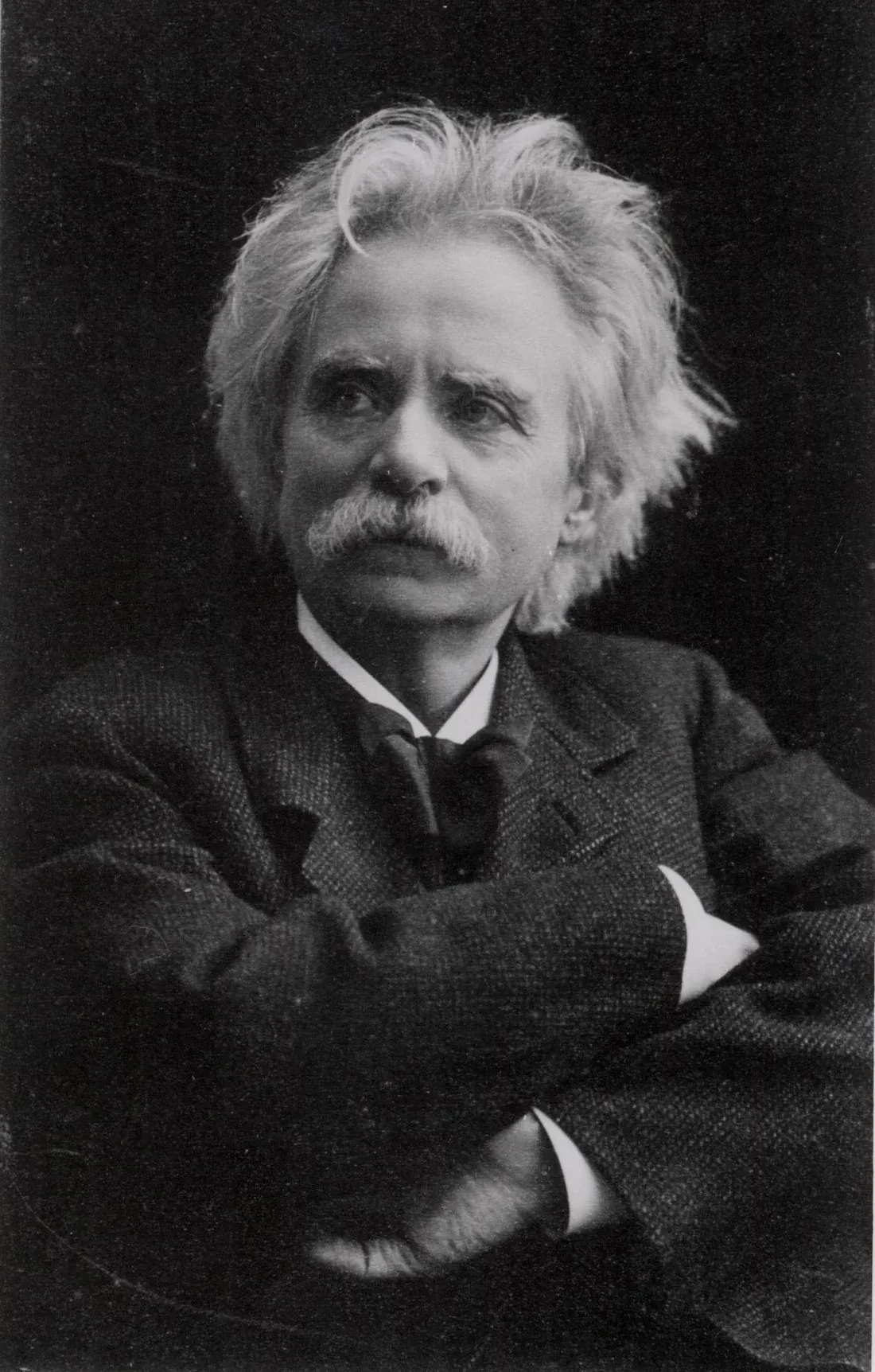
Edvard Grieg · photograph (c. 1903, photographer unknown) · Grieg Archives, Bergen Public Library · no known copyright restrictions · Wikimedia Commons
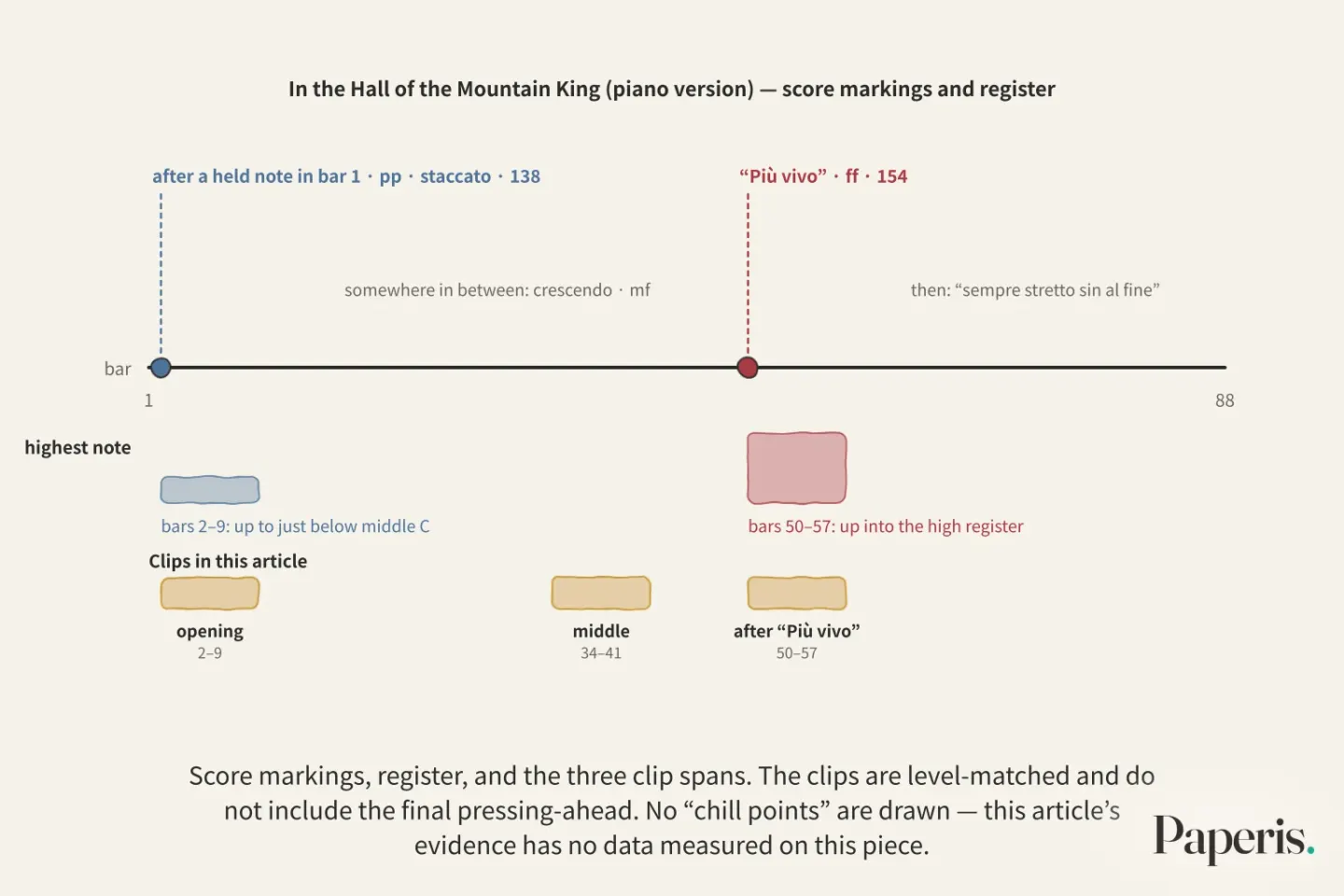
The first measure is a single long note with a fermata. Starting from the second measure, in a very low register, a short, detached melody walks: B-C#-D-E-F#-D-F#. At the beginning of the score are marked "Alla marcia molto marcato" (in the style of a march, very marked), a tempo where a quarter note is beaten 138 times per minute, "pp" (pianissimo, very softly), and "e sempre staccato" (always detached). The clips in this article all have their volume levels adjusted to the same standard, so the dynamic differences of soft and loud in the score will not be heard through the clips.
Clip: Grieg, In the Hall of the Mountain King (piano version), bars 2–9 (synthesized piano; 1918 edition; score input Mutopia Project, public domain)
That short, detached melody in the low register has passed by twice.
The score holds onto this pattern for a long time while altering it. In the middle, "crescendo" (getting louder) and "mf" (mezzo-forte, moderately loud) appear, and at measure 50, alongside "Più vivo" (faster), the tempo rises to 154 with "ff" (fortissimo, very loud) attached. After that, "sempre stretto sin al fine" follows, an indication to keep pressing forward and rushing until the end.
If your skin gets goosebumps while listening to a piece where the same pattern grows larger and faster, does that reaction come from the piece, or does it come from the listener? This article follows this question with research that measured goosebumps while listening to music. Among the evidence this article relies upon, there are no experiments that played this piece and measured goosebumps. The studies used pieces chosen directly by participants or other pieces chosen for the experiment, and sentences below that apply the research results to this piece are all hypotheses.
Goosebumps Are the Peak of Emotion Left on the Body
There is an exploratory study that played familiar and unfamiliar music to 32 students (16 who make music, 16 who do not). At the moment they reported feeling goosebumps, skin conductance changed distinctly, and in a few cases, actual hair standing up was also observed. Skin temperature showed no distinct change (DOI: 10.1177/102986490500900207). This means goosebumps are a bodily response that leaves a mark.
Musical goosebumps are a response where a chilly shiver passes down the back of the neck, spine, or arms, or goosebumps rise on the skin while listening to music. One review article distinguishes and treats this experience from goosebumps rising to protect the body or shivering from cold (PMID 25639033).
A representative index measured on the body is the skin conductance response. The skin conductance response is a change where electricity passes more easily through the skin as the sweat glands on the palms open slightly when the body is tense or excited. In an experiment that played sound passages from music and movies while directly recording hairs standing up using an optical device, the skin conductance response increased and breathing deepened the moment hairs stood up. The authors interpreted this response of hairs standing up as an index of an "emotionally moved state" (PMID 21276827). In a study that played seven pieces of music to 95 people as well, self-rated intensity, skin conductance response, and heart rate all peaked together at the goosebump passages (PMID 19673806).
These bodily responses are grouped and read as arousal. Arousal is the degree to which the body and mind are awake and excited. A review containing the previous study of 95 people concluded that because goosebumps show subjective feelings and bodily arousal together, they are a reliable indicator pointing to an individual's emotional peak (PMID 19673806). Goosebumps are frequently used in psychology research as a marker pointing to the peak of pleasure and emotional arousal (PMID 31725733).
Goosebumps are not a single feeling either. In a survey where 375 people wrote down their experiences of having gone through goosebumps, goosebumps were frequently described as a moved state mixed with various emotions, and commonly occurred in situations of listening alone (DOI: 10.1177/0305735618798024). An online experiment with 179 people that mixed paintings, videos, music videos, text, and music excerpts sorted out three branches: goosebumps coming with smiles and warmth, goosebumps coming with frowns, coolness, and sadness, and goosebumps coming with tears and a choking sensation (PMID 31725733). Classification is not done by music alone. In a large-scale survey from 1995, many college students thought joyful music induced goosebumps more, but in a correlational study where students listened to various songs, goosebumps were much more strongly linked to sadness than to the joy felt in the song (DOI: 10.2307/40285693). Experimental results showing that songs which caused goosebumps were heard as both joyful and sad point in the same direction (PMID 28387335).
Then, how common is this experience? The exact figure measuring what percentage of the population experiences musical goosebumps is not in the abstract this article relies on. One personality study started from the observation that while most people say they occasionally get goosebumps while listening to music, there are also people who seem never to experience them at all (DOI: 10.1177/1948550610386810). The one line to take away is this: goosebumps are the peak of emotion that leaves a record on the body, and that emotion is not bundled into joy alone.
The Growing Sound Is Just One Candidate
In the previous survey of 375 people, the musical features repeatedly named alongside chills were crescendos, the human voice, lyrics, and feelings of togetherness or blending (DOI: 10.1177/0305735618798024). A crescendo is marked in sheet music as "gradually getting louder," meaning to increase the volume bit by bit. This mark also appears in the sheet music for "In the Hall of the Mountain King."
Surveys gather what people remember. There have also been experiments that directly changed the sound. Twenty-four people who frequently experience chills were played three songs chosen from the previous survey as eliciting chills, once in their original form and once with the chill-inducing passages edited out. In the edited version, chills dropped markedly for all three songs. For two of the songs, the real-time intensity of chills moved together with sound volume, brightness, and roughness (PMID 30420822). The authors noted that prior research on chills had largely relied on correlational evidence, and left open the possibility that different features of each song engage different mechanisms.
Another experiment involving 40 people used two pieces of music: one experimental piece containing a crescendo, and one control piece featuring a guitar solo. The experimenters altered the overall volume and brightness of the whole piece, playing each piece in its original version, a quieter version, a louder version, a less bright version, and a brighter version. In the crescendo piece, chills occurred more frequently in the louder version, and actually decreased in the brighter version. In the guitar solo piece, none of the manipulations had any effect (DOI: 10.1177/2059204320915654). The effect of increased volume in this experiment appeared only in the piece containing the crescendo.
Results showing that the body follows a growing sound also appear outside of chills. When 24 young, healthy individuals (12 choir members and 12 non-musicians) were played crescendos in vocal and orchestral music, blood vessels in the skin constricted and blood pressure rose in proportion to the magnitude of the crescendo. Conversely, in Bach cantatas continuing at an even volume, skin blood vessels dilated and blood pressure fell, with no qualitative difference between the two groups (PMID 19569263). This study did not measure chills. It only shows that the body's autonomous responses follow changes in musical loudness.
Tempo also changes the vigor felt by the body. In an experiment where the same piece was played at 14 different tempos, the vigor felt by listeners increased with tempo, but how much they liked it was highest at a moderate tempo, and the more aroused the listeners already were, the more that peak shifted toward faster tempos (DOI: 10.1177/0305735690182004). This experiment did not measure chills either.
Clip: Grieg, In the Hall of the Mountain King (piano version), bars 34–41 (synthesized piano; 1918 edition; score input Mutopia Project, public domain)
The same melodic figure climbed into a higher register, and the number of notes per measure became much greater than at first.
Clip: Grieg, In the Hall of the Mountain King (piano version), bars 50–57 (Più vivo) (synthesized piano; 1918 edition; score input Mutopia Project, public domain)
The passage after the "faster" marking passed by broadly into a high register at a tempo of 154. As noted earlier, the volumes of the three clips were adjusted to the same level. Thus, the difference between pp and ff in the sheet music cannot be heard when comparing the clips; what is heard is the difference in register, number of notes, and tempo. The "drive on to the end" marking in the score is also not included in the clips.
Applying the crescendo experiments to "In the Hall of the Mountain King," the score of this piece also contains a "gradually getting louder" somewhere in the middle, overlapping in structure with the side where the volume-increasing effect appeared in that experiment—namely, the piece containing the crescendo. This is an assumption. That experiment measured the results in 40 people by making another single piece entirely louder or quieter, and data measuring which passage of this piece makes who feel chills do not exist in the evidence this article relies on.
There is another picture looking at the piece as a whole. This is a corpus analysis comparing 988 songs reported to elicit chills with control songs matched for the same artist, similar length, and similar popularity. Viewed through the acoustic features averaged across whole songs, chill-inducing songs were sadder than the control songs. In exploratory results, they were slower, less intense, and featured a greater proportion of instrumental performance (PMID 34377428). Because this analysis did not separately examine passages where the sound swells within the song, it is not evidence that contradicts the crescendo results. It merely shows that, in the exploratory analysis, songs reported to elicit chills were not clustered on average around fast and loud tracks. A growing sound is one of several candidates that elicit chills, but it was not confirmed as a common property of all chill-inducing songs.
When the Ear Anticipates
There is a study that gathered 1,806 instances of chills across 1,019 pieces of music where 402 people marked the exact times they got chills, using machine learning to pinpoint the chill-inducing moments. The timing of the chills was predicted better than chance, reinforcing with a larger dataset the existing evidence that low-level acoustic features, such as the physical properties of sound, also evoke chills. However, deviation from expectation and uncertainty were better predictors than acoustic features (DOI: 10.1101/2024.10.02.616280). This study is a preprint before peer review.
To read these results, two terms are necessary. Musical expectation is the unconscious anticipation of what note or chord will come next while listening to music. Uncertainty is the degree to which potential candidates for what comes next are evenly split, making it difficult to guess what will arrive. How the ear's anticipation connects to pleasure is covered in more detail in "Pachelbel's Canon — Over the Same Eight Notes, What Is the Ear Waiting For?" and "Haydn — Why Is the Ear Surprised, and When Does Surprise Feel Good?".
An experiment with 186 songs chosen by 54 Japanese participants points in a similar direction. Chills could be identified by the flow of sound a few seconds before and after they occurred, and chills were particularly linked to rhythm uncertainty. However, overall acoustic and lyric features of a piece could not identify how many times chills occurred within a song (PMID 34998244). What identified chills in this study was the flow of the few seconds immediately before and after the chills, rather than the overall features of the song.
Familiarity also plays a role. When 33 participants listened to 70 completely unfamiliar music excerpts, there was no relationship between pleasure and galvanic skin response. In a second experiment where 7 participants listened to 35 unfamiliar music excerpts twice at 30-minute intervals, the galvanic skin response increased upon listening to them again (PMID 24046738). The authors considered that predictability arising from already knowing the piece plays an important role in arousal. This study did not measure chills. Another experiment dealing with aesthetic chills exposed 58 participants to six aesthetic stimuli, previously verified to evoke chills, in randomized order. As exposure repeated, the likelihood of chills occurring decreased, but among those who experienced chills, the intensity and duration increased (PMID 40173129).
"In the Hall of the Mountain King" repeats the same motif, so it may be a piece where the ear easily anticipates what comes next. Data measuring at which points in this piece expectations are thwarted do not exist in the evidence this article relies on. The takeaway line is this: There are results showing that the timing of chills matched better with spots where the ear's expectations were thwarted or hard to anticipate than with acoustic features like sound volume, but that result is still a preprint before peer review.
The Moment of Intense Pleasure, the Brain's Reward Circuit
There is a study that imaged the brain's blood flow while playing music chosen by the participants themselves that caused "chills down the spine." The equipment used was positron emission tomography. Positron emission tomography is an imaging test that captures where and how much a very small amount of a radioactive tracer put into the body gathers in the brain. The reports of chills were accompanied by changes in heart rate, muscle electrical activity, and respiration, and as the chills became stronger, blood flow increased or decreased in regions considered to be involved in reward, motivation, emotion, and arousal. The authors noted that these regions also respond to food, sex, and drugs of abuse (PMID 11573015). The number of participants does not appear in the abstract.
A study 10 years later measured whether dopamine is released in the brain using the same type of scan. Dopamine is one of the chemical substances that nerve cells use to pass signals to the next cell, and it is involved in reward and motivation. The striatum is a cluster of nerve nuclei deep inside the brain and is involved in reward and motivation. At the moment emotional arousal reached its peak while listening to music, dopamine was released in the striatum (PMID 21217764).
This study also looked at the time course separately. Functional magnetic resonance imaging is an imaging test that tracks changes in blood flow in each part of the brain in units of a few seconds. When the same people listened to the same music and were imaged with this test, the locations within the striatum that were more involved differed between while waiting for the peak and at the moment of experiencing the peak (PMID 21217764). The number of participants also does not appear in this abstract. The authors concluded that intense pleasure in music can lead to dopamine release in the striatum. The authors also wrote that just waiting for the peak can lead to dopamine release through a different pathway from the peak itself.
Both the evidence that blood flow changes in regions considered to be involved in reward and emotion depending on the intensity of chills, and the evidence that dopamine was released in the striatum at the moment emotional arousal reached its peak, came from positron emission tomography studies. The earlier study used music chosen by the participants themselves, and the later study's abstract did not describe that peak with the word chills. In a study of 26 people who were played songs they chose themselves and songs among other participants' songs that they rated as less enjoyable, the degree of pleasure and bodily arousal moved strongly together, and people who did not feel pleasure did not show a clear increase in arousal either (PMID 19834599). The authors viewed that even without tangible rewards, the intensely felt emotion itself can serve as a reward.
There are also experiments that targeted other neurotransmitter systems. In a randomized controlled trial where 21 healthy individuals were administered an opioid agonist and an antagonist respectively in a double-blind manner and listened to music, the drugs changed neither the self-reported pleasure nor the number of times chills occurred. What changed were body indicators such as skin conductance responses (PMID 36514207). In an experiment where pupils dilated at the moment of chills, the authors viewed this as suggesting the involvement of another neurotransmitter system called norepinephrine (PMID 27500655). The takeaway sentence is this. At the moment of intense pleasure, the brain's reward circuit operates, a trial manipulating opioids did not change pleasure or the frequency of chills, and the pupil study suggested the involvement of norepinephrine.
Who Feels It More
The personality trait that consistently appears alongside the tendency to easily feel chills in the evidence this article relies on is openness to experience. Openness to experience is one branch of a framework that measures personality into five categories, representing the degree of openness to novelty in imagination, beauty, emotion, action, thought, and value. In a study that asked young adults about their chill experiences, personality, music tastes, and listening habits, openness was the personality trait that best predicted chills. Openness predicted preferences for contemplative and complex genres, but genre preferences did not predict chills. What bridged openness and chills was everyday immersion, such as listening to music more frequently and cherishing music (DOI: 10.1177/1948550610386810).
In an experiment where 100 college students were actually played five pieces prone to eliciting chills and measured for chills via self-report and skin conductance responses, the frequency of chills rose alongside the overall openness score and five of its six sub-facets (DOI: 10.1177/0305735615572358). In surveys and experiments measuring sensitivity to reward, individuals who responded more strongly to rewards experienced stronger musical chills (DOI: 10.1525/mp.2015.32.5.484).
Genetics were also examined. When 15,606 individuals with genetic information in the Netherlands were asked about their tendency to feel chills from visual art, poetry, and music, up to 29% of the variation in that tendency across individuals was explained by family relationships, with a quarter of that explained by common genetic variants. Genetic scores related to openness also tracked with both types of chill tendencies (PMID 41706705). A 1995 study gathering a student cohort found that women reported chills more often than men (DOI: 10.2307/40285693).
Even the same person is not always the same. In brains scanned with functional magnetic resonance imaging while 49 participants sat quietly right before listening to music, the connectivity between auditory regions and reward regions predicted the duration of subsequent chills. The prediction held up in independent data using different music, and what matched was the connectivity corresponding to that exact moment's state just before listening, rather than a fixed connection unique to each person (PMID 39133721). The one-line takeaway is this: even for the exact same song, chills may or may not arrive depending on the listener's personality, genetics, and brain state at that moment.
What We Still Don't Know
We are still sorting out even what goosebumps are. A systematic review released as a preprint in 2020 noted that even though the literature had doubled since the previous review, the question of what criteria must be met to call something a goosebump remained a major open question (DOI: 10.31234/osf.io/yc6d8).
The theories on why they occur are also divided. The authors of the crescendo experiment discussed an explanation viewing them as the body's defensive response to an approaching sound alongside one viewing them as social bonding (DOI: 10.1177/2059204320915654). A 2024 review addressing aesthetic chills pointed out that goosebumps arise from both rewarding and threatening stimuli, and named how the brain separates and weighs reward and threat as one of the core questions (PMID 38383913).
The relationship between tempo and goosebumps is even more vacant. A 1999 hypothesis paper proposed that there are optimal tempos where each passage's character becomes sharpest and that goosebumps might mesh with them, calling for empirical research (DOI: 10.2307/40285804). Within the evidence this article relies on, we could not find experiments measuring goosebumps while varying tempo.
The evidence for causality is also thin. In the evidence this article relies on, the goosebump experiments that actually changed sounds directly were the two studies above, each with scales of 24 people for three pieces and 40 people for two pieces. And data measuring goosebumps after playing "In the Hall of the Mountain King" is absent from the evidence this article relies on. How reactions differ when this piece rings out in orchestration versus on the piano cannot be known from this evidence either.
Following Along Again from Start to Finish
Now let us follow the score again from the beginning, placing what the research has shown side by side with it. None of the results were measured with this piece.
The opening section walks in a very low register, very softly, and staccato. Placed in this spot are the finding that the ear's guess matched the goosebump timing better than the acoustic features (preprint), and the finding that, though goosebumps were not measured, pleasure and skin conductance responses went their separate ways with unfamiliar music. Measured against those findings, someone who already knows this melody and someone hearing it for the first time might hear this passage differently. This, too, is an assumption.
Moving toward the middle of the piece, the same pattern climbs higher and the notes multiply. In the middle of the score, "gradually louder" also appears. Placed beside this "gradually louder" are the survey where crescendos were repeatedly cited alongside goosebumps, the 40-person experiment where goosebumps were more frequent when pieces featuring crescendos were made loud overall, and the 24-person experiment where blood pressure rose in proportion to the size of the crescendo. Placed together with these is the finding that goosebumps did not increase even when the volume was turned up in a solo guitar piece.
At the 50th measure "faster," the tempo rises to 154 and an ff is attached. Placed in this spot is the experiment showing that the faster the tempo, the more vitality was felt, but how much the music was liked was highest at a moderate tempo, and the more aroused a person already was, the more that peak shifted toward the faster side. Kept close by is also the exploratory analysis reporting that pieces reported to evoke goosebumps were, as a whole-song average, actually slower and less intense. That analysis did not look at a single passage within the piece.
And in all those spots, there is the listener. Openness, sensitivity to reward, the share explained by family relationships, and the state of the brain right before listening differ from person to person. Within the scope supported by research, goosebumps are a response created together by the events within the piece and the listener. Which passage of this piece evokes goosebumps in whom remains an assumption until measured with that piece.
Source Papers
- "An Exploratory Study of Physiological Changes during ‘Chills’ Induced by Music" (2005) — DOI: 10.1177/102986490500900207 — 32 students, skin conductance changes during moments of chills, piloerection in some, no change in skin temperature.
- "[Music-induced chills as a strong emotional experience]." (2014) — PMID 25639033 — Review (English abstract), distinguishing music chills from defense and cold chills and outlining mechanisms and individual differences.
- "Physiological correlates and emotional specificity of human piloerection." (2011) — PMID 21276827 — Optical recording of piloerection, skin conductance response ↑, respiration depth ↑, interpreted as an index of a "moved state".
- "Chills as an indicator of individual emotional peaks." (2009) — PMID 19673806 — 95 people, 7 tracks, subjective intensity, skin conductance, and heart rate peak during chills, concluding it is a reliable index of emotional peaks.
- "A survey into the experience of musically induced chills: Emotions, situations and music" (2018) — DOI: 10.1177/0305735618798024 — Survey of 375 people, mixed and moving emotions, listening alone, crescendo, voice, lyrics, a sense of oneness.
- "Distinct varieties of aesthetic chills in response to multimedia." (2019) — PMID 31725733 — 179 people online, three branches of chills: warm, cool, and moving.
- "The Emotional Sources of "Chills" Induced by Music" (1995) — DOI: 10.2307/40285693 — Student correlation study, chills are more strongly associated with sadness than joy, with women reporting more.
- "Two types of peak emotional responses to music: The psychophysiology of chills and tears." (2017) — PMID 28387335 — Chills show increased skin conductance and subjective arousal, and chill-inducing songs are perceived as both joyful and sad.
- "Shivers and Timbres" (2010) — DOI: 10.1177/1948550610386810 — Young adults, openness is the strongest predictor of chills, mediated by everyday musical engagement rather than genre preference.
- "Suppressing the Chills: Effects of Musical Manipulation on the Chills Response." (2018) — PMID 30420822 — 24 people, removing chill-inducing passages reduced chills across all three songs, correlating with size, brightness, and roughness in two songs.
- "A Vigilance Explanation of Musical Chills? Effects of Loudness and Brightness Manipulations" (2020) — DOI: 10.1177/2059204320915654 — 40 people, in crescendo pieces, volume ↑ chills ↑, brightness ↑ chills ↓, with no effect in solo instrumental pieces.
- "Dynamic interactions between musical, cardiovascular, and cerebral rhythms in humans." (2009) — PMID 19569263 — 24 people, blood vessel constriction and blood pressure increase proportional to the crescendo, no qualitative difference between musicians and non-musicians.
- "Effects of Tempo and Situational Arousal on the Listener's Perceptual and Affective Responses to Music" (1990) — DOI: 10.1177/0305735690182004 — 14 different tempos of the same song, perceived liveliness increases with tempo, and preference peaks at a moderate tempo.
- "The Relationship Between Valence and Chills in Music: A Corpus Analysis." (2021) — PMID 34377428 — 988 chill songs vs control songs, sadder (confirmatory), slower, less intense, and more instrument-focused (exploratory).
- "Melodic expectation as an elicitor of music-evoked chills" (2024) — DOI: 10.1101/2024.10.02.616280 — Preprint, 402 people, 1,019 songs, 1,806 instances of chills, expectation violation and uncertainty are better predictors than acoustic features.
- "Decoding peak emotional responses to music from computational acoustic and lyrical features." (2022) — PMID 34998244 — 54 Japanese participants, 186 songs, chills are associated with rhythm uncertainty, and whole-song features fail to decode chill frequency.
- "Chills and Tempo" (1999) — DOI: 10.2307/40285804 — Hypothesis paper, potential link between optimal tempo at each passage and chills, calling for empirical research.
- "Familiarity mediates the relationship between emotional arousal and pleasure during music listening." (2013) — PMID 24046738 — Pleasure is unrelated to skin conductance in unfamiliar music, with skin conductance increasing upon repeated exposure.
- "Repeated exposure decreases aesthetic chills likelihood but increases intensity." (2025) — PMID 40173129 — 58 people, repeated exposure decreases the likelihood of chills, but increases the intensity and duration for those who experience them.
- "Intensely pleasurable responses to music correlate with activity in brain regions implicated in reward and emotion." (2001) — PMID 11573015 — PET, blood flow changes in reward, emotion, and arousal regions depending on the chill intensity of self-selected music.
- "Anatomically distinct dopamine release during anticipation and experience of peak emotion to music." (2011) — PMID 21217764 — Raclopride PET, striatal dopamine release during peak arousal, separating the locations of anticipation and experience using fMRI.
- "The rewarding aspects of music listening are related to degree of emotional arousal." (2009) — PMID 19834599 — 26 people, strong correlation between pleasure and arousal, no arousal without pleasure.
- "The role of opioid transmission in music-induced pleasure." (2023) — PMID 36514207 — 21 people double-blind randomized, opioid manipulation does not change pleasure or chill count, but changes skin conductance responses.
- "Music chills: The eye pupil as a mirror to music's soul." (2016) — PMID 27500655 — Pupil dilation at the moment of chills, suggesting involvement of the norepinephrine system.
- "Getting aesthetic chills from music: The connection between openness to experience and frisson" (2015) — DOI: 10.1177/0305735615572358 — 100 college students, 5 songs, correlation between chill count and openness and 5 out of 6 sub-facets.
- "General Reward Sensitivity Predicts Intensity of Music-Evoked Chills" (2015) — DOI: 10.1525/mp.2015.32.5.484 — Survey + experiment, higher reward responsiveness predicts stronger chills.
- "Genetic underpinnings of chills from art and music." (2026) — PMID 41706705 — 15,606 people in the Netherlands, up to 29% family relatedness for chill tendency variation, a quarter of which are common variants, correlated with openness polygenic scores.
- "State-dependent connectivity in auditory-reward networks predicts peak pleasure experiences to music." (2024) — PMID 39133721 — 49 people fMRI, pre-listening auditory-reward connectivity predicts chill duration, with only state-dependent connectivity generalizing to independent data.
- "Chills in music: A systematic review" (2020) — DOI: 10.31234/osf.io/yc6d8 — Preprint systematic review, open question on necessary and sufficient criteria for chills, proposing a preliminary model.
- "The neurobiology of aesthetic chills: How bodily sensations shape emotional experiences." (2024) — PMID 38383913 — Review, chills arising from both reward and threat stimuli, with the core question being how the brain separates the two.
Sources (30)
- An Exploratory Study of Physiological Changes during ‘Chills’ Induced by MusicDOI 10.1177/102986490500900207
- [Music-induced chills as a strong emotional experience]PMID 25639033
- Physiological correlates and emotional specificity of human piloerectionPMID 21276827
- Chills as an indicator of individual emotional peaksPMID 19673806
- A survey into the experience of musically induced chills: Emotions, situations and musicDOI 10.1177/0305735618798024
- Distinct varieties of aesthetic chills in response to multimediaPMID 31725733
- The Emotional Sources ofDOI 10.2307/40285693
- Two types of peak emotional responses to music: The psychophysiology of chills and tearsPMID 28387335
- Shivers and TimbresDOI 10.1177/1948550610386810
- Suppressing the Chills: Effects of Musical Manipulation on the Chills ResponsePMID 30420822
- A Vigilance Explanation of Musical Chills? Effects of Loudness and Brightness ManipulationsDOI 10.1177/2059204320915654
- Dynamic interactions between musical, cardiovascular, and cerebral rhythms in humansPMID 19569263
- Effects of Tempo and Situational Arousal on the Listener's Perceptual and Affective Responses to MusicDOI 10.1177/0305735690182004
- The Relationship Between Valence and Chills in Music: A Corpus AnalysisPMID 34377428
- Melodic expectation as an elicitor of music-evoked chillsDOI 10.1101/2024.10.02.616280
- Decoding peak emotional responses to music from computational acoustic and lyrical featuresPMID 34998244
- Chills and TempoDOI 10.2307/40285804
- Familiarity mediates the relationship between emotional arousal and pleasure during music listeningPMID 24046738
- Repeated exposure decreases aesthetic chills likelihood but increases intensityPMID 40173129
- Intensely pleasurable responses to music correlate with activity in brain regions implicated in reward and emotionPMID 11573015
- Anatomically distinct dopamine release during anticipation and experience of peak emotion to musicPMID 21217764
- The rewarding aspects of music listening are related to degree of emotional arousalPMID 19834599
- The role of opioid transmission in music-induced pleasurePMID 36514207
- Music chills: The eye pupil as a mirror to music's soulPMID 27500655
- Getting aesthetic chills from music: The connection between openness to experience and frissonDOI 10.1177/0305735615572358
- General Reward Sensitivity Predicts Intensity of Music-Evoked ChillsDOI 10.1525/mp.2015.32.5.484
- Genetic underpinnings of chills from art and musicPMID 41706705
- State-dependent connectivity in auditory-reward networks predicts peak pleasure experiences to musicPMID 39133721
- Chills in music: A systematic reviewDOI 10.31234/osf.io/yc6d8
- The neurobiology of aesthetic chills: How bodily sensations shape emotional experiencesPMID 38383913