
Paperis Articles
Für Elise — What Brings Back a Tune That Plays On in Your Head?
The earworm studies gathered here found more clues on the listener's side: repeated listening, an idle mind, and listening habits
Your field's papers, as audio
Pick your fields and journals — Paperis summarizes the key papers and turns them into audio. Listen on your commute.
Start Paperis free →Für Elise — What Brings Back a Tune That Plays On in Your Head?
When the First Few Notes Play Again
"Für Elise" is a short piano piece written around 1810 by the German composer Ludwig van Beethoven. It was not published during Beethoven's lifetime, and the sheet music first came out in 1867, long after he passed away. It is in A minor, in 3/8 time with three eighth notes per measure, and in Beethoven's catalog of works, it is designated as WoO 59, a number used for pieces without opus numbers. It is also called bagatelle number 25, referring to short character pieces. A short melodic analysis paper written in Indonesian describes the structure of this piece as A–A′-B–A″ (DOI: 10.26740/rj.v3n1.p56-62).

Ludwig van Beethoven · Joseph Karl Stieler, “Beethoven with the manuscript of the Missa solemnis” (1820) · Beethoven-Haus Bonn · public domain · Wikimedia Commons
Even if you do not know the title of the piece, you may have heard its first few notes somewhere before. The right hand alternates between E and D sharp, and then descends. E and D sharp are two notes separated by a single semitone. A semitone is one of the twelve steps into which Western music divides an octave, and it is the distance from a key on the keyboard to the very next key.
Clip: Beethoven, Für Elise, WoO 59, opening notes (upbeat to the first note of bar 2) (synthesized piano; 1888 Breitkopf & Härtel edition; score input Mutopia Project, public domain)
This clip was synthesized as a piano sound for this article from the 1888 Breitkopf edition of the sheet music, and we chose the tempo. The first notes in the right hand are E-D sharp-E-D sharp-E-B-D-C-A. After alternating two notes with a semitone difference, it descends to A.
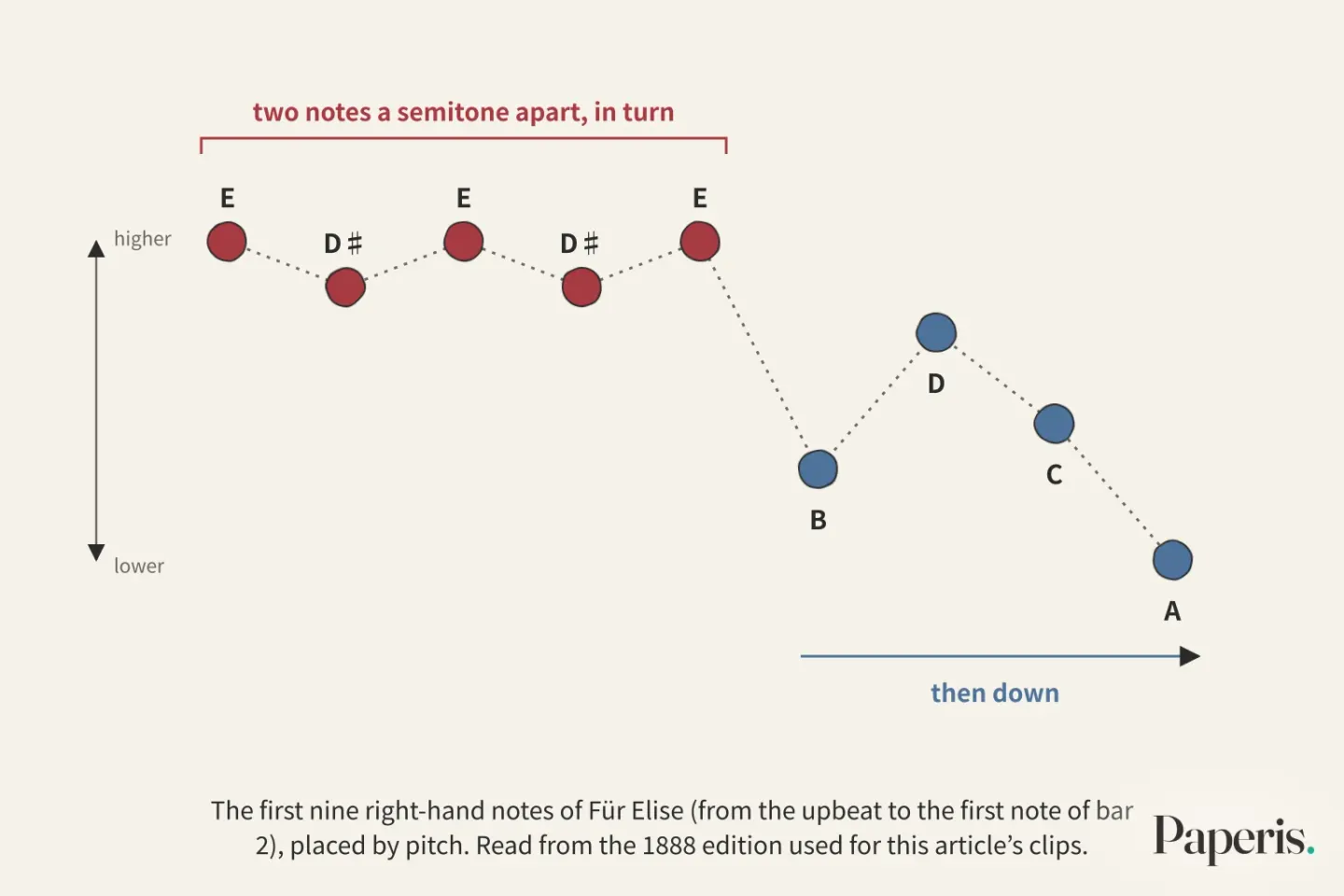
There are times when such a short snippet plays over and over in your head all day. You hear it even though you did not listen to it, and even when you try to stop it, it starts all over again. That is the question of this article. Why do certain melodies repeat on their own inside the head? Is it because of the nature of the song, or because of the listener and the circumstances of that moment? We clarify this first. Research that directly played "Für Elise" and measured the results is not among the evidence found for this article. The answers come from music psychology studies using other songs and survey respondents, and this piece is a place to test those results with our ears.
Names Attached to the Music in Your Head
Musical imagery is the experience of recalling music as if hearing it, even though no actual sound is playing. You can recall it intentionally, or it can come to mind on its own. Researchers give a separate name to the latter. Involuntary musical imagery is musical imagery that comes to mind and continues on its own without you trying to recall it. This experience commonly appears as a short snippet of melody repeating in your head (PMID 32583211). An earworm is the everyday term for this very phenomenon of a snippet of melody repeating itself automatically in your head.
Earworms are not rare. In a survey asking 12,519 Finnish internet users about their past experiences, 89.2% answered that they experience them at least once a week (DOI: 10.1177/0305735611406578). One review that collected and read 33 peer-reviewed papers and 47 studies published up to that point organizes this phenomenon as a well-established one backed by accumulated consistent results. However, the authors note the limitation that the study subjects are skewed toward educated people in the West, yet conclude that the evidence still depicts this as a universal psychological phenomenon (PMID 32583211). The frequency comes out differently depending on the sample. In a study surveying 426 people in mainland China, the frequency of earworms came out lower than in Western samples. The abstract of this study does not state the cause of that difference (DOI: 10.1177/1029864920948572).
Being common and being distressing are different stories. In a study that had people keep a diary following a survey, earworms visited most respondents frequently, but most of the time they were not unpleasant (DOI: 10.1525/mp.2011.28.4.425). When two research laboratories in Finland and the UK classified 1,046 reports describing how people reacted to earworms using the same method, many of the cases were neutral or pleasant experiences (PMID 24497938). A study surveying a sample of South African students adds one thing to this. The more frequent a person's earworms were, the lower their degree of feeling negatively about earworms actually was. In the same study, "earworm frequency" and "involuntary musical imagery frequency" were strongly linked, but the overlapping share was only 36.8%, so the authors report that this matches the concern that definitions greatly influence self-reports, and write that we should not treat earworms as the exact same thing as involuntary musical imagery (DOI: 10.1177/10298649211028643).
There is one thing to take away from this section. The experience of a song spinning in your head is an ordinary thing that the vast majority experience, and it is usually not distressing.
When They Strike
There is a study that classifies "the moment an earworm started" written down by radio listeners and online survey respondents. The starting situations were grouped into four categories: right after listening to music, when something touched a memory, during a specific mood, and when attention was loose (DOI: 10.1177/0305735611418553). In a study using both surveys and diaries, earworms were also frequently connected to recent instances of listening to the favorite music (DOI: 10.1525/mp.2011.28.4.425).
First are the number of listens and the timing. In an experiment where unfamiliar songs were played 2 times or 6 times and then participants were asked at random intervals over three days (36 people), those songs popped into the head more often the more familiar they were through repeated listening and the earlier it was after listening. Whether the song was connected to the person's life and thought about deeply made no difference (DOI: 10.1177/0305735613511506). In an online-conducted induction experiment, by giving clues and having participants recall tunes, matching familiarity could trigger earworms in over half of the participants. In this experiment, repeated exposure to that music in the recent past was a stronger predictor than very recent listening, and the authors conclude that recent recall helps earworms but is not a strictly necessary condition (DOI: 10.1177/1029864912440770). There is another experiment pointing in the same direction. When four unfamiliar song choruses were played 1 to 4 times each, and the next day participants were made to do a task of recalling items in order during and after each song played (44 people), songs heard more the previous day tended to interfere more with task performance at that time. However, that effect varied by song (PMID 36622014). Here, "interference" is not a value that directly measured earworms, but a value measuring the degree to which singing along in the head overlaps with the memory task.
Next is the phenomenon where the first few notes pull the rest along. There is an experiment where after four short new songs with numbers from 1 to 10 put to lyrics were learned 10 or 30 times, only the front part of the melody was played and participants were instructed "do not sing the rest in your head." One-third of the participants experienced the melody continuing on its own despite the instructions (DOI: 10.5539/ijps.v18n2p47). In this experiment, with just the front part of the learned song, the rest followed for some of the people who had been given instructions not to do so.
The last is the moment when the mind is idle. The relationship between cognitive load and mind music has been mixed among previous studies. After showing 200 people two movie trailers with only music and no dialogue, they were made to either close their eyes for 5 minutes or perform a dot task with varying difficulty. Then, rather than asking about earworms directly, it was measured through a questionnaire recording brain activity during that time. Of those who only closed their eyes, 65% reported mind music, and for those who did the easiest task, it dropped to 32.5%. It was lower in harder tasks, but there was no difference between the medium and high difficulty levels. Even 24 hours later, 21% reported that music. The authors view these results as supporting the hypothesis that the more spare brain capacity there is, the more easily earworms occur (DOI: 10.1080/17470218.2016.1227860).
Putting these results side by side across a single day looks like this. Since no single study followed such a day, this scene is a hypothetical scenario gathering the results. Suppose you heard "Für Elise" a couple of times somewhere in the morning. The 36-person experiment reported that songs heard multiple times and earlier after listening came to mind more frequently. In another induction experiment, repeated exposure in the recent past was a stronger cue than very recent recall. The time spent tackling demanding brain work in the afternoon resembles the situation of the people doing the dot task, and under that condition, reports of mind music decreased. The moment of looking out the car window with nothing to do on the commute home is close to the condition of resting with eyes closed, and reports were highest under that condition. However, because that experiment measured the 5 minutes right after watching the trailer, the length of time differs from a day with several hours stretching between morning and evening. If the first few notes start spinning again at that moment, the three clues pinpointed separately by the studies are that the song was familiar, had been heard multiple times in the recent past, and the mind was empty. There is no research found in this article showing that when these three overlap, an earworm definitely arrives.
The conclusion of this section is this. There are experiments showing that songs heard multiple times and in the recent past come to mind more often, and there are experiments showing more mind music reports under idle mind conditions. In studies investigating everyday earworms through surveys and diaries, the tunes spinning in people's heads varied from person to person, but they were always songs familiar to that individual (PMID 19948084).
What Properties of a Song Stick?
Then what about the song itself? There is a saying that fast songs or songs with lyrics get stuck better, and studies asking about past experiences have reported such links. There is a study that directly tested this. In the first study surveying 263 people, the tempo and presence of lyrics in the music people usually listened to predicted the content of their earworms and actually resembled it. In a second experiment where 80 people were made to listen to fast and slow songs, and songs with and without lyrics, tempo did not predict whether an earworm came to mind, and the presence of lyrics affected the duration for which the earworm continued. The authors conclude that earworms are a different experience for everyone who listens to them, brought on by that person's music-listening habits and music engagement (DOI: 10.1525/mp.2022.39.3.320). In light of this result (our interpretation), some of the links that seemed to be properties of the song may have instead been properties of the music the listener usually chose. This study did not directly separate the two.
There are also studies that directly compared the songs themselves. When 3,000 survey participants gathered songs they picked as earworms, songs that were more successful on the UK music charts and charted more recently were picked more often. The research team paired 100 frequently picked songs with 100 songs that were never picked, matching them for popularity and song style, and then compared 83 melody characteristics. Compared to a large collection of pop songs, the songs picked as earworms had melody up-and-down contour shapes that were more common in that collection than the unpicked songs, and the average steepness between points where the melody changed direction was less common. This comparison was viewed through statistics within a large pop song collection. Earworm songs also had a faster average tempo (DOI: 10.1037/aca0000090). The compared songs were pop songs picked from the survey, and popularity was measured based on the UK charts.
Tempo turned out differently between these two studies. In the experiment where 80 people listened to fast and slow songs, tempo did not predict whether an earworm came to mind (DOI: 10.1525/mp.2022.39.3.320), whereas in the study comparing pop songs picked from a survey, earworm songs were faster on average (DOI: 10.1037/aca0000090). One side is a design where earworms were elicited in a lab, while the other is a design gathering and comparing songs people already experienced, so it is difficult to put both results on the same scale and judge which side is right.
There is also an argument pointing to repetition within a song. A chapter in a book dealing with musical illusions writes that the frequent repetition of phrases within a single song could be another source of earworms, and notes that such devices are very common in modern popular music. The same chapter also argues that the current "fad" of earworms is due in part to ubiquitous background music and almost nonstop music listening (DOI: 10.1093/oso/9780190206833.003.0009). This is an argument by the author, not an experimental result. There are also more specific hypotheses. A theoretical paper predicts that if an earworm is the same snippet looping continuously in the head, then uninterrupted repetition must have been included within the song when that music was engraved in memory. It also predicts that such looping happens when a person pays less attention to their surroundings. This idea clashes with the view that the catchiest part of a song usually loops. The author writes that this prediction must be confirmed through more structured experiments (DOI: 10.1177/20592043231165661). This is a hypothesis that has not yet been verified.
Trying this hypothesis on "Für Elise" is a hypothesis. Among the evidence found by this article, there is no study measuring this song. First, let's listen to one round of the first theme.
Clip: Beethoven, Für Elise, WoO 59, opening theme (upbeat through bar 8) (synthesized piano; 1888 Breitkopf & Härtel edition; score input Mutopia Project, public domain)
The melody starting with E-D#-E-D#-E-B-D-C produces the same start one more time in bar 5, and closes on A in bar 8. Counting with the sheet music file we used, the first five-note motif E-D#-E-D#-E returns every time the first theme returns. This is at the beginning of the song, in the middle (around bar 52), and near the end (around bar 96). The return of this motif in the middle and near the end of the song is a repetition that returns with gaps in between, unlike the continuous repetition the hypothesis talks about. The entire song is not made of only this motif. Once the first theme ends, passages with different melody shapes follow.
Clip: Beethoven, Für Elise, WoO 59, bars 23–30 (synthesized piano; 1888 Breitkopf & Härtel edition; score input Mutopia Project, public domain)
This passage from bar 23 to bar 30 has more notes in the same eight bars. While the first theme's bars 1 to 8 combine both hands for 56 notes, this passage has 95 notes. If the above hypothesis is right, a snippet that repeats continuously within the song—like the first figure that alternates E and D# twice right away—could become the material for looping in the head. This is merely trying the hypothesis on this song. There is no study found by this article that played this song and measured which passage remains in the head, and the hypothesis itself has not yet been confirmed. "Für Elise" has no lyrics, and it is also unknown how experiments showing that the presence or absence of lyrics affects earworm duration would act upon this song.
No study found by this article has measured the melody shape and tempo—which the pop song comparison study looked at—in "Für Elise". This article cannot judge how this comparison based on a pop song collection would apply to this piece, which is a piano piece. To summarize, there are also clues on the song side. The presence of lyrics affected duration in experiments, and the pop song comparison showed differences in chart success and melody shape. However, studies measuring the song side are fewer among those found by this article, results for tempo were mixed, and repetition within the song still remains at the level of arguments and hypotheses.
How Faithful Is Mental Playback?
If earworms come from memory, how much does the tune spinning in your head resemble the original? There is a study where participants wore accelerometers on their wrists for four days and tapped their hands to the beat whenever music played in their heads. The tempo of the music in the head was revived very closely to the original song from long-term memory. However, the recalled tempo tended to be pulled toward the average. The higher the arousal state felt by the individual at that moment, the more the music in the head tended to be fast (PMID 26122757). When 20 people were asked for three days twice—once to record songs that popped up spontaneously and once to intentionally recall the same song—to compare them, the two tempos showed a strong correlation, and the intentionally recalled side was not even more accurate (PMID 29380139).
Pitch is similar. Absolute pitch is the ability to name a heard pitch without a reference note, or to produce a pitch of that height upon hearing only its name. It is a very rare ability in Western English-speaking regions. Yet, when 30 people were made to sing aloud and record the music spinning in their heads at random times over a week, 44.7% of the recordings were the exact same pitch as the original song, and 68.9% fell within one semitone. This is the result of a convenience sample of 30 people, and the authors view this as new evidence that many people are using pitch memory equivalent to absolute pitch in mental playback (PMID 39134919). The idea that a song still sounds like the same song even when sung in a raised key was covered in "Pitch and Intervals — Raise the Key and It's Still the Same Song; Vibrate Twice as Fast and It Keeps Its Name". This study shows that mental playback held onto the original pitch nearly half of the time.
We can picture this result as a single scene using the opening motif of "Für Elise". This is also a hypothesis. The studies above did not use this piece. If this piece spins in someone's head, according to the results above, that playback would be close to the tempo of the version that person has listened to, though it might be pulled slightly toward the average, and E and D-sharp would ring near their original pitches as well. The earworms painted by these studies are a matter of quite faithfully replaying the sound that memory has preserved.
When Trying to Shake It Off
What people reported doing to shake off an earworm is split in two. In a study combining surveys and diaries, actively trying to block or get rid of it was less successful than simply accepting it. The authors view this as matching the psychological theory that the more you try to suppress a thought, the more that thought comes to mind. In the diaries of this study, the return of the same earworm was relatively rare, and the likelihood of it lasting over 24 hours was also low (PMID 19948084). In a study classifying 1,046 response reports, accepting and enjoying the response was among the most common, but not a few people also struggled to cope with unwanted earworms. The methods they reported using most often and finding most effective were seeking out and listening to that song, and distracting themselves with other music or speech. The authors put these results forward as hypotheses to be tested in the future (PMID 24497938).
These results are all people's self-reports. Experiments randomly assigning methods and comparing them are not in the evidence for this article. The dot-probe experiments seen earlier measured whether earworms arise, not the effect of shaking off an earworm that has already formed. In one study, the accepting side fared better than the blocking side, and in another study, seeking out the song or distracting with other music or speech was reported to be most effective. A study weighing both results on the same scale is not in the evidence found by this article.
Earworms Differ by Person
There are people who experience earworms often and those who experience them rarely. In a large-scale Finnish survey, the more people practiced and listened to music, the more frequent their earworms were; women reported them more often than men, and the frequency decreased toward older age groups. People who had practiced music for a long time tended to experience longer snippets and instrumental music without lyrics more often, and were less bothered by earworms (DOI: 10.1177/0305735611406578). In a study analyzing 1,536 online survey respondents, people who habitually sang often had longer earworms, and those who listened to a lot of music experienced earworms more frequently. No relationship was seen with musical training background (DOI: 10.1525/mp.2014.31.4.323). In the study of 263 people seen earlier, what predicted earworm frequency was how intensely one engaged with music, not musical training. However, musical training predicted how long a single earworm lasted. The authors of the same study also note that results on the relationship between musical training and earworms vary across studies (DOI: 10.1525/mp.2022.39.3.320).
Mental habits are also involved. In the study of 1,536 people, those with high sub-clinical obsessive traits experienced earworms more frequently and found them more bothersome (DOI: 10.1525/mp.2014.31.4.323). Experience sampling is a research method where participants are asked at random times during the day, such as via mobile phone notifications, to immediately write down what they are experiencing at that exact moment. Unlike surveys that ask people to recall past events, it captures the moment experiences happen. In an experience sampling study that sent notifications six times a day for seven days to 101 college students, earworms visited more frequently the stronger people's sub-clinical tendency for unwanted thoughts to keep intruding was (PMID 32497111). People with a strong tendency to intentionally push away thoughts that come to mind reported that their earworms were longer, more disruptive, and harder to shake off. However, this tendency did not connect to earworm frequency (DOI: 10.1177/1029864913492530).
So who finds earworms distressing? In the first study where 200 people answered a survey, the feeling of intrusion moved together with the negative experience of earworms, but moved separately from frequency. In a second study investigating 203 people, rumination bridged the gap between having frequent earworms and feeling distressed by them. Rumination is a thinking habit of chewing over and repeating the same worries or thoughts in one's head like food. The authors suggest that why earworms are distressing to only certain people cannot be explained by content or frequency alone, and that the cause of annoyance should be sought in the person doing the thinking rather than the thought itself (PMID 37716016). Musical obsessions are a form of involuntary musical imagery that is distressing and disrupts daily life, and are reported as a distinct form separate from ordinary earworms. A review collecting 96 such cases notes that musical obsessions may be underdiagnosed because they are not well captured by current obsessive-compulsive disorder assessment tools (PMID 24997394).
Here is what to take away from this section. How frequent earworms are goes together with how much one listens to, sings, and engages with music, while how distressing they are goes together with thinking habits like rumination.
What We Still Don't Know
We still do not know why earworms exist or what use they are. A review gathering 47 studies notes that its function is still not fully understood (PMID 32583211). What properties of a song summon an earworm is also an open question. The hypothesis pointing to seamless repetition within a song awaits confirmation (DOI: 10.1177/20592043231165661), and studies on tempo showed conflicting results between experiments and song comparison research (DOI: 10.1525/mp.2022.39.3.320, DOI: 10.1037/aca0000090). Melody shape research came from a bunch of UK chart pop songs. The limitation also remains that most of the evidence came from Western samples (PMID 32583211). And research measuring how much and which part of the single song "Für Elise" remains in the head is not in the evidence this article found.
So
We return once again to the first few notes. If the fragment alternating between E and D-sharp is spinning in someone's head, the clues captured in greater number by the research gathered in this article lie on the listener's side. These include whether they have heard it multiple times in the recent past, whether their mind is free at that moment, and how much and what kind of music they usually listen to and sing. There are also clues on the side of the song. The presence of lyrics made a difference in how long an earworm lasts, melody shape and chart success made a difference in whether a song is selected as an earworm, and findings on tempo were mixed. However, in the evidence found by this article, there are fewer studies measuring the song side, and no studies measuring whose share is larger. The melody spinning in your head is summoned not just by the properties of the song, but together by the listener's listening habits, memory, and state at that moment. The authors of studies surveying 263 people and 80 people view earworms as an experience that differs from person to person (DOI: 10.1525/mp.2022.39.3.320). Whether that melody is distressing, according to the conclusion of one study, is not explained solely by the song's content or frequency, but is connected to habits of thought like rumination.
Source Papers
- "ESTETIKA MUSIK PADA STRUKTUR MELODI FUR ELISE KARYA LUDWIG VAN BEETHOVEN" (2022) — DOI: 10.26740/rj.v3n1.p56-62 — Analysis of the melodic structure of Bagatelle No. 25 in A minor, WoO 59, in 3/8 time with an A A′ B A″ form.
- "Involuntary musical imagery as a component of ordinary music cognition: A review of empirical evidence." (2020) — PMID 32583211 — Review of 33 papers and 47 studies showing consistent results and a universal phenomenon, a bias toward Western-educated samples, and functions not yet fully understood.
- "Musical activities predispose to involuntary musical imagery" (2011) — DOI: 10.1177/0305735611406578 — Survey of 12,519 Finnish internet users, with 89.2% experiencing it at least once a week, linked to practice, listening amount, gender, and age.
- "Validation of the Chinese Involuntary Musical Imagery Scale and its Application in Mainland China" (2020) — DOI: 10.1177/1029864920948572 — 426 people in mainland China, showing lower frequency than Western samples.
- "The Persistence of Musical Memories: A Descriptive Study of Earworms" (2011) — DOI: 10.1525/mp.2011.28.4.425 — Survey and diary study showing that they are common, frequent, linked to recent exposure, and mostly not unpleasant.
- "Sticky tunes: how do people react to involuntary musical imagery?" (2014) — PMID 24497938 — 1,046 reaction reports from Finland and the UK, finding that many cases are neutral or pleasant, and that listening to the song and distracting oneself with music/speech are reported as the most common and effective responses, presented as a hypothesis to be tested.
- "Psychometric evaluation of the Involuntary Musical Imagery Scale (IMIS) in a South African sample" (2021) — DOI: 10.1177/10298649211028643 — Negative affect correlated positively with frequency, with earworm frequency and INMI frequency sharing 36.8% of variance.
- "How do “earworms” start? Classifying the everyday circumstances of Involuntary Musical Imagery" (2011) — DOI: 10.1177/0305735611418553 — Four categories of starting circumstances: music exposure, memory cues, emotional states, and low attention.
- "Repetition and recency increases involuntary musical imagery of previously unfamiliar songs" (2013) — DOI: 10.1177/0305735613511506 — 36 people, 2 versus 6 exposures, showing that greater familiarity and earlier timing lead to higher frequency, while processing depth is irrelevant.
- "Inducing involuntary musical imagery: An experimental study" (2012) — DOI: 10.1177/1029864912440770 — Internet induction experiment, inducing it in over 50% when familiarity is controlled, with recent repeated contact as a stronger predictor.
- "The song that never ends: The effect of repeated exposure on the development of an earworm." (2023) — PMID 36622014 — 44 people, 1 to 4 exposures, showing a tendency for next-day sequence recall interference to grow with more exposure, varying by song.
- "Involuntary Musical Imagery Elicited by the Reflexive Imagery Task" (2026) — DOI: 10.5539/ijps.v18n2p47 — After learning new songs 10 or 30 times, presenting the beginning with instructions not to continue singing, resulting in one-third experiencing involuntary imagery that continues on its own.
- "A Novel Indirect Method for Capturing Involuntary Musical Imagery under Varying Cognitive Load" (2017) — DOI: 10.1080/17470218.2016.1227860 — 200 people, baseline 65%, low load 32.5%, 24 hours later 21%, supporting the available cognitive capacity hypothesis.
- "Earworms (stuck song syndrome): towards a natural history of intrusive thoughts." (2010) — PMID 19948084 — Always familiar songs, recurrence is rare and difficult to exceed 24 hours, and active blocking is less successful than passive acceptance.
- "The Idiosyncrasy of Involuntary Musical Imagery Repetition (IMIR) Experiences" (2022) — DOI: 10.1525/mp.2022.39.3.320 — Survey of 263 people: listening habits predict earworm content, absorption predicts frequency, and education predicts persistence / Experiment with 80 people: tempo does not predict earworm emergence, lyrics affect persistence, and experiences are idiosyncratic.
- "Catchy Music and Earworms" (2019) — DOI: 10.1093/oso/9780190206833.003.0009 — Book chapter arguing that constant background music exposure and the repetition of phrases within a song are sources of earworms.
- "Involuntary, Limited, and Contiguously Repeating Musical Imagery (InLaCReMI): Reconciling Theory and Data on the Musical Material Acquired by Earworms" (2023) — DOI: 10.1177/20592043231165661 — Theoretical paper hypothesizing that seamless looping arises from music with seamless repetition during encoding and when peripheral attention is low, requiring empirical confirmation.
- "The speed of our mental soundtracks: Tracking the tempo of involuntary musical imagery in everyday life." (2015) — PMID 26122757 — Four days of accelerometer tapping, showing that tempo is reproduced very faithfully, with regression to the mean and a positive relationship with arousal.
- "Involuntary and voluntary recall of musical memories: A comparison of temporal accuracy and emotional responses." (2018) — PMID 29380139 — 20 people, strong correlation in tempo between spontaneously recalled and intentionally recalled songs, with intentional recall not being more accurate.
- "Absolute pitch in involuntary musical imagery." (2024) — PMID 39134919 — Convenience sample of 30 people, with 44.7% of recordings matching the original pitch and 68.9% within ±1 semitone.
- "Individual Differences Predict Patterns in Spontaneous Involuntary Musical Imagery" (2012) — DOI: 10.1525/mp.2014.31.4.323 — 1,536 people, singing leads to length, listening leads to frequency, music education is irrelevant, and obsessive tendencies lead to frequency and annoyance.
- "Individual traits that influence the frequency and emotional characteristics of involuntary musical imagery: An experience sampling study." (2020) — PMID 32497111 — Experience sampling of 101 college students 6 times a day for 7 days, showing a positive relationship between intrusive thought proneness and occurrence.
- "Individual differences in mental control predict involuntary musical imagery" (2013) — DOI: 10.1177/1029864913492530 — Thought suppression tendency is linked to length, disturbance, and difficulty shaking it off, but not to frequency.
- "The aversiveness of intrusiveness: Evidence from involuntary musical imagery." (2024) — PMID 37716016 — Surveys of 200 and 203 people, showing that the sense of intrusion is shared with negative experiences but unrelated to frequency, rumination mediates frequency leading to negative experiences, and the cause lies with the thinker.
- "Dissecting an earworm: Melodic features and song popularity predict involuntary musical imagery" (2017) — DOI: 10.1037/aca0000090 — Earworm songs named by 3,000 people, with chart success and recency making them more frequently named, comparing 83 melodic features across 100 songs: overall contour is more common, slope between inflection points is less common, and average tempo is faster (UK chart pop).
- "Musical obsessions: a comprehensive review of neglected clinical phenomena." (2014) — PMID 24997394 — Review of 96 cases, noting that distressing musical obsessions are not well captured by current obsessive-compulsive disorder evaluations, potentially leading to underdiagnosis.
Sources (26)
- ESTETIKA MUSIK PADA STRUKTUR MELODI FUR ELISE KARYA LUDWIG VAN BEETHOVENDOI 10.26740/rj.v3n1.p56-62
- Involuntary musical imagery as a component of ordinary music cognition: A review of empirical evidencePMID 32583211
- Musical activities predispose to involuntary musical imageryDOI 10.1177/0305735611406578
- Validation of the Chinese Involuntary Musical Imagery Scale and its Application in Mainland ChinaDOI 10.1177/1029864920948572
- The Persistence of Musical Memories: A Descriptive Study of EarwormsDOI 10.1525/mp.2011.28.4.425
- Sticky tunes: how do people react to involuntary musical imagery?PMID 24497938
- Psychometric evaluation of the Involuntary Musical Imagery Scale (IMIS) in a South African sampleDOI 10.1177/10298649211028643
- How doDOI 10.1177/0305735611418553
- Repetition and recency increases involuntary musical imagery of previously unfamiliar songsDOI 10.1177/0305735613511506
- Inducing involuntary musical imagery: An experimental studyDOI 10.1177/1029864912440770
- The song that never ends: The effect of repeated exposure on the development of an earwormPMID 36622014
- Involuntary Musical Imagery Elicited by the Reflexive Imagery TaskDOI 10.5539/ijps.v18n2p47
- A Novel Indirect Method for Capturing Involuntary Musical Imagery under Varying Cognitive LoadDOI 10.1080/17470218.2016.1227860
- Earworms (stuck song syndrome): towards a natural history of intrusive thoughtsPMID 19948084
- The Idiosyncrasy of Involuntary Musical Imagery Repetition (IMIR) ExperiencesDOI 10.1525/mp.2022.39.3.320
- Catchy Music and EarwormsDOI 10.1093/oso/9780190206833.003.0009
- Involuntary, Limited, and Contiguously Repeating Musical Imagery (InLaCReMI): Reconciling Theory and Data on the Musical Material Acquired by EarwormsDOI 10.1177/20592043231165661
- The speed of our mental soundtracks: Tracking the tempo of involuntary musical imagery in everyday lifePMID 26122757
- Involuntary and voluntary recall of musical memories: A comparison of temporal accuracy and emotional responsesPMID 29380139
- Absolute pitch in involuntary musical imageryPMID 39134919
- Individual Differences Predict Patterns in Spontaneous Involuntary Musical ImageryDOI 10.1525/mp.2014.31.4.323
- Individual traits that influence the frequency and emotional characteristics of involuntary musical imagery: An experience sampling studyPMID 32497111
- Individual differences in mental control predict involuntary musical imageryDOI 10.1177/1029864913492530
- The aversiveness of intrusiveness: Evidence from involuntary musical imageryPMID 37716016
- Dissecting an earworm: Melodic features and song popularity predict involuntary musical imageryDOI 10.1037/aca0000090
- Musical obsessions: a comprehensive review of neglected clinical phenomenaPMID 24997394