Paperis Articles
Gymnopédie No. 1 — Does Music Ease Anxiety, and Does the Pulse Follow?
Starting from an 1888 piano piece marked “slow and painful,” we follow the trials that measured whether music reduces anxiety and stress. Self-reported anxiety fell repeatedly; machine-measured bodies moved less, and in some analyses not significantly.
Your field's papers, as audio
Pick your fields and journals — Paperis summarizes the key papers and turns them into audio. Listen on your commute.
Start Paperis free →Gymnopédie No. 1 — Does Music Ease Anxiety, and Does the Pulse Follow?
A Piece Marked "Slowly, Painfully"
The French composer Erik Satie wrote three piano pieces called "Gymnopédies" in 1888, of which the first is "Gymnopédie No. 1." At the beginning of the sheet music for this 3/4-time piece is the expression "Lent et douloureux." It means "slowly and painfully." The initial dynamic is pp, which means very softly. The tempo is marked only as "slowly" with no specific number given.
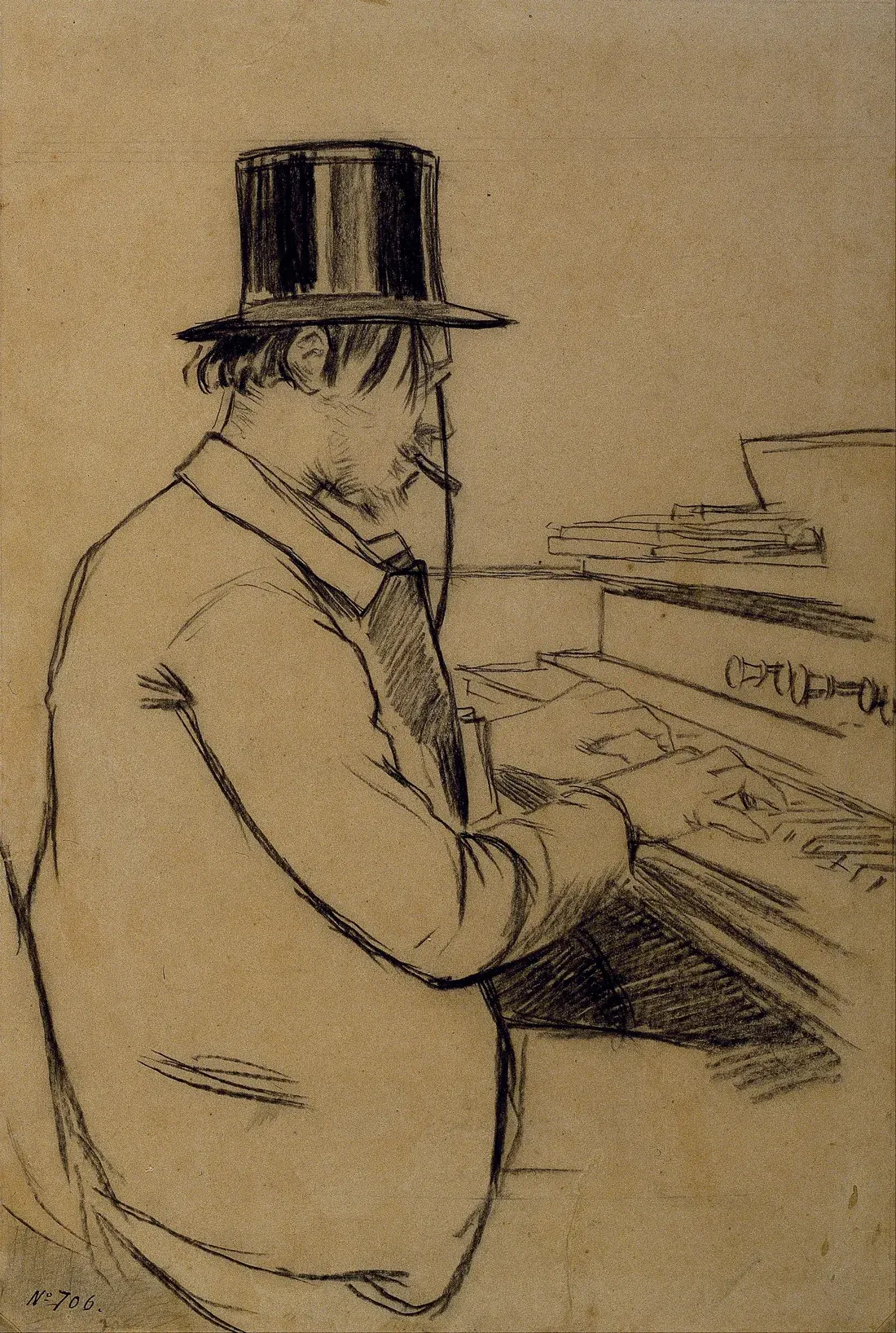
Erik Satie at the harmonium · Santiago Rusiñol (1891) · Museu Nacional d’Art de Catalunya · public domain · Wikimedia Commons
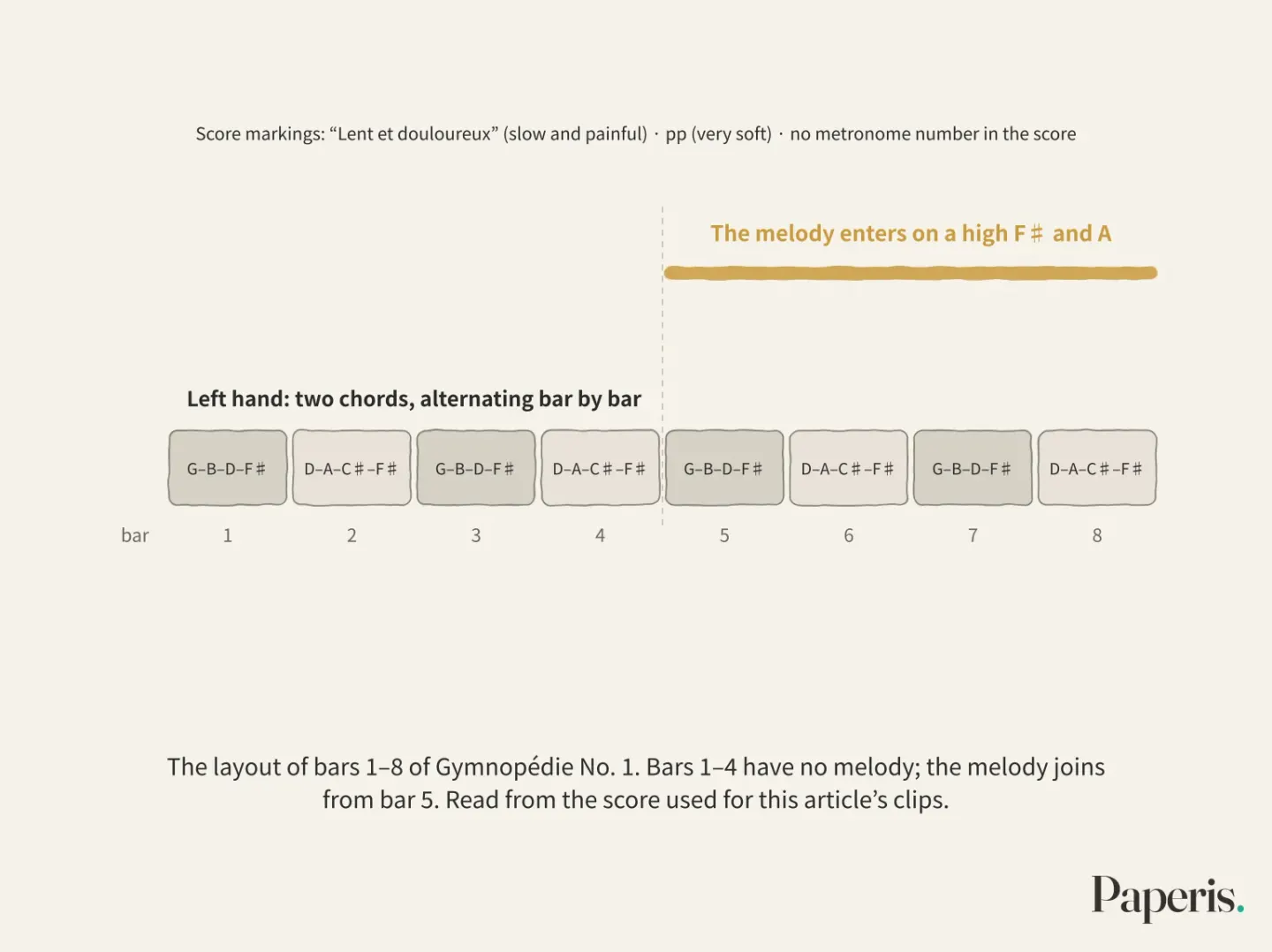
The first four measures of the piece have no melody. The left hand simply alternates playing two four-note chords—G-B-D-F# and D-A-C#-F#—one per measure. The melody enters in measure 5 with a high F# and A, and then measures 9 through 12 return to alternating between the just two chords. The clip below is a synthesized piano performance of measures 1 through 8 of this piece. We set the tempo to one second per quarter note (quarter note = 60). After the two chords alternate for four measures, the high melody is layered on top starting from measure 5.
Clip: Satie, Gymnopédie No. 1, bars 1–8 (synthesized piano; score input Mutopia Project, public domain)
Taking this piece as our entry point, we ask two questions: Does listening to music truly reduce anxiety and stress, and what does the slow and soft character of a piece like this add to that answer? The evidence this article relies on does not include experiments that directly played "Gymnopédie No. 1" and measured anxiety or pulse. The answers come from studies using other music. In trials that specified the music, the selections were chosen by patients or came from their own or app playlists, and one review that gathered biomarkers noted that many studies used classical music. The abstracts of analyses pooling multiple trials generally did not separately specify whether the pieces were slow or quiet, and only one 2026 conference abstract measured tempo. The property of a slow tempo is addressed only to the extent indicated by a few experiments that specifically examined tempo. Sentences applying the research findings to this piece remain hypothetical throughout.
When You Play Music for Someone Waiting for Surgery
A trial published in 2002 divided 93 adults facing anesthesia and surgery into two groups. Forty-eight listened to music of their choice for 30 minutes, and 45 received no intervention (PMID 12032013). Chance decided who went into which group. A randomized controlled trial is an experiment where participants are assigned by chance, like drawing lots, into two or more groups, and only one group receives an intervention like music while the results are compared. Leaving it to chance makes it less likely that the two groups were different people to begin with, making it easier to attribute later differences to the music.
This trial measured two things. One is anxiety measured by a questionnaire. State anxiety is the degree of anxiety felt at this very moment, measured in studies by scores from self-reported questionnaire items. The group that listened to the music saw their state anxiety drop by 16% compared to before listening, while the control group showed no distinct change. The other is bodily indicators. Heart rate, blood pressure, electrical responses of the skin, and stress hormones in the blood showed no difference between the two groups (PMID 12032013). The authors wrote in their conclusion that "under the conditions of this study," patients who listened to music reported less anxiety, while bodily outcomes were no different. In this single trial, the mind answered by self-reporting and the body measured by machines gave different answers.
A single trial is swayed by chance. A meta-analysis is a method that gathers the results of multiple studies tackling the same question and recalculates them all at once. A 2013 Cochrane systematic review gathered 26 trials covering preoperative anxiety involving 2,051 people. Every trial played pre-recorded music. The state anxiety score of the side that listened to music dropped by an average of 5.72 points more than the side that received only standard care. Small effects were seen in heart rate and diastolic blood pressure, and there was no support showing that systolic blood pressure, respiratory rate, and skin temperature decreased (PMID 23740695).
The same review judged most of the trials to be at high risk of bias. Because listeners know whether they heard music and rate their own anxiety directly, blinding is usually impossible in trials unless music is compared against another intervention. The authors therefore wrote that the results should be interpreted with caution. In their conclusion, the 2013 authors viewed music as a potential alternative to sedatives and anti-anxiety medications used before surgery to reduce anxiety in preoperative patients. This conclusion stands upon trials with a high risk of bias, which the authors themselves wrote should be interpreted with caution (PMID 23740695).
Another meta-analysis from 2018 gathered 92 trials with 7,385 participants of adult patients who listened to music around the time of surgery, calculating outcomes with 81 of them. Music reduced anxiety compared to control conditions, with an effect size of 0.69 (PMID 29665028). Effect size is a value that compares the average difference between two groups to the spread of their scores, serving as a number that allows studies using different trials to be lined up and compared. The authors explained that translating this value onto an anxiety scale stretching from 0 to 100 corresponds to a reduction of 21. The same analysis evaluated the risk of bias across the studies as moderate to high, and the conclusion was that music interventions reduce anxiety and pain in adult patients undergoing surgery (PMID 29665028). A 2023 meta-analysis gathering 30 recent surgical patient trials from the past decade with 2,280 people found that along with anxiety, systolic blood pressure (by an average of 4.62 mmHg) and heart rate (by an average of 3.37 beats per minute) also decreased more than with standard care, and the authors concluded that music interventions reduce anxiety, pain, and bodily responses in surgical patients (PMID 37276961).
While multiple meta-analyses have repeated the pattern where anxiety self-reported by adults waiting for or undergoing surgery decreases more in the group that listened to music, the Cochrane and 2018 analyses evaluated the risk of bias in those trials as high, or moderate to high. The subjects of these results are patients waiting for or undergoing surgery. Healthy office workers on their commute are not among them.
Did Pulse, Blood Pressure, and Cortisol Move Together?
In a 2018 systematic review covering 44 studies on recorded music and biological markers, cortisol was the most frequently analyzed indicator (PMID 29779734). Cortisol is a hormone released in greater amounts when experiencing stress, and studies measure its quantity by collecting saliva or blood. Among the 44 studies in that review, 27 were in clinical settings like hospitals, and 17 were in other settings. Out of 33 tested indicators, 13 were reported to change in response to music, and cortisol emerged in half of the clinical studies as shifting toward reduced stress. The effect appeared regardless of genre, whether participants chose the music themselves, or listening duration, though many studies used classical music. The authors noted that while the evidence is still accumulating, there is support for using music listening to reduce stress, especially in clinical settings (PMID 29779734).
A 2020 analysis pooling 104 randomized controlled trials of music interventions with 9,617 participants found a significant stress-reducing effect in both bodily indicators (effect size 0.380) and mental indicators (0.545). Among bodily indicators, heart rate (0.456) showed a larger effect than blood pressure (0.343) or hormones (0.349) (PMID 31167611). In this analysis, the body moved together with a smaller magnitude than the mind.
In other sets, bodily indicators were not significant. A multilevel meta-analysis published in 2025 gathered 51 music therapy trials designed and conducted by qualified music therapists tailored to patients. Self-reported anxiety showed a moderate effect size (0.410), while bodily indicators showed a small and statistically nonsignificant effect (0.153 across 13 trials). While the authors viewed music therapy—especially listening-based approaches or those mixing listening with active playing—as effective in reducing anxiety symptoms, they noted that bodily outcomes and long-lasting effects require further study (PMID 40547443). A 2017 meta-analysis gathering 19 randomized controlled trial papers targeting healthy individuals similarly found that self-reported anxiety decreased (effect size 0.30), while anxiety-related bodily signals did not decrease significantly. In a few studies, blood pressure, cortisol, and heart rate shifted substantially. The authors concluded that because the studies varied widely from one another and lacked methodological rigor, the results may have been skewed, and music listening should be considered cautiously as part of a more complex psychological intervention (DOI: 10.1177/0305735617712424).
A meta-analysis published in 2026 only as a conference abstract gathered 19 trials that played recorded music before and after procedures or surgeries (including laboratory settings), and calculated results using 8 of them. The effect size for self-reported anxiety was 1.14, but the difference between studies was very large, and the range plausible for the next single study spanned from a large decrease to the effect reversing in direction. Cortisol decreased in all three trials where it was measured. Music played during anesthesia consistently showed no effect, with the largest effects appearing before surgery and in laboratory settings. The authors concluded that pre-surgery music clinically and meaningfully reduced anxiety and bodily stress, adding that autonomic nervous system indicators were more consistent than self-reported anxiety (DOI: 10.1161/circ.154.suppl_1.16259). The 2025 analysis gathered therapies conducted by music therapists, whereas this conference abstract gathered recorded music, pooling different sets of studies.
There are also pitfalls on the survey side. A 2020 experiment played three pieces of music to 50 Germans. Listening to Pachelbel's "Canon" increased self-perceived calmness, listening to an electroacoustic piece decreased it, and Turkish music fell in between. Heart rate showed no difference across any of the pieces. The authors added that listeners may interpret whether survey statements are phrased positively or negatively depending on their state at the time, which can skew self-assessments (DOI: 10.1177/0305735620968902).
In the largest analysis, bodily indicators decreased with a smaller magnitude than mental indicators, and they were nonsignificant in analyses pooling only music therapy or healthy individuals.
Stress in Healthy People Outside the Operating Room
A 2001 experiment gave 87 college students (43 women, 44 men) the task of preparing a presentation. One group listened to Pachelbel's "Canon" while preparing, and the other group was in a quiet room. Students in the quiet room showed increases in self-reported anxiety, heart rate, and systolic blood pressure after the task, and those increases did not appear in the students who listened to music. This result was independent of gender (PMID 11796077). The structure of this piece was covered in "Pachelbel's Canon — Over the Same Eight Notes, What Is the Ear Waiting For?".
A 2013 experiment yielded a different answer. Sixty healthy women listened to one of three things before taking a standardized social stress test. The researchers chose Allegri's "Miserere" as relaxing music, the sound of splashing water, and silence with no sound. Cortisol responses after the stress test were highest in the music group and lowest in the water sound group. Alpha-amylase, another stress marker in saliva, returned to baseline levels much faster in the music group than in the rest group. There were no differences between the groups in heart rate and questionnaire indicators. The authors concluded that music acted mainly on the autonomic nervous system for faster recovery, and less on hormonal and psychological responses (PMID 23940541). In the same music group, one marker recovered quickly, while another marker turned out to be the highest among the three groups.
A 2024 experiment gave 105 healthy women a standard task called the Trier Social Stress Test and then divided them into four groups. They were given relaxing music chosen by the researcher, relaxing music chosen by themselves, water sounds, and silence. Stress measured by skin conductance and questionnaires showed no meaningful changes across the four conditions. In exploratory analyses, cortisol continued to rise in all conditions except the researcher-chosen music condition. The authors concluded that, except for that single trend, stress markers did not recover better after music (PMID 39024851).
Change the comparison group, and the results change too. Two 2019 experiments induced unpleasant moods in college students with speech preparation and mental arithmetic tasks, and then had them listen to music. In the first experiment (70 people), students who listened to music had a greater reduction in anxiety than students who sat in silence. In the second experiment (75 people), music did not reduce anxiety any more than a control group that listened to a radio talk show. The authors wrote that music may help regulate mood before stress, but other activities offer similar benefits (DOI: 10.1111/aphw.12185).
There is an analysis that gathers experiments like these. A meta-analysis released as a preprint (not peer-reviewed) in 2022 gathered 14 experiments with 706 people that assigned music or a control condition after inducing laboratory stress in healthy people. The cumulative effect of music on recovery was small at 0.15 and not statistically significant, and the differences between studies were large. The authors wrote that no definitive conclusion can currently be drawn about the effect of music on short-term stress recovery in healthy people (DOI: 10.31234/osf.io/erhvk).
When gathered through a preprint meta-analysis, music listened to by healthy people after experiencing stress in the laboratory has not led to the conclusion that it clearly accelerates recovery.
Slow Tempos and Arousal
A 2006 experiment played six styles of music in random order to 12 musicians and 12 age-matched non-musicians while measuring their breathing, blood pressure, and heart rate. With fast tempos and simple rhythmic structures, tidal volume, blood pressure, and heart rate rose compared to before listening to the music. During a 2-minute pause slipped in between, heart rate, blood pressure, and respiratory rate dropped even lower than the baseline before listening to the music (PMID 16199412). Arousal is the degree to which the body and mind are awake and stirred up. The authors concluded that music produces arousal effects primarily related to tempo, that slow or meditative music can induce relaxation, and that relaxation is especially pronounced during pauses (PMID 16199412).
A 2007 study compared 11 structural features of 16 music excerpts with listeners' bodily responses. The features that moved most strongly along with bodily indicators were tempo, accent, and whether notes were played staccato or legato. Music that sped up breathing and raised skin conductance and heart rate was fast, strongly accented, and staccato (PMID 17516815).
In a 2017 experiment, listening to slow music increased salivary oxytocin and lowered heart rate, but it was fast music that decreased salivary cortisol (PMID 29211795). A 2025 experiment compared participants' favorite smells and favorite music. Pleasant smells slowed breathing and lowered heart rate, music increased self-perceived arousal regardless of tempo, and it had no effect on the coupling between the autonomic nervous system and brain waves (PMID 41107329).
There are also results from surveys. An online survey released as a preprint in 2022 asked 470 people about tracks they chose to recover from stress, and the calmer and softer the songs were, the lower their self-perceived arousal was while listening (DOI: 10.31234/osf.io/tfeq2). In the earlier 2026 conference abstract, out of 11 studies reporting tempo, 10 showed that slow music below 80 beats per minute came out on the beneficial side (DOI: 10.1161/circ.154.suppl_1.16259). The 10 and 11 are counts of the number of studies.
Can these results be applied to "Gymnopédie No. 1"? The sheet music for this piece marks the tempo only as "slow" without a number, so the performer decides just how slowly to play it. The clip below is an example we made for comparison. It is the same measures 1–8 as the previous clip and the notes are identical, but the tempo is doubled to a quarter note equals 120. The two clips have their volume levels matched to the same standard.
Clip: Our example: Satie, Gymnopédie No. 1, bars 1–8 at double speed (synthesized piano; score input Mutopia Project, public domain)
The same eight measures pass in just under 14 seconds instead of roughly 26 seconds. Applying the results of 2006 and 2007 to this piece, the hypothesis stands that even with the same notes, the listener's body may respond differently depending on the tempo. An experiment playing these two tempos of the piece and measuring pulse is not among the evidence this article relies on. In the 2025 experiment, music increased self-perceived arousal regardless of tempo.
Who Chose the Music?
Self-selected music is music that participants choose for themselves, and the opposite is music predetermined by researchers. One randomized controlled trial divided 174 women scheduled for gynecological surgery into two groups. One group listened to a playlist they made themselves before admission, and the other group listened to a playlist predetermined by an app for 20 minutes, one hour before surgery. State anxiety scores decreased in both groups (5.5 points for the self-chosen group, 7.2 points for the predetermined group), and the difference was not statistically significant. Physiological indicators did not change after listening to music either. The authors concluded that self-chosen music reduces pre-surgical anxiety as much as predetermined music does (DOI: 10.1186/s13063-021-05511-2). This trial had no group that did not listen to music, so the effect of the music itself cannot be known here.
A 2023 experiment had 61 people submerge their hands in cold water over three days while listening to self-chosen music, researcher-chosen music, and the sound of splashing water. Who chose the music and the gender did not directly affect the stress response. However, looking at the interaction, women felt the highest self-perceived stress and had the longest heart rate recovery with self-chosen music, whereas men showed the lowest heart rate response to the cold water with self-chosen music. The authors noted that men tend to benefit more from self-chosen music than women do (PMID 37688892).
Two peer-reviewed meta-analyses found no relationship between who chose the music and the effect. A 2018 analysis pooling perioperative trials stated that there was no meaningful association between music selection and effects (PMID 29665028), and a 2015 analysis covering post-surgical recovery (73 trials) reported that post-surgical anxiety was also reduced, while finding that who chose the music and when it was played made no major difference (PMID 26277246). A report favoring researcher-chosen music came from a single conference abstract. That abstract merely stated that studies using researcher-chosen music were better than those using self-chosen music and attached the numbers 91% versus 25%, without clarifying what those percentages represented (DOI: 10.1161/circ.154.suppl_1.16259).
Records outside the laboratory show a different branch. In a 2015 study, 55 college students logged music listening and stress four times a day during normal semester weeks and exam weeks, and 25 of them also collected saliva. Music listening was associated with lower self-reported stress, and that association was greatest when participants reported listening for relaxation, at which point cortisol was also lower. The authors interpreted that music listening can serve as a means to reduce stress in daily life (PMID 26142566). A 2016 study surveyed 53 people five times a day for a week. Music listening itself was not related to stress reduction; self-reported stress and cortisol were lower when listening with others, and when listening alone, stress was lower in cases where relaxation was cited as the reason (PMID 27393906). Both studies are observational studies where people logged what they did in daily life, and the reason "for relaxation" is also a self-identified categorization, so it cannot be read as a cause. In two small 2023 experiments (27 women, 21 men), people who frequently listened to music to relax in daily life did not recover better from laboratory stress, and the authors noted that the sample was small and requires further exploration (PMID 37901088).
Peer-reviewed meta-analyses have found no difference based on who chose the music, and the fact that why and with whom people listen in daily life move together with stress is the result of observational studies.
Mapping the Branches of Research to This Piece
Using only the results cited earlier, we place "Gymnopédie No. 1" across various branches of research. These are all hypothetical. The results of directly measuring this piece are not among the evidence in this article.
In settings where adults awaiting or undergoing surgery listen to recorded music, multiple meta-analyses show a trend where self-reported anxiety decreases further (PMID 23740695; PMID 29665028). Those trials did not test this specific piece (the abstracts did not disclose which pieces were used), and the risk of bias in those trials ranged from moderate to high. For physiological markers, a Cochrane review showed small effects on heart rate and diastolic blood pressure with no support for systolic blood pressure (PMID 23740695), a 2023 meta-analysis reported that systolic blood pressure and heart rate also decreased (PMID 37276961), and a 2002 single trial found no difference (PMID 12032013).
In settings where healthy individuals listen after being stressed in a laboratory, the pooled results of a preprint meta-analysis were not significant (DOI: 10.31234/osf.io/erhvk). Results were also mixed in experiments where music was played during or before a stress task. Students who listened to Pachelbel's "Canon" did not experience increases in anxiety and systolic blood pressure (PMID 11796077), while women who listened to the "Miserere" showed the largest cortisol response (PMID 23940541). Because the two experiments differed completely in timing (during versus before the task), participants, comparison conditions, and measured markers, the difference in results cannot be attributed to the pieces of music. Nor can we predetermine which side this piece would fall on in that setting.
In the realm of tempo, there are experiments where breathing and heart rate increased with fast music and decreased during rests (PMID 16199412). This piece only has "slow" written for its tempo in the score, so how slow it is within "slow" depends on the performance.
In the realm of who chooses the music, peer-reviewed meta-analyses have not found evidence that whether the listeners chose the piece themselves or the researchers assigned it changes the results.
What We Still Don't Know, and What We Have Learned
How long it lasts is also still open. In a 2021 meta-analysis on the anxiety effects of music therapy (32 trials, 1,924 people), the effect was significant immediately after treatment (effect size 0.36) but not at follow-up (0.23). The authors wrote that only 8 trials reported follow-up results and the follow-up periods varied widely, so more research is needed on how long the effect lasts (PMID 34365216). A 2025 trial analyzed 95 female gynecological surgery patients with high anxiety scores. The group that listened to music twice had reduced anxiety on the day of surgery while the control group increased, but that difference did not continue up to 24 hours after surgery, and changes in blood pressure and heart rate also did not differ between the groups (PMID 41034371).
The relationship between music and sleep was covered separately in "The Goldberg Variations — Feeling Rested, and Sleep on the Machine".
Whether a piece marked "Slowly, with anguish" reduces anxiety cannot be answered by the evidence in this article. Regarding the broader question that piece stands in for, what the trials that played music showed is this. In the trials that specified the pieces, the music was chosen by the patient or was a personal or app playlist, and a review that gathered biomarkers noted that many studies used classical music. Meta-analysis abstracts generally did not specify separately whether the pieces were slow or quiet, and the only one that counted tempo is a 2026 conference abstract. Self-reported anxiety in adults facing or undergoing surgery repeatedly came out on the side of decreasing, and caveats were always attached to the quality of that evidence. Pulse, blood pressure, and cortisol decreased less than questionnaires in the largest analyses, and in some analyses were not significant. In laboratory stress recovery among healthy people, the pooled results of a preprint meta-analysis were not significant.
The effects of music turned out differently depending on what is measured (self-reported mind or machine-measured body) and what the setting is (anxiety while waiting for surgery, or recovery after laboratory stress), and evidence looking specifically at the "slow and quiet" side amounts to only a few tempo experiments.
Source Papers
- "Music and preoperative anxiety: a randomized, controlled study." (2002) — PMID 12032013 — 93 pre-operative adults, 30 minutes of self-selected music versus no treatment. 16% reduction in state anxiety; no differences in heart rate, blood pressure, electrodermal response, cortisol, or catecholamines.
- "Music interventions for preoperative anxiety." (2013) — PMID 23740695 — Cochrane review, 26 trials with 2,051 participants. STAI-S score lower by 5.72 points, small effects on heart rate and diastolic blood pressure, no support for systolic blood pressure, etc. High risk of bias in many studies, interpret with caution.
- "Meta-analysis evaluating music interventions for anxiety and pain in surgery." (2018) — PMID 29665028 — 92 surgical adult trials with 7,385 participants. Anxiety SMD −0.69 (21 mm on a 100 mm scale), moderate to high risk of bias, music selection and timing unrelated to effects.
- "The biological impact of listening to music in clinical and nonclinical settings: A systematic review." (2018) — PMID 29779734 — 44 studies, 13 out of 33 indicators changed, cortisol decreased in half of clinical studies. Evidence still accumulating but supports application for stress reduction in clinical settings.
- "Music therapy for the treatment of anxiety: a systematic review with multilevel meta-analyses." (2025) — PMID 40547443 — 51 music therapy trials. Questionnaire anxiety g=0.410, physical indicators g=0.153 not significant. Further research needed on body and organ effects.
- "Music for anxiety? Meta-analysis of anxiety reduction in non-clinical samples" (2017) — DOI: 10.1177/0305735617712424 — 19 studies of healthy individuals. Questionnaire anxiety d=−0.30, bodily signals not significant. Heterogeneity and lack of methodological rigor, consider with caution.
- "Effects of music interventions on stress-related outcomes: a systematic review and two meta-analyses." (2020) — PMID 31167611 — 104 trials with 9,617 participants. Body d=.380, mind d=.545, heart rate .456 > blood pressure .343 · hormones .349.
- "Abstract 16259: Effect of Pre-Procedure Recorded Music Exposure on Biomarkers of Anxiety and Stress" (2026) — DOI: 10.1161/circ.154.suppl_1.16259 — Conference abstract. 19 recorded music trials before/after procedures/surgeries (including laboratory settings) (8 calculated). Anxiety g=−1.14, I²=91.4%, prediction interval −2.87 to +0.60. Autonomic indices more consistent, music ineffective during anesthesia, researcher selection better than self-selection (91% vs 25%, denominator unknown), slow tempo 10/11.
- "The effect of music in anxiety reduction: A psychological and physiological assessment" (2020) — DOI: 10.1177/0305735620968902 — 50 Germans, Canon increased self-perceived calmness, no heart rate difference, potential bias due to questionnaire item phrasing direction.
- "Relaxing music prevents stress-induced increases in subjective anxiety, systolic blood pressure, and heart rate in healthy males and females." (2001) — PMID 11796077 — 87 college students, Canon versus silence while preparing for a presentation. Prevented increases in anxiety, heart rate, and systolic blood pressure, regardless of gender.
- "The effect of music on the human stress response." (2013) — PMID 23940541 — 60 healthy women, Allegri's "Miserere", water sounds, or rest before a stress test. Cortisol response highest in the music group, alpha-amylase recovery faster in the music group, no difference in heart rate or questionnaires.
- "The effect of music on stress recovery." (2024) — PMID 39024851 — 105 healthy women, four conditions after stress. No change in questionnaires or skin conductance, tendency for continued suppression of cortisol rise only with researcher-selected music.
- "Does Listening to Music Regulate Negative Affect in a Stressful Situation? …" (2019) — DOI: 10.1111/aphw.12185 — 70 and 75 college students. Anxiety ↓ compared to silence, no better than a radio talk show.
- "Music listening and stress recovery in healthy individuals: a systematic review with meta-analysis of experimental studies" (2022) — DOI: 10.31234/osf.io/erhvk — Preprint. 14 experiments with 706 participants, g=0.15 not significant, high heterogeneity, definitive conclusions impossible.
- "Cardiovascular, cerebrovascular, and respiratory changes induced by different types of music in musicians and non-musicians: the importance of silence." (2006) — PMID 16199412 — 24 participants. Fast tempo and simple rhythm increased respiration, blood pressure, and heart rate; pauses dropped them below baseline. Arousal mainly related to tempo.
- "Relationships between musical structure and psychophysiological measures of emotion." (2007) — PMID 17516815 — 16 excerpts, 11 features. Tempo, accentuation, and staccato showed the strongest associations with bodily indicators.
- "Increase in salivary oxytocin and decrease in salivary cortisol after listening to relaxing slow-tempo and exciting fast-tempo music." (2017) — PMID 29211795 — Slow music increased oxytocin and decreased heart rate; fast music decreased cortisol.
- "Pleasant odors specifically promote a soothing autonomic response and brain-body coupling through respiratory modulation." (2025) — PMID 41107329 — Pleasant odors decreased respiration and heart rate; music increased subjective arousal regardless of tempo, with no autonomic effect.
- "The sound of stress recovery: an exploratory study of self-selected music listening after stress" (2022) — DOI: 10.31234/osf.io/tfeq2 — Preprint online survey of 470 respondents. Calmer and softer songs were associated with lower arousal while listening.
- "Comparing the effects of self-selected MUsic versus predetermined music on patient ANXiety prior to gynaecological surgery: the MUANX randomized controlled trial" (2021) — DOI: 10.1186/s13063-021-05511-2 — 174 women, personal playlist versus app playlist. Both groups showed decreased state anxiety, with no difference between them and no change in physical indicators.
- "Benefits of Music Intervention on Anxiety, Pain, and Physiologic Response in Adults Undergoing Surgery: A Systematic Review and Meta-analysis." (2023) — PMID 37276961 — 30 surgical patient trials with 2,280 participants. Anxiety g=−1.48, systolic blood pressure −4.62 mmHg, heart rate −3.37 beats, largest effects with 30–60 minute interventions.
- "Effects of participant-selected versus researcher-selected music on stress and mood - The role of gender." (2023) — PMID 37688892 — 61 participants in a cold-water experiment. No direct effects of selection or gender, but a gender interaction.
- "Music as an aid for postoperative recovery in adults: a systematic review and meta-analysis." (2015) — PMID 26277246 — 73 trials. Reduced postoperative anxiety and pain, with little difference based on music selection or timing.
- "Music listening as a means of stress reduction in daily life." (2015) — PMID 26142566 — Daily logs of 55 college students. Music listening associated with decreased subjective stress, greatest when the goal was relaxation, which also showed lower cortisol.
- "The stress-reducing effect of music listening varies depending on the social context." (2016) — PMID 27393906 — 53 participants over 7 days. Music itself was unrelated; stress and cortisol were lower when listening together, and when alone, only when the goal was relaxation.
- "How is music listening purpose related to stress recovery? - two preliminary studies in men and women." (2023) — PMID 37901088 — 27 women and 21 men. Habitual listening for relaxation was unrelated to improved recovery; small sample size.
- "Effects of music therapy on anxiety: A meta-analysis of randomized controlled trials." (2021) — PMID 34365216 — 32 trials with 1,924 participants. Immediate SMD −0.36 significant, follow-up −0.23 not significant, only 8 trials reported follow-up.
- "Effect of music intervention on preoperative anxiety, a randomised clinical study." (2025) — PMID 41034371 — 95 gynecological surgery patients with high anxiety analyzed. Anxiety differed on the day of surgery but was not maintained 24 hours later; no differences in blood pressure or heart rate.
Sources (28)
- Music and preoperative anxiety: a randomized, controlled studyPMID 12032013
- Music interventions for preoperative anxietyPMID 23740695
- Meta-analysis evaluating music interventions for anxiety and pain in surgeryPMID 29665028
- The biological impact of listening to music in clinical and nonclinical settings: A systematic reviewPMID 29779734
- Music therapy for the treatment of anxiety: a systematic review with multilevel meta-analysesPMID 40547443
- Music for anxiety? Meta-analysis of anxiety reduction in non-clinical samplesDOI 10.1177/0305735617712424
- Effects of music interventions on stress-related outcomes: a systematic review and two meta-analysesPMID 31167611
- Abstract 16259: Effect of Pre-Procedure Recorded Music Exposure on Biomarkers of Anxiety and StressDOI 10.1161/circ.154.suppl_1.16259
- The effect of music in anxiety reduction: A psychological and physiological assessmentDOI 10.1177/0305735620968902
- Relaxing music prevents stress-induced increases in subjective anxiety, systolic blood pressure, and heart rate in healthy males and femalesPMID 11796077
- The effect of music on the human stress responsePMID 23940541
- The effect of music on stress recoveryPMID 39024851
- Does Listening to Music Regulate Negative Affect in a Stressful Situation? …DOI 10.1111/aphw.12185
- Music listening and stress recovery in healthy individuals: a systematic review with meta-analysis of experimental studiesDOI 10.31234/osf.io/erhvk
- Cardiovascular, cerebrovascular, and respiratory changes induced by different types of music in musicians and non-musicians: the importance of silencePMID 16199412
- Relationships between musical structure and psychophysiological measures of emotionPMID 17516815
- Increase in salivary oxytocin and decrease in salivary cortisol after listening to relaxing slow-tempo and exciting fast-tempo musicPMID 29211795
- Pleasant odors specifically promote a soothing autonomic response and brain-body coupling through respiratory modulationPMID 41107329
- The sound of stress recovery: an exploratory study of self-selected music listening after stressDOI 10.31234/osf.io/tfeq2
- Comparing the effects of self-selected MUsic versus predetermined music on patient ANXiety prior to gynaecological surgery: the MUANX randomized controlled trialDOI 10.1186/s13063-021-05511-2
- Benefits of Music Intervention on Anxiety, Pain, and Physiologic Response in Adults Undergoing Surgery: A Systematic Review and Meta-analysisPMID 37276961
- Effects of participant-selected versus researcher-selected music on stress and mood - The role of genderPMID 37688892
- Music as an aid for postoperative recovery in adults: a systematic review and meta-analysisPMID 26277246
- Music listening as a means of stress reduction in daily lifePMID 26142566
- The stress-reducing effect of music listening varies depending on the social contextPMID 27393906
- How is music listening purpose related to stress recovery? - two preliminary studies in men and womenPMID 37901088
- Effects of music therapy on anxiety: A meta-analysis of randomized controlled trialsPMID 34365216
- Effect of music intervention on preoperative anxiety, a randomised clinical studyPMID 41034371