Paperis Articles
The Goldberg Variations — Feeling Rested, and Sleep on the Machine
A story about a sleepless count, and what trials of bedtime music actually showed
Your field's papers, as audio
Pick your fields and journals — Paperis summarizes the key papers and turns them into audio. Listen on your commute.
Start Paperis free →The Goldberg Variations — Feeling Rested, and Sleep on the Machine
1741, One Aria and Thirty Variations
The German composer Johann Sebastian Bach published a keyboard piece in 1741. Today, it is called the "Goldberg Variations". The piece begins with an aria, goes through thirty variations, and returns to the initial aria at the very end. Bach published this piece for a two-manual harpsichord. A harpsichord is a keyboard instrument that makes sound by plucking strings inside when a key is pressed. A story about sleepless nights clings to this piece.
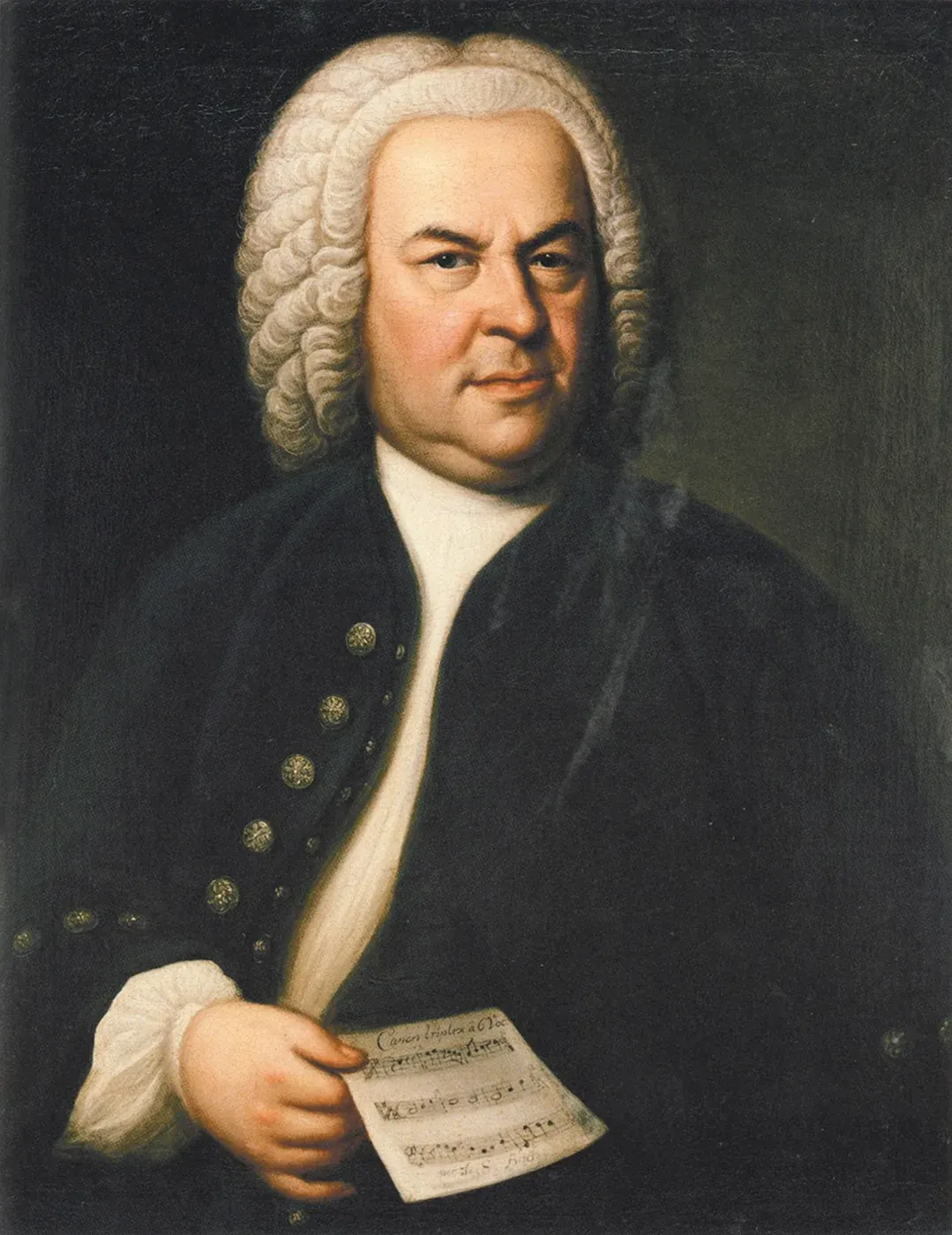
Johann Sebastian Bach · oil painting by Elias Gottlob Haussmann (1748, second version of the 1746 portrait) · Bach-Archiv Leipzig · public domain · Wikimedia Commons
A variation is a piece in which a single tune presented at the beginning serves as a foundation, followed by successive modifications that change the melody, rhythm, and texture while preserving its skeleton. An aria is a name for a piece with a flowing, song-like melody, and in this piece, it is placed at the very front to serve as the foundation for the thirty variations. We listen to the first eight measures of the aria through a synthesized harpsichord. We set the tempo to 1 beat per second, or 60 beats per minute. The sheet music does not have a number indicating the tempo.
Clip: Bach, Goldberg Variations, BWV 988, Aria, bars 1–8 (synthesized harpsichord; Bach-Gesellschaft edition; score input Mutopia Project, CC BY-SA 3.0)
It is in triple meter, with three beats making up a measure, and at the tempo we set, it sounds slow. The lowest melody places one note per measure, descending from G, F#, E, to D, then passing through B, C, and D to reach G. These eight notes are the skeleton of the aria.
Next is the first eight measures of Variation 1. The tempo is 92 beats per minute, which we also set.
Clip: Bach, Goldberg Variations, BWV 988, Variation 1, bars 1–8 (synthesized harpsichord; Bach-Gesellschaft edition; score input Mutopia Project, CC BY-SA 3.0)
The notes move much more densely. Counting by the sheet music, in the same eight measures, the aria has 84 notes and Variation 1 has 137 notes. Yet the first note of each measure in the lowest melody follows the same G-F#-E-D-B-C-D-G as the aria. The property of variations—where the surface changes and the skeleton remains—is contained just like this in these two passages. The story of measuring Bach's music with numbers was covered in "Bach — Music Written by Mathematics, or Music That Mathematics Can Measure?".
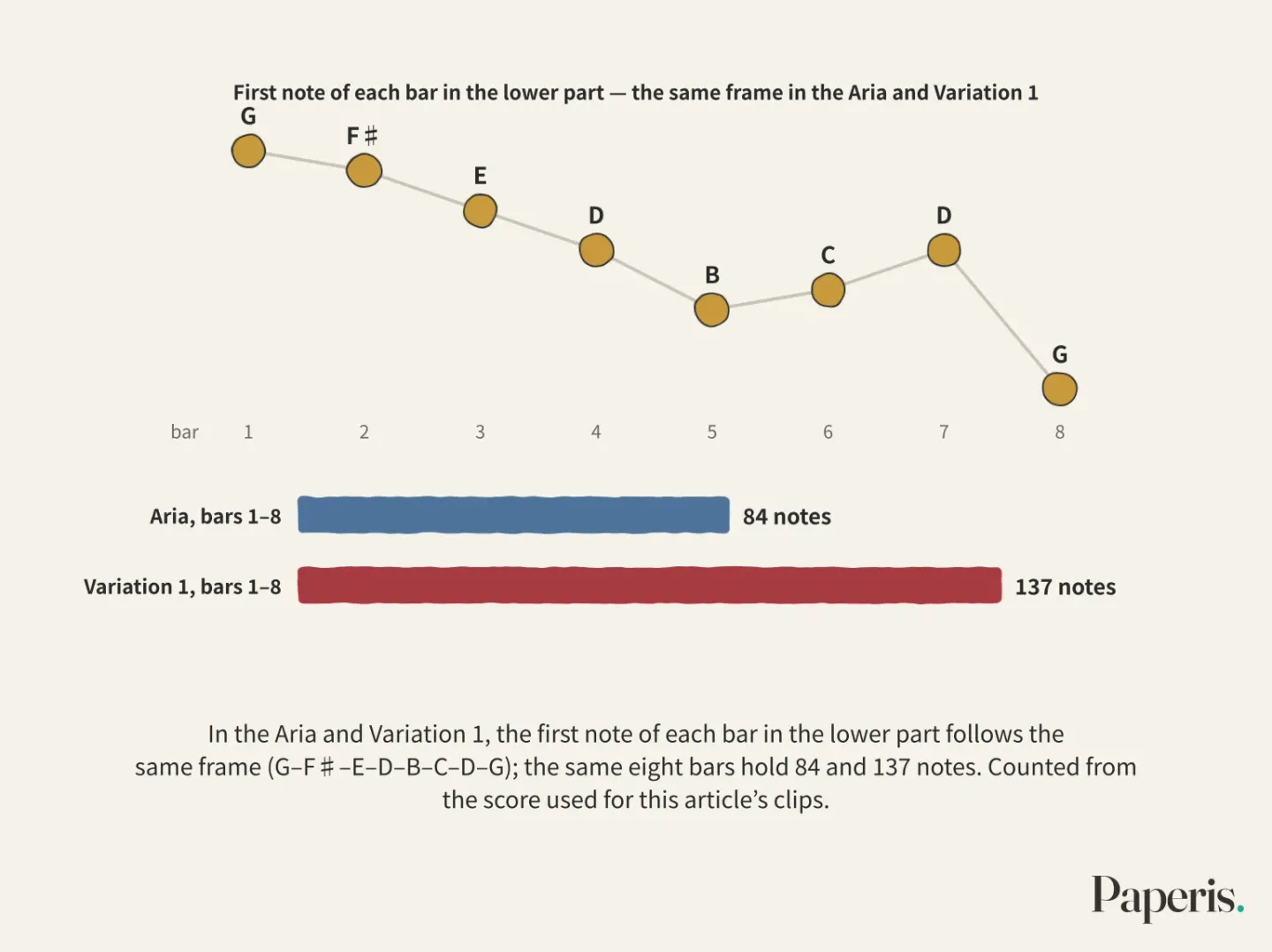
Within this single piece, the aria and variations built on the same skeleton with much denser notes are contained together.
The Tale of the Sleepless Count
There is a story that the harpsichordist Goldberg played this piece for Count Keyserling, who could not fall asleep. This story appears in the biography of Bach by the German musicologist Johann Nikolaus Forkel, published in 1802. Goldberg, the namesake attached to the title of the piece today, is this player. The studies this article relies on do not deal with the truth or falsity of that story.
Among the list of evidence for this article, as a study that directly played this piece, there is one listening study published in 1985 in the journal Music Perception. When various recordings and arrangements were played and evaluated across multiple dimensions of cognition, emotion, and perception, the evaluation difference between the harpsichord recording and the piano recording was very small. Even when the order of the variations was shuffled and played, the original order was preferred in only one out of the 15 dimensions measured (DOI: 10.2307/40285323). This study did not measure sleep. A study that played this piece and measured how sleep changes is not in the list of evidence for this article.
The idea connecting sleep and music is much older than Bach. In his medical book, the Islamic Golden Age physician Jurjani (1042–1137) recommended slow, pleasant music and natural sounds like flowing water for sleep hygiene, and for one type of sleeplessness symptom, he prescribed a piece of music, even noting down its rhythm and mode (PMID 36840854). Since this is a historical paper introducing the recommendations of an ancient physician, data measuring the effect is not included.
Whether that story is true and whether music aids sleep are different questions, and the latter question is what research has directly addressed.
People Who Play Music When Falling Asleep
Among 651 people who answered an online survey, 62% answered that they use music to try to fall asleep (PMID 30427881). Because these were people who responded to an online survey, this percentage cannot be generalized to all adults. A Danish survey yields different numbers. When a representative sample of 1,195 people was drawn by matching age and sex from 3,667 adult respondents recruited via Facebook advertisements, 20% used music for sleep once or twice a month or more, 11% used it every week, and 4.5% used it almost every day (PMID 39972405). In the same survey, the most common sleep strategy was "keeping a consistent routine" (73%), and music was one of twenty-four strategies investigated.
Insomnia is a condition in which difficulty falling asleep or frequently waking up during the night continues, making daytime functioning difficult. In the Danish survey, people with insomnia used an average of 8.4 sleep strategies, while those without used 6.6, and people who used music were younger and more likely to have insomnia (PMID 39972405). Sleep quality, as used in this article, is the score given by an individual on a questionnaire rating how well they slept. The Pittsburgh Sleep Quality Index, which the trials in this article primarily used, ranges from 0 to 21 points, with higher scores meaning worse sleep (PMID 36000763). In a face-to-face interview survey of 844 adults aged 18 to 94, 26.0% answered that they use music as a sleep aid, with books (39.8%) and television (31.2%) being more common. The habit of using media for sleep appeared alongside greater fatigue and worse sleep quality scores (PMID 25313639). Because both surveys asked at a single point in time, these data cannot determine whether music or media worsened sleep, or whether people with poor sleep sought them out.
What people play varies greatly from person to person. Respondents to the survey of 651 people listed 545 musicians across 14 genres, and the authors concluded that these choices followed personal taste rather than a consistent musical structure (PMID 30427881). Free-text responses asking why people believe music helps them sleep were grouped into four categories: the belief that music itself has sleep-inducing properties, the belief that music is part of a bedtime habit, the belief that music shifts the body and mind into a state suited for sleep, and the belief that music masks internal and external distractions that would otherwise disrupt sleep. The authors noted that these reasons go far beyond simple physical and mental relaxation.
Bedtime music is a common habit, and the music people listed in the survey of 651 people followed personal preference rather than a unified structure.
Pooling the Trials — The Score for "I Slept Well" Improved
Every day, for 25 to 60 minutes, anywhere from three days to three months, participants listen to recorded music. This is what the music group did in 13 trials involving 1,007 adults who struggled with sleep (PMID 36000763). A randomized controlled trial is an experiment where participants are left to chance like drawing lots to be divided into two or more groups, after which only one group receives an intervention like music and the results are compared. All 13 of these trials compared the group listening to music against a group doing nothing or receiving only usual care. A meta-analysis is a method that gathers the results of multiple studies tackling the same question and recalculates them all at once. A 2022 Cochrane systematic review pooled these 13 trials in a meta-analysis, updating a 2015 edition that had gathered 314 people across six studies (PMID 36000763; PMID 26270746).
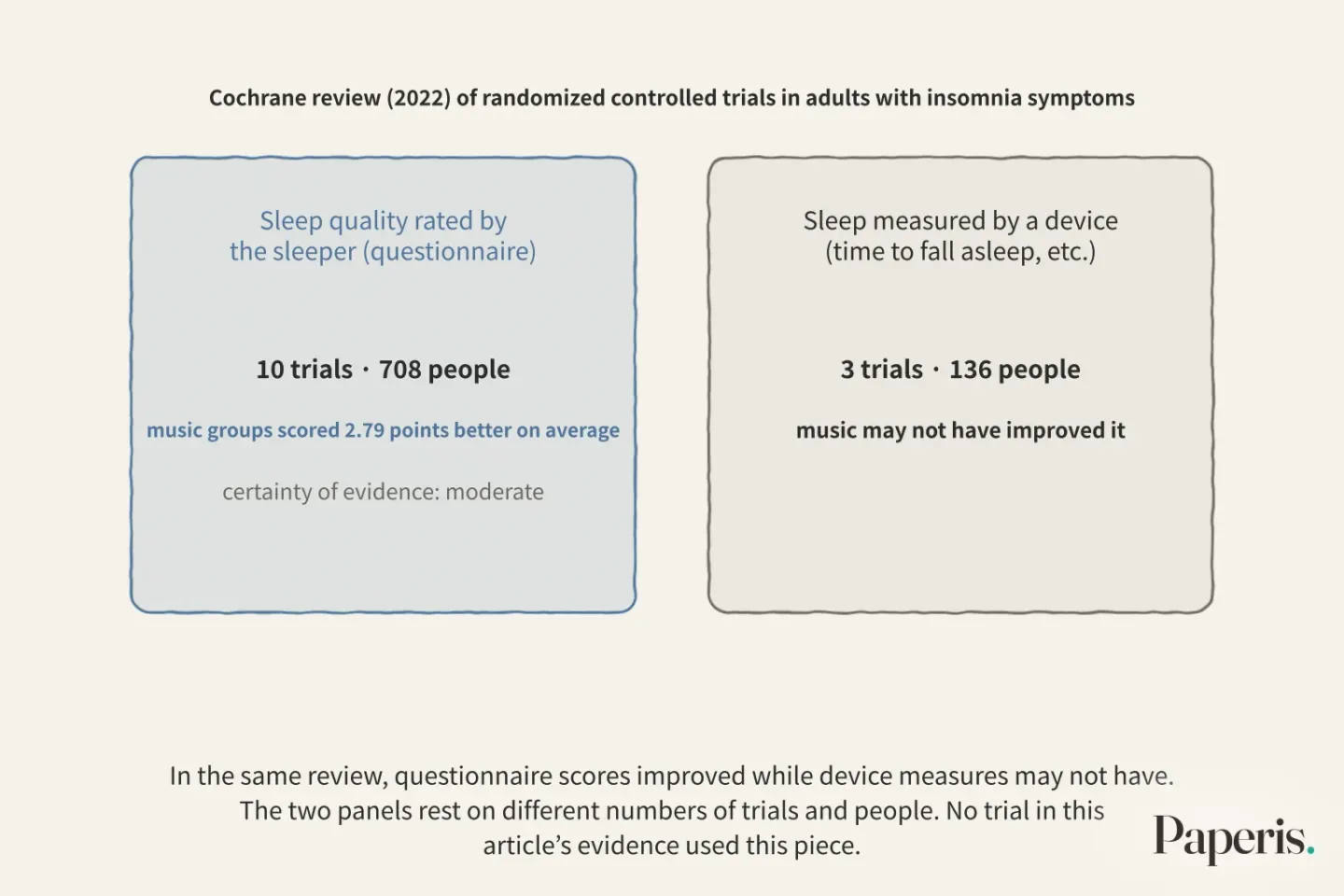
The sleep quality score was an average of 2.79 points better in the music group (10 trials, 708 people). The statistically captured range was between 1.72 points and 3.86 points, and the reviewers rated the certainty of the evidence as "moderate." Reviewers interpreted this difference as a magnitude of improvement roughly equal to one standard deviation of scores among people (PMID 36000763).
Other items showed weaker results. Insomnia severity showed no clear difference between the music group and comparison groups (2 trials, 63 people, very low certainty of evidence). Problems with sleep latency, total sleep time, and sleep efficiency yielded evidence that music might reduce them, but the certainty was low (3 trials, 197 people), and there might be no effect on the feeling of waking up during the night. In 3 trials (136 people) that measured these same items with devices, music may not have improved these values. No trials reported adverse effects (PMID 36000763). Reviewers concluded that music may be effective in improving subjective sleep quality in adults with insomnia symptoms, and noted that more research is needed regarding other aspects of sleep and the impact of insomnia on daytime life.
Let us look closely at an individual trial. 94 university students aged 19 to 28 complaining of sleep difficulties listened to comfortable classical music or an audiobook for 45 minutes in bed for 3 weeks, or did nothing. Sleep quality scores improved noticeably only in the music group, and not in the audiobook group or the do-nothing group (PMID 18426457). Which pieces of music were played is not in the abstract. The authors concluded that comfortable classical music is an effective way to reduce sleep problems. This is the conclusion of a single trial observing 94 university students with sleep difficulties for 3 weeks. In another trial dividing 75 university students aged 18 to 30 into classical, jazz, and breathing-and-relaxation-exercise-only groups, after 5 weeks both music groups outperformed the exercise-only group in both insomnia severity and sleep quality, with neither genre proving better (PMID 39053128).
The picture blurs for people without sleep problems. In a meta-analysis reviewing 22 papers (1,514 people) covering people without sleep disorders, when 6 studies involving 424 people were combined, the improvement in sleep quality compared to standard care was not clear (mean difference 0.80 points, low quality of evidence). Looking separately at only 3 studies lasting 3 weeks or longer, there was a 2.09-point improvement. The authors concluded that durations of 3 weeks or longer look promising, but results vary wildly across studies, and larger trials reporting long-term outcomes are needed before routine recommendation (PMID 33896299).
That adults with insomnia symptoms who listened to recorded music daily could see their self-rated sleep quality improve (moderate certainty of evidence) is the extent of what current trials support.
How You Feel You Slept and How Machines Measure Sleep
There is a trial that divided 57 people diagnosed with insomnia disorder into three groups (PMID 30676671). Nineteen people listened to music in bed, 19 listened to audiobooks, and 19 were placed on a waiting list. The results split into three tiers. The primary indicator—the severity of insomnia—clearly improved within the music group, but the difference compared to the other groups fell slightly short of statistical criteria (effect size 0.71, p=.06). The feeling that sleep had improved and the quality of life clearly improved in the music group. Sleep measured by polysomnography, which measures brain waves during sleep, and by a wrist-worn motion tracker did not change. The authors summarized that bedtime music seems to have a positive effect on the feeling of sleep and quality of life, but does not have a clear effect on the severity of insomnia, and noted that further research is needed on the effects according to the type of insomnia and when used as an adjunct to other treatments or for prevention.
A trial of 112 adults undergoing outpatient treatment for depression and experiencing insomnia looks similar (PMID 35697087). The group that listened to music in bed for four weeks saw their sleep quality score improve by 2.1 points at week 4, but by week 8, four weeks after the music ended, that difference shrank to 0.1 points. There was no change in sleep measured by the wrist tracker, and depressive symptoms also did not change. This is the result for a single group with insomnia accompanying depression, and the authors suggested music as a safe and moderately effective sleep aid for this group.
What the abstracts tell us about this gap is one thing. Although the risk of bias varied across studies, because participants could not be blinded to the fact that they were listening to music, all trials in the Cochrane review were judged to be at "high" risk of performance bias, and some were also at high risk of detection bias (PMID 36000763). However, these abstracts cannot determine whether the gap between subjective feelings and machine measurement is due to that bias or to something that machines fail to catch.
The improvements shown by music trials were in self-rated sleep quality scores, accompanied by findings that sleep measured by machines may not improve.
Arias and Variations — What Does Sleep Music Sound Like?
There is a study that collected 90 playlists of three types—sleep, relaxation, and energy—from the music streaming service Spotify by looking at their titles and descriptions, and compared the characteristics of the songs. The songs in the sleep playlists were mostly acoustic and instrumental, and were slower, quieter, and less energetic than the other playlists. Natural sounds were also prominently frequent in the sleep playlists. A computer classification model sorted out the songs in the sleep playlists with 72% accuracy, and the strongest clue separating sleep music from relaxation music was the brightness of the sound. The authors concluded that sleep music is distinct from relaxation music, and that properties of the sound texture such as brightness are important (DOI: 10.1177/10298649241269011). This study also only counted songs that people chose as sleep music, and did not measure actual sleep.
Another study that gathered songs from the "Study" playlist of the same service and compared them with existing sleep music data shows a different comparison. The sound characteristics assigned by the service were very similar, and the genres mostly overlapped. The authors interpreted that both types of music aim to create a pleasant yet unobtrusive sound environment (PMID 36959270). Playlist studies count songs that people chose as sleep music, and do not measure whether those songs help with sleep.
Arousal is the degree to which the body and mind are awake and excited. In an experiment where 12 performing musicians and 12 age-matched non-musicians were made to listen to six styles of music in random order, listening to music with a fast tempo and simple rhythm structure increased ventilation, blood pressure, and heart rate compared to initial rest. A 2-minute break inserted in the middle lowered heart rate, blood pressure, and ventilation even below the initial resting levels (PMID 16199412). The authors concluded that music produces arousal effects mainly related to tempo, and that slow or meditative music can induce relaxation, with that relaxation being especially pronounced during breaks. In another study analyzing the structure of 16 musical snippets, tempo, accent, and staccato degree best separated the levels of arousal (PMID 17516815). Both studies measured awake people, and did not measure sleep. What tempo and beat are was covered in "Rhythm and Beat — Evenly Spaced Stepping Stones, and the Steps That Cross Them".
Applying these results to the Goldberg, the assumption arises that a slowly played aria may be on the side of raising arousal less than quickly played variations. What the studies measured were tempo, accent, and staccato, and they did not measure how densely packed the notes are. There are two gaps in this assumption. One is that studies measuring arousal or sleep by playing this piece are not in the reference list of this article. The other is that the slowness of the aria is chosen by the performer. There is no tempo number on the score, and the 60 beats per minute heard earlier is also a value we decided.
Results comparing which music is better for sleep are scarce. In a subgroup analysis of a meta-analysis (5 trials) that gathered only people aged 60 and older, the improvement in the group that listened to soothing music was greater than in the group that listened to rhythm-focused music, and the effect was present when listened to for over 4 weeks (PMID 33880759). This is a result targeting older adults. In the earlier college student trial, there was no better side between classical and jazz (PMID 39053128). These two results are difficult to line up directly because the types of music compared were different.
Songs chosen as sleep music are generally slow, quiet, and in experiments during wakefulness, tempo was linked to arousal. Which song is best for sleep has not yet been determined.
How Music Helps Sleep — Six Explanations
Relaxation that loosens the body and mind, distraction that turns attention away from worries in the head, entrainment where the body's rhythm matches the beat of the music, masking that covers up bothersome background noise, the pleasure of listening to music one likes, and the expectation that comes from the cultural belief that music helps sleep. A review that combed through scattered literature summarized researchers' explanations into these six (PMID 31655374). The evidence evaluated by the review differed for each explanation. Masking had evidence supporting sleep improvement, relaxation, distraction, and pleasure had mixed evidence, expectation was about as far as being plausible, and entrainment was plausible amidst being mixed. The authors thought relaxation was likely the middle link connecting several explanations. Among the reasons people wrote down in the previous 651-person survey, changing the body and mind into a state fit for sleep and blocking out stimulation are similar to relaxation and masking in this list. We are the ones who made this comparison.
A literature review re-examining six music sleep studies lasting over 3 weeks calculated that music made sleep quality scores 1.15 points better on average per week than comparison conditions, and put forward one hypothesis for why (PMID 32849025). As listening to music takes the place of the habit of chewing over worries in bed, a new connection forms between the bed and sleep. This is an explanation proposed by the authors, and the results directly measuring that connection are not in the abstract.
The paths by which music helps sleep are not fixed to one. The explanation that one review saw as having evidence was masking, but a systematic review that separately examined sound stimuli like white and pink noise concluded that there was no strong evidence to recommend them (PMID 31655374; PMID 34964434).
What We Do Not Yet Know
Whether sleep measured by machines changes remains an open question. There were only 3 machine-measured trials in the Cochrane review, and the effect of insomnia on daytime life is an item that reviewers noted requires more research (PMID 36000763).
We also do not know how long the effects last. In a trial addressing insomnia accompanying depression, the difference nearly vanished 4 weeks after the music ended (PMID 35697087), and whether this holds true in other groups cannot be known from this evidence.
Sleep sounds outside of music have even weaker evidence. A systematic review examining 34 studies (1,103 people) on white noise and pink noise concluded that there is no strong evidence to recommend such sound stimuli, while adding that among short-term studies, none reported side effects (PMID 34964434). A perspective paper organizing app-based sleep sounds such as sleep music, background noise, and story narrations noted that relaxation using music has confirmed effectiveness in improving sleep quality, but the results for background noise are inconclusive and the evidence for narration content is limited. The same paper also pointed out that sleep hygiene recommendations to avoid screens in bed may conflict with app use, and that randomized controlled trials compared with well-matched control groups are rare (PMID 41056369).
And this piece itself remains. Whether it is the Goldberg Aria or the variations, studies that played that specific music and measured sleep are not on this article's list of evidence.
Two Questions Remain Separate
Whether the story attached to the piece is true and whether music helps people sleep are two separate questions. The former question was not addressed by the studies this article relied on.
Placing what the trials support and what they fail to support side by side for the latter question yields this. What is supported is one thing. When adults with insomnia symptoms listened to recorded music daily (three days to three months of the trial period), their self-rated sleep quality could improve (moderate certainty of evidence). What is not supported are three things. Sleep measured by machines may not have improved (PMID 36000763). For people without sleep problems, the overall improvement was not clear (low quality of evidence), improvements were seen only in three studies with listening durations over three weeks, and the authors noted that the results were erratic, so larger trials are needed (PMID 33896299). As for whether the difference remains after the music stops, there is no evidence except for one trial on insomnia accompanying depression where the difference nearly vanished after four weeks (PMID 35697087).
The Goldberg Variations lie outside these two lines. Which pieces the trials used cannot be known because the abstracts do not contain track lists. The claim that playing the aria slowly may raise arousal less is an assumption drawn from experiments measuring awake people with other music, and since the sheet music lacks tempo numbers, that slowness is also chosen by the performer. Research measuring sleep with this piece is not on this article's list of evidence.
Source Papers
- "Listening to music for insomnia in adults." (2022) — PMID 36000763 — Cochrane review of 13 trials with 1,007 participants: subjective sleep quality (PSQI) improved by an average of 2.79 points (10 trials, 708 participants, moderate certainty), difference in insomnia severity unclear (very low certainty), instrumental measurements may show no improvement, risk of bias varies by study, but all trials had high performance bias.
- "Music for insomnia in adults." (2015) — PMID 26270746 — Previous edition of the same Cochrane review, 6 studies with 314 participants.
- "The music that helps people sleep and the reasons they believe it works: A mixed methods analysis of online survey reports." (2018) — PMID 30427881 — Online survey of 651 participants, 62% use music for sleep, 545 musicians across 14 genres, selection follows personal taste, four main reasons.
- "The art of sleep: examining sleep strategies in the general population with a focus on the use of music for sleep." (2025) — PMID 39972405 — 1,195 respondents matched for age and gender from Danish Facebook ad respondents, 20% use music 1 to 2 times a month or more, 11% weekly, 4.5% almost daily, users are younger and more likely to have insomnia.
- "The Use of Media as a Sleep Aid in Adults." (2016) — PMID 25313639 — Interviews with 844 adults, 26.0% use music, media sleep aid use associated with fatigue and poorer PSQI.
- "A randomized controlled trial of bedtime music for insomnia disorder." (2019) — PMID 30676671 — 57 participants with insomnia disorder (music, audiobook, waitlist), group differences in insomnia severity unclear (p=.06), subjective improvement and quality of life enhanced, no changes in polysomnography or actigraphy.
- "Music improves sleep quality in students." (2008) — PMID 18426457 — 94 college students, 45 minutes of relaxing classical music for 3 weeks, only the music group showed PSQI improvement (audiobook and no-treatment groups did not).
- "Bedtime music therapy for college students with insomnia: A randomized assessor-blinded controlled trial." (2024) — PMID 39053128 — 75 college students, both classical and jazz showed improvement over control, no superiority between genres.
- "Music-based Intervention for Improving Sleep Quality of Adults without Sleep Disorder: A Systematic Review and Meta-analysis." (2022) — PMID 33896299 — 424 participants across 6 studies of people without sleep disorders showed unclear improvement (low quality of evidence), subgroups of 3 weeks or longer showed improvement, larger trials needed.
- "Music to improve sleep quality in adults with depression-related insomnia (MUSTAFI): randomized controlled trial." (2023) — PMID 35697087 — 112 depression outpatients, PSQI improved by 2.1 points at week 4, dropping to 0.1 points at week 8, no change in actigraphy.
- "Characterizing music for sleep: A comparison of Spotify playlists" (2024) — DOI: 10.1177/10298649241269011 — 90 playlists, sleep music is acoustic, instrumental, slow, quiet, with natural sounds, classification accuracy 72%, brightness is the strongest cue distinguishing it from relaxation music.
- "Music that is used while studying and music that is used for sleep share similar musical features, genres and subgroups." (2023) — PMID 36959270 — Study music and sleep music share very similar sound characteristics and genres.
- "Cardiovascular, cerebrovascular, and respiratory changes induced by different types of music in musicians and non-musicians: the importance of silence." (2006) — PMID 16199412 — 24 participants, fast tempo increases respiration, blood pressure, and heart rate, pauses decrease them below baseline, arousal is primarily related to tempo.
- "Relationships between musical structure and psychophysiological measures of emotion." (2007) — PMID 17516815 — 16 excerpts, tempo, accent, and staccato best distinguish levels of arousal.
- "Effect of music therapy on improving sleep quality in older adults: A systematic review and meta-analysis." (2021) — PMID 33880759 — 5 trials in adults aged 60 and older, subgroup analysis showed sedative music yields greater improvement than rhythm-focused music, for 4 weeks or longer.
- "How does music aid sleep? literature review." (2019) — PMID 31655374 — Six explanations, masking has evidence, relaxation, distraction, and enjoyment are mixed, expectation is possible, entrainment has mixed potential.
- "Music on Prescription to Aid Sleep Quality: A Literature Review." (2020) — PMID 32849025 — 6 studies lasting 3 weeks or longer, average improvement of 1.15 points per week, bedtime routine replacement hypothesis.
- "Systematic review: auditory stimulation and sleep." (2022) — PMID 34964434 — 34 studies with 1,103 participants using white and pink noise, no strong evidence, no adverse effects reported.
- "Between sound and sleep: a perspective on Sonic Sleep Aids." (2025) — PMID 41056369 — Perspective paper, music relaxation effects confirmed, background noise conclusion unclear, spoken-word evidence limited, contrasts with screen use concerns and lack of controlled trials.
- "The effect of music on the improvement of sleep quality: a report from the viewpoint of Jorjani." (2023) — PMID 36840854 — Historical paper, Jorjani (1042–1137) recommended slow, pleasant music and natural sounds.
- "The Effects of Instrumentation, Playing Style, and Structure in the Goldberg Variations by Johann Sebastian Bach" (1985) — DOI: 10.2307/40285323 — Small difference in evaluation between harpsichord and piano recordings, even when changing variation order, original order preferred on only 1 out of 15 dimensions.
Sources (21)
- Listening to music for insomnia in adultsPMID 36000763
- Music for insomnia in adultsPMID 26270746
- The music that helps people sleep and the reasons they believe it works: A mixed methods analysis of online survey reportsPMID 30427881
- The art of sleep: examining sleep strategies in the general population with a focus on the use of music for sleepPMID 39972405
- The Use of Media as a Sleep Aid in AdultsPMID 25313639
- A randomized controlled trial of bedtime music for insomnia disorderPMID 30676671
- Music improves sleep quality in studentsPMID 18426457
- Bedtime music therapy for college students with insomnia: A randomized assessor-blinded controlled trialPMID 39053128
- Music-based Intervention for Improving Sleep Quality of Adults without Sleep Disorder: A Systematic Review and Meta-analysisPMID 33896299
- Music to improve sleep quality in adults with depression-related insomnia (MUSTAFI): randomized controlled trialPMID 35697087
- Characterizing music for sleep: A comparison of Spotify playlistsDOI 10.1177/10298649241269011
- Music that is used while studying and music that is used for sleep share similar musical features, genres and subgroupsPMID 36959270
- Cardiovascular, cerebrovascular, and respiratory changes induced by different types of music in musicians and non-musicians: the importance of silencePMID 16199412
- Relationships between musical structure and psychophysiological measures of emotionPMID 17516815
- Effect of music therapy on improving sleep quality in older adults: A systematic review and meta-analysisPMID 33880759
- How does music aid sleep? literature reviewPMID 31655374
- Music on Prescription to Aid Sleep Quality: A Literature ReviewPMID 32849025
- Systematic review: auditory stimulation and sleepPMID 34964434
- Between sound and sleep: a perspective on Sonic Sleep AidsPMID 41056369
- The effect of music on the improvement of sleep quality: a report from the viewpoint of JorjaniPMID 36840854
- The Effects of Instrumentation, Playing Style, and Structure in the Goldberg Variations by Johann Sebastian BachDOI 10.2307/40285323