Paperis Articles
Pachelbel's Canon — Over the Same Eight Notes, What Is the Ear Waiting For?
A piece in which the cello repeats eight low notes 28 times. How far has anyone actually counted the claim that its progression is everywhere in pop, and what happens in the ear while the same notes come round again — only as far as music-cognition research supports.
Your field's papers, as audio
Pick your fields and journals — Paperis summarizes the key papers and turns them into audio. Listen on your commute.
Start Paperis free →Pachelbel's Canon — Over the Same Eight Notes, What Is the Ear Waiting For?
Eight Notes, Twenty-Eight Times
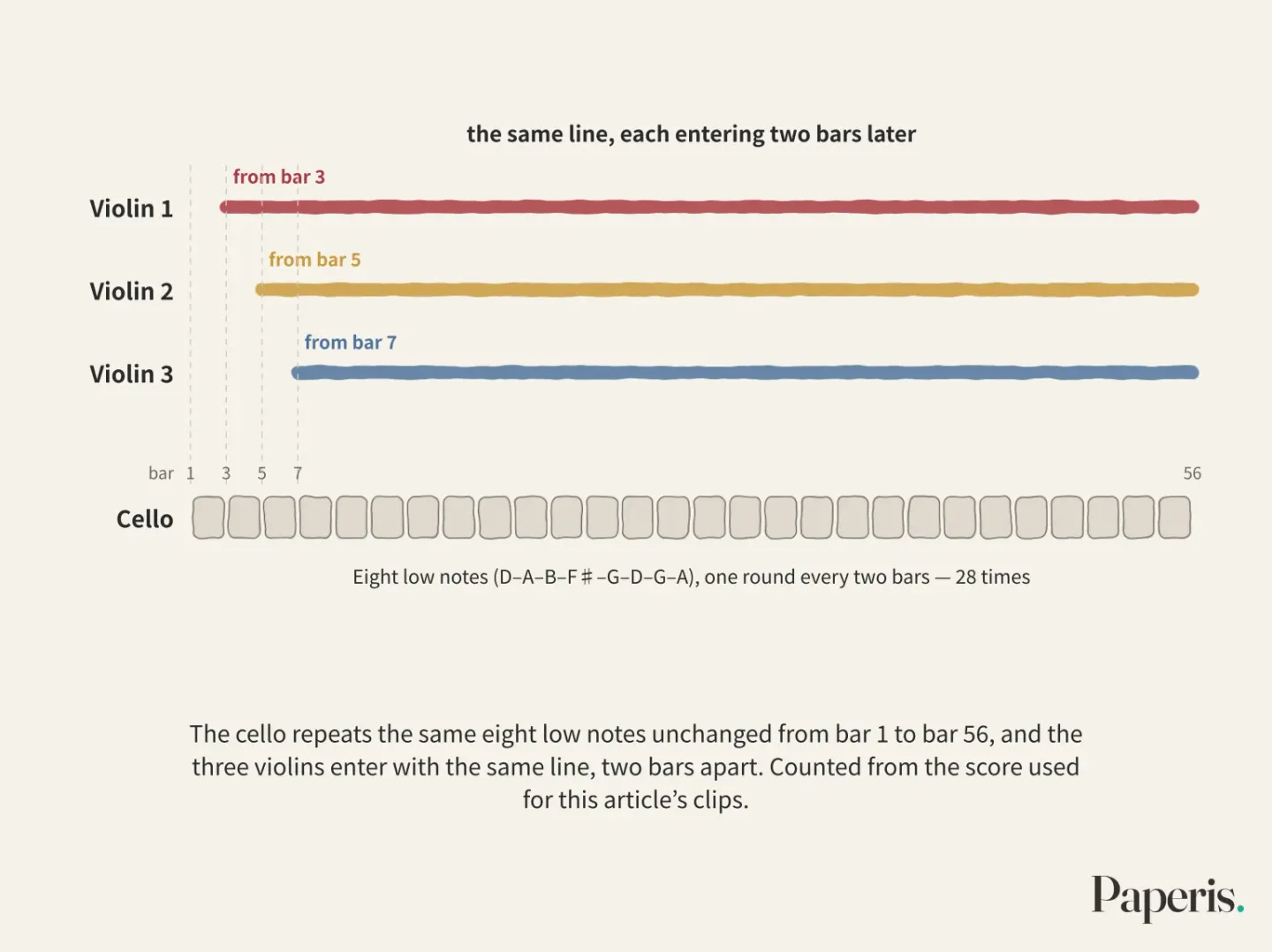
The piece commonly known as "Pachelbel's Canon" is an instrumental work by the late 17th-century German composer and organist Johann Phelbel. Its written title is "Canon for Three Violins and Basso," and its key is D major. A voice is one line of melody in a piece where several lines move together; a canon is a texture where one voice begins a melody and other voices follow it strictly after a short delay, and in this piece, three violins take up a single melody in that way. The basso is the part responsible for the lowest bass notes, and in the performance attached to this article, the cello takes that role. It is not certain exactly when the piece was written. Its layout is simple. The cello repeats two bars of eight low notes—D, A, B, F-sharp, G, D, G, A—from bar 1 to bar 56 without changing them a single time, 28 times in total.
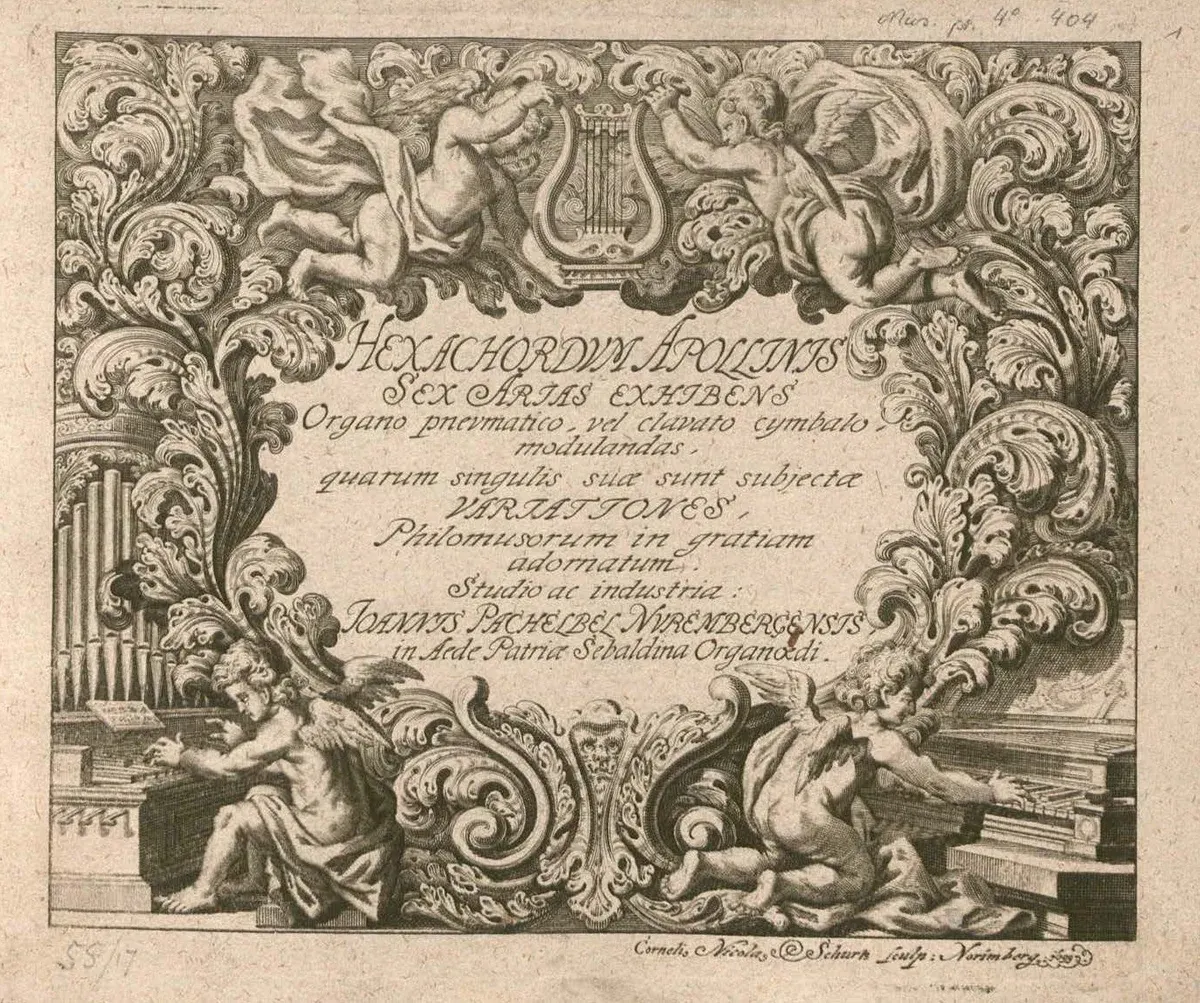
Title page of Johann Pachelbel’s keyboard collection Hexachordum Apollinis (1699) · engraving by Cornelius Nicolaus Schurz · public domain · Wikimedia Commons
First, let us listen to bars 1-2, where the cello plays those eight notes alone for one round. This is a sound made with synthesized strings, and we set the tempo.
Clip: Pachelbel, Canon, bars 1–2 — the cello alone with the eight-note bass (synthesized strings; score input Mutopia Project, CC BY 4.0)
The eight low notes starting from D have completed one round at A. Until the piece ends, this wheel keeps turning on the bottom. A ground bass is a texture in which the lowest voice endlessly repeats the same short figure.
Above it, Violin 1 enters at bar 3, Violin 2 at bar 5, and Violin 3 at bar 7, following the same melody with a two-bar delay each time. The "canon" in the piece's title is precisely this following entry. This is the passage in bars 1-8 where, while the cello turns through the same eight notes four times, the violins enter one by one at bars 3, 5, and 7.
Clip: Pachelbel, Canon, bars 1–8 — three violins enter two bars apart (synthesized strings; score input Mutopia Project, CC BY 4.0)
The cello has turned through the same eight notes four times, and above it, the violins have built up one by one at two-bar intervals. Two questions can be asked about this piece. One is whether the chord progression of this piece is truly reused everywhere in today's pop music. The other is what happens in the listener's ear while the same low note repeats twenty-eight times. This article follows both questions through music cognition and psychology research. One thing must be clarified first: Among the studies this article relies on, only a single study with 30 healthy participants directly used the canon progression. The rest of the studies used different pieces, artificially created chords for experiments, or survey respondents, and applying their results to the canon is entirely a matter of assumption.
"That Progression Is Everywhere", Just How Far Have the Counts Gone?
A chord is several notes of different pitches sounding all at once. A chord progression is the sequence in which chords move from one to the next. In research, the name "Canon chord progression" is also used (PMID 28652751). To check whether "this progression is used everywhere in popular music" is correct, there is no other way than to collect a large number of songs and count them. A corpus study is research that collects a large number of songs and counts how frequently a certain chord or chord flow appears.
One corpus study that counted the harmony of rock music selected 100 songs in total from the music magazine Rolling Stone's "500 Greatest Songs of All Time", taking the top 20 songs for each decade from the 1950s through the 1990s (DOI: 10.1017/s026114301000067x). Two researchers analyzed the 100 songs independently by hand, and the agreement rate between the two analyses exceeded 90%. What this study counted were individual chords, steps from one chord to the next, root note movements, patterns of chords appearing together, and changes over time. One of the results was that after the chord built on the tonic note (I), the chord built on the fourth degree (IV) was the most common, and that specific chord frequently appeared right before the tonic chord. The tonic note is the note from which the scale starts, and the central note where, when a song clearly reaches that note, it feels most stable and restful. A corpus analysis covering country music notes that it found evidence of country music relying more heavily on three chords than other styles do (DOI: 10.1093/oxfordhb/9780190945442.013.22).
How many popular songs feature the Canon progression is not counted anywhere in the corpus studies this article relies on. There are music theory papers that deal with progressions in popular music where four chords loop like a ring. That author reports that in a progression where four chords based on A, F, C, and G cycle in turn (and transposed forms thereof), the forms starting on A and C, and to a lesser extent starting on F, became staples in mainstream popular music during the last few decades of the 20th century and the first few decades of the 21st century, and analyzes example songs (DOI: 10.30535/mto.23.3.6). This paper is an analytical text that did not count songs, nor is it a text dealing with the Canon progression. How to select samples is also a problem. The author of a handbook chapter covering popular music corpora argues that one should not rely solely on established lists like Billboard charts or Rolling Stone lists, but must select songs tailored to the claim one intends to make for the results to be meaningful (DOI: 10.1093/oxfordhb/9780190945442.013.29).
Apart from counting, there are experiments showing that people perceive a chord progression as a single chunk. In an experiment where participants were made to listen only to the chord progressions of well-known classical, pop, and rock songs and guess what the songs were, musical training helped with guessing, but even among non-musicians there were people who recognized songs solely from their chord progressions (DOI: 10.1177/0305735617721638). In a 2026 experiment where participants were asked to match looping chord progressions in popular music, all participants performed much better than chance, and the effect of musical training was small (DOI: 10.18061/emr.6678). Therefore, the takeaway is this. A chord progression can remain in the ear as a single unit, but the "countless" in the statement "the Canon progression is used in countless songs" is not verified by the evidence in this article.
The Ear Anticipates the Next Chord
When an unfitting chord sounds where a piece should end, the brainwaves show a response that peaks roughly 0.2 seconds after that chord sounds (PMID 14681114). A review paper summarizing studies on this response notes that it is recorded even in people without musical training and in children, interpreting the ability to implicitly learn the rules of music and process music with that knowledge as a general capacity of the human brain. Musical expectation is the implicit anticipation of what note or chord will come next while listening to music.
Researchers view that anticipation as arising from the music that has come in. Statistical learning is the process of naturally absorbing what frequently follows what through mere listening, without trying to learn. One magnetoencephalography (MEG) study calculated "the probability that this chord follows that chord" from a corpus of Western music, using it as an approximation of the frequencies the participants had heard over time (PMID 21364895). When musicians and non-musicians listened to three types of chord progressions, early brain responses grew larger the lower the probability of the progression, and this effect varied in interaction with musical training. The authors suggest that this response reflects the probabilities of musical rules accumulated in the head. Although it is a different collection of songs from the corpus in the previous section, the frequencies measured from the song collection find use here. A similar thing happened with unfamiliar scales. When chords were built using an unfamiliar scale dividing an octave into 18 steps and played to 36 non-musicians, a brain mismatch response appeared at infrequently occurring chord transitions. Yet the participants failed to consciously recognize the frequent transitions above chance level (DOI: 10.2139/ssrn.4468693). This result is a single study released as a preprint prior to peer review.
The framework of familiar music also aids listening itself just a little bit. When a familiar scale framework was played first using major scale notes or two chords sounding like a cadence, the interval between two notes was discriminated more accurately than without the framework (PMID 29062295). However, that benefit was small, and the authors note that the primary advantage of the framework may lie in priming the anticipated sound rather than helping hear the pitch more accurately.
Anticipation also reaches likes and dislikes. In an experiment where participants rated preferences after listening to entire chord progressions, the preference ratings of all participants, with or without musical training, varied according to the manipulation of harmonic expectation (PMID 18038947). However, when attention was directed to the melody, that difference disappeared in participants without musical training. Applying these results to the canon, after the cello's eight notes loop a few times, listeners may find it easier to anticipate the next low note. However, there is no study in the evidence for this article measuring how many loops it takes within a single piece for that to happen. The takeaway is this: there are multiple findings that the ear anticipates the next sound using the statistics of the music that has come in, and that anticipation appears even in people without musical training.
Does Hearing It Several Times Make It Better?
After three experiments in which people were played a mix of unfamiliar and familiar melodies and then had them played again, people liked the unfamiliar melodies they had heard repeatedly more (PMID 9796224). The mere exposure effect is the phenomenon where simply being exposed to something multiple times without any particular reward makes you like it more. In the same experiment, the aftereffect on liking and the effect measured by "having heard the piece before" faded at different rates over time, and changing the timbre of the melody between study and test greatly disrupted recognition while leaving liking almost unaffected. The authors interpret the memory remaining in liking and the memory in recognition as corresponding to unconscious memory and conscious memory, respectively. According to the authors' interpretation, this means that even if you do not remember a piece, you can end up liking it more. However, the authors also note that some of the results conflict with existing memory research involving sound.
So does listening to it more keep making you like it more? Here, two pictures diverge. A discussion paper published in a Danish psychology journal summarizes that the better people know a melody the more they like it, but from a certain point evaluation flattens out or drops (DOI: 10.7146/pl.v28i1.8363). That paper suggests the cause is likely rooted in arousal levels. Arousal is the degree to which the body and mind are awake and stirred up. Unfamiliar music invites excessive arousal, while very familiar music invites a lack of stimulation, and the explanation is that the "familiar yet not entirely predictable" point in between is best. There are also opposing results. When an expert played 40 pieces of music categorized into four levels of complexity 28 times per piece over about four weeks, liking steadily increased with listening across all four levels of complexity, and conversely there was no inverted-U-shaped trace (PMID 28408864). The authors conclude that regardless of complexity, familiarity is the most important variable explaining differences in musical preference. The pieces were unfamiliar to the participants, and what best predicted liking was the experience of having listened to music in a similar style.
Brain imaging is less settled. In a brain imaging study where pop and rock songs were selected and played based on each person's familiarity and liking, regions involved in emotion and reward were more active during familiar songs than unfamiliar ones (PMID 22110619). However, a meta-analysis pooling 11 brain imaging studies (212 participants) comparing familiar and unfamiliar music failed to find active regions appearing consistently across the studies, and concludes that larger studies are needed (PMID 30344470).
Although the number 28 overlaps with the cello in Canon, the 28 times in this experiment is the number of times the same piece was replayed over four weeks. Here is what to take away. The tendency to grow to like things the more times you hear them has appeared in multiple experiments, but where that tendency breaks off differs from study to study. And the repetitions in those experiments were repetitions of hearing the melody presented in the study phase again in the test phase (PMID 9796224), or listening to the same piece again over about four weeks (PMID 28408864). This is a different kind of repetition from eight low notes spinning around 28 times inside a single song.
When Guesses Are Right and When They Miss
There is a study where a machine learning model assigned numbers to 80,000 chords in American popular songs for "how hard it was to guess each chord" and "how unexpected it was," and had people listen to the chords to rate their enjoyment (PMID 31708393). Uncertainty is the degree to which upcoming candidate options are evenly split, making it hard to guess what will come. Surprise is the degree to which the actually heard chord deviates from the guess. In this study, both are values calculated by the model, and enjoyment is the listener's evaluation.
The results showed two corners. Enjoyment ratings were high in places where guesses were easy and the chord missed by a lot (low uncertainty, high surprise), and in places where guesses were hard and the chord came as guessed (high uncertainty, low surprise). In brain imaging, the activity of the amygdala, hippocampus, and auditory cortex followed this pairing, while the nucleus accumbens—regarded as processing reward predictions—reflected only uncertainty. The authors write that these results challenge existing models that explained musical enjoyment. Another research team obtained the same preference for the two corners in a brain imaging study where 24 people listened to 50 actual musical excerpts, and this time found a pairing of uncertainty and surprise even in the activity of brain regions related to reward (PMID 37928727). In the background of this study is the theory that forming, testing, and revising hypotheses about one's surroundings can itself be a reward, and the constantly shifting texture of music provides ample opportunities for this. The authors conclude that their results support the hypothesis that the ventral striatum is involved in the process of deriving enjoyment from learning the structure of music. The ventral striatum is an area counted among the core structures of the reward system. In a study where 527 people listened to chord progressions and were asked to draw where in their bodies they felt sensations, specific chord progressions evoked sensations in the chest and belly, and those sensations went hand in hand with ratings of beauty (PMID 38715936).
There are also results showing differences depending on the group. In an experiment comparing jazz improvisers, non-improvising musicians, and non-musicians, jazz players liked unexpected chord progressions more (PMID 29028508). When surprise is enjoyable is covered in more detail in "Haydn — Why Is the Ear Surprised, and When Does Surprise Feel Good?".
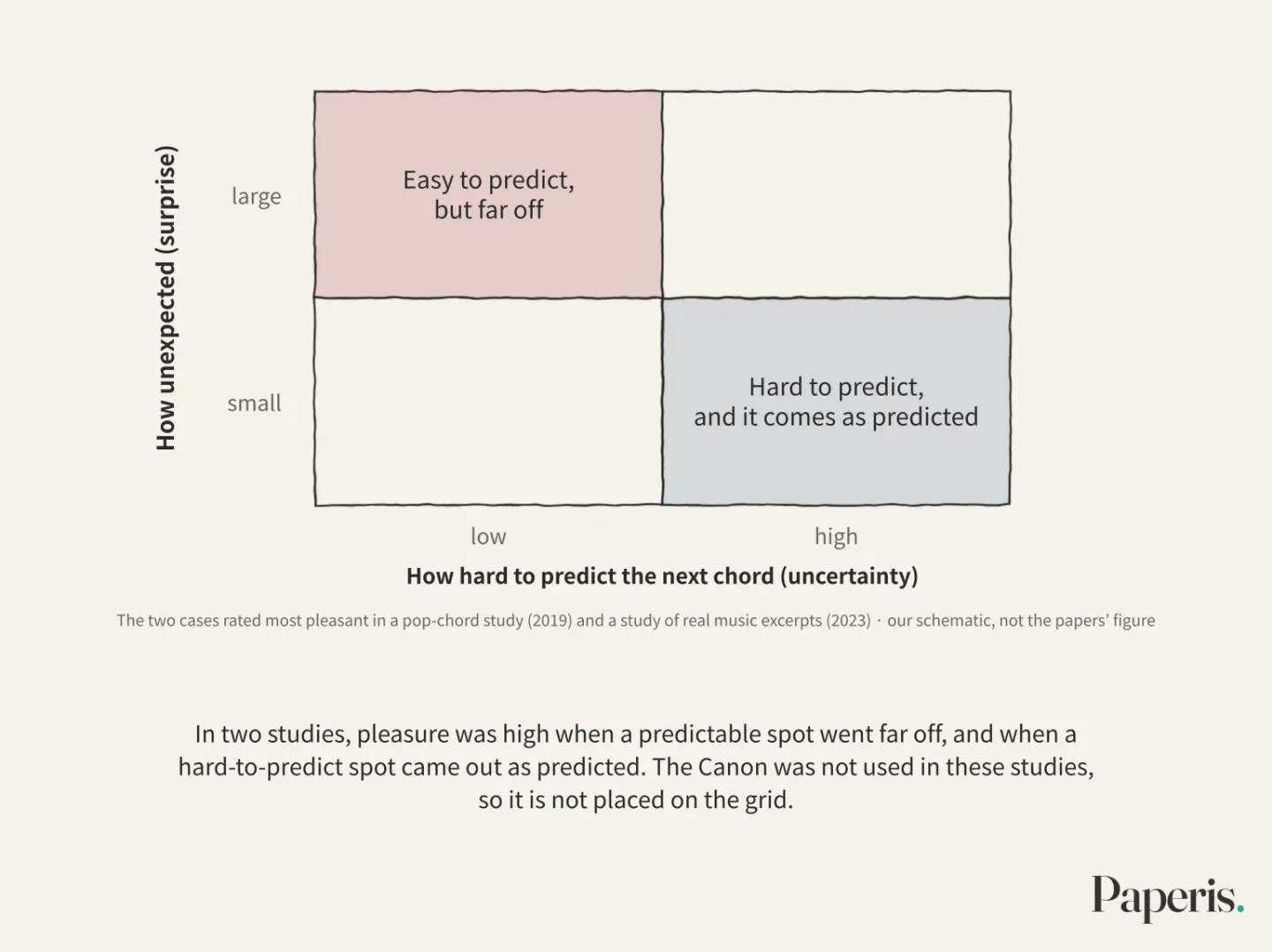
It is difficult to apply this framework directly to the Canon. In the Canon, the repetition confirmed in the score is eight identical low notes of the cello looping in the same order 28 times, and one might assume that after a few loops, the next low note could become easy to guess. However, because the two-corner framework measured popular song chords with a model, these studies cannot tell us where the repetition of the low notes falls within that framework.
Among the studies this article relied on, there is one experiment that directly used the Canon progression (PMID 28652751). Among 30 healthy participants, 15 were played music made of the Canon chord progression, and 15 were played a transposed version of it, while they were given the task of picking out rarely mixed-in sounds and had their brainwaves measured. Contrary to expectations, there was no difference in the brainwave components of the two groups. When the participants were divided after listening into 17 who answered that the music was enjoyable and 13 who did not, those who answered that it was enjoyable had a larger brainwave component called P300 measured at the forehead and also higher motivation scores. Because this division was made based on post-listening responses, this is an association showing that enjoyment, brainwaves, and motivation went together. The authors suggest that the effects of the Canon chord progression on brain activity and motivation may depend on the listener's subjective feeling rather than the progression itself. This result is a single experiment with 30 participants, and it is not possible to know from the abstract alone whether the music played was a performance of Pachelbel's original piece or music made using that progression. It is also impossible to know from the abstract whether the transposed version still retained the sequence of the same progression, making it difficult to conclude definitively how much this result tested the role of the progression itself. The abstract also contains no content measuring guesses or surprise.
The Bottom Stays the Same, the Top Changes
The number of notes a violin melody packs into a single measure changes from passage to passage. Taking Violin 1 as the baseline, the count goes from 4 notes per measure up to 8 and 16, then drops back to 4 to 6, and in measures 19 to 22 surges to 28 before returning to 4. Let us listen to those measures 19 to 22. The violins race up and down with rapid notes, while the cello repeats the exact same eight notes it had at the beginning.
Clip: Pachelbel, Canon, bars 19–22 — fast violins over the same eight bass notes (synthesized strings; score input Mutopia Project, CC BY 4.0)
Up top, the notes moved densely; down below, the cello kept the exact eight notes we heard at first. There are musicology writings addressing what is placed on top of a repeating bass. A handbook chapter on French composer Marin Marais's repeating-bass dance pieces analyzes how Marais offsets the predictability of a constantly recurring four-measure bass with creative variation techniques (DOI: 10.1093/oxfordhb/9780197645352.013.0042). A chapter covering English composer Henry Purcell's opera Dido and Aeneas suggests that Purcell turned a common compositional technique into artistic expression by contrasting the repeating bass with phrases of uneven lengths (DOI: 10.1093/oso/9780190271664.003.0006). Both are musicological interpretations of other composers' pieces, not experiments that measured listeners.
Though it did not measure pleasure, one result points to the role of the melody even in brain responses to chords deviating from the rules. When that response was measured without controlling for differences in the topmost melody, the response was largest at unexpected chords, but when melody differences were controlled, there was no difference in response magnitude among the three conditions (PMID 24607297). The authors suggest that a large share of the response changes observed in chord progressions comes from melody differences. This is the result of a single study measured with magnetoencephalography.
Applying these results to the canon, a picture emerges where the eight notes at the bottom serve as the foundation of expectation, while the violin melody—whose note count changes section by section—and the canon entering two measures out of phase take charge of the changes that hold the ear. This picture is a hypothesis pieced together from results obtained with other pieces and experimental sounds, and no study has confirmed the roles of the bottom and top melodies in the canon within the basis of this article.
From Start to Finish, Following Along Once
We place the pieces from earlier in order onto the scene of a person listening to the Canon from the beginning. The facts of the scene are the structure of the piece verified in the score, and the links connecting them are all hypotheses checked against the results obtained from other pieces and experimental sounds.
In measures 1–2, the cello alone plays eight low notes for one cycle. If this person is hearing the piece for the first time, during the first cycle there is nothing yet learned from repetition within this piece. However, since the earlier magnetoencephalography study viewed the statistics of Western music people have heard up to that point as the basis for estimation, estimation based on those statistics may exist even in the first cycle. Violin 1 enters at measure 3, and violins 2 and 3 enter playing the same melody two measures later at measures 5 and 7. Meanwhile, the cello has gone through the same eight notes four times. Applying the statistical learning research, by about this point the ear may have unconsciously begun to learn the sequence of low notes. Like the participants in the new scale experiment, the person may not well notice the fact that they have learned it.
As the cycles repeat, the next low note on the bottom may become easier to anticipate. Above it, the violin melody increases from 4 to 8, then 16 notes per measure before decreasing, becomes dense up to 28 notes in measures 19–22, and then returns to 4 notes again. For this person, the upper melody may be responsible for holding the attention of the ear. However, because research directly measuring how the bottom repetition and the top variation work together does not exist in the evidence for this article, the two are simply placed side by side.
The piece ends on a single note, D, at the end. It is the same note that started the first cycle. What has been verified as fact in this scene is only the structure of the piece, and when and what the ear anticipated while listening to the piece was not measured anywhere in the evidence of this article.
What We Do Not Yet Know
First, among the studies this article relies on, the experiment that played music with a Pachelbel's canon chord progression is a single study with a sample size of 30, and its abstract only shows a link between responses of enjoyment and brain waves and motivation, without measuring guesses, surprise, or familiarity. Second, our evidence also lacks a corpus study counting how often a Pachelbel's canon chord progression is used in popular music. The rock corpus that did the counting looked at units like steps between chords across 100 songs.
Third, it remains unsettled where the relationship between familiarity and liking breaks. An experiment showing it did not break even after listening 28 times over four weeks conflicts with discussion papers arguing that excessive familiarity flattens or drops ratings. A neuroimaging meta-analysis failed to find a region that responds consistently to familiarity. The author of a commentary on a harmonic corpus study guesses that listeners might prefer songs with a medium level of harmonic content, but this is an untested hypothesis within a commentary (DOI: 10.18061/emr.v10i3.4842).
Fourth, it may vary by group. There is an experiment showing that jazz improvisers liked unexpected chord progressions more, making it hard to assume that the same repetition produces the same effect for everyone. However, that experiment measured preference for unexpected progressions, not responses to repetition.
So What Did We Learn
Canon’s cello repeats eight low notes 28 times, and the three violins follow the same melody above it two bars behind while changing the number of notes. Saying that "the same progression is used in countless pop songs" does not add up as evidence for this article. The rock corpus was measured in units like the steps between chords across 100 songs, and Canon's progression itself has not been counted in that way. Alongside that is an experiment showing that people perceive chord progressions as a single chunk.
As for what happens in the ear while the same low note repeats, three separate lines of research using other songs and experimental sounds serve as pieces of reference. There are findings that the ear guesses the next chord from the statistics of incoming music, a tendency to prefer music heard multiple times, and results showing greater pleasure from surprises at easily guessable spots or hits at hard-to-guess spots. Research that measured boredom or pleasure specifically for Canon does not exist among the evidence for this article. Among the studies this article relied on, a single experiment that directly used the Canon progression found no difference in brain waves between the Canon progression and a transposed version, and people who reported feeling pleasure showed higher brain wave and synchronization scores. The idea that repetition can lead to boredom or serve as a foundation for pleasure depending on what changes on top of it is an assumption that stitches together musicological interpretations and experiments on other songs. What current research supports goes only up to those pieces, and has not been verified with Canon.
Source Papers
- "A corpus analysis of rock harmony" (2011) — DOI: 10.1017/s026114301000067x — Manual analysis of the top 20 and 100 songs per decade out of the 500 Rolling Stone songs (agreement rate 90% or higher); IV is the most common chord after I and frequently appears right before the tonic chord.
- "A Corpus Analysis of Harmony in Country Music" (2022) — DOI: 10.1093/oxfordhb/9780190945442.013.22 — Country music sits between rock and common-practice-era music, avoids minor tonic chords, and leans heavily on three chords.
- "Tonal Ambiguity in Popular Music's Axis Progressions" (2017) — DOI: 10.30535/mto.23.3.6 — Theoretical analysis showing that Am–F–C–G and its rotations have been staples of mainstream popular music in recent decades, with tonality wavering between major and Aeolian.
- "Corpus Formation in Popular Music Scholarship" (2023) — DOI: 10.1093/oxfordhb/9780190945442.013.29 — Argument that corpora yield meaningful results only when constructed to fit specific arguments rather than relying on pre-existing lists.
- "Connecting chord progressions with specific pieces of music" (2017) — DOI: 10.1177/0305735617721638 — Matching songs using only chord progressions; training is advantageous, but some non-musicians also succeed.
- "The Role of Musical Training in the Perception of Popular-Music Harmonic Schemata" (2026) — DOI: 10.18061/emr.6678 — Everyone performs better than chance at matching cyclic chord progression pairs, while the effect of training is small.
- "Toward the neural basis of processing structure in music." (2003) — PMID 14681114 — Inappropriate cadences trigger an ERAN of about 200ms, which is recorded in non-musicians and children as well, indicating that the acquisition of implicit musical rules is a general ability.
- "The effect of conditional probability of chord progression on brain response: an MEG study." (2011) — PMID 21364895 — The lower the conditional probability in the corpus, the larger the early neuromagnetic response, interacting with musical training.
- "Statistical Learning of Chord-Transition Regularities in a Novel Equitempered Scale: An MMN Study" (2023) — DOI: 10.2139/ssrn.4468693 — Preprint. A new 18-equal-temperament scale tested on 36 non-musicians shows MMN for rare second tones, while explicit recognition is at chance level.
- "Effects of Canon chord progression on brain activity and motivation are dependent on subjective feelings, not the chord progression per se." (2017) — PMID 28652751 — ERP in 30 healthy participants (15 with the Canon progression, 15 with a transposed version) shows no difference between conditions; 17 participants who reported feeling pleasure scored higher on Fz P300 and motivation than the 13 others (post-hoc grouping), suggesting that the effect depends on subjective feelings rather than the progression itself.
- "Familiar Tonal Context Improves Accuracy of Pitch Interval Perception." (2017) — PMID 29062295 — A major-scale context significantly helps pitch interval discrimination compared to a context-free condition, though the gain is small and the main benefit may be the priming of expected stimuli.
- "Harmonic expectation and affect in Western music: effects of attention and training." (2007) — PMID 18038947 — When listening to entire progressions, preference ratings are sensitive to harmonic expectation regardless of training.
- "Exposure effects on music preference and recognition." (1998) — PMID 9796224 — Repetition increases preference for unfamiliar melodies, and the memory effects for preference and recognition fade differently.
- "TO KNOW IT IS TO LOVE IT? A Psychological Discussion of the Mere Exposure and Satiation Effects in Music Listening" (2007) — DOI: 10.7146/pl.v28i1.8363 — Discussion article. Liking increases with familiarity up to a point, after which it flattens or drops, explained by arousal levels.
- "Repeated Listening Increases the Liking for Music Regardless of Its Complexity" (2017) — PMID 28408864 — 40 songs played 28 times each over about 4 weeks show monotonically increasing preference across all complexity levels with no U-shape, where stylistic familiarity is the strongest predictor.
- "Music and emotions in the brain: familiarity matters." (2011) — PMID 22110619 — Emotion and reward circuits show greater activation for familiar music.
- "Neural Correlates of Familiarity in Music Listening: A Systematic Review and a Neuroimaging Meta-Analysis." (2018) — PMID 30344470 — 11 studies and 212 participants show no consistent active regions, highlighting the need for larger studies.
- "Uncertainty and Surprise Jointly Predict Musical Pleasure and Amygdala, Hippocampus, and Auditory Cortex Activity." (2019) — PMID 31708393 — 80,000 Billboard chords show high pleasure at either low uncertainty and high surprise or high uncertainty and low surprise, while the nucleus accumbens reflects uncertainty alone.
- "Auditory and reward structures reflect the pleasure of musical expectancies during naturalistic listening." (2023) — PMID 37928727 — 24 participants and 50 real music excerpts replicate the same interaction, involving the ventral striatum.
- "Bodily maps of uncertainty and surprise in musical chord progression and the underlying emotional response." (2024) — PMID 38715936 — 527 participants show that specific chord progressions trigger cardiac and abdominal sensations linked to aesthetic evaluation.
- "Jazz musicians reveal role of expectancy in human creativity." (2017) — PMID 29028508 — Jazz musicians prefer unexpected chord progressions.
- "The Ground-Bass Variation Dances of Marin Marais" (2025) — DOI: 10.1093/oxfordhb/9780197645352.013.0042 — Marais offsets the predictability of a four-measure repeating bass with creative variation techniques.
- "Ground Bass Techniques" (2017) — DOI: 10.1093/oso/9780190271664.003.0006 — Purcell pits a repeating pattern and asymmetric phrase structures against each other to turn a common technique into artistic expression.
- "Melody effects on ERANm elicited by harmonic irregularity in musical syntax." (2014) — PMID 24607297 — Controlling for melodic differences makes the ERANm magnitude difference disappear, showing that melodic differences account for a large share of the response change.
- "Corpus Studies of Harmony in Popular Music: A Response to Gauvin" (2015) — DOI: 10.18061/emr.v10i3.4842 — Commentary. The conjecture that listeners may prefer harmonic content of medium complexity.
Sources (25)
- A corpus analysis of rock harmonyDOI 10.1017/s026114301000067x
- A Corpus Analysis of Harmony in Country MusicDOI 10.1093/oxfordhb/9780190945442.013.22
- Tonal Ambiguity in Popular Music's Axis ProgressionsDOI 10.30535/mto.23.3.6
- Corpus Formation in Popular Music ScholarshipDOI 10.1093/oxfordhb/9780190945442.013.29
- Connecting chord progressions with specific pieces of musicDOI 10.1177/0305735617721638
- The Role of Musical Training in the Perception of Popular-Music Harmonic SchemataDOI 10.18061/emr.6678
- Toward the neural basis of processing structure in musicPMID 14681114
- The effect of conditional probability of chord progression on brain response: an MEG studyPMID 21364895
- Statistical Learning of Chord-Transition Regularities in a Novel Equitempered Scale: An MMN StudyDOI 10.2139/ssrn.4468693
- Effects of Canon chord progression on brain activity and motivation are dependent on subjective feelings, not the chord progression per sePMID 28652751
- Familiar Tonal Context Improves Accuracy of Pitch Interval PerceptionPMID 29062295
- Harmonic expectation and affect in Western music: effects of attention and trainingPMID 18038947
- Exposure effects on music preference and recognitionPMID 9796224
- TO KNOW IT IS TO LOVE IT? A Psychological Discussion of the Mere Exposure and Satiation Effects in Music ListeningDOI 10.7146/pl.v28i1.8363
- Repeated Listening Increases the Liking for Music Regardless of Its ComplexityPMID 28408864
- Music and emotions in the brain: familiarity mattersPMID 22110619
- Neural Correlates of Familiarity in Music Listening: A Systematic Review and a Neuroimaging Meta-AnalysisPMID 30344470
- Uncertainty and Surprise Jointly Predict Musical Pleasure and Amygdala, Hippocampus, and Auditory Cortex ActivityPMID 31708393
- Auditory and reward structures reflect the pleasure of musical expectancies during naturalistic listeningPMID 37928727
- Bodily maps of uncertainty and surprise in musical chord progression and the underlying emotional responsePMID 38715936
- Jazz musicians reveal role of expectancy in human creativityPMID 29028508
- The Ground-Bass Variation Dances of Marin MaraisDOI 10.1093/oxfordhb/9780197645352.013.0042
- Ground Bass TechniquesDOI 10.1093/oso/9780190271664.003.0006
- Melody effects on ERANm elicited by harmonic irregularity in musical syntaxPMID 24607297
- Corpus Studies of Harmony in Popular Music: A Response to GauvinDOI 10.18061/emr.v10i3.4842