
Paperis Articles
Vivaldi's "Spring" — Birdsong Written in the Score, but What Does the Ear Picture?
The score used here prints "Song of the Birds" and "Thunder" above the notes. What do listeners see in music without labels? As far as imagery research on other music shows.
Your field's papers, as audio
Pick your fields and journals — Paperis summarizes the key papers and turns them into audio. Listen on your commute.
Start Paperis free →Vivaldi's "Spring" — Birdsong Written in the Score, but What Does the Ear Picture?
Spring Written on the Score
Italian composer Antonio Vivaldi's "The Four Seasons" is a set of four violin concertos, one piece for each season. "The Four Seasons" was published in 1725. A concerto is a piece where a solo instrument takes turns playing with an ensemble or plays together with them. The first piece in "The Four Seasons" is "Spring", and by opus number it is the first piece in Opus 8. The first movement is in E major, with four beats to a bar. In this movement, the solo violin goes along with a string ensemble made up of two violin parts, a viola, and a cello.
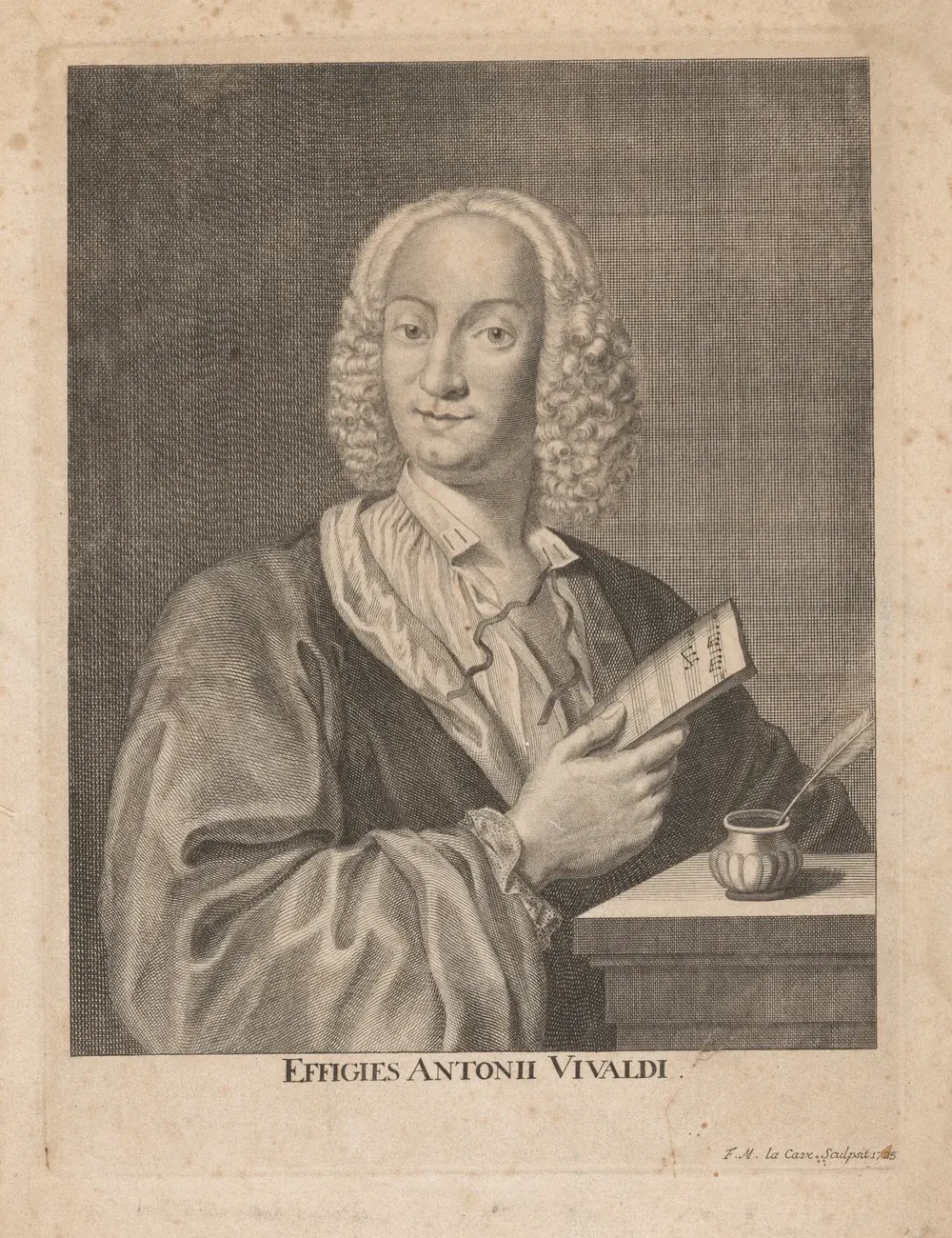
Antonio Vivaldi · engraving by François Morellon La Cave (1725) · Rijksmuseum, Amsterdam · public domain · Wikimedia Commons
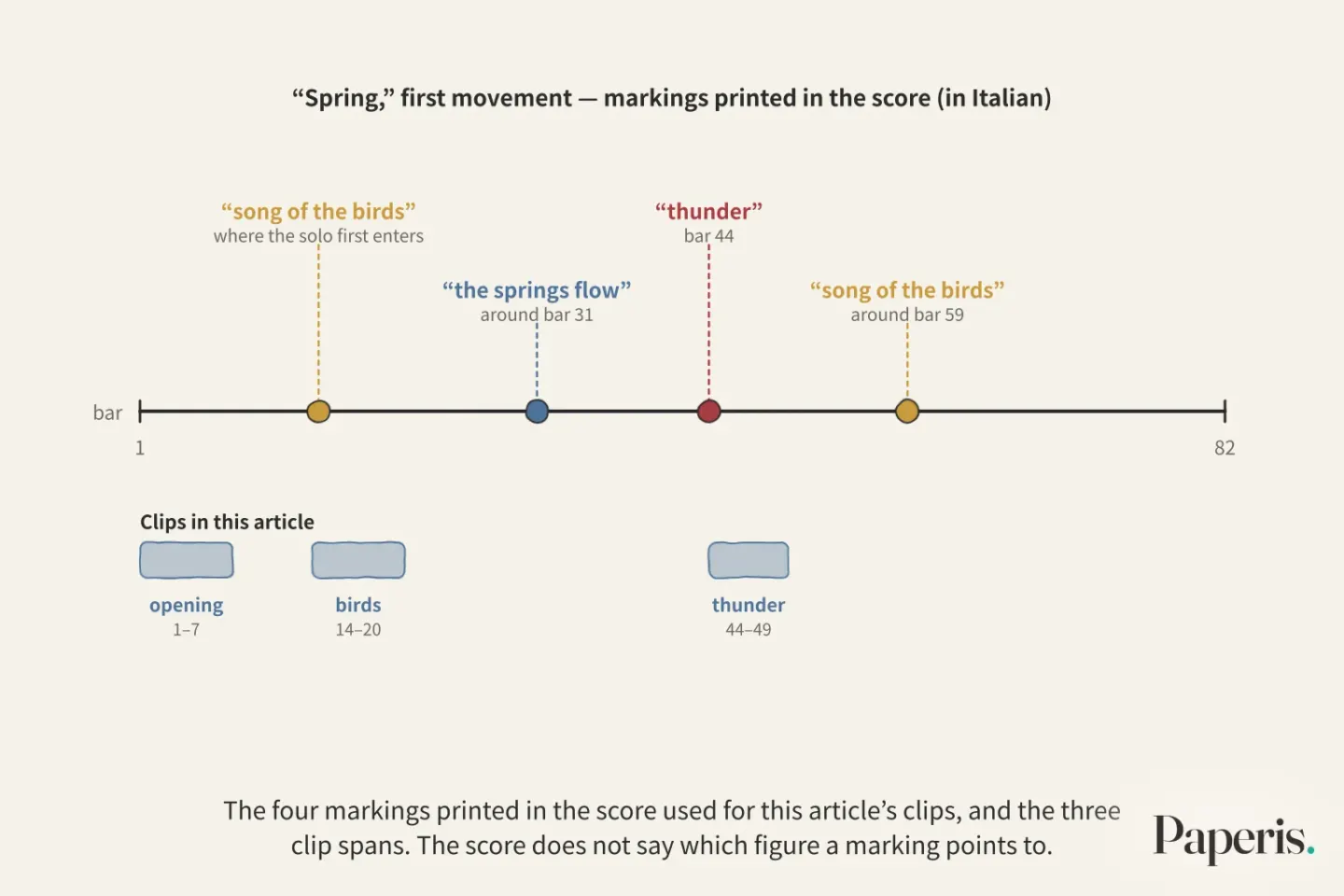
On the score used to make the performance clip for this article, Italian words are printed above the notes. Where the solo violin first enters, there is "The song of birds"; around bar 31, "Springs flow"; at bar 44, "Thunder"; and around bar 59, "The song of birds" again. Lines of poetry are also written above the movement. Spring has arrived, birds greet spring with joyful song, springs flow in the gentle breeze, dark clouds and lightning and thunder, and after it ceases the birds sing again. This poem is a sonnet. A sonnet is a short, traditional European poem with a fixed number of lines and rhyme scheme.
Music that attaches stories to a piece in this way has a separate name. Program music is music that reveals a story or scene from outside the piece through a title or text, and seeks to portray it in sound. Placed on the opposite side of that is absolute music. Absolute music is music written without a story outside the piece, asking listeners to hear the texture of the sound itself.
A musicology paper published in 2017 evaluates "The Four Seasons" as a major shift in the way art portrays the seasons. It argues that "The Four Seasons" broke away from religious and mythological allegory, moving toward depicting the forces of nature and the bodies and minds of people standing before them. The same paper separately discusses Vivaldi pairing sonnets with concertos and the aesthetic reasons for choosing the story scenes to be painted with music (DOI: 10.1017/s1478570617000070).
First, let's listen to the opening passage of the movement. This is a spot where all five parts play together, corresponding in the sonnet to the phrase "Spring has arrived".
Clip: Vivaldi, The Four Seasons, “Spring,” Op. 8 No. 1, I, opening (bars 1–7) (synthesized strings; score input Mutopia Project, CC BY-SA 3.0)
What you just heard is synthesized strings, and the tempo was decided while creating this article. It is not an actual performance recording.
Here is the question of this article. If we erase the words on the score and leave only the sound, will a listener recognize the birds, the springs, and the thunder? Among the studies this article relies on, there is no experiment that played "Spring" and measured the scenes that came to mind. The answers are borrowed from music cognition and psychology studies using other music, and all sentences applying those results to "Spring" are hypotheses.
Sounds in "The Song of the Birds" and "The Thunder"
From measure 14 to measure 20, marked with the label "The Song of the Birds," the violas and cellos rest. Only the solo violin and two violin parts remain, repeating the same note shortly in a high register.
Clip: Vivaldi, “Spring,” I, bars 14–20 — marked “song of the birds” in the score (synthesized strings; score input Mutopia Project, CC BY-SA 3.0)
In the passage you just heard, the lower string instruments were omitted, and three high-pitched sounds repeated the same note shortly.
There is a name for this compositional method. Tone painting is a compositional method that mimics sounds or movements outside of music with instrument sounds, such as bird song or thunder. However, what the score guarantees is only up to "this word was written in this place." The label does not tell us which specific cry of which bird the shortly cut high notes resemble.
Measures 44 to 49, marked with the label "The Thunder," have a different texture. In measures 44 and 46, all five parts repeat the same note very quickly, and in between at measure 45, the solo violin rapidly sweeps up an octave. From measure 47 to 49, the solo continues a fast figure in a high register.
Clip: Vivaldi, “Spring,” I, bars 44–49 — marked “thunder” in the score (synthesized strings; score input Mutopia Project, CC BY-SA 3.0)
What you just heard was a passage where the fast repetition of the entire ensemble and the fast ascent of the solo alternated, and at the end, the solo continued a fast figure in a high register.
Although lightning and thunder both appear in the sonnet, the score's label is just the single word "The Thunder." Which figure is the lightning and which figure is the thunder is not written in the score. Matching them up is left to the listener or the commentator.
The musicology paper mentioned earlier analyzes that Vivaldi used various textures and resonances to create strong contrasts, and that those contrasts enhanced the emotional effect of the sound-painted scenes (DOI: 10.1017/s1478570617000070). The difference where lower instruments are omitted in "The Song of the Birds" and five parts surge all at once in "The Thunder" can be read as examples of such contrast. This is our interpretation in this article, and the paper's abstract does not point specifically to these two passages. The property by which notes of the same pitch sound different depending on the instrument was covered in "Timbre — Same Pitch, Same Loudness, a Different Face".
There is one thing to take away from this section. The labels in a score only tell us what the composer intended to paint, not a guarantee that the listener will recognize it. The studies below measured the gap between those two things using different music.
What Crosses Over When We Listen Without a Cover
We look at emotion first. In an experiment where spoken utterances laden with emotion and music played by performers to convey specific emotions were cut into very short snippets and played to listeners, anger, joy, neutrality, and sadness were guessed with higher-than-chance accuracy even in snippets of 0.1 seconds or less. Most other emotions were also higher than chance at 0.25 seconds or less. However, it took longer for the correct answers to stabilize in music than in speech, leading the authors to suggest that sonic cues unfolding over time are also used to judge emotion in music. The patterns of sonic cues carrying emotion resembled each other in speech and music (PMID 31153307). This means that for music played with emotion, broad textures like joy or sadness are recognized better than chance from very short snippets alone.
In another study, the accuracy of recognizing emotion depended on the musical culture. In a study where 48 snippets of 10 seconds each of Western classical music and traditional Chinese string music were played to 100 Western listeners from the UK, the US, New Zealand, and Australia, joy and sadness were recognized more accurately in Western classical music, while nursery rhymes were recognized more accurately in Chinese music. The authors conclude that cultural bias is distinct in emotion perception among Western listeners, and that this bias arises from the entanglement of cultural familiarity with the emotional and structural properties of music (PMID 40426648).
The content of a scene is a different matter. There is a study where 353 people recruited online were played three snippets of orchestral film music representing joy, tenderness, and fear, and were asked to write down the scenes that came to mind. The written contents were grouped into three branches: stories featuring places, people, and actions; associations such as emotions, thoughts, and memories; and the source of having seen it in a movie or drama. However, the degree of overlap in scene content among different people was relatively low, and looking at 254 people who retook the same survey 3 weeks later, it was higher within the same person. The factors influencing the degree of agreement were cited as the vividness of the scene and the intensity of the felt emotion. As the title of the paper suggests, the scenes that came to mind contained both content that varied from person to person and content that was shared. The authors summarize that individual-level tendencies exist in the degree to which scenes match, supporting previous research suggesting that music makes people listen as if to a story (PMID 37883377). The degree to which the scenes that came to mind overlapped among people was relatively low, and more consistent within the same person.
The two studies were measured separately. The emotion side measured accuracy in guessing the correct answers for snippets played with emotion, while the scene side measured how much the scenes of people listening to film music overlapped with one another. A study directly comparing how much emotions overlap between people and how much scenes overlap in a single experiment does not exist among the studies gathered in this article. Therefore, the comparison that "emotions overlap while scenes diverge" is this article's summary placing the two results side by side. When applying this summary to "Spring", even a person who does not know the cover can recognize the bright texture, but whether that texture looks new may vary from person to person. This is not a result measured by "Spring".
There is also a study that later compared written scenes with the scenes imagined by listeners. In North Indian classical music, medieval meditative poetic verses that pictorially describe the appearance of each raga—a melodic framework—have been passed down. One study collected scenes imagined by contemporary listeners while listening to this music, and confirmed that the scenes for calm snippets and sad snippets diverged distinctly. Compared to scenes for Western music, common themes existed, but cultural differences were also revealed. Listeners heard the pieces without receiving the old poetic verses, and the researcher later compared the verses' scenes with the listeners' scenes. In this single study, the two shared striking similarities alongside major differences (DOI: 10.1177/20592043231206255).
There is also a study using music depicting a storm. This is a preliminary study where Beethoven's "Pastoral Symphony" 4th movement "Storm" was played to 33 university music majors, who were asked to express what they heard through self-made video and audio works and notes. The students had previously taken a 6-month analysis class taught to find the meaning of music within the textures inside the music. This was a class that taught absolute music-style listening. Even after the class, responses pointing purely to properties inside the music only increased from 0% to 9.5%, which was not a meaningful increase, and 52.6% of students did not change their frameworks of thought before and after the class. The most frequent response was extra-musical associations (68%). The authors conclude that classical music evokes extra-musical content, and that this is as worthy of being addressed in education as analytical properties (DOI: 10.1177/0255761419850247). The abstract does not disclose whether the students listened knowing the title of the piece.
When You Read the Text First
"Spring" is a piece you can listen to without knowing the sonnet, or you can read beforehand in a concert program or album notes and then listen. There is no study among the ones collected in this article that measured how listening after reading the text first differs using "Spring". The closest things are experiments that gave scenes through text or video and played music along with them.
One brain imaging study had 16 people imagine emotionally charged scenes according to a text script, while sometimes playing music that matched that emotion and other times not playing it. While imagining the scenes, the emotion felt by participants became noticeably stronger when music was present, and under the condition where music was added, the activity of emotion-related regions like the temporal pole, amygdala, and hippocampus was greater (PMID 31026474). When mapping the structure of this experiment—the setup where the text sets the scene and the music adds emotion—onto the sonnet and movements of "Spring", for someone who reads the sonnet and listens, the music may act to heighten the emotion of that scene. This is an assumption, and it is a single study with a scale of 16 people.
There are also results showing that music even shifts the content of imagination. After showing 100 people a video of a figure heading toward a distant target point, they were made to close their eyes and continue imagining that journey. While imagining, they either listened to music or heard nothing. Strong evidence emerged that music affects the vividness and mood of the imagination, as well as the time that passed and distance traveled within the imagination, and part of that effect was explained by musical features like tempo (PMID 34362960). In this experiment, the video gave the starting point of the scene, and the music changed the vividness and mood, time, and distance of the imagination.
A similar story comes from the side of the performers. In a study where 8 piano students and 2 teachers played Mozart's variations and described the scenes that came to mind at the time, the background of the piece—such as the composer, personal memories, and historical context—entered into the imagined scenes (DOI: 10.1525/mp.2026.2694951). Since it is a qualitative study that interviewed 10 people, it should be read as the performers' firsthand accounts of how what they know seeps into the scenes.
The Scene Is Built Inside the Listener
The experience we have described so far with the phrase "a scene comes to mind" has a name. Visual imagery is when a scene or shape that is not in front of our eyes appears to be visible in our minds. We keep this distinct from a similar-sounding term. Musical imagery is when we recall music as if hearing it in our heads even though no sound is actually playing. The question of this article runs in the opposite direction: toward the picture that appears in the mind when listening to music.
In music psychology, visual imagery is included in theory as one of several pathways through which music arouses emotion. A 2008 theoretical framework listed brainstem reflexes, evaluative conditioning, emotional contagion, visual imagery, episodic memory, and musical expectancy, and the authors argued that failing to distinguish the pathways could lead to mixed results or difficult interpretations (PMID 18826699). In 2013, a framework in the same lineage expanded the pathways to eight by adding rhythm synchronization and aesthetic judgment (PMID 23769678). Both are theoretical frameworks, and the size of each pathway has not been measured.
There are also experiments trying to isolate whether visual imagery actually intervenes in emotion. While 35 participants listened to film music snippets, one condition had them perform a task of moving their eyes rapidly back and forth while another condition had them look at a blank screen. The eye-movement task significantly reduced the frequency and vividness of scenes coming to mind. However, among nine experienced emotions, the only one that decreased was longing, and the rest did not clearly decrease (DOI: 10.1177/2059204320959580). This is a result where, even though scenes were induced to come to mind less, most emotions did not clearly decrease. The authors presented this method as a new approach to investigate the causal role of visual imagery on emotion, and noted that future work must examine the effect that the distraction task itself has on scene formation.
In studies using electroencephalography (EEG), brainwave changes accompanying this experience were observed. When the brainwaves of 42 participants were measured while they listened to 24 music snippets with their eyes closed, occipital alpha waves—a component of brainwaves—decreased in the early part of listening for both static and moving scenes (PMID 38242363). In a study where 30 participants listened to multiple genres of music for longer periods and were unexpectantly asked, "Did a scene appear just now, or did you deliberately recall it?", the decrease in alpha waves appeared more consistently when scenes came to mind spontaneously than when they were deliberately recalled (PMID 41419053).
So, do people with musical training see scenes better? In a study comparing individuals with and without musical training, the trained group performed better on a task mentally comparing the pitches of songs and a task mentally comparing everyday sounds. However, there was no difference between the two groups in a visual imagery task mentally comparing the shapes of objects (PMID 11074089). Because this was not a task measuring scenes that appear while listening to music, this study provides neither grounds to say that untrained people see fewer scenes in "Spring" nor grounds to say they see more. Meanwhile, the earlier EEG study using 24 music snippets provided additional evidence that musical training may influence part of the relationship between static and moving scenes and brainwaves (PMID 38242363). Whether training increases the amount of scenes seen and whether it alters the brain's response depending on the scene are different questions, and both remain open.
Making Sound Alike, Borrowing Qualities
The way a passage like “Song of the Birds” points to a scene can be divided into two paths. One is sonic painting as defined earlier, namely making outside sounds resemble instrument sounds. The other is the path of hearing properties of sound translated into the language of another sense. This is the style of calling high pitches "light" and low pitches "heavy."
The second path has been measured through experiments. Forty people (20 of whom had musical training) were played 20 sounds varying in pitch, loudness, instrument (violin and flute), and tremor (vibrato), and were asked to rate how well six pairs of tactile metaphors—sharp and dull, smooth and rough, soft and hard, light and heavy, warm and cold, wet and dry—matched them. The tactile metaphors were strongly associated with all the musical variables investigated, and high pitches were rated as sharper, rougher, harder, colder, drier, and lighter than low pitches. The authors examine three explanations together: the similarity of sensory processing ways, the experience of sound and touch being encountered together in daily life, and abstract dimensions of meaning such as force and activity (DOI: 10.1177/0305735610377592).
Applying these results to the passage “Song of the Birds”, pitches in the high register may sound sharper, rougher, harder, colder, drier, and lighter according to the same study. The performance technique of playing notes staccato was not a variable changed in that experiment, nor was it measured with “Spring”. There is also no study among the ones gathered in this article that measured whether those qualities lead to the scene of a bird. In this article's summary, both paths include the properties of sound in the score, and whether to see those properties as a bird is completed on the side of the listener, as seen in the previous section.
Following Along Step by Step
Let us imagine two people listening to the first movement of "Spring". One person does not know the sonnet, while the other read the sonnet in the program notes beforehand. The below is a projection of the studies cited so far onto this scene, and none of these scenes were measured using "Spring".
In the opening passage, five parts play together. Comparing this to an experiment where even short, emotionally performed snippets match emotions like joy better than chance (PMID 31153307), both listeners can hear a bright texture. However, that experiment did not use "Spring", and in a study of 100 Western listeners (PMID 40426648), joy was more accurate in Western classical music, whereas nursery tunes were more accurate in Chinese music. The authors interpret this as a result where familiarity and musical properties are intertwined.
In the "birds' song" passage, the low instruments drop out and the high notes repeat briefly. The person who read the sonnet knows that "birds welcome spring with joyous song". Comparing this to a neuroimaging experiment where adding music that fits a textual scene amplified the felt emotion (PMID 31026474), the music may heighten the emotion of that phrase for this person. That experiment did not measure whether the music changes the content of the imagined scene. Comparing what a person without the sonnet will see to a film music study (PMID 37883377), the degree of overlap among people may be relatively low, and it might not be birds.
In the "thunder" passage, five parts rapidly drive the same pitch. Comparing this to a preliminary study where many responses from music students listening to storm music were extra-musical associations (DOI: 10.1177/0255761419850247), both people may call to mind something outside the music. Whether that is thunder, lightning, or something else provides a clue only to the person who read the sonnet. The score heading has only the single word "Thunder", so even the person who read the sonnet pairs which musical figure is lightning on their own.
Around measure 59 after the storm, the "birds' song" heading appears again. For the person who read the sonnet, this spot pairs with the phrase "birds sing again after it clears". For the person who does not know the sonnet, it is unclear whether this spot will sound like the same scene as the earlier bird passage. This article did not compare the notes of the two passages to each other, and no study measuring whether such a return is understood is among the studies collected in this article.
What can diverge in this scene is the content of the scene, and what can overlap is the emotional texture. This, too, is a synthesis placing separately measured studies side by side, and no study measuring what the two people actually see is among the studies collected in this article.
What We Don't Know Yet
The biggest missing piece is "Spring" itself. There is no study among those collected in this article that played "Spring" and measured the scenes that came to mind, and there is no experiment comparing when the same piece is given with a sonnet versus without one. How much the scenes that come to mind change when a title or commentary is provided cannot be answered directly by the evidence collected in this article.
There are also limitations to the remaining studies. The large study analyzing scene content used three snippets of film music and an online sample (PMID 37883377), the listeners in the study looking at cultural differences in emotion recognition were all Western listeners (PMID 40426648), and the storm music study was a preliminary study of 33 music students (DOI: 10.1177/0255761419850247). Because film music is music used together with a scene from the beginning, it is unclear whether it will be heard in the same way as a Baroque concerto.
Research looking for tone-painting using music collection data also has debates over its methodology. There is one exploratory analysis that paired lyric words and musical features in a large collection of English popular songs and folk songs. One commentary praised its scale, yet pointed out that because there were no pre-established hypotheses, comparisons increased and statistical power dropped significantly (DOI: 10.18061/emr.v13i3-4.6771). This is an opinion from the side offering a critique as a journal commentary, and it is not a study that measured whether people hear and understand tone-painting.
So What Do We Know
The sheet music for "Spring" that made the clips for this article has sonnets and the cover titles "Song of the Birds," "Flowing Spring," and "Thunder" printed on it. What the composer intended to depict remains in writing. In studies that played music without covers, sounds performed with emotion were recognized better than by chance even in very short snippets, the scenes that came to mind had a relatively low degree of overlap between people, and there were also common categories of stories, associations, and sources. Because these two findings are from different studies, placing them side by side is this article's synthesis. While imagining scenes described in text, listening to music at the same time intensified the felt emotions, and in an imaginative journey that started with video, the music changed the vividness and mood of the imagination.
Within the scope supported by these studies, rather than handing over scenes wholesale, music helps the listener build the scenes. A sonnet is closer to text that decides where those scenes will go. Because there was no study among the ones collected in this article that played "Spring" and measured the scenes that came to mind, this final sentence is also a hypothesis applying research done on other music to "Spring." The next time you hear the passage from "Song of the Birds," even if what comes to mind is not a bird, it is entirely within the range shown by the research.
Source Papers
- "ANTONIO VIVALDI AND THE SUBLIME SEASONS: SONORITY AND TEXTURE AS EXPRESSIVE DEVICES IN EARLY EIGHTEENTH-CENTURY ITALIAN MUSIC" (2017) — DOI: 10.1017/s1478570617000070 — The Four Seasons marks a shift in depicting seasons from allegory to natural description, paired sonnets and concertos, and contrasts in texture and timbre that amplify the emotional impact of sound scenes (musicological analysis).
- "The time course of emotion recognition in speech and music." (2019) — PMID 31153307 — Both speech and music clips under 0.1 seconds allow better-than-chance recognition of anger, joy, neutrality, and sadness, though music takes longer to stabilize.
- "Cross-Cultural Biases of Emotion Perception in Music." (2025) — PMID 40426648 — 100 Western listeners recognized joy and sadness more accurately in Western classical music and children's songs in Chinese music, showing cultural bias.
- "Music listening evokes story-like visual imagery with both idiosyncratic and shared content." (2023) — PMID 37883377 — 353 online participants and three film music snippets showed three branches of imagery—stories, associations, and sources—with low inter-subject agreement and higher intra-subject consistency.
- "Tone painting and painting tones: A follow-up study of listeners' audiovisual responses to Beethoven's Thunder Storm" (2019) — DOI: 10.1177/0255761419850247 — A preliminary study of 33 music majors found 68% extra-musical associations, while post-analysis class increases in intra-musical responses were not significant.
- "Music enhances activity in the hypothalamus, brainstem, and anterior cerebellum during script-driven imagery of affective scenes." (2019) — PMID 31026474 — fMRI of 16 participants showed that adding music matching script-driven imagined scenes intensified subjective emotions.
- "Music influences vividness and content of imagined journeys in a directed visual imagery task." (2021) — PMID 34362960 — 100 participants showed that music influenced the vividness, mood, time, and distance of imagined journeys, with some explained by tempo.
- "Visual Mental Imagery Evoked in Indian Classical Music: A Listener-Oriented Study" (2023) — DOI: 10.1177/20592043231206255 — Hindustani music scenes diverged by calmness versus sadness, sharing commonalities and differences with Western music, alongside coexisting similarities and differences to medieval poetic verses.
- "Relationships Between Visual Imagery, Emotion, and Music During Music Performance" (2026) — DOI: 10.1525/mp.2026.2694951 — A qualitative study of 10 piano players showed that the background of the piece entered their imagery during performance.
- "Emotional responses to music: the need to consider underlying mechanisms." (2008) — PMID 18826699 — A theoretical framework of six additional emotion-induction pathways including visual imagery.
- "From everyday emotions to aesthetic emotions: towards a unified theory of musical emotions." (2013) — PMID 23769678 — An expanded theoretical framework (review) spanning eight pathways (BRECVEMA).
- "Saccadic Eye-Movements Suppress Visual Mental Imagery and Partly Reduce Emotional Response During Music Listening" (2020) — DOI: 10.1177/2059204320959580 — In 35 participants, an eye-movement task reduced imagery frequency and vividness, but among emotions, only longing decreased.
- "The neuro-oscillatory profiles of static and dynamic music-induced visual imagery." (2024) — PMID 38242363 — EEG of 42 participants showed posterior alpha suppression after early listening for both static and dynamic imagery.
- "Spontaneous visual imagery during extended music listening is associated with reliable alpha suppression." (2026) — PMID 41419053 — 30 participants showed more consistent alpha suppression during spontaneous imagery.
- "Music training and mental imagery ability." (2000) — PMID 11074089 — Musicians excelled in auditory imagery tasks, with no difference in visual imagery tasks.
- "How music touches: Musical parameters and listeners' audio-tactile metaphorical mappings" (2010) — DOI: 10.1177/0305735610377592 — 40 participants and 20 sounds showed that tactile metaphors strongly correlated with pitch, loudness, timbre, and vibrato, with higher pitches rated as sharper and lighter.
- "A Call for Hypothesis-Driven, Multi-Level Analysis in Research on Emotional Word Painting in Music: Commentary on Sun & Cuthbert (2018)" (2019) — DOI: 10.18061/emr.v13i3-4.6771 — Commentary. Tone-painting corpus analyses suffer from multiple comparison issues without a priori hypotheses.
Sources (17)
- ANTONIO VIVALDI AND THE SUBLIME SEASONS: SONORITY AND TEXTURE AS EXPRESSIVE DEVICES IN EARLY EIGHTEENTH-CENTURY ITALIAN MUSICDOI 10.1017/s1478570617000070
- The time course of emotion recognition in speech and musicPMID 31153307
- Cross-Cultural Biases of Emotion Perception in MusicPMID 40426648
- Music listening evokes story-like visual imagery with both idiosyncratic and shared contentPMID 37883377
- Tone painting and painting tones: A follow-up study of listeners' audiovisual responses to Beethoven's Thunder StormDOI 10.1177/0255761419850247
- Music enhances activity in the hypothalamus, brainstem, and anterior cerebellum during script-driven imagery of affective scenesPMID 31026474
- Music influences vividness and content of imagined journeys in a directed visual imagery taskPMID 34362960
- Visual Mental Imagery Evoked in Indian Classical Music: A Listener-Oriented StudyDOI 10.1177/20592043231206255
- Relationships Between Visual Imagery, Emotion, and Music During Music PerformanceDOI 10.1525/mp.2026.2694951
- Emotional responses to music: the need to consider underlying mechanismsPMID 18826699
- From everyday emotions to aesthetic emotions: towards a unified theory of musical emotionsPMID 23769678
- Saccadic Eye-Movements Suppress Visual Mental Imagery and Partly Reduce Emotional Response During Music ListeningDOI 10.1177/2059204320959580
- The neuro-oscillatory profiles of static and dynamic music-induced visual imageryPMID 38242363
- Spontaneous visual imagery during extended music listening is associated with reliable alpha suppressionPMID 41419053
- Music training and mental imagery abilityPMID 11074089
- How music touches: Musical parameters and listeners' audio-tactile metaphorical mappingsDOI 10.1177/0305735610377592
- A Call for Hypothesis-Driven, Multi-Level Analysis in Research on Emotional Word Painting in Music: Commentary on Sun & Cuthbert (2018)DOI 10.18061/emr.v13i3-4.6771