Paperis Articles
Aging and Collapse — Rust That Swells from Within, Neighbor Columns That Take Up the Weight
Cracks in a building do not all mean the same thing, and the steel inside concrete can rust once carbon dioxide or salt breaks the conditions that protected it, and the rust can swell and split the concrete. Whether the weight of a failed member can pass to its neighbors and be carried there is what separates local damage from progressive collapse.
Your field's papers, as audio
Pick your fields and journals — Paperis summarizes the key papers and turns them into audio. Listen on your commute.
Start Paperis free →Aging and Collapse — Rust That Swells from Within, Neighbor Columns That Take Up the Weight
The Building You Enter and Leave Every Day
The building you enter and leave every day seems to stand just as it did yesterday. Even if a thin crack appears on one side of a wall, the building still stands as before. Yet the materials making up the building change little by little each year. Substances entering from the outside move through the concrete all the way to the inside, and the decay of the concrete depends in part on that movement (DOI: 10.1155/2017/8453095).
Buildings and bridges built with steel and concrete can endure harsh weather for a very long time. Even so, it still happens that the rebar inside rusts earlier than expected and causes trouble (DOI: 10.1016/s1452-3981(23)17049-0). The financial cost society pays because of rust in the rebar inside concrete is also massive (DOI: 10.1617/s11527-017-1131-6).
This article follows three things: what the various cracks appearing in a building mean, why the rebar inside concrete rusts and how that rust pushes the concrete apart, and where the weight goes when one spot fails to hold. The guides are two scenes. One is rust swelling inside concrete, and the other is a neighboring column taking over the weight of a collapsed column.
Not All Cracks Are the Same
On the walls or floors of an old building, such cracks are easily seen. There are several reasons why cracks form (DOI: 10.3390/buildings13030765). Load is the general term for the weight and forces that a building receives. A structure is the framework that carries the loads a building receives down to the ground. Cracks can form anywhere in this framework.
A crack is a split formed when a material breaks apart. Because concrete fractures have many branches, one review paper divides them into eight criteria (DOI: 10.3390/buildings13030765).
A beam is the part laid horizontally that receives the weight above it, and a column is the part standing vertically that sends that weight down. A member is an individual part that makes up the structure, such as a beam, column, or floor slab. Large cracks occurring in members made of steel and concrete vary depending on the type of load the member mainly receives (DOI: 10.3390/buildings13030765). Therefore, even the same crack has different meanings depending on where it formed and why.
Very small cracks are almost unavoidable in concrete. Cracks narrower than 0.3 millimeters (300 micrometers) are like this. Such cracks do not necessarily mean a risk of collapse. However, even small cracks erode the strength with which concrete performs its function, increase the rate at which it deteriorates, and shorten its usable lifespan (DOI: 10.1002/admi.201800074). This width is merely a value showing how much of a "small crack" there is, not a value used as a dividing line between danger and safety.
If a crack spreads excessively and uncontrollably, the story changes. Such cracks can reduce the member's load-bearing capacity and water-tightness, rust the rebar inside it, and weaken the bonding force between the rebar and the concrete (DOI: 10.3390/buildings13030765). Cracks are divided into multiple branches, and the meaning of a crack is not determined by the appearance of a single crack alone (DOI: 10.3390/buildings13030765).
How Concrete Protects Steel Reinforcement
Steel reinforcement buried inside concrete is still iron, so it rusts if the conditions are right. Reinforced concrete is a material in which rebar, which is strong against pulling, is placed inside concrete, which is strong against pressing, so that the two forces are shared. The properties of these two materials are covered in "Building Materials — The Chalk That Snaps, the Paper Clip That Bends". What this piece looks at is time.
An oxidation-reduction reaction is a chemical reaction in which one substance loses electrons and another gains them, with oxidation and reduction happening together. Corrosion is a process where a metal gradually deteriorates due to a spontaneous oxidation-reduction reaction with its surrounding environment. The electron-transfer reaction itself is covered in "Oxidation and Reduction — A Hand That Catches the Thrown Ball, a Ball Sent the Long Way Around". The rusting of rebar is also corrosion, and iron rusts when it meets oxygen and water (OpenStax Chemistry 2e 17.6).
Then why is the rebar inside moisture-retaining concrete usually fine for a long time? The water filling the small pores inside concrete is strongly alkaline, and rebar generally avoids rusting thanks to this alkalinity (DOI: 10.4028/www.scientific.net/ssp.272.226). In that water, a thin iron oxide film naturally forms on the surface of the rebar and clings tightly to it, and this film protects the rebar from rusting (DOI: 10.1201/9781003081302-4). Passivation is a state where a thin film attached to the surface of a metal protects that metal from rusting. If the alkalinity drops or harmful substances penetrate far enough to reach the rebar's surface, this film can be lost, and the steel then loses the cover that protected it from rust (DOI: 10.1201/9781003081302-4).
Rebar has one more cover. Concrete cover is the layer of concrete wrapping the outside of the rebar. Anything from the outside must first pass through this layer to reach the rebar.
Two Paths Where Protection Collapses
Carbon dioxide is always mixed in the air, and that carbon dioxide seeps from the outside of concrete to the inside. Carbonation is the process in which carbon dioxide in the air seeps into concrete and neutralizes the water filling small pores inside the concrete. When that water is neutralized, there is a risk that the rebar will rust (DOI: 10.1617/s11527-020-01558-w). This is because if the alkalinity drops, the protective layer on the outside of the rebar can disappear (DOI: 10.1201/9781003081302-4).
How carbonation progresses depends on conditions. How wet the concrete is, how concentrated the carbon dioxide in the surrounding air is, humidity, the time of exposure to water, and temperature all have an effect. The mix of materials used to make the concrete, the age of the concrete, and the curing method also have an effect (DOI: 10.1617/s11527-020-01558-w). Replacing part of the cement with other materials is cited as the most realistic way to reduce the carbon dioxide emitted when making concrete, but the risk of the rebar rusting due to carbonation can increase (DOI: 10.1617/s11527-020-01558-w). This means a trade-off can occur between concrete that emits less carbon dioxide and concrete that protects rebar for a long time.
One review notes that academic opinions are divided on the process by which carbonation leads to structural damage. There are those who argue that carbonation weakens the structure and makes the rebar prone to rusting, and those who argue that carbonation alone does not cause enough damage to make the rebar rust (DOI: 10.3390/buildings12050586).
The second path is salinity. Chlorides are substances containing chlorine as charged particles, like salt (sodium chloride), and are a representative type of saltiness that rusts rebar inside concrete. Charged particles that harm concrete, like chlorides, move along the small pores inside the concrete. How well concrete blocks the movement of such particles is one of the factors that determines how long that concrete lasts (DOI: 10.1155/2017/8453095). If chlorides reach the outside of the rebar in sufficient quantity, the protective layer can be lost (DOI: 10.1201/9781003081302-4). Chlorides break the protective layer in spots and initiate rusting, which requires chlorides to accumulate above a certain concentration (DOI: 10.1520/stp25011s). When predicting how reinforced concrete structures deteriorate over time, corrosion caused by chlorides is also a separate item that is evaluated (DOI: 10.1061/(asce)st.1943-541x.0001544). In transportation facilities like bridges where deicing salt is spread and in parking lots, rebar corrosion is mainly initiated by the chlorides in that salt (DOI: 10.4028/www.scientific.net/ssp.272.226).
Methods for calculating how quickly external substances enter concrete have advanced considerably. A 2018 review summarizes that those calculations are at least ahead compared to the understanding of when rust begins and how the started rust spreads, and many open questions remain on the latter (DOI: 10.1617/s11527-017-1131-6). When rebar begins to rust and how fast it spreads are questions that have not yet been fully resolved.
When Rust Swells
Now we follow a piece of rebar inside concrete. In a freshly built structure, this rebar is wrapped in a cover, and the outside has a protective layer. As the years pass, if carbon dioxide neutralizes the water inside the concrete or salty moisture seeps along the pores to reach the front of the rebar, the conditions for the rebar to rust are set (DOI: 10.1617/s11527-020-01558-w) (DOI: 10.1155/2017/8453095).
When rebar rusts, the volume generally increases where the iron has turned into rust. However, hardened concrete tightly wraps around the rebar. The swelling rust pushes the surrounding concrete outward from within, and that pushing force pulls the surrounding concrete in a circular direction, tearing it open. When that pulling force exceeds the degree the concrete can withstand, cracks form (DOI: 10.4028/www.scientific.net/ssp.272.226). If the rust progresses quickly, the cover may crack and fall away, and as the rust continues, the rebar and concrete lose the force by which they grip each other (DOI: 10.4028/www.scientific.net/ssp.272.226).
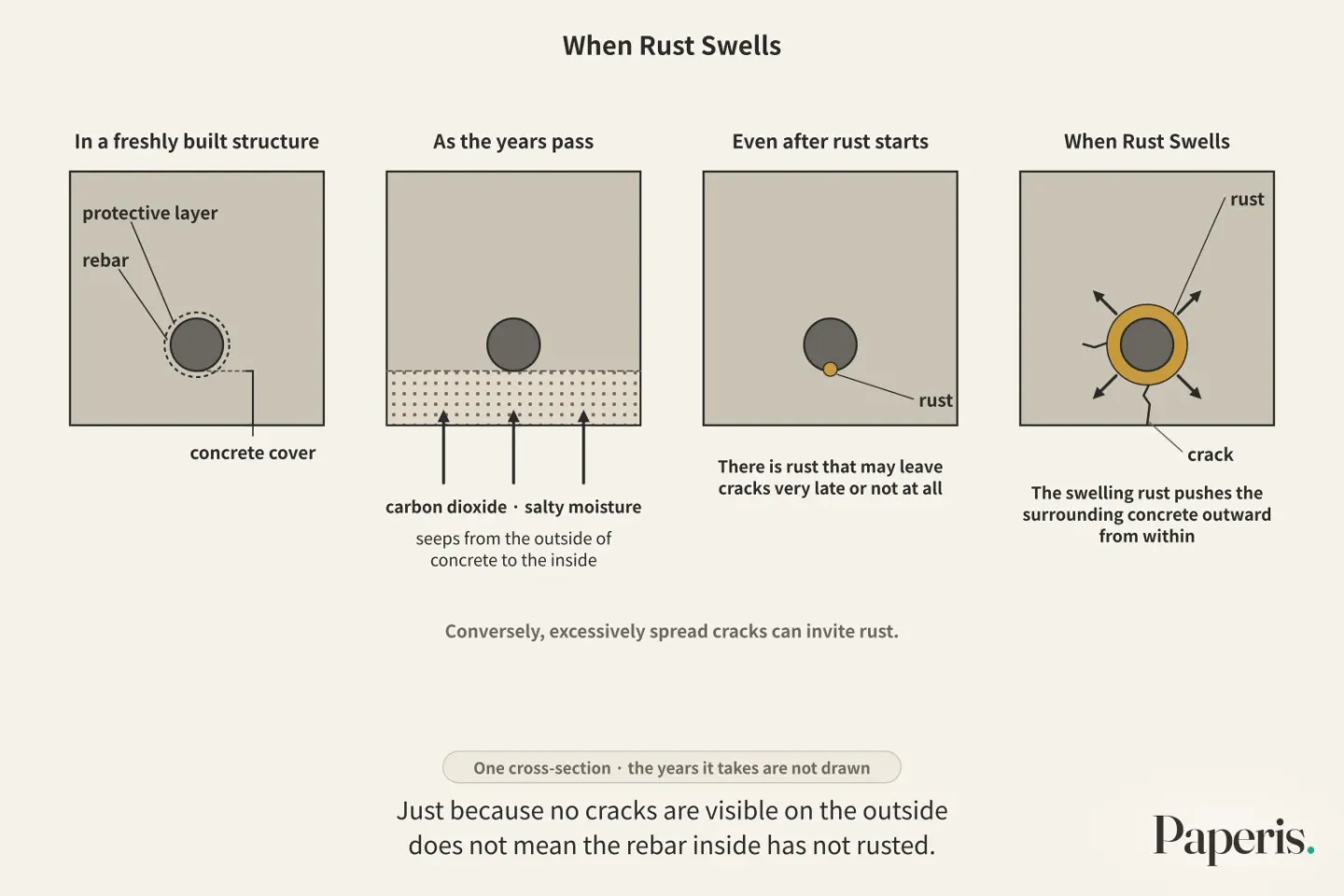
If the cracks grow and spread, the property of the concrete blocking water may decline, and such cracks can invite rebar corrosion (DOI: 10.3390/buildings13030765). If the cover cracks and falls away due to rust, the degradation process may become even faster (DOI: 10.1002/maco.201206669). Rust makes cracks, and those cracks can in turn invite more rust. How started rust spreads remains an open question in many ways, as we saw in the previous section (DOI: 10.1617/s11527-017-1131-6).
According to this sequence, cracks caused by rust appear only after the rust has started and swelled (DOI: 10.4028/www.scientific.net/ssp.272.226). There is rust that may leave cracks very late or not at all. In rust caused solely by chlorides—that is, rust that narrows and digs deep into a single point on the rebar—the accumulation of rust may be greatly delayed or may not happen at all. Therefore, when such rust cannot be ruled out, one must be cautious about finding rust inside using visible signals on the outside, a study concludes by comparing theory and real structural cases (DOI: 10.1002/maco.201206669). Just because no cracks are visible on the outside does not mean the rebar inside has not rusted.
Finding Things Before They Become Serious
For a long time, structural inspection relied on human eyes and hands. According to a 2003 review, inspections back then were carried out using traditional methods such as visual examination and tapping to listen to the sound. Among the practices covered by that review, this labor-intensive work was done less often than once every 2 years for bridges, and whenever needed for buildings (DOI: 10.1177/1475921703036169). As we saw in the previous section, cracks caused by rust appear only after the rust has started and swollen, and since some rust may leave cracks very late or not at all, relying solely on visual inspection means things are sometimes found too late.
Using bridges and buildings safely requires inspection and maintenance, and doing so requires a way to gauge the rust on rebar. That method must be able to catch problems that would be obstacles to longevity before they become serious (DOI: 10.1016/s1452-3981(23)17049-0). Therefore, methods of measuring the inside without breaking the concrete are used. Non-destructive testing is an examination that measures the state inside a structure without breaking or detaching it. Methods that use electricity to measure rust and non-destructive testing are used to gauge corrosion of rebar inside bridges and buildings (DOI: 10.1016/s1452-3981(23)17049-0). Measuring how well concrete blocks electricity is one of those ways. This value moves together with the degree to which chlorides spread into the concrete and rebar corrosion, serving as a clue to gauge the state of a structure in use. However, surrounding conditions like moisture as well as internal rebar and cracks also shake this measured value (DOI: 10.1155/2017/8453095).
According to the same 2003 review, the method of finding damage by looking at whether the shaking of the entire structure changes had been studied for 30 years up to that point. This method was somewhat successful when the damage was large, but not as successful at the stage where damage was just beginning, and new research to fix this was just getting started (DOI: 10.1177/1475921703036169). The methods of that time easily found damage after it was heavily hurt, while missing it when it was first hurt.
The performance of structures changes over time, and methods looking ahead by tying those changes together with inspection, monitoring, and maintenance have also been refined. However, a 2016 review assesses that these ideas had not yet properly entered design and evaluation standards, as well as actual sites (DOI: 10.1061/(asce)st.1943-541x.0001544). Another review from 2018 considers that in tending to aging reinforced concrete, mainly industrialized countries need to change from cautious judgments relying on experience to strategies relying on knowledge (DOI: 10.1617/s11527-017-1131-6). Inspection is the work of finding signals before problems become serious, and those methods are not yet perfect.
When a Single Column Fails
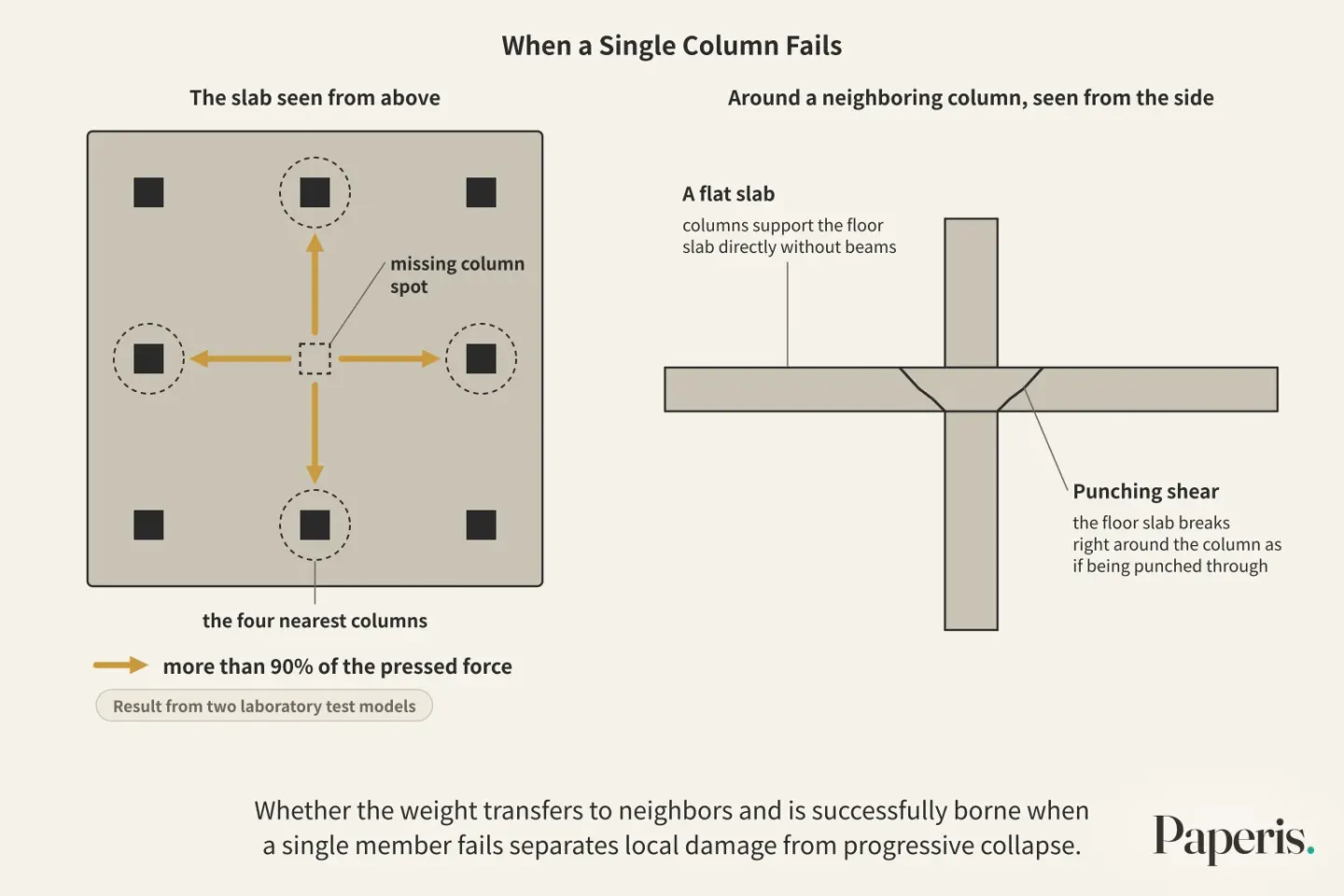
In a large reinforced concrete slab two bays long and two bays wide (held up by a three-by-three grid of columns), if the single middle column disappears, where does the weight loaded on that spot go? When two such slab test models were built in a laboratory, the entire floor was loaded evenly first, and then the missing column spot was pushed down increasingly hard from above, more than 90% of the pressed force shifted only to the four nearest columns (DOI: 10.1061/(asce)st.1943-541x.0002090). The force loaded on the missing column spot does not disappear and is handed over to the neighboring columns. This force is a different value from the design load that the columns usually bore (DOI: 10.1061/(asce)st.1943-541x.0002090).
Load redistribution is the process where, when one member fails to bear a load, the load it was carrying moves over to neighboring members. Redundancy is having other paths within the structure for the load to travel along even if one part is cut off. In the previous experiment, the force loaded on the missing column spot moving to the four neighbors is load redistribution. The paths the load takes to the ground and the basics of redundancy are covered in "Loads and Load Paths — A Child on Your Shoulders, Weight That Travels Down to Your Soles".
If the neighboring columns that take over the load can hold out, the damage stops right there. If even the neighbors fail to hold out, the damage spreads to the next neighbors. Progressive collapse is an event where initial local damage, caused by losing one or a few load-bearing members, spreads and causes part or all of the structure to collapse. It is a term compared to a chain reaction (DOI: 10.5075/epfl-thesis-4613).
There is a structure where this kind of spreading has been studied particularly well. A flat slab is a structure where columns support the floor slab directly without beams. It is widely used in buildings and parking lots (DOI: 10.5075/epfl-thesis-4613). This structure is much more vulnerable to progressive collapse than a frame with beams. This is because there are no beams to share the load that the lost column was carrying (DOI: 10.1061/(asce)cf.1943-5509.0000680).
Punching shear is a failure where the floor slab breaks right around the column as if being punched through. Without reinforcement bars prepared for punching or bars piercing through the column as we will see later, this failure usually happens suddenly with almost no warning signs (DOI: 10.14359/51685833). This is because the deflection is small and cracks on the top of the slab are usually not visible (DOI: 10.5075/epfl-thesis-4613). The force that the spot can bear after breaking is usually much smaller than before it broke. Therefore, if punching occurs in one column, more load is loaded onto neighboring columns, and if those columns also break by punching, progressive collapse can begin (DOI: 10.14359/51685833).
There can be a distance between a single break and total collapse. In a study testing five half-scale test models of a single story supported by nine columns, whenever the connections broke successively by punching, the load-bearing capacity dropped briefly and then revived, and that bearing capacity was maintained until complete collapse (DOI: 10.14359/51686731). Through tests abruptly removing columns in one-third scale test models and numerical analysis, the bearing capacity of the slab pulling like a membrane, the capacity remaining after punching, and the capacity bearing through bending were discussed as resistances that can mitigate progressive collapse (DOI: 10.1061/(asce)cf.1943-5509.0000680).
One of the factors that greatly changed the post-breakage resistance was the location where the rebar passed. Integrity reinforcement consists of bars placed to pierce through the column at the bottom of the floor slab, hanging the damaged part onto the column even after the slab breaks. In a study testing 24 test models, integrity reinforcement passing through the columns significantly increased the post-punching bearing capacity and the ability to hold out while deflecting greatly. In contrast, the resistance contributed by the top reinforcement of the slab after punching was small. This was because the thin concrete cover over it spalled off, preventing the bars from doing their job (DOI: 10.5075/epfl-thesis-4613). In another experiment, an unreinforced control test model was able to endure considerably and deflect significantly even after failure, largely thanks to the integrity reinforcement placed generously at the bottom. In the test models of that experiment, which had fewer slab reinforcement bars and wider spans relative to the thickness, flexural failure dominated the behavior (DOI: 10.1680/macr.14.00293). Up to this point, all results come from laboratory test models.
Whether the weight transfers to neighbors and is successfully borne when a single member fails separates local damage from progressive collapse.
A Case of Multiple Layers Overlapping
On January 25, 1971, two-thirds of a 16-story apartment building under construction at 2000 Commonwealth Avenue in Boston, Massachusetts, collapsed. It was a building still under construction, and there were casualties. The destruction began at the roof and spread into a progressive collapse all the way down to the basement (DOI: 10.1061/(asce)0887-3828(2004)18:1(54)).
A case study reanalyzing this collapse notes that the description of the collapse provided by surviving workers was typical of punching shear. One of the technical causes was the concrete. Failing to properly protect the concrete in cold weather kept the concrete strength low, which played a part in lowering the punching shear strength of the slab. The same study notes that there was virtually no inspection, quality control, planning, or supervision at the construction site, and lists multiple causes for this collapse, examining them one by one (DOI: 10.1061/(asce)0887-3828(2004)18:1(54)).
Since this building collapsed while it was being built, it is a different case from aging over time. Still, this case shows how the punching we saw earlier spreads into a progressive collapse. Among the various causes examined by the case study are low concrete strength and the fact that there was virtually no site inspection or quality control. At least in this case, the collapse happened when multiple layers of weaknesses overlapped.
Back in Front of That Wall
We return to the first wall. The thin crack on one side of the wall might be a small crack almost unavoidable in concrete, a crack pushed out by rust swelling inside, or a crack following the type of load. Looking at the crack alone does not determine which one it is.
Seeing a crack does not mean it will collapse right away, nor does not seeing a crack mean the inside is fine. Cracks caused by rust appear only after the rust has started, and some rust may leave cracks very late or not at all. Conversely, excessively spread cracks can invite rust. Inspections try to find signals before problems become serious, but the methods are not yet perfect. Even if one member fails to hold up, if its neighbors take over that weight and hold on, the damage stops right there; if they do not, it spreads. When rust starts and how fast it spreads are questions researchers are still solving (DOI: 10.1617/s11527-017-1131-6).
Where to Look Further
How electrons move in the reaction where iron rusts is covered in "Oxidation and Reduction — A Hand That Catches the Thrown Ball, a Ball Sent the Long Way Around". You can begin exploring what weight and force are in "Force and Motion — A Swinging Strap, a Body That Keeps Going".
The path that a load takes from the roof to the ground and the margin are covered in "Loads and Load Paths — A Child on Your Shoulders, Weight That Travels Down to Your Soles", while the facts that concrete is strong against being pressed and weak against being pulled, and materials like reinforced concrete and steel, are covered in "Building Materials — The Chalk That Snaps, the Paper Clip That Bends". Pushing and pulling forces and the way a beam bends are covered in "Compression and Tension — Stones Set Against Each Other, a Sagging Clothesline". Cracks caused by uneven ground settlement are covered in "Ground and Foundations — Footprints Left in the Sand, One Foot Sunk Deeper".
How rust changes a bridge's ability to withstand earthquakes was investigated by a modeling study. In this study, which simulated shaking a bridge rusted by road-salt chlorides on a computer, corrosion could actually decrease the vulnerability of some members, but it increased the vulnerability of most of the most critical members, and in the bridge configuration chosen by that study as representative, the earthquake vulnerability of the entire bridge increased significantly throughout its lifespan (DOI: 10.1061/(asce)st.1943-541x.0000260). Earthquakes themselves are covered in "Wind and Earthquakes — Wind Pushing at the Side, Jelly Wobbling with Its Plate".
Source Papers
- "The Phenomenon of Cracking in Cement Concretes and Reinforced Concrete Structures: The Mechanism of Cracks Formation, Causes of Their Initiation, Types and Places of Occurrence, and Methods of Detection—A Review" (2023) — DOI: 10.3390/buildings13030765 — Cracks can lower the load-bearing capacity and water tightness while inviting corrosion and weakened bonding, they are divided into eight criteria, and large cracks follow the type of main load.
- "A Review of Self‐Healing Concrete for Damage Management of Structures" (2018) — DOI: 10.1002/admi.201800074 — Tiny cracks less than 300 micrometers wide are nearly inevitable and do not necessarily mean collapse risk, but they impair function, accelerate deterioration, and shorten lifespan.
- "Carbonation and Corrosion Problems in Reinforced Concrete Structures" (2022) — DOI: 10.3390/buildings12050586 — The main deterioration of reinforced concrete is carbonation and rebar corrosion, covering protective film damage, volume expansion from oxidation, and crack growth, with academic opinions divided on how carbonation causes damage.
- "Understanding the carbonation of concrete with supplementary cementitious materials: a critical review by RILEM TC 281-CCC" (2020) — DOI: 10.1617/s11527-020-01558-w — Blended cements with reduced clinker lower emissions, but carbonation can neutralize pore water and increase the risk of rebar corrosion, while carbonation varies with saturation, carbon dioxide partial pressure, exposure conditions, mix proportions, age, and curing.
- "Electrical Resistivity of Concrete for Durability Evaluation: A Review" (2017) — DOI: 10.1155/2017/8453095 — Deterioration depends partly on the movement of aggressive ions, and electrical resistivity correlates with chloride diffusion and rebar corrosion, used for evaluating in-service structural state though environment, rebars, and cracks affect measurements.
- "Life-Cycle Performance of Deteriorating Structural Systems under Uncertainty: Review" (2016) — DOI: 10.1061/(asce)st.1943-541x.0001544 — Covering deterioration modeling like chloride corrosion and the roles of inspection, monitoring, and maintenance, it finds that the life-cycle concept has not yet been fully reflected in design and evaluation standards and practice.
- "Aging Considerations in the Development of Time-Dependent Seismic Fragility Curves" (2010) — DOI: 10.1061/(asce)st.1943-541x.0000260 — In bridge model analyses incorporating corrosion from deicing salt chlorides, vulnerability decreases for some members, but increases significantly across the lifespan for most core members and system vulnerability.
- "Challenges and opportunities in corrosion of steel in concrete" (2018) — DOI: 10.1617/s11527-017-1131-6 — The economic impact of steel corrosion in concrete is massive, transport modeling is ahead of understanding corrosion initiation and progression with the latter having many open questions, and the field needs to shift from experience-based to knowledge-based strategies.
- "Corrosion Monitoring of Reinforced Concrete Structures – A Review" (2007) — DOI: 10.1016/s1452-3981(23)17049-0 — Reinforced concrete can last a very long time but fails due to early rebar corrosion, reviewing electrochemical and non-destructive techniques to find problems before they become severe.
- "Review Paper: Health Monitoring of Civil Infrastructure" (2003) — DOI: 10.1177/1475921703036169 — Inspection is done by visual and hammering tests less often than once every two years for bridges and as needed for buildings, and dynamic property-based detection succeeds moderately for large damage but less for early damage.
- "Load Transfer and Collapse Resistance of RC Flat Plates under Interior Column Removal Scenario" (2018) — DOI: 10.1061/(asce)st.1943-541x.0002090 — In two 2×2 bay large test models, more than 90% of the concentrated force applied upon interior column removal was distributed to the four nearest columns.
- "Post-punching behavior of reinforced concrete slabs" (2010) — DOI: 10.5075/epfl-thesis-4613 — Punching has little warning and can spread to progressive collapse, and across 24 test models, integrity rebars passing through the column greatly improved post-punching behavior while top rebars contributed little due to thin cover spalling.
- "Post-Punching Behavior of Flat Slabs" (2013) — DOI: 10.14359/51685833 — Without reinforcement, punching occurs suddenly without warning and with low residual strength, which can overload neighboring columns and lead to progressive collapse.
- "Dynamic Disproportionate Collapse in Flat-Slab Structures" (2014) — DOI: 10.1061/(asce)cf.1943-5509.0000680 — Flat slabs are much more vulnerable to collapse than moment frames because they lack beams to redistribute loads, and it discusses membrane, post-punching, and flexural resistance mechanisms through one-third scale dynamic testing and analysis.
- "Gravity and Lateral Load-Carrying Capacities of Reinforced Concrete Flat Plate Systems" (2014) — DOI: 10.14359/51686731 — In five half-scale test models, sequential punching caused temporary load drops, but system capacity recovered and was maintained until total collapse.
- "Load-resisting mechanism to mitigate progressive collapse of flat slab structures" (2015) — DOI: 10.1680/macr.14.00293 — Even the unreinforced control test model showed significant post-failure resistance and deformation capacity thanks to the integrity rebars at the bottom of the floor.
- "Collapse of 2000 Commonwealth Avenue: Punching Shear Case Study" (2004) — DOI: 10.1061/(asce)0887-3828(2004)18:1(54) — In 1971 during construction in Boston, a 16-story apartment building suffered progressive collapse from roof to basement, where low concrete strength from inadequate cold protection contributed to reduced punching strength alongside virtually nonexistent inspection and quality control.
- "Corrosion of reinforcement (A)" (2021) — DOI: 10.1201/9781003081302-4 — A thin passive film forms naturally on the rebar surface in a strongly alkaline environment, and is lost when carbonation lowers pH or chlorides enter in sufficient concentration.
- "Effect of Chloride-Induced Steel Corrosion on Working Life of Concrete Structures" (2018) — DOI: 10.4028/www.scientific.net/ssp.272.226 — An alkalinity of pH 12.5 to 13.5 protects rebars, bridge and parking garage corrosion is mainly started by deicing salt chlorides, and rust volume expansion creates tension in the surrounding concrete that, when exceeding strength, causes cracks, early cover cracks and spalling, and continued loss of bond.
- "Concrete cover cracking owing to reinforcement corrosion – theoretical considerations and practical experience" (2012) — DOI: 10.1002/maco.201206669 — Rust volume expansion leads to cover cracking and spalling which can accelerate deterioration, but in pure chloride (pitting) corrosion, rust accumulation can be greatly delayed or fail to occur, so reliance on surface signs for detection is risky unless localized corrosion can be ruled out.
- "The Threshold Concentration of Chloride in Concrete for the Initiation of Reinforcement Corrosion" (1990) — DOI: 10.1520/stp25011s — Chlorides break the passive film locally to initiate corrosion, which requires a certain threshold concentration.
- "Chemistry 2e — 17.6 Corrosion" (2019) — OpenStax Chemistry 2e 17.6 — Corrosion is the degradation of metals by a natural electrochemical process, iron rusts with oxygen and water, and rust does not form a protective layer but flakes off to expose fresh iron.
Sources (22)
- The Phenomenon of Cracking in Cement Concretes and Reinforced Concrete Structures: The Mechanism of Cracks Formation, Causes of Their Initiation, Types and Places of Occurrence, and Methods of DetectiDOI 10.3390/buildings13030765
- A Review of Self‐Healing Concrete for Damage Management of StructuresDOI 10.1002/admi.201800074
- Carbonation and Corrosion Problems in Reinforced Concrete StructuresDOI 10.3390/buildings12050586
- Understanding the carbonation of concrete with supplementary cementitious materials: a critical review by RILEM TC 281-CCCDOI 10.1617/s11527-020-01558-w
- Electrical Resistivity of Concrete for Durability Evaluation: A ReviewDOI 10.1155/2017/8453095
- Life-Cycle Performance of Deteriorating Structural Systems under Uncertainty: ReviewDOI 10.1061/(asce)st.1943-541x.0001544
- Aging Considerations in the Development of Time-Dependent Seismic Fragility CurvesDOI 10.1061/(asce)st.1943-541x.0000260
- Challenges and opportunities in corrosion of steel in concreteDOI 10.1617/s11527-017-1131-6
- Corrosion Monitoring of Reinforced Concrete Structures – A ReviewDOI 10.1016/s1452-3981(23)17049-0
- Review Paper: Health Monitoring of Civil InfrastructureDOI 10.1177/1475921703036169
- Load Transfer and Collapse Resistance of RC Flat Plates under Interior Column Removal ScenarioDOI 10.1061/(asce)st.1943-541x.0002090
- Post-punching behavior of reinforced concrete slabsDOI 10.5075/epfl-thesis-4613
- Post-Punching Behavior of Flat SlabsDOI 10.14359/51685833
- Dynamic Disproportionate Collapse in Flat-Slab StructuresDOI 10.1061/(asce)cf.1943-5509.0000680
- Gravity and Lateral Load-Carrying Capacities of Reinforced Concrete Flat Plate SystemsDOI 10.14359/51686731
- Load-resisting mechanism to mitigate progressive collapse of flat slab structuresDOI 10.1680/macr.14.00293
- Collapse of 2000 Commonwealth Avenue: Punching Shear Case StudyDOI 10.1061/(asce)0887-3828(2004)18:1(54
- Corrosion of reinforcement (A)DOI 10.1201/9781003081302-4
- Effect of Chloride-Induced Steel Corrosion on Working Life of Concrete StructuresDOI 10.4028/www.scientific.net/ssp.272.226
- Concrete cover cracking owing to reinforcement corrosion – theoretical considerations and practical experienceDOI 10.1002/maco.201206669
- The Threshold Concentration of Chloride in Concrete for the Initiation of Reinforcement CorrosionDOI 10.1520/stp25011s
- Chemistry 2e — 17.6 Corrosion