Paperis Articles
Building Materials — The Chalk That Snaps, the Paper Clip That Bends
Concrete resists pushing very well and pulling very poorly, so steel bars are set inside it to take the pull, while steel and wood each have their own strengths and weaknesses in stretch, weight, fire and water. The question for choosing a material is what force this spot carries.
Your field's papers, as audio
Pick your fields and journals — Paperis summarizes the key papers and turns them into audio. Listen on your commute.
Start Paperis free →Building Materials — The Chalk That Snaps, the Paper Clip That Bends
Chalk and Paper Clips
Stand a stick of chalk upright on a desk and press down hard on it with your finger. Even with a fair amount of force, the chalk stays put. This time, hold both ends and snap it slightly. The chalk breaks with a snap, with no sign of bending.
An iron paper clip in a drawer behaves differently. If you straighten it with your fingertips, it bends, and even when you let go, it stays in the straightened shape. No matter how many times you bend it, it does not snap on the first try.
Two objects handled by the same hand bend this differently. The chalk held out against being pressed but was weak against being snapped. The paper clip bent significantly before snapping. Materials used to build things also differ in how they hold up, just like these two. Materials stacked up like stone and brick are closer to the chalk side, while steel is closer to the paper clip side.
This article starts from the question, "Which material is the strongest?" After passing in turn from stone and brick to steel and wood, that question changes to, "What kind of force is this spot receiving?" The guides are two things: chalk and paper clips.
Pushing Force and Pulling Force
Even a building standing still receives forces without a break. The weight of the roof and the floor, along with the people and furniture upon them, constantly press downward. Load is the general term for the weight and forces that a building receives.
The forces a material receives branch into two main paths. Being pushed and tending to shorten is called compression, and being pulled and tending to lengthen is called tension. Even the same force makes a material suffer more when concentrated on a narrow cross-section (OpenStax University Physics Volume 1 12.3). Standing a piece of chalk upright and pressing it was compression.
Let us return to the hands that snapped the piece of chalk. At that time, a single piece of chalk received two forces at once. The inward side that curved in was pressed, and the outward side that parted open was pulled (OpenStax University Physics Volume 1 12.3). The chalk split on the outward side where it was being pulled.
We can see the part in a building that experiences this most often, which is the beam. A beam is the part laid horizontally that receives the weight above it, and a column is the part standing vertically that sends that weight down. A beam bends under the weight, and a column is mainly pressed from above. Where a beam is pressed and where it is pulled as it bends is followed in detail by "Compression and Tension — Stones Set Against Each Other, a Sagging Clothesline".
Therefore, two questions are asked separately of a material. How well it endures being pushed, and how well it endures being pulled. Even within the same material, the two answers are not the same.
Pressing Down by Stacking: Stones and Bricks
If you look at an old brick wall, you can see thin gray lines between every single brick. Mortar is a paste that fills the space between bricks or stones and glues them together. Masonry is the method of sticking blocks like bricks or stones together with mortar and stacking them up. A masonry wall built without any steel inside stands using only bricks and mortar (DOI: 10.3390/app132212306).
Experiments on walls like this have mainly looked at how they behave when they receive a force pushing down from above (DOI: 10.3390/app132212306). However, the properties, sizes, and shapes of walls vary greatly from experiment to experiment, and a proper comparison between seemingly identical conditions has not yet been made. Because it is a wall mixed with bricks and mortar, figuring out how it moves is tricky in itself (DOI: 10.3390/app132212306). The properties of a masonry wall depend on the individual properties of the bricks and the mortar, their ratio, and whether cracks are already present (DOI: 10.12989/sem.2005.20.1.021).
The same goes for walls built by mixing in stones. In an experiment where walls built by mixing fired clay bricks with chunks of limestone and sandstone were pressed down, a calculation that factored in the different properties of each mixed block accurately predicted the amount of force the wall could withstand (DOI: 10.1617/s11527-022-01912-0). This is the result of a study that used both experiments and models.
When the force comes from the side, the situation changes. A masonry wall that receives a pushing force from the side, like an earthquake, moves in two ways. It can slide along the face of the wall, or it can bend and bulge outward from the face of the wall (DOI: 10.3390/fib11090078). Various methods of reinforcing such walls by attaching fiber or steel mesh to the outside have been studied. A literature review gathering reinforcements that prevent outward bending pointed to the bonding at the interface between the reinforcement and the wall as the key factor determining how well the reinforcement works (DOI: 10.3390/fib11090078).
A stacked wall does not behave based on the strength of a single block alone. The properties of a masonry wall also depend on how firmly the bricks and mortar are stuck together (DOI: 10.12989/sem.2005.20.1.021).
Concrete: Stone Made by Pouring
A truck with a rotating drum at a construction site pours out a gray paste. Concrete is a material made by binding grains like sand and gravel together with cement paste. This material of bundled grains is grouped with stone or ceramics (DOI: 10.1061/(asce)0733-9399(1990)116:8(1686)). Cement is a powder that hardens when mixed with water and binds the surrounding grains into a single mass. Because concrete can be poured into molds before it hardens, you get stone-like masses in the shapes you want without having to carve stone.
Concrete is very strong against being pushed and very weak against being pulled (DOI: 10.1201/9781351027700-18). And because it is weak against being pulled, when it breaks, it snaps suddenly like a piece of chalk (DOI: 10.13189/cea.2020.080508). Brittleness is the property of a material breaking suddenly without stretching or bending much. There are also computer models that simulate the process of a crack spreading and then concentrating in one place (DOI: 10.1061/(asce)0733-9399(1990)116:8(1686)).
On the opposite side of brittleness lies the property demonstrated by a paper clip. Ductility is the property of a material stretching or bending significantly before it breaks.
A crack is a split formed when a material breaks apart. In concrete, cracks mostly open up on the side being pulled. One calculation model treats the damage of concrete being pulled and being pressed as two separate damages (DOI: 10.1061/(asce)0733-9399(1998)124:8(892)). Even with the same concrete, the way it damages differs depending on which side receives the force.
There are also various types of concrete. Ultra-high-performance concrete, which has seen rapidly increasing research in recent years, has very high resistance to being pushed and pulled, a very strong bond with steel placed inside it, and even shows ductility. Some types also have fibers mixed in. Therefore, a review from 2021 notes that structures made with this can behave very differently from ordinary concrete structures, that separate caution is needed when directly adopting ordinary concrete design methods, and that new design thinking is required to make the most of this material's properties (DOI: 10.1061/(asce)st.1943-541x.0003073).
To sum up ordinary concrete in a single line: it is "a material strong against being pushed, weak against being pulled, and breaking suddenly when it snaps."
Reinforced Concrete — Putting Steel Where the Cracks Form
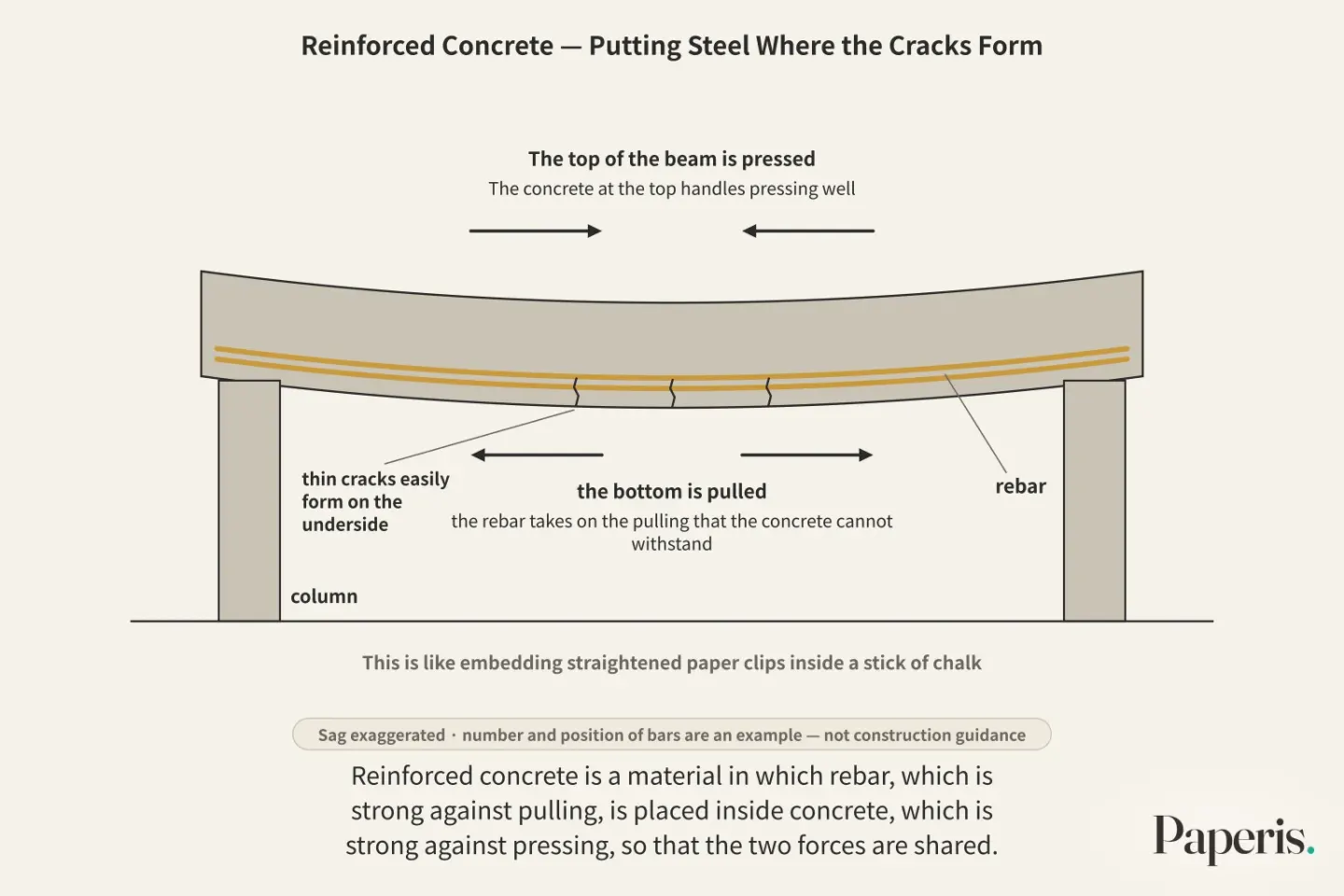
Imagine a concrete beam with both ends resting on a pair of columns. When the weight of a floor and people rests on top, the middle of the beam sags slightly. The top of the beam is pressed, and the bottom is pulled (OpenStax University Physics Volume 1 12.3). The concrete at the top handles pressing well. The concrete at the bottom is weak against pulling, so thin cracks easily form on the underside.
Rebar is a steel rod placed inside concrete. When rebar is placed at the bottom of the beam where the pulling happens, the rebar takes on the pulling that the concrete cannot withstand (DOI: 10.1201/9781351027700-18) (DOI: 10.1201/b12839). Reinforced concrete is a material in which rebar, which is strong against pulling, is placed inside concrete, which is strong against pressing, so that the two forces are shared. This is like embedding straightened paper clips inside a stick of chalk.
Even so, this pairing does not eliminate cracks entirely. Concrete with rebar still tends to crack under relatively small loads (DOI: 10.1201/b12839). The fact that not all cracks are the same is covered in "Aging and Collapse — Rust That Swells from Within, Neighbor Columns That Take Up the Weight".
Rebar does not only handle the pulling share. Rebar wrapped around and bundling concrete inside a column changes how the concrete behaves when pressed (DOI: 10.1061/(asce)0733-9445(1999)125:9(1009)). In an analytical study modeling several columns made by wrapping a steel skeleton with concrete, columns made of very strong concrete relied more heavily for the ductility needed during earthquakes on the wrapped rebar than columns of ordinary strength (DOI: 10.1061/(asce)0733-9445(1999)125:9(1009)). Being strong against pressing and enduring before snapping are different properties. Concrete is very strong against pressing yet snaps suddenly when it fails (DOI: 10.1201/9781351027700-18) (DOI: 10.13189/cea.2020.080508).
Concrete cover is the layer of concrete wrapping the outside of the rebar. What happens when the rebar inside this layer rusts is followed in "Aging and Collapse — Rust That Swells from Within, Neighbor Columns That Take Up the Weight".
Steel: It Handles the Pull, and Stretches Before It Breaks
Steel handles pulling forces well enough to take the pulled side of concrete (DOI: 10.1201/9781351027700-18).
We pick up the paper clip from the drawer again. A paper clip straightened with our fingertips stays straight even after we let go. Elasticity is the property where an object whose shape has been changed by a force returns to its original shape when the force is removed, and plasticity is the property where the changed shape remains even after the force is removed. The paper clip just bent while keeping its changed shape, without breaking. Metals are ductile materials whose shape changes and remains that way before they break (OpenStax University Physics Volume 1 12.4). Up to what point of force things return and from where they remain is covered by "Compression and Tension — Stones Set Against Each Other, a Sagging Clothesline".
One weakness of steel is fire. When a fire breaks out and steel reaches a certain temperature, it can no longer hold its ground supporting the structure. Therefore, methods of covering steel so it does not reach that temperature are used. Wrapping in concrete, applying gypsum boards, and cement-based coatings are traditional methods. There are also coatings that, when applied thinly and exposed to fire, swell up to several times their original thickness to become a layer of char that blocks heat. However, challenges such as how long they can block it remain (DOI: 10.3390/fire8040155). Another weakness is rust. The chemistry of how iron rusts is covered by an existing article, and rust inside buildings is covered by "Aging and Collapse — Rust That Swells from Within, Neighbor Columns That Take Up the Weight".
Wood: Strong for Its Weight, Recombined into New Materials
Several 7- to 10-story wooden buildings had been built in Europe and Australia, while wooden buildings were capped at 6 stories or fewer in the United States, according to a 2017 review (DOI: 10.1061/(asce)sc.1943-5576.0000334). Wood is being considered as a material for tall buildings. Wood is a material strong for its weight (DOI: 10.1061/(asce)sc.1943-5576.0000334).
There is a limit to the thickness that can be obtained from a single log. Mass timber is wood made into large blocks by gluing or nailing together wooden boards or lumber. Thanks to glued laminated timber, which bonds layers of wood together with adhesive, it is possible to create parts of a thickness and shape capable of taking heavy loads (DOI: 10.1061/(asce)sc.1943-5576.0000334). Laminated lumber, nail-laminated panels, and panels made by bonding multiple thin sheets all fall under this category (DOI: 10.1080/17480272.2020.1720804). Cross-laminated timber is a large panel made by gluing thin layers of wood together with their grains running in alternating directions, and is one type of mass timber. Thanks to mass timber, which has excellent load-bearing properties, wood can now be used in larger and more complex buildings. A 2017 review notes that cross-laminated timber has reached a stage where it can be considered an economical and more sustainable alternative to traditional materials (DOI: 10.1080/24705314.2017.1354156).
"Wood burns" is a true statement. The question to ask is how well the structure holds up while a fire is burning. If it is a solid cross-section like a log, wood resists fire relatively well, according to a 2017 review (DOI: 10.1061/(asce)sc.1943-5576.0000334). There is also evidence on the other side. When 63 experiments involving fires in wooden rooms were gathered, most became 80 to 180 degrees Celsius hotter than rooms built with non-combustible materials. As the wood burned, it added heat to the fire, and that share grew along with the rate at which the wood turned to char. However, this relationship has high uncertainty and variance (DOI: 10.1002/fam.3121).
A review compiling large-scale fire tests notes the conditions together. If cross-laminated timber is adequately protected, the share that wood adds to a fire can become negligible, and it can hold up well even with some interior surfaces exposed. In actual fires, however, the rate at which wood turns to char and the thickness of the outer layer losing strength were greater than the values commonly used in guidelines. Depending on the type of adhesive used to bond the layers, delamination occurred and re-flashover happened, especially in small rooms, and structural members could collapse unless the fire went out on its own or was extinguished by someone (DOI: 10.1177/07349041211034460). Most tests were conducted on residential homes, and unknowns remain for larger spaces like offices (DOI: 10.1177/07349041211034460). Data is also scarce for large spaces with floors exceeding 100 square meters, rooms with a lot of exposed wood, rooms with small windows, and the risk of wood smoldering from the inside after flames have died out (DOI: 10.1002/fam.3121). Current evidence supports neither the assertion that wooden buildings are vulnerable to fire nor the assertion that thick wood is completely fireproof.
Another weakness of wood is water. Because wood is a material derived from living organisms, it runs the risk of rotting if water seeps in (DOI: 10.13073/fpj-d-20-00076). Therefore, steps to prevent water intrusion and methods to protect the wood when prevention fails are being examined together (DOI: 10.1080/17480272.2020.1720804).
In earthquakes, wood and steel form a pair. Common steel connections joining cross-laminated timber walls tend to fail in a brittle, sudden manner, making them considered unsuitable for earthquake-prone areas. Therefore, new connections with greatly increased ductility have been proposed, and in most of them, the wood remained undamaged while the connection side bent in a pre-predicted manner. However, some have complex assemblies that may be difficult to mass-produce (DOI: 10.3390/buildings13020505). In these assemblies, the steel connections take on the share of resisting and bending before breaking.
What Kind of Force Does This Spot Feel?
We scan a building from the bottom up. Even a single column mixes materials. There are columns where a steel skeleton is wrapped in concrete, and that perimeter is surrounded by rebar (DOI: 10.1061/(asce)0733-9445(1999)125:9(1009)). The beam above it may be reinforced concrete holding rebar in the spots that get pulled (DOI: 10.1201/9781351027700-18). Steel beams meant to withstand flames are also covered with concrete, gypsum board, or intumescent paint (DOI: 10.3390/fire8040155).
The wood side is no different. When steel and wood are bonded into one, the two materials together increase strength and stiffness (DOI: 10.1007/s44242-025-00065-x). Arrangements placing cross-laminated timber panels on top of folded steel beams have also been studied (DOI: 10.15376/biores.16.4.8489-8508). Steel handles the joints in cross-laminated timber walls (DOI: 10.3390/buildings13020505).
Put this way, "Which material is the strongest?" has no single-line answer. Concrete is good at being pushed down, steel at being pulled and stretching before snapping, and wood is strong for its weight, while each has its own weak spot among pulling, fire, and water. The question for choosing a material is "What kind of force does this spot feel?" It asks together whether the spot is being pushed down or pulled, whether it touches fire or water, and whether its weight needs to be reduced.
Putting Down Chalk and Paper clips
The guide in this article has its limits. Chalk is much softer than concrete, and concrete varies greatly in its properties depending on how it is mixed. What chalk shows is the way it splits, not its strength.
The steel beams and columns of a building are thick and large to a degree that cannot be compared to paper clips. The fact that a paper clip bends easily under your fingertips does not mean steel is soft.
The fact that concrete cracks comes from the property that this material is weak against being pulled. The idea that not all cracks are the same, and that cracks caused by rust, belongs to "Aging and Collapse — Rust That Swells from Within, Neighbor Columns That Take Up the Weight".
Where to Look Further
- Which side is pressed and which side is pulled when a beam bends, along with elasticity and plasticity, continues in "Compression and Tension — Stones Set Against Each Other, a Sagging Clothesline".
- The path that loads take from the roof to the ground is covered by "Loads and Load Paths — A Child on Your Shoulders, Weight That Travels Down to Your Soles", while what ductility does during an earthquake is covered by "Wind and Earthquakes — Wind Pushing at the Side, Jelly Wobbling with Its Plate".
- The fact that not all cracks are the same, as well as rust on coatings and rebar, is handled by "Aging and Collapse — Rust That Swells from Within, Neighbor Columns That Take Up the Weight".
- The chemistry of iron rusting can be picked up in "Oxidation and Reduction — A Hand That Catches the Thrown Ball, a Ball Sent the Long Way Around", and the word force itself can begin in "Force and Motion — A Swinging Strap, a Body That Keeps Going".
Source Papers
- "Pre-Stressed Concrete Structures" (2019) — DOI: 10.1201/9781351027700-18 — Concrete is very strong in compression and very weak in tension, so the tensile side is reinforced with steel
- "Prestressed Concrete Design to Eurocodes" (2011) — DOI: 10.1201/b12839 — Ordinary concrete is strong in compression and weak in tension, and even reinforced concrete where steel bars take tension is prone to cracking and corrosion at low loads
- "A Study on Mechanical and Durability Aspects of Concrete Modified with Steel Fibers (SFs)" (2020) — DOI: 10.13189/cea.2020.080508 — Because it is weak in tension and strong in compression and undergoes brittle fracture, tensile reinforcement is necessary
- "University Physics Volume 1 — 12.3 Stress, Strain, and Elastic Modulus" (2016) — OpenStax University Physics Volume 1 12.3 — Stress is the intensity of force acting on a cross-section, including tensile stress that pulls and stretches and compressive stress that pushes and shrinks, and a bending object is compressed on one side and pulled on the opposite side
- "University Physics Volume 1 — 12.4 Elasticity and Plasticity" (2016) — OpenStax University Physics Volume 1 12.4 — Elasticity and plasticity, and ductile materials like metals retain a changed shape before breaking
- "Performance of Unreinforced Masonry Walls in Compression: A Review of Design Provisions, Experimental Research, and Future Needs" (2023) — DOI: 10.3390/app132212306 — Unreinforced masonry consists of bricks or blocks bonded with mortar, research focuses on compressive behavior, and there is large property variation between experiments
- "Shear modulus and stiffness of brickwork masonry: An experimental perspective" (2005) — DOI: 10.12989/sem.2005.20.1.021 — Masonry is a heterogeneous composite whose properties vary depending on the properties, proportions, bonding, and cracking of bricks and mortar
- "Compressive strength of heterogeneous masonry walls containing blends of brick types" (2022) — DOI: 10.1617/s11527-022-01912-0 — Compression experiments and models for walls mixed with clay brick, limestone, and sandstone lumps, and strength prediction formulas incorporating lump-specific properties
- "Review of Out-of-Plane Strengthening Techniques of Unreinforced Masonry Walls" (2023) — DOI: 10.3390/fib11090078 — In-plane and out-of-plane behaviors under horizontal seismic loads, external attachment reinforcement methods, and the core factor of reinforcement efficiency being the bond at material interfaces
- "Random Particle Model for Fracture of Aggregate or Fiber Composites" (1990) — DOI: 10.1061/(asce)0733-9399(1990)116:8(1686) — A particle model for brittle aggregate composites such as concrete, rock, and ceramics, reproducing the spread and localization of cracks
- "Plastic-Damage Model for Cyclic Loading of Concrete Structures" (1998) — DOI: 10.1061/(asce)0733-9399(1998)124:8(892) — A concrete model that treats tensile damage and compressive damage separately
- "A Review of Developments and Challenges for UHPC in Structural Engineering: Behavior, Analysis, and Design" (2021) — DOI: 10.1061/(asce)st.1943-541x.0003073 — The very high tensile, compressive, and bond strengths, strain hardening, and ductility of ultra-high-performance concrete, along with cautions when applying existing RC designs as-is and the need for a new design philosophy that harnesses its properties
- "Strength and Ductility of Concrete Encased Composite Columns" (1999) — DOI: 10.1061/(asce)0733-9445(1999)125:9(1009) — High-strength (110 MPa) concrete columns rely more on ties to secure ductility than low- and medium-strength columns do
- "A Comprehensive Review on Intumescent Coatings: Formulation, Manufacturing Methods, Research Development, and Issues" (2025) — DOI: 10.3390/fire8040155 — Traditional fire-resistant coverings (concrete, gypsum board, cement-based) that prevent steel from reaching critical temperatures, coatings that swell up to many times their thickness in fire to form an insulating char layer, and remaining challenges such as protection time
- "Can Wood Become an Alternative Material for Tall Building Construction?" (2017) — DOI: 10.1061/(asce)sc.1943-5576.0000334 — 7- to 10-story timber buildings in Europe and Australia, up to 6 stories in the US, large cross-sections using glulam, good strength-to-density ratio, and solid cross-sections favorable for fire performance
- "Potential for decay in mass timber elements: A review of the risks and identifying possible solutions" (2020) — DOI: 10.1080/17480272.2020.1720804 — Types of mass timber, the impact of moisture intrusion on performance, and steps for limiting intrusion and protection
- "Mass timber – the emergence of a modern construction material" (2017) — DOI: 10.1080/24705314.2017.1354156 — CLT has excellent load-bearing performance, enabling larger structures, and is reaching the stage of being viewed as an economical and sustainable alternative to traditional materials
- "Review of fire experiments in mass timber compartments: Current understanding, limitations, and research gaps" (2022) — DOI: 10.1002/fam.3121 — 63 timber compartment fire experiments, mostly 80 to 180°C higher than non-combustible compartments, with data gaps in spaces exceeding 100 square meters
- "Review of large-scale fire tests on cross-laminated timber" (2021) — DOI: 10.1177/07349041211034460 — Contribution is minimal if adequately covered and protected, charring rate and zero-strength layer in real fires are larger than guideline values, delamination and re-ignition depending on the adhesive, potential collapse without fire suppression, and testing focused mainly on residential use
- "Biological Durability of Cross-Laminated Timber— The State of Things" (2021) — DOI: 10.13073/fpj-d-20-00076 — Risk of decay upon moisture intrusion because it is a biogenic material
- "Design for Seismic Resilient Cross Laminated Timber (CLT) Structures: A Review of Research, Novel Connections, Challenges and Opportunities" (2023) — DOI: 10.3390/buildings13020505 — Traditional steel connections are vulnerable to brittle fracture and unsuitable for seismic regions, whereas new connections greatly improve ductility and allow damage-free wood deformation
- "Structural behaviour of steel-timber composite elements: an overview" (2025) — DOI: 10.1007/s44242-025-00065-x — The mechanism by which composite elements joining steel and timber together increase overall strength and stiffness
- "A literature review on cold-formed steel-timber composite structures" (2021) — DOI: 10.15376/biores.16.4.8489-8508 — Literature on experiments and analyses of composite structures tying cold-formed steel beams and CLT panels together
Sources (23)
- Pre-Stressed Concrete StructuresDOI 10.1201/9781351027700-18
- Prestressed Concrete Design to EurocodesDOI 10.1201/b12839
- A Study on Mechanical and Durability Aspects of Concrete Modified with Steel Fibers (SFs)DOI 10.13189/cea.2020.080508
- University Physics Volume 1 — 12.3 Stress, Strain, and Elastic Modulus
- University Physics Volume 1 — 12.4 Elasticity and Plasticity
- Performance of Unreinforced Masonry Walls in Compression: A Review of Design Provisions, Experimental Research, and Future NeedsDOI 10.3390/app132212306
- Shear modulus and stiffness of brickwork masonry: An experimental perspectiveDOI 10.12989/sem.2005.20.1.021
- Compressive strength of heterogeneous masonry walls containing blends of brick typesDOI 10.1617/s11527-022-01912-0
- Review of Out-of-Plane Strengthening Techniques of Unreinforced Masonry WallsDOI 10.3390/fib11090078
- Random Particle Model for Fracture of Aggregate or Fiber CompositesDOI 10.1061/(asce)0733-9399(1990)116:8(1686
- Plastic-Damage Model for Cyclic Loading of Concrete StructuresDOI 10.1061/(asce)0733-9399(1998)124:8(892
- A Review of Developments and Challenges for UHPC in Structural Engineering: Behavior, Analysis, and DesignDOI 10.1061/(asce)st.1943-541x.0003073
- Strength and Ductility of Concrete Encased Composite ColumnsDOI 10.1061/(asce)0733-9445(1999)125:9(1009
- A Comprehensive Review on Intumescent Coatings: Formulation, Manufacturing Methods, Research Development, and IssuesDOI 10.3390/fire8040155
- Can Wood Become an Alternative Material for Tall Building Construction?DOI 10.1061/(asce)sc.1943-5576.0000334
- Potential for decay in mass timber elements: A review of the risks and identifying possible solutionsDOI 10.1080/17480272.2020.1720804
- Mass timber – the emergence of a modern construction materialDOI 10.1080/24705314.2017.1354156
- Review of fire experiments in mass timber compartments: Current understanding, limitations, and research gapsDOI 10.1002/fam.3121
- Review of large-scale fire tests on cross-laminated timberDOI 10.1177/07349041211034460
- Biological Durability of Cross-Laminated Timber— The State of ThingsDOI 10.13073/fpj-d-20-00076
- Design for Seismic Resilient Cross Laminated Timber (CLT) Structures: A Review of Research, Novel Connections, Challenges and OpportunitiesDOI 10.3390/buildings13020505
- Structural behaviour of steel-timber composite elements: an overviewDOI 10.1007/s44242-025-00065-x
- A literature review on cold-formed steel-timber composite structuresDOI 10.15376/biores.16.4.8489-8508