
Paperis Articles
Wind and Earthquakes — Wind Pushing at the Side, Jelly Wobbling with Its Plate
Wind and earthquakes push buildings from the side. A building is an object that sways at its own tempo, so against wind the aim is, beyond withstanding it, to keep the sway people feel in check, and against a rare large earthquake the aim is for the building not to collapse even if it is damaged.
Your field's papers, as audio
Pick your fields and journals — Paperis summarizes the key papers and turns them into audio. Listen on your commute.
Start Paperis free →Wind and Earthquakes — Wind Pushing at the Side, Jelly Shaken Plate and All
Weight Pressing from Above, Force Pushing from the Side
When we think of the force a building receives, we usually picture the weight pressing down from above. It is the picture of stacked bricks where the lower bricks support the upper ones. Yet, on a windy day, a building's flanks are shoved, and when an earthquake strikes, the ground beneath our feet moves back and forth sideways. Both are forces coming from the side.
The problems these two forces leave in a building are different. Wind easily shakes tall buildings for a long time, making the people inside uncomfortable, while earthquakes shake the building along with the ground, potentially damaging the structure itself. This article follows in turn why buildings shake, how wind and earthquakes are different problems, and what goals guide the construction of buildings facing large earthquakes.
As our guide, we take a single piece of jelly on a plate. When you set a plate of jelly down on a table and the plate shakes slightly, the jelly wobbles a few times at its own tempo before stopping. Jelly sliced tall wobbles slowly and broadly, while jelly sliced low and wide shivers finely and quickly. Buildings, too, shake like this at their own individual tempos.
Lateral Loads
Load is the general term for the weight and forces that a building receives. There are loads that push down from above, such as the weight of the building itself or the weight of the people and objects used inside it, and there are loads that push from the side, like wind and earthquakes. A horizontal load is a load that pushes a building from the side, like wind or earthquake.
A structure is the framework that carries the loads a building receives down to the ground. The force received from the side also travels down this framework and is ultimately supported by the ground via the foundation.
For low or mid-rise buildings, a simple calculation method that treats the wind as a steady pushing force is widely used in design. For very tall buildings, this method can be excessively generous or, conversely, underestimate the forces, and above all, it cannot account for how the building sways or the forces that shake it in a direction perpendicular to the wind. For tall buildings, wind tunnel tests are emphasized together (DOI: 10.56748/ejse.641).
The taller a building gets, the more easily it bends, the more likely it is to sway significantly, and the sway is especially large on the top floor. This swaying can increase the total force the building experiences, and tall buildings are usually designed on the premise that they are built not to collapse in the wind (DOI: 10.12989/was.2015.21.5.565). Which of wind or earthquakes dictates the design varies by location. One paper notes that in areas with moderate earthquakes, wind frequently dictates the design (DOI: 10.1061/41031(341)83).
With forces coming from the side, the question is not only how hard they push, but also how they make the building sway.
Do Tall Buildings Really Sway in the Wind?
A 508-meter building in Taiwan has 30 devices measuring sway installed across six floors. While three typhoons passed by, these devices recorded how the building actually swayed back and forth, and they also recorded the sway from a distant earthquake (DOI: 10.1061/(asce)st.1943-541x.0000264). Even on days without big winds, the building trembles slightly, so recording just those minor trembles makes it possible to figure out quickly and reliably what rhythm the building sways with (DOI: 10.1002/eqe.215).
Some buildings have been shaken on purpose. On the campus of the California Institute of Technology, there is a nine-story reinforced concrete library. What kind of material reinforced concrete is is covered in "Building Materials — The Chalk That Snaps, the Paper Clip That Bends". The researchers placed two machines that spun with their weight skewed to one side on the top floor of this building and shook it. The building went back and forth at a set speed for each direction. Going back and forth once North-South took 0.50 seconds, East-West took 0.66 seconds, and twisting back and forth took 0.46 seconds (DOI: 10.1785/bssa0580030891).
You can understand why a building goes back and forth like this by looking at jelly. If you look at the top part of the jelly after tapping the plate, the jelly that was skewed to one side does not stop even when it reaches its original spot, but overshoots to the opposite side. This is because something in motion tries to keep going, and that property is inertia. Inertia is the tendency of a stopped object to stay stopped, and a moving object to keep going straight at the same speed. The jelly that has overshot and bent is pulled back again by the force trying to return it to its original shape. A bent object goes back and forth because the force trying to return it to its original shape and the property of keeping on going work alternately, and while doing so, it loses energy little by little (OpenStax Physics 5.5). A building going back and forth is the same physics.
Regarding the wobbling jelly, there are two things you can ask. How many times it goes back and forth in a second, and how far it skews. Frequency is the number of times a wobble repeats during 1 second, measured in a unit called hertz. Amplitude is the distance the wobble moves farthest away from its resting spot. The jelly's rhythm is its frequency, and the magnitude of the skew is its amplitude (OpenStax University Physics Volume 1 15.1).
The jelly, once tapped and let go of, wobbles to the exact same rhythm always, even though nobody is pushing it. Natural frequency is the frequency at which an object wobbles on its own when it is neither pushed nor held from the outside. Every object has a fixed value for this (OpenStax University Physics Volume 1 15.6). Just as tall-cut jelly wobbles slowly, this rhythm is slower the heavier the object is and faster the stiffer it is (OpenStax University Physics Volume 1 15.5). Because buildings bend more easily the taller they get (DOI: 10.12989/was.2015.21.5.565), their rhythm goes toward the slower side. San Francisco's 60-story pyramid-shaped building swayed the most at a rhythm of about 0.28 times per second in the records left behind during the 1989 earthquake (DOI: 10.1061/(asce)0733-9445(1991)117:8(2389)).
Although this rhythm is calculated beforehand using computer models, when measured, models frequently fail to get the natural frequency exactly right. They usually underestimate it, revealing that buildings are stiffer than thought (DOI: 10.1002/eqe.215). A building is an object that wobbles to its own rhythm, and because that rhythm cannot be fully known through calculation alone, we measure it.
Why It Doesn't Stop Easily
After you put down a plate, the jelly's wobbling dies down after a few cycles. This is because some energy of the swaying leaks out with each back-and-forth, and the leaked energy mostly becomes heat (OpenStax University Physics Volume 1 15.5). Damping is the degree to which the energy of a sway escapes and the sway dies down.
A building's damping is on the small side. One can think of the damping that brings a displaced object back to its resting position the fastest without overshooting and oscillating back and forth (OpenStax University Physics Volume 1 15.5). If we set that damping to 100 in the 9-story library from earlier, this building's damping was between 0.7 and 2 (DOI: 10.1785/bssa0580030891). When damping is this small, a sway shrinks only little by little while keeping its rhythm almost the same (OpenStax University Physics Volume 1 15.5). A building with small damping keeps swaying for a long time once it starts.
Even that small value is not fixed as a single number. The library's damping varied by this much depending on the intensity of the shaking used in the test, and this 1968 test report noted that knowing the damping during a strong earthquake requires tests with harder shaking (DOI: 10.1785/bssa0580030891). The damping of a tall building must be chosen differently depending on the size of the sway, and a 1986 paper suggested that fixing the sway size can yield damping values that match actual measurements well (DOI: 10.1002/eqe.4290140505). The escaped energy merely changes form into heat and does not vanish, a principle covered in "Energy — Money That Doesn't Shrink When Exchanged, Odd Coins Scattered in Your Pockets".
When the Beats Match
This time, let us place a tall-cut jelly and a short-cut jelly side by side on a table, and suppose the table moves back and forth at a single beat. Even though the two jellies are on the same table, the sizes of their wobbling are different. The jelly whose own beat is closer to the table's beat wobbles more widely, and when the table's beat changes, the side that wobbles more widely changes as well.
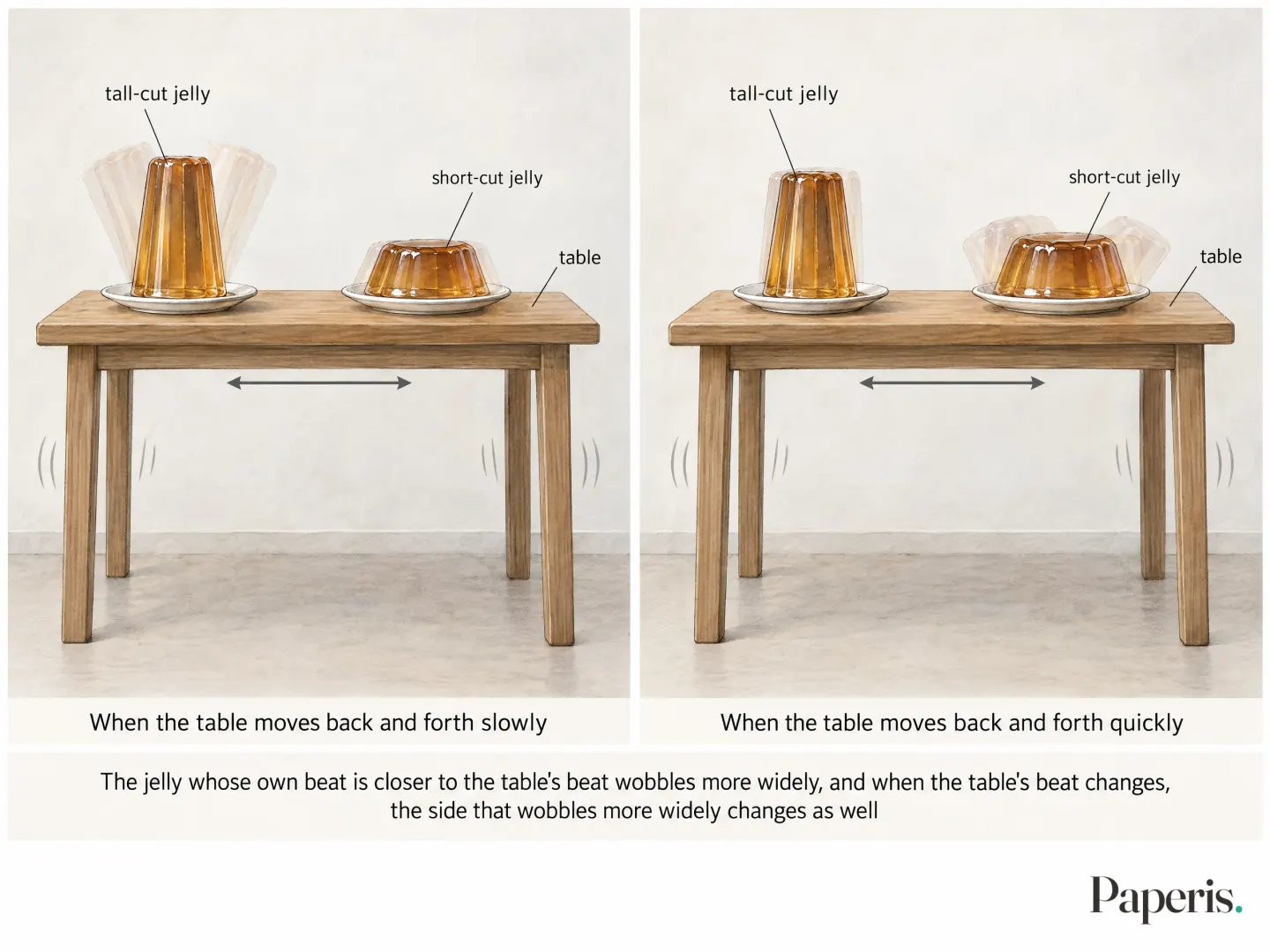
Resonance is a phenomenon where the shaking grows large when a shaking force is applied at the same beat as the frequency at which an object naturally shakes. If other conditions are similar, an object whose shaking beat is closer to its own natural frequency shakes more largely, and an object farther away shakes less (OpenStax University Physics Volume 1 15.6). The small damping from the previous section becomes an issue here. An object whose shaking does not die down easily builds up higher shaking when the beats match (OpenStax University Physics Volume 1 15.6).
Both wind and earthquakes can rhythmically shake buildings. In wind design for tall buildings, resonance is one of the core problems (DOI: 10.56748/ejse.641), and the ways wind shakes a building include gusts and vortices generated behind the building (DOI: 10.1002/tal.413). One of the reasons why the shaking received differs from building to building, even under the same wind or the same earthquake, is that their beats are different.
Wind: Even When It Doesn't Collapse, It's a Problem
Norway's 18-story timber building was the world's tallest wooden building at the time of its announcement (2021) (DOI: 10.1002/tal.1882). When wind was simulated flowing around this building on a computer, the structure swayed particularly hard in a direction perpendicular to the wind, and that sway was most sensitive to the wind's flow and the building's shape. Looking at this single building, international code provisions alone did not always prevent discomfort for the people inside (DOI: 10.1002/tal.1882). What this study evaluated was human comfort rather than structural survival.
Serviceability is a property separate from whether a building can withstand loads, assessing whether people can use and inhabit it inside without discomfort. Whether a tall building swaying in the wind is tolerable for humans is determined by the acceleration of the sway (DOI: 10.21022/ijhrb.2015.4.1.001). Acceleration is a value representing how quickly speed changes. The acceleration of a swaying object becomes greater the farther it moves away from its original position (OpenStax University Physics Volume 1 15.1). Based on field surveys collecting the responses of people inside buildings swaying in the wind and experiments using motion simulator devices, acceptance guidelines are established by placing thresholds on the maximum value of acceleration (DOI: 10.21022/ijhrb.2015.4.1.001).
Even with the same magnitude of acceleration, the body perceives it differently depending on the rhythm. There has been a long debate over whether the frequency of the sway must be considered. In one motion simulator experiment, when the shaking frequency was increased from 0.15 to 1 time per second, the acceleration measured at the people's heads grew larger. The abstract does not state how many people were tested. The researchers concluded that this effect should be reflected in the standards for comfort (DOI: 10.1061/(asce)0733-9445(2006)132:2(296)).
Low-frequency building sway is known to induce motion sickness symptoms in some people. While reactions severe enough to cause vomiting do not occur in wind-swayed buildings, one review predicts that mild symptoms such as drowsiness and fatigue will appear. The same review notes that these mild symptoms have not yet been measured in tall buildings, and they may be masked by work or attributed to a tiring day (DOI: 10.12989/was.2011.14.6.499).
Then, should we just build structures stiffer? One study suggested that increasing stiffness in tall buildings may be difficult to serve as a solution for comfort and serviceability (DOI: 10.12989/was.2015.21.5.565). The paths taken are several. They change the structural system, refine the building's shape to catch less wind, or attach devices that drain away the energy of the sway (DOI: 10.12989/was.1999.2.3.201). One design proposal focused on increasing damping states that the authors increased the building's damping by 5 to 10 times to virtually eliminate the resonant part of the wind-induced sway, citing a design applied to a building under construction as an example (DOI: 10.1002/tal.413). It is a given that tall buildings are constructed not to collapse in the wind, and managing the sway to a level that humans can tolerate is a separate task that must be solved in the face of the wind on top of that.
What Makes Earthquakes Different
During an earthquake, the ground beneath your feet shakes buildings. When the ground moves sideways, the bottom of a building follows the ground, but the upper part tries to stay in place because of inertia. Thus, the force that an earthquake exerts on a building is a force originating from inertia, repeats by changing direction, and lasts for a long time rather than ending in a single moment like an explosion (DOI: 10.1061/9780784413357.178). The shaking of the ground spreads out as a wave, and an earthquake with a larger amplitude causes the ground to move more and results in greater damage (OpenStax Physics 13.2). What a wave is, is covered in "Waves — Fans Rising in Their Seats, a Wave Circling the Stadium".
There is one case where the rhythm of the ground and the rhythm of the building met. In the autumn of 2002, earthquakes struck consecutively in the Molise region of southern Italy, and the small village of Bonefro there suffered mostly moderate damage. However, two reinforced concrete buildings were different. The two buildings stood close to each other on a soft sedimentary layer, their design and construction were very similar, and the biggest difference was their height. The 4-story building was damaged more severely, and the 3-story building was damaged less. The first earthquake on October 31 damaged both buildings, and the second earthquake on the following day greatly increased the damage to the 4-story building, precisely when a 5-minute vibration record was being captured (DOI: 10.1785/012003186).
The results of analyzing the record in four ways agreed with one another. The rhythm of the 4-story building changed with the damage, and the rhythms before, during, and after the damage all fell between 1.25 and 2.5 times per second. The less damaged 3-story building was about 4 times per second. To see whether the resonance of the ground and the building could have amplified the damage, the researchers measured the natural frequency of the ground itself using three methods, and obtained the result that the resonance frequencies of the more damaged building and the ground were very close (DOI: 10.1785/012003186). Although this is a case looking at two buildings in a single village, in earthquakes, how well the rhythm of the ground matches the rhythm of a building can determine the damage, and when a building is damaged, that rhythm also changes.
Damaged, Perhaps, but Not Collapsing
While a building is standing, there are earthquakes that happen often, and large earthquakes that happen much more rarely than the lifetime of the building (DOI: 10.14273/unisa-1042). Seismic design is the work of building by calculating the shaking that an earthquake will cause in advance. Elasticity is the property where an object whose shape has been changed by a force returns to its original shape when the force is removed, and plasticity is the property where the changed shape remains even after the force is removed.
In traditional seismic design, buildings are constructed so that during frequent or occasional earthquakes over the building's lifetime, they remain within the elastic range—meaning they return to their original shape after shaking. For large earthquakes that happen much more rarely than the lifetime of the building, it is accepted that the building bends through plasticity and is significantly damaged. Even then, collapse must be prevented to protect human lives (DOI: 10.14273/unisa-1042). A 2014 paper also notes that current seismic standards aim to prevent collapse and protect human lives (DOI: 10.1061/9780784413357.178). The goal of seismic design against rarely occurring large earthquakes is to protect human lives by ensuring the building does not collapse even if it is damaged.
To accept damage, that damage must fall within a range that the building can endure. What determines that range is ductility and the ability to dissipate energy (DOI: 10.14273/unisa-1042). Ductility is the property of a material stretching or bending significantly before it breaks. What ductility asks is whether a material does not break right away when it exceeds its tolerable limit and instead holds out while its shape changes, which is a different property from how well it normally bends in the wind. Only spots within the frame that can bend significantly before breaking can absorb earthquake energy while bending (DOI: 10.14273/unisa-1042). Which materials have high ductility and which ones break suddenly is covered in "Building Materials — The Chalk That Snaps, the Paper Clip That Bends".
It is also predetermined where the damage will be concentrated. A beam is the part laid horizontally that receives the weight above it, and a column is the part standing vertically that sends that weight down. Buildings framed with a skeleton are often built with stronger columns and weaker beams, allowing the earthquake energy to be absorbed as the ends of the beams and the base of the first-floor columns bend through plasticity (DOI: 10.14273/unisa-1042). This is a method where columns are generally kept in the elastic range to prevent collapse, and damage is concentrated in designated spots on the beams (DOI: 10.26021/2575). In the face of an earthquake, a building's safety depends together on whether it is in sync with the ground and on where and how it bends when subjected to large forces.
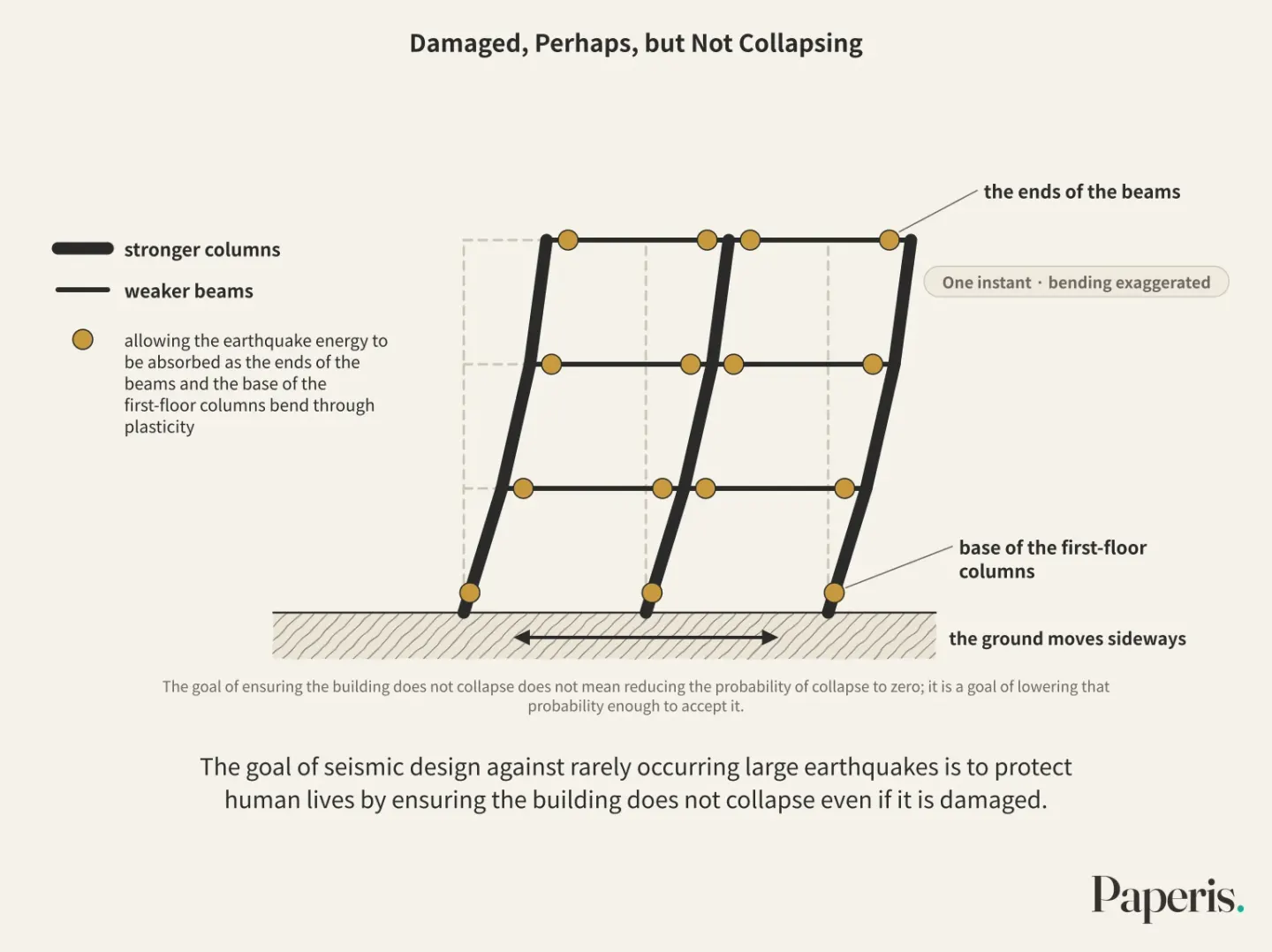
This approach comes with a cost. The method of concentrating damage on beams leaves damage in the skeleton and floors after a major earthquake, which may require major repairs or demolition, and during that time, the building is very likely to become unusable (DOI: 10.26021/2575). Design that targets even the level of damage is discussed as the next step (DOI: 10.1061/9780784413357.178). Beam and column connection methods that reduce the damage itself are being developed through experiments (DOI: 10.26021/2575), and while there are also results showing that connection joints using special cement composites bent better and cracked more finely, this has only been demonstrated through computer analysis (DOI: 10.62754/ais.v6i3.418).
The goal of ensuring the building does not collapse does not mean reducing the probability of collapse to zero; it is a goal of lowering that probability enough to accept it. Calculating reliably in advance how a building will bend through plasticity and break during a large earthquake is very difficult, which is why a doctoral dissertation notes that experiments remain the most reliable verification method today (DOI: 10.14273/unisa-1042). Where that probability increases is also connected to ductility. According to a 2009 paper, under the design standards covered in that paper, it was common to build steel frames with diagonal braces in places with moderate earthquakes by allowing them to be constructed without requiring separate earthquake-tailored detailed designs, and there was no clear evidence that frames built that way could bend sufficiently before breaking. Analyses by other researchers covering buildings constructed this way found that the probability of collapse during the maximum considered earthquake in design could be at an unacceptable level, and this paper proposes alternative design methods to reduce that probability (DOI: 10.1061/41031(341)83).
Jelly on the Plate Again
jelly was only useful in this article for showing the tempo. It differs from a real building in three ways. First, jelly is done for once it splits, but a building can be built so that designated spots bend first and endure. Second, jelly's tempo always looks the same, but a building's tempo changes with damage, and damping also varies depending on the size of the shaking (DOI: 10.1785/012003186; DOI: 10.1002/eqe.4290140505). Third, buildings are much stiffer than jelly. That shaking is measured by attaching devices rather than with the naked eye (DOI: 10.1061/(asce)st.1943-541x.0000264).
For tall buildings, the premise is to build them so they do not collapse in the wind, and what is asked on top of that regarding the wind is whether the people inside can endure the shaking. What is asked in front of a major earthquake is whether they remain standing even if damaged. How much wind-induced shaking exhausts people was noted by a 2011 review as not yet measured in tall buildings (DOI: 10.12989/was.2011.14.6.499).
Where to Look Further
Inertia, which keeps the upper part of a building in place, continues from "Force and Motion — A Swinging Strap, a Body That Keeps Going", and frequency and the shaking passing through the ground continue from "Waves — Fans Rising in Their Seats, a Wave Circling the Stadium". Where the energy that escaped through damping goes is covered by "Energy — Money That Doesn't Shrink When Exchanged, Odd Coins Scattered in Your Pockets".
Among other parts of this series, "Loads and Load Paths — A Child on Your Shoulders, Weight That Travels Down to Your Soles" covers the path by which the weight pressing from above travels down to the ground, "Building Materials — The Chalk That Snaps, the Paper Clip That Bends" covers which materials have high ductility and which ones break suddenly, "Ground and Foundations — Footprints Left in the Sand, One Foot Sunk Deeper" covers how soil and land support buildings and how water-saturated land loses its bearing strength during an earthquake, and "Aging and Collapse — Rust That Swells from Within, Neighbor Columns That Take Up the Weight" covers how damaged buildings are inspected.
Source Papers
- "University Physics Volume 1 — 15.1 Simple Harmonic Motion" (2016) — OpenStax University Physics Volume 1 15.1 — Frequency is the number of oscillations per unit time, amplitude is the maximum distance away from equilibrium, and the acceleration of simple harmonic motion is proportional to displacement and in the opposite direction.
- "University Physics Volume 1 — 15.5 Damped Oscillations" (2016) — OpenStax University Physics Volume 1 15.5 — Real-world oscillations fade due to friction, damping forces usually siphon off energy as thermal energy, small damping decreases only amplitude while keeping the period almost unchanged, very large damping returns to equilibrium without oscillating, critical damping returns to equilibrium the fastest without oscillation, and the natural angular frequency is determined by the force constant and mass.
- "University Physics Volume 1 — 15.6 Forced Oscillations" (2016) — OpenStax University Physics Volume 1 15.6 — The natural frequency is the frequency without driving or damping, driving at a pace matching the natural frequency causes resonance, a small driving force yields a large response, moving away from the driving pace decreases amplitude, and smaller damping produces a higher resonance peak.
- "Physics — 5.5 Simple Harmonic Motion" (2020) — OpenStax Physics 5.5 — Deformation creates a restoring force in the opposite direction, and an object reaching equilibrium overshoots due to momentum, deforming in reverse and repeating until it loses energy.
- "Physics — 13.2 Wave Properties: Speed, Amplitude, Frequency, and Period" (2020) — OpenStax Physics 13.2 — Earthquakes entail multiple types of waves, and earthquakes with large amplitudes cause severe ground motion and heavy damage.
- "Wind Loading on Tall Buildings" (2007) — DOI: 10.56748/ejse.641 — Simple quasi-static wind load treatments used for low- and mid-rise buildings can be overly conservative or underestimate loads for very tall buildings, and fail to handle dynamic responses (resonance, acceleration, damping, stiffness) and cross-wind responses; wind tunnel testing is emphasized.
- "Control of wind-induced motion in high-rise buildings with hybrid TM/MR dampers" (2015) — DOI: 10.12989/was.2015.21.5.565 — Increasing height makes buildings flexible, causing large vibrations especially on top floors, which can increase overall loads and cause occupant discomfort; increasing stiffness may not be a solution for comfort and usability.
- "Cyclic Behavior and Performance of Beam-Column Connections in Concentrically Braced Frames" (2009) — DOI: 10.1061/41031(341)83 — Notes that wind often governs design in moderate seismic regions; interpretations (such as by Hines et al.) suggest that a certain design approach (R=3) may carry an unacceptable collapse probability under maximum considered earthquakes, prompting alternative design philosophies.
- "Vibration and soil-structure interaction tests of a nine-story reinforced concrete building" (1968) — DOI: 10.1785/bssa0580030891 — Shaking the Millikan Library at the California Institute of Technology (a 9-story reinforced concrete shear wall building) with a top-floor eccentric mass shaker yielded natural periods of 0.50 seconds north-south, 0.66 seconds east-west, and 0.46 seconds torsional, with damping ranging from 0.70% to 2.00% of critical across the test range, indicating that stronger stress tests are needed for damping during major earthquakes.
- "Seismic Response of Transamerica Building. I: Data and Preliminary Analysis" (1991) — DOI: 10.1061/(asce)0733-9445(1991)117:8(2389) — Records from the 60-story pyramidal Transamerica Building during the 1989 Loma Prieta earthquake show a primary translational response of about 0.28 Hz.
- "Dynamic Behavior of Taipei 101 Tower: Field Measurement and Numerical Analysis" (2010) — DOI: 10.1061/(asce)st.1943-541x.0000264 — Natural frequencies, modes, and damping ratios were obtained from records of three typhoons and one distant earthquake using thirty accelerometers across six floors of the 508-meter Taipei 101, and compared with a finite element model.
- "Ambient vibration studies for system identification of tall buildings" (2002) — DOI: 10.1002/eqe.215 — Finite element models frequently fail to accurately predict natural frequencies and usually underestimate them, meaning buildings are stiffer than expected; ambient vibration measurements alone can quickly and reliably estimate modes and frequencies using little data.
- "Damping in tall buildings—a mechanism and a predictor" (1986) — DOI: 10.1002/eqe.4290140505 — A predictive formula enabling damping in tall buildings to be specified as a value when vibrating at a specific amplitude, aligning well with field measurements.
- "The damped outrigger concept for tall buildings" (2007) — DOI: 10.1002/tal.413 — A design concept that increases reliable structural damping 5 to 10 times to virtually eliminate dynamic responses to wind (buffeting and vortex shedding), with an application example on a building under construction.
- "Mitigation of motions of tall buildings with specific examples of recent applications" (1999) — DOI: 10.12989/was.1999.2.3.201 — Flexible structures can suffer impaired usability and comfort due to excessive wind-induced vibration, which can be reduced through alternative structural systems, aerodynamic shape adjustments, and auxiliary damping devices.
- "Comfort assessment of high‐rise timber buildings exposed to wind‐induced vibrations" (2021) — DOI: 10.1002/tal.1882 — An 18-story timber building in Norway (the world's tallest timber building at the time) exhibited particularly strong cross-wind vibrations sensitive to wind flow and building shape, showing that international standard provisions alone often fail to prevent occupant discomfort.
- "Wind-Induced Motion of Tall Buildings: Designing for Occupant Comfort" (2015) — DOI: 10.21022/ijhrb.2015.4.1.001 — Summarizes occupant responses based on field surveys and simulator experiments, provides acceptance guidelines based on maximum acceleration thresholds, and outlines mitigation strategies.
- "Frequency Dependence of Human Response to Wind-Induced Building Motion" (2006) — DOI: 10.1061/(asce)0733-9445(2006)132:2(296) — Addresses the long-standing debate over the need to consider frequency, showing that raising frequencies from 0.15 to 1.00 Hz in simulators amplifies head acceleration, which should be reflected in comfort standards.
- "A review of two theories of motion sickness and their implications for tall building motion sway" (2011) — DOI: 10.12989/was.2011.14.6.499 — Low-frequency building vibrations cause motion sickness symptoms in some occupants without vomiting; low-dose symptoms such as drowsiness and fatigue are predictable but have never been measured in tall building residents.
- "Performance-Based, Blast-Resistant and Seismic Design of Reinforced Concrete Buildings in Industrial and Petrochemical Facilities" (2014) — DOI: 10.1061/9780784413357.178 — Seismic loads are long-duration repeated inertial loads, while blast loads are short impacts; current seismic standards signify collapse prevention and life safety, whereas next-generation performance-based design addresses performance and damage levels.
- "Analysis of RC Building Dynamic Response and Soil-Building Resonance Based on Data Recorded during a Damaging Earthquake (Molise, Italy, 2002)" (2004) — DOI: 10.1785/012003186 — Two similar reinforced concrete buildings in Bonefro (a 4-story building that suffered more damage and a 3-story building that suffered less) showed that alongside damage, the fundamental frequency of the 4-story building shifted into the 2.5–1.25 Hz range, the 3-story building shifted to about 4 Hz, and the ground's resonance frequency was very close to that of the taller building.
- "Robustness and seismic behaviour of structures equipped with traditional and innovative beam-to-column connections" (2017) — DOI: 10.14273/unisa-1042 — Ph.D. dissertation. Strong columns and weak beams dissipate energy through yielding at beam ends and first-story column ends, maintaining elasticity during frequent earthquakes and permitting damage during rare major earthquakes while preventing collapse and protecting lives, keeping damage within ductility and energy dissipation capacities; predicting nonlinear behavior during strong earthquakes is extremely difficult, making experimentation the most reliable approach.
- "The Development and Validation of a Non-tearing Floor Precast Concrete Structural System for Seismic Regions." (2010) — DOI: 10.26021/2575 — Ph.D. dissertation. Traditional seismic design concentrates damage in beam plastic hinges while keeping columns mostly elastic, which can lead to major repairs, demolition, and functional loss following large earthquakes; developed non-tearing connections to reduce damage.
- "Performance of Engineering Cementitious Composites (ECC) IN Beam-Column Joints for Seismic Resilience" (2025) — DOI: 10.62754/ais.v6i3.418 — A numerical analysis (ABAQUS) study that proposes improving the ductility and energy dissipation of ECC joints and adopting a design philosophy based on "damage control" instead of "collapse prevention."
Sources (24)
- University Physics Volume 1 — 15.1 Simple Harmonic Motion
- University Physics Volume 1 — 15.5 Damped Oscillations
- University Physics Volume 1 — 15.6 Forced Oscillations
- Physics — 5.5 Simple Harmonic Motion
- Physics — 13.2 Wave Properties: Speed, Amplitude, Frequency, and Period
- Wind Loading on Tall BuildingsDOI 10.56748/ejse.641
- Control of wind-induced motion in high-rise buildings with hybrid TM/MR dampersDOI 10.12989/was.2015.21.5.565
- Cyclic Behavior and Performance of Beam-Column Connections in Concentrically Braced FramesDOI 10.1061/41031(341)83
- Vibration and soil-structure interaction tests of a nine-story reinforced concrete buildingDOI 10.1785/bssa0580030891
- Seismic Response of Transamerica Building. I: Data and Preliminary AnalysisDOI 10.1061/(asce)0733-9445(1991)117:8(2389
- Dynamic Behavior of Taipei 101 Tower: Field Measurement and Numerical AnalysisDOI 10.1061/(asce)st.1943-541x.0000264
- Ambient vibration studies for system identification of tall buildingsDOI 10.1002/eqe.215
- Damping in tall buildings—a mechanism and a predictorDOI 10.1002/eqe.4290140505
- The damped outrigger concept for tall buildingsDOI 10.1002/tal.413
- Mitigation of motions of tall buildings with specific examples of recent applicationsDOI 10.12989/was.1999.2.3.201
- Comfort assessment of high‐rise timber buildings exposed to wind‐induced vibrationsDOI 10.1002/tal.1882
- Wind-Induced Motion of Tall Buildings: Designing for Occupant ComfortDOI 10.21022/ijhrb.2015.4.1.001
- Frequency Dependence of Human Response to Wind-Induced Building MotionDOI 10.1061/(asce)0733-9445(2006)132:2(296
- A review of two theories of motion sickness and their implications for tall building motion swayDOI 10.12989/was.2011.14.6.499
- Performance-Based, Blast-Resistant and Seismic Design of Reinforced Concrete Buildings in Industrial and Petrochemical FacilitiesDOI 10.1061/9780784413357.178
- Analysis of RC Building Dynamic Response and Soil-Building Resonance Based on Data Recorded during a Damaging Earthquake (Molise, Italy, 2002)DOI 10.1785/012003186
- Robustness and seismic behaviour of structures equipped with traditional and innovative beam-to-column connectionsDOI 10.14273/unisa-1042
- The Development and Validation of a Non-tearing Floor Precast Concrete Structural System for Seismic RegionsDOI 10.26021/2575
- Performance of Engineering Cementitious Composites (ECC) IN Beam-Column Joints for Seismic ResilienceDOI 10.62754/ais.v6i3.418