Paperis Articles
Light — How One Window and One Curtain Change a Room
The same room becomes a different place depending on where light comes from and what it passes through. Light shapes mood and contrast, can turn into glare, and reaches the body's daily clock — but "more daylight means better health" has not yet been established.
Your field's papers, as audio
Pick your fields and journals — Paperis summarizes the key papers and turns them into audio. Listen on your commute.
Start Paperis free →Light — How One Window and One Curtain Change a Room
The Same Room, Three Faces
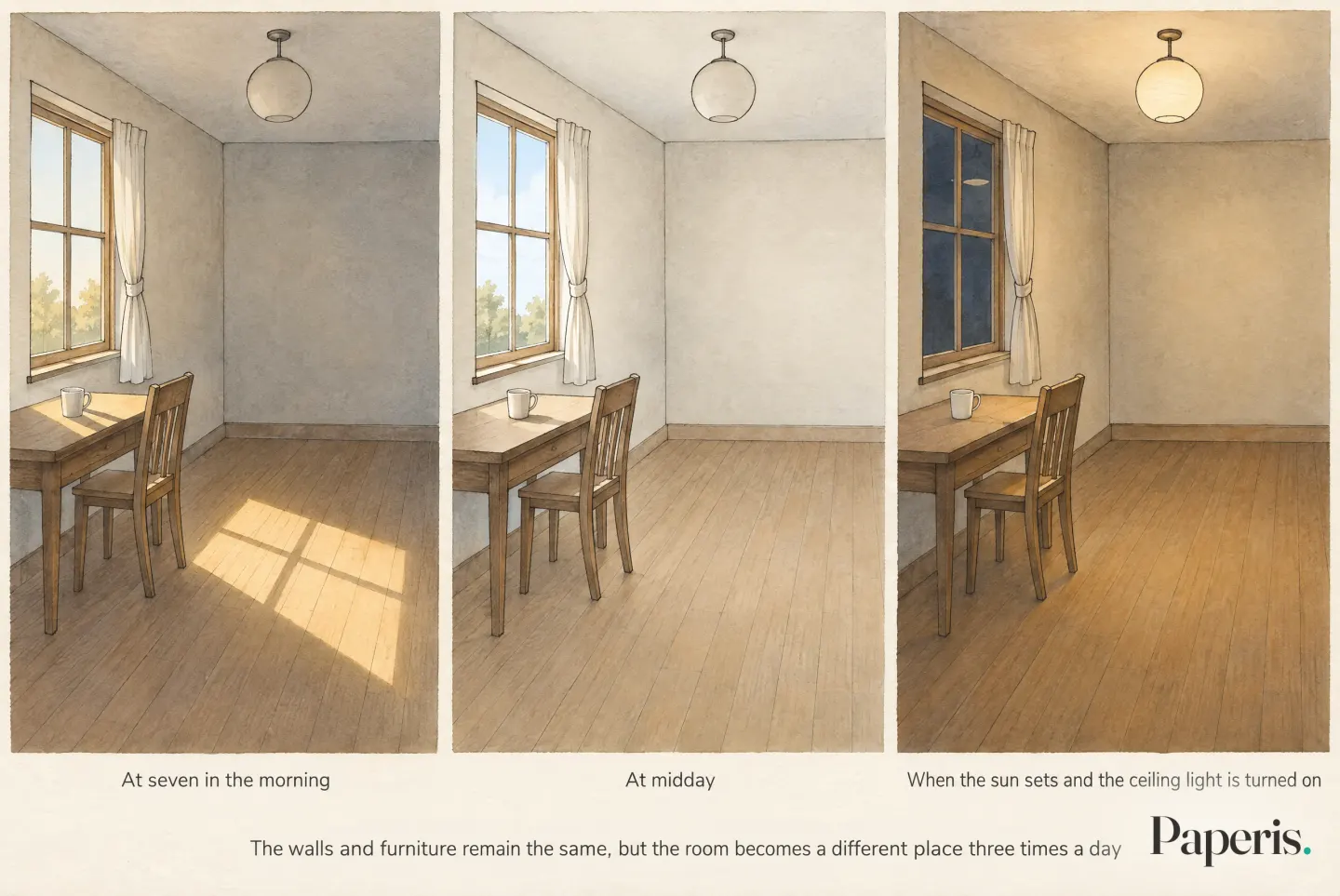
At seven in the morning, the sun enters low through a single east-facing window in a small room. The sunlight traces a long rectangle on the floor in the exact shape of the window frame, and a long shadow clings to the cup on the desk. The far corner of the room is still dim.
At midday, the sun climbs high and the rectangle on the floor disappears. The room grows evenly bright and the shadows pale. When the sun sets and the ceiling light is turned on, the window that once showed the outside turns into a black mirror reflecting the inside of the room.
The walls and furniture remain the same, but the room becomes a different place three times a day. All that has changed is the light. This article practices the eye for seeing light inside a building. We will follow in turn where light enters and in what form, how that light changes the mood of the room, and what it does to our bodies. Our guides are a single window and a single curtain in this room.
Start with the Light When Looking at a Building
Let us start by naming the long rectangle on the floor of a morning room. Natural light is light coming from the sun and the sky, also called daylight.
When you hang a thin white curtain over that window, the sharp rectangle on the floor blurs, and the light spreads out from the entire curtain. Filtered light is light that has been diffused and weakened after passing through something once, such as a thin curtain, a bamboo blind, or window bars.
The ceiling light that brightens the room after the sun sets is yet another kind of light. Artificial lighting is light illuminated by a human-made light source, such as an electric lamp.
A space is an empty place created by enclosing walls, floors, and roofs, something both seen with the eyes and experienced with the body. Without light, that empty place cannot be seen. Looking at a space therefore goes hand in hand with looking at light.
When reading a building, light is one of the elements to examine (Ferreira, Introduction to Architecture ch. 3). The first two questions to throw are: where did this light come from, and what has it passed through?
The Spot Where Light Enters
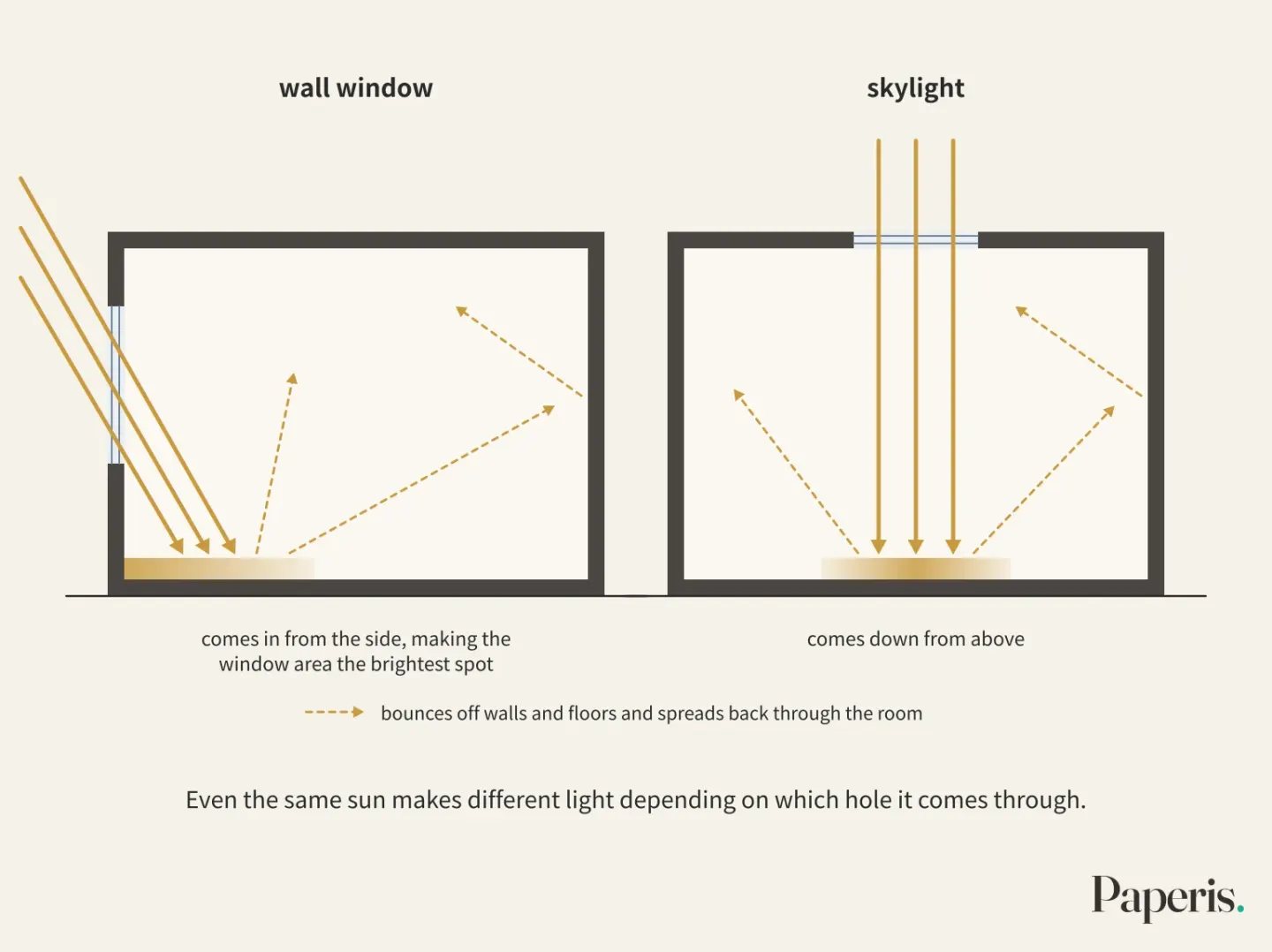
Even the same sun makes different light depending on which hole it comes through. Daylighting is the act of bringing natural light into a building. The holes that let light in are broadly windows cut into walls and windows cut into roofs.
Light entering through a wall window comes in from the side, making the window area the brightest spot. A skylight is a window made in a roof or ceiling. Light entering through a skylight comes down from above.
The light that enters bounces off walls and floors and spreads back through the room. One study looking at four classrooms examined window orientation, seating position, and line of sight, along with surface reflectance, as factors governing the light that reaches the eye (DOI: 10.3390/buildings11100439).
The direction one looks and the time also change the light. In a study measured across all four seasons in a single south-facing room in Cyprus, the light reaching the eye varied depending on which way one looked, the season, and the time of day. In winter, when the sun hangs low and sunlight shoots straight deep into the room, it was much higher than in other seasons (DOI: 10.1177/14771535231204162).
Daylighting comes with trade-offs. One must weigh at once spreading light evenly through the room, excessively harsh light, the heat that sunlight brings with it, and the outside viewable through the window (DOI: 10.5539/jsd.v1n3p3). In low-latitude regions with intense sunlight, bringing in natural light means bringing in direct sunlight, which increases the risks of eye-piercing harsh glare and indoor overheating. Therefore, windows are commonly reduced or tinted glass and shading are used, which in turn reduces natural light and leads to turning on electric lights instead (DOI: 10.5075/epfl-thesis-6425). This is what a doctoral dissertation examining an office in north-central Mexico notes.
Where a window is placed, and at what time and from which direction the sun enters, vastly alters the light of a room. Nor does a large window automatically mean correspondingly good light.
The Difference Between Bright and Dark
In that room at seven in the morning, a bright rectangle on the floor and the still-dim inner corner exist together, and the shadow of the window frame hangs obliquely on the side wall. Contrast is the difference between the bright spots and the dark spots within a single scene.
Common yardsticks for measuring lighting were made to check whether a desk is bright enough and whether there is light that pierces the eyes. There is the critique that those yardsticks fail to capture how contrast makes a space more worth looking at. Earlier studies attempting to link simple contrast values with people's evaluations did not reach a consensus, and this paper reports that in an experiment showing computer-generated drawings of rooms with natural light online, it singled out the contrast scale that moves together with evaluations of "drawing the eye" (DOI: 10.1177/1477153516644292).
There is also an experiment in which only the pattern of the window was changed and shown in the same room made in virtual reality. When the same experiment was repeated in Norway, Switzerland, and Greece, the window shapes that altered the light patterns falling on the floor changed how enjoyable, interesting, and calm the room appeared, and that effect was similar across the three countries. Whether the sky was clear or cloudy and whether the room was a place for work or gathering did not change the evaluations. Only the brightness evaluations differed by country, which the authors noted is difficult to generalize due to the limitations of virtual reality and the different experimental seasons in each country (DOI: 10.1080/15502724.2021.1999257).
In Part 1 of the same study, an experiment changing window size, there were differences between countries in the evaluations of 406 participants. How enjoyable and calm the room appeared differed between the participants from Greece and Norway. This is the result that the same window may not give the same feeling in places with different latitudes (DOI: 10.1080/15502724.2020.1854779).
Mood is measured outside of drawings as well. In a survey of 102 churchgoers across several Catholic churches in Ibadan, Nigeria, natural light moved most strongly together with the feeling of spiritual uplift among the architectural elements surveyed (DOI: 10.47363/jcert/2026(8)208). Because this is a correlation of moving together, it does not go so far as to say that light created that feeling.
There are experiments showing that window shapes and the light patterns falling on the floor moved together with the impression of a room. However, most of that evidence comes from evaluations of rooms seen in drawings or virtual reality, and the same room does not give the exact same feeling everywhere.
When the Light Is Too Much
At seven in the morning, sitting at a desk facing a window, a low-hanging sun stabs right into your eyes. The monitor looks hazy and your eyes squint involuntarily. Glare is a state in which a place in the field of view is overly bright, making it uncomfortable or difficult to see.
Glare depends on where you sit in a room and which way you look, so it is hard to gauge simply by how bright the room as a whole is. One paper factored in the range over which a person can move seats or turn their gaze. As a result, in offices with hand-operated blinds, the time during which intolerable glare was expected by calculation dropped sharply, and the usable daylight increased. This is a result calculated by computer rather than measured on actual people (DOI: 10.1177/1477153511420097).
It is also difficult to capture glare in a single number. In an experiment where 48 participants rated comfort in a daylit laboratory office, commonly used glare indices predicted the comfort people felt even less well than the intensity of light measured at eye level alone (DOI: 10.1080/15502724.2014.881720).
Devices that filter light also become a nuisance when they go against people. In a study looking at three Nordic office buildings, automatically moving shading systems could be seen as a source of discomfort. This was a judgment based on key personnel interviews at one building and re-analyzed existing surveys from another. It was because the occupants could not stop the movement themselves, and in one office, the occupants turned the exterior shading off altogether. Occupants preferred manually operated shading, and occupants in one building cited the ability to operate the shading themselves as one of the primary reasons for their satisfaction with daylight (DOI: 10.15627/jd.2017.1).
Even a single curtain in a morning room is drawn at a time decided by the person in the room. What office users singled out in studies was also whether they could directly control the shading. Whether strong light can be avoided, and whether a person can control that light, also determines the light of a room.
What Light Does to the Body
The time you feel sleepy at night and wake up in the morning is usually similar from day to day. A circadian rhythm is a rhythm in which bodily functions like sleep, waking, and hormone secretion rise and fall over a cycle of about a day. This rhythm spans not only sleep but also functions like digestion and immunity (DOI: 10.3390/buildings14041125).
Inside the body is a clock that guides this rhythm. A biological clock is the clock inside the brain that guides the circadian rhythm, tuned to the external day and night by taking in light that enters through the eyes. The main pathway that conveys that light to the clock consists of light-responding cells in the eye separate from the cells that see objects (DOI: 10.1016/j.bcp.2020.114304). Therefore, light entering the eyes affects sleep and waking, hormones, attention, and thinking power, aside from the act of seeing (DOI: 10.1371/journal.pbio.3001571).
The direction for lighting that considers this clock is relatively clear in a review and an expert consensus statement. One review noted that putting light that acts strongly on the body during the day and weakly at night would be the closest improvement lighting can make right now. The same review also noted that more research is needed to move what was learned in the lab into homes and workplaces (DOI: 10.1080/15502724.2021.1872383). International experts issued consensus recommendations on how much indoor light should be set during the day, evening, and night for healthy adults, using an international standard value that measures the light reaching these cells in the eye (DOI: 10.1371/journal.pbio.3001571).
In light of those recommendations, some rooms miss the mark. In measurements of artificial light taken under 40 conditions at a hospital room in Norway during winter at a time without natural light, 38 conditions were weaker than the daytime recommendation, and 38 were stronger than the evening recommendation. The authors cited these results as an example of how lighting planned just for seeing and kept at the same intensity all the time can disrupt the circadian rhythm (DOI: 10.1088/1742-6596/3140/10/102010).
Light in buildings is both a visible scene and a signal that reaches the biological clock.
What Is Confirmed and What Is Not Yet
We often hear that a house with good sunlight is good for the body. One review that gathered and organized literature on natural light and health noted that some of those claims are associations, hypotheses, or beliefs, and that the evidence clearly and well-documented by statistics is quite small. Even so, it re-examined each health category to first separate its association with natural light, and noted that this led to the first practical applications for building design (DOI: 10.1177/1477153513509258).
Another review notes that light has strong direct effects on mood, thinking, alertness, and sleep. At the same time, it notes that there is as yet no factual basis for the assumption that natural light is generally "better" than artificial light, and also notes that most research has been conducted with laboratory artificial light rather than natural light whose intensity and color change moment by moment. The conclusion of this review is that if architecture becomes more conscious of natural light beyond visual appeal and visual comfort, the quality of where we work and live can rise, and sunlight must be seriously considered as biologically necessary for a healthy life (DOI: 10.1016/j.bcp.2020.114304).
There are experiments showing that people prefer the natural light side. In an experiment where 25 young participants spent an afternoon once under artificial light and once under natural light, the participants preferred natural light as visually comfortable and less glaring. To separate light from scenery, this experiment blocked the view outside the window. The changes in light also moved together with changes in that afternoon's alertness and mood (DOI: 10.1177/1477153514531518).
A meta-analysis pooling the results of 30 studies on light and well-being found that light has a small to moderate beneficial effect on well-being. This analysis is a chapter of a doctoral dissertation, and it also noted design problems such as studies with poor reporting or missing statistical adjustments. Here, light refers not just to indoor natural light, but to the overall act of exposure to light. In a study from the same doctoral dissertation on indoor lighting for elderly Europeans, the association between light exposure and well-being and health was limited in the primary analysis, and the author noted that better-designed randomized trials are needed (DOI: 10.5463/thesis.1201).
There are counter-results as well. When researchers surveyed over 20,000 residents aged 40 and older in Tromsø, a northern Norwegian city where the sun does not set in summer and does not rise in winter, seasonal differences in sleep were small or nonexistent. Insomnia was more common in winter only among men, and sleep duration did not vary by season. The authors considered the effect of extreme day-length differences across seasons on sleep to be small, and added that the city's abundant artificial lighting may have helped keep sleep consistent throughout the year (DOI: 10.1080/07420528.2020.1845191).
A study measuring 116 older adults living in their own homes in Shanghai also shakes up simple conclusions. Indoor light was generally lacking, but the higher the peak light reaching the eyes during the day, the lower the sleep efficiency, while the higher the peak light in the evening, the higher it was instead. The authors interpreted that high daytime peaks were likely uncomfortable glare rather than body-helpful light, and that evening light instead represented activities involving socializing with people (DOI: 10.1177/19375867261426378). This is a study that observed associations, and the interpretation belongs to the authors.
What is confirmed is that light reaches the biological clock through the eyes, and "the more natural light, the healthier" is not yet confirmed.
The View Outside the Window
Through the morning room window, a piece of the sky and the trees across come in together with the light. The view outside the window is the outward appearance seen from inside the room through the window. How the outside view connects with the feeling of a room being spacious is covered in "Space and Scale — The Seat with Its Back to the Wall, Facing the Window" from the same series.
A 2021 review diagnoses that while the view outside the window touches health and well-being, there is no fixed mold to guide its design. That review gathered scattered studies to propose a framework and looks at three things: what is visible, how much is visible from where one sits, and how clearly it is visible (DOI: 10.1080/15502724.2021.1965889).
The link between the outside view and well-being is also not simple. In a survey of 213 employees at a green-certified office building in Canada, having an outside view moved together with well-being. However, when other indoor conditions like air and light were considered together, the share belonging solely to the view outside the window did not stand out separately (DOI: 10.3389/fpsyg.2018.01583).
Hospitals also deal with this question. A review covering the effects of natural environments noted that just having a garden-like view through a hospital window can influence the post-surgical recovery period and the need for painkillers (DOI: 10.1021/es103907m). Natural light and the view outside the window also made the list of elements cited by inpatients in a synthesis that gathered and pooled nine studies on hospital user experience using a defined method (DOI: 10.1177/19375867221118675). However, this is a story of the limited setting of a hospital and is not grounds to generalize that windows speed up recovery.
Back to That Room
Now we look at that room with the eastern window once again. At seven in the morning, the long rectangle on the floor is natural light that has entered through the window on the wall. Because the sun is low, the light reaches far into the room. In the seat facing the window, this light becomes a glare; in the seat with the window to the side, the same light is less piercing to the eyes.
When a thin curtain is drawn, that same light becomes filtered light, blurring the rectangle on the floor. When to draw the curtain is decided by the person in the room. In the middle of the day, the contrast softens.
When the sun sets, the ceiling lights take charge of the room. From the side of the biological clock, this light is evening light. Measurements from a hospital room earlier provided an example showing that lighting turned on at the same intensity solely for visibility can be brighter than evening recommendations.
When you enter a building next, you will have things to ask. Where did this light come from and what did it pass through? Where does it create contrast and whose eyes does it pierce? Can a person control that light? And right now, is it day or night to the body's clock?
Where to Look Next
- The story of an architect who placed bringing light into a room at the center of his design continues in "Louis Kahn — Giving the Pipes Their Place, Letting Light into the Room".
- The story of the architect who turned patient rooms toward the morning sun is in "Alvar Aalto — Patient Rooms Turned to the Morning Sun, a Lecture-Room Ceiling in Waves".
- The Roman temple that brought in light through a single hole pierced at the top of its roof is covered in "The Pantheon — A Cracked Bowl That Stands as Arches".
- Buildings that emptied their walls into glass to bring in light and the outside to the fullest can be found in "Mies van der Rohe — Give the Weight to the Frame, Empty the Walls into Glass".
- The feeling given by ceiling heights and open spaces is covered by "Space and Scale — The Seat with Its Back to the Wall, Facing the Window", and surface colors and textures by "Material and Texture — A Wall the Fingertips Know, a Room That Returns a Clap". Paths and uses for walking inside a building continue into "Paths and Use — A Newcomer's Steps, an Occupant's Word".
Source Papers
- "Introduction to Architecture — 3 Elements of Architecture" (Kelsey Ferreira, Open Oregon Educational Resources) — Ferreira, Introduction to Architecture ch. 3 — Examines light when analyzing architecture.
- "Recommendations for daytime, evening, and nighttime indoor light exposure to best support physiology, sleep, and wakefulness in healthy adults" (2022) — DOI: 10.1371/journal.pbio.3001571 — Light entering the eye affects circadian rhythms, sleep, neuroendocrine function, and cognition; expert-consensus recommendations for daytime, evening, and nighttime indoor lighting using the international standard metric for light reaching melanopsin cells.
- "A Review of Human Physiological Responses to Light: Implications for the Development of Integrative Lighting Solutions" (2021) — DOI: 10.1080/15502724.2021.1872383 — A review of the biological effects of architectural lighting; moving laboratory insights into homes and workplaces requires further research, but strong biological light during the day and dim light at night are likely the most immediate improvements.
- "A Window View Quality Assessment Framework" (2021) — DOI: 10.1080/15502724.2021.1965889 — Window views affect health and well-being, but in the absence of a design framework, a three-variable framework of view content, view quantity, and clarity is proposed.
- "The relevance of daylight for humans" (2020) — DOI: 10.1016/j.bcp.2020.114304 — Melanopsin-containing cells in the eye connect to the biological clock to align with the 24-hour cycle; most research uses laboratory artificial light, and while light has strong direct effects on mood, cognition, alertness, and sleep, the assumption that natural light is generally better than artificial light lacks factual evidence yet, but sunlight should be seriously considered as a biological requirement.
- "The 'adaptive zone' – A concept for assessing discomfort glare throughout daylit spaces" (2011) — DOI: 10.1177/1477153511420097 — Glare depends on seating and gaze direction, making evaluation difficult; incorporating a range for repositioning seats and lines of sight significantly reduces unbearable glare hours in manually shuttered offices and increases usable daylight (simulation).
- "Contrast measures for predicting perceptual effects of daylight in architectural renderings" (2016) — DOI: 10.1177/1477153516644292 — Existing metrics focus primarily on work-plane illuminance and glare, missing the positive effects of contrast; research attempting to link simple contrast values to evaluations lacked consensus, and online rendering experiments showed that certain contrast metrics correlated with visual interest evaluations.
- "A Critical Investigation of Common Lighting Design Metrics for Predicting Human Visual Comfort in Offices with Daylight" (2014) — DOI: 10.1080/15502724.2014.881720 — Evaluation of 48 people in a daylight laboratory office; vertical illuminance explained comfort better than common metrics including glare indices (such as DGP and DGI), highlighting the fundamental limitations of glare indices.
- "Daylight and health: A review of the evidence and consequences for the built environment" (2013) — DOI: 10.1177/1477153513509258 — Some claims about the health benefits of daylight are associations, hypotheses, and beliefs, with statistically significant and well-documented evidence being quite limited; nevertheless, an initial categorization by health domain was created, leading to the first practical design applications.
- "Daylight for Energy Savings and Psycho-Physiological Well-Being in Sustainable Built Environments" (2009) — DOI: 10.5539/jsd.v1n3p3 — Good daylighting requires trade-offs and optimization among light distribution, glare, solar heat gain, and views.
- "Effects of realistic office daylighting and electric lighting conditions on visual comfort, alertness and mood" (2014) — DOI: 10.1177/1477153514531518 — 25 young participants spent an afternoon under electric lighting or daylight without outdoor views; natural light was preferred for visual acceptance and glare, and light variations were associated with clarity and mood changes.
- "Night and Day: A Study on Triangular Associations between Light, the Circadian Rhythm, and Wellbeing" (2025) — DOI: 10.5463/thesis.1201 — Ph.D. dissertation meta-analysis (30 papers): light has small to moderate positive effects on well-being, with design issues such as poor reporting and lack of statistical adjustment. Chapters 7 and 8 on indoor lighting for older adults show limited links between light exposure and well-being or health in basic analysis, calling for better-designed randomized trials.
- "Human-Centric Lighting Design: A Framework for Supporting Healthy Circadian Rhythm Grounded in Established Knowledge in Interior Spaces" (2024) — DOI: 10.3390/buildings14041125 — Circadian rhythms affect multiple functions including sleep, digestion, and immune regulation, making access to natural light important.
- "Melanopic light exposure for bedridden patients during winter darkness: An in-situ study" (2025) — DOI: 10.1088/1742-6596/3140/10/102010 — Measurement of electric lighting after sunset in Norwegian hospital rooms showed that 38 out of 40 were lower than daytime recommendations and 38 were higher than evening recommendations, indicating that fixed lighting designed purely for vision can disrupt circadian rhythms.
- "Regional Differences in the Perception of Daylit Scenes across Europe Using Virtual Reality. Part II: Effects of Façade and Daylight Pattern Geometry" (2022) — DOI: 10.1080/15502724.2021.1999257 — VR experiments in Norway, Switzerland, and Greece showed that façade geometry alone affects pleasantness, interest, and calmness (consistent across countries), with regional differences found only in brightness (generalization is difficult due to VR and seasonal differences).
- "Regional Differences in the Perception of Daylit Scenes across Europe Using Virtual Reality. Part I: Effects of Window Size" (2021) — DOI: 10.1080/15502724.2020.1854779 — A VR experiment with 406 people showed differences between Greece and Norway in evaluations of room pleasantness and calmness, suggesting that the same window may not produce the same response across latitudes.
- "Beyond Exposure to Outdoor Nature: Exploration of the Benefits of a Green Building's Indoor Environment on Wellbeing" (2018) — DOI: 10.3389/fpsyg.2018.01583 — Among 213 employees in a Canadian LEED Gold office, window views correlated positively with well-being, but did not independently predict it when other indoor factors were considered.
- "Solar Shading in Low Energy Office Buildings - Design Strategy and User Perception" (2017) — DOI: 10.15627/jd.2017.1 — In three Nordic offices, automated shading that users could not manually adjust was a source of discomfort (users turned off the system in one office); users preferred manual control, which was the primary reason for satisfaction.
- "On advanced daylighting simulations and integrated performance assessment of complex fenestration systems for sunny climates" (2014) — DOI: 10.5075/epfl-thesis-6425 — In low latitudes, introducing daylight means introducing direct sunlight, increasing the risks of glare and overheating; reducing window size, using tinted glass, or adding shading reduces daylight and leads to artificial lighting use (measurements in two Mexican offices, Ph.D. dissertation).
- "Investigation of the daylight spectrum in an indoor environment using CIE S 026 melanopic metrics" (2023) — DOI: 10.1177/14771535231204162 — Measurements in a south-facing room in Cyprus showed that light reaching the eye varied by season, time of day, and gaze direction, with direct sunlight providing the most in the low-sun winter.
- "Analysis of Photopic and Melanopic Lighting in Teaching Environments" (2021) — DOI: 10.3390/buildings11100439 — In four classrooms, window orientation, observer position, gaze, and surface reflectance affected the light reaching the eye.
- "The Architecture of Sacred Spaces: Exploring How form, Light and Materiality Shape Spiritual Experience in Catholic Churches in Ibadan, Nigeria" (2026) — DOI: 10.47363/jcert/2026(8)208 — A survey of 102 churchgoers showed that natural light had the strongest positive correlation with spiritual uplift.
- "Sleep in the land of the midnight sun and polar night: The Tromsø study" (2020) — DOI: 10.1080/07420528.2020.1845191 — Among 21,083 people aged 40 and older at 69 degrees north, seasonal differences in sleep were small or nonexistent (insomnia was more common in winter for men only), and the impact of extreme day length variations was minor, potentially contributed to by urban artificial lighting.
- "Quantitative Study of Indoor Light and Sleep Health in Elderly" (2026) — DOI: 10.1177/19375867261426378 — In 116 older adults in Shanghai, indoor lighting was insufficient; higher peak daytime eye-level illuminance was associated with lower sleep efficiency, while evening illuminance showed the opposite, which the authors interpreted as daytime peak levels being caused by glare.
- "Can Natural and Virtual Environments Be Used To Promote Improved Human Health and Wellbeing?" (2011) — DOI: 10.1021/es103907m — Natural environments can aid stress reduction and recovery, and garden views from hospital windows can influence reductions in postoperative recovery time and analgesic requirements.
- "A Systematic Review and Conceptual Framework of Biophilic Design Parameters in Clinical Environments" (2022) — DOI: 10.1177/19375867221118675 — A systematic review of 9 hospital user-experience studies identified natural light and window views as key elements highlighted by inpatients.
Sources (26)
- Introduction to Architecture — 3 Elements of Architecture
- Recommendations for daytime, evening, and nighttime indoor light exposure to best support physiology, sleep, and wakefulness in healthy adultsDOI 10.1371/journal.pbio.3001571
- A Review of Human Physiological Responses to Light: Implications for the Development of Integrative Lighting SolutionsDOI 10.1080/15502724.2021.1872383
- A Window View Quality Assessment FrameworkDOI 10.1080/15502724.2021.1965889
- The relevance of daylight for humansDOI 10.1016/j.bcp.2020.114304
- The 'adaptive zone' – A concept for assessing discomfort glare throughout daylit spacesDOI 10.1177/1477153511420097
- Contrast measures for predicting perceptual effects of daylight in architectural renderingsDOI 10.1177/1477153516644292
- A Critical Investigation of Common Lighting Design Metrics for Predicting Human Visual Comfort in Offices with DaylightDOI 10.1080/15502724.2014.881720
- Daylight and health: A review of the evidence and consequences for the built environmentDOI 10.1177/1477153513509258
- Daylight for Energy Savings and Psycho-Physiological Well-Being in Sustainable Built EnvironmentsDOI 10.5539/jsd.v1n3p3
- Effects of realistic office daylighting and electric lighting conditions on visual comfort, alertness and moodDOI 10.1177/1477153514531518
- Night and Day: A Study on Triangular Associations between Light, the Circadian Rhythm, and WellbeingDOI 10.5463/thesis.1201
- Human-Centric Lighting Design: A Framework for Supporting Healthy Circadian Rhythm Grounded in Established Knowledge in Interior SpacesDOI 10.3390/buildings14041125
- Melanopic light exposure for bedridden patients during winter darkness: An in-situ studyDOI 10.1088/1742-6596/3140/10/102010
- Regional Differences in the Perception of Daylit Scenes across Europe Using Virtual Reality. Part II: Effects of Façade and Daylight Pattern GeometryDOI 10.1080/15502724.2021.1999257
- Regional Differences in the Perception of Daylit Scenes across Europe Using Virtual Reality. Part I: Effects of Window SizeDOI 10.1080/15502724.2020.1854779
- Beyond Exposure to Outdoor Nature: Exploration of the Benefits of a Green Building's Indoor Environment on WellbeingDOI 10.3389/fpsyg.2018.01583
- Solar Shading in Low Energy Office Buildings - Design Strategy and User PerceptionDOI 10.15627/jd.2017.1
- On advanced daylighting simulations and integrated performance assessment of complex fenestration systems for sunny climatesDOI 10.5075/epfl-thesis-6425
- Investigation of the daylight spectrum in an indoor environment using CIE S 026 melanopic metricsDOI 10.1177/14771535231204162
- Analysis of Photopic and Melanopic Lighting in Teaching EnvironmentsDOI 10.3390/buildings11100439
- The Architecture of Sacred Spaces: Exploring How form, Light and Materiality Shape Spiritual Experience in Catholic Churches in Ibadan, NigeriaDOI 10.47363/jcert/2026(8)208
- Sleep in the land of the midnight sun and polar night: The Tromsø studyDOI 10.1080/07420528.2020.1845191
- Quantitative Study of Indoor Light and Sleep Health in ElderlyDOI 10.1177/19375867261426378
- Can Natural and Virtual Environments Be Used To Promote Improved Human Health and Wellbeing?DOI 10.1021/es103907m
- A Systematic Review and Conceptual Framework of Biophilic Design Parameters in Clinical EnvironmentsDOI 10.1177/19375867221118675