Paperis Articles
Material and Texture — A Wall the Fingertips Know, a Room That Returns a Clap
We do not experience buildings with our eyes alone. A surface's fine grain shows itself when the fingertips sweep across it, and the echo that walls and ceilings throw back is a cue the ear uses to judge how far away a sound is. Evidence that wood and natural elements put people at ease has grown, but in a randomized trial the effect was small, and taste and expectation get mixed in.
Your field's papers, as audio
Pick your fields and journals — Paperis summarizes the key papers and turns them into audio. Listen on your commute.
Start Paperis free →Material and Texture — A Wall the Fingertips Know, a Room That Returns a Clap
Two Rooms of the Same Size
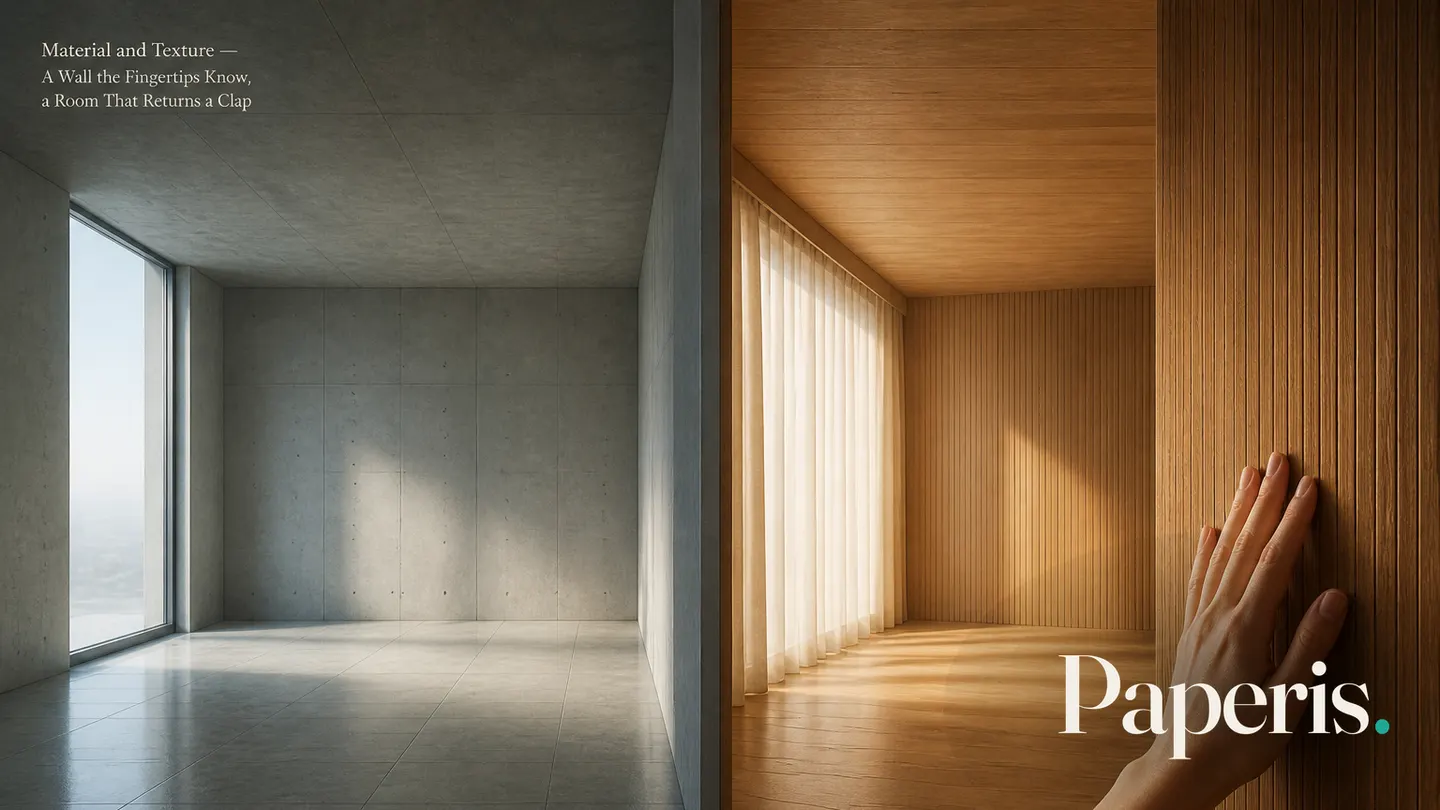
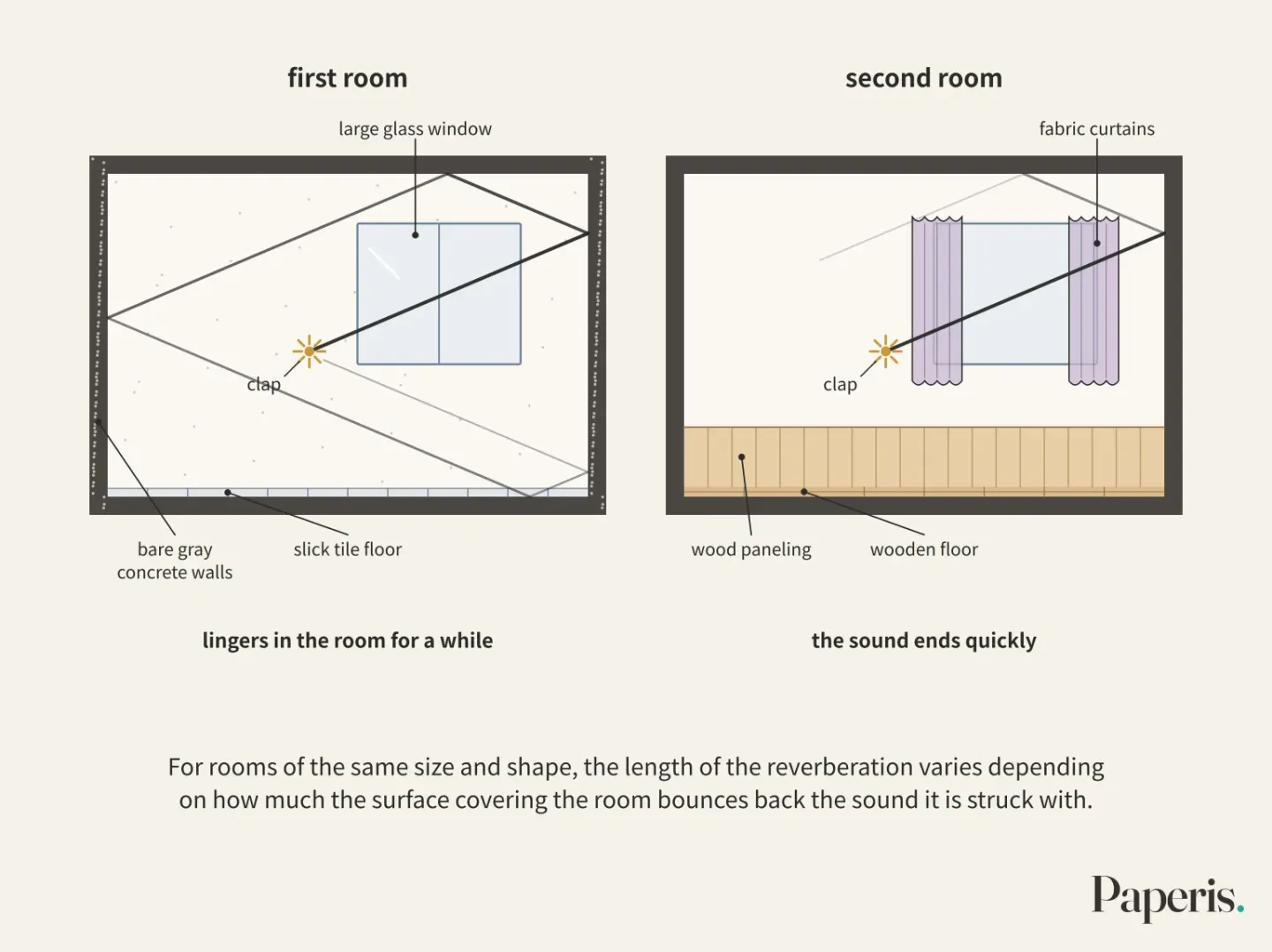
On the same floor of a building, there are two rooms of identical size and shape. The first room has bare gray concrete walls, a slick tile floor, and a single large glass window. The second room has a wooden floor, wood paneling along the lower walls, and fabric curtains on the window.
If you clap your hands once in the middle of the first room, the sound does not stop right away and lingers in the room for a while. If you make the same clap in the second room, the sound ends quickly. When you press your palm against the wall and stroke it, the first room feels scratchy, while in the second room the wood grain catches your fingertips. In the second room, you can also smell the wood.
Even though the two rooms are the same in size and shape, the feeling when you step into them is different. The only things that differ are what covers the walls, floors, and windows. This article examines where that difference comes from, following in turn through the hands, eyes, and ears.
Buildings Experienced Not Just with the Eyes
Photographs of buildings capture only what is visible. A person who steps inside a building instead hears sounds, smells scents, steps on and touches walls and floors, and experiences the interior (DOI: 10.1186/s41235-020-00243-4). Architecture textbooks likewise treat space as something both seen with the eyes and experienced (Ferreira, Introduction to Architecture ch. 3). Space is an empty place enclosed by walls, floors, and roofs—something seen with the eyes and experienced with the body.
Architectural design has long been led by the eyes. In recent decades, architects and designers have begun incorporating sound, touch, smell, and rarely even taste into their work, where touch includes the senses of body posture, movement, and balance (DOI: 10.1186/s41235-020-00243-4). The architect and theorist Juhani Pallasmaa argued that to properly feel architecture, one must not stop at merely looking at a building, but walk through it, listen to its reverberation, smell it, and touch its surfaces (DOI: 10.1111/j.1540-6245.2012.01526.x). This claim is the thought of an architectural theorist and has not been verified by experiment.
A multisensory experience is an experience in which separate inputs received by multiple senses such as the eyes, ears, hands, and nose are woven together into one. We experience the outside world as a single whole because the brain weaves together the streams coming from multiple senses; the brain combines senses as well as separates them, and attention, memory, and the task at hand also intervene in that process. This review article examines those neural circuits primarily through experiments on rodents like mice, and notes that an understanding at the circuit level is still lacking (DOI: 10.1016/j.pneurobio.2019.01.004).
Sensory interaction is a phenomenon where what is received by one sense changes the feeling of another. Examples include how the color of lighting intertwines with how warm or cool a room feels, and how the sounds heard intertwine with how safe a public space feels (DOI: 10.1186/s41235-020-00243-4). Therefore, just the eyes are not enough to unpack the different feelings of two rooms.
The Surface Within Reach
When you press your palm against the concrete wall of the first room and slowly sweep it across, tiny holes and bumps catch your fingertips. Architecture textbooks treat this property of the surface as texture (Ferreira, Introduction to Architecture ch. 3). Texture is a surface property like whether a surface is smooth or rough, comprising the texture felt by touching with the hands and the texture seen only with the eyes.
Looking at monkey experiments, the paths by which the fingertips discern a surface are two. Coarse bumps are conveyed by which spot on the fingertip skin is pressed, and fine grains are conveyed by rapid vibrations stirred in the skin while the finger sweeps across the surface. In experiments recording individual nerve fibers in monkey fingertips, most everyday surfaces were distinguished by the temporal pattern of these vibrations, and the two paths together accounted for texture judgment (DOI: 10.1073/pnas.1305509110). It is believed that in humans too, fine grains are felt through skin vibrations generated when a finger sweeps across a surface (DOI: 10.1126/science.1166467). The movement of the hand over the surface plays a role in recognizing fine grains.
Even when sweeping a surface with the tip of a rod held in the hand, texture is conveyed quite well. In an experiment where everyday surfaces like corduroy, paper, and rubber were swept with bare fingers and a rod respectively, the textures felt by the two methods were similar but not identical. The roughness was felt similarly, while hardness and stickiness tended to show differences. Roughness, hardness, and stickiness were revealed by previous research to be the three main branches of texture touched with bare hands (DOI: 10.1080/08990220701318163). The texture known to the fingertips encompasses not only whether it is smooth or rough, but also whether it is hard and whether it clings to the hand.
Visible Results, Real Materials
What if the floor in the second room is not real wood, but a panel printed with a wood grain? From a distance, they look almost the same. This difference is made by finish materials for walls and floors. Finish materials are the substances that cover and complete the outer surfaces of walls, floors, and ceilings.
There is an experiment where participants were placed in two rooms: one decorated with planed panels of Japanese cedar, widely used as a traditional building material in Japan, and the other lined with a resin sheet printed with a wood grain, with 83 participants staying in each room for 30 minutes. Evaluations of the rooms turned out better the more a person liked the room, meaning they were heavily influenced by personal taste. Even those who disliked the cedar room did not show a bad feeling toward it. Bodily responses were independent of taste, with blood pressure dropping more in the cedar room than in the printed room, while stress markers in saliva decreased in both rooms. The researchers noted that they also measured volatile compounds in the air of the two rooms (DOI: 10.1186/s10086-020-01910-2). Because the two rooms may have differed not only in appearance but also in their airborne compounds, this experiment cannot settle whether the difference in blood pressure came from the eyes, the nose, or other differences.
Just showing the appearances of materials changes impressions. In an experiment where 44 people were shown 22 small models combining wood, fabric, tile, and paint in various combinations, wood was the material that looked warmest, and the larger the surface area covered by wood, the warmer it looked. Brighter models looked more appealing and softer, while medium-to-dark tones felt stimulating. Fabric was the most appealing material on its own, but its appeal dropped when mixed with wood (DOI: 10.1186/s10086-025-02191-3). In this model experiment, the impression of a single material also varied depending on the adjacent materials and the overall brightness.
Color is also a property attached to the surface. A review gathering studies on the psychological meanings of color in graphic, interior, product, and marketing design summarizes that the same color frequently evokes mutually opposing responses together. Red brings to mind both passion and danger, blue brings to mind both trust and sadness, and these responses vary greatly depending on the context where the color is used, culture, individual differences such as age, gender, and personality, as well as accompanying colors, saturation, and brightness. While concluding that it is clear colors influence psychological shifts, the authors note limitations in that research in this field often fails to precisely define colors, includes few participants, or makes stimuli overly simplistic (DOI: 10.24234/miopap.v12i1.64). Color reaches the mind, but which color produces what mood is hard to state apart from the context and the person.
The Room the Ears Measure
We return to the clap in the first room. Reverberation is the lingering sound that bounces off walls and ceilings for a while after the sound stops. There is an experimental laboratory that kept the size and shape the same while altering only how much the walls and ceilings bounce sound back, thereby adjusting the length of the reverberation (DOI: 10.1068/p180403). For rooms of the same size and shape, the length of the reverberation varies depending on how much the surface covering the room bounces back the sound it is struck with. Sound absorption is when the materials of the walls, floor, and ceiling swallow incoming sound instead of bouncing it back. Classrooms bring in sound-absorbing materials to reduce reverberation (DOI: 10.1121/1.1490363).
In that laboratory, reverberation was a clue by which the ears measured distance. When 288 people were asked how far away sounds coming from various distances sounded, they answered that the sounds were quite a bit closer than reality in the room with little bounce. In the room with much bounce, they initially answered that the sounds were farther than reality often, and after listening multiple times, their answers grew closer to reality. Raising the background noise made the sounds feel closer (DOI: 10.1068/p180403). In an earlier experiment where 200 blindfolded people listened to sounds in an ordinary room with solid walls, even when they listened just once for the first time, they answered that sounds that were actually farther away were farther. However, they guessed close sounds to be farther than reality and far sounds to be closer than reality (DOI: 10.1068/p080311). Because the ears use reverberation as one of the clues to gauge the distance to the place where a sound originated, sound is also a sense for feeling space.
Reverberation is also intertwined with the business of understanding speech. Intelligibility is the degree to which one accurately understands heard speech. The speech that reaches the listener is determined together by the speaker's voice and distance, early reflections that arrive first, late-lingering reverberation, and noise. People understand speech well only when both late reverberation and noise are low. Conditions that a normal-hearing adult can tolerate in a casual conversation may be difficult for adults and children in a learning setting, and can be hard to bear for people with difficulties in hearing, language, attention, or processing. This review article concludes that there are no good ways to substitute for managing reverberation (DOI: 10.1055/s-2004-828666). In an experiment where words laced with room reverberation were played through earphones, as the reverberation grew longer, comprehension scores dropped across all six age groups from an average age of 10 to 72, and children and older adults needed to hear sounds louder than young adults to reach the best scores (DOI: 10.1121/1.387773).
There is also research that reached a conclusion different from the preceding review. A study that measured 279 university classrooms in Canada and predicted the speech intelligibility of occupied classrooms reported that speech quality was not very sensitive to changes in reverberation, and that the two classrooms with the worst quality suffered due to ventilation noise. This study reported that bringing in too much sound-absorbing material weakens the lecture voice reaching the back row, and concluded that adjusting reverberation by itself should not be a design priority (DOI: 10.1121/1.1490363). On the speaking side, too, reverberation plays a part. When 20 people were asked to read text in a dead room, a medium room, and a live room, the longer the reverberation, the less they raised their voices, and erecting sound-reflecting panels near the speaking position reduced vocal effort and self-perceived strain together. The place where throats grew the least tired was the medium room (DOI: 10.1121/1.4950812). Reverberation has distinct roles on the listening side and the speaking side.
Although some research connects reverberation to mood, it is still in a preliminary stage. In a preliminary survey of about 330 first-graders at an elementary school in Torino, Italy, children in classrooms with long reverberation felt less joyful and satisfied with themselves. The researchers note that they selected the school so that socioeconomic levels and acoustic conditions were evenly mixed, but the results also showed a tendency for wealthier neighborhoods and native-speaking children to attend classrooms with better acoustics (DOI: 10.3389/fpsyg.2019.02736). Because this is a relationship measured by a survey at a single point in time, it is difficult to isolate the share due solely to acoustics from these circumstances.
What Wood and Greenery Do
Putting a potted plant next to an office desk or applying wood paneling to a wall is common. Underlying that is the idea that people feel more at ease when they are close to nature. Biophilia is the idea that humans have an innate drive to be close to other living things. American biologist Edward O. Wilson put forward this hypothesis in 1984 and popularized it (DOI: 10.18502/keg.v2i2.596). Biophilic design is a design approach that seeks to bring connections with nature into buildings—ranging from natural elements like plants and water, to natural materials like wood, to shapes that mimic nature. This design is broader than bringing plants into buildings, and open questions and debates still remain regarding what counts as "nature" (DOI: 10.1016/j.foar.2021.07.006).
The evidence varies in strength across different items. A 2015 review compiling psychological studies supporting biophilic design concluded that while some items, such as placing natural elements indoors, have substantial evidence, empirical evidence is lacking for items using natural materials or natural flows, and called for more research (DOI: 10.3390/buildings5030948). A review compiling the effects of wood interior finishes on the indoor environment concludes that their effects are generally favorable or neutral. They moderate fluctuations in air humidity, provide a pleasant feel to occupants, and suppress certain bacteria. The negative side is limited to substances emitted by wood, which are volatile organic compounds (DOI: 10.1007/s00107-020-01532-x). Volatile organic compounds are carbon compounds that easily evaporate into the air at ordinary temperatures, and the components that make up wood scent are also included here. Among them, some can be sensed as an odor even at very low concentrations, changing the feel of indoor air, and formaldehyde and acrolein can be harmful to health under certain conditions. The authors conclude that more research is needed to better understand these phenomena (DOI: 10.1007/s00107-020-01532-x).
In an experiment testing wooden rooms through random assignment, 61 participants experienced both a room with introduced wooden elements and a room without wood. Participants rested in an armchair in the same room after being stressed by a computer task. Anxiety near the end of the experiment was markedly lower in the wooden room, but other psychological indicators amounted to no more than the wooden room possibly being slightly better, and performance on a task sustaining attention was similar between the two rooms. Contrary to expectations, nerve activity on the side that tightens the body was actually more active in the wooden room. The authors concluded that this result supports the notion that wood in office environments has a small beneficial effect on mood (DOI: 10.1016/j.jenvp.2023.102059).
Small experiments show mixed results. In an experiment presented at a conference, in a room where Japanese cedar panels were hidden behind curtains so they were not visible and only airborne compounds reached the participants, 10 people showed no difference in saliva stress markers, blood pressure, and heart rate variability compared to an ordinary room, with only vitality differing slightly (DOI: 10.1097/01.ede.0000391778.14268.18). In an experiment published in Japan where 14 college students entered four rooms with varying amounts of wood used, the more wood there was, the stronger and more pleasant the scent felt, but what was felt mentally and how the body reacted did not match each other (DOI: 10.2488/jwrs.57.150). In an experiment where participants were made to smell Taiwanese cedar, heart rate dropped after smelling the scent and some negative moods such as confusion and fatigue decreased, but there were also responses that the scent was less pleasant. Expectations also play a role. In the same experiment, people who were given positive information in advance about the scent had less angry and hostile moods, but that information did not alter bodily responses. Good information also eased the unpleasantness of the scent (DOI: 10.1186/s10086-022-02021-w). Several of these experiments used woods widely utilized in Japan and Taiwan. While there are also studies showing nature through virtual reality, they have issues with motion sickness, difficulty in wayfinding, and limitations in sensory input, and their number is still small (DOI: 10.3390/buildings11040148).
While evidence that wood and natural elements make people comfortable is accumulating, in a randomized experiment of 61 people the effect was small, bodily and mental responses frequently conflicted, and personal taste and expectations mixed into the results.
Back to the Two Rooms
Now we return to the two rooms. If clapping lingered longer in the first room, since they are rooms of the same size, it means the surfaces of that room bounced sound back more. When someone speaks in that room, it is harder to understand when reverberation overlaps with noise, and that can be even more so for adults and children in a learning place, and for those who are hard of hearing. However, in a Canadian university classroom study, noise played a larger role than reverberation, and the conclusions of the two pieces of evidence differ from each other. According to one laboratory experiment, a speaker would raise their voice less in such a room, but the place where the throat grew least tired was a room with moderate reverberation. To someone who has just stepped inside, the same sound might seem to come from a different distance than in the second room.
The palm pressed against the wall knows the difference between the roughness of concrete and the grain of wood. A fine grain is felt as a tremor rising on the skin when you sweep your hand across it. If the grain of the second room was a printed pattern, in one cedar experiment, a real-wood room and a printed room parted ways in blood pressure. However, it was not sorted out whether that difference came from the appearance, or from the smell or other differences. In the second room looking warm, the area of the surface covered by wood steps in, and in the degree of appeal, brightness and the fabric attached beside it interfere.
The smell of wood comes from volatile compounds in the air. Those compounds change the feel of the room, and some compounds can be harmful depending on conditions. If the second room feels more comfortable, part of that share is made by the material, and part by the preference for liking the room and the expectations placed on wood. In one experiment that randomly assigned 61 people, the share of the material did not come out as large.
Materials and texture, color, and sound are elements that determine the impression of a building, and that impression is made together by the hands, eyes, ears, and nose, reaching each person differently.
Where to Look Next
Other pieces in the same series are "Light — How One Window and One Curtain Change a Room", "Space and Scale — The Seat with Its Back to the Wall, Facing the Window", and "Paths and Use — A Newcomer's Steps, an Occupant's Word".
The story of the architect who shaped ceilings while thinking about sound continues in "Alvar Aalto — Patient Rooms Turned to the Morning Sun, a Lecture-Room Ceiling in Waves". Buildings that emptied their walls using the material of glass are in "Mies van der Rohe — Give the Weight to the Frame, Empty the Walls into Glass", and buildings wrapped in brick are in "Kim Swoo-geun — A Walkway Lifted Above the Traffic, a Maze Wrapped in Brick".
Why materials snap or bend to endure, and their structural properties, are covered in "Building Materials — The Chalk That Snaps, the Paper Clip That Bends".
Source Papers
- "Introduction to Architecture — 3 Elements of Architecture" (Kelsey Ferreira, Open Oregon Educational Resources) — Ferreira, Introduction to Architecture ch. 3 — Definition of architectural elements: texture is a surface property with tactile and visual qualities. Space is both something seen and something experienced.
- "Senses of place: architectural design for the multisensory mind" (2020) — DOI: 10.1186/s41235-020-00243-4 — A review discussing how architecture was once vision-centric but has begun incorporating other senses. Interactions between senses, such as lighting color ↔ thermal comfort and sound ↔ a sense of safety in public spaces.
- "On Being Moved by Architecture" (2012) — DOI: 10.1111/j.1540-6245.2012.01526.x — An aesthetics paper introducing Pallasmaa's argument that "architectural appreciation is a multisensory experience."
- "The circuit architecture of cortical multisensory processing: Distinct functions jointly operating within a common anatomical network" (2019) — DOI: 10.1016/j.pneurobio.2019.01.004 — A review stating that multisensory processing is a functional group encompassing integration and segregation, driven by attention, memory, and context (focusing on rodent models; circuit-level understanding remains lacking).
- "Spatial and temporal codes mediate the tactile perception of natural textures" (2013) — DOI: 10.1073/pnas.1305509110 — Neural recordings from monkey fingertips: coarse textures are conveyed via spatial patterns, while most natural textures are conveyed via temporal patterns generated by vibrations during scanning.
- "The Role of Fingerprints in the Coding of Tactile Information Probed with a Biomimetic Sensor" (2009) — DOI: 10.1126/science.1166467 — Human perception of fine textures is mediated by skin vibrations produced when sweeping a finger (experiments using fingertip-sized artificial sensors).
- "Texture perception through direct and indirect touch: An analysis of perceptual space for tactile textures in two modes of exploration" (2007) — DOI: 10.1080/08990220701318163 — Textures explored with bare fingers versus a rod are similar but not identical. Roughness is comparable, whereas hardness and stickiness differ.
- "Effects and interaction of different interior material treatment and personal preference on psychological and physiological responses in living environment" (2020) — DOI: 10.1186/s10086-020-01910-2 — Cedar board room versus wood-grain printed resin sheet room, 83 people: subjective evaluations depend on preference, whereas physiological responses do not; blood pressure dropped in the cedar room, salivary alpha-amylase was suppressed in both rooms, and volatile organic compounds were measured in both rooms.
- "Visual perceptions of wood-integrated material combinations: effects on psychological and physiological responses" (2025) — DOI: 10.1186/s10086-025-02191-3 — 22 models and 44 people: wood appears the warmest; bright models evoke attraction and softness; fabric mixed with wood reduces attraction.
- "THE PSYCHOLOGICAL MEANING OF COLOR IN DESIGN: A SEMANTIC REVIEW" (2025) — DOI: 10.24234/miopap.v12i1.64 — Responses to color are ambivalent and depend on context, culture, and individual differences. While color clearly affects the mind, methodological limitations exist (lack of color standardization, small sample sizes, simple stimuli).
- "Effects of Room Reflectance and Background Noise on Perceived Auditory Distance" (1989) — DOI: 10.1068/p180403 — A room where size and shape were kept constant while only reflection was altered to control reverberation, 288 people: low reflection leads to an underestimation of distance; high reflection leads to initial overestimation followed by estimates closer to reality; noise makes distances sound shorter.
- "Absolute and Relative Cues for the Auditory Perception of Egocentric Distance" (1979) — DOI: 10.1068/p080311 — 200 blindfolded people: even upon first presentation, perceived distance varied according to actual distance, with close objects overestimated and distant ones underestimated.
- "Room Acoustics and Speech Perception" (2004) — DOI: 10.1055/s-2004-828666 — Speech is determined by sound source, distance, early reflections, late reverberation, and noise; both reverberation and noise must be low. This is more difficult for adults and children in learning environments, as well as for individuals with hearing, language, attention, or processing difficulties. There is no good alternative for controlling reverberation.
- "Monaural and binaural speech perception in reverberation for listeners of various ages" (1982) — DOI: 10.1121/1.387773 — Earphone listening: as reverberation increases, scores decline across all six age groups (averaging 10 to 72 years, 10 people each), and children and older adults require higher volume.
- "Rating, ranking, and understanding acoustical quality in university classrooms" (2002) — DOI: 10.1121/1.1490363 — 279 classrooms: speech quality is less sensitive to changes in reverberation; the worst factor is ventilation noise, and excessive sound absorption lowers lecture volume in the back rows.
- "Effects of speech style, room acoustics, and vocal fatigue on vocal effort" (2016) — DOI: 10.1121/1.4950812 — 20 people: longer reverberation and the presence of reflectors reduce vocal volume and self-reported effort; a medium-sized room minimizes vocal fatigue.
- "Influence of Classroom Acoustics on Noise Disturbance and Well-Being for First Graders" (2019) — DOI: 10.3389/fpsyg.2019.02736 — Preliminary study of approximately 330 first-graders in Turin: enjoyment and self-satisfaction are lower in classrooms with long reverberation, and wealthier areas have better acoustic conditions.
- "Biophilic Design Applications: Putting Theory and Patterns into Built Environment Practice" (2017) — DOI: 10.18502/keg.v2i2.596 — Introduction to Wilson's (1984) biophilia hypothesis and an examination of the application of biophilic design.
- "Biophilic design in architecture and its contributions to health, well-being, and sustainability: A critical review" (2021) — DOI: 10.1016/j.foar.2021.07.006 — Biophilic design is broader than simply bringing in plants (encompassing physical, sensory, metaphorical, morphological, material, and spiritual aspects), and open questions and debates remain around the concept of "nature."
- "A Review of Psychological Literature on the Health and Wellbeing Benefits of Biophilic Design" (2015) — DOI: 10.3390/buildings5030948 — Items such as the presence of natural elements have strong evidence, whereas items related to natural materials and processes lack empirical support.
- "The influence of wooden interior materials on indoor environment: a review" (2020) — DOI: 10.1007/s00107-020-01532-x — The effects of wooden interior finishes are generally positive or neutral, with negative impacts limited to volatile organic compounds (certain aldehydes and terpenes produce odors even at low concentrations, while formaldehyde and acrolein pose health risks depending on conditions).
- "Psychological and physiological effects of a wooden office room on human well-being: Results from a randomized controlled trial" (2023) — DOI: 10.1016/j.jenvp.2023.102059 — Crossover randomized controlled trial with 61 people: anxiety was clearly lower in the wooden room, other indicators showed weak signals, attention tasks were similar, and sympathetic nervous activity was higher in the wooden room; authors concluded a "weak positive effect."
- "Effects of Emissions From Cedar Timber on Psychological and Physiological Factors in Indoor Environment" (2010) — DOI: 10.1097/01.ede.0000391778.14268.18 — Conference poster abstract. Cedar room hidden by curtains, crossover design with 10 people: no differences in stress indicators or psychological scales, with only a slight change in vitality.
- "Psychological and Physiological Effects in Humans Induced by the Visual and Olfactory Stimulations of an Interior Environment Made of Hiba (Thujopsis dolabrata) Wood" (2011) — DOI: 10.2488/jwrs.57.150 — Four rooms with varying amounts of hiba wood, 14 college students: greater amounts of wood increased odor intensity and perceived comfort, while psychological evaluations and physiological responses did not correspond.
- "Physiological and psychological responses to olfactory simulation by Taiwania (Taiwania cryptomerioides) essential oil and the influence of cognitive bias" (2022) — DOI: 10.1186/s10086-022-02021-w — Fragrance lowers heart rate and suppresses feelings of confusion, fatigue, and depression, though pleasantness is reduced. Positive prior information about the fragrance reduced anger and hostility but had no effect on physiological responses.
- "Application of Virtual Environments for Biophilic Design: A Critical Review" (2021) — DOI: 10.3390/buildings11040148 — Virtual environments can support biophilic design research, but face limitations in motion sickness, wayfinding, and sensory input, and existing research remains sparse.
Sources (26)
- Introduction to Architecture — 3 Elements of Architecture
- Senses of place: architectural design for the multisensory mindDOI 10.1186/s41235-020-00243-4
- On Being Moved by ArchitectureDOI 10.1111/j.1540-6245.2012.01526.x
- The circuit architecture of cortical multisensory processing: Distinct functions jointly operating within a common anatomical networkDOI 10.1016/j.pneurobio.2019.01.004
- Spatial and temporal codes mediate the tactile perception of natural texturesDOI 10.1073/pnas.1305509110
- The Role of Fingerprints in the Coding of Tactile Information Probed with a Biomimetic SensorDOI 10.1126/science.1166467
- Texture perception through direct and indirect touch: An analysis of perceptual space for tactile textures in two modes of explorationDOI 10.1080/08990220701318163
- Effects and interaction of different interior material treatment and personal preference on psychological and physiological responses in living environmentDOI 10.1186/s10086-020-01910-2
- Visual perceptions of wood-integrated material combinations: effects on psychological and physiological responsesDOI 10.1186/s10086-025-02191-3
- THE PSYCHOLOGICAL MEANING OF COLOR IN DESIGN: A SEMANTIC REVIEWDOI 10.24234/miopap.v12i1.64
- Effects of Room Reflectance and Background Noise on Perceived Auditory DistanceDOI 10.1068/p180403
- Absolute and Relative Cues for the Auditory Perception of Egocentric DistanceDOI 10.1068/p080311
- Room Acoustics and Speech PerceptionDOI 10.1055/s-2004-828666
- Monaural and binaural speech perception in reverberation for listeners of various agesDOI 10.1121/1.387773
- Rating, ranking, and understanding acoustical quality in university classroomsDOI 10.1121/1.1490363
- Effects of speech style, room acoustics, and vocal fatigue on vocal effortDOI 10.1121/1.4950812
- Influence of Classroom Acoustics on Noise Disturbance and Well-Being for First GradersDOI 10.3389/fpsyg.2019.02736
- Biophilic Design Applications: Putting Theory and Patterns into Built Environment PracticeDOI 10.18502/keg.v2i2.596
- Biophilic design in architecture and its contributions to health, well-being, and sustainability: A critical reviewDOI 10.1016/j.foar.2021.07.006
- A Review of Psychological Literature on the Health and Wellbeing Benefits of Biophilic DesignDOI 10.3390/buildings5030948
- The influence of wooden interior materials on indoor environment: a reviewDOI 10.1007/s00107-020-01532-x
- Psychological and physiological effects of a wooden office room on human well-being: Results from a randomized controlled trialDOI 10.1016/j.jenvp.2023.102059
- Effects of Emissions From Cedar Timber on Psychological and Physiological Factors in Indoor EnvironmentDOI 10.1097/01.ede.0000391778.14268.18
- Psychological and Physiological Effects in Humans Induced by the Visual and Olfactory Stimulations of an Interior Environment Made of Hiba (Thujopsis dolabrata) WoodDOI 10.2488/jwrs.57.150
- Physiological and psychological responses to olfactory simulation by Taiwania (Taiwania cryptomerioides) essential oil and the influence of cognitive biasDOI 10.1186/s10086-022-02021-w
- Application of Virtual Environments for Biophilic Design: A Critical ReviewDOI 10.3390/buildings11040148