Paperis Articles
Grimms' Fairy Tales — Where Did the Tight Dress Go?
The Brothers Grimm's book of tales was revised again and again between the first edition of 1812 and the last of 1857. We set the original texts of two editions side by side on Rapunzel's tight dress and Snow White's mother, then look in turn at who scholars think did the revising and why, and at the people who told the tales.
Your field's papers, as audio
Pick your fields and journals — Paperis summarizes the key papers and turns them into audio. Listen on your commute.
Start Paperis free →Grimms' Fairy Tales — Where Did the Tight Dress Go?
From 1812 to 1857, a Book Revised Over Time
The book we call "Grimm's Fairy Tales" is titled Children's and Household Tales (Kinder- und Hausmärchen). It was compiled in German by the German scholar brothers Jacob Grimm and Wilhelm Grimm, with the first volume published in 1812 and the second in 1815 (DOI: 10.4000/feeries.829). The brothers began collecting folktales from both written and oral sources in the first decade of the 19th century, viewing those stories as evidence of an ancient German literature in danger of vanishing (DOI: 10.3366/ccs.2005.2.1.23). What the brothers sought to collect was the folktale. A folktale is a story passed down by word of mouth from person to person without a known author. This article is written by comparing the various editions of this book published in Germany in German.
The book that transferred those stories onto paper was not printed just once and finished. The first edition is the edition in which a book is printed and released for the very first time. The first edition of this book consists of two volumes published in 1812 and 1815. A revised edition is an edition reprinted after revising the text of a previously published book. The second edition came out in 1819, and the seventh edition came out in 1857, 45 years after the first publication (DOI: 10.12775/rp.2016.004). There are seven major editions in total published during Wilhelm Grimm's lifetime (DOI: 10.17192/openumr/804). With each passing edition, the brothers added, subtracted, and combined stories, and the 1857 edition contained 200 stories and 10 legends. A 2005 paper counts 17 editions in total (DOI: 10.3366/ccs.2005.2.1.23).
Another name is attached to the 1857 edition. The definitive edition is the edition last revised and published by the compiler while still alive. In German it is called the "last-hand edition," and in Grimm's Fairy Tales the 1857 edition holds that place (DOI: 10.17877/de290r-8217).
There is a saying frequently heard about Grimm's Fairy Tales. It is that they were initially crude stories read by adults which, through repeated editions, were softened into children's books. This article tests that claim against three things: the 1812 and 1857 original texts of two stories, research on who revised them and why, and the people who told the stories.
Rapunzel, Tight Clothes, and a Heavy Woman
Rapunzel is a girl locked in a tower with neither door nor stairs. The woman who imprisoned her calls up from beneath the tower for her to let down her hair, and climbs up using that hair. From a certain day onward, a prince climbs the tower the same way, and a single word spoken by Rapunzel reveals the secret. In the 1812 first edition, that single word goes like this.
„sag’ sie mir doch Frau Gothel, meine Kleiderchen werden mir so eng und wollen nicht mehr passen.“
"Tell me, Mother Gothel, my little clothes are getting so tight and won't fit any more." — Brothers Grimm, "Rapunzel", Children's and Household Tales (Kinder- und Hausmärchen), 1812 first edition (original · translated by Paperis)
In this edition, after being driven out of the tower, Rapunzel gives birth to twins in the wilderness, a son and a daughter. The reader reads the tight clothes and the twins together. In the 1857 edition, the speech in the same spot changes.
„sag sie mir doch, Frau Gothel, wie kommt es nur, sie wird mir viel schwerer heraufzuziehen, als der junge Königssohn, der ist in einem Augenblick bei mir.“
"Tell me, Mother Gothel, how is it that you are so much heavier to pull up than the young king's son? He is up here with me in a moment." — Brothers Grimm, "Rapunzel", Children's and Household Tales (Kinder- und Hausmärchen), 1857 edition (7th edition) (original · translated by Paperis)
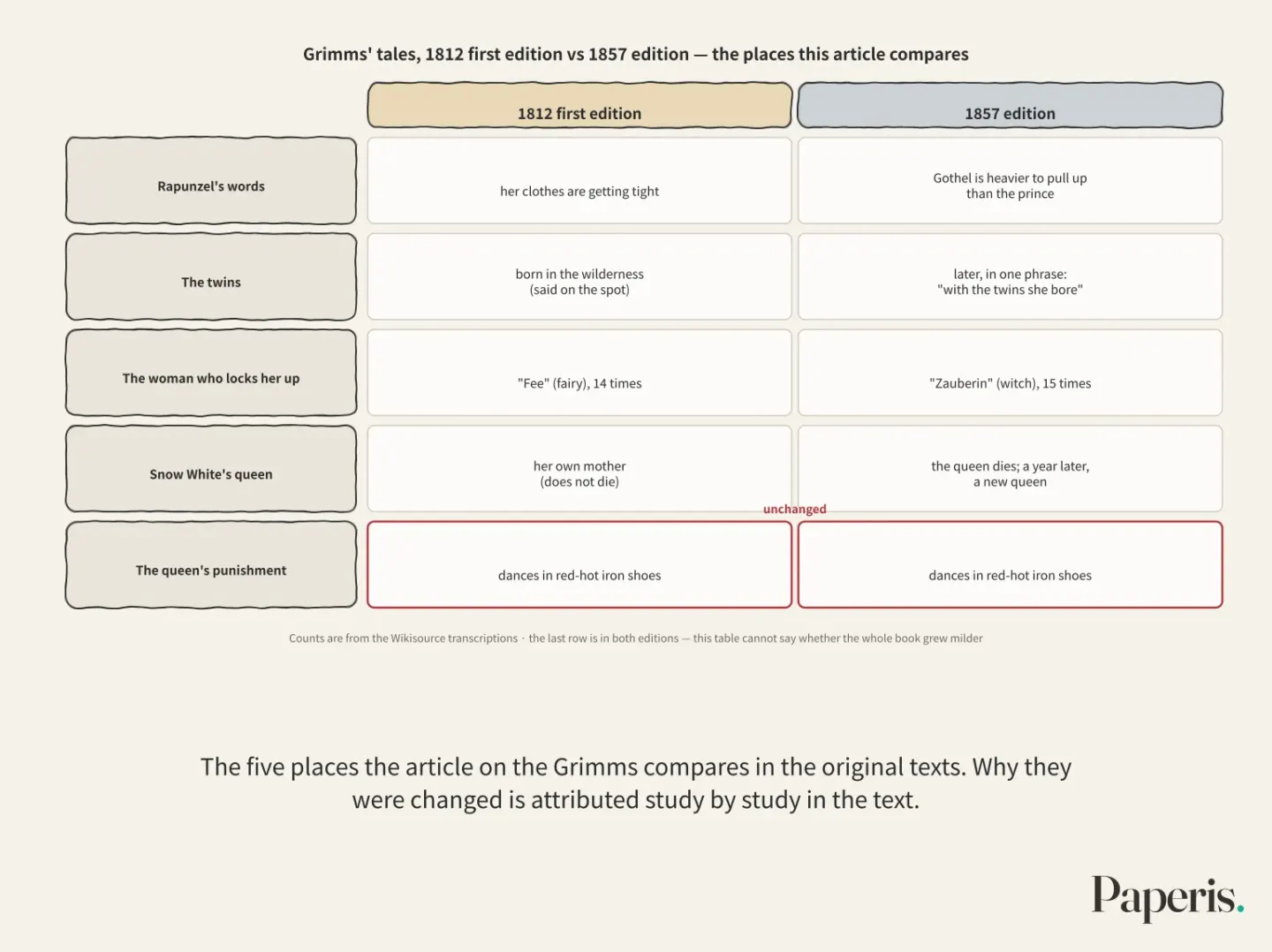
If the remark in the 1812 edition was a story about clothes, the remark in the 1857 edition is a story about weight. The twins remain in the 1857 edition as well. In the passage where the prince finds Rapunzel again at the end, the twins appear in the phrase stating she lives "with the twins she bore." The 1812 edition records right then and there that she gave birth to twins in the wilderness where she was driven out, while the 1857 edition reveals that fact later in a single clause.
The name of the woman who imprisoned Rapunzel changes too. If we count the words in the texts of the two editions transcribed on Wikisource, the 1812 edition calls her "Fee" (fairy) fourteen times and never calls her "Zauberin" (witch). The 1857 edition reverses this, with "Zauberin" appearing fifteen times and "Fee" not even once. The title "Mother Gothel" by which Rapunzel calls her is identical in both editions. The length of the story changes as well. If counted from the same transcripts, the 1812 edition falls just short of 900 words, whereas the 1857 edition reaches roughly 1,340 words, becoming about 1.5 times longer.
In the passages compared in this article, the 1857 edition changed the single word that reveals the secret and the woman's name, while keeping the twins.
Snow White, Mother and Stepmother
"Snow White" begins with a queen who wanted a child and gives birth to a daughter. In the 1812 first edition, the very next paragraph continues like this:
Die Königin war die schönste im ganzen Land, und gar stolz auf ihre Schönheit.
The queen was the most beautiful in all the land, and very proud of her beauty. — Brothers Grimm, "Snow White", Children's and Household Tales 1812 first edition (original · translated by Paperis)
This queen is the exact same queen who desired a child and gave birth to a daughter in the previous paragraph, and she does not die in between. The queen who asks the mirror who is the fairest of all is, in the 1812 edition, the mother who gave birth to Snow White. In the 1857 edition, two sentences are inserted in between.
Und wie das Kind geboren war, starb die Königin. Über ein Jahr nahm sich der König eine andere Gemahlin.
When the child was born, the queen died. After a year the king took another wife. — Brothers Grimm, "Snow White", Children's and Household Tales 1857 edition (7th edition) (original · translated by Paperis)
The difference is also visible in the word count. In the text of the Wikisource transcription, the 1812 edition uses "Mutter" (mother) twice and does not use "Stiefmutter" (stepmother) even once. The 1857 edition uses "Stiefmutter" four times and does not use "Mutter" even once.
There are also places that did not change. It is the punishment the queen receives at the end of the story. The 1857 edition records it like this:
Aber es waren schon eiserne Pantoffeln über Kohlenfeuer gestellt und wurden mit Zangen herein getragen und vor sie hingestellt. Da mußte sie in die rothglühenden Schuhe treten und so lange tanzen, bis sie todt zur Erde fiel.
But iron slippers had already been set over a coal fire, and they were carried in with tongs and set before her. Then she had to step into the red-hot shoes and dance until she fell down dead. — Brothers Grimm, "Snow White", Children's and Household Tales 1857 edition (7th edition) (original · translated by Paperis)
The same punishment is in the 1812 edition as well. The punishment of wearing glowing iron shoes and dancing until death is present in both editions, and this passage did not become milder between the two editions.
Regarding the shape of this story, one study provides a clue. In the German literary world of 1812, folk tale collections were overflowing, and among them was the author Albert Ludwig Grimm, who had published Children's Tales (Kindermährchen) in 1809. This study suggests that the Brothers Grimm relied on him, particularly in restructuring "Snow White" (DOI: 10.4000/feeries.1014). However, this abstract does not specifically point out the passage where the mother was changed into a stepmother.
Comparing the original texts side by side shows what changed, but the original texts do not tell us why it was changed. That question is handed over to research.
Who Fixed Them? The Hands of Wilhelm Grimm
From edition to edition, the person who revised the texts is generally identified as the younger brother, Wilhelm Grimm. From 1812 to 1857, descriptions that Wilhelm deeply tinkered with the texts in every edition are repeated in multiple studies (DOI: 10.17192/openumr/804; DOI: 10.3366/ccs.2005.2.1.23). A 2011 dissertation classifying young female characters in the 1857 definitive edition views that edition as heavily revised by Wilhelm and states that the stories featured in it are treated as works of art rather than folk traditions (DOI: 10.17877/de290r-8217).
There is also a text where Wilhelm himself reveals one aspect of his editing. As reported by a 1991 paper, in the preface to the sixth edition he wrote that he inserted "popular maxims and distinctive turns of speech" into the stories. Friedrich Panzer, an editor who compiled the first somewhat critical edition, summarized in the preface to that edition in 1948 that through successive editions, popular idioms, metaphors, proverbs, and rhyming set phrases increased, while things that ran counter to the folk storytelling style were pruned away as much as possible (DOI: 10.1007/978-3-322-97010-7_12). Wilhelm's remark is an explanation by the person involved, and Panzer's summary is a later editor's assessment.
This editing leads to the question of speech style. A spoken style is phrasing that, even though written down, makes it sound as though someone is telling it aloud. A 2025 paper argues that the brothers took spoken characteristics as models from the beginning, and that the more a story originated from a book, the more it absorbed spoken phrasing with successive editions. According to the same paper, texts based on orally heard stories kept the traces of spoken style present in the 1812 first edition unchanged up to 1857 (DOI: 10.5817/bbgn2025-1-4). That paper notes that research has previously turned a blind eye to the parts that remained unchanged between 1812 and 1857.
The direction of the revisions does not converge on a single path either. "The Tale of the Toad" (No. 105) was transcribed from an oral tradition in the Hessian region in 1813, and only in the fifth edition of 1843 did it take on the shape known today. The sentences added in between made the story's totemistic aspects stand out more (DOI: 10.1515/fabula-2020-0002). Some stories were also dropped. A 2016 Polish paper counts 37 stories omitted from the first edition and notes that they are completely unknown to Polish readers (DOI: 10.12775/rp.2016.004). "The Story of the Children Who Played at Butchering," one of the stories dropped in later editions, is an anecdote that had been published in a Berlin newspaper (1810–1811) edited by the German writer Heinrich von Kleist and was republished in the first edition. A 2026 paper suggests that the reason this story was omitted in later editions may be related to the new picture of Germany's past that the brothers painted, and writes that the "stale news" of the stories the brothers removed, including this one, ultimately did not fit that picture (DOI: 10.1080/00168890.2026.2744728).
The revisions across editions involved both subtraction and addition. Proverbs and spoken styles increased, some stories gained new sentences, and some stories were dropped entirely.
Why Were They Revised? — Four Angles from Research
The reasons for the revisions can be read from four angles: children's books, education, readership and translation, and language and nation. The evidence relied upon differs for each angle.
The first angle is children's books. A 2005 paper notes that the brothers initially conceived of the book as scholarly material containing unmanipulated data and source information, that while being read in Germany the book gradually shifted toward children's books, and that Wilhelm significantly altered the content and form, departing from the brothers' original intent (DOI: 10.3366/ccs.2005.2.1.23). This paper frames the shift toward children's books as part of the process of how it was read in Germany, rather than presenting it as the reason why Wilhelm made revisions. A 2016 Polish paper arguing that the first edition should be translated into Polish goes further, claiming that from the second edition onward the stories were rewritten, revised, and censored, and that Wilhelm transformed what was originally writing for adult readers into pure children's literature by adding Christian values and erasing sexual innuendo (DOI: 10.12775/rp.2016.004). Self-censorship is when a writer or editor removes or tones down content on their own initiative before anyone tells them to. A 2009 paper examines the role that editing, revision, and self-censorship played when handling sexual content and horror in the Brothers Grimm and Finnish fairy tales by Laura Soine (DOI: 10.1353/bkb.0.0181). Because this abstract is a single line, it does not state what conclusions were reached.
Research is divided right from what kind of book this was initially conceived to be and for whom. The 2005 paper views it as scholarly material, while the 2016 paper views it as writing for adult readers. A 2004 paper records that the book was originally transcribed from oral traditions for children and youth readers (DOI: 10.1080/1361454042000294087). A 2019 paper suggests that conflicting views on children could have influenced the revisions across editions, and that the compromises in that process were complex (DOI: 10.4000/genesis.3922).
The second angle is education. The 2016 French study examined earlier alongside "Snow White" views the brothers as having created a new format with distinct moral values in order to establish a foothold in a literary world overflowing with fairy tale collections. The brothers repeatedly stated their intention across editions to issue this book as "a true educational book" (ein eigentliches Erziehungsbuch), and that intention reveals itself in nearly 50 years of rewriting, according to this study (DOI: 10.4000/feeries.1014).
The third angle is readership and translation. A chapter in the 2014 book The Legacy of Grimm views the brothers as having changed the format and scope of the book so that ordinary German readers could easily read it, largely influenced by translator Edgar Taylor's 1823 English translation German Popular Stories (DOI: 10.23943/princeton/9780691160580.003.0003). Taylor's translation is the first English translation of the book (DOI: 10.3366/ccs.2005.2.1.23).
There are also accounts connecting the edits to success. The 2016 Polish paper writes that Wilhelm's edits were the primary reason for the global success of these German fairy tales (DOI: 10.12775/rp.2016.004). The 2005 paper writes that Wilhelm's edits created a unique voice and a single genre, which made the book a classic of German children's reading and one of the most translated books in German literature (DOI: 10.3366/ccs.2005.2.1.23). Both sentences merely speak of the outcomes produced by the edits, without stating that Wilhelm made revisions aiming for success. There are also two pieces of evidence addressing success itself. Folklorist Ingeborg Weber-Kellermann wrote in the preface to the 1976 Insel Verlag edition that the book's success was thanks to children's rooms in bourgeois households becoming a consumer base (DOI: 10.1007/978-1-137-09873-3_4). Building on archival materials and other reception records published in 2016, a 2024 paper reveals that the time when this book began selling well in Germany was much later than previously thought (DOI: 10.1515/fabula-2024-0006). These two pieces of evidence only address when and how the book succeeded, not why it was revised.
The fourth angle is language and nation. A 2010 linguistic study considers that the brothers followed several goals, whether consciously or not. These include making the stories as a whole look German even though many drew inspiration from France, finding an ideal storytelling style suited to the new genre through a balance between archaic and everyday language, and spreading or reflecting stereotypes about the proper roles of boys and girls (DOI: 10.1075/lal.10). The introduction to The Legacy of Grimm views the brothers as having been conscious from the start of handing down these stories to a reading German-speaking public, thereby playing a part in creating a new nationalist-tinged folklore tradition (DOI: 10.23943/princeton/9780691160580.003.0001).
Can we map these four angles onto that line in Rapunzel? Among the evidence this article relies upon, no study pinpoints Rapunzel's tight-clothing line to reveal why it was changed. The 2016 Polish paper's argument that sexual innuendo was erased pertains to the book as a whole, and Rapunzel's name does not appear in its abstract.
The reasons do not converge into one, but emerge from distinct evidence for each angle.
The People Who Told the Stories
A story provider is someone who told a known story to a collector or wrote it down and handed it over. Among the story providers of the nursery and household tales is the renowned storyteller Dorothea Viehmann (DOI: 10.1515/fabula-2026-0006). Her portrait was included as the frontispiece in the book. A 2019 paper suggests that this portrait, along with the brothers' academic writings, helped prop up the authenticity of oral folktales (DOI: 10.1515/fabula-2019-0015). The portrait, drawn by the artist Ludwig Emil Grimm, survives in three editions, and this paper reads how the brothers' descriptions and the drawing relied on each other, intertwining physiognomy (the practice of reading a person's character from their facial features), stereotypes about the East, and the work of mourning. The author's conclusion is that the brothers constructed and solidified such an "ideal storyteller" in this way.
Viehmann's stories themselves do not belong to just a single branch. A 2019 comparative study notes that her stories contain elements of German, Romance, and Slavic cultures together, showing how multiple languages and cultures were mixed (DOI: 10.3986/sms20192209). The source attribution left by the brothers is also not the final word. The brothers recorded different sources for "The White Bride and the Black Bride" (No. 135), but a 2023 paper argues based on linguistic features that it is plausible Viehmann told this story as well (DOI: 10.1515/fabula-2023-0015). A 2026 paper announces the new discovery of a story by Viehmann that Jacob Grimm transcribed in 1813, noting that the text surpasses her other stories in its bawdiness (DOI: 10.1515/fabula-2026-0006).
Viehmann was not the only one. A 2011 dissertation analyzing the 1857 edition divides the stories among young female providers, male providers, and the elderly storyteller Viehmann (DOI: 10.17877/de290r-8217). Researchers such as Heinz Rölleke, Ruth Bottigheimer, and Jack Zipes have shaken the authority of the Brothers Grimm as folktale collectors in scholarly discussions (DOI: 10.1353/mat.2010.a384533).
The image that "stories passed down by mouth were transcribed just as they were" is an aspect that, according to the 2019 paper dealing with the portrait, was propped up jointly by the brothers' writings and the portrait.
Laying Two Volumes Side by Side
Imagine a reader with the 1812 first edition and the 1857 definitive edition laid side by side on a desk. Open "Rapunzel", and in the left-hand book a fairy climbs the tower, while in the right-hand book a witch climbs it. The Rapunzel in the left-hand book says her clothes are getting tight, whereas the Rapunzel in the right-hand book asks why the older woman is heavier than the prince. Both books feature twins in the wilderness. The story on the right is about 1.5 times longer. Flipping to "Snow White", the queen who asks the mirror in the left-hand book is the mother who gave birth to Snow White, while in the right-hand book she is a stepmother who took the place of the queen who died when the child was born. The punishment of the iron shoes at the end of the story is present in both books.
When asked what happened during the forty-five years in between, research points to Wilhelm Grimm's hand, to the proverbs and colloquial speech patterns that hand inserted, and presents children's books, educational texts, translations, readerships, language, and the nation as the reasons that moved that hand. The evidence to trace the reason behind every single changed sentence between the two books falls short within the scope this article relies upon.
At least the Polish translations are all based on the right-hand book, the 1857 edition. The earlier 2016 Polish paper notes that readers are largely unaware that the only version they know is the final, censored one (DOI: 10.12775/rp.2016.004). In English, as the publisher's introduction notes, translator Jack Zipes first translated all 156 stories of the 1812 and 1815 first editions in 2014. The same introduction comments that the stories in the first edition capture multiple voices rooted in oral tradition, and that those voices disappeared in the more embellished later editions (DOI: 10.2307/j.ctt6wq18v). This is an appraisal from a book description. The 2025 paper we saw earlier looked at something different. It suggests that oral traces of stories heard by ear remained intact from 1812 to 1857, while stories derived from books absorbed more colloquial phrasing with each successive edition.
What Remains Unknown, and the "Original Grimm's Fairy Tales"
Three questions remain open. Why a single line was changed, like Rapunzel's dialogue, is not explained by the sources this article relies on. Studies differ on who the brothers had in mind as readers in 1812. How the 2016 Polish paper's assertion—that editorial revision was the primary cause of worldwide success—fits together with a 2024 study that dates the onset of strong sales within Germany later is also not settled by the sources used here.
We also explored how the same work changes across editions in "The Tale of Chunhyang — A Story That Changed with Every Singing and Every Copying" and "Frankenstein — How Far Did Her Husband's Hand Reach?". In Grimm's Fairy Tales, the editors revised the same book over forty-five years.
Therefore, "Did Grimm's Fairy Tales Grow Gentler with Each New Edition?" cannot be answered in a single direction based solely on the sources this article compared. Rapunzel's tight-clothing dialogue disappeared, but the twins remained, and the punishment in Snow White where the queen dances to her death in red-hot iron shoes is present in both editions. There are studies that claim the direction was toward gentleness. That the editions as a whole moved toward erasing sexual innuendo is the argument of a 2016 Polish paper. A 2005 paper notes that as the book was read in Germany, it shifted toward children's literature, but does not state that the text became gentler. Among the sources this article relies on, there is no study showing the opposite for the editions as a whole either. The "original Grimm's fairy tales" refers to the multiple editions spanning from 1812 to 1857.
Source Papers
- "Les commentaires paratextuels des Kinder- und Hausmärchen, gesammelt durch die Brüder Grimm" (2012) — DOI: 10.4000/feeries.829 — The first volume in 1812 and the second in 1815 were heavily revised and expanded with each edition, eventually adding a third volume containing commentaries and testimonies.
- "Aspects of Gender in Translations of 'Sleeping Beauty'" (2005) — DOI: 10.3366/ccs.2005.2.1.23 — Collected from texts and oral data of the first decade of the 19th century, initially conceived as academic material, shifted to children's books in German reception, Wilhelm heavily revised content and form across seventeen editions, 200+ tales and 10 legends by 1857, the polishing made the book a classic of German children's reading and the most translated book, Taylor's first English translation in 1823.
- "O konieczności polskiego przekładu pierwszego wydania „Baśni dla dzieci i dla domu" braci Grimm z lat 1812 i 1815" (2016) — DOI: 10.12775/rp.2016.004 — The second edition in 1819, the seventh edition in 1857 forty-five years later, the argument that Wilhelm turned adult texts into children's literature through Christian values and censorship of sexual undertones, Wilhelm's editing as the main reason for global success, 37 tales withdrawn from the first edition, Polish translations all based on the 1857 edition.
- "Grimms Märchen im Wandel: sprachliche Phänomene im Auflagenvergleich" (2025) — DOI: 10.17192/openumr/804 — Wilhelm deeply revised every edition, comparing the seven major editions during his lifetime (1812–1857).
- "Die adoleszenten Jungfrauen in den Kinder- und Hausmärchen der Brüder Grimm" (2011) — DOI: 10.17877/de290r-8217 — Treating the 1857 definitive edition as a heavily revised work by Wilhelm and treating it as a work of art, dividing providers into young women, young men, and Viehmann.
- "Contes pour enfants ou livre d'éducation ? Albert Ludwig Grimm et les « frères Grimm » autour de S(ch)neewittchen" (2016) — DOI: 10.4000/feeries.1014 — A new format of differing moral values amidst overflowing collections, the will for a "true educational book," relying on Albert Ludwig Grimm in the reconstruction of "Snow White".
- "Sprichwörter und Redensarten bei den Brüdern Grimm" (1991) — DOI: 10.1007/978-3-322-97010-7_12 — Wilhelm revealed in the preface to the sixth edition that he inserted folk proverbs and turns of phrase, Panzer's (1948) compilation.
- "Zur editorischen Leistung von Jacob und Wilhelm Grimm" (2025) — DOI: 10.5817/bbgn2025-1-4 — Texts originating from books increasingly adopted oral features, texts from oral sources kept 1812 oral traces until 1857, a gap in continuity research.
- "„The Boy and the Snake"" (2020) — DOI: 10.1515/fabula-2020-0002 — Tale number 105 recorded in Hesse in 1813, final shape in the fifth edition in 1843, added sentences emphasizing the totemic aspect.
- "Kleist's Berliner Abendblätter and the Grimms' "How Some Children Played at Slaughtering": Old News" (2026) — DOI: 10.1080/00168890.2026.2744728 — Connecting the reason why the brothers re-included an anecdote from Kleist's newspaper in the first edition and then removed it in later editions to a newly painted German past.
- "Sex and Violence in Fairy Tales for Children" (2009) — DOI: 10.1353/bkb.0.0181 — The role of editing, revision, and self-censorship in the Brothers Grimm and Laura Soane's handling of sexual content and horror.
- "The untranslated grimms: Kinder- und Hausmärchen. Tales of Violence and Terror" (2004) — DOI: 10.1080/1361454042000294087 — Described as a book transcribed from oral tradition originally for children and adolescent readers.
- "Épigenèse et littérature pour enfants : à propos des contes des frères Grimm" (2019) — DOI: 10.4000/genesis.3922 — Conflicting views of childhood influencing revisions, the complexity of compromise.
- "Hyping the Grimms' Fairy Tales" (2014) — DOI: 10.23943/princeton/9780691160580.003.0003 — Changing form and scope for general readers to read easily under the influence of Taylor's 1823 translation.
- "From Odysseus to Tom Thumb and Other Cunning Heroes: Speculations about the Entrepreneurial Spirit" (2002) — DOI: 10.1007/978-1-137-09873-3_4 — Weber-Kellermann (1976): the nursery of the bourgeois household as the consumer base.
- "Der rückprojizierte Erfolg" (2024) — DOI: 10.1515/fabula-2024-0006 — 2016 discovery material showing that sales success within Germany was much later than previously thought.
- "Grimm Language" (2010) — DOI: 10.1075/lal.10 — Strengthening the German impression (many stories French-inspired), ideal storytelling style, gender role stereotypes.
- "The Vibrant Body of the Grimms' Folk and Fairy Tales, Which Do Not Belong to the Grimms" (2014) — DOI: 10.23943/princeton/9780691160580.003.0001 — Conscious of handing it over to a reading German-speaking public, a new folk tradition tinged with nationalism.
- "Eine unbekannte Märchenerzählung aus dem Munde der Viehmännin: ATU 853 Redekampf mit der Königstochter" (2026) — DOI: 10.1515/fabula-2026-0006 — Discovery of a story recorded by Jacob in 1813 from the renowned storyteller Viehmann, more bawdy than other Viehmann stories.
- "Intermediale Wechselwirkung von Text und Bild zur Stilisierung einer idealen Märchenerzählerin" (2019) — DOI: 10.1515/fabula-2019-0015 — Viehmann's portrait props up authenticity, three editions, physiognomy and Oriental stereotypes, the brothers creating and cementing an ideal storyteller.
- "Medkulturnost v pravljicah Dorotheae Viehmann, Laure Gonzenbach in Tine Vajtove ob primeru pravljic o začarani nevesti (ATU 402)" (2019) — DOI: 10.3986/sms20192209 — German, Romance, and Slavic elements in Viehmann's stories, multilingual and multicultural.
- "Ein übersehenes Märchen von Dorothea Viehmann: Philologische, stilometrische und motivvergleichende Untersuchungen zu KHM 135 Die weiße und die schwarze Braut" (2023) — DOI: 10.1515/fabula-2023-0015 — Possibility of Viehmann as a provider through linguistic characteristics despite different source attributions by the brothers.
- "Back to Ölenberg: An Intertextual Dialogue between Fairy-Tale Retellings and the Sociohistorical Study of the Grimm Tales" (2010) — DOI: 10.1353/mat.2010.a384533 — Rölleke, Bottigheimer, Zipes, etc., shaking the brothers' authority as collectors.
- "The Original Folk and Fairy Tales of the Brothers Grimm: The Complete First Edition" (2014) — DOI: 10.2307/j.ctt6wq18v — (Publisher blurb) Complete first English translation of 156 tales from the 1812 and 1815 editions, multiple oral voices of the first edition.
Sources (24)
- Les commentaires paratextuels des Kinder- und Hausmärchen, gesammelt durch die Brüder GrimmDOI 10.4000/feeries.829
- Aspects of Gender in Translations of 'Sleeping Beauty'DOI 10.3366/ccs.2005.2.1.23
- O konieczności polskiego przekładu pierwszego wydania „Baśni dla dzieci i dla domuDOI 10.12775/rp.2016.004
- Grimms Märchen im Wandel: sprachliche Phänomene im AuflagenvergleichDOI 10.17192/openumr/804
- Die adoleszenten Jungfrauen in den Kinder- und Hausmärchen der Brüder GrimmDOI 10.17877/de290r-8217
- Contes pour enfants ou livre d'éducation ? Albert Ludwig Grimm et lesDOI 10.4000/feeries.1014
- Sprichwörter und Redensarten bei den Brüdern GrimmDOI 10.1007/978-3-322-97010-7_12
- Zur editorischen Leistung von Jacob und Wilhelm GrimmDOI 10.5817/bbgn2025-1-4
- „The Boy and the SnakeDOI 10.1515/fabula-2020-0002
- Kleist's Berliner Abendblätter and the Grimms'DOI 10.1080/00168890.2026.2744728
- Sex and Violence in Fairy Tales for ChildrenDOI 10.1353/bkb.0.0181
- The untranslated grimms: Kinder- und Hausmärchen. Tales of Violence and TerrorDOI 10.1080/1361454042000294087
- Épigenèse et littérature pour enfants : à propos des contes des frères GrimmDOI 10.4000/genesis.3922
- Hyping the Grimms' Fairy TalesDOI 10.23943/princeton/9780691160580.003.0003
- From Odysseus to Tom Thumb and Other Cunning Heroes: Speculations about the Entrepreneurial SpiritDOI 10.1007/978-1-137-09873-3_4
- Der rückprojizierte ErfolgDOI 10.1515/fabula-2024-0006
- Grimm LanguageDOI 10.1075/lal.10
- The Vibrant Body of the Grimms' Folk and Fairy Tales, Which Do Not Belong to the GrimmsDOI 10.23943/princeton/9780691160580.003.0001
- Eine unbekannte Märchenerzählung aus dem Munde der Viehmännin: ATU 853 Redekampf mit der KönigstochterDOI 10.1515/fabula-2026-0006
- Intermediale Wechselwirkung von Text und Bild zur Stilisierung einer idealen MärchenerzählerinDOI 10.1515/fabula-2019-0015
- Medkulturnost v pravljicah Dorotheae Viehmann, Laure Gonzenbach in Tine Vajtove ob primeru pravljic o začarani nevesti (ATU 402)DOI 10.3986/sms20192209
- Ein übersehenes Märchen von Dorothea Viehmann: Philologische, stilometrische und motivvergleichende Untersuchungen zu KHM 135 Die weiße und die schwarze BrautDOI 10.1515/fabula-2023-0015
- Back to Ölenberg: An Intertextual Dialogue between Fairy-Tale Retellings and the Sociohistorical Study of the Grimm TalesDOI 10.1353/mat.2010.a384533
- The Original Folk and Fairy Tales of the Brothers Grimm: The Complete First EditionDOI 10.2307/j.ctt6wq18v