Paperis Articles
Crow's-Eye View — A Serial That Stopped After Showing Only the Dragon's Head
Yi Sang's serial poem Crow's-Eye View ran in the Chosun Jungang Ilbo in the summer of 1934; the surviving Wikisource transcription runs to fifteen poems. The "Author's Note" attributed to Yi Sang says he left it unfinished amid all the fuss and will "stop for now"; one study says the newspaper stopped printing it before the series was complete; and the transcription marks the last installment "complete." Scholars read the thirteen children of Poem No. 1 as surrealism, historical allegory, Taoist time, a step in the sequence, or a device that unsettles interpretation itself — and one study has re-examined manuscripts said to be in Yi Sang's hand.
Your field's papers, as audio
Pick your fields and journals — Paperis summarizes the key papers and turns them into audio. Listen on your commute.
Start Paperis free →Crow's-Eye View — A Serial That Stopped After Showing Only the Dragon's Head
Thirteen Children in the Newspaper, Summer 1934
In the summer of 1934, a daily newspaper, the Joseon Jungang Ilbo, published a poem without a single space. It was Poem No. 1, the opening piece of "Crow's-Eye View" (Ogamdo) by the poet Yi Sang (1910–1937). A Wikisource transcription keeping the original text records that this series ran from July 24 to August 8, 1934. All original texts cited in this article are from that transcription and have not been collated against the original newspaper. The first two lines go like this:
Thirteen children dash down the road. (A dead-end alley is fitting for the road.)
(Original: 十三人의兒孩가道路로疾走하오. / (길은막달은골목이適當하오.))
— Yi Sang, "Crow's-Eye View," Poem No. 1 (the Joseon Jungang Ilbo 1934, Wikisource transcription)
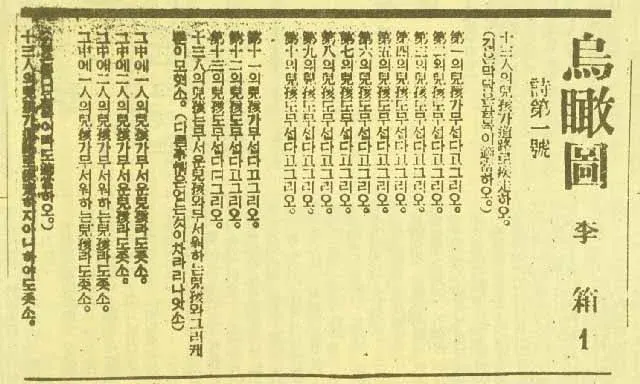 "Crow's-Eye View," Poem No. 1, in the Joseon Jungang Ilbo of July 24, 1934 · Public domain · Wikimedia Commons
Ahae means a child. The sentence that thirteen children run down the road is stuck together in a single block mixing Chinese characters and Hangul. A series poem is poetry that issues multiple numbered poems under a single title in a set, one after another. "Crow's-Eye View" was published in the newspaper bearing numbers like Poem No. 1 and Poem No. 2, and the pieces listed on the Wikisource "Crow's-Eye View" page run up to Poem No. 15.
Yi Sang is a pen name. One study views Kim Haegyeong, who worked as an architectural engineer for the Japanese Government-General of Korea and wrote poetry in Japanese, as having established a new literary face called "Yi Sang" through the serial poem "Crow's-Eye View," and counts "Crow's-Eye View" Poem No. 1 as the first work with which he announced his existence to the Joseon literary scene (DOI: 10.23296/minmun.2018..67.133).
This article takes a newspaper serialization from colonial Joseon and writes on it, relying on the abstracts of domestic and foreign research papers discussing that serialization and the poetry. The question is one: why did this serialization stop? Following that question, we meet two more things: the differing answers researchers offer to the question of what the "13" inside the poem is, and the question of whether the manuscript known to have been written in Yi Sang's own hand is truly his.
"The Newspaper Stopped" — The Research Record
How the serialization ended is recorded directly in an English-language paper's abstract published in 2016, upon which this article relies. When "Crow's-Eye View" was first serialized in a newspaper in 1934, Yi Sang's playfulness was misread as a meaningless repetition of symbols, taken as an insult to the readers, and the newspaper even stopped printing it before the poetry sequence was finished, the abstract notes (DOI: 10.1353/seo.2016.0004). In this sentence, the entity that stopped the serialization is the newspaper.
The same paper traces the cause of that reaction to it having been "misread." This assessment belongs to the author of that paper. Moreover, the abstract alone does not show from which primary record the fact that "the newspaper stopped" was taken. Documents such as a newspaper company's notice or an editor's testimony are not among the evidence this article relies upon.
That Yi Sang's experiments faced criticism also appears in domestic research. However, the subject addressed by that research is broader than the single serialization of "Crow's-Eye View." A 2006 study analyzing "Critical Condition," which can be called Yi Sang's final poetry sequence, notes that Yi Sang carried out his formal experiments and overall planning of poetry sequences "while braving the criticism of being abstruse." The same study views those experiments as an attempt to forge the modern structure and form of the Korean language through poetry, and assesses that while the experiments were at times unstable, they were original and expanded the possibilities of the Korean language in the 1930s (KCI ART001029007). This study also considers that the impression of Yi Sang's poetry being difficult has been inflated through the process of interpreting Japanese-language works and establishing posthumous drafts as definitive texts.
The English paper notes that "Crow's-Eye View" was regarded as an "insult" to readers, and domestic research records that there was "criticism of being abstruse" toward Yi Sang's experiments. How that criticism and the newspaper company's decision connected, or whether they did at all, cannot be known from the evidence this article relies upon.
"A Word from the Author" — Yi Sang's Side of the Matter
Yi Sang's side of the matter remains as well. At the end of the Wikisource page for "Crow's-Eye View" is a short piece called "A Word from the Author". It is recorded as a piece written by Yi Sang after the serialization stopped, though when and where it was published cannot be verified from the sources this article relies on. The piece opens like this, and two sentences later, it reads:
Why does everyone call me mad? Do we really mean to rest easy while lagging decades behind others? … I sweated to pick thirty pieces out of two thousand.
(Original: 왜 미쳤다고들 그러는지 대체 우리는 남보다 수십 년씩 떨어지고도 마음 놓고 지낼 작정이냐. … 이천 점에서 삼십 점을 고르는데 땀을 흘렸다.)
— Yi Sang, "A Word from the Author" (Wikisource page for "Crow's-Eye View")
This piece is said by the author himself about his own work. The speaker is the voice that speaks within the poem, and cannot be assumed to be the same person as the one who wrote the poem. The voice that says "It is said to be scary" is the speaker, but "A Word from the Author" is spoken directly by the author outside the poem. The distinction that the primer "Speaker and Point of View — "Hearken!": A Voice That Begs to Be Believed" covered is useful here. Even so, the author's own words do not show the whole situation. This piece reads "A Word from the Author" as Yi Sang's standpoint.
Confronting the people who called him mad, Yi Sang asks back whether we mean to idle away peacefully while lagging decades behind others. And he records that he sweated to pick 30 pieces out of 2,000. The poems listed on the Wikisource page number 15. The statement that he picked 30 pieces and the fact that 15 pieces were printed can only be placed side by side. The writing only notes that he "picked," and does not record that the newspaper and he arranged to print all 30 pieces.
The circumstances under which the serialization stopped appear in the following passage. The final line is a sentence near the end of the text after a paragraph break, so the space between has been shortened with "…".
From the work of '31 and '32 I set out the dragon's head, and with all the uproar I leave it there without even a rat's tail, let alone a snake's—it is a pity. Forgetting the stifling conditions of a newspaper was my mistake too, but I bow to my two brothers Yi Tae-jun and Park Tae-won for standing so stoutly on my side. … Never again like this—of course there will be some other way next time—for now I stop.
(Original: 31년 32년 일에서 용대가리를 딱 꺼내어 놓고 하도들 야단에 뱀 꼬랑지커녕 쥐꼬랑지도 못 달고 그냥 두니 서운하다. 깜박 신문이라는 답답한 조건을 잊어버린 것도 실수지만 이태준 박태원 두 형이 끔찍이도 편을 들어 준 데는 절한다. … 다시는 이런 ― 물론 다시는 무슨 다른 방도가 있을 것이고 우선 그만둔다.)
— Yi Sang, "A Word from the Author" (Wikisource page for "Crow's-Eye View")
"I set out the dragon's head and cannot attach even a rat's tail" twists the idiom yongdusami—a dragon's head and a snake's tail—which means grand at the start and fizzling out at the end. It means he laid out only the beginning and could not bring it to a close. As the circumstance for failing to close, Yi Sang writes "with all the uproar," and goes on to write that it "was" his mistake "too" to have forgotten the stifling conditions of a newspaper. The writing names no names as to who made an uproar. He is grateful that two people, the novelists Yi Tae-jun and Park Tae-won, took his side. And he writes that he "stops for now." What it is that he is stopping, that sentence leaves without an explicit object.
When you match the two records against each other, the subjects of the sentences differ. In the abstract of the English paper, the newspaper stops publishing it. In "A Word from the Author," Yi Sang writes that he "stops for now." The two do not strictly clash. The author may have written that after the newspaper stopped it, or the order may have been the other way around. The record to sort out that sequence is not present in the sources this article relies on.
One mark showing what the end of the serialization looked like also remains in the transcription. According to the Wikisource transcription, the serialization bears episode numbers from "Crow's-Eye View Yi Sang 1" to "9," and the final installment is marked as "Crow's-Eye View Yi Sang (Complete)." There are 10 installments in all, and the final installment bears the mark "Complete," meaning concluded. This is not a marking verified by comparison with the original newspaper. Following the transcription, the page printed the final installment as "Complete," and Yi Sang wrote in "A Word from the Author" that he was stopping. The abstract of the 2016 English paper records that the newspaper stopped publishing it before completion. This piece places the three records side by side, and does not amend or read one by means of the other two. What is present in the sources this article relies on regarding how the serialization ended is a single short piece by the author and one researcher's summary, the final installment in the Wikisource transcription bears the mark "Complete," and no record from the newspaper publisher's side exists.
The Person Who Stood Up for Him, A Circle That Saw Him as Immature
Among the two people whom "A Word from the Author" thanks, the name of Yi Tae-jun also appears in studies covering the 1930s literary circle the Nine-Person Association (Guinhoe). A 2017 study examining the relationship between Yi Sang and the Guinhoe summarizes that, according to existing research, the Guinhoe can be seen as three distinct groups: Kim Yu-yeong's Guinhoe, Yi Tae-jun's Guinhoe, and Yi Sang's Guinhoe. According to that study, "Yi Tae-jun's Guinhoe" did accept Yi Sang, but regarded his literature as "immature" or "abnormal," and Yi Sang was passively accepted into the group, lingering on its fringes. Yi Sang's literature began to be understood by the poet and critic Kim Kirim, who identified Yi Sang's poetry as an avant-garde of modernism, as that study notes (DOI: 10.23352/yisang..13.201712.95).
"A Word from the Author" counts Yi Tae-jun as someone who stood up for him, while this study records that the Yi Tae-jun faction of the Guinhoe viewed Yi Sang's literature as immature. These are two records with different textures. Based on this text, the two cannot be connected and explained, so they simply stand side by side. However, there are studies suggesting that the evaluations of Yi Sang's literature were layered even within the same paragraph, making it difficult to draw them as a single line of "readers versus Yi Sang."
What Can Be Counted in the Original Text
The reason the serialization stopped lacks sufficient records, but what a poem looks like can be counted directly from the original text. Following the first line and the bracketed sentence, Poem No. 1 continues like this:
The 1st child says it is scared. The 2nd child too says it is scared. The 3rd child too says it is scared.
(original: 第一의兒孩가무섭다고그리오. / 第二의兒孩도무섭다고그리오. / 第三의兒孩도무섭다고그리오.)
— Yi Sang, "Crow's-Eye View" (Ogamdo), Poem No. 1 (translated by Paperis)
The same sentence continues up to the 13th child, changing only the number. Counted from the Wikisource transcription, the phrase "says it is scared" appears 13 times and the character for "child" appears 26 times in a single version of Poem No. 1. The grouping "thirteen children" appears three times: in the first line, the middle, and the last line. Rhythm is the melody created when speech sounds repeat at regular intervals. The repetition we saw in "Rhythm in Poetry — Where the Breath Breaks on Its Own" is taken to an extreme here. With no spaces to mark where to pause, the same ending "…says it is scared" returns 13 times.
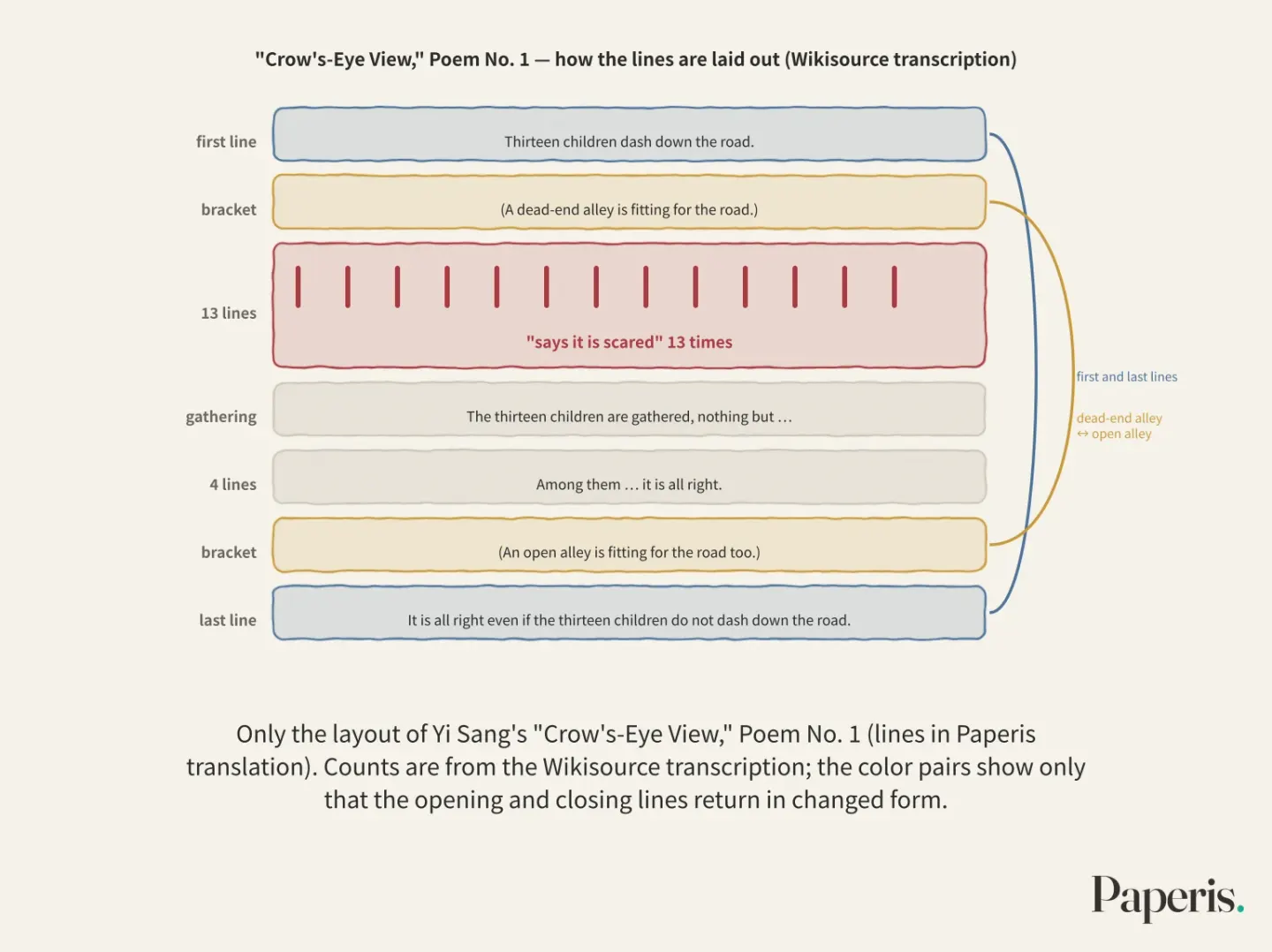
The repetitions are followed by a line stating that scary children and scared children are gathered, and then a line starting with "Among them" repeats four times. Its first line is "It is all right if, among them, one child is a scary child." And the poem ends like this:
(An open alley is fitting for the road too.) It is all right even if the thirteen children do not dash down the road.
(original: (길은뚤닌골목이라도適當하오.) / 十三人의兒孩가道路로疾走하지아니하야도좃소.)
— Yi Sang, "Crow's-Eye View" (Ogamdo), Poem No. 1 (translated by Paperis)
The opening bracket said that a "dead-end alley" was fitting, while the bracket near the end says that an "open alley" is fitting too. The first line said the children dash, while the final line says it is all right even if they do not dash. The two sentences from the beginning return at the end, each flipped in turn. That structure can be verified by anyone in the original text, and this article does not presume to determine its meaning.
A 2016 English paper points out that most critics have fixated only on decoding the content of "Crow's-Eye View," failing to ask why Yi Sang played with the form of the poetry itself (DOI: 10.1353/seo.2016.0004). The very form that the paper notes was read in 1934 as "meaningless repetition of signs" now remains as a structure that we can count in this way. The repetitions and brackets of Poem No. 1 can be counted in the original text, but what they mean cannot.
Five Approaches to Reading "13"
A 2013 domestic study analyzing Poem No. 1 notes at the outset that although various interpretations of the poem have been attempted, a precise fit does not yet seem to exist (KCI ART001783209). The five approaches below are ways "Thirteen children" or Poem No. 1 has been read in the sources this article relies upon. These are the readings of different researchers, and this article does not choose among them.
The first is a reading that connects the poem to French literature. Surrealism was an artistic movement that arose in France in the 1920s, seeking to draw expression from things that reason cannot govern, such as dreams and the unconscious. The aforementioned 2013 study analyzes the poem starting from its sentence structure, suggesting that it shares bloodlines with French surrealist literature. As one point of similarity, it cites an awakening to a special hallucination, such as the "13th hour" appearing in Nerval's poetry. The same study views Yi Sang's surrealism as having emerged through the romanticism of the magazine Ruins (Pyheo), where thirteen coterie members gathered, and also puts forward the possibility of Jean Cocteau's influence alongside a sociological interpretation (KCI ART001783209). In that study, the places where the two "13s" appear are passages discussing points of similarity with surrealism and the path that surrealism traversed.
The second is a reading that connects the poem to history. Allegory is a mode of expression that layers another meaning—often political or historical events—behind the apparent story. A 2008 study reading Park Tae-won's fiction and Yi Sang's "Crow's-Eye View" together suggests that both works deeply harbor the anarchistic activities and emotional resonance of the Heroic Corps of Joseon, an independence movement organization active in the 1920s. That study reads "Thirteen children" as an "unerased trace" of history, and views the dual-text character—differing on the surface and underneath—as a strategy chosen under strict censorship (KCI ART001301431).
The third is a reading that connects the poem to Eastern philosophy. A 2019 study that re-examined the title "Crow's-Eye View" and "13" understands "crow's-eye view (烏瞰)" as a gaze looking down upon the whole from outside human fixed perspective, equating this with concepts from Daoist philosophy. In that study, "13" embodies a temporal consciousness rather than a simple numerical concept, connecting with the cyclical and repetitive concept of time in Daoism. "Thirteen children" is read as entities attempting to gain infinite freedom and peace within a finite space so as to transcend death. This study expresses the hope that its findings will serve as the possibility of a new methodology for Yi Sang research, which has leaned heavily toward Western theory (DOI: 10.22143/HSS21.10.6.39).
The fourth is reading the poem within the flow of the entire series. A 2014 domestic study views each piece of "Crow's-Eye View" as a serial poem that stands on its own while successively building meaning. Nos. 1 through 6 attempt to escape the anxiety and terror of the modern world but fail to dismantle the firm subject, thereby diagnosing and recording the pathological symptoms experienced by the subject. Nos. 7 through 14 are a record of experiments attempting to escape that world and enter an artificial one, and the final No. 15 confirms that in those experiments both the actual ego and the artificial ego are dominated by the other. This study expresses regret that no works follow "Crow's-Eye View," leaving the subsequent exploration unseen (KCI ART001861926). According to this reading, Poem No. 1 is placed at the starting step of the path walked by the fifteen pieces.
The fifth is a reading that revisits the very obscurity of Poem No. 1. A 2026 study rereads the obscurity of Poem No. 1 through the concept of "disaster sensibility." According to that study, the reader attempts to interpret this poem by connecting cause and effect, only to experience that interpretation slipping away repeatedly, through which they belatedly reflect upon and feel the conditions of perception by which they have read the world. Therefore, this study concludes Yi Sang's obscurity not as a problem to be solved through interpretation, but as a performance that makes the reader doubt their own perception (DOI: 10.37123/th.2026.23.227).
If we reread the very same first line, (original: 十三人의兒孩가道路로疾走하오.), through these five lenses, it looks like this. In the first reading, this line is a sentence whose bloodlines touch French surrealism. In the second reading, the thirteen children are an "unerased trace" of history remaining within a series that deeply harbors the anarchistic activities of the Heroic Corps of Joseon, and that study puts forward this reading with the qualification "can be said to be." In the third reading, the thirteen children are entities seeking to gain infinite freedom and peace within a finite space, and that "13" is a cyclical and repetitive temporal consciousness. Following the fourth reading, this line is placed at the starting step of a fifteen-part series (this placement is this article's gloss). In the fifth reading, this line is a sentence that makes the reader attempt to connect cause and effect only to experience that interpretation slipping away. A 2014 study analyzing two English translations suggests that while Yi Sang's style can give the extreme impression of being excessively esoteric or meaningless wordplay, the meaning makes enough sense to translate if the translator understands the author's premise as a whole (KCI ART001900580). As to what "13" is, the studies this article relies upon do not converge on a single answer, and this article does not choose an answer either.
Whose Hand Wrote the Manuscript?
There is another layer to the history of a text: the question of where the letters of the "Crow's-Eye View" we read today came from. A holograph manuscript is a manuscript written directly in the author's own hand.
A 2019 study re-examined the manuscripts of "Crow's-Eye View" Poems No. 4, 5, and 6, which had been known as Yi Sang's holographs. These three pieces became known after being introduced as Yi Sang's own handwritten manuscripts in The Complete Works of Yi Sang (1977), edited by the literary critic Lee O-young. That study suggests that if they are Yi Sang's holographs, they would also hold significance as source texts. The study analyzed the paper the manuscripts were written on, the relationship between the "Work List Memo" found alongside them and The Selected Works of Yi Sang, and Kim Kirim's handwriting, concluding that these manuscripts were likely copied out by Kim Kirim. It explains that Kim Kirim appears to have copied the first-published texts to compile The Selected Works of Yi Sang (DOI: 10.22871/mklite.2019..58.008). A manuscript copy is something that someone has copied out by hand from an already existing piece of writing. Following this study's conclusion, that manuscript becomes a copy by Kim Kirim.
This conclusion is the textual scholarship of a single study. The study itself notes that the Injeong Literary Museum, which holds the manuscripts, should make the "Crow's-Eye View" holograph manuscripts public so they can undergo proper verification, and adds that even if the manuscripts are deemed not to be in Yi Sang's hand, characters like "某後左右" in Poem No. 5 leave room for considerable debate and remain a matter for further examination (DOI: 10.22871/mklite.2019..58.008).
This is not the only instance where a record bearing Yi Sang's name has been re-examined. In 2014, reports that a letter by Yi Sang had been unearthed appeared in various media outlets, but the exact same letter had already been introduced as a letter by Lee Hyun-wook back in 2001. Another study in 2019 notes that the letter was written on manuscript paper from a publishing house that opened in 1940 and bears a postmark dated December 26, 1940, on the envelope, leading it to conclude that Yi Sang, who passed away in 1937, could not have written it. Judging the signature, handwriting, and style to be far from Yi Sang's, it concludes that it is appropriate to view this letter as one by Lee Hyun-wook. The study notes that the contents of the letter convey the relationship between Lee Hyun-wook and the novelist Choi Jung-hee, and records that Lee Hyun-wook was none other than the novelist Ji Ha-ryeon (DOI: 10.22784/eomun.2019..81.147).
What these two pieces of textual scholarship leave the reader with is the same kind of caution found in the story of how the serialization of "Crow's-Eye View" was halted: that some of the manuscripts and letters known to be Yi Sang's were later re-examined.
What We Do Not Yet Know
Several questions remain that cannot be answered by the evidence this article relies upon.
The article's evidence does not state when or where "A Word from the Author" was published. Knowing the circumstances of its publication would allow us to tell whether the piece was a reaction immediately after the suspension of serialization or a later recollection.
Nor can we know what happened inside the newspaper office. A 2016 English paper states that the newspaper stopped the serialization, but the primary record that served as its evidence does not appear in the abstract. The evidence this article relies upon also does not explain under what circumstances the character "Complete" (完) was stamped on the final installment of the transmission manuscript. "A Word from the Author" does not reveal whose uproar the phrase "with all the uproar" refers to.
We also do not know what occurred between the statement of picking 30 pieces out of 2,000 and the fact that 15 pieces were published. The evidence this article relies upon does not state that there was ever a plan to publish 30 pieces.
Judgments surrounding manuscripts known to be in Yi Sang's own hand await the public release and verification of those manuscripts. And as for the number "13," as a 2013 study notes, a neat, definitive interpretation does not yet seem to exist (KCI ART001783209).
What Have We Learned
In the summer of 1934, a daily newspaper published a series of poems without spacing, and fifteen poems up to Poem No. 15 remain in the Wikisource transcription. There are three records that this article relies on regarding how the serialization ended. Yi Sang's side writes in "A Word from the Author" that he could not finish because of "all the uproar" and "for now I stop," the abstract of an English paper records that the newspaper stopped printing them before completion, and the final installment in the Wikisource transcription bears the word "The End" (完). Records from the newspaper side to bridge that gap are not in the sources this article relies on.
The poem's structure can be counted directly from the original text. "Says it is scared" is repeated thirteen times, a dead-end alley changes to an open alley, and dashing changes to being all right even if they do not dash. What that structure means—especially what "13" is—is read differently by each study as surrealism, a historical allegory, Daoist time, the flow of the series, or a device that shakes interpretation itself.
Yi Sang wrote in "A Word from the Author" that he set out only the dragon's head and could not attach its tail. Regarding this serialization today, the remaining records and studies take a similar shape. The beginning remains clear, and how the end was tied up is recorded differently in each account.
Source Papers
- "Textual Evidence and Authentication of Yi Sang's 'Autograph Manuscripts'—Focusing on 'Crow's-Eye View'" (2019) — DOI: 10.22871/mklite.2019..58.008 — Concludes that the manuscripts of "Crow's-Eye View" Poems Nos. 4, 5, and 6 introduced in Complete Works of Yi Sang (1977) in his own hand are Kim Kirim's copies of the first published versions for Selected Works of Yi Sang, based on an analysis of paper, notes, and handwriting. It demands that the holding repository release and verify the manuscripts, noting that some character issues remain.
- "The Mirror Motif in the Crow’s-Eye View (Ogamdo) Poems" (2016) — DOI: 10.1353/seo.2016.0004 — Notes that at the time of its 1934 serialization, Yi Sang's playfulness was read as the meaningless repetition of signs and an insult to readers, leading the newspaper to stop publishing it before completion. It points out that criticism has remained mired in decoding meaning while ignoring formal play, and analyzes the mirror motif and the theme of entrapment.
- "A Reading of Yi Sang’s “Crow’s-Eye View (Ogamdo)” “Poem No. 1” Along with Its Literary-Historical Context" (2013) — KCI ART001783209 — Considers that no neat interpretation yet exists and analyzes the syntactic structure first. It reads the work through the possible influence of Cocteau, sociological interpretation, connections with French surrealism such as Apollinaire and Nerval (the 13th time slot), and surrealism via the Ruins coterie.
- "Kyongsong Modernism and Historical Allegory: Reading “A Day in the Life of Novelist Kubo” and “Crow’s-Eye View Poem No. 1”" (2008) — KCI ART001301431 — Reads Park Tae-won and Yi Sang's serial works in a political and historical context as harboring the anarchist exploits of the Heroic Corps, viewing "the 13 children" as an undeleted trace of history and the double text as a potential strategy under censorship.
- "Yi Sang’s Serial Poem “Critical Condition” and Korean Language Experiments" (2006) — KCI ART001029007 — Considers that the obscurity of Yi Sang's poetry has been overinterpreted in the process of analyzing Japanese-language works and finalizing posthumous manuscripts, and evaluates his formal experiments and serial poetry planning—braving accusations of obscurity—as an attempt conscious of the task of modernizing Korean poetry.
- "“Crow’s-Eye View Poem No. 1” and the Duality of the Persona Named Yi Sang: Reading Yi Sang's Poetry as a Multidimensional Bird's-Eye View of Colonial Modern Spacetime" (2018) — DOI: 10.23296/minmun.2018..67.133 — Considers that architectural engineer and Japanese-language poet Kim Hae-kyung established the persona of Yi Sang through "Crow's-Eye View," viewing Poem No. 1 as the first work by which Yi Sang announced his presence to the Korean literary scene.
- "An Interpretation of “Crow’s-Eye View” as a Serial Poem" (2014) — KCI ART001861926 — Reads "Crow's-Eye View" as a serial poem that builds meaning sequentially, following the flow of Nos. 1–6, Nos. 7–14, and No. 15. It records the regret left by the absence of subsequent works.
- "Textual Evidence and Authentication of Yi Sang's 'Autograph Manuscripts'—Focusing on Letters" (2019) — DOI: 10.22784/eomun.2019..81.147 — Concludes that a letter reported in 2014 as being by Yi Sang cannot belong to Yi Sang, who died in 1937, judging by the 1940 manuscript paper and the December 26, 1940 postmark, and that it is properly seen as a letter by Yi Hyun-wook (Jiharyeon).
- "Disaster-Sensibility in Yi Sang's “Ogamdo-Poem No. 1”: Statement Structure and the Collapse of Cognitive Conditions" (2026) — DOI: 10.37123/th.2026.23.227 — Re-reads the obscurity of Poem No. 1 as a disaster-sensibility, concluding that it is a performance where the reader makes repeated attempts at causal interpretation and experiences their withdrawal, thereby feeling the conditions of self-awareness.
- "Yi Sang and the Nine-Member Society (Guin-hoe)" (2017) — DOI: 10.23352/yisang..13.201712.95 — Divides the Nine-Member Society into three parts, summarizing that Yi Tae-jun's faction accepted Yi Sang but regarded his literature as immature and abnormal, whereas Kim Kirim understood Yi Sang's poetry as a modernist avant-garde.
- "A Reconsideration of the Titles “Crow’s-Eye View (Ogamdo)” and the Meaning of “13” in “Crow’s-Eye View Poem No. 1”" (2019) — DOI: 10.22143/HSS21.10.6.39 — Reads “Crow’s-Eye” as a gaze surveying the whole, “13” as a temporal consciousness touching upon the Daoist cyclical concept of time, and “the 13 children” as beings trying to gain infinite freedom within a finite space.
- "Translating the desire for escape from the past: An analysis of two English translations of Yi Sang’s “Ogamdo”" (2014) — KCI ART001900580 — Analyzes two 21st-century English translations and suggests that while Yi Sang's style may give the impression of being obscure or meaningless wordplay, once the author's premise is understood, it makes enough sense to be translated.
Sources (7)
- 이상 ‘육필 원고’의 진위 여부 고증(考證)-「오감도」를 중심으로DOI 10.22871/mklite.2019..58.008
- The Mirror Motif in the Crow’s-Eye View (Ogamdo) PoemsDOI 10.1353/seo.2016.0004
- 「오감도 시 제1호」와 이상(李箱)이라는 페르소나의 이중성 식민지 근대 시공간의 다차원적 조감도로서 이상 시 읽기DOI 10.23296/minmun.2018..67.133
- 이상 ‘육필 원고’의 진위 여부 고증(考證) - 편지를 중심으로DOI 10.22784/eomun.2019..81.147
- Disaster-Sensibility in Yi Sang'sDOI 10.37123/th.2026.23.227
- 이상과 구인회(九人會)DOI 10.23352/yisang..13.201712.95
- 「오감도 시제1호」의 시제(詩題) ‘오감도(烏瞰圖)’와 ‘13’의 의미 재고(再考)DOI 10.22143/hss21.10.6.39