Paperis Articles
Hamlet — Is That the Question, or Is Here the Point?
The first line of the same soliloquy differs between the 1603 and 1623 printings. Why Hamlet survives as three books — what research has settled, and what it still argues over.
Your field's papers, as audio
Pick your fields and journals — Paperis summarizes the key papers and turns them into audio. Listen on your commute.
Start Paperis free →Hamlet — Is That the Question, or Is Here the Point?
1603, "Ay, there's the point"
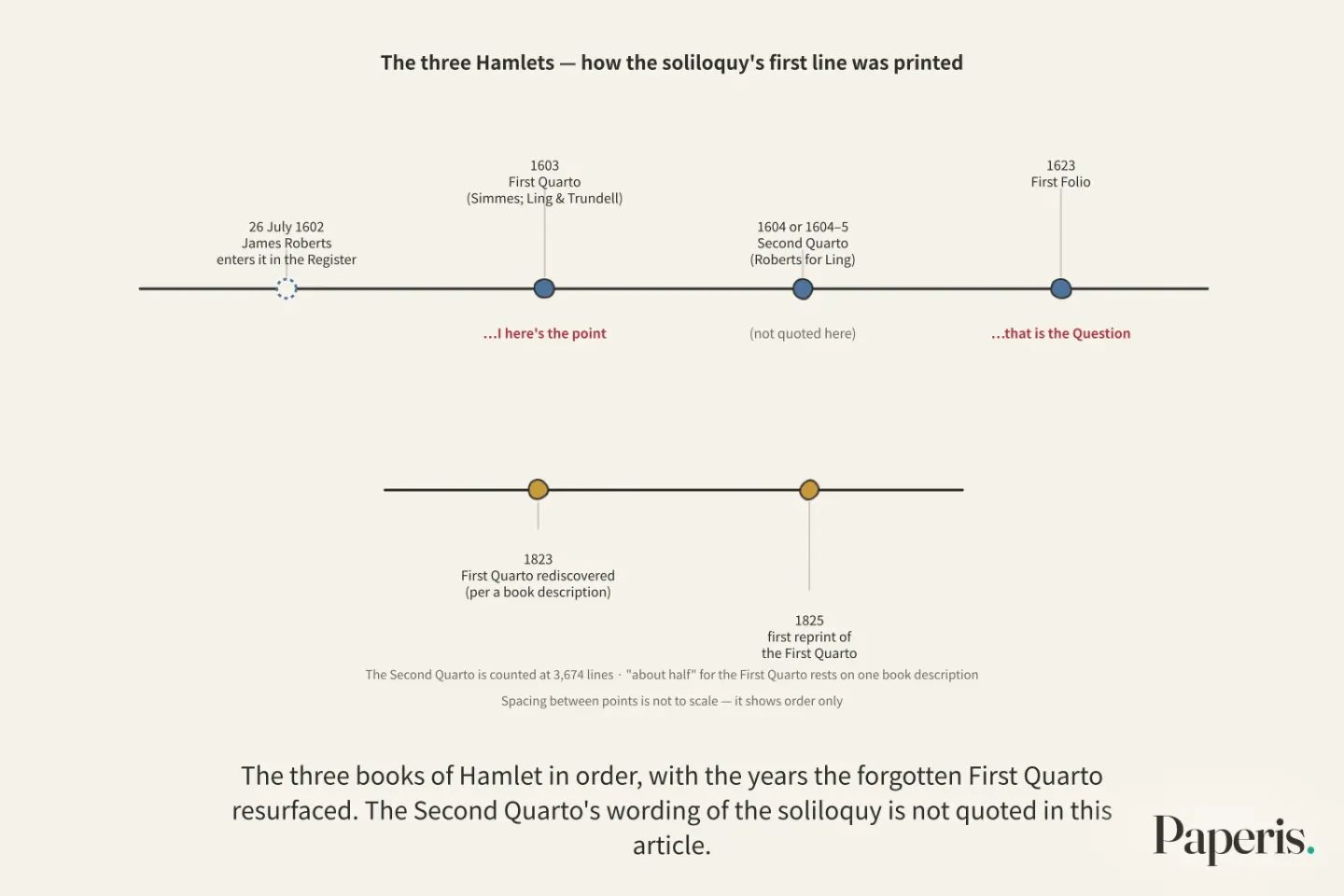
Hamlet is a tragedy by the English playwright William Shakespeare. It was written in English, and its protagonist is Hamlet, the Prince of Denmark. This play does not come down to us as a single book. It was printed in three different books between 1603 and 1623, and all three differ in length and wording (DOI: 10.1086/704576; DOI: 10.31857/s1605788024040056). The first two books are quartos, and the third is a folio. A quarto is a small book made by folding a large sheet of paper twice to make four leaves, or eight pages. Hence, the 1603 edition is called the First Quarto, and the subsequent edition the Second Quarto. The year of the Second Quarto is recorded as 1604 or 1604–1605 depending on the evidence (DOI: 10.1086/704576; DOI: 10.1057/9781137024763_4). A folio is a large book made by folding paper only once. The First Folio is the first collected edition of Shakespeare's plays, published in 1623, seven years after his death. The third book of Hamlet is the text published in this collection.
Even the first line of the most famous soliloquy is different. First is the book printed initially in 1603.
To be, or not to be, I here's the point, To Die, to sleepe, is that all? I all: No, to sleepe, to dreame, I mary there it goes, — William Shakespeare, Hamlet, First Quarto (1603)
Here, "I" is today's "Ay," meaning "yes." That "yes" appears three times in three lines. In the book printed twenty years later, the same passage looks like this.
To be, or not to be, that is the Question: Whether 'tis Nobler in the minde to suffer The Slings and Arrowes of outragious Fortune, — William Shakespeare, Hamlet, First Folio (1623)
The "that is the question" that we know comes from this version.
Thus, there are two questions. Why are there three versions, and what is the 1603 edition with such a different first line? The answers come from the surviving books themselves and from the scholarship that has read them. At the end, we also add a story about the 1603 edition coming to the Korean stage.
How Three Books Came to Be
Some records survive of how the books came to be published. On July 26, 1602, the London stationer James Roberts entered the right to publish Hamlet in the Stationers' Register. The following year in 1603, the short First Quarto appeared, printed by Valentine Simmes and published by Nicholas Ling and John Trundell. The Second Quarto followed as a much longer text, printed by Roberts himself for Ling (DOI: 10.1086/704576). The title page of the surviving First Quarto also bears a line stating it was printed in London in 1603 for N.L. and John Trundell, with the author's name printed as "Shake-speare". Shakespeare scholar John Jowett calls these facts of registration and printing an "island of certainty" in a field full of uncertainty and dispute (DOI: 10.1086/704576).
The difference in length is substantial. According to the introduction of an edition compiled for students, researchers, and actors, the First Quarto is roughly half the length of the Second Quarto and the Folio text, rearranges or combines plot sequences, and contains a scene between Horatio and the Queen that appears only in this edition (DOI: 10.1017/9781316563915). The Second Quarto is counted at 3,674 lines (DOI: 10.5325/tpnc.1.1.0111).
The names of the characters also differ. Counting directly from the original transcriptions for this article, the 1603 edition uses the name "Corambis" 12 times and never uses "Polonius", whereas the 1623 Folio text does the reverse, using "Polonius" 20 times and never "Corambis" (counts exclude the speech prefixes "Cor." and "Pol."). The stage directions differ as well. The 1603 edition specifies that Ophelia enters playing a lute with her hair unbound and singing, the Second Quarto states simply that she enters, and the 1623 edition records that she enters distracted. Some studies read this lute as a symbol of another Ophelia revealed throughout the 1603 edition—a more resourceful, spirited figure who responds lucidly to her situation (DOI: 10.1057/9781137024763_4).
This First Quarto was forgotten for a long time. According to the introduction to one book, Sir Henry Bunbury discovered a loosely bound volume of twelve Shakespeare plays in his family closet in 1823, which contained a copy of Hamlet unknown until then (DOI: 10.9783/9780812290394). The same introduction calls this edition "both the first Hamlet and the last Hamlet", and notes that the reception of the text depended entirely on this temporal mismatch, having become widely known only after the familiar Hamlet had ascended to the pinnacle of English literature (DOI: 10.9783/9780812290394).
How It Got the Name "Bad"
Two years after it reappeared, the explanations split in two. In 1825, the antiquarian publishers John Thomas Payne and Henry Foss reprinted the edition for the first time, promoting it as Hamlet "as first printed by Shakespeare" (DOI: 10.1086/704576). In December of the same year, an article published in a magazine under the pseudonym "Ambrose Gwinnett" first proposed the explanation that this edition was a text transmitted by watching and listening to performances (DOI: 10.1093/notesj/gjaf066). The view that it was "as first printed by Shakespeare" continued to find occasional support thereafter (DOI: 10.1086/704576).
Entering the 20th century, the other explanation became the foundation of editing. New bibliography is a research trend from the early 20th century in which scholars like W. W. Greg, R. B. McKerrow, and A. W. Pollard attempted to bring a scientific attitude to the examination and compilation of early playbooks. This trend brought major advances in bibliographical knowledge while also producing more speculative ideas. Among them were the division of early playbooks into "good" quartos and "bad" quartos, and the explanation of memorial reconstruction (DOI: 10.1017/9781108936927.013). A bad quarto is a name given by 20th-century bibliographers to certain quartos that they believed were printed through corrupted channels rather than as Shakespeare wrote them. The person who first used that name was the bibliographer A. W. Pollard (DOI: 10.1353/shb.2018.0061).
Memorial reconstruction is the explanation that actors who performed in the play or audience members who watched it gathered the lines they remembered to reconstruct the text. There is also primary source material that this explanation relies upon. In the preface to the 1623 Folio, John Heminges and Henry Condell condemned earlier circulating editions as stolen and surreptitiously issued copies, and as early 20th-century critics took these words seriously, a narrative took hold viewing, for example, the short quarto of Henry V as a text produced through unauthorized channels such as piracy and memorial reconstruction (DOI: 10.1353/shb.2018.0061). The evidence this writing relies on does not contain a sentence pointing specifically to the First Quarto of Hamlet. Shorthand stories also come from the same era. The contemporary playwright Thomas Heywood complained that one of his plays had been transcribed by shorthand at the theater and printed as a botched text (DOI: 10.1086/704576). This is a story about Heywood's play and is not testimony regarding Hamlet.
A review of a 1985 production staging the 1603 edition at the Orange Tree Theatre in Richmond, near London, notes that this edition is called a "bad" quarto because it appears to derive from an unauthorized text that actors from Shakespeare's company may have pieced together from memory. The same writing adds that this edition may contain revisions made by the company for performance and provides information about early performances (DOI: 10.1093/oso/9780198711773.003.0072). As Jowett's overview notes, for many critics the First Quarto is a low-quality text that underwent messy transmission, such as memorial reconstruction by actors (DOI: 10.1086/704576).
Names Re-examined
In 1996, 41 Shakespeare-era play texts that had been classified as "bad quartos" or memorial reconstructions were all re-examined in a single book. This is a book by researcher Laurie Maguire. According to the book's description, it dismantles the theories of Greg and the scholars who followed him, and examines the methods critics have used to diagnose texts as "bad" and the historical evidence for memorial reconstruction (DOI: 10.1017/cbo9780511553134). A chapter from 2021 summarizes that while the New Bibliography's distinction between good and bad quartos and memorial reconstruction became controversial in the long run, it served as the foundation of early play-editing techniques over the past century (DOI: 10.1017/9781108936927.013). That it became controversial and that it still serves as a foundation exist together in a single sentence.
Subsequent research splits into at least three directions. The first views the 1603 edition as Shakespeare's own earlier version. As Jowett reports, researcher Terry Bourus argued in 2014 that the First Quarto contains a version written by Shakespeare in 1589 (DOI: 10.1086/704576). A 2019 paper views the First Quarto as the author's rough draft before it became a censored performance script, and counts 577 lines where the text differs while matching up with the Second Quarto (DOI: 10.3167/cs.2019.31010212). A 2012 study that compares the two quartos in three ways with François de Belleforest's Histoires Tragiques, a major source for the Hamlet story, suggests that the short First Quarto borrowed more heavily from the source in proportion, and that certain borrowings grew from the source through the First Quarto into the Second Quarto, pointing to the view that the First Quarto comes first (DOI: 10.1353/pgn.2012.0016).
The second views the 1603 edition as a scrambled text from the early 1600s. In a 2019 paper, Jowett argues that Hamlet's reprimand regarding the "robustious periwig-pated fellow," a passage found only in the First Quarto, is writing from 1602 rather than the 1580s and was not written by Shakespeare. The result of counting and comparing word clusters leads him to view it as closer to Heywood. Jowett himself states that this result does not address the entire origin of the First Quarto, yet notes that it aligns with other arguments viewing the First Quarto as a scrambled text from the early 1600s rather than an original version from the late 1580s (DOI: 10.1086/704576). Bourus and Jowett offer opposing answers to the same question: when and from whose hand did the First Quarto emerge?
The third connects the text to performance. A 2019 article views the First Quarto as a text deserving of recognition, believing it to be a kind of time capsule capturing what the actors actually performed rather than the poet's complex verse (DOI: 10.3167/cs.2019.31010203). Behind this idea lies a larger debate: whether Shakespeare's company cut long plays down to about two hours for performance. A 2012 paper considers that scholars such as Lukas Erne, Steven Mullaney, and Andrew Gurr built persuasive (though not decisive) arguments that acting companies generally put on two-hour texts and that the "bad quartos" of some plays are closer to actual performance lengths (DOI: 10.1353/shb.2012.0029). Another paper from the same year considers such a two-hour theory completely wrong and releases records casting substantial doubt on the assumption of a two-hour limit (DOI: 10.1353/shb.2012.0057). A 2024 counter-argument calculates that performing the Second Quarto's 3,674 lines at 1,200 lines per hour would take about 3 hours and 4 minutes, and suggests that long plays were generally cut for performance in outdoor theaters (DOI: 10.5325/tpnc.1.1.0111). This debate concerns the running time of long plays in general and does not in itself yield the answer that the First Quarto is an abridgment.
Some studies are difficult to place in any of these three branches. A 2006 paper argues that revisions between editions show a consistent pattern, opposing the explanations of memorial reconstruction and abridgment, and attributes those revisions to the author's rewriting. The abstract of this paper does not go so far as to state which edition came first (DOI: 10.2979/tex.2006.1.2.60).
Clues surrounding earlier editions and dating are also matters of dispute. The writer Thomas Nashe linked an earlier edition of this play to the remark that it contains "many good sentences" (DOI: 10.1093/oso/9780192868497.003.0007). There are multiple explanations concerning what that earlier edition was. According to a book's introduction, the First Quarto has been pronounced a rough draft, a shorthand pirated text, a memorial reconstruction, and a lost Hamlet that supposedly existed before Shakespeare (DOI: 10.9783/9780812290394). The author of a 1927 paper wrote that the lost old play is commonly attributed to the dramatist Kyd and that they consider this attribution correct, yet countered that the belief that a substantial portion of that play survives in the un-Shakespearean verse of the First Quarto relies on an impossible theory of creation (DOI: 10.2307/457399). A 2019 paper considers that among 15 word links connecting a play list to the First Quarto, the connection with the play Dido, Queen of Carthage is most problematic for establishing a 1588–1589 date, and presents new evidence casting doubt on that connection by re-examining the overlap most commonly cited between the two plays (DOI: 10.3167/cs.2019.31010209).
The same explanation has been put to the test with other plays. A 1996 chapter introduces the view that the Romeo and Juliet First Quarto is a memorial reconstruction as the established doctrine up to that time and re-examines its foundation (DOI: 10.1017/ccol0521570476.003). A 2019 study comparing the relative pronouns of two editions of Richard III concludes that the differences cannot be explained by memorial reconstruction (DOI: 10.7311/0860-5734.28.2.04). This is the result for a play other than Hamlet and does not carry over unchanged and apply to the Hamlet First Quarto. It does, however, show that the same explanation is being re-examined across multiple plays.
What the 1603 edition is has not yet been settled, and the "bad quarto" is a single explanation that served as the foundation of 20th-century editing. The introduction to a 2022 essay collection notes that the reason this edition is treated as an increasingly important text is not because there is a consensus on what it is, but because a growing number of Shakespeare scholars agree that it is worth arguing over (DOI: 10.3167/9781800735538).
The Editor's Choices
In modern edited editions of Hamlet, there are places where the editor has chosen between texts. A 2024 Russian paper notes that in the two places it examined, modern edited editions generally follow the Folio instead of the Second Quarto, and argues that both places should follow the Second Quarto (DOI: 10.31857/s1605788024040056). A 2019 paper views the Second Quarto and the Folio as two substantially yet differently substantial pieces of evidence, and considers that editors should turn readers' eyes to meaningful differences (DOI: 10.4000/variants.1002). The fencing dialogue between Claudius and Laertes that was in the Second Quarto disappeared in the Folio, and famous editors have explained that it was removed to fit the meter or cut intentionally to make the play faster. A short 2025 paper puts forward the hypothesis that James I's campaign against dueling may have influenced this, while stating itself that there is no direct and decisive evidence for that hypothesis (DOI: 10.1093/notesj/gjaf101).
Editing that mixes texts has a name. Eclectic editing mixes sentences from multiple editions within a single text, creating a text that does not exist as such in any single edition. According to a 2026 chapter, Shakespearean editing became more academic and systematic in the 18th century, the era of editors such as Nicholas Rowe, Alexander Pope, Lewis Theobald, Samuel Johnson, Edward Capell, Edmond Malone, and James Boswell (DOI: 10.4324/9781003591832-3). The same chapter sees a paradox in the attempt to make a new edition and establish a single original Hamlet (DOI: 10.4324/9781003591832-3).
There are also editions that try to move away from eclectic editing, and disputes that have taken place over those editions. According to a 1993 paper, Stanley Wells, one of the editors of the Oxford Shakespeare, defended his edition by stating that it broke away from traditional eclectic editing. This paper points out that editorial intervention and mixing were still used consistently in that edition as well, and argues that instead of trying to reconstruct an "authoritative" text, each old edition on its own is closest to the collaboration of the theater company in Shakespeare's time (DOI: 10.1017/s0266464x00007764). A 2024 paper reads a single line of Horatio's found only in the Second Quarto in the first scene, and considers that when read apart without mixing texts, it becomes visible that the first scene of the Second Quarto places more emphasis on interiority (DOI: 10.4000/11njc). There are also books that publish the texts separately altogether. A lecture guide cites the Arden Shakespeare series' release of a three-text Hamlet in two volumes in 2006, with one of them published separately as The Texts of 1603 and 1623, as a good example of multiple-text editing (DOI: 10.1111/j.1741-4113.2008.00536.x).
The "to be, or not to be" of commonly read books is the same as the line printed in the 1623 Folio. In commonly read modern edited editions of Hamlet, there are places where the editor has chosen between the Second Quarto and the Folio, and there are also books that publish the texts separately.
Readers Who Stage and Read the 1603 Edition Separately
In 1881, the director William Poel selected the 1603 edition and staged it at St George's Hall. Most contemporary accounts dismissed it as a flawed attempt ruined by amateur actors. Today, this production is revisited as a pioneering performance of that edition (DOI: 10.1057/9781403913661_2). The 1985 Orange Tree Theatre production we saw earlier also belongs to that current (DOI: 10.1093/oso/9780198711773.003.0072).
It has been staged on Korean soil as well. The 2009 production "Hamlet Q1" by Lee Hyon-u was the first time the First Quarto was brought to the stage in Korea. A 2017 paper discussing this production notes that it shifted away from the melancholic Hamlet that Korean stages had often portrayed through a shamanistic framework, moving instead toward the unusually proactive Hamlet drawn by the 1603 edition, and introduced student audiences to the idea of "a play with multiple texts" (DOI: 10.1353/atj.2017.0031).
It is also read separately in book form. In 1998, an edition compiling the First Quarto in modern spelling was published for students, researchers, and actors (DOI: 10.1017/9781316563915). There is also the separate volume from the Arden Shakespeare series we saw earlier. A 2017 paper reads the spelling, type, and layout of the 1603 edition as creating meaning in their own right (DOI: 10.12745/et.21.1.3189).
What We Still Do Not Know
The biggest question remains. Whether the 1603 edition is an earlier version by Shakespeare, a text scrambled through performance, or a mix of both brings different answers from different researchers. Jowett also wrote that a single paper cannot solve that entire question (DOI: 10.1086/704576). It is not settled whether theater companies cut down long plays for the stage, and papers arguing that side note that we can never know for certain what those old performance texts were like (DOI: 10.1353/shb.2012.0029).
What stage directions found in only one edition tell us also requires caution. The 1603 edition notes in a scene with Queen Gertrude that the ghost enters in a nightgown, while the other two editions do not specify this attire. A 2026 paper examining this difference concludes that the direction neither establishes Shakespeare's final intention nor the costumes of every early performance, and is best viewed as an important possibility for performance preserved in a single edition (DOI: 10.1080/0895769x.2026.2763704). The question of authorship is not the subject of this article. That dispute is covered in "The Shakespeare Authorship Question — Was the Swan of Avon Alone?".
Reading Between Three Books
We take three things with us. Hamlet survives in three books: the First Quarto, the Second Quarto, and the 1623 Folio, and from the very first line of its most famous soliloquy, it splits between "That is the point" and "That is the question." The explanation that views the short 1603 edition as a "bad quarto" and the result of actors' memorial reconstruction became the foundation of 20th-century editing, and today researchers are re-examining that explanation, with some studying it as Shakespeare's earlier draft and others as a corrupted text from the early 1600s, while others connect it to performance. Furthermore, in the modern edited versions we commonly read, there are places where the editor chose between the Second Quarto and the Folio, and there are those who compile and read or stage the 1603 edition separately.
What comes after "To be, or not to be" depends on which book you open.
Source Papers
- "Whose Hamlet Mocks the Warm Clown?" (2019) — DOI: 10.1086/704576 — Registered by Roberts on July 26, 1602; Q1 printed by Sims, Ling, and Trundle in 1603; Q2 by Roberts and Ling in 1604–1605. Many critics view Q1 as a text that underwent memorial reconstruction, while others doubt this. The 1825 Payne and Foss reprint The First Edition of Hamlet, and Burrows in 2014, argue for a 1589 edition. The argument that the "warm clown" passage is a writing from 1602 not by Shakespeare (closer to Heywood) aligns with viewing Q1 as a disordered text from the early 1600s. Cites Heywood's complaint about shorthand.
- "The First Quarto of Hamlet" (1998) — DOI: 10.1017/9781316563915 — (Book introduction) Q1 is about half the length of Q2 and F, features rearranged order, unique scenes for Horatio and the Queen, and serves as a modernized edition for students, researchers, and actors.
- "A Response to Steven Urkowitz and Michael J. Hirrel" (2024) — DOI: 10.5325/tpnc.1.1.0111 — Q2 has 3,674 lines; at 1,200 lines per hour, this equals about 3 hours and 4 minutes. Takes the position that long plays were shortened in performance.
- "Enter Ofelia playing on a Lute" (2014) — DOI: 10.1057/9781137024763_4 — Compares stage directions for Ophelia in Q1, Q2, and F; reads Q1's Ophelia as a bolder figure with clearer self-expression.
- ""Hamlet" After Q1: An Uncanny History of the Shakespearean Text" (2014) — DOI: 10.9783/9780812290394 — (Book introduction) Bunbury's 1823 discovery, various declarations viewing Q1 as a rough draft, shorthand pirated text, memorial reconstruction, or pre-Shakespearean version; its acceptance depends on whether it became known after familiar editions reached their peak.
- "Thomas Frognall Dibdin as Ambrose Gunthio, Author of 'A Running Commentary on the Hamlet of 1603' (1825)" (2025) — DOI: 10.1093/notesj/gjaf066 — (Short note) A pseudonymously authored piece from December 1825 offering the earliest argument viewing Q1 as a text transcribed from performance.
- "The New Bibliography" (2021) — DOI: 10.1017/9781108936927.013 — Greg, McKerrow, and Pollard, adopting a scientific attitude. Good/bad quartos and memorial reconstruction were debated long-term but served as the foundation of editorial technique for a century.
- "The Distribution and Ordering of Speeches and Shakespearean Revision" (2018) — DOI: 10.1353/shb.2018.0061 — Pollard first introduced the "bad quarto," and early 20th-century critics took Heminge and Condell's condemnation of a "stolen and surreptitious copy" seriously (in the context of discussing Henry V).
- "[March 1985], Nicholas Shrimpton … on a production of the First Quarto version of Hamlet at the Orange Tree Theatre" (1997, essay from 1987) — DOI: 10.1093/oso/9780198711773.003.0072 — (Review of a production) Why it is called "bad" (an unauthorized text potentially pieced together from actors' memories); its literary quality is much lower, but it may contain performance revisions and early staging information.
- "Shakespearean Suspect Texts: The 'Bad' Quartos and their Contexts" (1996) — DOI: 10.1017/cbo9780511553134 — (Book introduction) Exhaustive review of 41 suspect texts, dismantling Greg's theory and examining methods of diagnosing "badness" alongside historical evidence for memorial reconstruction.
- "Q1 Hamlet" (2019) — DOI: 10.3167/cs.2019.31010212 — Views Q1 as an authorial early draft prior to the text that passed the censor, corresponding to Q2 but featuring 577 different lines.
- "Hamlet and the French Connection" (2012) — DOI: 10.1353/pgn.2012.0016 — Three-way comparison with Belleforest, showing Q1 borrows proportionally more, suggesting borrowing flows source → Q1 → Q2, implying Q1 comes first.
- "Now, Gods, Stand Up For Bastards: The 1603 'Good Quarto' Hamlet" (2006) — DOI: 10.2979/tex.2006.1.2.60 — Consistent patterns of revision between editions; opposes memorial reconstruction and abridgment theories, attributing variations to authorial rewriting.
- "The Hybrid Hamlet" (2019) — DOI: 10.3167/cs.2019.31010203 — (Practitioner's essay) Views Q1 as a time capsule of what actors actually performed.
- ""This is too long": A Historically-Based Argument for Aggressively Editing Shakespeare in Performance" (2012) — DOI: 10.1353/shb.2012.0029 — Evaluates arguments by Urkowitz, Orgel, and Gurr that two-hour performances are persuasive but inconclusive, noting that the "bad quarto" is closer to performance length. The original performance text cannot be known with certainty.
- "Did Shakespeare's Company Cut Long Plays Down to Two Hours Playing Time?" (2012) — DOI: 10.1353/shb.2012.0057 — The two-hour theory is completely wrong; long plays were generally performed at nearly full length.
- "Hamlet's Book" (2023) — DOI: 10.1093/oso/9780192868497.003.0007 — Nashe links an earlier version of Hamlet with "many good sentences" (in the context of the sententia tradition).
- "Thomas Kyd and the First Quarto of Hamlet" (1927) — DOI: 10.2307/457399 — Attributing the lost play to Kyd is "frequently, and in the author's view correctly" accepted, while the belief that that play survives in Q1's non-Shakespearean verse is refuted as an impossible theory.
- "Shakespeare, Virgil and the First Hamlet" (2019) — DOI: 10.3167/cs.2019.31010209 — Re-examines overlaps with Dido, used for dating to 1588–1589, and questions the connection.
- "The 'Bad' Quarto of Romeo and Juliet" (1996) — DOI: 10.1017/ccol0521570476.003 — Introduces the memorial reconstruction theory for Romeo and Juliet Q1 as the established consensus of the time, while re-evaluating its basis.
- "The Choice of Relative Pronouns in the First Quarto and First Folio Texts of Shakespeare's Richard III" (2019) — DOI: 10.7311/0860-5734.28.2.04 — Differences in relative pronouns cannot be explained by memorial reconstruction.
- "Shakespeare and the First Hamlet" (2022) — DOI: 10.3167/9781800735538 — (Essay collection introduction) Q1 is a cheap 1603 book that has grown in importance not because there is consensus, but because an increasing number of researchers agree it is worth debating.
- "Hamlet's Early Editors" (2026) — DOI: 10.4324/9781003591832-3 — 18th-century editors Rowe, Pope, Theobald, Johnson, Capell, and Malone illustrate the paradox of trying to establish a single original text through new editions.
- "Text and Stage: Shakespeare, Bibliography, and Performance Studies" (1993) — DOI: 10.1017/s0266464x00007764 — Countering Wells's defense of breaking away from eclectic texts, points out that intervention and eclecticism were also used in the Oxford edition, and that each old edition is closest to contemporary collaboration.
- "Horatio's 'mote': mining a metaphor in Q2 Hamlet" (2024) — DOI: 10.4000/11njc — A single line found only in Q2, where close reading reveals an emphasis on interiority in the opening scene of Q2.
- "Hamlet and Ludi (Commentary on Two Words in Hamlet: Quarto vs Folio)" (2024) — DOI: 10.31857/s1605788024040056 — Modern edited texts follow F in two places, but should follow Q2.
- "A Possible Explanation of an Omission Regarding Fencing in the First Folio Text of Hamlet" (2025) — DOI: 10.1093/notesj/gjaf101 — (Short note) Fencing dialogue from Q2 is omitted in F; discusses meter, pace, and the hypothesis of an anti-dueling movement (which the author notes lacks direct evidence).
- "Textual Editing, Shakespeare's Metre and the Reader on the Clapham Omnibus" (2019) — DOI: 10.4000/variants.1002 — Q2 and F are substantive yet distinct pieces of evidence; editors should direct attention to meaningful differences.
- "The Last of the Pre-Raphaelites" (2002) — DOI: 10.1057/9781403913661_2 — Poel's 1881 production of Q1 was judged by most contemporaries as an amateur-ruined attempt, but has recently regained attention as a pioneering staging.
- "Lee Hyon-u's Hamlet Q1 and Pedagogical Performance on the Korean Stage" (2017) — DOI: 10.1353/atj.2017.0031 — Korea's first Q1 production in 2009 replaced a gloomy, shaman-framed Hamlet with an active one, spreading the concept of "plays with multiple texts."
- "Teaching & Learning Guide for: Modern Problems of Editing: The Two Texts of Marlowe's Doctor Faustus" (2008) — DOI: 10.1111/j.1741-4113.2008.00536.x — (Teaching guide) The 2006 Arden two-volume Hamlet (featuring separate 1603 and 1623 texts) cited as an example of multi-text editing.
- "The Hamlet First Quarto (1603) & the Play of Typography" (2017) — DOI: 10.12745/et.21.1.3189 — Q1's spelling, type, and layout generate meaning.
- "A Stage Direction at the Edge of the Page: A Quarto Variant in Hamlet's Ghost Scene" (2026) — DOI: 10.1080/0895769x.2026.2763704 — Q1's unique stage direction specifying the Ghost's nightgown fails to establish a final intention or all early performance costumes, yet preserves a staging possibility within a single edition.
Sources (33)
- Whose Hamlet Mocks the Warm Clown?DOI 10.1086/704576
- The First Quarto of HamletDOI 10.1017/9781316563915
- A Response to Steven Urkowitz and Michael J. HirrelDOI 10.5325/tpnc.1.1.0111
- Enter Ofelia playing on a LuteDOI 10.1057/9781137024763_4
- Hamlet\DOI 10.9783/9780812290394
- Thomas Frognall Dibdin as Ambrose Gunthio, Author of 'A Running Commentary on the Hamlet of 1603' (1825)DOI 10.1093/notesj/gjaf066
- The New BibliographyDOI 10.1017/9781108936927.013
- The Distribution and Ordering of Speeches and Shakespearean RevisionDOI 10.1353/shb.2018.0061
- [March 1985], Nicholas Shrimpton … on a production of the First Quarto version of Hamlet at the Orange Tree TheatreDOI 10.1093/oso/9780198711773.003.0072
- Shakespearean Suspect Texts: The 'Bad' Quartos and their ContextsDOI 10.1017/cbo9780511553134
- Q1 HamletDOI 10.3167/cs.2019.31010212
- Hamlet and the French ConnectionDOI 10.1353/pgn.2012.0016
- Now, Gods, Stand Up For Bastards: The 1603 'Good Quarto' HamletDOI 10.2979/tex.2006.1.2.60
- The Hybrid HamletDOI 10.3167/cs.2019.31010203
- This is too long\DOI 10.1353/shb.2012.0029
- Did Shakespeare's Company Cut Long Plays Down to Two Hours Playing Time?DOI 10.1353/shb.2012.0057
- Hamlet's BookDOI 10.1093/oso/9780192868497.003.0007
- Thomas Kyd and the First Quarto of HamletDOI 10.2307/457399
- Shakespeare, Virgil and the First HamletDOI 10.3167/cs.2019.31010209
- The 'Bad' Quarto of Romeo and JulietDOI 10.1017/ccol0521570476.003
- The Choice of Relative Pronouns in the First Quarto and First Folio Texts of Shakespeare's Richard IIIDOI 10.7311/0860-5734.28.2.04
- Shakespeare and the First HamletDOI 10.3167/9781800735538
- Hamlet's Early EditorsDOI 10.4324/9781003591832-3
- Text and Stage: Shakespeare, Bibliography, and Performance StudiesDOI 10.1017/s0266464x00007764
- Horatio's 'mote': mining a metaphor in Q2 HamletDOI 10.4000/11njc
- Hamlet and Ludi (Commentary on Two Words in Hamlet: Quarto vs Folio)DOI 10.31857/s1605788024040056
- A Possible Explanation of an Omission Regarding Fencing in the First Folio Text of HamletDOI 10.1093/notesj/gjaf101
- Textual Editing, Shakespeare's Metre and the Reader on the Clapham OmnibusDOI 10.4000/variants.1002
- The Last of the Pre-RaphaelitesDOI 10.1057/9781403913661_2
- Lee Hyon-u's Hamlet Q1 and Pedagogical Performance on the Korean StageDOI 10.1353/atj.2017.0031
- Teaching & Learning Guide for: Modern Problems of Editing: The Two Texts of Marlowe's Doctor FaustusDOI 10.1111/j.1741-4113.2008.00536.x
- The Hamlet First Quarto (1603) & the Play of TypographyDOI 10.12745/et.21.1.3189
- A Stage Direction at the Edge of the Page: A Quarto Variant in Hamlet's Ghost SceneDOI 10.1080/0895769x.2026.2763704