Paperis Articles
The Tale of Chunhyang — A Story That Changed with Every Singing and Every Copying
In 1925 Yi Kwang-su retold the Chunhyang story in a newspaper; the writer Cha Sang-chan recorded a Namwon legend claiming Chunhyang was homely. How variant versions multiplied through singers' voices, lending-library copies rented for a fee, commercial woodblock editions, modern rewritings and films — and the words researchers use for the early versions.
Your field's papers, as audio
Pick your fields and journals — Paperis summarizes the key papers and turns them into audio. Listen on your commute.
Start Paperis free →The Tale of Chunhyang — A Story That Changed with Every Singing and Every Copying
Mongryong of 1925, and Plain-Face Chunhyang of Namwon
The Tale of Chunhyang is a story that arose in the late Joseon period and has been handed down with its author unknown. Its core thread follows Yi Mongryong, the son of the Namwon magistrate, who meets Chunhyang, the daughter of the kisaeng Wolme, and falls in love; the newly appointed magistrate, Byeon Hakdo, demands that Chunhyang serve him and, upon meeting refusal, has her beaten; and Mongryong, returning as a secret royal inspector, rescues Chunhyang (KCI ART001571386) (DOI: 10.20516/classic.2020.49.141). This article is written by looking at the various variant versions of the Chunhyang story that have been passed down in Korea from the late Joseon period to the present. The question is simple: why did the same story remain in so many versions?
On September 30, 1925, The Dong-a Ilbo began serializing a newly written Chunhyang story by the novelist Yi Kwang-su. Titled "Another Telling of the Tale of Chunhyang", the serialization ran until January 3 of the following year. The opening scene is the passage where Mongryong calls Bangja and asks if there is anywhere worth seeing in Namwon.
"Hey there, Bangja!" called out Mongryong, who had been sitting idly lost in thought, half-looking at the book open on his desk. "Say, is there nothing worth seeing anywhere in this Namwon of yours?"
(Original: 『여바라 방자야!』 하고 책상 위에 펴 놓은 책도 보는 듯 마는 듯 우두커니 하고 무엇을 생각하고 앉았던 몽룡(夢龍)은 소리를 치었다. 『얘, 너의 남원 고을에 어디 볼 만한 것이 없느냐?』)
— Yi Kwang-su, "Another Telling of the Tale of Chunhyang" (serialized in The Dong-a Ilbo, 1925–1926; translated by Paperis)
In that same year of 1925, the Towolhoe theater troupe put on a 10-act play of The Tale of Chunhyang adapted by the director Park Seung-hee. The plot was kept the same as the novel used for its base text, while the format was a sort of musical play that added songs and traditional Korean musical accompaniment to modern dialogue-based theater (DOI: 10.23013/localh.2021.24.1.001). Within a single year, the same story stood both as a newspaper novel and as a sung drama on the stage.
The writer Cha Sang-chan brings up a story while noting that he is transcribing a legend circulating around Namwon. The piece begins with the remark that Chunhyang is a figure known to everyone, and immediately shifts to a completely opposite tale.
Ask who in Joseon is the finest or the most famous, and there is no one whose name has spread so widely through novels, songs, plays and films, known to young and old, learned and unlearned alike, as Chunhyang. According to that legend, Chunhyang was no beauty at all, but the plainest face in all the world.
(Original: 조선에서 누가 제일 잘나고 누가 제일 이름이 많이 났느냐 하여도 춘향(春香)이처럼 소설로 노래로 또는 연극과 영화로 이름이 널리 전해져서 남녀노소(男女老少) 유식하고 무식하고 할 것 없이 누구나 잘 아는 인물(人物)은 없을 것이다. 그 전설대로 말한다면 춘향이는 원래가 미인이 아니요 천하의 둘도 없는 박색(薄色)이었다.)
— Cha Sang-chan, "The Legend of Plain-Face Pass" (Collection of Korean Yadam Historical Tales; translated by Paperis)
Plain-face is a term for a person with an unattractive face. This piece is included in the Collection of Korean Yadam Historical Tales. Yadam are short stories that transcribed tales circulating among the common people or anecdotes of famous figures into writing. Chunhyang in the legend transcribed by Cha is Wolme's daughter and meets Young Master Yi, but she is abandoned and takes her own life. The story concludes with a scene where Young Master Yi becomes the magistrate of Namwon and crosses Plain-Face Pass. According to this legend, The Tale of Chunhyang was born on that road as well. It holds that Young Master Yi, on his way down as the Namwon magistrate, composed a biography and a memorial service text that "praised Chunhyang as a peerless beauty, the complete opposite of her actual appearance," stopped in Jeonju, and summoned Kim Eok-seok, the foremost master singer of Jeolla Province, to learn to sing it. The piece adds that it is not known whether today's The Tale of Chunhyang is precisely that. There is also a separate edition where the same writing is included under the title "Chunhyang Is Not a Beauty" with slightly different sentences. Even a single legend has two versions.
Mongryong in the newspaper, songs on the stage, an ugly Chunhyang. These three are examples showing how far the versions of The Tale of Chunhyang can diverge. We follow that path to see why these versions multiplied so.
The Road Learned in School: From Pansori to Novel
In school, The Tale of Chunhyang is commonly taught as a "pansori-derived novel." Pansori is a performance where a single singer unfolds a long story, alternating between song and speech, to the beat of a drum. The explanation goes that stories once sung as pansori were moved into writing to become novels.
There is research that traces where the diagram resembling this explanation came from. According to that study, researchers of The Tale of Chunhyang in the 1930s regarded an 84-leaf woodblock-printed edition from Jeonju—namely, the Wan-pan 84-leaf edition—as the oldest among the various editions, and that judgment led to the diagram of "source folktale → pansori → pansori-derived novel" (DOI: 10.17838/korcla.2010..38.012). It is the picture of going from an old story at the root to pansori, and from pansori to a novel.
Here the central word of this article appears. An variant version is one of multiple editions with differing contents or sentences that arose while the same work was being passed down. A major thread of research on The Tale of Chunhyang has been collecting and comparing variant versions. The Wan-pan 84-leaf edition is also one of the variant versions, and granting that edition the place of "the oldest" was a judgment of the 1930s. What came to be newly known after that judgment will be revisited later.
Every Time It Was Sung, Every Time It Was Copied
One place where editions split is song. A study analyzing a North Korean adapted version suggests that The Tale of Chunhyang has not been a work of fixed form and content from its inception, and that when the singer and the listener change, the work itself can change as well (KCI ART002071500). Films show this property too. Director Im Kwon-taek's pansori film Chunhyang takes the singing of singer Cho Sang-hyun as its narrative framework, yet in its details draws upon several editions from earlier eras, including a script recording the songs sung by a single singer (DOI: 10.20907/kslt.2017.45.101). Multiple editions were woven together into a single film.
Another place is books copied by hand. Manuscripts are books that people copied by hand rather than printing. The copyist could alter or shorten the text, and some editions interpolated songs, as we will see later in Namwon-gosa. In nineteenth-century Seoul, The Tale of Chunhyang in the vernacular circulated in the form of books available for rent (KCI ART001726220). Rental books are books made to be rented out for money.
Namwon-gosa, counted among the representative variant versions of The Tale of Chunhyang, belongs to the lineage made as rental books in Seoul (DOI: 10.32428/poetry.28..201005.265). Today it survives as a five-volume manuscript in five books at BULAC, the library in Paris, France (DOI: 10.33335/KLL.104.4). One study notes this edition as a variant version circulating in Seoul in the 1860s (KCI ART001227321). Namwon-gosa contains close to 100 poems and songs (DOI: 10.31889/kll.2026.9.216.473). The person who wrote this edition arranged popular songs from contemporary songbooks to fit the flow of the story, and sometimes composed and interpolated new songs (DOI: 10.32428/poetry.27..200911.307). One study suggests that the circumstance of its creation as a rental book—that is, the intent to reflect the tastes of the reading public and increase the efficiency of renting—likely influenced the author's thinking (DOI: 10.32428/poetry.28..201005.265).
Still another place is books printed using woodblocks. Commercial woodblock editions are books engraved and printed from woodblocks by publishers for sale. Editions printed in Seoul are called Gyeong-pan, and those printed in Jeonju are called Wan-pan. Even within the Wan-pan, there were methods to save printing costs by reducing the number of woodblock pages (KCI ART001927831).
A study comparing the 30-leaf, 23-leaf, and 20-leaf editions among Gyeong-pan The Tale of Chunhyang views the fact that some passages actually grew longer while the leaf count decreased as a clue to finding the reasons for the rewriting from a different angle. In passages where the text shrank, it was straightened into a stable rhythm suited for reading aloud, the diction characteristic of unfolding pansori scenes grew weaker, and the diction of a novel read as text grew stronger. The researcher sees this shift as a phenomenon that appeared as pansori, a performance art, transformed into reading material (DOI: 10.15822/skllr.2011.39.2.113). Most of the wordplay-laden descriptions in Namwon-gosa were also excised in the process of being printed as commercial woodblock editions (DOI: 10.15565/jll.2021.06.86.301). The Gyeong-pan 35-leaf edition contains passages that summarize and shorten the long plot of Namwon-gosa (KCI ART001000457).
The Wan-pan of Jeonju went in a different direction as well. The 84-leaf Yeonnyeo-chunhyang-sujeol-ga was influenced by earlier Wan-pan editions and a script recording the songs sung by the singer Jang Jae-baek, while newly inserting passages comparing Chunhyang to patriotic figures from the Imjin War. One study infers that this change likely reflected the anti-Japanese sentiment in Honam between the mid-1890s and the mid-1900s (DOI: 10.20516/classic.2021.54.167). In the Gyeong-pan of Seoul, editions with reduced leaf counts emerged, whereas new passages entered the 84-leaf edition of Jeonju.
When sung, the singer; when copied, the copyist; when printed, the publisher each altered the story, and those marks of alteration remain as variant versions.
To Newspapers, Stages, and Theaters
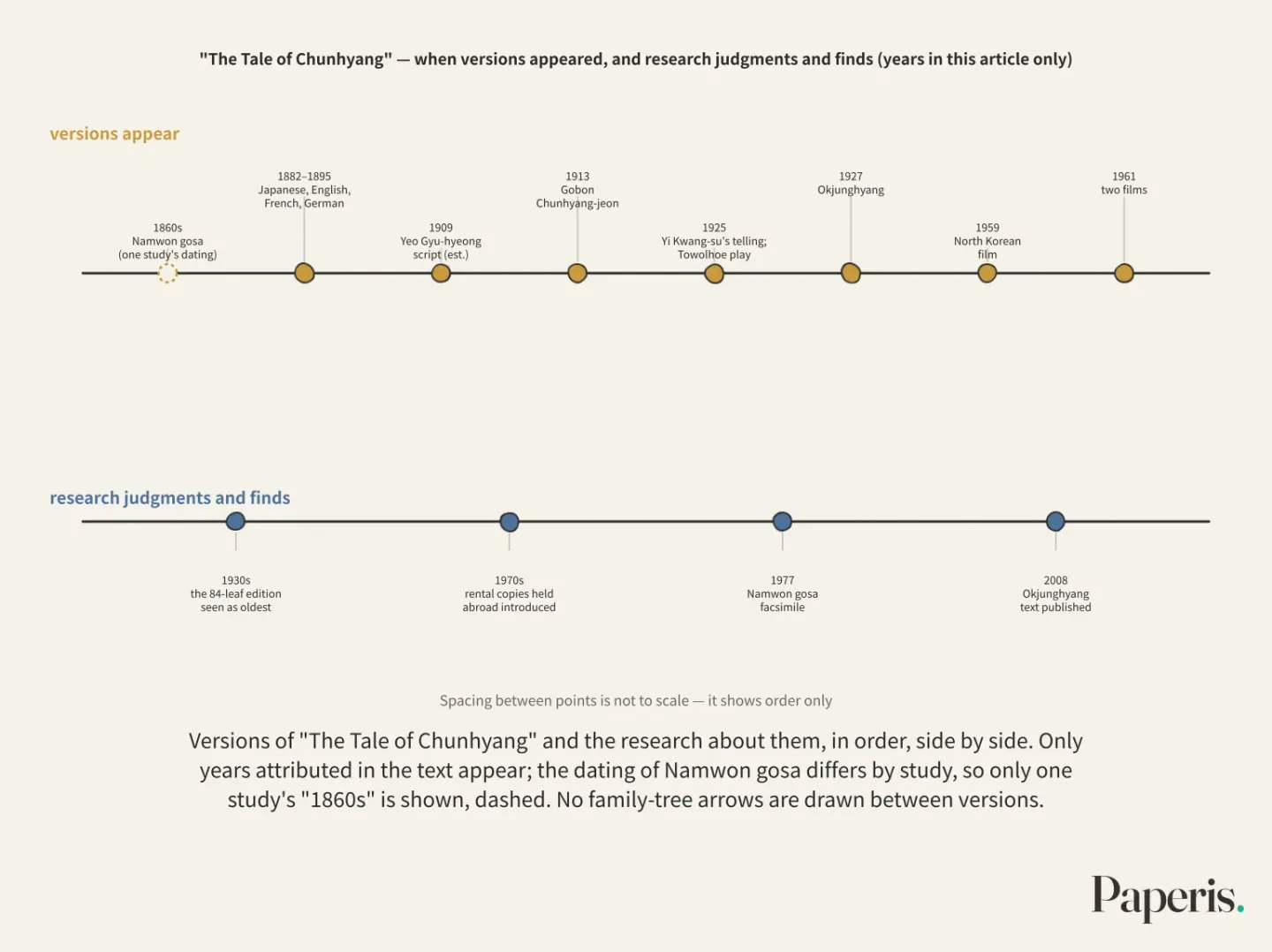
Published in 1913 by the publishing house Sinmungwan, “Gobon Chunhyangjeon” is an edition rewritten by the man of letters Choe Nam-sun based on a Seoul rental-book edition (DOI: 10.17838/korcla.2010..38.012). Entering the 20th century, modern writers and publishers join the hands that revise stories. Adaptation is the work of making a new edition by revising the plot, characters, or sentences based on an existing work.
Choe Nam-sun did not reveal what his base text was, and researchers in the 1930s who lacked knowledge of rental-book editions could not know it. One study guesses that Choe's intention to make this edition into a "classics" must have been the reason he did not state his base text (DOI: 10.17838/korcla.2010..38.012). When an adapter does not say what they leaned on, that edition becomes one of unknown origin for a time.
In the same 1910s, Yi Hae-jo, Choe Nam-sun, and Park Geon-hoe each revised The Tale of Chunhyang and printed it in movable type, and the three editions differed from one another. Choe Nam-sun added new content while claiming to aim for a proper edition resembling old books (KCI ART002113432). “Okjunghwa”, written by Yi Hae-jo (DOI: 10.23296/minmun.2008..38.536), gained popularity and was followed by similar books, and many illustrations went into that lineage of movable-type editions. Among old fiction printed in movable type at the time, The Tale of Chunhyang was uniquely rich in illustrations (DOI: 10.33645/cnc.2018.09.40.5.413). The script for The Tale of Chunhyang by the stylist Yeo Gyu-hyeong is estimated to have been created between May and November 1909, and was used when pansori was staged as a theatrical play at the Wongaksa theater that year. After the theater closed, that script was read again as reading material in the 1920s and 1930s (KCI ART001390150). A version used on stage had moved to the bookshelf.
Yi Kwang-su's "Another Telling of the Tale of Chunhyang" also stands upon this current. In the Wikisource transcription, this serialization is divided into seven chapters: "Ties of Fate," "Love," "Parting," "Yearning," "Chastity," "The Royal Inspector," and "Stepping Out." A study that compares this edition with the Gyeong-pan 16-chapter edition and the Wan-pan 84-chapter edition considers that while the core story stem is the same, the order of minor incidents differs. Lengthy explanations of characters are omitted while dialogue and actions step to the fore, incidents passed over briefly in old editions are filled out with detailed descriptions, and incidents absent from old editions are newly invented and inserted in the middle. The researcher considers that the writer took into account the causality of events inherent to the plot of modern fiction (KCI ART001838399). As we saw in "How Stories Are Built — The Order Things Happen and the Order They Are Told," plot is the order in which a writer selects and lays out events, and the fabric of reasons connecting those events. The retouching by Yi Kwang-su that that study saw lay precisely in that fabric.
How to view this edition is divided among researchers. One study considers that "Another Telling of the Tale of Chunhyang" was long dismissed as a "popular mass novel" and received little attention, yet is worth evaluating as a practice of Chosun national literature in the 1920s that established the Chunhyang story as a canon while remaining conscious of the tradition of oral literature handed down in the Korean language (DOI: 10.23296/minmun.2016..60.329). Another study compares the same edition with old editions, pointing out that the intention to rewrite is clear in the early part, while the further it goes toward the end, the more it accepts the sentences of Choe Nam-sun's “Gobon Chunhyangjeon” as they are. That researcher views this as the result of writing things down as they went for a newspaper serialization, and reads the serialization itself as a project mindful of box-office success (DOI: 10.22871/mklite.2016..49.001). From the same edition, one side sees national literature, and the other sees popular appeal and commercial success.
The legend translated by Cha Sang-chan is yet another branch. If adaptation alters an existing work, "The Legend of Plain-Face Pass" is an edition outside of fiction that Cha Sang-chan wrote down, stating it was a legend floating around the vicinity of Namwon.
When we move to the theater, the branches multiply further. In 1961, directors Shin Sang-ok and Hong Seong-gi each released a Chunhyangjeon film in the same year, and one study considers that the two films split the same classic, making one an emotion-centric story and the other an order-centric story (DOI: 10.22758/sni.2026.31.065). In North Korea, director Yun Ryong-gyu made the first Chunhyangjeon film in 1959 (DOI: 10.1080/17564905.2026.2726675). It also went beyond the sea. A Japanese translation was serialized in the Osaka Asahi Shimbun in 1882, and English (1889), French (1892), and German (1895) editions came out (DOI: 10.15859/yscs..32.201012.307). In television comedy alone, 14 works using The Tale of Chunhyang as material were made from the 1980s to the 2010s (DOI: 10.15859/yscs..79.202302.137).
Wolmae Across Many Versions
We line up Wolmae, Chunhyang's mother, side by side across many versions. Below are the words each study uses to portray Wolmae in that version.
A study comparing the three-volume rental edition Namwon-gosa read in Seoul and the Wan-pan 84-chapter edition Yeolnyeo Chunhyang sujeol-ga read in Jeolla Province suggests that while Wolmae in Namwon-gosa is a retired gisaeng greeting a young noble lord, Wolmae in the 84-chapter edition is closer to an autonomous mother (DOI: 10.15859/yscs..33.201106.125). Another study reading Namwon-gosa mostly classifies Wolmae as one of several supporting roles moving according to immediate gain (DOI: 10.23836/kornov.2023.56.411). In Yi Kwang-su's "Another Telling of the Tale of Chunhyang", Wolmae is depicted as a snobbish character (DOI: 10.22871/mklite.2016..49.001). A study covering the North Korean people's opera The Tale of Chunhyang notes that Wolmae in the pansori The Song of Chunhyang is written as a snobbish and coarse gisaeng, whereas Wolmae in the people's opera changes into a strong mother whose heart aches for her daughter's plight while fighting the irrationality of class discrimination. The researcher connects this shift to the ideal maternal image championed by North Korea (DOI: 10.1353/atj.2026.a989961).
A character of the same name changes across versions into a retired gisaeng, a profit-chasing supporting role, a snob, and a mother fighting class discrimination. Studies read these differences together with the contexts from which those versions emerged. Such is the case for a study that reads the difference between Namwon-gosa and the 84-chapter edition alongside changes in the people who enjoyed that version, namely the consuming class (DOI: 10.15859/yscs..33.201106.125), and a study that reads the Wolmae of the North Korean version alongside the society's maternal image.
Chunhyang herself differs across versions too. Kim Chunhyang, the gisaeng in Namwon-gosa, is a cold, arrogant, and shrewd woman who does not hesitate to lie in a crisis, while Yi Mongryong is a frivolous lecher (DOI: 10.23836/kornov.2023.56.411). Yeolnyeo Chunhyang sujeol-ga sets Chunhyang's social standing as a woman of an ordinary household (DOI: 10.29190/JEKLL.2020.50.59). The 1892 French translation also changed Chunhyang from a gisaeng to a commoner, and songs and dramatic lines amplifying joy and sorrow were omitted during the translation process (DOI: 10.15859/yscs..32.201012.307). There is also a study suggesting that the author of Namwon-gosa neither idealized any character as absolute good nor antagonized anyone as absolute evil, thereby portraying the characters in a three-dimensional way (DOI: 10.23296/minmun.2024..84.357). As seen in "Character — A Man Who Worries About His Train Even on the Morning He Becomes a Vermin", a three-dimensional character has layers of traits and inner thoughts like a real person, and is a character capable of changing as they experience the story.
Scenes grow and shrink too. The dream Chunhyang has while imprisoned grew longer as two other dreams were added to a single dream that had been present since the early versions, and in later versions, one of them was even omitted (DOI: 10.17319/cle.2015..30.209). The "Sipjangga" passage, where Chunhyang begins her words with the count for each stroke of the paddle she receives to protest, is surmised to have remained a steadfastly preserved part amidst the variations of many variant versions (DOI: 10.20516/classic.2020.49.141). Passages preserved for a long time and passages that changed frequently exist together within a single work.
There are even versions where the ending changes. One film by director Kim Dae-woo made Bangja, previously a supporting role, the protagonist, crafting a story where Bangja competes with Mongryong over Chunhyang and wins, ending in tragedy (DOI: 10.20907/kslt.2019.52.193). A web novel continues the story right after the original ending with Mongryong betraying Chunhyang, and turns Byun Hakdo, who was the villain, into a character who helps Chunhyang (DOI: 10.20864/skl.2026.1.89.195). The Chunhyang of the legend translated by Cha Sang-chan is abandoned by Young Master Yi. What changes when a version changes are the characters' personalities and social standing, the length of scenes, and sometimes even the ending.
Where Is the Original
Researchers in the 1930s saw the 84-leaf Wan-pan edition as the oldest version. When rental-booklet editions housed in foreign libraries were introduced to Korea in the 1970s, it came to light that Choe Nam-seon's Gobon Chunhyangjeon had taken as its base a rental booklet lent out in Hyangmok-dong, Seoul, and the same study notes that it also became increasingly known that Seoul's rental booklets had nothing to do with pansori (DOI: 10.17838/korcla.2010..38.012). Namwon Gosa was first made public in facsimile in 1977, and as this edition became widely known, the fact that Chunhyangjeon research had concentrated on the 84-leaf edition came to be seen as increasingly problematic. The same study notes that new discussions regarding the origin of pansori are emerging (KCI ART001227321).
What to call the early editions varies by study. One study writes that Namwon Gosa is a representative variant version carrying on aspects close to the early version of The Tale of Chunhyang (DOI: 10.23296/minmun.2024..84.357), while another study attaches the word "presumed" to that same judgment (DOI: 10.23836/kornov.2023.56.411). A study comparing Namwon Gosa and the 84-leaf edition cites Manhwabon Chunhyangga as "the earliest currently surviving version of 'The Tale of Chunhyang'" (DOI: 10.15859/yscs..33.201106.125). A study dealing with Wolmae in North Korean national opera calls the pansori Chunhyangga the "original" before adaptation (DOI: 10.1353/atj.2026.a989961), and a study dealing with web novels calls the preceding story that a web novel continues writing the "source text" (DOI: 10.20864/skl.2026.1.89.195). "The earliest version" means the earliest among the editions surviving now, whereas "original" and "source text" are terms used to call a preceding work compared to a rewritten work. There is also a distance between saying it is "close to the early version" and saying "this is the original."
How close an edition is to pansori is pictured differently for each line of editions. Regarding Seoul's rental booklets, there is a study noting that, as seen above, it became increasingly known that they had nothing to do with pansori (DOI: 10.17838/korcla.2010..38.012). A study analyzing the narrative of the Seoul rental booklet Namwon Gosa also argues, based on scenes that disappear in editions called pansori, that the cultural form underlying this edition differs from pansori. However, that study also sees the narrative of Namwon Gosa as having provided the foundation from which new passages could later arise in pansori (DOI: 10.15565/jll.2021.06.86.301). Regarding Jeonju's Wan-pan 84-leaf edition, there is a study that views this edition as having been influenced by a text recording the singing of the singer Jang Jae-baek (DOI: 10.20516/classic.2021.54.167). The first two concern Seoul's rental booklets, while the latter concerns Jeonju's commercial woodblock edition, so these are not conflicting claims. Instead of a one-way arrow going from pansori to fiction, a picture emerges where each lineage is sometimes closer to pansori and sometimes farther away.
Research determining which edition is the original is not among the evidence this article relies on. When studies speak of early editions, they stop at describing the distance to the early editions or the chronological order among surviving editions, using phrases like "close to the early version," "presumed," and "the earliest currently surviving version of 'The Tale of Chunhyang.'"
What We Still Do Not Know
"Okjunghyang," serialized in ten installments by Song Heon-seok in the magazine Jeommae Tongbo in 1927, was merely mentioned by name in variant studies in the early 1930s while its actual form remained unknown, until its original text was first made public in 2008 (DOI: 10.23296/minmun.2008..38.536). A 1959 North Korean film was long thought lost due to political suppression, but the authors of that study rediscovered it in Warsaw, Poland (DOI: 10.1080/17564905.2026.2726675). The inventory of variants is not yet closed.
Nor have all known editions been fully read. A researcher who has worked on annotating Namwongosa notes that nearly thirty years after the first annotations appeared, no supplementary research has followed, and that words whose meanings remain unresolved are more numerous among the native Korean expressions than among the Sino-Korean terms (KCI ART001227321). Who read Namwongosa is also being asked anew. One study examines the physical binding and transcription methods of the actual books, arguing that this edition was a custom-made sechaekbon (commercial rental book) intended for palace women and upper-class cultured readers (DOI: 10.33335/KLL.104.4). The reading that an anti-Japanese consciousness is embedded in the 84-leaf Wan-pan edition also clarifies itself as an exploration of a "possibility" and an "inference" (DOI: 10.20516/classic.2021.54.167). The dating of editions, their readers, and the lineages among them are still being rewritten today.
So What Do We Know
The pansori singer's voice, the hand copying rented books, the woodblock merchant counting copies, the writer keeping a newspaper serialization going, the stage and the theater each rewrote The Tale of Chunhyang. The reason there are so many versions lies in the path this story has traveled. A study analyzing two films from 1961 views The Tale of Chunhyang as a story of an open structure, continuously varied as it passed through commercial woodblock editions, handwritten manuscripts, and pansori (DOI: 10.22758/sni.2026.31.065).
A study analyzing North Korean retouched versions likewise sees The Tale of Chunhyang as retaining its own openness and fluidity even today (KCI ART002071500). Since research fixing which version is the original does not exist in the foundations this article relies on, asking what was added, subtracted, and changed in each version may be the more fitting question for this work.
The scene in the newspaper where Mongryong asks if there is "anything worth seeing" in Namwon, and the plain-face Chunhyang Cha Sang-chan recorded as a Namwon legend, are both variations of this long branch. The Tale of Chunhyang is a work handed down through the entire path along which its versions have diverged.
Source Papers
- "Reading the 'Chunhyang' Story Intertextually: A Study of Yi Kwang-su's Another Telling of the Tale of Chunhyang" (2013) — KCI ART001838399 — Comparing Another Telling of the Tale of Chunhyang with the 16-leaf Gyeong-pan and 84-leaf Wan-pan editions, finding the core trunk identical with differences in event arrangement, description, and new event insertion.
- "Intercultural Contestation in Another Telling of the Tale of Chunhyang: Focusing on Intercultural Contestation Surrounding the Translation and Adaptation of <The Tale of Chunhyang>" (2016) — DOI: 10.23296/minmun.2016..60.329 — Overlooked since being classified as vulgar fiction, but reevaluated as a practice of Joseon national literature in the 1920s.
- "A Reconsideration of Yi Kwang-su's <Another Telling of the Tale of Chunhyang>" (2016) — DOI: 10.22871/mklite.2016..49.001 — Adaptation intent is distinct in the first half while the latter half accepts existing episodes, resulting from newspaper serialization and box-office planning.
- "A Study on the 'Modernization of Classics Production' by the Director Park Seung-hee (1901–64) during the Joint-Stock Company Period (1925.4–26.3) of the Towolhwe Theatre Troupe (1923–31): Focusing on the Adapted and Directed <The Tale of Chunhyang> (1925)" (2021) — DOI: 10.23013/localh.2021.24.1.001 — The 1925 Towolhwe 10-act The Tale of Chunhyang, maintaining the base plot plus musical drama type with chang and traditional Korean music accompaniment.
- "Some Issues in the Adaptation of <Old Text of The Tale of Chunhyang>" (2010) — DOI: 10.17838/korcla.2010..38.012 — The base text for Choi Nam-seon's 1913 adaptation is Seoul rental-book texts, judging the 1930s 84-leaf edition as the best version and its schemas, introducing 1970s rental-book texts.
- "Several Issues on Annotations to ??Namwongosa??" (2007) — KCI ART001227321 — A variant text circulated in Seoul in the 1860s, made public in a facsimile in 1977, the problem of concentration on the 84-leaf edition, new discussions on pansori origins, unresolved words.
- "A Study on the Form-Bibliographic Characteristics and Readership of Namwongosa" (2025) — DOI: 10.33335/KLL.104.4 — A 5-volume, 5-fascicle manuscript held at BULAC, a rental-book text tailored for upper-class women.
- "Aspects by Character and Narrative Meaning of Poetry in Namwongosa" (2026) — DOI: 10.31889/kll.2026.9.216.473 — About 100 poems.
- "Exploring the Inclusion of Poetry in Namwongosa-Lineage The Tale of Chunhyang and Its Relation to Poetry History" (2009) — DOI: 10.32428/poetry.27..200911.307 — Arranging popular songs into the narrative context and composing new songs.
- "The Narrative-Stylization Process of Poetry Included in the Namwongosa-Lineage The Tale of Chunhyang" (2010) — DOI: 10.32428/poetry.28..201005.265 — Reflecting rental-book production and reader tastes, a style distinct from pansori.
- "The Meaning of the Jester-Like Narrative Style in Namwongosa" (2021) — DOI: 10.15565/jll.2021.06.86.301 — Jester-like narration mostly excised in commercial woodblock publishing, a cultural format different from pansori, the foundation for later pansori deunm (masterpiece segments).
- "A Reconsideration of the Adaptation Direction of Gyeong-pan The Tale of Chunhyang" (2011) — DOI: 10.15822/skllr.2011.39.2.113 — Comparing the 30-, 23-, and 20-leaf Gyeong-pan editions, strengthening 4-foot meter and prose style, from a performance piece to a reading text.
- "The Emergence of Commercial Woodblock Editions and Changes in Traditional Storytelling Methods: Focusing on ?Namwongosa? and the Gyeong-pan 35-Leaf ?The Tale of Chunhyang?" (2003) — KCI ART001000457 — A passage where the Gyeong-pan 35-leaf edition summarizes the Namwongosa plot.
- "New Materials and Tasks for Commercial Woodblock Fiction" (2014) — KCI ART001927831 — Wan-pan also saving production costs through length reduction.
- "A Reconsideration of the Adaptation, Enjoyment Contexts, and Thematic Consciousness of the Wan-pan 84-Leaf <The Tale of Chunhyang Sujeol-ga>" (2021) — DOI: 10.20516/classic.2021.54.167 — Influence of Jang Jae-baek's performance text, the passage identifying patriotic figures of the Japanese invasions of Korea, possible reflection of Honam anti-Japanese consciousness.
- "The Reception and Adaptation Aspects of the North Korean Cho Ryong-chul Polished Version <The Tale of Chunhyang>" (2015) — KCI ART002071500 — The Tale of Chunhyang is not a fixed form and content but a work changing according to singers and audiences.
- "Reception Aspects of <The Tale of Chunhyang> in the Film <The Tale of Chunhyang> and Its Characteristics as a Variant Text: Centering on Im Kwon-taek's <Chunhyangdeon>" (2017) — DOI: 10.20907/kslt.2017.45.101 — Using Cho Sang-hyun's singing as a frame, accepting previous editions such as Jang Jae-baek's performance text.
- "Transition Period Characteristics Appearing in 1910s Adapted Editions of <The Tale of Chunhyang>: Centering on the Adapted Editions of Yi Hae-jo, Choi Nam-seon, and Park Geon-hoe" (2016) — KCI ART002113432 — Variations among the three adapted editions, with Choi Nam-seon aiming for a standard text and including new content.
- "Existence Aspect of Illustration and Its Meaning in Print-Edited <Chunhyang-jeon>" (2018) — DOI: 10.33645/cnc.2018.09.40.5.413 — Illustrations in 7 types of movable-type books of the Okjunghwa lineage, with The Tale of Chunhyang alone having many illustrations.
- "Formation of the <The Tale of Chunhyang> Script of the Yeo Gyu-hyeong Version and Its Shift in Reception as a Reading Text" (2009) — KCI ART001390150 — The 1909 Wongaksa changgeuk script, transitioning into a reading text in the 1920s–30s.
- "Value and Meaning as a Variant Text of the Film The Tale of Chunhyang: Focusing on Shin Sang-ok's <The Tale of Seong Chunhyang> (1961) and Hong Sung-ki's <The Tale of Chunhyang> (1961)" (2026) — DOI: 10.22758/sni.2026.31.065 — Stratified literature and open narrative, bifurcated into emotion-centered and order-centered narratives.
- "The rise and fall of changgeuk cinema: the 1959 adaptation of The Tale of Chunhyang in North Korea" (2026) — DOI: 10.1080/17564905.2026.2726675 — North Korea's first Chunhyang film (1959, Yun Ryong-gyu), considered lost and rediscovered in Warsaw.
- "Adaptation Aspects and Later Transformations of the French Edition of The Tale of Chunhyang, Printemps Parfumé" (2010) — DOI: 10.15859/yscs..32.201012.307 — Four 19th-century foreign-language translations, with the French edition making Chunhyang a commoner and omitting songs.
- "On the Storytelling Transition of 'Chunhyang Content' in Comedy: Construction of 20th-Century The Tale of Chunhyang Variant Texts" (2023) — DOI: 10.15859/yscs..79.202302.137 — Fourteen comedy Chunhyang contents from the 1980s to the 2010s.
- "Characteristics Differences Among The Tale of Chunhyang Variant Texts Seen through the Personalities of Supporting Characters: Centering on <Namwongosa> and the 84-Leaf <The Tale of Chunhyang Sujeol-ga>" (2011) — DOI: 10.15859/yscs..33.201106.125 — Differences in supporting characters between Seoul rental-book texts and the Wan-pan 84-leaf edition, Wolmae shifting from a retired gisaeng to an independent mother, changes in readership.
- "The Anthropology of The Tale of Chunhyang: Chunhyang and Surrounding Characters in <Namwongosa>" (2023) — DOI: 10.23836/kornov.2023.56.411 — <Namwongosa> presumed close to an early version, with a shrewd Chunhyang, a frivolous Mongryong, and profit-seeking supporting roles.
- "The Idea of Motherhood in the North Korean Minjok Gageuk Chunhyangjeon : The Gendered Role of Wolmae" (2026) — DOI: 10.1353/atj.2026.a989961 — Wolmae in North Korean national musical theater transforms into a maternal and strong mother.
- "A Study on the Correlation between Expression Methods of Women's Appearance in Literature and Contemporary Perceptions of Femininity: Centering on Linguistic Expressions in Namwongosa and The Tale of Chunhyang Sujeol-ga" (2020) — DOI: 10.29190/JEKLL.2020.50.59 — The Tale of Chunhyang Sujeol-ga sets Chunhyang as a woman of an ordinary household.
- "<Namwongosa>, or the <The Tale of Chunhyang> of a 'Border Crosser'" (2024) — DOI: 10.23296/minmun.2024..84.357 — A representative variant text continuing aspects close to the early version, where the author's gaze shapes characters three-dimensionally.
- "Aspects and Roles of the 'Prison Dream' in the Derivation of Variant Texts of <The Tale of Chunhyang>" (2015) — DOI: 10.17319/cle.2015..30.209 — The prison dream expands by adding the groom dream and the Hwangreung Shrine dream to the broken-mirror dream, with some parts dropped later.
- "Discourse Methods and Meaning of the 'Ten-Blow' Passage in The Tale of Chunhyang: Centering on the Wan-pan 84-Leaf <The Tale of Chunhyang Sujeol-ga>" (2020) — DOI: 10.20516/classic.2020.49.141 — Byeon Hak-do's demand for sexual compliance and the torture frame, the ten-blow passage presumed preserved despite variant variations.
- "<Namwongosa>, Desires and Perceptions Entangled in the Story" (2011) — KCI ART001571386 — Five common story stages of The Tale of Chunhyang (Young Master Yi, Governor Byeon, secret royal inspector, reunion).
- "An Analysis of Modern Adaptation Aspects of <The Tale of Chunhyang> Appearing in the Film <The Servant>" (2019) — DOI: 10.20907/kslt.2019.52.193 — Making Bangja the protagonist, competing with and defeating Mongryong, with a tragic ending.
- "Playful Appropriation, Continuation, and Rewriting of <The Tale of Chunhyang> Appearing in Web Novels: Centering on <Impertinent Chunhyang> and <Chunhyang Phantasia>" (2026) — DOI: 10.20864/skl.2026.1.89.195 — Continuation right after the ending due to Mongryong's betrayal, making Byeon Hak-do a helper.
- "The Discovery of 'Emotional Humans' and the Complexity, Purity, and Ideologization of Emotion: The Context of the Representation of 'Love' in the 19th-Century Vernacular Novel <Namwongosa>" (2012) — KCI ART001726220 — A vernacular version of The Tale of Chunhyang circulated in rental-book form in 19th-century Seoul.
- "Overview of a New Variant Text of The Tale of Chunhyang, Okjungh香 (Okjunghyang)" (2008) — DOI: 10.23296/minmun.2008..38.536 — Song Heon-seok's 1927 adaptation Okjunghyang, serialized 10 times in Jeommae Tongbo, first public release of the original text, skeleton of Yi Hae-jo's <Okjunghwa>.
Sources (27)
- 문화횡단적 경합으로서의 『일설춘향전』 - 〈춘향전〉의 번역과 개작을 둘러싼 문화횡단적 경합을 중심으로DOI 10.23296/minmun.2016..60.329
- 이광수의 〈일설춘향전〉에 대한 再考DOI 10.22871/mklite.2016..49.001
- ‘연출자 박승희(1901~64)’의 극단 토월회(土月會: 1923~31) 시절 중 합자회사 체제 시기(1925.4~26.3) ‘고전의 현대화 상연’에 대한 고찰 -각색․연출작 ≪춘향전≫(1925)을 중심으로-DOI 10.23013/localh.2021.24.1.001
- 『고본춘향전』 개작의 몇 가지 문제DOI 10.17838/korcla.2010..38.012
- 『남원고사(南原古詞)』의 형태서지학적 특징과 독자층 연구DOI 10.33335/kll.104.4
- 『南原古詞(남원고사)』 시가의 인물별 양상과 서사적 의미DOI 10.31889/kll.2026.9.216.473
- 『남원고사』계 『춘향전』의 시가 수록과 시가사의 관련 모색DOI 10.32428/poetry.27..200911.307
- 『남원고사』계 『춘향전』수록 시가의 서사양식화 과정DOI 10.32428/poetry.28..201005.265
- 『남원고사』 재담적 서술문체의 의미DOI 10.15565/jll.2021.06.86.301
- 京板 春香傳의 改作方向에 대한 再論DOI 10.15822/skllr.2011.39.2.113
- 완판 84장본 〈열녀춘향수절가〉의 개작 및 향유 맥락과 주제 의식 재고찰DOI 10.20516/classic.2021.54.167
- 영화 〈춘향전〉의 〈춘향전〉 수용 양상과 이본으로서의 특징 — 임권택의 〈춘향뎐〉을 중심으로DOI 10.20907/kslt.2017.45.101
- Existence Aspect of Illustration and Its Meaning in Print-Edited <Chunhyang-jeon>DOI 10.33645/cnc.2018.09.40.5.413
- 영화 춘향전의 이본(異本)으로서의 가치와 의미 - 신상옥 감독의 〈성춘향〉(1961)과 홍성기 감독의 〈춘향전〉(1961)을 중심으로DOI 10.22758/sni.2026.31.065
- The rise and fall of changgeuk cinema: the 1959 adaptation of The Tale of Chunhyang in North KoreaDOI 10.1080/17564905.2026.2726675
- 프랑스판 춘향전 Printemps Parfumé의 개작양상과 후대적 변모DOI 10.15859/yscs..32.201012.307
- 코미디에서 ‘춘향전 콘텐츠’의 스토리텔링 전환에 대하여 -20세기 『춘향전』 이본의 구축DOI 10.15859/yscs..79.202302.137
- 보조인물의 성격으로 본 ‘춘향전’ 이본 간의 특성 차이 -〈남원고사〉와 84장본 〈열녀춘향수절가〉를 중심으로DOI 10.15859/yscs..33.201106.125
- 춘향전 인간학-〈남원고사〉의 춘향과 주변 캐릭터DOI 10.23836/kornov.2023.56.411
- The Idea of Motherhood in the North Korean Minjok Gageuk Chunhyangjeon : The Gendered Role of WolmaeDOI 10.1353/atj.2026.a989961
- 문헌 속 여성의 외양에 대한 표현 방식과 당대 여성성 인식과의 상관성 연구 - 『남원고사(南原古詞)』와 『열녀춘향수절가』의 언어 표현을 중심으로DOI 10.29190/jekll.2020.50.59
- 「남원고사」, 혹은 ‘境界人’의 「춘향전」DOI 10.23296/minmun.2024..84.357
- 〈춘향전〉 이본 파생에서 ‘옥중 꿈’의 양상과 역할DOI 10.17319/cle.2015..30.209
- 『춘향전』 ‘십장가’ 대목의 담화 방식과 그 의미 —완판84장본 「열녀춘향수절가」를 중심으로DOI 10.20516/classic.2020.49.141
- 영화 〈방자전〉에 나타난 〈춘향전〉의 현대적 변용 양상 분석DOI 10.20907/kslt.2019.52.193
- 웹소설에 나타난 〈춘향전〉의 놀이적 전유와 이어 쓰기, 다시 쓰기 - 〈발칙한 춘향〉, 〈춘향환상곡〉을 중심으로DOI 10.20864/skl.2026.1.89.195
- 춘향전 새 이본 「옥중향(獄中香)」 개관DOI 10.23296/minmun.2008..38.536