Paperis Articles
Kuunmong — In Which Script Were the Five Mountains First Written?
Kuunmong, the novel attributed to Kim Man-jung, survives in both Hangul and Literary Chinese, each opening with the same five mountains. We set side by side what scholars cite as they divide: a Literary Chinese edition printed in Naju in 1725, a record in the Samgwangi that the novel was read in Hangul in 1680s Seoul, and the reliability of the Seopo Yeonbo chronicle.
Your field's papers, as audio
Pick your fields and journals — Paperis summarizes the key papers and turns them into audio. Listen on your commute.
Start Paperis free →Kuunmong — In Which Script Were the Five Mountains First Written?
Two Sets of Books Beginning with Five Mountains
The Nine Cloud Dream is a novel known to have been written by Kim Man-jung, a civil official during the reign of King Sukjong of the Joseon dynasty. Kim Man-jung raised the issue of court personnel administration to King Sukjong and incurred the king's wrath, leading to his exile to Seoncheon (DOI: 10.22861/tiks.2008..1.7). According to an explanation that has become virtually the accepted consensus in academia, he wrote this novel in his place of exile in Seoncheon around 1688 (DOI: 10.17258/jib.2022..92.55). We will look later at the fact that there are counterarguments to this explanation. This article is written concerning the books left behind by the Joseon novel The Nine Cloud Dream and the discussions that Korean researchers have waged over those books.
The Nine Cloud Dream is handed down in two kinds of scripts. There are books written in Hangul and books written in Classical Chinese. Classical Chinese is writing composed solely of Chinese characters according to the grammar of ancient Chinese literary language. Both are transcribed on Internet Wikisource, and the first sentence is as follows.
In all the world there are five famous mountains: in the east, the Eastern Peak, Mount Tai; in the west, the Western Peak, Mount Hua; in the south, the Southern Peak, Mount Heng; in the north, the Northern Peak, Mount Heng of the north; and in the middle, the Central Peak, Mount Song. (Original: 천하 명산이 다셧시 잇스니 동의는 동악 태샨이오, 셔의는 셔악 화샨이오, 남의는 남악 형샨이오, 북의는 북악 항샨이오, 가온대ᄂᆞᆫ 즁악 슝샨니라.) — Kim Man-jung, The Nine Cloud Dream (Hangul text, Wikisource transcription; translated by Paperis)
Of the famous mountains under heaven there are five. The east is called the "Eastern Peak," that is, Mount Tai; the west the "Western Peak," that is, Mount Hua; the south the "Southern Peak," that is, Mount Heng; the north the "Northern Peak," that is, Mount Heng of the north. The mountain in the middle is called the "Central Peak," that is, Mount Song. These are the so-called Five Peaks. (Original: 天下名山曰有五焉:東曰「東岳」,即泰山;西曰「西岳」,即華山;南曰「南岳」,即衡山;北曰「北岳」,即恆山。中央之山曰:「中岳」即嵩山。此所謂五岳也。) — Kim Man-jung, The Nine Cloud Dream (Classical Chinese text, Wikisource transcription; translated by Paperis)
The two writings begin by naming the same five mountains in the same order. They are Mount Tai in the east, Mount Hua in the west, Mount Heng in the south, Mount Heng in the north, and Mount Song in the middle. These five are called the Five Peaks. The story is one, but the scripts are two.
Then which side was what Kim Man-jung wrote first? The original work is the writing just as the author first invented it. The controversy over whether the original work of The Nine Cloud Dream is the Hangul version or the Classical Chinese version continues among researchers of old fiction, and there are also various opinions on which of the many variant editions is closest to the original (DOI: 10.17788/dbhc.2020..190.014). A variant edition is each of various books produced when the same work comes to differ slightly in writing while being copied and carved. An article in 2025 summarizes that even researchers who participated earnestly in research on the original could not reach a unanimous conclusion, and opinions were divided even on whether the original was in Hangul or Classical Chinese (DOI: 10.23836/kornov.2025.60.5).
The two views have names. The Classical Chinese version theory is the view that the original work of The Nine Cloud Dream was written in Classical Chinese, and the vernacular version theory is the view that it was written in Hangul. Researchers also call Hangul the "national script." The grounds raised by the two sides and the research surrounding them span old records, the dates of surviving books, the composition of the work, and the circumstances under which the books were printed. This article places those side by side in turn. Whether the original work of The Nine Cloud Dream was in Hangul or Classical Chinese is divided among researchers, and this article does not judge which side it is.
The Same Spot, Different Sentences
The second sentences of both texts narrow down to Mount Heng among the Five Peaks.
Of the Five Peaks, only Mount Heng lies farthest from China: Mount Jiuyi stands to its south, the Dongting river to its north, and the waters of the Xiao and Xiang wrap around three sides of it, so it is the most beautiful place of all. (Original: 오악 듕의 오직 형샨 ᄀᆞ쟝 즁국의 멀어 구의샨이 그 남ᄋᆡ 잇고, 동졍강이 그 북의 잇고, 소샹강 물이 그 샴면의 둘너시니, 졔일 슈려ᄒᆞᆫ 곳이라.) — Kim Man-jung, The Nine Cloud Dream (Hangul text, Wikisource transcription; translated by Paperis)
Of the Five Peaks, only Mount Heng lies farthest from the central lands. Mount Jiuyi stands to its south, Lake Dongting passes to its north, and the waters of the Xiang encircle it on three sides, as if an ancestor sat gravely in the middle while the descendants stood in rows around, hands folded in a bow. (Original: 五岳之中,惟衡山距中土最遠。九疑之山在其南,洞庭之湖經其北,湘江之水環其三面,若祖宗儼然中處,而子孫羅立而拱揖焉。) — Kim Man-jung, The Nine Cloud Dream (Classical Chinese text, Wikisource transcription; translated by Paperis)
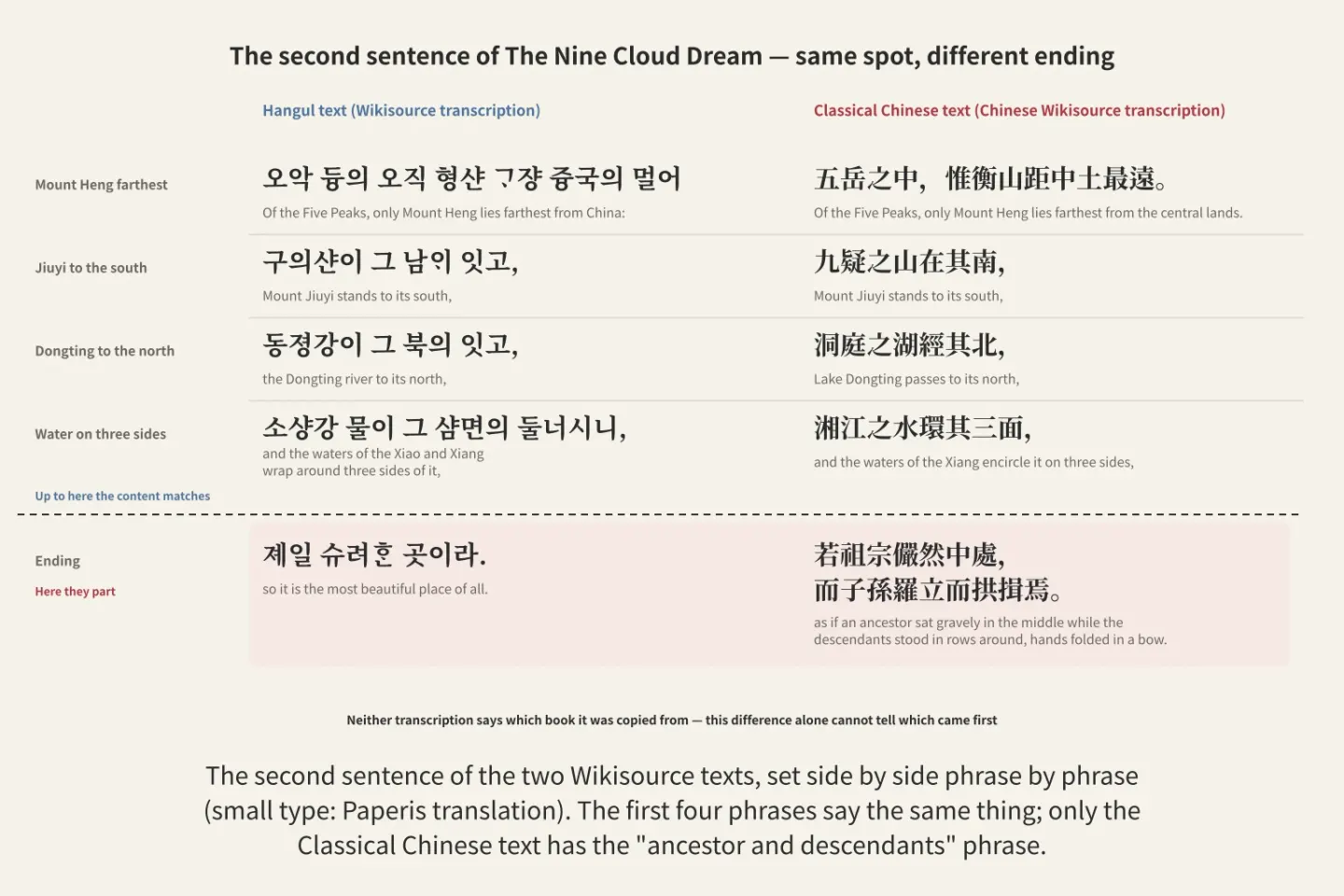
Figure: a diagram Paperis drew using only what the article says
Up to the point that Mount Heng is the farthest from China, with Mount Jiuyi to the south, Dongting to the north, and water surrounding on three sides, the two texts are identical. The two sentences end differently. The Classical Chinese text ends by comparing the mountains around Mount Heng to "ancestors and descendants," while this Hangul text ends with "so it is the most beautiful place of all." The "ancestor and descendant" phrase is absent from this spot in the Hangul text.
This difference is a difference between these two texts. Neither text indicates which book was copied from. Therefore, these two texts alone cannot tell us whether this passage was omitted during translation into Hangul, added during translation into Classical Chinese, or what other books contain.
Research points to the same wall. Existing studies on variant editions have centered on three editions—the Eulsa edition, the Seoul National University edition, and the Kang Jeon-seop edition—and it has been pointed out that simply comparing a few words or sentences between them is not enough to track down the original (DOI: 10.17788/dbhc.2020..190.014). A 2011 paper notes that, unlike scriptures, The Nine Cloud Dream is a novel that copyists could intentionally alter (KCI ART001611168). The presence or absence of a single sentence cannot tell us by itself which side came first.
The Side That Claims It Was Written in Classical Chinese
The 1977 book A Study of the Original Text of The Nine Cloud Dream put forward the Classical Chinese original hypothesis. The researcher who published this book wrote in a 2006 article that their theory had won broad support in the academic field (KCI ART001439129). The same article notes that, as divergent views and criticisms of that theory have recently emerged, the vernacular original hypothesis is rising to prominence, and states their intention to re-establish the Classical Chinese original hypothesis (KCI ART001439129).
The grounds for the Classical Chinese original hypothesis are gathered in a 2008 article. This article was written by someone on the side that proposed and has defended the theory, moving from calling the Classical Chinese original their own "cautious conjecture" to a firm conclusion (DOI: 10.22861/tiks.2008..2.1). The first is the dating of the textual versions. This article considers the Eulsa edition to be the oldest recorded among the variants of The Nine Cloud Dream, and posits that because there is the Nojon copy upon which the Eulsa edition was based, the time gap between the Classical Chinese version and Kim Man-jung is further narrowed (DOI: 10.22861/tiks.2008..2.1). The second is the circumstances of its composition and its structure. It argues that the motivation of writing The Nine Cloud Dream for his mother Lady Yun, as well as the novel's structure in the style of Chinese fiction, support the Classical Chinese original hypothesis (DOI: 10.22861/tiks.2008..2.1). The third is family testimony. Seopo is Kim Man-jung's pen name, and this article cites testimony from Kim Man-jung's tenth-generation direct descendant that the manuscript in Kim Man-jung's own hand was a Classical Chinese version—which the writer calls "undeniable testimony"—and concludes that this allows for the definite conclusion that the original was in Classical Chinese (DOI: 10.22861/tiks.2008..2.1). The same article considers that there is no clear philological authority for the conclusion that the original was a vernacular version (DOI: 10.22861/tiks.2008..2.1). When and in what form that descendant's testimony was recorded does not appear in this abstract.
A hypothesis in the opposing direction is also part of this debate. As summarized in the 2006 article, researchers Bouchez and Ji Yeon-suk put forward a hypothesis that viewed the Classical Chinese Nojon B copy as a translation of the Seoul National University Korean-script copy, treating the Seoul National University copy as the original text (KCI ART001439129). The 2006 article tries to refute this hypothesis by citing several passages from the Nojon B copy (KCI ART001439129). The contents of this hypothesis are conveyed here only through the writings of those refuting it.
Even what is called the "accepted view" differs from article to article. That 2008 article refers to the view that the original was written in the vernacular as the "accepted view" and refutes it (DOI: 10.22861/tiks.2008..2.1). A 2022 article writes that "currently in the academic field," the original is viewed as a Classical Chinese version, and among the Classical Chinese versions, the Nojon copy is presumed to be closest to the original (DOI: 10.17258/jib.2022..92.55). This article itself soon judges that view to be mistaken because it resulted from ignoring records in Samgwan-gi. That story is covered in the next section.
A 2025 article divides the books into lineages. In this article's classification, the books of the original lineage are just two: the Classical Chinese Nojon B copy and the Kyujanggak copy, which faithfully transcribed it into Hangul (DOI: 10.22943/han.2025..111.003). It views the Jangseogak copy, copied in the 1900s, as belonging to the same lineage as the Kyujanggak copy and as having a supplementary role in helping to guess the prototype of the original-lineage Hangul version despite containing many errors, while considering the Toyo Bunko copy and the Ewha Womans University copy to be closer to the Nojon A copy, a book rewritten while being translated into Classical Chinese (DOI: 10.22943/han.2025..111.003). It therefore concludes that the Kyujanggak copy retains its position as "the sole original-lineage Hangul version" (DOI: 10.22943/han.2025..111.003). In this classification, the original-lineage Hangul version is a book translated from the Classical Chinese version.
The grounds for the Classical Chinese version hypothesis seen here came from the 2006 and 2008 articles by the side that proposed and maintained that theory, and the descendant's testimony, which is the core evidence for the "conclusion," relies on the evaluation of a single writer.
The Classical Chinese original hypothesis cites the dating of surviving books, the structure of Chinese fiction, and family testimony as its grounds, and the 2025 classification places the original-lineage Hangul version as a book translated from the Classical Chinese version.
A Single Line in The Samgwan-gi
The evidence for the other side starts with a record left by a single person. It is The Samgwan-gi left by the late Joseon literatus Yi Jae. A 2020 paper reviews this record and states that it reveals that the Hangul version of The Nine Cloud Dream was already popular among women in Seoul before 1689 (DOI: 10.17788/dbhc.2020..190.014). A 2022 paper also considers this record to show that The Nine Cloud Dream was read in Hangul in Seoul in the 1680s (DOI: 10.23073/riks.2022.12.12.007). The same paper argues, based on the fact that Yi Jae's mother and King Sukjong's Queen Inhyeon were blood sisters, that The Nine Cloud Dream, which Yi Jae is said to have heard often in his youth, likely came from the royal court (DOI: 10.23073/riks.2022.12.12.007).
This record clashes with the conventional view on the period of composition. The 2020 paper points out that the academic consensus that Kim Man-jung wrote The Nine Cloud Dream during his exile to Seoncheon—between September 1687 and November 1688—is mistaken (DOI: 10.17788/dbhc.2020..190.014). The textual study from 2022 that conveyed the view of "contemporary academia" in the previous section considers that general view to be wrong because it overlooked the record in The Samgwan-gi showing that women from aristocratic families read this novel in the 1680s (DOI: 10.17258/jib.2022..92.55). Exactly which year that passage in The Samgwan-gi refers to does not appear in these abstracts.
The three papers introduced here all lean on this single record from The Samgwan-gi for their conclusion. The conclusions drawn in the abstracts of the three papers are two: that The Nine Cloud Dream was already read as a vernacular novel in the 1680s, and that discussions on the author and the original text must be reopened. Sentences asserting that the Hangul version was the original work do not appear in these abstracts.
The same record even opens up the question of authorship. According to the 2020 paper, Yi Jae is the first person to name Kim Man-jung as the author of The Nine Cloud Dream, but he did not present evidence to support his claim. Yet most Joseon-era records that point to Kim Man-jung as the author take The Samgwan-gi as their source (DOI: 10.17788/dbhc.2020..190.014). Therefore, this paper concludes that there is no reliable basis for the Kim Man-jung authorship theory, and that discussions regarding the author and the original text must start over from the beginning (DOI: 10.17788/dbhc.2020..190.014). This question asking where the author's name came from in a single line has the same shape as the question followed in "The Tale of Hong Gildong — Where Does the One Line Naming Heo Gyun Come From?".
The mother as reader connects to different letters in the two papers. A 2019 paper, which judging by its abstract does not seem to be a piece dealing with the original text debate, surmises that Kim Man-jung would have written a vernacular novel suited to the reading background and refinement of his mother, Lady Yun (DOI: 10.17319/cle.2019..40.117). The 2008 paper seen earlier uses that same motivation—that it was written for his mother—as grounds to support the Classical Chinese version theory (DOI: 10.22861/tiks.2008..2.1). The same motivation is used as a surmise on one side, and as an argument on the other.
The record in The Samgwan-gi is used as evidence that The Nine Cloud Dream was read in Hangul in Seoul in the 1680s, and there is research that uses it to re-examine even the conventional consensus on the composition period and the author.
Can We Trust Seopo's Chronicle?
The dispute surrounding the composition period converges on the credibility of a single record. Seopo's Chronicle (Seopo-yeonbo) is a record documenting Kim Man-jung's life and writings year by year. A 2016 article reassessing the statements in Seopo's Chronicle shows a poem expressing deep grief followed by the composition of the novel, and includes passages stating that it was made to be a suitable pastime for his mother, and that it was composed not only for his mother but also to broaden the author's own mind and soothe his sorrow (KCI ART002122340). The Joseon silhak scholar Yi Gyu-gyeong praised The Nine Cloud Dream in Oju-yeonmun-jangjeon-sango as having been written for his mother, and many critics thereafter have understood the motive for its composition following this record (DOI: 10.22861/tiks.2008..1.7).
A 2025 article responds precisely regarding this chronicle. This article departs from the point that recently, based on records in Samgwan-gi and "A Biography of Lady Yun" (Yunssi-haengjang), views have emerged that question the reliability of Seopo's Chronicle and doubt the established consensus on the author and the composition period (DOI: 10.22943/han.2025..111.003). This article concedes that it is uncertain who compiled the chronicle. Even so, it judges the chronicle to be a reliable record based on points such as the fact that the writing dates recorded in the chronicle match Kim Man-jung's collected writings, Seopo-jip, and that the contents of the writings conveyed by the chronicle also align with other records from the same period (DOI: 10.22943/han.2025..111.003).
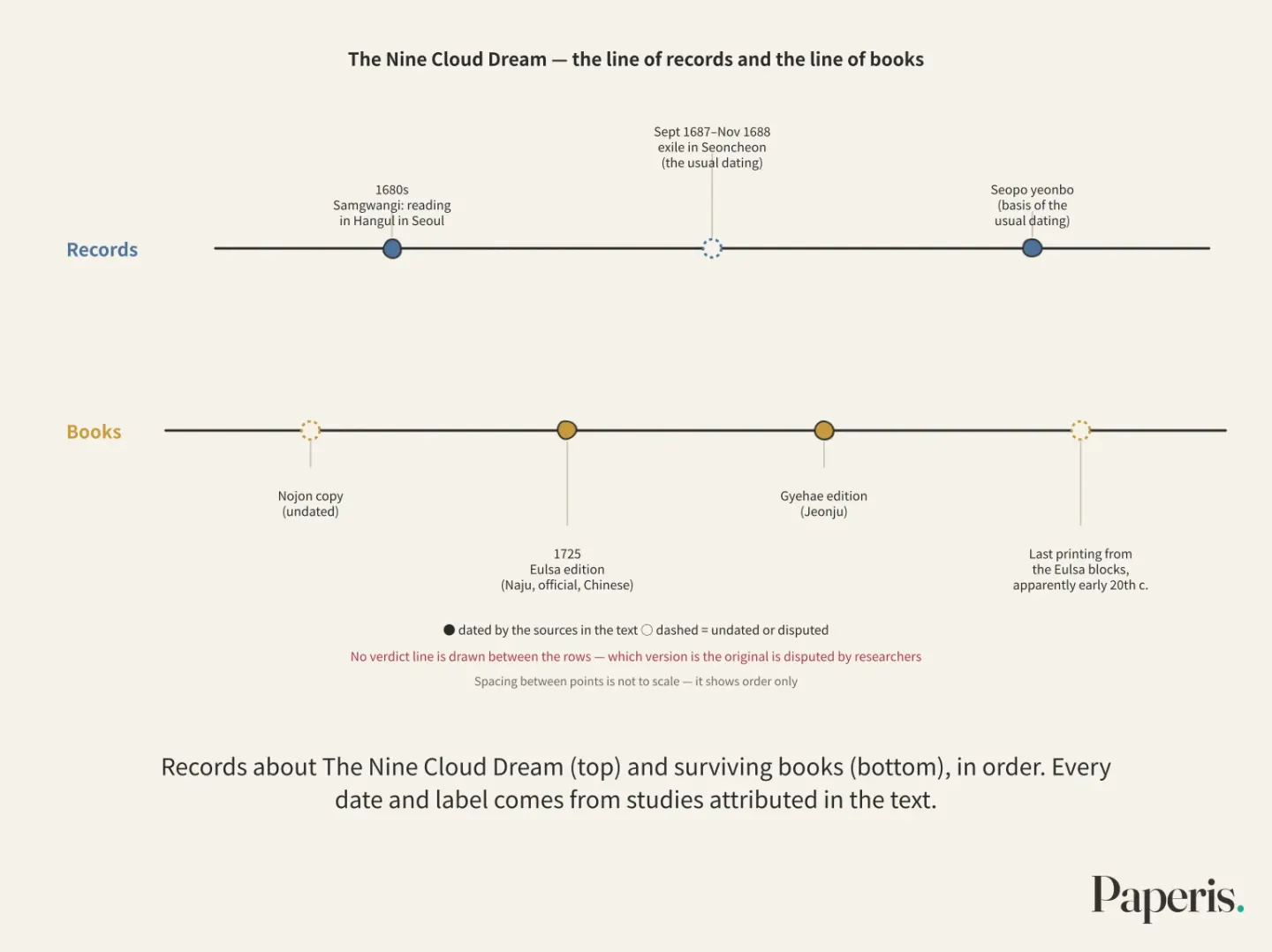
Here, the two sides confront each other over the same question. The side that puts forward Samgwan-gi considers the prevailing theory of composition during the Seoncheon exile to be incorrect, while the side that views Seopo's Chronicle as a reliable record responds to that view and preserves the foundation of the existing consensus. The composition period diverges depending on which record, Samgwan-gi or Seopo's Chronicle, is given more weight, and that divergence is intertwined with the questions of the original text's wording and authorship.
The Classical Chinese Edition Printed in Naju
Now we move on to the books that remain. The Eulsa edition is an official government-printed edition published in Naju in 1725, and a 2022 study of a variant edition considers this book to be the earliest among the surviving variant editions of The Nine Cloud Dream (DOI: 10.17258/jib.2022..92.55). An official government-printed edition is a book printed using wooden blocks carved by a government office. The Eulsa edition is a Classical Chinese version (KCI ART001439129). A manuscript edition is a book copied out by hand by a person. A 2025 paper concludes that, including printed books as well as manuscripts, the Naju edition—that is, the Eulsa edition—is the variant that emerged at the earliest date (DOI: 10.23836/kornov.2025.60.5).
The very first printed book is no longer extant, but various later printings survive (DOI: 10.17258/jib.2022..92.55). A later printing is a book printed again at a later time using that same originally carved wooden block. We can follow the path that this wooden block traveled. The Eulsa edition was printed using the blocks carved in Naju in 1725. That government woodblock was handed over to the private sector in the late Joseon period and used to print commercial publications. The final printing among the surviving books appears to date to the early 20th century, and that book is mixed with newly carved blocks replacing roughly one-third of the total (DOI: 10.17258/jib.2022..92.55). The wooden block carved by the government office in 1725 was being used in private hands by the time of that printing, which appears to be from the early 20th century. Separate from the woodblocks, the text of the book also spread. Nearly a century later, the Gyehae edition printed in Jeonju took this Naju edition as its basis, and the Gyehae edition left behind even more circulating editions in later periods (DOI: 10.23836/kornov.2025.60.5).
Evaluations regarding the character of this book have also shifted. A commercial woodblock edition is a book carved on woodblocks and printed by a publisher to sell. According to a 2025 paper, the Naju edition was previously considered a commercial woodblock edition, but with the recent confirmation that The Nine Cloud Dream is listed in the bookblock catalog of the Naju government office, it has come to be discussed as a book printed by the government (DOI: 10.23836/kornov.2025.60.5). Citing evidence of sales and its relationship with later commercial publishing, this paper views the Naju edition as a "market-oriented official edition" and evaluates it, consequently, as the beginning of commercial publishing (DOI: 10.23836/kornov.2025.60.5).
The same paper draws a clue regarding the circumstances of its publication from the side of the original text. The paper suggests the possibility that the in-law of Jeong Gak-seon, who was the magistrate of Naju in the year the Naju edition came out, was Kim Man-jung's daughter, and because of this, the Naju edition may unexpectedly have stood quite close to the original text (DOI: 10.23836/kornov.2025.60.5). This is put forward as a possibility.
The standing of the Naju edition is a matter of dispute. A 2008 paper views the Nojon copy as a book based on the Eulsa edition (DOI: 10.22861/tiks.2008..2.1). A 2025 paper criticizes several scholars for treating the Nojon copy as preceding the Naju edition, thereby lowering the Naju edition and treating it as a variant several steps removed from the original. The fundamental problem lies in attempting to find a variant close to the original when not even circumstantial evidence regarding the original is in place (DOI: 10.23836/kornov.2025.60.5).
New estimates have also emerged regarding the dating of woodblock editions carved in Hangul. Gyeong-pan editions are commercial woodblock editions printed in Seoul, and Wanpan본 are commercial woodblock editions printed in Jeonju. A 2026 paper estimates that among the 32-leaf copies of The Nine Cloud Dream printed in Seoul, the earlier edition came out before the 1860s, and earlier variant editions can be traced back to the late 18th century (KCI ART003356579). A loose leaf of The Nine Cloud Dream pasted inside the cover of another book is highly likely to be an early Wanpan edition and is estimated to have been printed in the late 18th century (KCI ART003356579). This paper evaluates that The Nine Cloud Dream was able to spread widely across regions not only as a Classical Chinese woodblock edition but also as a Hangul woodblock edition (KCI ART003356579).
There is research viewing the Classical Chinese edition printed by the government in Naju in 1725 as the earliest surviving The Nine Cloud Dream, there are scholars who have viewed the Nojon copy as preceding it, and there is an estimate that Hangul woodblock editions can be traced back to the late 18th century.
Who Read It in Which Script?
While books were printed and copied, people read them. Appreciation is the entire process of reading, copying, lending, rewriting, and enjoying a work. The passage from Samgwan-gi raised by the opposing side in the debate over the original text of The Nine Cloud Dream is also a record of who read this novel in which script.
A 2019 paper portrays a mother in a 17th-century literati household as a reader who read, copied, lent, and preserved novels, arguing that high-quality vernacular Korean full-length novels could emerge against this background (DOI: 10.17319/cle.2019..40.117). A 2020 paper notes that finding the original requires looking at far more variant editions than before, and calls for attention especially to vernacular Korean variant editions circulated as rental books (DOI: 10.17788/dbhc.2020..190.014). Rental books are books copied and produced by rental bookstores—shops that lent books for money—for the purpose of lending them out. A 2022 paper suggests that the extent of variation among variant editions differs depending on the script. It points out that while Classical Chinese variant editions have differing titles attached to each section, there is almost no difference in content, whereas vernacular Korean variant editions show significant differences not only in the division of sections but also in content depending on the variant (DOI: 10.23073/riks.2022.12.12.007). This observation was put forward as part of an argument to broaden variant research, and it does not speak to which script the original was in.
There are also books that traveled back and forth between scripts. The Nine Cloud Dream has a vernacular Korean variant rewritten in the rhythm of gasa poetry, and a 2022 study revealed that the book this variant was based on is a Classical Chinese variant of the Eulsa edition lineage. This study suggests that the person who rewrote this variant chose to use a vernacular Korean tone when depicting characters' emotions, and a Classical Chinese tone when fitting their personalities and the work's universe (DOI: 10.18399/actako.2022..87.001). This is an instance where a Classical Chinese variant of the Eulsa edition lineage served as the foundation for a vernacular Korean variant.
The texture of the story also shifted with each variant. A 2014 study suggests that the Wanpan vernacular Korean edition printed in Jeonju places greater emphasis on the filial piety and heroic qualities of the male protagonist, Yang Soyu, compared to the Seoul National University copy, and strips away most of the Buddhist coloring from the scene of waking up from the dream. This study reads that as a result of reflecting the understanding and demands of the people who read the book (KCI ART001949680). A 2026 study analyzes that the Seoul National University copy and the Eulsa edition arranged the same zither scene differently, and leaves both possibilities open: that the difference could be the author's original intention, or that it might have been added through editing as the book circulated (DOI: 10.22996/yonmin.45..202602.419). A story that changes with every copy is a pattern we also traced in "The Tale of Chunhyang — A Story That Changed with Every Singing and Every Copying".
The question of which script the original text of The Nine Cloud Dream was in lies upon the same historical record as the question of who read, copied, and rewrote this novel in which script.
What We Still Do Not Know, and What We Take With Us
The biggest vacant spot is a manuscript in Kim Man-jung's own hand. A 2011 paper concludes that since both groups of variant editions contain flawed sentences, efforts to find or reconstruct the original text using the surviving variants without Kim's autograph copy are in vain (KCI ART001611168). A 2025 study on the Naju edition proposes that rather than relying on variant editions whose proximity to the original is unknown, we should adopt the Naju edition—the oldest, relatively free of major textual defects, and most influential in circulation—as a representative standard text (DOI: 10.23836/kornov.2025.60.5). A 2015 study holds that since the original does not survive, we must compare various variant editions to prepare a reliable text (KCI ART002054710). A 2022 paper suggests that examining a greater number of variant editions than before makes new discussions about the author and the original possible (DOI: 10.23073/riks.2022.12.12.007). Facing the same circumstance that no autograph copy survives, we find simultaneous proposals: that doing so with the remaining variants is futile; that we should compare multiple variants to establish a reliable text; that we should base our work on the book with the greatest influence in circulation; and that we should examine variant editions more broadly.
What the abstracts this article relies on do not tell us also remains. Exactly which sentence that passage in Samgwangi is and which year it points to, when and how the Seopo descendant's testimony was recorded, and when the Nojon copy was made are not found in these abstracts. The two opening passages we compared earlier are also texts whose source books are unknown, so they cannot be used as evidence to determine the original work.
There are three things we take with us. The opening passage about the Five Sacred Peaks in The Nine Cloud Dream is transmitted in both Hangul and Classical Chinese. The theory of the Classical Chinese original points to the dates of the 1725 Eulsa edition and the Nojon copy, the structure of Chinese novels, and the descendant's testimony, whereas opposing studies cite the 1680s record in Samgwangi of it being read in Hangul in Seoul to question the established view, without concluding that Hangul was the original script; this dispute is intertwined with the time of composition, the reliability of Seopoyonbo, and the question of authorship. Furthermore, much of the evidence for this debate consists of records concerning who read, printed, and edited this novel in which script. Unless Kim Man-jung's autograph manuscript is discovered, the answer to which script The Nine Cloud Dream was first written in depends on which records one weighs more heavily.
Source Papers
- "Revisiting the Author and Original Text of The Nine Cloud Dream" (2020) — DOI: 10.17788/dbhc.2020..190.014 — The Samganki shows Hangul versions were already popular among women in Seoul before 1689, making the conventional view that it was written during the Seoncheon exile (1687.09–1688.11) incorrect; Yi Jae is the first person to name the author, but with no evidence → Kim Man-jung authorship lacks a basis, and discussion must start over.
- "Publishing and Literary-Historical Significance of the Naju Edition (Eulsa Edition) of The Nine Cloud Dream" (2025) — DOI: 10.23836/kornov.2025.60.5 — The earliest variant, with opinions divided even on the original language; shifts from block-printed books to official bureau prints to "market-oriented government prints," marking the beginning of commercial publishing; Jeong Gakseon's mother-in-law was Kim Man-jung's daughter (raising the possibility of proximity to the original); served as the basis for the Jeonju edition, and proposed as a standard edition.
- "The Problem of the Composition Date of The Nine Cloud Dream and the Status of the Kyujanggak Copy of The Nine Cloud Dream" (2025) — DOI: 10.22943/han.2025..111.003 — Seopo Yeonbo is reliable (for three reasons); the original text lineage = Classical Chinese Nojon B text + its direct Hangul translation Kyujanggak copy; only the Jangseogak copy belongs to the same lineage, while the Toyo Bunko and Ewha Womans University copies belong to the Nojon A (Classical Chinese adaptation) lineage, making the Kyujanggak copy the only Hangul copy of the original lineage.
- "Revisiting the Original Text of The Nine Cloud Dream" (2008) — DOI: 10.22861/tiks.2008..2.1 — The proposition that the vernacular text is the original lacks precedent; the Eulsa edition is the highest-ranking historical text and a Nojon text; maternal kin ties and Chinese novel structures, along with testimony from Seopo's tenth-generation descendant → leads to the conclusion that the original was in Classical Chinese.
- "A Comprehensive Study of The Nine Cloud Dream" (2006) — KCI ART001439129 — The 1977 Classical Chinese text theory and its support (described by the author), the emergence of the vernacular text as the original theory, refuting Boucher and Ji Yeon-suk's Seoul National University copy as the prototype theory, and establishing that the Eulsa edition is a Classical Chinese text.
- "A Bibliographical Study of the Eulsa Edition of The Nine Cloud Dream" (2022) — DOI: 10.17258/jib.2022..92.55 — Summarizes that current academia views the work as having a Classical Chinese original, a Nojon text, and having been written in Seoncheon in 1688, while refuting this based on the Samganki; the Eulsa edition is the oldest extant variant, published by the Naju government office in 1725, with later impressions and about one-third of the blocks replaced in the early 20th century.
- "An Examination of the Possibility of Finding the Original Text of The Nine Cloud Dream" (2011) — KCI ART001611168 — Novels can be altered by copyists, and both groups of variants contain flawed sentences; without a holograph manuscript, searching for or reconstructing the original text is futile.
- "The Necessity of Studying Variants of The Nine Cloud Dream" (2022) — DOI: 10.23073/riks.2022.12.12.007 — The Samganki indicates Hangul reading in Seoul in the 1680s; Yi Jae's mother and Queen Inhyeon were blood sisters → raising the possibility of a court origin; Classical Chinese texts show minor content differences while Hangul texts show major ones, making the examination of more variants necessary.
- "Aspects of Allusion (Yongsa) and Classical Chinese Poetry Utilization in the Characters and Narrative of The Nine Cloud Dream" (2015) — KCI ART002054710 — Since the original text does not survive, it actively utilizes conventional Classical Chinese writing practices such as allusions and classical poetry.
- "The Composition Motive and Thematic Consciousness of The Nine Cloud Dream" (2008) — DOI: 10.22861/tiks.2008..1.7 — Exile to Seoncheon after incurring King Sukjong's wrath; Yi Gyu-gyeong's Oju Yeonmun Jangjeon Sango evaluates it as written for the mother, alongside subsequent critics' interpretations.
- "Kim Man-jung's Exile Life, Depression, and the Composition of The Nine Cloud Dream" (2016) — KCI ART002122340 — Re-examines the statements in Seopo Yeonbo (composition of a novel following poems of loss, as a pastime for his mother, to soothe his own sorrow).
- "Mother Readers and Kim Man-jung's Novel Writing" (2019) — DOI: 10.17319/cle.2019..40.117 — The role of 17th-century yangban mother readers, and the presumption that Kim Man-jung wrote a Hangul novel suited for his mother.
- "A Bibliographical Study of the Hangul Woodblock Edition of The Nine Cloud Dream" (2026) — KCI ART003356579 — Gyeongpan 32-chapter copy A dates to before the 1860s with a predecessor edition tracing back to the late 18th century; backing sheets may be from an early Wanpan edition and are estimated to be from the late 18th century; both Classical Chinese and Hangul woodblock editions were widely circulated.
- "The Language and Style of The Nine Cloud Dream: Focusing on Gasa-style Variants" (2022) — DOI: 10.18399/actako.2022..87.001 — The base text of Gasa-style variants is the Eulsa-edition-lineage Classical Chinese text, featuring the conscious utilization of Hangul-style and Classical Chinese-style expressions.
- "Character Portrayal and Thematic Consciousness in the Wanpan Edition of The Nine Cloud Dream" (2014) — KCI ART001949680 — The Wanpan edition emphasizes Yang Soyu and removes Buddhist coloring, reflecting the understanding and demands of its consuming audience.
- "Aspects of Musical Communication and Intellectual Play in The Nine Cloud Dream" (2026) — DOI: 10.22996/yonmin.45..202602.419 — Differences in the geomungo scene between the Seoul National University copy and the Eulsa edition, presenting two possibilities: the original author's initial intent or editorial enhancement during circulation.
Sources (10)
- 구운몽의 작자와 원본 재론DOI 10.17788/dbhc.2020..190.014
- 나주판(을사본) <구운몽>의 출판·소설사적 의의DOI 10.23836/kornov.2025.60.5
- 『구운몽』의 창작 시기 문제와 『구운몽』 규장각본의 위상DOI 10.22943/han.2025..111.003
- <구운몽> 원작 재론DOI 10.22861/tiks.2008..2.1
- 구운몽 을사본 판본 연구DOI 10.17258/jib.2022..92.55
- 구운몽 이본 연구의 필요성DOI 10.23073/riks.2022.12.12.007
- <구운몽>의 창작 동기와 주제의식DOI 10.22861/tiks.2008..1.7
- 어머니 독자와 김만중의 소설 창작DOI 10.17319/cle.2019..40.117
- <구운몽>의 언어와 문체: 가사체 이본을 중심으로DOI 10.18399/actako.2022..87.001
- 『구운몽』 속 음악적 소통과 지적 유희의 양상DOI 10.22996/yonmin.45..202602.419