Paperis Articles
Aladdin — An Orphan Tale Set in a Kingdom Whose Name Escapes Memory
Known as a signature tale of the Thousand and One Nights, "Aladdin" appears earliest, as far as is known, in a French book translated by the French Orientalist Antoine Galland. We look in turn at the Arabic manuscript Galland owned, the storyteller Hanna Diyab from Aleppo in Syria, Galland's diary, and the sources that differ over who made the tale.
Your field's papers, as audio
Pick your fields and journals — Paperis summarizes the key papers and turns them into audio. Listen on your commute.
Start Paperis free →Aladdin — An Orphan Tale Set in a Kingdom Whose Name Escapes Memory
"Sire, in a Kingdom of China"
"Aladdin" is known as a story from the Thousand and One Nights. Yet the earliest known book containing "Aladdin" as we know it today is written in French. It is The Thousand and One Nights: Arabic Tales, twelve volumes published from 1704 to 1717, in which the French orientalist Antoine Galland (1646–1715) translated, adapted, and greatly expanded the Arabic Thousand and One Nights (DOI: 10.1353/bh.2019.0004). Oriental studies is a field where European scholars researched the languages, writings, and histories of the Middle East and Asia. This article looks at that French book and the path the story took to get inside it.
The Thousand and One Nights is a book where a single outer story holds countless inner stories. A frame narrative is a structure in which a character within the outer story tells the inner stories. A manuscript is a book copied out by hand. The medieval Arabic manuscript of the Thousand and One Nights begins with that familiar frame where Shahrazad tells stories to the king every night (DOI: 10.4324/9781003403883-8). The "Order They Are Told" covered in "How Stories Are Built — The Order Things Happen and the Order They Are Told" is entrusted entirely to one person's mouth here.
In Galland's French book, "Aladdin" also begins with that mouth. Below is the first sentence of the 1806 edition published by the Normant press in Paris.
Sire, dans la capitale d’un royaume de la Chine, très-riche et d’une vaste étendue, dont le nom ne me vient pas présentement à la mémoire, il y avoit un tailleur nommé Mustafa, sans autre distinction que celle que sa profession lui donnoit.
Sire, in the capital of a kingdom of China, very rich and very vast, whose name does not come to my mind at present, there was a tailor named Mustafa, with no distinction other than what his trade gave him. — The Thousand and One Nights, "Aladdin, or the Wonderful Lamp", translated by Antoine Galland (1806 edition) (original · translated by Paperis)
"Sire" is what Shahrazad calls the sultan. The setting is a kingdom of China, and the storyteller says the name of the country does not come to mind at present. Aladdin is the son of the tailor Mustafa. This 1806 edition lists the author of the story as "Anonyme" (Anonymous) and Galland as the translator. The book presents itself as a translation. Then a question follows: if it was translated, where is the original text?
On Galland’s Desk, an Arabic Manuscript
What Galland used as the basis for his translation was a 15th-century Arabic manuscript, and that manuscript was an incomplete book (DOI: 10.1163/22138617-12340149). This manuscript is the oldest surviving manuscript of the Thousand and One Nights (DOI: 10.5617/jais.4545).
How old it is remains disputed. The manuscript does not record the date it was copied. Researchers therefore estimated its date using the coin name "ashrafi" that appears in the text. Muhsin Mahdi, the researcher who edited and published this manuscript, considered this coin to be a gold coin issued between 1290 and 1293. One paper refutes that this identification holds, concluding that it is unlikely this manuscript was copied earlier than 1450 (DOI: 10.5617/jais.4545). Other sources this article relies on call this manuscript a "15th-century" one (DOI: 10.1353/bh.2019.0004; DOI: 10.1163/22138617-12340149).
The twelve volumes also included stories outside this manuscript. Galland inserted the story of Sinbad and added stories from other Arabic manuscripts as well (DOI: 10.4324/9781003403883-8). A 2013 review article discussing both books summarizes the situation this way. Galland published the first six volumes in 1704–1706, and after finishing the seventh volume, he ran out of stories to translate. The eighth volume, which came out in 1709, was published without his permission, and the remaining volumes, which came out in 1712–1717, were put together with stories received from an oral source named Hanna of Aleppo of the Maronite Church (DOI: 10.1353/ecs.2013.0024). However, because research has shown that a single story at the beginning of the ninth volume had an identified Arabic source (DOI: 10.1163/22138617-12340149), saying that all the remaining volumes are Hanna's stories is a summary from that review article.
Other studies identify "Aladdin" as a story coming from this "Hanna," that is, Hanna Diyab (DOI: 10.4324/9781003403883-8). The stories Diyab told in 1709 were the last ones Galland inserted, and taking up nearly a third of the whole, they became the best-known stories in this book (DOI: 10.1353/bh.2019.0004). The researcher Mia Gerhardt gave these stories a name because they are absent from earlier Arabic storytelling traditions, and that name has been used ever since (DOI: 10.1353/bh.2019.0004). Orphan tales is a name for stories that appeared in Galland’s Thousand and One Nights but cannot be found in the Arabic storytelling tradition before it.
The work of finding the sources of the Galland edition continues to this day. A 2018 paper notes that the Arabic sources of two stories featured at the beginning of the eighth and ninth volumes of the Galland edition had not been known to research until recently, when they were identified by the researcher Ibrahim Akel (DOI: 10.1163/22138617-12340149). To say that "Aladdin" is a story without an Arabic original means that it has not been found within the Arabic tradition known up to now.
The Young Man from Aleppo
Hanna Diyab was a Maronite Christian from Aleppo, in present-day Syria. He spent much of his youth traveling with the Frenchman Paul Lucas (DOI: 10.18574/nyu/9781479849475.003.0007). One book introduction describes Diyab as a guide and interpreter for Lucas, a French naturalist and antiquarian (DOI: 10.18574/nyu/9781479820047.001.0001). The two left the area near Aleppo in early 1707, passed through Cyprus, Alexandria, Cairo, Tunis, Livorno, and Marseille, and reached Paris in September 1708, where they spent several months together. Diyab set out on his return journey in June 1709, passing through Istanbul to return to Aleppo in June 1710 (DOI: 10.18574/nyu/9781479849475.003.0007).
During those months in Paris, Diyab met Galland. According to a 2019 paper by researcher Ruth B. Bottigheimer, Diyab told Galland several stories on March 25, 1709, but Galland did not write them down. He did not write down "Aladdin" either. The paper notes that telling "Aladdin" took two days, and that Diyab later wrote the story down in Arabic. The next fifteen stories were recorded by Galland, mostly written down at the time he heard them (DOI: 10.1353/bh.2019.0004).
The record of this is found in Galland's diary. Diyab became known to Western scholarship when his name was discovered in Galland's diary more than a century after his death, and he has since become a familiar figure to scholars studying the history through which the texts of the Thousand and One Nights passed (DOI: 10.18574/nyu/9781479849475.003.0007). A 2018 paper was published with the first complete English translations of the summaries Galland wrote in his diary after listening to Diyab's oral storytelling (DOI: 10.13110/marvelstales.32.1.0114). However, a 2026 book describes "Aladdin" as the only one of Diyab's stories with no notes whatsoever in Galland's diary (DOI: 10.1163/9789004751910_004). Bottigheimer writes that the stories told on March 25 were not recorded either, but what those stories were does not appear in the sources relied on by this article. A 2013 book review notes that references to this story in the diary are "sketchy" (DOI: 10.1353/ecs.2013.0024). Having no notes and having a sketchy reference are not the same thing.
Diyab left behind writing of his own as well. In 1764, he wrote a travelogue of his youthful journey. Because the first pages had fallen away, the manuscript was listed as anonymous in the catalog of the Catholic priest Paul Sbath, who acquired it in the early 20th century; after Sbath's death in 1945, his family transferred it to the Vatican Library, where it remains today. Until the early 1990s, few scholars knew that Diyab had written this travelogue (DOI: 10.18574/nyu/9781479849475.003.0007). A publisher's book description notes that this travelogue was translated into English for the first time, with the translation appearing in 2021 (DOI: 10.18574/nyu/9781479849475.003.0007; DOI: 10.18574/nyu/9781479820047.001.0001). The same book description notes that after Lucas promised a position in Louis XIV's royal library and failed to deliver it, Diyab returned to Aleppo. This travelogue is a memoir written by Diyab in his old age (DOI: 10.18574/nyu/9781479820047.001.0001).
Scholarship treats the travelogue and the diary differently. A 2014 paper dealing with the stories Diyab told in 1709 uses Galland's 1709 diary as direct evidence while employing Diyab's autobiography as background to help explain it (DOI: 10.13110/marvelstales.28.2.0302). The introduction to the translation likewise notes only that the relationship between Diyab and the Thousand and One Nights has long vexed scholars, and that the publication of the travelogue may help shed light on that connection (DOI: 10.18574/nyu/9781479849475.003.0007). The publisher's book description calls Diyab "the man who made Aladdin" (DOI: 10.18574/nyu/9781479820047.001.0001), but that is a promotional phrasing.
One Story, Two Explanations
The grounds this article relies on regarding who wrote "Aladdin" are split into two sides. Galland's diary is used by both. A 2014 paper uses the 1709 diary as direct evidence for the Diyab side (DOI: 10.13110/marvelstales.28.2.0302), and a 2018 paper is attached to an English complete translation of the diary summary (DOI: 10.13110/marvelstales.32.1.0114). Within that, the point that mentions of "Aladdin" are faint serves as grounds for the other side.
One side views Galland as having directly authored the story. That 2013 review article reports that Arab literature researchers around that time viewed "Aladdin" as Galland's own creation. The grounds reported by the review article are twofold: that the story's structure is closer to French fairy tales than to other stories in the Arabic Thousand and One Nights, and that mentions of this story in Galland's diary are faint. The review article therefore writes that the best-known stories in the Thousand and One Nights lack a known Arabic original and are close to pseudotranslations rather than translations (DOI: 10.1353/ecs.2013.0024). A pseudotranslation is a piece of writing written without an original text to translate, presented as if it were translated from another language. A chapter published in 2019 also writes that "Aladdin" and "Ali Baba" may actually have been written by Galland himself (DOI: 10.1017/9781108614672.003). The phrasing of this chapter is "may be." Among the grounds this article relies on, the Galland authorship theory consists of the view anonymously reported by the review article and a chapter's "may be," and research directly arguing for this is absent from this article's grounds.
The other side views Diyab as the source of the story. A chapter published in 2025 writes that the Thousand and One Nights known today comes partly from medieval manuscripts and partly from a single early modern oral source, and that oral source is Diyab. According to the same chapter, "Aladdin" is the first story Diyab told (DOI: 10.4324/9781003403883-8). A 2018 paper calls Diyab the most internationally influential person among named early modern storytellers, and records that he told "Aladdin" and "Ali Baba" to Galland (DOI: 10.13110/marvelstales.32.1.0114). Bottigheimer writes that telling "Aladdin" took two days (DOI: 10.1353/bh.2019.0004).
There is also something both sides see together: the point that "Aladdin" resembles European fairy tales. The 2025 chapter views Diyab as having written the storyline of a poor boy becoming rich in "Aladdin," and views this flow as unfamiliar to the medieval Thousand and One Nights and familiar in the European fairy tales of Italian author Gianfrancesco Straparola. The same chapter records that magic in Diyab's story operates independently of God, and that this is also identical to European fairy tales of the same era (DOI: 10.4324/9781003403883-8). A 2014 paper also argues that the stories Diyab told in 1709 are heavily steeped in the conventions of European fairy tales (DOI: 10.13110/marvelstales.28.2.0302). Up to the point of resembling European fairy tales, both sides agree. What splits is whose hands that resemblance came from. The view reported by the 2013 review article reads it as a trace of Galland's creation, while the 2025 chapter reads it as the way Diyab structured the story.
There is also research that looks separately at Galland's hand between the two explanations. A 2004 paper views that while the earlier volumes were based on Arabic manuscripts, the later volumes originating from Diyab's oral performance left greater room for Galland to invent and insert things. According to this paper, Galland emphasized exotic sentiment more in the later volumes, painted a world consisting of caravanserais, sofas, and veils, and let his taste for luxury fully unfold to present an Orient overflowing with gold and jewels (DOI: 10.1353/mat.2004.0043). Whichever explanation one follows, the French sentences the reader read belong to Galland.
What Was Spoken and What Came Down by Mouth
"Aladdin" has persistently been trailed by the label of a folktale handed down by word of mouth (DOI: 10.1353/bh.2019.0004). Oral transmission is the passing down of stories not written in text, from one person's mouth to another's. Bottingheimer untangles two things from this phrase.
First is where the stories came from. In Bottingheimer's reading, Mahdi repeatedly denied the idea that the stories of the Thousand and One Nights circulated in spoken language. Bottingheimer views that idea as a mistaken assumption, and writes that the persistent claim that Diyab's stories—such as "Aladdin" and "Ali Baba"—came from folk oral tradition rests on that very assumption. This paper builds on earlier research that values the textual tradition of the tales in the Thousand and One Nights, including Galland's manuscript. In the late 17th and early 18th centuries in the Levant—the eastern Mediterranean region that included Aleppo—it was common practice to read the stories of the Thousand and One Nights aloud from handwritten books, and listeners acquired the stories through their ears in that way (DOI: 10.1353/bh.2019.0004).
Second is how Diyab passed them to Galland. The same paper writes that Diyab mainly told these stories by word of mouth (DOI: 10.1353/bh.2019.0004). A 2014 paper goes a step further, arguing that Diyab told the stories to Galland in French (DOI: 10.13110/marvelstales.28.2.0302). A 2025 book also records that Diyab was able to read, write, and speak French (DOI: 10.4324/9781003403883-8). Being told by mouth and a story being handed down from mouth to mouth are two different things. The evidence this article relies on speaks of the former, while there is Bottingheimer's counterargument regarding the latter.
The Path the Stories Travelled
Following the facts we have looked at so far, we trace the path “Aladdin” has taken, step by step.
The first spot is Paris in 1709. Diyab told the story to Galland, and according to Botterheimer, “Aladdin” took two days (DOI: 10.1353/bh.2019.0004). If the 2014 paper is right, that language was French (DOI: 10.13110/marvelstales.28.2.0302). If we follow the view that sees Diyab as the source, the path reaches back one step further to what Diyab had heard and read before that, but just where that spot was does not appear in the evidence this article relies on. A 2025 chapter sees the trajectory of “Aladdin”'s poor boy becoming rich as familiar from Straparola's European fairy tales (DOI: 10.4324/9781003403883-8). In the Levant, where his hometown Aleppo belonged, it was common to open manuscripts and read stories aloud, but Botterheimer writes that the exact setting where Diyab told the story remains in the realm of guess-work (DOI: 10.1353/bh.2019.0004). On the side that sees the story as Galland's creation, the story begins with Galland (DOI: 10.1353/ecs.2013.0024).
The second spot is Galland's diary. Summaries remain for other Diyab stories, but in “Aladdin”'s place, there is no memo (DOI: 10.1163/9789004751910_004).
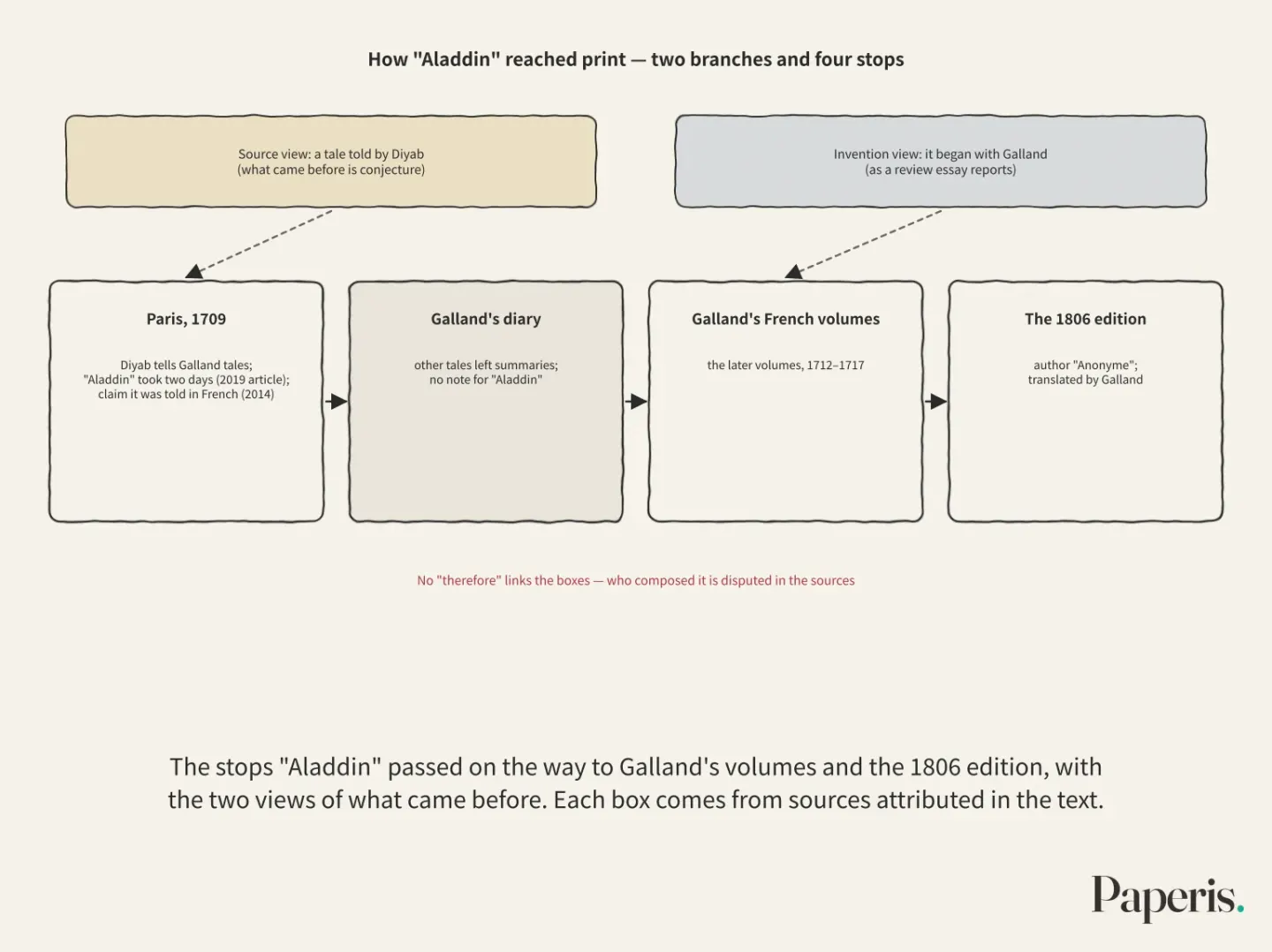
The third spot is Galland's French book. The final volumes came out in 1712–1717 (DOI: 10.1353/ecs.2013.0024), and Galland passed away in 1715 (DOI: 10.4324/9781003403883-8). The fourth spot is the 1806 edition. This edition lists the author as "Anonyme" and Galland as the translator, and opens the story with Shahrazad's "Your Majesty."
The last spot is today. A 2019 study ranks “Aladdin and the Wonderful Lamp” as the most internationally popular tale among fairy tales from the Middle East, and notes that its image today is under the overwhelming influence of the 1992 Disney animation (DOI: 10.5406/jamerfolk.132.525.0275). At the end of the path, the story is called a tale "from the Middle East," and in the middle of the path is the person who wrote that story down in French. The evidence diverges over whether there was someone who told it to him before that.
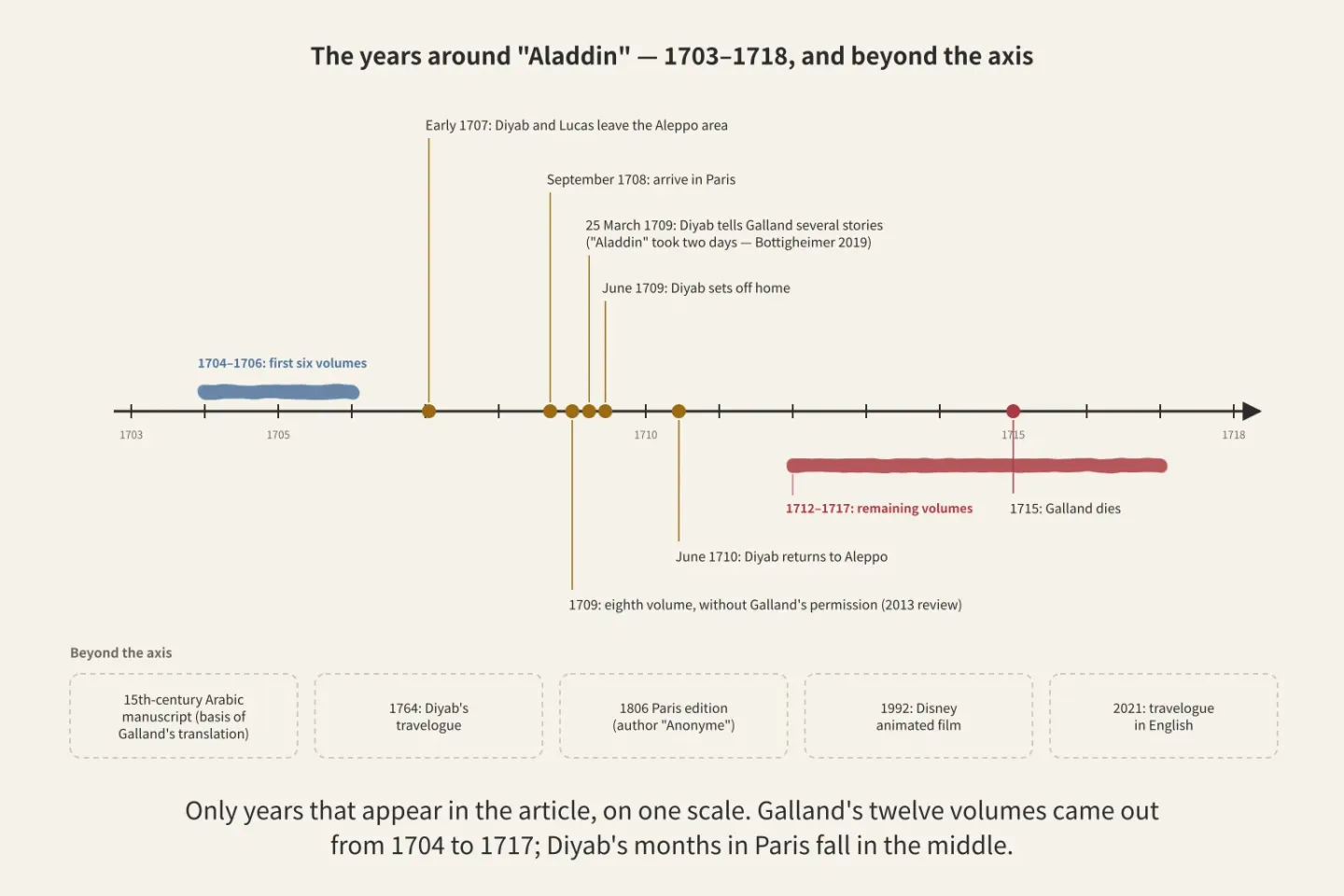
Figure: a diagram Paperis drew using only what the article says
What We Still Do Not Know
The evidence this article relies on leaves some questions unanswered. Botermans writes that Diyab later wrote down "Aladdin" in Arabic (DOI: 10.1353/bh.2019.0004), but whether that Arabic writing survives today and how closely it matches Galland's French sentences does not appear in the sources used here. Whether a separate Arabic manuscript containing "Aladdin" survives, and if so whether it predates Galland, is also outside the scope of the evidence this article relies on. What Diyab's travelogue might add to this question is stated by the translator's introduction as only "could be helpful" (DOI: 10.18574/nyu/9781479849475.003.0007). When Galland's Arabic manuscript was copied is also disputed between Mahdi's dating and the counter-argument that it is later than 1450 (DOI: 10.5617/jais.4545).
The article "The Tale of Chunhyang — A Story That Changed with Every Singing and Every Copying" followed the path of how a single story changes from edition to edition. "Aladdin" is credited as a story told in Paris to Galland by Diyab, a man from Aleppo (DOI: 10.4324/9781003403883-8), and a 2013 book review passes along the view that sees it as Galland's invention (DOI: 10.1353/ecs.2013.0024). Whichever the case, that story printed in the book was written in French, and that book bore the name "Arabian Nights" (DOI: 10.1353/bh.2019.0004).
The Phrase "Aladdin of the Thousand and One Nights"
There are three things to carry with you. The earliest known book to contain "Aladdin" is Antoine Galland's French Thousand and One Nights, published between 1704 and 1717; this story came from outside the Arabic manuscript Galland used as his base; and it has not been found in earlier Arabic storytelling traditions either, earning it the name "orphan tales." Several studies point to Hanna Diyab from Aleppo, who told stories to Galland in Paris in 1709, as its source, and a 2013 book review notes that Arabic literature scholars consider it Galland's own creation. "Aladdin" is noted as the only Diyab story without a mention in Galland's diary. Separately, a 2004 paper suggests that Galland had more room to invent details in the later volumes that came from Diyab's oral storytelling.
In this story, "namelessness" appears twice. The 1806 edition listed the author of "Aladdin" as "Anonyme," and Diyab's travelogue sat cataloged as a manuscript of unknown author for a time because its opening pages had torn away (DOI: 10.18574/nyu/9781479849475.003.0007). In the 1806 edition, Shahrazad says that the name of the kingdom does not come to her mind at present. The phrase "Aladdin of the Thousand and One Nights" smooths over with a single name a winding road that passed through a disputed authorship, an Orientalist scholar in Paris, and a book stamped "Anonymous."
Source Papers
- "Reading for Fun in Eighteenth-Century Aleppo: The Hanna Dyâb Tales of Galland's Mille et une nuits" (2019) — DOI: 10.1353/bh.2019.0004 — Galland transferred and greatly expanded a 15th-century Arabic manuscript into 12 volumes (1704–1717), with Diyāb's tales making up the final additions and nearly a third of the total; Gerhardt's "orphan tales", Mahdi's rejection of oral circulation and critique of the "oral folk origin" theory, March 25, 1709, "Aladdin" recorded over two days without a contemporaneous note and later written in Arabic, and reading aloud in the Levant (the exact setting where Diyāb was heard remains speculative).
- "The Arabian Nights" (2025) — DOI: 10.4324/9781003403883-8 — Today's Thousand and One Nights combines medieval manuscripts with early modern oral sources (Diyāb), with "Aladdin" as the first tale; its rags-to-riches trajectory shows familiarity with Straparola's European fairy tales, magic independent of God, and Diyāb's fluency in reading, writing, and speaking French.
- "Beautiful Infidels: The Western Travels of The Arabian Nights" (2013, a review of two books) — DOI: 10.1353/ecs.2013.0024 — Volume-by-volume circumstances of the Galland edition, with the remaining volumes coming from "Hanna the Maronite of Aleppo"; the reviewer relays that "Arabic literature researchers consider 'Aladdin' to be Galland's creation" (noting a structure closer to French fairy tales and vague diary references), pointing to pseudotranslation.
- "The Origin and Development of the Oriental Tale" (2019) — DOI: 10.1017/9781108614672.003 — "Aladdin" and "Ali Baba" may have been written by Galland himself.
- "The Man Who Made the Nights Immortal: The Tales of the Syrian Maronite Storyteller Ḥannā Diyāb" (2018) — DOI: 10.13110/marvelstales.32.1.0114 — Internationally most influential among early modern storytellers whose names are known; an accompanying essay to the first complete English translation of the Galland diary summary.
- "East Meets West: Hannā Diyāb and The Thousand and One Nights" (2014) — DOI: 10.13110/marvelstales.28.2.0302 — The 1709 tales are heavily steeped in European fairy-tale conventions, told in French (argued), with the 1709 diary serving as direct evidence and the autobiography providing background.
- "The Story of Aladdin; or, the Wonderful Lamp" (2026) — DOI: 10.1163/9789004751910_004 — "Aladdin" is the only Diyāb tale lacking any diary note by Galland.
- "Introduction" (The Book of Travels, 2021) — DOI: 10.18574/nyu/9781479849475.003.0007 — Discovered in Galland's diary and introduced to Western scholarship, the Maronite merchant and storyteller traveled primarily with Lucas, documented in a 1764 travelogue at Sfax and the Vatican in the early 1990s spanning journeys from 1707 to 1710, where publication may help clarify their relationship.
- "The Book of Travels" (2022, publisher book introduction) — DOI: 10.18574/nyu/9781479820047.001.0001 — Lucas's guide and interpreter, translated into English for the first time, covering Royal Library commitments, homecoming, late-life recollections, and the phrase "the man who made Aladdin" from the introductory text.
- "Further Considerations on Galland's Mille et une Nuits: A Study of the Tales Told by Hanna" (2004) — DOI: 10.1353/mat.2004.0043 — The later volumes derived from Diyāb's oral performances leave greater room for authorial creation and exhibit pronounced exoticism and luxury tastes.
- "The Arabic Source Text for Galland's Dormeur éveillé" (2018) — DOI: 10.1163/22138617-12340149 — Galland relied primarily on an incomplete 15th-century manuscript and Diyāb's tales, with the Arabic sources for the opening two tales of volumes eight and nine identified by Akel.
- "The Age of the Galland manuscript of the Nights: Numismatic Evidence for Dating a Manuscript?" — DOI: 10.5617/jais.4545 — The oldest surviving manuscript lacks a date, refuting Mahdi's coin-based identification, and is unlikely to have been copied much earlier than 1450.
- "Aladdin Almighty: Middle Eastern Magic in the Service of Western Consumer Culture" (2019) — DOI: 10.5406/jamerfolk.132.525.0275 — Internationally the most popular Middle Eastern fairy tale, heavily driven by the overwhelming influence of Disney's 1992 film.
Sources (13)
- Reading for Fun in Eighteenth-Century Aleppo: The Hanna Dyâb Tales of Galland's Mille et une nuitsDOI 10.1353/bh.2019.0004
- The Arabian NightsDOI 10.4324/9781003403883-8
- Beautiful Infidels: The Western Travels of The Arabian NightsDOI 10.1353/ecs.2013.0024
- The Origin and Development of the Oriental TaleDOI 10.1017/9781108614672.003
- The Man Who Made the Nights Immortal: The Tales of the Syrian Maronite Storyteller Ḥannā DiyābDOI 10.13110/marvelstales.32.1.0114
- East Meets West: Hannā Diyāb and The Thousand and One NightsDOI 10.13110/marvelstales.28.2.0302
- The Story of Aladdin; or, the Wonderful LampDOI 10.1163/9789004751910_004
- IntroductionDOI 10.18574/nyu/9781479849475.003.0007
- The Book of TravelsDOI 10.18574/nyu/9781479820047.001.0001
- Further Considerations on Galland's Mille et une Nuits: A Study of the Tales Told by HannaDOI 10.1353/mat.2004.0043
- The Arabic Source Text for Galland's Dormeur éveilléDOI 10.1163/22138617-12340149
- The Age of the Galland manuscript of the Nights: Numismatic Evidence for Dating a Manuscript?DOI 10.5617/jais.4545
- Aladdin Almighty: Middle Eastern Magic in the Service of Western Consumer CultureDOI 10.5406/jamerfolk.132.525.0275