Paperis Articles
The Mona Lisa — A Face Without Lines, Shadows Built in Layers
Leonardo da Vinci painted the Mona Lisa's face so that light shades into dark without lines. We follow what 100 million light measurements with a computer model and the analysis of a single ground-layer sample said about those layers and the ground beneath, what an X-ray study of seven of his painted faces said about his technique, what yearly measurements of the wooden panel beneath show, and where they stopped.
Your field's papers, as audio
Pick your fields and journals — Paperis summarizes the key papers and turns them into audio. Listen on your commute.
Start Paperis free →The Mona Lisa — A Face Without Lines, Shadows Built in Layers
A Portrait Begun in Florence
Around 1503, the Italian painter Leonardo da Vinci began painting a portrait of a woman in Florence. This is the painting we now call the "Mona Lisa". Leonardo painted this face on a panel made of poplar wood, and the painting currently hangs in the Louvre Museum in Paris, France (DOI: 10.13140/2.1.1021.1525). The paint was color powder mixed with oil. Italian painters around the end of the 15th century were right in the middle of exploring new effects opened up by oil-based paints (DOI: 10.1017/s1062798712000348).
If you look closely at the face in the painting, it is hard to find where lines were drawn around the eyes, the mouth, and under the chin. No boundary is visible between where the bright cheek transitions into dark shadow. This article asks one question about that face: what was built and in what order to make these shadows? We will follow in turn how far studies measuring the painting with light and X-rays have answered that question and where they stopped.
The story of how the gaze in the face follows the viewer was covered in "The Mona Lisa's Gaze — Eyes That Follow You Across the Gallery", and this article looks only at the paint applied to that face.
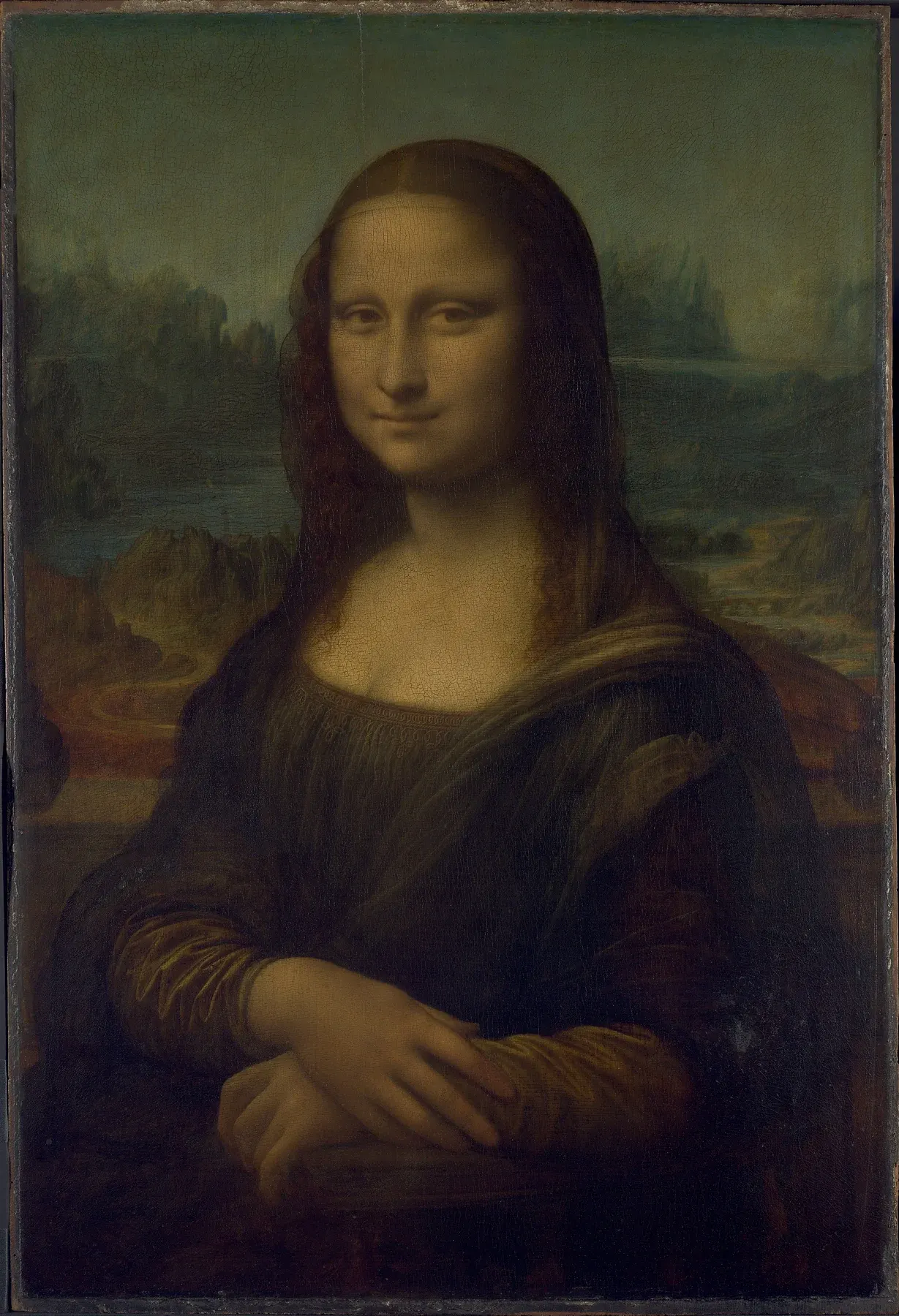
Leonardo da Vinci, Mona Lisa (c. 1503–1519) · Musée du Louvre, Paris · public domain · Wikimedia Commons (C2RMF)
Shadows That Blur Without Lines
There is a name for the way this face is painted. Sfumato is a technique of painting where, instead of drawing outlines, you blend smoothly from light to dark like smoke. In Leonardo's paintings, this technique gives flesh a "smoky" look, and the contours are so subtle that they seem to have no hard edges (DOI: 10.1017/s1062798712000348). It was already a celebrated craft by the 16th century (DOI: 10.1017/s1062798712000348).
Two more words are needed to explain what that shadow is made of. Pigment is the fine powder that gives paint its color. What the powder and the oil each do is covered in "Paint and Materials — The Same Powder, Different Doughs". Glaze is a thin, transparent layer of paint brushed on top so that the color underneath shows through.
Near the end of the 15th century, Italian painters adopted the glazing technique of Flemish painters (from around present-day Belgium) to bring depth and three-dimensionality to their paintings. Those glazes were very thin, see-through layers, rich in oil and poor in pigment (DOI: 10.1017/s1062798712000348). The same paper cites Leonardo's shadows as a prime example, concluding that the sfumato he used was a technique built on these glazes (DOI: 10.1017/s1062798712000348). Another painting that created light by layering thin coats was covered in "Girl with a Pearl Earring — Light Built in Layers, a Name Not Asked".
Translating this explanation to standing in front of the painting looks like this. According to this explanation, the transition from the cheek to the shadow is created by an accumulation of thin coats through which the underlying color shows. Leonardo's shadows have been explained by this layering. What a study that directly measured the Mona Lisa saw regarding that explanation is the next question.
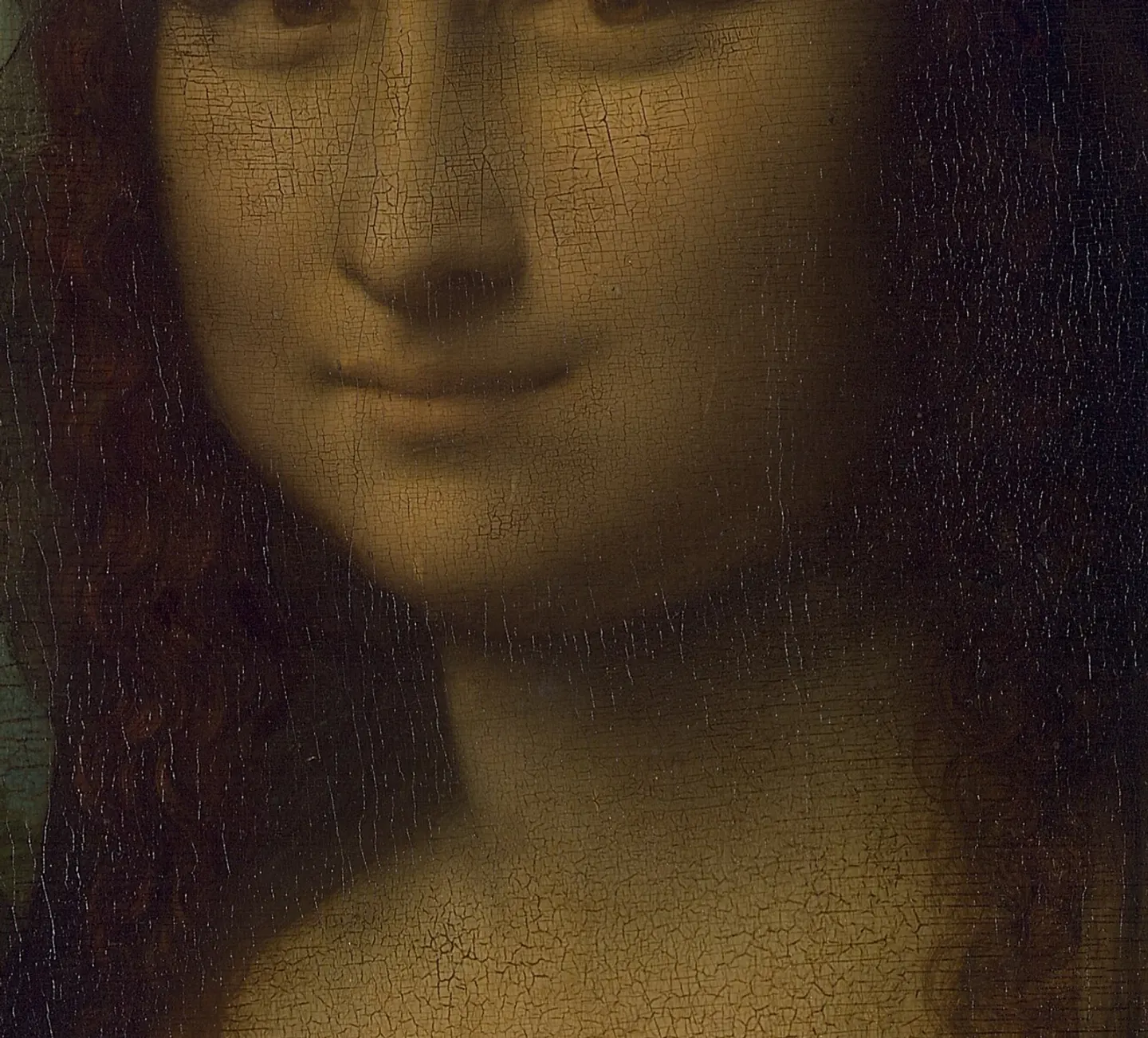
Detail · Leonardo da Vinci, Mona Lisa (c. 1503–1519) · Musée du Louvre, Paris · public domain · Wikimedia Commons (C2RMF)
100 Million Lights Measured from the Mona Lisa
100 million records measuring the light bounced off the surface of the Mona Lisa, split by color, have been collected (DOI: 10.1364/ao.47.002146). In 2008, a camera taking pictures separately in multiple colors recorded the intensity at every point on the painting's surface. This was a measurement where nothing was removed from the painting. The authors state that this measurement is intended to capture the flesh-tone technique, namely sfumato, but which spot on the painting the values were measured from does not appear in the abstract.
The research team first obtained a view calculated to peel away the transparent protective layer covering the very top of the painting. Two things emerged from underneath it. One was that a single brown pigment called umber was read in the upper layer. The other was that a peak appeared where the value measuring how deep and vivid a color is shot up unusually high. The authors view both of these features as characteristics of the glaze technique (DOI: 10.1364/ao.47.002146).
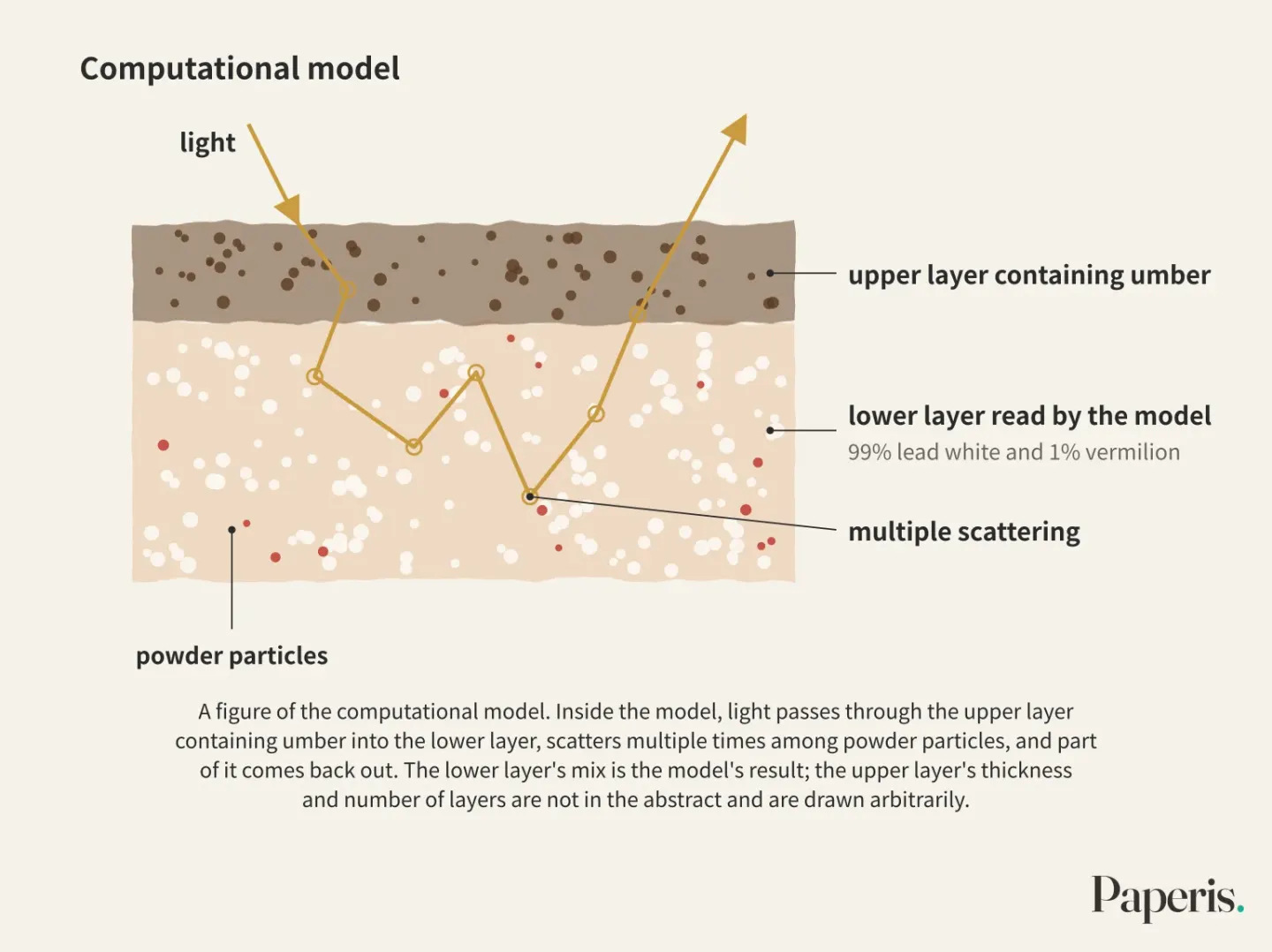
The research team added a computational model to this. This is a model that calculates the path of light entering into the painted layers, bumping into powder particles and scattering, and then coming back out again. This model re-confirmed the peak of deep and vivid color and the umber in the upper layer, and also produced the mixture of the layer underneath (DOI: 10.1364/ao.47.002146). Lead white is a white pigment made from lead. The lower layer read by the model was a mixture of 99% lead white and 1% of the red pigment vermilion (DOI: 10.1364/ao.47.002146). Read through the model, this means that a pale flesh tone made by mixing a tiny bit of red into white is laid underneath.
Let us follow the path drawn by this model as a single ray of light. Inside the model, light passes through the upper layer containing umber, goes down into the lower layer, bounces and scatters multiple times among the powder particles inside the painted layers, and then part of it comes back out. The authors explain that peak of deep and vivid color through this multiple scattering (DOI: 10.1364/ao.47.002146). Which layer the light mainly scatters in, which spot on the painting that peak belongs to, and whether the upper layer is a single layer or multiple layers do not appear in the abstract.
In the light measured from the Mona Lisa, a single umber is read in the upper layer and a peak where the depth and vividness of the color shoots up unusually high appears, and the authors view both of these as characteristics of the glaze technique. The computational model additionally read the lower layer as a blend of 99% lead white and 1% vermilion. To the explanation of "shades built in layers" in the previous section, this measurement and model attach the names of the materials on the Mona Lisa. The thickness of the upper layer is not written down as a value in the abstract of this study.
Seven Faces Through X-Rays
Seven faces painted by Leonardo were measured all at once in 2010 using a different method. X-ray fluorescence analysis is a method of shooting X-rays at a painting and measuring the light that bounces back differently for each element to find out which elements are present in that spot. This study measured the faces of seven Leonardo paintings with this analysis without touching the paintings, revealing how paint layers were stacked up in sfumato (DOI: 10.1002/anie.201001116). A 2013 paper also notes that seven Leonardo paintings housed in the Louvre Museum were measured using X-ray fluorescence (DOI: 10.1017/s1062798712000348). Whether both abstracts are describing the exact same measurement cannot be confirmed from the abstracts alone.
X-ray fluorescence analysis is widely used to identify which pigments are present. However, in structures where layers are piled on top of each other like paintings created on an easel, it is very difficult to interpret the values quantitatively (DOI: 10.1017/s1062798712000348). Even so, the authors of the 2013 paper write that in addition to which pigments were used, they obtained depth-direction information on how Leonardo built up his shadows (DOI: 10.1017/s1062798712000348).
Placing the seven works side by side, the 2010 study reports that significant diversity was clearly visible in Leonardo's technique (DOI: 10.1002/anie.201001116). The 2013 paper notes that by comparing the paintings against one another, it pinpointed unique characteristics of Leonardo's technique (DOI: 10.1017/s1062798712000348).
A study measuring seven faces painted by the same artist also reported great diversity in his technique. What that diversity consists of does not appear in the two-sentence abstract, but if techniques are not bound to a single approach even within a single artist, it is difficult to transplant the number of layers or materials measured from other Leonardo paintings over to those of the Mona Lisa. These two abstracts do not list individually which paintings the seven works are, nor do they record the values obtained separately from the Mona Lisa's face or the thickness of each individual layer. To talk about the Mona Lisa's face, we must return to the results measured directly from the Mona Lisa.
At the Very Bottom, the Layer Covering the Wooden Panel
Beneath the layers of paint lies the layer that supports the entire painting. The ground layer is the layer spread evenly across the entire surface before painting on a canvas or wooden panel. In 2023, a tiny sample from the ground layer of the Mona Lisa was analyzed (DOI: 10.1021/jacs.3c07000). The researchers looked at this sample using two methods. One is an analysis using a large accelerator facility that produces very bright X-rays, reading the angles at which crystals bend and emit X-rays to find out what crystals are contained. The other is an analysis that shines infrared light to see the chemical state of the oil.
The oil in the sample had undergone a strong reaction where lead-rich parts turned like soap, and the white lead within it contained little cerussite, one of the main crystals making up white lead (DOI: 10.1021/jacs.3c07000). What stood out most was something else. Plumbonacrite is a rare lead compound that remains stable only in an alkaline environment. Alkalinity is the opposite side of acidity, the property toward lye or soapy water. This rare compound was found in the sample from the Mona Lisa's ground layer (DOI: 10.1021/jacs.3c07000).
Putting these results together, the researchers propose a hypothesis. They hypothesize that Leonardo likely treated the oil by adding a large amount of lead oxide, specifically lead monoxide, to make a thick paint suitable for covering the Mona Lisa's wooden panel (DOI: 10.1021/jacs.3c07000). The researchers looked for mentions of lead monoxide in Leonardo's handwritten manuscripts and later translations, and note that the information obtained from them was ambiguous (DOI: 10.1021/jacs.3c07000).
The same study looked at another painting. These are fragments that fell from the mural The Last Supper in Milan. There, two crystal forms of lead monoxide, litharge and massicot, appeared together, along with lead compounds called plumbonacrite and shannonite. The researchers report that these fragments confirm lead monoxide was Leonardo's material, and note that shannonite was detected for the first time in a historical painting (DOI: 10.1021/jacs.3c07000). This is a result from a painting other than the Mona Lisa, and a mural at that.
What the abstract reported from the Mona Lisa's ground layer sample is lead-rich oil that turned like soap and plumbonacrite, and that lead monoxide was added to make a thick paint is the researchers' hypothesis drawn from that result. The lead monoxide crystals supporting that hypothesis came from fragments of another painting. And the results on the Mona Lisa side were all obtained from a single small sample of the ground layer.
The Wooden Panel Supporting the Paint
All the layers of paint rest on a single wooden panel. According to a presentation report published in 2011, Leonardo painted this picture between 1503 and 1514, and the panel is made of white poplar, a type of poplar wood, measuring roughly 79 by 53 centimeters and about 13 millimeters thick (DOI: 10.13140/2.1.1021.1525). This panel is not flat and is warped in two directions at once. There is also an 11-centimeter-long crack running all the way through the thickness of the panel, which may have formed not long after the painting was made and is firmly locked with the warped shape into which the panel has set (DOI: 10.13140/2.1.1021.1525).
The panel is fitted into an oak frame. Four crossbars spanning the panel press it slightly toward the frame, holding the panel flatter than it would rest if nothing were holding it (DOI: 10.13140/2.1.1021.1525). Although the display case housing the painting strictly controls the climate, small changes in temperature and humidity are unavoidable, and those changes create tiny warps in the panel (DOI: 10.13140/2.1.1021.1525). This means the panel beneath the paint moves slightly in response to the surrounding humidity.
Measuring this movement began in 2004. As the painting was about to be moved to a new display case, curators at the Louvre asked an international research team composed of wood science and optical measurement experts four questions: Are the climate standards of the new display case appropriate? What is the risk that the old crack will grow further? How can the frame holding the panel be repaired? How can current monitoring methods be improved (DOI: 10.13140/2.1.1021.1525) (DOI: 10.4000/11v48)? When the display case is opened once a year, the team manually measures the weight and shape of the panel and the force exerted by the crossbars, and automatically records the warping of the panel and the force of the bars while it remains inside the display case (DOI: 10.13140/2.1.1021.1525).
The research team translated these measurements into a calculation model. The 2011 presentation report, carrying over the results from a book published in 2006, notes that a model calculating how heat and humidity move through the panel successfully predicted the tendency of the panel to warp, and that the risk of the crack growing was also evaluated using this model (DOI: 10.13140/2.1.1021.1525). A 2020 paper notes that by gathering observation and non-invasive testing data, they created a "digital twin" of this panel—a numerical simulation predicting the movement of the panel according to humidity—and used it to compare two ways of fitting the panel into the frame. Because the two methods could not be compared directly as they were, the researchers newly proposed a method to transfer both results onto a single framework for comparison (DOI: 10.1088/1757-899x/949/1/012089). Which of the two methods was better does not appear in that abstract.
A 2024 paper summarizes the results gathered so far. It obtained the elasticity values of the panel wood, evaluated the spots where the panel and frame touch and the forces at those spots, and proposed ways to repair the frame (DOI: 10.4000/11v48). The conclusion the authors write at the end of the abstract returns to the story of the paint. The main deformation pattern of the panel calculated by the model corresponds to the pattern of fine cracks running like a net across the paint layer, and the risk of the crack growing can be evaluated with this model (DOI: 10.4000/11v48). Exactly what that risk is does not appear as a numerical value in these abstracts.
The paint of the Mona Lisa rests on a wooden panel that moves slightly according to humidity, and since 2004 the research team has measured the shape and forces of the panel every year while evaluating the risk of the crack growing using a calculation model. The result that the deformation pattern of the panel calculated by the model corresponds to the fine crack pattern of the paint layer shows once again that the layers of paint and the panel beneath them are the top and bottom of a single picture. Whether the movement of the panel caused the fine cracks is not stated by these abstracts.
A Copy Painted Layer by Layer Again
If measurements tell us about the materials layer by layer, how can we know in what order those layers were built up? A 2014 paper chose a different path. Based on previously published analysis results and historical records of the painting, the author directly painted a copy of the Mona Lisa using materials the same as, or at least comparable to, those Leonardo used (DOI: 10.4000/ceroart.3828). The purpose was to put forward ideas on how the paint layers accumulated at various stages as the painting progressed, and the author discusses the meticulous methods applied at each step to achieve the effect of sfumato (DOI: 10.4000/ceroart.3828).
This is an attempt made through a replica copy. The order obtained while painting the copy is one person's proposal connecting measurement results and old records, and is of a different grade from values measured on the original. The abstract does not state how many stages there were or what each one was.
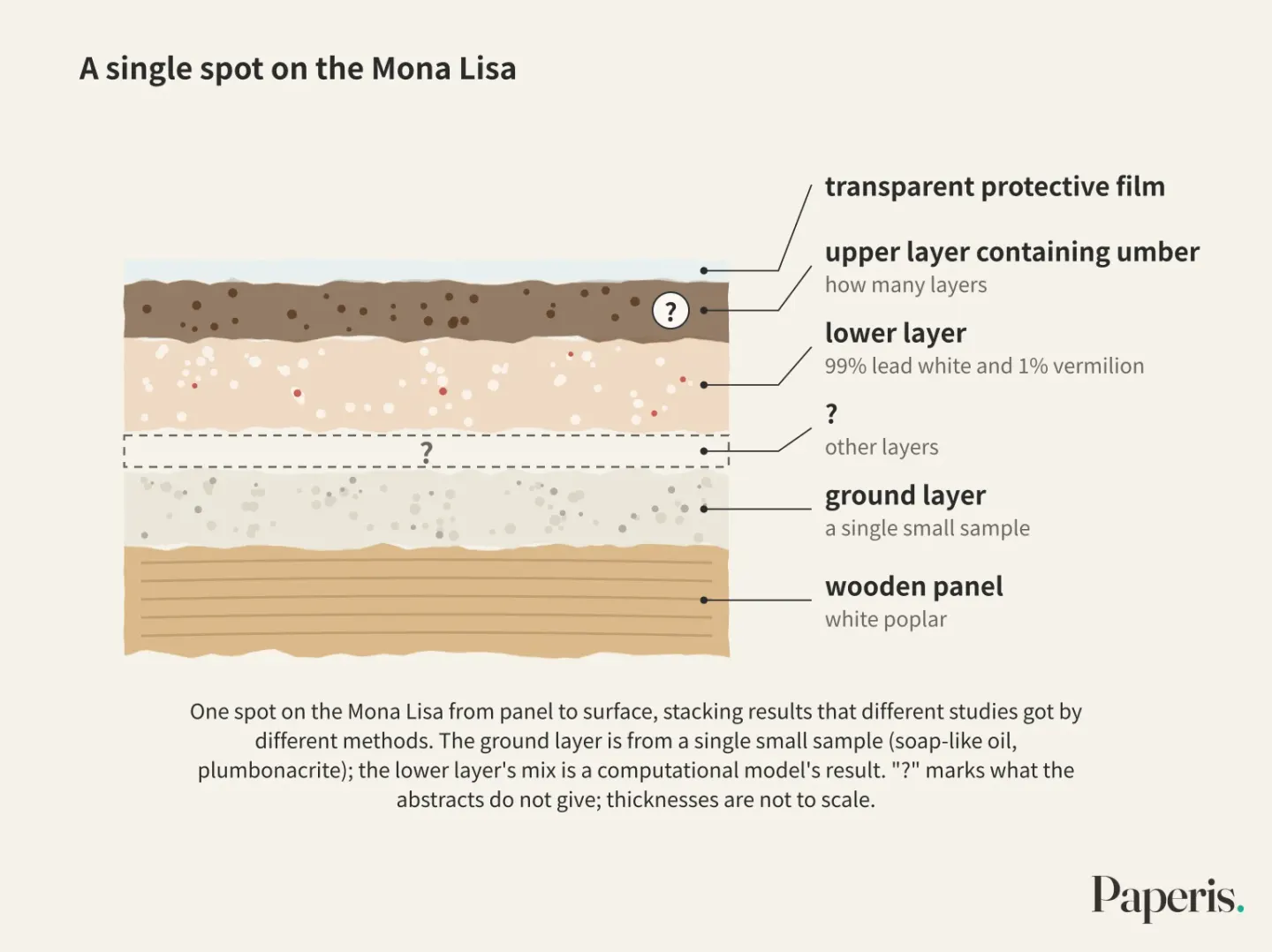
Using only the facts cited up to here, let's trace a single spot on the Mona Lisa from the wooden panel all the way to the surface. At the very bottom is a wooden panel made of white poplar, roughly 13 millimeters thick, which warps ever so slightly depending on moisture (DOI: 10.13140/2.1.1021.1525). A ground layer covers it, and the ground layer sample contained lead-rich soap-like oil and plumbonacrite (DOI: 10.1021/jacs.3c07000). In a 2008 study that attempted to read the technique used for painting flesh tones, a computational model read a lower layer made of 99% lead white and 1% vermilion, and above that, an upper layer containing umber was read (DOI: 10.1364/ao.47.002146). The 2008 authors view the umber in this upper layer and the saturation peak as characteristics of the glazing technique, and a 2013 paper describes the glaze of that era as a layer with much oil and few pigments through which the underneath shows (DOI: 10.1017/s1062798712000348). Values measuring the ratio of oil and pigment in the upper layer of the Mona Lisa are not in these abstracts. At the very top, a transparent protective film covers it, and the 2008 measurement calculated it away to read underneath (DOI: 10.1364/ao.47.002146).
There are blanks in this cross-section. Whether there are other layers between the ground layer and the lower layer, or how many times the upper layer was reapplied, do not appear in these abstracts. The results of the ground layer and the results of the 2008 light measurement were obtained by different studies using different methods, and this cross-section simply stacks the two side by side.
Remaining Questions
If we gather what the measurements have answered, it is this. The light measurements and calculation models saw an upper layer containing brown pigment and a pale flesh-colored lower layer read through the model in the Mona Lisa, and a single small sample of the ground layer yielded oil high in lead and a rare lead compound. When widened to Leonardo's other paintings, there are also reports that a large diversity was seen in his technique.
There are also three things left unanswered. The first is the thickness and number of the layers. The abstracts followed by this article do not write down as figures how many layers the Mona Lisa's upper layer is and how thick it is. The second is the order of the layers as a whole. The measurements told us the materials of some layers, and the step-by-step order connecting between them is a proposal put forward by the replica. The third is the lead monoxide in the ground layer. That Leonardo intentionally put it in is the research team's inference, and his manuscript answers that question only ambiguously (DOI: 10.1021/jacs.3c07000).
And there is one question that measurements cannot reach from the start. Why Leonardo painted this face in layers without lines. The materials of the layers and the scattering of light tell us how the shadows formed, but they do not tell us what he hoped for in painting them that way.
What the measurements and models told us is part of what several layers of the Mona Lisa are made of, and why Leonardo painted them that way lies outside of that. The shadows that blur without lines are still inside those layers, and research is in the middle of reading those layers one story at a time.
Source Papers
- "X-ray and Infrared Microanalyses of Mona Lisa's Ground Layer and Significance Regarding Leonardo da Vinci's Palette" (2023) — DOI: 10.1021/jacs.3c07000 — Analyzed a single micro-sample of the Mona Lisa's ground layer using synchrotron X-ray diffraction and micro-infrared spectroscopy. Strongly saponified lead-rich oil, cerussite with little lead white, and plumbonacrite, which is stable only in alkaline environments. The assumption that Leonardo treated oil with lead monoxide to make a thick paint to cover the wooden panel; the manuscript's mention is ambiguous. In the Last Supper fragments: litharge, massicot, plumbonacrite, and shannonite (first time in a historical painting).
- "Multispectral camera and radiative transfer equation used to depict Leonardo's sfumato in Mona Lisa" (2008) — DOI: 10.1364/ao.47.002146 — 100 million reflection spectra from the Mona Lisa, varnish removed by calculation, single umber pigment in the upper layer and a distinct maximum in saturation (both characteristics of the glaze technique). A radiative transfer model confirms this and suggests the lower layer is 99% lead white and 1% vermilion, explaining the saturation maximum through multiple scattering.
- "Revealing the sfumato Technique of Leonardo da Vinci by X-Ray Fluorescence Spectroscopy" (2010) — DOI: 10.1002/anie.201001116 — Revealed the paint layer-building method of sfumato on the faces of seven paintings by Leonardo using non-invasive X-ray fluorescence analysis, showing great diversity in technique.
- "Chemical Analysis and Painted Colours: the Mystery of Leonardo's Sfumato" (2013) — DOI: 10.1017/s1062798712000348 — Exploration of oil paints by late-15th-century Italian painters and Flemish-style glazing (thin and transparent, high medium and low pigment); sfumato is glaze-based, giving skin tones a smoky appearance and contours without hard edges, famous since the 16th century. X-ray fluorescence measurements of seven Louvre paintings; quantitative interpretation of layer structure is difficult, but depth information for shadow modeling and comparison between paintings reveal unique characteristics.
- "Experimental studies on the wooden support of the "Mona Lisa"" (2011) — DOI: 10.13140/2.1.1021.1525 — Presentation material (registered on ResearchGate). Created between 1503 and 1514, white poplar panel approximately 79 × 53 cm and about 13 mm thick, double curvature, a crack about 11 cm piercing the thickness (may have formed not long after production), oak frame with four crossbars, four questions from the Louvre in 2004, manual measurements and automated monitoring every year, small temperature and humidity changes in the display case cause tiny deformations, heat and moisture models well predict the warping tendency, crack propagation risk assessment, research ongoing.
- "Learning from Objects: the use of advanced numerical methods … for the Mona Lisa's Digital-Twin" (2020) — DOI: 10.1088/1757-899x/949/1/012089 — Created a hygro-mechanical numerical simulation (digital twin) of the panel using observation and non-invasive testing data, and developed a projection technique (PMC) comparing two frame conditions. Comparison results are not in the abstract.
- "Combining engineering and wood science for the conservation of artworks: Hygro-mechanical study of Mona Lisa's wooden support" (2024) — DOI: 10.4000/11v48 — International research team since 2004, display case climate criteria, crack propagation risk, frame improvement, monitoring. Direct measurements, continuous monitoring, finite element model. Elastic values, contact locations and forces, frame improvement proposals. Conclusion: The panel's peripheral deformation pattern corresponds to the paint layer's craquelure pattern, and crack propagation risk assessment is possible.
- "Paint handling in Leonardo's Mona Lisa: guides to a reconstruction" (2014) — DOI: 10.4000/ceroart.3828 — Painted a replica of the Mona Lisa using identical or equivalent materials based on published analytical results and historical data, discussing step-by-step paint layer buildup and the process for achieving sfumato (reconstruction copy).
Sources (8)
- X-ray and Infrared Microanalyses of Mona Lisa's Ground Layer and Significance Regarding Leonardo da Vinci's PaletteDOI 10.1021/jacs.3c07000
- Multispectral camera and radiative transfer equation used to depict Leonardo's sfumato in Mona LisaDOI 10.1364/ao.47.002146
- Revealing the sfumato Technique of Leonardo da Vinci by X-Ray Fluorescence SpectroscopyDOI 10.1002/anie.201001116
- Chemical Analysis and Painted Colours: the Mystery of Leonardo's SfumatoDOI 10.1017/s1062798712000348
- Experimental studies on the wooden support of theDOI 10.13140/2.1.1021.1525
- Learning from Objects: the use of advanced numerical methods … for the Mona Lisa's Digital-TwinDOI 10.1088/1757-899x/949/1/012089
- Combining engineering and wood science for the conservation of artworks: Hygro-mechanical study of Mona Lisa's wooden supportDOI 10.4000/11v48
- Paint handling in Leonardo's Mona Lisa: guides to a reconstructionDOI 10.4000/ceroart.3828