Paperis Articles
Munch's The Scream — The c. 1910 Version's Yellow, Moisture and Chlorine
Why the cadmium yellow in the c. 1910 Scream at the Munch Museum is turning off-white, traced through a study that combined the painting, a microsample and mock-up paints and pointed to moisture and chlorine compounds, and another that looked at the pigment's particles — and which version of the picture each result is about.
Your field's papers, as audio
Pick your fields and journals — Paperis summarizes the key papers and turns them into audio. Listen on your commute.
Start Paperis free →Munch's The Scream — The c. 1910 Version's Yellow, Moisture and Chlorine
Around 1910, The Munch Museum's The Scream
The Norwegian painter Edvard Munch first painted The Scream in 1893. It is a painting of a person clasping their face with both hands and opening their mouth on a path along a bay leading to the sea, beneath a fiery sunset. Munch did not stop at a single instance of this scene. The 1893 painting on cardboard is now in the National Museum in Oslo, there are also boards drawn with crayon and pastel, several printed lithographs, and around 1910 he painted the same scene again. Editions are individual paintings where the artist has recreated the same scene. Therefore, when speaking of The Scream, one must first specify which edition it is.
The protagonist of this article is the plate painted around 1910, held by the Munch Museum in Oslo (DOI: 10.25250/thescbr.brk481). In this edition, a few spots that were once a vivid yellow have faded to a whitish hue, and the paint has begun to lift in places. A 2020 article in C&EN, a science news magazine published by the American Chemical Society, reports that because of this change, the painting has rarely been brought out before the public to prevent further damage (DOI: 10.1021/cen-09819-scicon4). An explanatory text written directly in 2021 by the researchers who analyzed this edition also notes that it is rarely exhibited due to this property of the painting deteriorating (DOI: 10.25250/thescbr.brk481).
This article holds onto a single yellow of this edition. That yellow is what it was made of, and what causes it to fade to a whitish hue. The anxiety contained in the painting or Munch's mind is not the subject of this article, and stories surrounding the painter's mental health were covered in "Genius and Madness — The Thin Sheet Between Them". Direct measurements of The Scream are of only this single edition from around 1910 at the Munch Museum, and whenever a researcher's newly made test paint, commercially available modern oil paint, another painter's work, or the result of a mathematical model rather than a specific painting appears, it is stated as such.
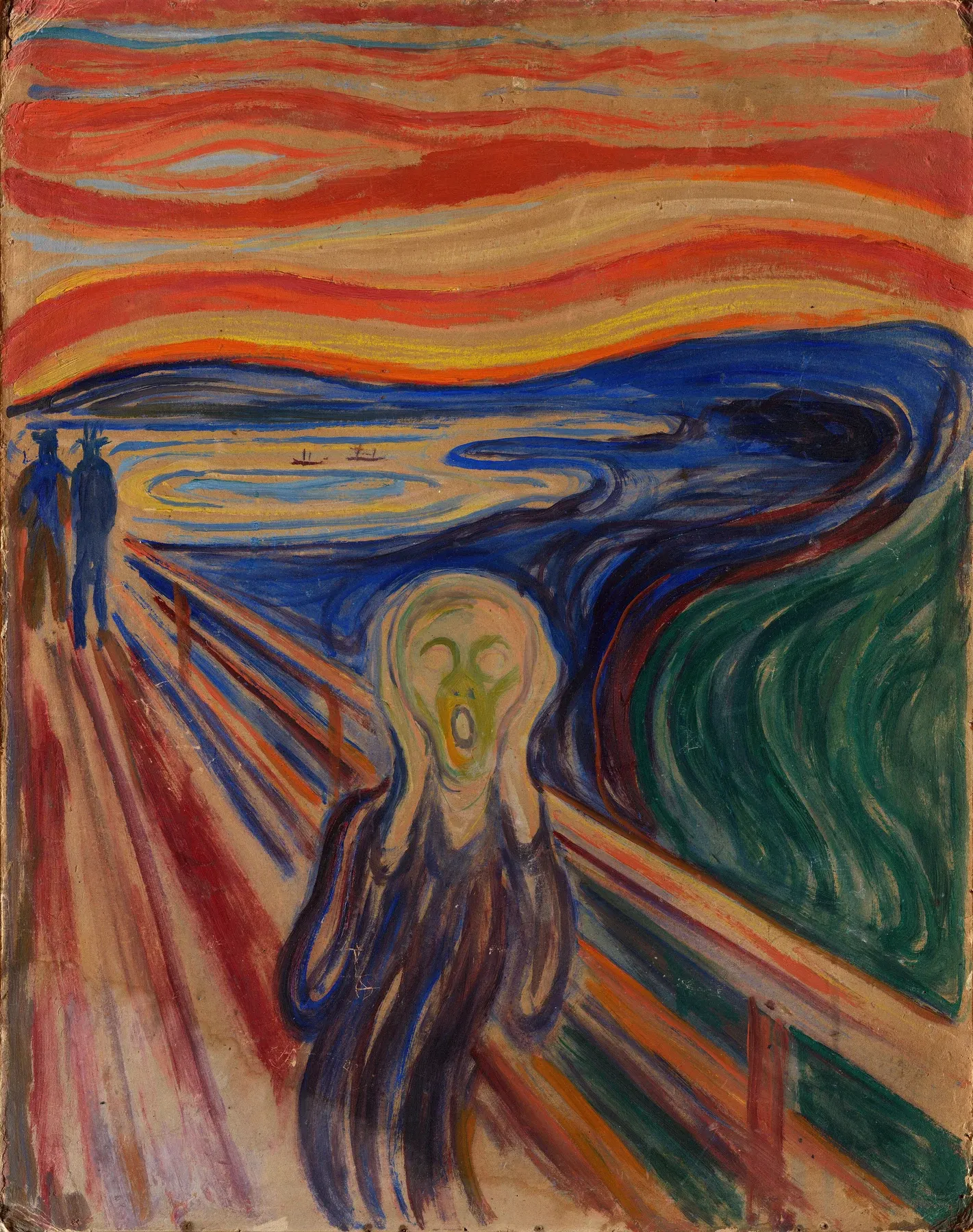
Edvard Munch, The Scream (c. 1910 version) · Munch Museum, Oslo · public domain · Wikimedia Commons (Google Arts & Culture) — the version this article discusses
The Munch Museum's The Scream from around 1910 is a painting whose yellow has faded and lifted, leading to it being rarely exhibited up to the 2020 and 2021 data, and all results of directly measuring The Scream in this article belong to this single edition.
The Name of Yellow, Cadmium Yellow
Paint colors come from pigments. Pigments are fine powders that give paint its color. The powder that made that yellow in The Scream is cadmium yellow (DOI: 10.1126/sciadv.aay3514). Cadmium yellow is a yellow pigment based on a compound of cadmium and sulfur, which is cadmium sulfide. Pigments where some of the cadmium is replaced by zinc also belong to this same family (DOI: 10.1002/chem.201801503).
This pigment has been widely used by painters since the late 19th century (DOI: 10.1002/chem.201801503). Cadmium sulfide yellow, with its intense color, was an important color in the palettes of late 19th- and early 20th-century painters such as the Dutch painter Vincent van Gogh, the Spanish painter Pablo Picasso, the French painter Henri Matisse, and Munch (DOI: 10.48550/arxiv.1909.01933).
Cadmium yellow was considered a stable pigment. However, a 2018 paper noted that this yellow is changing color in famous paintings like Matisse's Le bonheur de vivre, Van Gogh's Flowers in a Blue Vase, and Munch's The Scream, and it points to the formation of cadmium sulfate carrying water molecules as the most likely cause (DOI: 10.1002/chem.201801503). The abstract of this paper does not specify which version of The Scream it refers to. Cadmium sulfate is a compound formed when cadmium sulfide combines with oxygen. The same paper noted that what drives this breakdown and how those factors act throughout the entire process had not been known until then (DOI: 10.1002/chem.201801503). A preprint published in 2019 summarizes that the cadmium yellow in paintings of this era is severely fading, flaking, and discoloring, and that this phenomenon is related to reactions that cadmium sulfide undergoes with oxygen, moisture, and the paint's binder with the help of light (DOI: 10.48550/arxiv.1909.01933).
What pigments and binders are, and how the same powder changes depending on what kind of dough it goes into, were covered in "Paint and Materials — The Same Powder, Different Doughs". The changes experienced by another yellow of the same era, chrome yellow, can be found in "Van Gogh's Sunflowers — The Shadow Settling on the Yellow".
To sum up, the factors driving this breakdown were unknown until 2018, and the 2019 preprint pointed to oxygen, moisture, and the binder together in a reaction aided by light. What the core factor was in The Scream around 1910 came from a 2020 study that examined that version directly.
Paintings, Samples, and Replica Paints
Around 1910, the research team behind the original paper on The Scream looked at three things together (DOI: 10.1126/sciadv.aay3514). The first is non-invasive spectroscopic measurement, which measures a wide range of the image on the spot without removing the painting from its place. Spectroscopic measurement is a method of finding out the components of a substance by shining light on it and looking at the light that returns. The second is an analysis of a tiny sample taken from the painting, examined with extremely bright X-rays produced by a particle accelerator facility. The third is not the painting, but replica paint newly made and artificially aged by the researchers. Replica paint is test paint newly made by researchers to mimic the paint of old paintings.
This research was led by researchers Costanza Miliani and Letizia Monico of the National Research Council of Italy (DOI: 10.1021/cen-09819-scicon4), and the results were published in 2020 in the academic journal Science Advances (DOI: 10.1126/sciadv.aay3514).
First, it was revealed what the yellow turned into. Cadmium sulfate and sulfites—another form in which sulfur combines with oxygen—were identified as substances created by the transformation of the original cadmium sulfide paint (DOI: 10.1126/sciadv.aay3514). Next is the cause. As a result of looking at the painting, samples, and replica paints together, the key factors driving the oxidation of cadmium sulfide were reported to be moisture and chlorine compounds moving within the paint, with light playing a less important role (DOI: 10.1126/sciadv.aay3514). The concluding sentence of the abstract presents the findings by combining the three methods, and does not separately record which results came from which method. In addition, when exposed to moisture, a reaction in which water-soluble paint components dissolved, migrated through the paint layer, and then re-crystallized was also associated with the formation of cadmium sulfate (DOI: 10.1126/sciadv.aay3514).
An article in C&EN goes on to report that this oxidation is the cause of the yellow becoming whitish and the paint lifting (DOI: 10.1021/cen-09819-scicon4). Regarding light, different articles express things differently even when discussing the same study. An explanation written directly by the researchers for general readers stated, "The main factor is moisture, not light" (DOI: 10.25250/thescbr.brk481), and the article wrote that the researchers found "light plays no role" (DOI: 10.1021/cen-09819-scicon4). The abstract of the original paper wrote "a less important role." Going by the abstract, light is a less important factor compared to moisture and chlorine compounds, but it was not said to have no share at all.
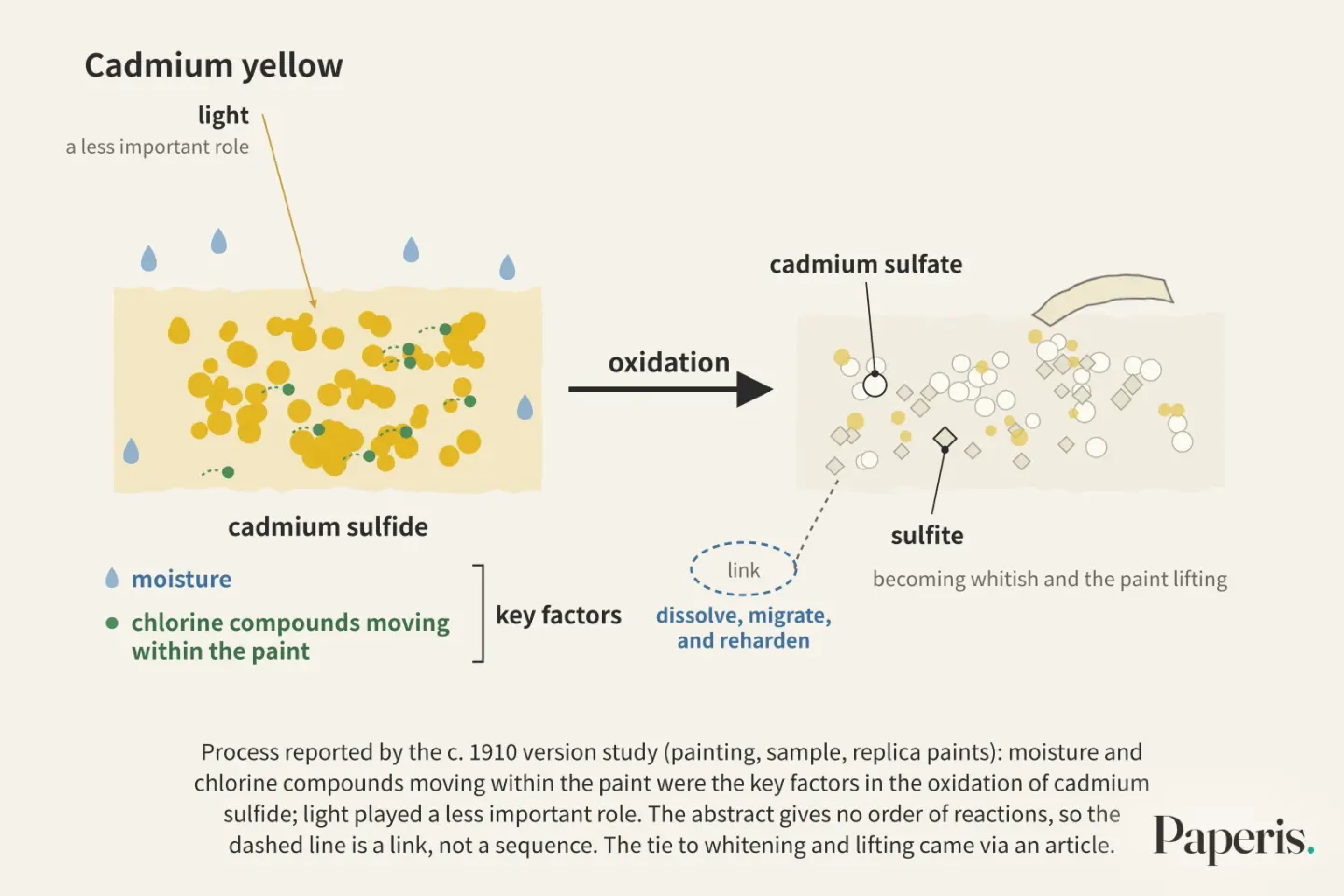
The meaning these results hold for readers is as follows. The whitish fading of the yellow in The Scream is a chemical reaction in which the yellow compounds inside the paint turn into other compounds, and the key factors reported to drive that reaction are moisture and chlorine compounds in the paint rather than light.
Experiments with Reconstituted Paint
The painting and its samples show the current state of a single version. To isolate causes by changing conditions, experiments outside the painting are necessary. Experiments that cannot be done with a real painting—such as intentionally humidifying it or exposing it to light—are instead conducted on reconstituted paint.
A 2018 study made reconstituted paint mixed in oil using two types of cadmium yellow (DOI: 10.1002/chem.201801503). One was cadmium sulfide, and the other had part of the cadmium replaced with zinc. The crystal structure was also divided into two types. These paints were then aged under light and dark conditions, with varying relative humidity. Relative humidity is a value indicating what percentage the moisture currently held is, compared to the maximum amount of moisture the air can hold at that temperature.
There were three results (DOI: 10.1002/chem.201801503). First, the side containing zinc was more vulnerable to light-driven oxidation, and both pigments could act as photocatalysts that help oxidize the surrounding oil. A photocatalyst is a substance that helps the chemical reactions of surrounding materials when exposed to light. Second, moisture pulled the trigger on the light-driven reaction where the yellow oxidizes into cadmium sulfate containing water molecules. Third, what substance it turned into depended on the aging conditions and the ratio of cadmium to zinc. Based on these results, the researchers proposed a reaction pathway for how the degradation process occurs, and concluded that this serves as a reliable foundation for understanding the degradation of the cadmium yellow paint in the painting and finding ways to preserve it better.
In this experiment, light and moisture were together within a single reaction. In the reconstituted paint, light-driven oxidation occurs, and moisture was the trigger that caused that oxidation. This result comes from an experiment using reconstituted paint, and its grade is different from what was measured in the around-1910 version of "The Scream".
In modern oil paints, moisture has also altered the oil that binds the color powder. A binder is a substance that holds pigment powders together and fastens them to the canvas, and in oil paints, oil pressed mainly from flaxseed does this job. A 2019 study tested modern oil paints from three companies that used cadmium sulfide or cadmium-zinc sulfide as their main pigments (DOI: 10.1038/s41598-019-41893-9). The authors note that this is the first study to examine the effect of relative humidity on modern oil paints. Paint layers aged naturally for 10 years were artificially aged again under low and high humidity, and the curing process of freshly applied paint was also observed across different humidity levels.
In paints aged under high humidity, more acid—which forms when oil oxidizes—was produced in all paints than under low humidity, more hydrolysis (where oil components break apart by reacting with water) also occurred, and the released fatty acids evaporated (DOI: 10.1038/s41598-019-41893-9). The authors' conclusion is that relative humidity has a clear effect on the chemical composition of paint. This is a result from modern paint, and it is not a measurement of the binder in "The Scream".
In the two experiments outside the painting, moisture altered both the yellow powder and the oil binding it. This points in the same direction as the result from "The Scream" study where moisture emerged as a key factor along with chlorine compounds, but both are results from reconstituted and modern paints.
Light-Sensitive Grains
Around 1910, the cadmium yellow of The Scream was looked at down to the atomic level. Researchers of a preprint published in 2019 viewed this pigment with an electron microscope equipped with a new detector (DOI: 10.48550/arxiv.1909.01933). This is because with ordinary light or X-ray analysis, the components in the paint are mixed more finely than the equipment can distinguish, making it difficult to know the physical state of the pigment grains (DOI: 10.48550/arxiv.1909.01933).
As a result, the cadmium sulfide pigment seen in this version was a clump of defect-rich nanoparticles roughly 5 to 10 nanometers in diameter (DOI: 10.48550/arxiv.1909.01933). A nanoparticle is a tiny grain whose size is measured in nanometers, with 1 nanometer being 1 billionth of a meter. The researchers note that it is known from similar particles used today as photocatalysts that such particles are inherently vulnerable to light. They consider that chlorine mixed into the particles and a mixed crystal structure where atoms do not stack in a single fixed way further increase this sensitivity to light (DOI: 10.48550/arxiv.1909.01933). The researchers saw the same unstable structure in another painting, Matisse's 1906 painting Flower Piece.
The conclusion of this preprint looks ahead. It states that knowing the nano-sized structure and impurities can be used to predict which paintings are most at risk of oxidation by light and to establish the most effective conservation strategies (DOI: 10.48550/arxiv.1909.01933). The judgment that it is "inherently vulnerable to light" borrows knowledge known from photocatalyst particles today, and that the crystal structure mixed with chlorine increases sensitivity is the judgment of this preprint. The results measuring how much the painting has faded due to light are not in this abstract.
There is one more result seen in another painting. A 2024 conference abstract froze cadmium yellow detached from the 1906 version of Matisse's Flower Piece, sliced it even thinner, and looked at it with an electron microscope (DOI: 10.1093/mam/ozae044.057). The paint was a clump of nanoparticles roughly 5 nanometers in diameter, and regions with different crystal structures were in contact even within a single grain. This abstract notes that cadmium sulfide is a photocatalyst that reacts to visible light, and citing previous research that such boundaries enhance photocatalytic action in similar substances, it considers that the structure of the particles may be important for the rate of decomposition. This is a result from Matisse's painting, not The Scream, and as a conference abstract, the weight of the evidence is also light.
So the evidence currently laid out regarding the yellow of The Scream measured different things. The original paper looked at the painting and its sample from the around-1910 version along with recreated paint made by the researchers, and picked out moisture and chlorine compounds as key factors, with light as a less important factor. The recreated paint experiment stated that oxidation involving light is triggered by moisture. The particle structure study that directly looked at the pigment of the same version interprets that the grains themselves are built to be vulnerable to light. The results measuring together in what proportions these three act within a single painting are not in the evidence cited here.
Regarding The Scream from around 1910, the research looking at oxidation factors through the painting, sample, and recreated paint points to moisture and chlorine compounds, while the research looking at the structure of the pigment grains points to a structure vulnerable to light — the two measured different things.
Following a Single Speck of Yellow
Now let's follow a single speck of yellow from the 1910 "The Scream". That yellow is a cadmium sulfide pigment, and as one preprint takes a look at, it is a clump made of defect-ridden grains measuring 5 to 10 nanometers across (DOI: 10.48550/arxiv.1909.01933). Inside that paint, there are also chlorine compounds that migrate through the paint layers (DOI: 10.1126/sciadv.aay3514).
According to the original paper's conclusion, moisture and chlorine compounds spur the oxidation of cadmium sulfide to produce cadmium sulfate and sulfite, and a reaction where water-soluble components dissolve, migrate, and reharden occurs alongside it nearby (DOI: 10.1126/sciadv.aay3514). This conclusion combines paintings, samples, and recreated paints, and does not even spell out the order of the reactions. Because of this oxidation, spots that were once a vivid yellow turn whitish and the paint flakes off in places, reports an article in “C&EN” (DOI: 10.1021/cen-09819-scicon4). According to that 2020 article, museums have hardly ever put this board out in front of the public so that the painting is not damaged further (DOI: 10.1021/cen-09819-scicon4).
These links all came from the same single study, and only the final link connecting oxidation to discoloration and flaking has come through an article. Neither the abstract of the original paper nor the preprint tells us what role the appearance of the grains plays in this chain.
The researchers wrote that this discovery would be used to protect paintings (DOI: 10.25250/thescbr.brk481). However, the abstract of the original paper does not write down preservation standards telling us what to do and how. The preprint, looking at the light-sensitive structure, writes that the same knowledge can be used to predict paintings at high risk of oxidation by light and to establish preservation strategies (DOI: 10.48550/arxiv.1909.01933).
There are also things that the abstracts cited here do not say with numbers. Standards that set preservation conditions numerically do not appear in these pieces of evidence either, nor does how many years from now and by how much this yellow will have faded at the current rate. A 2025 mathematical modeling study formulates the photocatalytic reaction of cadmium sulfide as equations where chemical processes and environmental factors are intertwined, and presents a computational method to simulate its progression under various situations (DOI: 10.1137/24m1709704). This study is a model dealing with cadmium yellow in general 19th-century paintings, and did not measure "The Scream".
The edition follows us right to the end as well. Let us suppose a visitor to Oslo stands in front of the 1893 "The Scream" owned by the National Museum. The results of directly measuring that painting are not in the evidence cited by this article. The evidence for this article is about the Munch Museum's c. 1910 edition, recreated paints, modern paints, Matisse's paintings, or a mathematical model not about a specific painting. Whether the 1893 edition, the crayon and pastel editions, and the lithograph used the same cadmium yellow and undergo the same things is not told by these pieces of evidence. If you transplant these results to a different edition with the same title, you end up diagnosing a painting that has never been measured.
While moisture and chlorine compounds have been reported as the key factors driving the oxidation of yellow in the Munch Museum's c. 1910 "The Scream", with light considered a less important factor, just how fast it happens and whether it applies to other editions still lie outside the evidence.
Source Papers
- "Probing the chemistry of CdS paints in The Scream by in situ noninvasive spectroscopies and synchrotron radiation x-ray techniques" (2020) — DOI: 10.1126/sciadv.aay3514 — Around 1910 version of "The Scream" (Munch Museum). In situ non-invasive spectroscopy on the painting + micro-sample synchrotron X-rays + artificially aged replica paints. Degradation products are cadmium sulfate and sulfite; moisture and mobile chlorine compounds are key drivers of CdS oxidation, light is less important; dissolution, migration, and recrystallization in moisture are linked to cadmium sulfate formation.
- "Saving the cadmium yellow pigments in The Scream" (2021) — DOI: 10.25250/thescbr.brk481 — Commentary written for general readers by researchers (Monico and Miliani). In situ non-invasive spectroscopy + synchrotron X-rays show that the main driver behind the decomposition of cadmium yellow in the around 1910 "The Scream" (Munch Museum) is moisture, not light; it is rarely exhibited due to its vulnerable nature; this will contribute to its preservation.
- "Saving The Scream from decay" (2020) — DOI: 10.1021/cen-09819-scicon4 — C&EN article (introducing the original Sci. Adv. 2020 paper). The yellow of the around 1910 version is turning whitish and flaking, almost never put out in front of the public; moisture and chlorides in the paint oxidize cadmium sulfide to cadmium sulfate, light plays no role (the original paper's abstract says "less important").
- "Role of the Relative Humidity and the Cd/Zn Stoichiometry in the Photooxidation Process of Cadmium Yellows (CdS/Cd1−xZnxS) in Oil Paintings" (2018) — DOI: 10.1002/chem.201801503 — Oil replica paint experiments. Zinc-containing ones are more vulnerable to photooxidation, both are photocatalysts for oil oxidation; photooxidation to moisture-bearing cadmium sulfate is triggered by humidity; products vary depending on conditions and ratios.
- "Revealing the nanoparticle composition of Edvard Munch's The Scream, and implications for paint alteration in iconic early 20th century artworks" (2019) — DOI: 10.48550/arxiv.1909.01933 — Preprint. The cadmium sulfide in the around 1910 "The Scream" is a clump of 5–10 nm defective nanoparticles; interpretation that chlorine and mixed crystal structures increase light sensitivity; the same structure is found in Matisse's "Flower Piece" (1906); can be used to predict light oxidation risks and for preservation strategies.
- "On the influence of relative humidity on the oxidation and hydrolysis of fresh and aged oil paints" (2019) — DOI: 10.1038/s41598-019-41893-9 — Modern oil paints from 3 companies containing cadmium (and zinc) sulfide. Increased dicarboxylic acids, increased hydrolysis, and evaporation of free fatty acids at high humidity; relative humidity has a clear effect on chemical composition.
- "Cryogenic FIB Lift-Out Reveals Atomic-Scale Photoactive Homojunctions in Cadmium Yellow Paint from Matisse's 'Flower Piece'" (2024) — DOI: 10.1093/mam/ozae044.057 — Conference abstract. The 1906 version of cadmium yellow in Matisse's "Flower Piece" is a clump of about 5 nm nanoparticles, crystal structure boundaries within a single particle, cadmium sulfide is a visible-light photocatalyst.
- "An Integro-Differential Model of Cadmium Yellow Photodegradation" (2025) — DOI: 10.1137/24m1709704 — Mathematical model of cadmium sulfide photocatalytic reactions, interaction of chemical processes and environmental factors, numerical methods for predicting various scenarios (not a specific painting).
Sources (8)
- Probing the chemistry of CdS paints in The Scream by in situ noninvasive spectroscopies and synchrotron radiation x-ray techniquesDOI 10.1126/sciadv.aay3514
- Saving the cadmium yellow pigments in The ScreamDOI 10.25250/thescbr.brk481
- Saving The Scream from decayDOI 10.1021/cen-09819-scicon4
- Role of the Relative Humidity and the Cd/Zn Stoichiometry in the Photooxidation Process of Cadmium Yellows (CdS/Cd1−xZnxS) in Oil PaintingsDOI 10.1002/chem.201801503
- Revealing the nanoparticle composition of Edvard Munch's The Scream, and implications for paint alteration in iconic early 20th century artworksDOI 10.48550/arxiv.1909.01933
- On the influence of relative humidity on the oxidation and hydrolysis of fresh and aged oil paintsDOI 10.1038/s41598-019-41893-9
- Cryogenic FIB Lift-Out Reveals Atomic-Scale Photoactive Homojunctions in Cadmium Yellow Paint from Matisse's 'Flower Piece'DOI 10.1093/mam/ozae044.057
- An Integro-Differential Model of Cadmium Yellow PhotodegradationDOI 10.1137/24m1709704