Paperis Articles
The Bilbao Effect — The Building on the Postcard, the City Outside It
After the Guggenheim Museum Bilbao opened in 1997, the hope that one building could revive a declining city spread worldwide. Studies show Bilbao's image changed alongside the transport and infrastructure investment and planning around it. For iconic projects chasing the Bilbao effect, assessments often find regeneration fell short of high expectations, though some buildings played other roles; studies of Bilbao's own neighbourhoods report gentrification pressure and more complex changes.
Your field's papers, as audio
Pick your fields and journals — Paperis summarizes the key papers and turns them into audio. Listen on your commute.
Start Paperis free →The Bilbao Effect — The Building on the Postcard, the City Outside It
A Metal Building on the Riverbank
In 1997, the Guggenheim Museum opened in Bilbao, a city in the Basque Country of northern Spain. It was a museum bearing the name of the Guggenheim Foundation, and the architect Frank Gehry designed it. The site was Abandoibarra, a plot of land along the Nervión River. A building made of a mass of curves wrapped in metal panels was placed on the riverbank. Since its opening in 1997, what role starchitect-designed architecture plays in revitalizing cities has been discussed together in academia and the media (DOI: 10.1080/09654313.2018.1465896). The story of curved buildings aiming for the pull at first glance was covered in "Curves — The Pull at First Glance, and the Conditions That Follow".
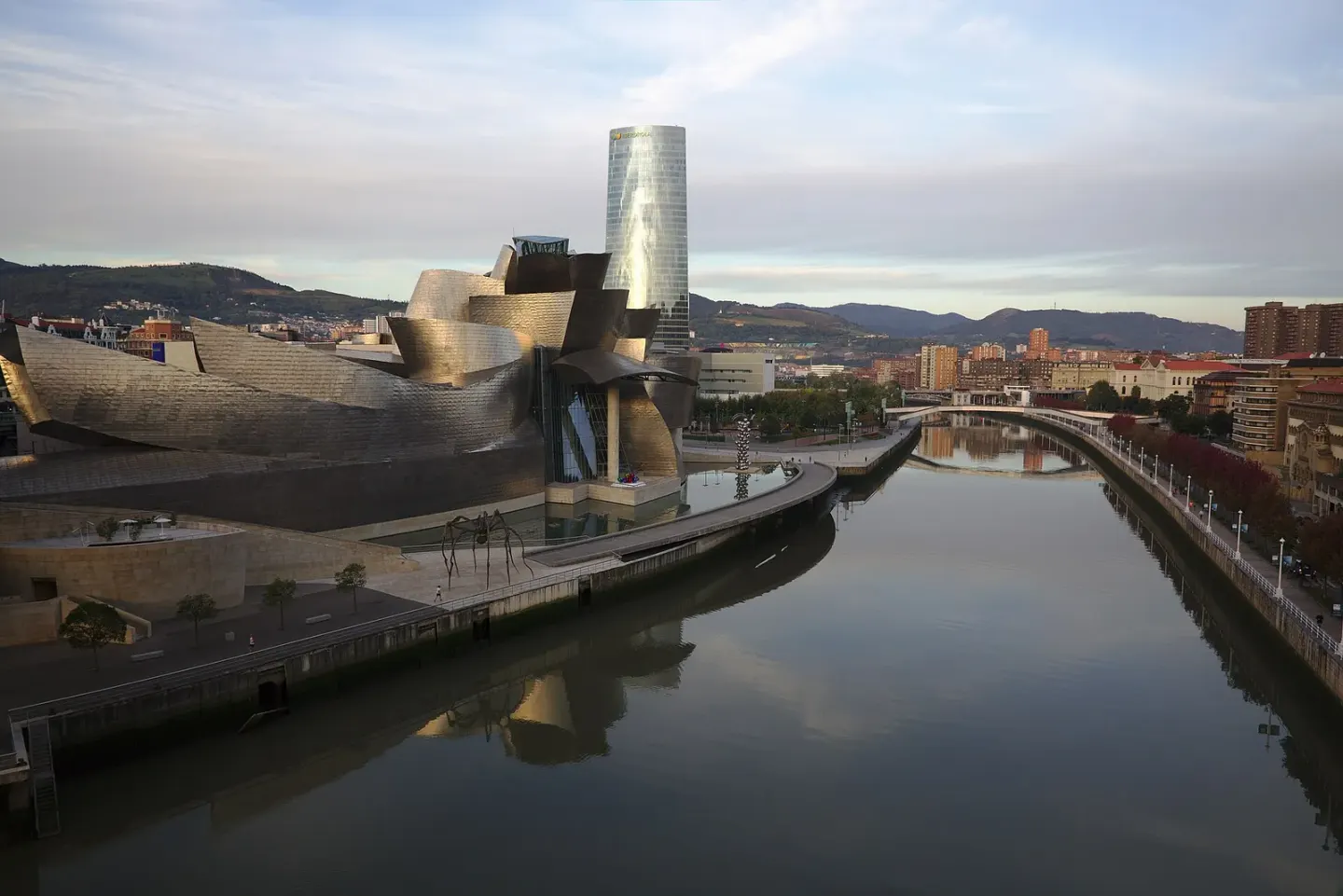
The Guggenheim Museum Bilbao and the Nervión River (the glass tower behind is a different, later building) · photo: PA · CC BY-SA 4.0 · Wikimedia Commons (photographed in 2015)
Bilbao before that was a textbook declining industrial city, and the entire metropolitan area had declined nonstop for 20 years (DOI: 10.1093/oso/9780199260409.003.0011). Bilbao as imagined from the outside was a city bundled together with pollution or political violence (DOI: 10.1111/1468-2427.00351). Then, in less than a decade, Bilbao became a place called the "Mecca of urban planning", and its representative face was the Guggenheim Museum (DOI: 10.1093/oso/9780199260409.003.0011).
From this change, a single word was born. The Bilbao effect refers to the expectation that a single striking building designed by a renowned architect will draw tourists and investment to a declining city and revive it. This term was coined by journalists, and an article re-examining the term in 2023 considers its meaning unclear. That article notes that it is only clear that the term points to an impact rippling out beyond the museum building (DOI: 10.1111/cura.12578). Therefore, to ask "Was there a Bilbao effect?", we must first decide what to count as the effect. The answer changes depending on whether it is the image, the number of tourists, jobs, or the lives of the neighborhood residents.
The protagonist of this story is a specific kind of building. An iconic building is one built so strikingly that just looking at its appearance brings the city to mind, making it serve as the face of the city. This article compares such a building to a single postcard. The postcard features the metal building on the riverbank. What is not captured on the postcard is the planning and money it took for that building to stand, as well as the surrounding neighborhood. The question "Can a single building save a city?" begins to be unraveled when we look at these two sides separately.
Postcards Travelling the World
Officials from other cities lined up to visit Bilbao and Barcelona to learn from their 15 years of revitalization up to that point (DOI: 10.1177/0042098010374510). A policy tour is a short visit by policy makers from other cities to learn the revitalization of a renowned city. A 2010 study was the first to reveal just how frequent these tours were. The same study also showed that as the "models" of the two cities circulated among policy makers, their messages shifted and transformed. At the same time, the researchers suggest that the sheer popularity of these two models points to a converging trend in global urban policy (DOI: 10.1177/0042098010374510). To translate this into our essay's metaphor, the postcard's message changed slightly as it circulated, but many cities wanted a similar postcard.
Foundations were also involved in spreading the story of Bilbao. A 2019 study comparing the Guggenheim plans in Abu Dhabi and Helsinki notes that the Guggenheim Foundation has been the most active since the late 1990s in transplanting its brand of museum to other cities, during which time the Bilbao story circulated internationally detached from its context, drawing in new cities (DOI: 10.1177/2399654419857096). A book chapter examining urban spectacles designed by star architects views the Bilbao effect narrative as having spread to both post-industrial nations and newly rising ones, leading cities to compete in "collecting" new buildings and cultural facilities as if they were goods, while often barely considering what those facilities would actually do within the city (DOI: 10.4135/9781446254523.n8).
This competition goes by two names. Culture-led regeneration is a strategy to revive declining former industrial sites, riverbanks, or city centers by putting museums, performance venues, and cultural events front and center. A 2005 review notes that this strategy has become common place for both old and new cities alike, and its rationale has expanded from economic performance to quality of life (DOI: 10.1080/00420980500107102). At the center of this approach was the contemporary art museum acting as a magnet to draw in tourists and outside investment (DOI: 10.5334/jcms.7011). City branding is a strategy to create and spread an image showing a city's appeal, competing with other cities for tourists and investment. Mega-events, festivals, and iconic architecture are used as tools for this. A 2015 essay comparing these three in a discussion argues that large-scale events leaving behind iconic buildings and permanent structures, unlike smaller events and festivals, often erode local culture in favor of a globally standardized taste, making them difficult to sustain as a means of promoting a city's culture (DOI: 10.4236/jss.2015.37039). In the metaphor of this article, the act of making a postcard is city branding itself.
What Changed in Bilbao
In 2001, researchers exchanged writings on the pages of an academic journal regarding the Guggenheim effect. In a 3-page rejoinder replying to the opponent's response, the side critical of the museum-centric strategy did not deny that the museum changed Bilbao's old image, which was tied to pollution and political violence, and wrote that they also did not take issue with Bilbao's likelihood of succeeding as an important tourist destination (DOI: 10.1111/1468-2427.00351). A 2006 study that attempted to measure the museum's economic effects numerically starts from the same point. It argues that there is little controversy over the impact the museum had on Bilbao's image, but that the effects it had on lodging and the local economy need more evidence (DOI: 10.1111/j.1468-2427.2006.00672.x). At least the critical rejoinder in this debate and the 2006 study agree that the picture on the postcard has changed. The dispute begins right after that: whether the postcard changed the city's livelihood as well.
The designs of the studies attempting to measure that livelihood vary. The 2006 study quantitatively analyzed tourism statistics and employment statistics to isolate just the museum's share within them, and tried to calculate the returns compared to the money put in. The same study notes at the beginning that it is not always clear how effective this expensive formula is (DOI: 10.1111/j.1468-2427.2006.00672.x). The profit figures obtained by this study and who made those estimations do not appear in the abstract seen by this article, so they are not carried over. A 2014 study established a framework where photographs of a single unique building are repeatedly published in the media and accumulate to boost a city's brand, and sought to test the impact of that brand on visitors to produce evidence that the Guggenheim brand calls tourists to Bilbao (DOI: 10.1007/s00168-014-0650-0). This study considers the path by which those photographs spread to be as important as the fact that the building is out of the ordinary.
A study analyzing Bilbao's image and people's perceptions 10 years after opening concluded that to create a new image for a city, there are things that need to be considered beyond just a single dazzling landmark (DOI: 10.1111/j.1559-1816.2011.00871.x). The abstract does not disclose the method and sample of this analysis.
There are also studies that followed what the museum did beyond tourism. The 2009 "The Bilbao Art World and the 'Guggenheim Effect' Reconsidered" summarizes that research up to that point had branched into two directions. One branch looked at urban development and success as a tourist magnet and image device, and the other looked at direct economic gains. The lens added by this study is the local art scene. While describing in detail for the first time that the museum contributed to creating and pushing forward changes in Bilbao's commercial galleries and non-profit art spaces, the study concurrently noted that other factors may have also been at play. Building on that, the study concludes that the museum's effects do not stop at increased tourism or tax revenue, but extend to the development of the local art scene, spatial arrangement, and public art support (DOI: 10.1080/09654310903230806).
A 2013 study looks at two directions together. One is to show that, contrary to the common criticism that the Guggenheim is an international art chain and thus ill-suited to the traditions of the Basque Country, it has quite deeply rooted itself within local institutions, private sectors, and policies. Separately from this, the other is to argue that Bilbao and the museum are increasingly entering global networks, citing the brand effect that draws tourists and the growing weight of the word "Bilbao" within a semantic network (DOI: 10.1080/09654313.2013.817543).
Behind these results lies an old measurement problem. A 2005 paper reviewing the evidence for culture-led regeneration overall concluded that evidence regarding how much flagship cultural facilities contribute to regeneration goals is limited. It states that measuring the social, economic, and environmental effects attributable to cultural elements is difficult itself, and that the "evidence" produced that way is rarely robust (DOI: 10.1080/00420980500107102). How much of the changes experienced by the city is the building's share has still not been neatly untangled.
What Lay Outside the Postcard
In the 1990s in Bilbao, countless projects were launched to remake the city's physical form and its social and economic structures. Urban policy played a decisive role in that process, and strategic investments in major transport and infrastructure projects provided solid backing (DOI: 10.1093/oso/9780199260409.003.0011). The Guggenheim Museum was the representative face of this change, but it was not the entirety of the change.
The development of Abandoibarra, the riverside land where the museum stands, was a major undertaking in its own right. Megaprojects are massive development projects built over multiple years, involving various public and private actors, that dramatically alter the shape of a city. According to a book chapter written on the basis of field research in Bilbao, what coordinated the transfer of land between the public and private sectors in Abandoibarra was a multi-agency public-private partnership called "Bilbao Ría 2000." The author of this chapter views the Basque political elite's motivation for bringing in the Guggenheim as extending beyond the regeneration gains a single building could provide, and as understandable only within the political circumstances of the Basque Country and its relationship with Spain. The author adds that those regeneration gains were "limited" (DOI: 10.1108/s1047-0042(2013)0000013007).
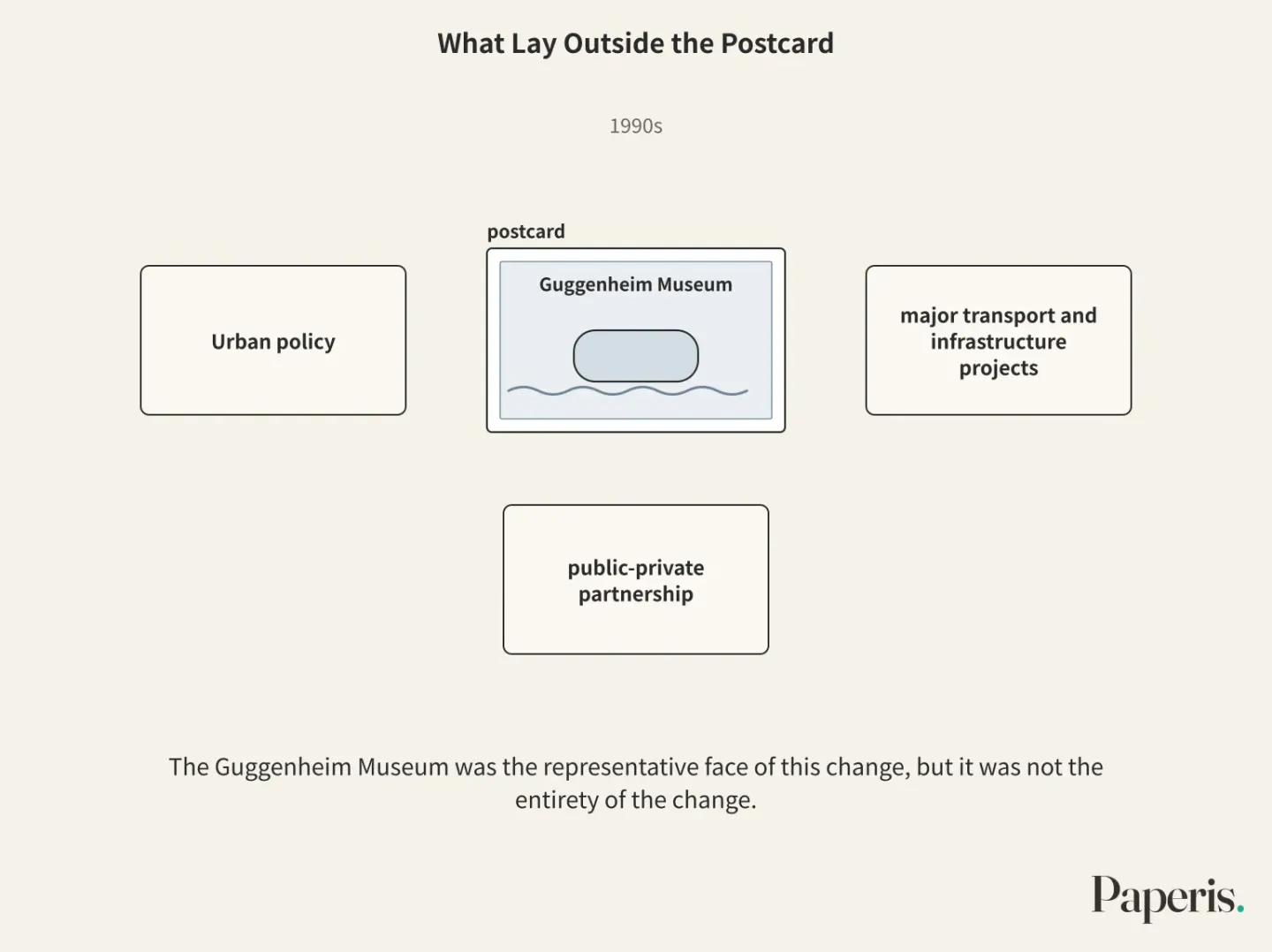
Other studies paint the same picture. A 2001 museology paper argued that because the museum's great success became a model, it had to be examined critically, and walked through the historical and political conditions, local cultural policy, and the intervention of an outside actor, a foundation, in that order. It concluded that the museum was the product of special political and socio-economic conditions and a unique case that should not be copied without criticism (DOI: 10.5334/jcms.7011). The introduction to a 2013 special issue comparing six museums across five European countries notes that while declining industrial cities can benefit from culture-led strategies, a single flagship project without the proper local context cannot bring about successful regeneration (DOI: 10.1080/09654313.2013.817544). The 2019 "The Fading Away of the Bilbao Effect" writes that the Guggenheim was merely one element among many in Bilbao's overall regeneration strategy (DOI: 10.30958/aja.6-1-2).
In 2025, the introduction to a special issue covering megaprojects broadly cites Bilbao as an example and carries over the judgment of earlier research (2010). Riverside redevelopment centered on the Guggenheim is spoken of as having transformed the city's image and driven tourism and economic growth, but the judgment is that it actually served as a symbol of a period when massive investments were made in infrastructure and the foundations of the economy were altered. In the words of the introduction, the museum and its surroundings became the symbol of urban change, but could also be seen as not having been the cause (DOI: 10.1093/cjres/rsaf009).
Two studies speak separately about what other cities took away from Bilbao. A 2010 study investigating policy tours reported that as a model travels among policy makers, the message changes and shifts (DOI: 10.1177/0042098010374510). The author of "The Fading Away of the Bilbao Effect" finds the reason why other cities struggled to replicate Bilbao's relative success in the fact that most of those city leaders missed the point that a symbolic building alone has limits in reviving a city's socio-economy, failing to examine Bilbao's socio-economic and political context and the broader regeneration strategy of which the Guggenheim was one element (DOI: 10.30958/aja.6-1-2). Translated into the metaphor of this article, the failure pointed out by that author is having failed to look outside the postcard. What officials who went on tours actually saw and what they missed has not been measured by research in the evidence gathered here, leaving it as an open question.
What Happened in Other Cities
In 2006, the Denver Art Museum in the United States opened a striking new building. A 2017 study analyzing stakeholder interviews and archival documents shows that this new wing served both to make Denver known as a cultural city to potential tourists and to boost the pride of Denver residents (DOI: 10.1080/13574809.2017.1399793). What this study measured is the role the building played within the city, not how much tourists or the economy increased.
Another paper that includes Denver as one of its cases reaches a different verdict on cultural megaprojects overall. The 2019 "The Disappearing Bilbao Effect" argues, drawing on the cases of Bilbao, Denver, Helsinki, and Abu Dhabi, that cultural megaprojects are actually a tool of renewal strategies driven by real estate development and leave considerable disadvantages for cities and regions. This paper concludes that the impact of iconic buildings on the urban fabric often goes in unintended and bad directions, and that the foundation's dream of establishing a chain of museums worldwide funded by host cities and controlled by the foundation has not come true (DOI: 10.30958/aja.6-1-2). Because it is an argument weaving together multiple cases, its weight differs from a study measuring a single city's results in numbers.
A 2019 study comparing Abu Dhabi and Helsinki looks at the decision-making process. The Guggenheim plans for the two cities were quite similar, but one was the capital of an emirate and the other the capital of a democracy. As a result of the comparison, Helsinki's democratic governance drew in multiple stakeholders to enhance collective intelligence, allowed critical evaluation to reduce risks, and emphasized the place's specificity to negotiate in a way favorable to the city (DOI: 10.1177/2399654419857096). In this study comparing the two cities, even with fairly similar plans, the Helsinki side, which allowed critical evaluation, negotiated more favorably for the city. What the study looked at was the process of the plan, not the results after the museum was built.
A 2020 study taking the Kunsthaus Graz art museum in Austria as a case used a method that added where and when its effects spread to a cost-benefit analysis. This study, which used both quantitative and qualitative methods, reported that the museum's operation drew purchasing power into the city of Graz and produced long-lasting positive effects in tourism marketing, citizens' pride and identity, the creative industries, and urban revitalization. Those effects were spatially concentrated within the city of Graz (DOI: 10.2478/rara-2020-0029). The same study notes at the outset that many projects imitating the Bilbao effect have failed to reach their goals, making the very role of such buildings as catalysts for urban development a subject of debate.
A 2018 study placing Graz, Lucerne in Switzerland, and Wolfsburg in Germany side by side changes the question. It suggests that not all cities entrusting public cultural buildings to star architects are trying to repeat the Bilbao effect. Medium-sized cities sought to gain an exceptional position in a specific field or within their own country, or to rearrange flows within the city, and the researchers view this process as closer to a socio-cultural expression than a pure economic investment (DOI: 10.1080/09654313.2018.1465896). The Louvre branch that opened in Lens, a declining industrial city in France, unmistakably brings Bilbao to mind, but it was not a direct copy of Bilbao. It was decided by the central government with local authorities mostly footing the bill, starting from the belief that art should be brought to workers in cities lacking cultural facilities. Because it is a 2013 paper published around the time of opening, its effects linger at the level of being "expected" (DOI: 10.1080/09654313.2013.819075).
There are also cases that fell short of expectations and are worth comparing with Bilbao. A 2016 study covering the "Calatrava Model" in Valencia, Spain—which is compared alongside Bilbao—considers that this model, which used mega-events and architectural symbols as an engine rather than a complement to urban change policy, failed overall and harmed the city's short-term capacity to withstand shocks. The same study adds that Valencia is nevertheless accepting changes around that architectural complex and melting them into the city's recovery process (DOI: 10.1080/09654313.2016.1257570). Although it is not a study directly covering Bilbao, the West Kowloon Cultural District plan in Hong Kong, conceived as a landmark for urban branding, was pushed forward from 1998 and put on hold in February 2006, at least for a time. The author of a 2008 paper analyzing this process believes that as the plan clung to large-scale projects, iconic buildings, and media exposure, it evaded fundamental questions about the project's substance, bottom-up consensus, and prospects for cultural development. The author concludes that urban competition waged with world-class architecture and mega-projects without addressing such questions is bound to be in vain (DOI: 10.3828/idpr.30.3.2). This is the judgment of a paper analyzing the process by which a plan was put on hold.
The results of cities aiming for renewal or branding through iconic architecture and grand projects do not converge in a single direction, and among them, some were not trying to copy Bilbao from the start. A chapter from a 2012 book dealing with star architects' spectacles summarizes that while a certain degree of success can be reaped in renewal and tourism, policymakers' high expectations are frequently unmet, and sometimes uneven and paradoxical effects appear (DOI: 10.4135/9781446254523.n8). According to the summaries of the 2012 and 2020 studies, such projects frequently fall short of expectations, and those assessments usually come from case studies and arguments. On the other hand, buildings that achieved outcomes different from the Bilbao effect, such as civic pride or tourism promotion within the city, are also reported as case studies.
Bilbao's Neighborhoods
A 2003 study looked at Bilbao La Vieja, a neighborhood right next to downtown Bilbao. The study introduces this neighborhood as one of the most disadvantaged residential areas in the metropolitan region while sitting in a strategic spot right next to the city center. As the first round of projects from the 1990s took root, the city council looked for new spaces to continue the regeneration, and this neighborhood made the list. The study projected that direct intervention by local government would play a decisive role in making this neighborhood a clear candidate for gentrification (DOI: 10.1080/0042098032000136129). Gentrification is a change where money and new residents enter an old, poor neighborhood, rent goes up, and the people and shops that were originally there get pushed out. The title of the paper, asking "Another Guggenheim Effect?", was, to put it in this article's metaphor, something that could happen outside the postcard, in the neighborhood chosen next for the regeneration project.
Subsequent research makes the picture more complex. A 2016 research team started from the premise that while culture-led urban policies have frequently triggered rising rents, the displacement of original residents, and changes in neighborhood commerce, that process is not singular, meaning that community life alone can be disrupted without displacement. The research team traced the process of trying to revive Bilbao's working-class neighborhood of San Francisco and change its image by drawing in cultural industries, using neighborhood-level socio-economic data, interviews, and participatory evaluation with residents. After analysis, the team concluded that conflicts can revolve around how space is portrayed and the "right to the neighborhood" rather than economic changes and class turnover, and suggested looking at culture-led neighborhood change in a less deterministic way than as a binary choice between "revitalisation or gentrification" (DOI: 10.1177/0042098016630507). The method of bringing the words of those who have lived there into design and evaluation was covered in "Paths and Use — A Newcomer's Steps, an Occupant's Word".
A 2021 study that followed a new downtown project in Łódź, Poland, modeled after Bilbao through ethnography, in-depth interviews, and urban planning documents, distinguishes between two things. These are the Bilbao effect in its original sense of investing in culture to drive urban prosperity, and the Bilbao effect as a pure megaproject. The research team views that the former holds the potential for social development in the city, while the latter mainly signifies extreme gentrification, with such projects typically benefiting a narrow group while the entire community bears the cost. They added the observation that renowned architects and special facilities were used to justify exceptions in planning procedures and concentrations of public investment (DOI: 10.26485/ps/2021/70.4/4).
There is also a hypothesis about how well a city can withstand price pressure. A 2008 study looked at Bilbao and the Guggenheim to provide empirical evidence for the hypothesis that the better the market in a redevelopment area is connected to the rest of the city, and the higher the productivity of the urban economy, the easier it is to absorb the price tension caused by urban revitalization (DOI: 10.1111/j.1468-2427.2008.00796.x). This is the hypothesis that the pressure revitalization brings to a neighborhood can be absorbed differently depending on that city's economy.
Still Debated
Returning to the 2001 rejoinder reveals the first strand of the dispute. It is a question of what one counts as an effect. That rejoinder writes that the opponent's reply relies solely on the gains generated by the number of visitors who found Bilbao, but visitor numbers were not the point of the original piece. What the original piece asked was whether an urban strategy focused on cultural facility investment and place marketing is a good way to revive a city (DOI: 10.1111/1468-2427.00351). One side counts tourists, while the other asks about urban recovery. Over the same art museum, the two sides open different ledgers. Thus, this dispute does not end with a single number.
Change what you count, and what you see changes. A qualitative longitudinal study following Glasgow, United Kingdom—which was the European Capital of Culture in 1990—from 1986 to 2003 points out that cultural effects are routinely dismissed as anecdotes compared to the "hard evidence" of economic and physical effects. In this study, which followed only cultural effects through the soft indicators of media and people's stories, the influence that remained strongest and longest even 15 years later was the effect on the image and identity held by the city's people (DOI: 10.1080/00420980500107532). Because the subject dealt with was a year-long cultural event rather than a building, it cannot be transferred to Bilbao as is.
The second strand is tourism itself. A 2023 re-examination considers that the museum's architecture and urban effects drew international attention and many imitators, and that the novelty of the museum's operation inspired major changes in Spanish museums and Basque cultural policy. The same piece questions the old assumption of success relying on large-scale international tourism given the climate crisis and notes that such tourism may be difficult to sustain, yet concludes by saying that Bilbao's cultural district is thriving and expanding along the Nervión River (DOI: 10.1111/cura.12578). Whether the arithmetic that more tourists is always better will hold true in the future remains open.
The third strand is symbols and causes. Regarding the change of the city as a whole, the introduction to a special issue relays the earlier judgment that the museum and its surroundings became symbols of change, but could also be seen as not having been the cause (DOI: 10.1093/cjres/rsaf009). Narrowing the scope, there is research showing that the museum contributed to changes in the local art scene (DOI: 10.1080/09654310903230806). Because a Bilbao without the museum being built cannot be observed, the museum's share has been handled by separating it from statistics and estimating it, as in a 2006 study. The difficulty of measurement pointed out by a 2005 review catches precisely at this spot (DOI: 10.1080/00420980500107102). This strand remains open not because one side's evidence won, but because methods for measuring it are lacking.
So What Do We Know?
Studies accumulated since the Bilbao art museum opened have not delivered a single verdict. When this article reads those studies and sorts the conditions, there are four, but this is not a list comparing multiple cities checked using the same method. The nature of the evidence also varies for each condition.
The first is whether the building is part of a larger plan. The Bilbao museum went up alongside 1990s investments in transportation and infrastructure and the redevelopment of the riverside land (the 2003 chapter in the preceding section). The introduction to a special issue covering six museums reviews the Bilbao effect debate, noting that a flagship project alone, without the right local context, cannot drive successful regeneration. This condition is a summary from the introduction (DOI: 10.1080/09654313.2013.817544). The second is whether the building actually draws tourists. A 2008 paper on Bilbao hypothesizes that such cultural investments create jobs only to the extent that they become tourist magnets, and that if the heritage industry accounts for too large a share of the urban economy, the effect can actually be negative. The third is whether the urban economy has the strength to withstand rising prices, which is a hypothesis from the same paper (DOI: 10.1111/j.1468-2427.2008.00796.x). This paper attempted to provide empirical evidence for the hypothesis, and the size of that result is not in the abstract. The fourth is whether the decision-making process allows plans to be scrutinized. This comes from a study comparing the decision-making processes of two cities and does not measure outcomes after the museum was built (DOI: 10.1177/2399654419857096).
Apart from the conditions, there is also the problem of the yardstick. A building competing for global tourists and a building aiming for civic pride or a unique domestic standing cannot be measured with the same yardstick (DOI: 10.1080/09654313.2018.1465896). Museums can also shoulder other roles. The introduction to the 2013 special issue suggests that museums can play an important role in building "social capital"—which creates networks connecting different experts, groups, and fields, and lowers the costs for people and businesses to move together (DOI: 10.1080/09654313.2013.817544).
Both "a single building saves a city" and "iconic architecture is just a waste of money" are claims larger than current evidence supports. Even the critics do not deny the point that Bilbao's image changed. The evidence to separate whether that change was the share of a single museum or the combined result of the broad investments and politics of the 1990s is not yet solid. That iconic architecture projects aiming for the Bilbao effect frequently fall short of high expectations is the summary of 2012 and 2020 studies (mostly case studies and argumentation), and there are also case studies showing they fulfilled other roles, such as civic pride within the city or tourism promotion. Two studies looking at Bilbao's neighborhoods report on the process by which Bilbao la Vieja, next to the city center, became a candidate for gentrification (the 2003 outlook), and conflicts in the working-class neighborhood of San Francisco that took a different shape from displacement (2016). Reduced to this article's metaphor, postcards are easily copied, but the city outside the postcard is not copied that way.
Source Papers
- "Restructuring Cities: Miracles and Mirages in Urban Revitalization in Bilbao" (2003) — DOI: 10.1093/oso/9780199260409.003.0011 — After 20 years of decline, numerous projects in the 1990s, urban policies, and investments in transportation and infrastructure supported Bilbao's regeneration, with the Guggenheim as its representative face.
- "A Reply to Beatriz Plaza's 'The Guggenheim-Bilbao Museum Effect'" (2001) — DOI: 10.1111/1468-2427.00351 — A three-page reply (opinion piece): it does not question changing the old image or the potential to succeed as a tourist destination, but asks whether the number of visitors matters, or if cultural facility investment strategies are a good way to achieve urban recovery.
- "Reviewing the 'Bilbao effect' inside and beyond the Guggenheim" (2023) — DOI: 10.1111/cura.12578 — A term coined by journalists whose meaning is unclear; the riverside cultural district is thriving, but the climate crisis questions the assumption of large-scale tourism-based success.
- "Bilbao and Barcelona 'in Motion'" (2010) — DOI: 10.1177/0042098010374510 — Reveals the scale of policy study tours for the first time; the model's message changes as it circulates, but its popularity suggests a convergence of global urban policies.
- "What difference does democratic local governance make? Guggenheim museum initiatives in Abu Dhabi and Helsinki" (2019) — DOI: 10.1177/2399654419857096 — The spread of the Bilbao story detached from its context; Helsinki's democratic governance reduces risk through critical evaluation and negotiates advantageously for the city.
- "Competing Cities and Spectacularizing Urban Landscapes" (2012) — DOI: 10.4135/9781446254523.n8 — Cities compete as if "collecting" buildings; while there is some success, the high expectations of policy makers are frequently unfulfilled.
- "Measure for Measure: Evaluating the Evidence of Culture's Contribution to Regeneration" (2005) — DOI: 10.1080/00420980500107102 — The evidence for the contribution of flagship cultural facilities to regeneration is limited and rarely robust.
- "Culture and City Branding: Mega-Events and Iconic Buildings as Fragile Means to Brand the City" (2015) — DOI: 10.4236/jss.2015.37039 — An argumentative paper: compares events, festivals, and iconic architecture as branding tools, and argues that iconic buildings and permanent structures are difficult to sustain.
- "The Return on Investment of the Guggenheim Museum Bilbao" (2006) — DOI: 10.1111/j.1468-2427.2006.00672.x — There is little controversy over the image effect, but more evidence is needed regarding lodging and economic effects; attempts to calculate the museum's share and returns through statistical quantitative analysis.
- "Culture-led city brands as economic engines: theory and empirics" (2014) — DOI: 10.1007/s00168-014-0650-0 — A framework where photographs of buildings accumulate in the media to build the brand; aims to provide evidence that the Guggenheim brand attracts tourists.
- "(Re)Building an Image for a City: Is A Landmark Enough?" (2012) — DOI: 10.1111/j.1559-1816.2011.00871.x — Image and perception analysis 10 years after opening; a new image requires more than one landmark.
- "Bilbao's Art Scene and the 'Guggenheim effect' Revisited" (2009) — DOI: 10.1080/09654310903230806 — The museum contributed to changes in local commercial and non-profit art spaces; other factors may have also played a role.
- "The Guggenheim Museum Bilbao: Between Regional Embeddedness and Global Networking" (2013) — DOI: 10.1080/09654313.2013.817543 — The museum is fairly well-rooted in the local context, and the weight of "Bilbao" has grown in the tourism brand and network of meanings.
- "Chapter 2 The Alleged Bilbao Miracle and its Discontents" (2013) — DOI: 10.1108/s1047-0042(2013)0000013007 — The Abandoibarra megaproject and Bilbao Ria 2000; the motivation for hosting can only be understood within the Basque political context.
- "Art for Whose Sake? Modern Art Museums and their Role in Transforming Societies: The Case of Guggenheim Bilbao" (2001) — DOI: 10.5334/jcms.7011 — A unique case that is the product of specific political and socio-economic circumstances and should not be replicated without criticism.
- "Renewal through Culture? The Role of Museums in the Renewal of Industrial Regions in Europe" (2013) — DOI: 10.1080/09654313.2013.817544 — Compares six museums; highlights the potential benefits of cultural strategy alongside the impossibility of regeneration through a single flagship project, and the role of social capital.
- "The Fading Away of the Bilbao Effect: Bilbao, Denver, Helsinki, Abu Dhabi" (2019) — DOI: 10.30958/aja.6-1-2 — Case argumentation: cultural megaprojects are instruments of real estate-led regeneration, their impacts are frequently unintended and negative, and other cities fail to examine Bilbao's context and overall strategy.
- "The symbolic value of megaprojects in urban and regional development" (2025) — DOI: 10.1093/cjres/rsaf009 — Introduction to a special issue on megaprojects: drawing on earlier research (Ponzini 2010), it can be argued that Bilbao's riverside redevelopment was a symbol of the investment period rather than its cause.
- "One icon, two audiences: how the Denver Art Museum used their new building to both brand the city and bolster civic pride" (2017) — DOI: 10.1080/13574809.2017.1399793 — Interview and archival analysis: the 2006 annex served both city promotion and civic pride.
- "Star architecture projects. The assessment of spatial economic effects by means of a spatial incidence analysis" (2020) — DOI: 10.2478/rara-2020-0029 — Kunsthaus Graz: long-term positive effects such as purchasing power influx, tourism marketing, civic pride, and creative industries, concentrated within the city of Graz.
- "Situating architectural performance: 'star architecture' and its roles in repositioning the cities of Graz, Lucerne and Wolfsburg" (2018) — DOI: 10.1080/09654313.2018.1465896 — Not all cities aim for the Bilbao effect; the social and cultural expression of a medium-sized city.
- "The New Louvre in Lens: A Regionally Embedded National Project" (2013) — DOI: 10.1080/09654313.2013.819075 — Central government decision, regional funding, art for workers; effects are at the expectation stage.
- "The Calatrava model: reflections on resilience and urban plasticity" (2016) — DOI: 10.1080/09654313.2016.1257570 — The overall failure of the model using architectural symbols as engines and the impairment of short-term shock absorption capacity, yet the city adapts.
- "City-branding without content: Hong Kong's aborted West Kowloon mega-project, 1998–2006" (2008) — DOI: 10.3828/idpr.30.3.2 — Put on hold in 2006; an analysis showing that it avoided content, bottom-up consensus, and cultural vision.
- "Another 'Guggenheim Effect'? The Generation of a Potentially Gentrifiable Neighbourhood in Bilbao" (2003) — DOI: 10.1080/0042098032000136129 — City government designation and intervention appear decisive in making Bilbao la Vieja a candidate for gentrification.
- "Culture-led neighbourhood transformations beyond the revitalisation/gentrification dichotomy" (2016) — DOI: 10.1177/0042098016630507 — Premise: cultural policies have often driven rent increases and displacement, but the process is not monolithic; analysis of the San Francisco neighborhood: conflicts can arise over spatial representations and the right to the neighborhood.
- "From culturally-led development to a mega-project. An extended case study of the New Centre of Łódź" (2021) — DOI: 10.26485/ps/2021/70.4/4 — Distinction between Bilbao 1 (cultural investment) and Bilbao 2 (megaproject and extreme gentrification).
- "On Some Challenges and Conditions for the Guggenheim Museum Bilbao to be an Effective Economic Re-activator" (2008) — DOI: 10.1111/j.1468-2427.2008.00796.x — Jobs created only to the extent that it becomes a tourism magnet; empirical evidence for conditional hypotheses regarding the share of the heritage industry, market integration, and productivity.
- "Deconstructing the City of Culture: The Long-term Cultural Legacies of Glasgow 1990" (2005) — DOI: 10.1080/00420980500107532 — Qualitative longitudinal study: 15 years later, the strongest and longest-lasting legacy is image and identity.
Sources (29)
- Restructuring Cities: Miracles and Mirages in Urban Revitalization in BilbaoDOI 10.1093/oso/9780199260409.003.0011
- A Reply to Beatriz Plaza's 'The Guggenheim-Bilbao Museum Effect'DOI 10.1111/1468-2427.00351
- Reviewing the 'Bilbao effect' inside and beyond the GuggenheimDOI 10.1111/cura.12578
- Bilbao and Barcelona 'in Motion'DOI 10.1177/0042098010374510
- What difference does democratic local governance make? Guggenheim museum initiatives in Abu Dhabi and HelsinkiDOI 10.1177/2399654419857096
- Competing Cities and Spectacularizing Urban LandscapesDOI 10.4135/9781446254523.n8
- Measure for Measure: Evaluating the Evidence of Culture's Contribution to RegenerationDOI 10.1080/00420980500107102
- Culture and City Branding: Mega-Events and Iconic Buildings as Fragile Means to Brand the CityDOI 10.4236/jss.2015.37039
- The Return on Investment of the Guggenheim Museum BilbaoDOI 10.1111/j.1468-2427.2006.00672.x
- Culture-led city brands as economic engines: theory and empiricsDOI 10.1007/s00168-014-0650-0
- (Re)Building an Image for a City: Is A Landmark Enough?DOI 10.1111/j.1559-1816.2011.00871.x
- Bilbao's Art Scene and the 'Guggenheim effect' RevisitedDOI 10.1080/09654310903230806
- The Guggenheim Museum Bilbao: Between Regional Embeddedness and Global NetworkingDOI 10.1080/09654313.2013.817543
- Chapter 2 The Alleged Bilbao Miracle and its DiscontentsDOI 10.1108/s1047-0042(2013)0000013007
- Art for Whose Sake? Modern Art Museums and their Role in Transforming Societies: The Case of Guggenheim BilbaoDOI 10.5334/jcms.7011
- Renewal through Culture? The Role of Museums in the Renewal of Industrial Regions in EuropeDOI 10.1080/09654313.2013.817544
- The Fading Away of the Bilbao Effect: Bilbao, Denver, Helsinki, Abu DhabiDOI 10.30958/aja.6-1-2
- The symbolic value of megaprojects in urban and regional developmentDOI 10.1093/cjres/rsaf009
- One icon, two audiences: how the Denver Art Museum used their new building to both brand the city and bolster civic prideDOI 10.1080/13574809.2017.1399793
- Star architecture projects. The assessment of spatial economic effects by means of a spatial incidence analysisDOI 10.2478/rara-2020-0029
- Situating architectural performance: 'star architecture' and its roles in repositioning the cities of Graz, Lucerne and WolfsburgDOI 10.1080/09654313.2018.1465896
- The New Louvre in Lens: A Regionally Embedded National ProjectDOI 10.1080/09654313.2013.819075
- The Calatrava model: reflections on resilience and urban plasticityDOI 10.1080/09654313.2016.1257570
- City-branding without content: Hong Kong's aborted West Kowloon mega-project, 1998–2006DOI 10.3828/idpr.30.3.2
- Another 'Guggenheim Effect'? The Generation of a Potentially Gentrifiable Neighbourhood in BilbaoDOI 10.1080/0042098032000136129
- Culture-led neighbourhood transformations beyond the revitalisation/gentrification dichotomyDOI 10.1177/0042098016630507
- From culturally-led development to a mega-project. An extended case study of the New Centre of ŁódźDOI 10.26485/ps/2021/70.4/4
- On Some Challenges and Conditions for the Guggenheim Museum Bilbao to be an Effective Economic Re-activatorDOI 10.1111/j.1468-2427.2008.00796.x
- Deconstructing the City of Culture: The Long-term Cultural Legacies of Glasgow 1990DOI 10.1080/00420980500107532