Paperis Articles
Trees Outside the Window — What Came In With the View
What a 1984 records study from one hospital showed, and what later research did and did not confirm
Your field's papers, as audio
Pick your fields and journals — Paperis summarizes the key papers and turns them into audio. Listen on your commute.
Start Paperis free →Trees Outside the Window — What Came In With the View
Twenty-Three People Across from a Brick Wall
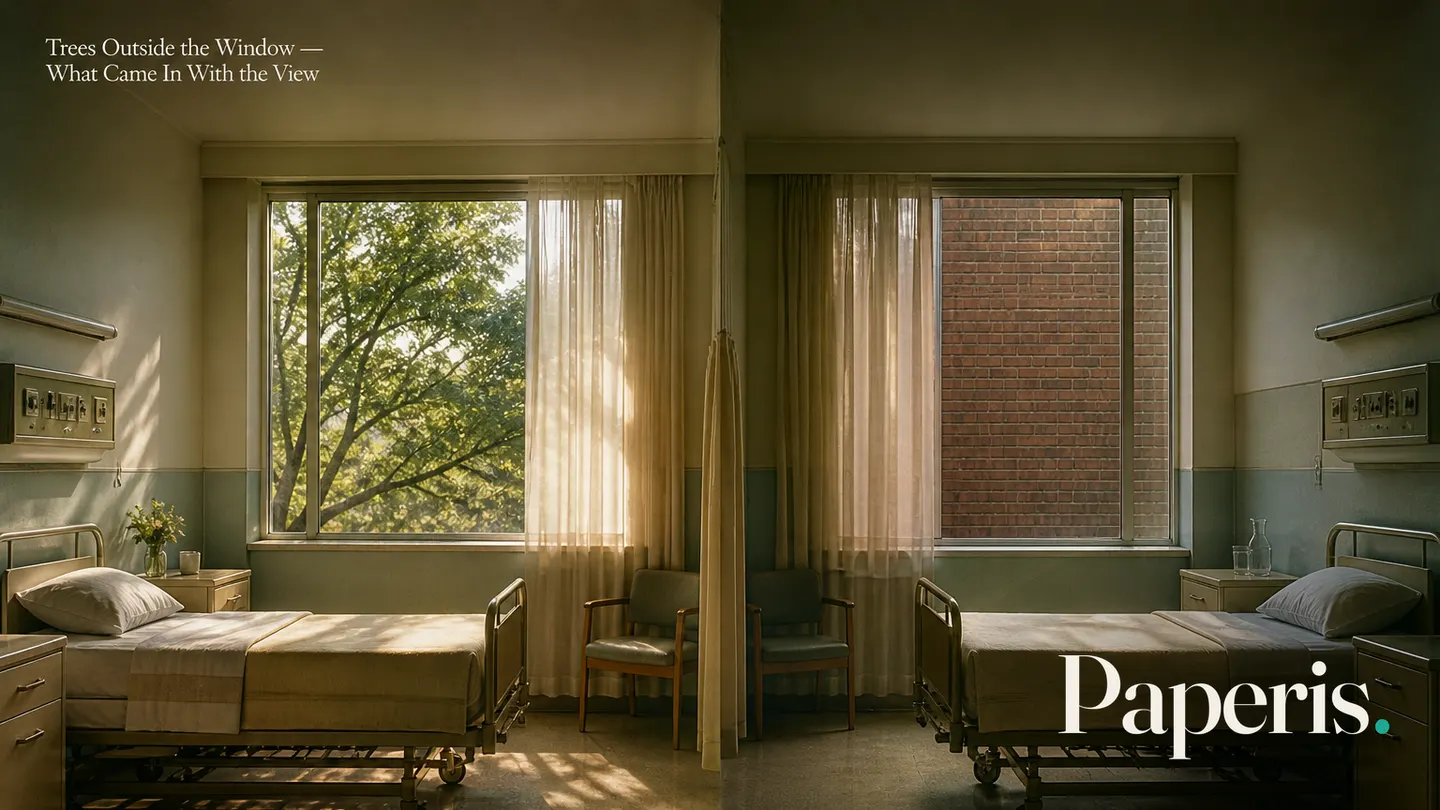
From the 1970s to the early 1980s, patients who underwent gallbladder removal surgery at a suburban hospital in Pennsylvania, USA, spent their recovery period in hospital rooms. Through the window of one room, a natural scene was visible, while the window of another similar-looking room faced the brick wall of an opposite building. It was the same surgery, similar rooms, and different windows.
The view outside the window is the outward appearance visible from inside the room through the window. A two-page paper published in the journal Science in 1984 looked back at the recovery records of patients who underwent gallbladder surgery at this hospital from 1972 to 1981, examining whether being assigned to a room with a natural view acted to aid recovery (PMID 6143402). The author of the paper is Roger Ulrich.
This study was not an experiment that newly gathered patients and assigned them to two rooms. A retrospective comparison study is a study that traces back the medical records of past patients and compares the outcomes between groups that had different conditions. Ulrich added one device to this. Matched comparison is a method of pairing people who differ only in the condition being compared while keeping their remaining characteristics similar, and then comparing their outcomes. Each of the 23 patients on the natural scenery side was paired with one patient from the brick wall side, comparing the records of a total of 46 people (PMID 6143402).
The results pointed in the same direction across three fronts. Patients on the natural scenery side had a shorter post-operative hospital stay, fewer negative evaluations written in nurse notes, and used less strong pain medication compared to their 23 matched counterparts on the brick wall side (PMID 6143402). The fact that three different records moved in one direction is the weight of this result, and the number of people supporting that weight is 46.
The title the author gave to the paper was "View through a window may influence recovery from surgery" (PMID 6143402). This question had been raised as a question mark even earlier than that. A photographic experiment published in 1979 showed slides of natural scenes and American urban scenes lacking natural elements to stressed people; those who saw the natural scenes experienced an increase in positive emotions like joy and friendliness and a decrease in fear, while the urban scenes increased sadness (DOI: 10.1080/01426397908705892). That paper called itself an "exploratory first step" and noted as a question to be solved in the future, "Would patients facing surgery be less anxious if their windows looked out on a park instead of a highway?" (DOI: 10.1080/01426397908705892). That paper also added a caveat not to read the conclusion about urban scenes as a psychological indictment of urban landscapes as a whole.
The starting point was a study comparing the records of 46 people, and that study introduced itself with a "may."
What Records Cannot Answer
If patients in two rooms differed only by a window and everything else was the same, the difference in the records could be read as coming from the window. The difficulty that record-comparison studies constantly face is that we cannot know all of that "everything else."
A confounding variable is a third factor tangled up in both the cause and effect being compared, which can make a nonexistent relationship look real or hide a real one. For instance, if a patient's condition played even a slight role when rooms were assigned at a hospital, the difference in recovery between the two rooms could arise from that condition rather than the view. This is an example of a general case, and there is no evidence that such a thing happened in the 1984 study. The point is that records alone make it hard to tell whether it happened or not.
Matched comparison reduces this difficulty. However, it only matches the characteristics used to make the pairs. Characteristics not left in records and characteristics not chosen when pairing can still differ between the two groups. The abstract of the 1984 paper merely notes "matched pairs of patients in similar rooms" (PMID 6143402).
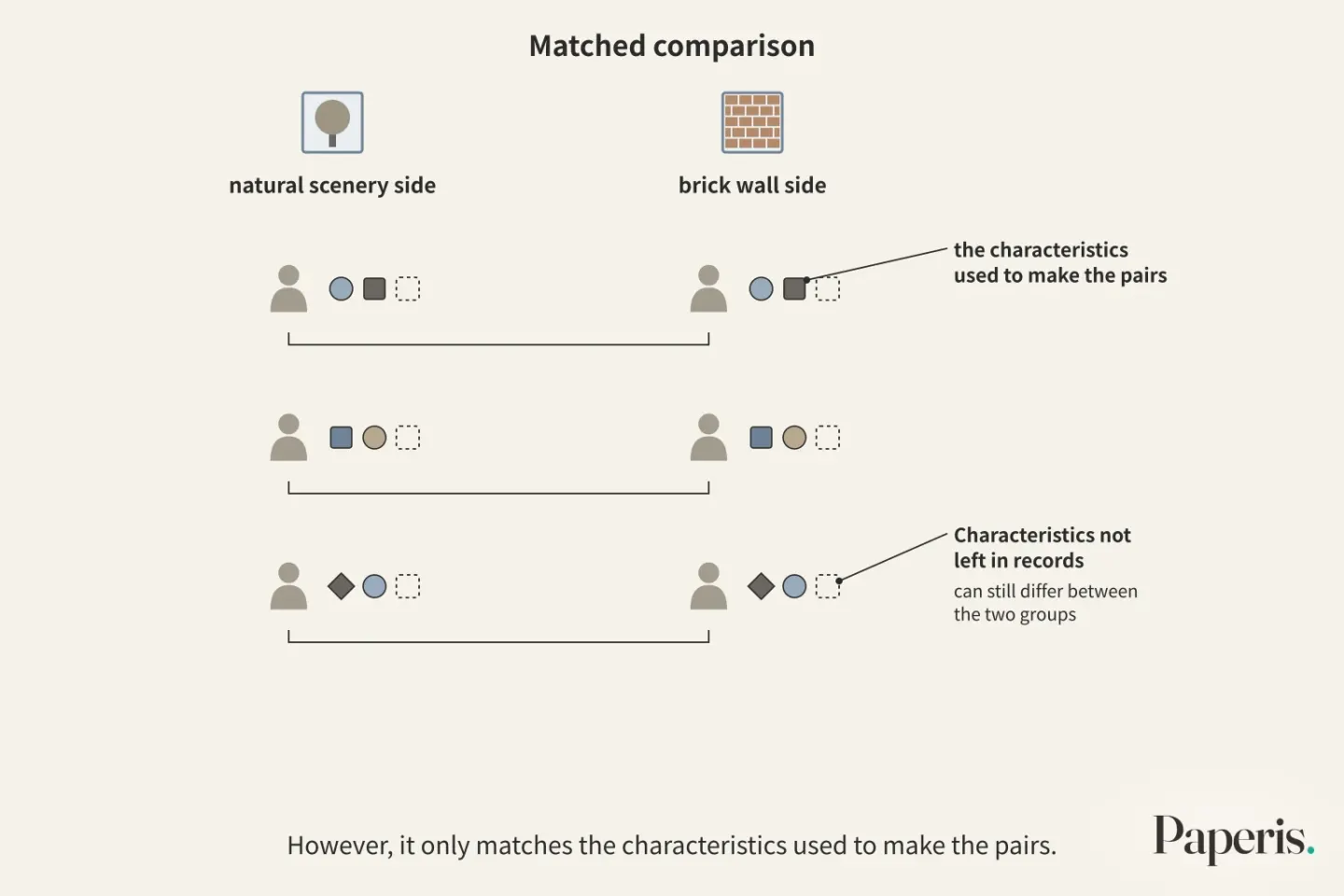
There is a long-standing method to fill this gap. Random assignment is a method that leaves who goes into which condition to chance, like drawing lots. If rooms are decided by drawing lots, we can expect measured and unmeasured characteristics alike to be distributed evenly across both groups. The 1984 study had no random assignment. Because it was a study dealing with past records, it was something that could not be done from the start, which is a limitation common to all designs of record comparison.
That is why the scope of what this study can support is determined. The 1984 study showed that nature outside the window and better recovery records appeared together, but it did not have the tools to distinguish whether the view changed the recovery.
"Could" and "Proved"
The title of the 1984 paper was "Could". When you spread out the writings that introduced this research afterward by document, the words used to call the same study differ from document to document.
An editorial in a 2003 health promotion journal wrote that in a landmark study, hospital patients who saw nature through a window recovered faster, stayed in the hospital less, needed fewer painkillers, and had fewer postoperative complications than patients who looked out at other buildings (DOI: 10.1093/heapro/dag012). It is an editorial that contains opinions. Complications are not included in the three outcomes written in the abstract of the 1984 paper, which are length of stay, nurse notes, and strong painkillers (PMID 6143402). The title of the original paper was "Could", and the verb in this editorial is "proved".
A 2015 review that historically surveyed the concept of healing gardens introduced this study as a famous study showing that nature seen through a window has a good effect on the recovery of hospitalized patients (PMID 26115787). Unlike these two, the introduction to a 2026 special issue of an architecture journal carries over the original title "Could" as is, and writes that this study popularized the idea that hospital rooms overlooking greenery speed up postoperative recovery. This phrase means that the idea spread widely, and does not contain talk about what the study proved. The introduction also added that the idea itself was not new and that plants have been brought into healing spaces since the healing temples of ancient Greece (DOI: 10.17613/npf0k-j8t41).
A paper that re-examined this study in the same year also carries over the original title "Could" as is, and evaluates that this study played a central role not only in establishing the idea that contact with nature benefits building users, but also the very idea of designing environments based on evidence. The authors of that paper see that many subsequent studies confirmed the central proposition that "contact with nature is good for us psychologically and physiologically", and now that conclusion leaves no room for doubt (DOI: 10.18848/2156-8960/cgp/a447). This is the evaluation of those authors. And the proposition they see as confirmed is the broad proposition that "contact with nature is good", which is different from the narrow proposition that "a single window accelerates surgical recovery".
Among the documents gathered here, the 2003 editorial called this study "proved", the 2015 review called it "showing", and the two 2026 documents carried over the "could" of the original title as is. What the original paper reported is the same. There is no basis in these documents to attribute these words to the fault of the original authors.
What Was Measured at the Hospital Afterward
From July 2006 to June 2010, a study compared the records of 6,138 patients admitted to a medical intensive care unit and 6,631 patients admitted to a surgical intensive care unit at a university hospital in Philadelphia, USA. Both units had 24 beds, and whether a patient went to a room with a window or a room with a view of nature was determined by whatever bed was empty at the time (DOI: 10.1097/ccm.0b013e318287f6cb).
On the medical side, there was no difference between patients in rooms with windows and rooms without windows in terms of intensive care unit mortality, in-hospital mortality, readmission, or delirium. On the surgical side, patients in rooms with a view of nature stayed in the intensive care unit slightly less and incurred slightly lower costs than patients in rooms with a view of industrial facilities. However, in an analysis that used the initially assigned bed and the time spent in that room to reduce the likelihood that patient condition influenced room assignment, there was no difference in any outcome. Even after adjusting the criteria strictly because the primary analysis compared outcome indicators multiple times, none of the differences remained statistically meaningful (DOI: 10.1097/ccm.0b013e318287f6cb).
In a pre-specified subgroup analysis, among patients who stayed in the medical intensive care unit for more than 72 hours, rooms with windows appeared alongside lower mortality, but this result also did not pass the threshold after adjustment. The authors concluded that intensive care unit rooms with windows or natural scenery do not improve outcomes or reduce costs for general medical and surgical patients, leaving the direct exposure of window light to patients and the effect in high-risk patients as questions to be explored in the future (DOI: 10.1097/ccm.0b013e318287f6cb). This records study of a single hospital, which is the largest among the studies gathered here, found no difference in general patients, and the clue seen in long-stay patients still remains just a clue.
Although what was compared differs, there are studies where no differences emerged in other hospital rooms either. A study comparing the records of 448 adolescents who underwent spinal fusion surgery between 2011 and 2017 at a single hospital for idiopathic scoliosis, a condition where the spine curves sideways, found no difference between 325 patients who used a window-side bed and 123 patients who used a door-side bed in hospital stay duration, complications, two-year outcomes, in-hospital pain scores, or daily opioid painkiller usage in two-person rooms (PMID 41657938). Even in a model that considered multiple factors together, bed position was not related to pain or painkillers. The authors concluded that a position close to the window does not affect in-hospital outcomes after this surgery, and added that using all beds when hospital beds are short can be a way to continue scheduled surgeries without harming post-surgical outcomes (PMID 41657938). What this study compared is distance to the window, and what was visible outside the window does not appear in the abstract.
There are also studies that found differences. Published in 2025, a study examining the records of 459 patients across two intermediate care wards in Sussex, UK, divided the degree of nature visible outside the window into three pre-determined stages and analyzed the length of hospital stay using a model that also considered other factors. The degree of visible nature was meaningfully related to the length of hospital stay, with each higher stage shortening the hospital stay by about 8.7%, and the season did not change this association (PMID 41476005). Hospital location and age at discharge were also related to the length of hospital stay. This study is a record comparison conducted as part of a hospital quality improvement project.
A study covering records from the cardiac intensive care unit of a hospital in the southeastern USA divided rooms of the same size into three types. These were rooms where the bed was placed alongside a large south-facing window so that both sunlight and the outside view came in, rooms where the bed was placed at a right angle to the window so that sunlight entered but the view was difficult to see, and rooms without windows. Analyzing 2,319 patients among electronic medical records from 2015 to 2019, among patients on mechanical ventilators, those in rooms with both sunlight and a view stayed in the intensive care unit 16.8 hours less than patients in rooms without windows (DOI: 10.1016/j.jointm.2022.11.002). This study attempted to separate sunlight and the view, but the comparison where a difference was reported was between rooms with both and rooms with neither.
296 women who underwent cesarean sections at three tertiary hospitals in Taipei and New Taipei, Taiwan, were randomly assigned to 46 hospital rooms with differing outdoor views and sunlight. The higher the satisfaction with the outdoor view, the lower the overall pain score (P = 0.046) and pain intensity (P = 0.004), and painkiller usage also tended to decrease (P = 0.057) (PMID 31125086). The value in parentheses is a measure of the likelihood that a difference this large would occur by chance when there is actually no difference, and it is commonly considered statistically meaningful when smaller than 0.05. The value for painkillers did not cross that threshold, but the abstract recorded this as a meaningful reduction. And although the rooms were randomly assigned, the results reported by the abstract were the relationship with the view satisfaction rated by the patients themselves, and results according to room type do not appear in the abstract. The authors concluded that if hospital room design increases view satisfaction, it can reduce painkiller usage and medical costs (PMID 31125086).
There is also a randomized study that used paintings instead of a real view. When 90 pediatric patients were randomly assigned to rooms with an underwater scene window mural, a tree window mural, or no mural, children in rooms with murals showed improvements in heart rate and systolic blood pressure compared to the control room, and the tree mural side had the most differences in health-related indicators (PMID 30309256).
The results are mixed. Two studies that found no difference, and two among the studies that did find one, were record comparisons, while the two studies that randomly assigned rooms were studies compared using patient-rated satisfaction or painted murals. What was compared also differs from study to study. They measured whether there was a window, whether nature was visible, how close to the window the bed was, how much nature was visible, and whether sunlight and a view entered together.
Why We Think This May Be Possible — Stress Recovery
Outside the hospital room, this question has been brought into the laboratory and asked in different ways. After giving participants a laboratory stress task, researchers have them view natural, urban, or indoor scenes for several minutes, and measure their heart rate, stress hormones in saliva, and mood. Stress recovery is the process by which tension and bodily responses that increased due to stress settle back to their original levels. A 2026 review paper also attempted to explain the 1984 results from the perspective of reducing stress (DOI: 10.18848/2156-8960/cgp/a447).
A 2014 review evaluates that experimental studies show strong evidence between staying in natural environments and recovering from physiological stress and mental fatigue. According to that review, viewing natural scenes generally reduces bodily symptoms of stress, decreases negative moods, and above all, increases positive emotions (PMID 25431444).
Studies conducted outside the laboratory, out in actual nature, have also accumulated. What these studies have frequently asked about is perceived restorativeness. Perceived restorativeness is the degree to which one feels that a tired mind is refilled again while staying in a certain place. In a 2019 meta-analysis pooling 22 studies that visited actual locations directly, outdoor environments with nature were rated higher in perceived restorativeness than urban environments without natural elements. Although the effect size was a very large difference, that size varied greatly across studies, and the difference was not explained by conditions such as study design or participants (DOI: 10.1177/0033294119884063). The authors considered it likely that the differences stemmed from inter-individual variations, such as age or connectedness to nature.
Evaluations among reviews differ regarding physiological indicators. The aforementioned 2014 review considered there to be strong experimental evidence for physiological stress recovery as well (PMID 25431444). A 2019 review systematically gathering 36 outdoor nature activity studies from the past eight years summarized that while the evidence for effects on emotion was solid, the results for physiological indicators varied greatly across studies (PMID 31100773). Since the former is a literature review without a limited study period and the latter is a systematic review gathering only outdoor activity studies from an eight-year span, the two evaluations looked at different scopes.
In short experiments showing scenes on a screen, there are cases where later ratings and momentary responses diverged. In a 2026 study where 164 healthy adults were randomly divided to view short two-dimensional nature videos or indoor videos before or after a laboratory stress task, participants later rated the nature videos as better for recovery and helpful for enduring stress. The research team repeatedly measured self-reported stress at the moment, salivary stress hormones, heart rate, and heart rate variability, but none of the pre-registered hypotheses concerning the magnitude of the stress response, recovery, and thoughts and rumination about stress turned out to be statistically significant (PMID 42657391). At the same time, tests evaluating whether the effects could be considered equal indicated that small-to-medium effect sizes could not be excluded. The authors considered that there may be a mismatch between the help from nature people recall later and their psychological and physiological responses at the time, and recommended recalibrating expectations regarding the effects of brief virtual nature exposure.
Other experiments found differences in some indicators. In an experiment where 92 young adults looked at room photos for 6 minutes after a stress task, the photo of a room with green plants was rated highest in perceived restorativeness and seemed to help recovery of positive emotions, but showed no difference for negative emotions or stress recovery (PMID 35688224). In an experiment where 63 women in early pregnancy were randomly divided to view urban scenes with differing amounts of green space for 5 minutes via virtual reality after a stress task, the scene with more green showed lower systolic blood pressure, reduced salivary stress markers, increased positive emotions, and decreased anxiety (PMID 36208780).
Laboratories and hospital rooms differ in many ways. In the experiments above, the participants were healthy adults or women in early pregnancy, the duration of viewing the scene was 5 to 6 minutes or a single short video, and the scenes were on screens or inside virtual reality. The patients in the 1984 study were real patients admitted after gallbladder surgery who were in front of a real window. Laboratories measure changes within a few minutes after intentionally inducing stress, whereas hospital studies measure length of stay and painkillers.
The evidence that people feel they recover in nature is solid in outdoor studies, but its magnitude varies greatly across studies, and in short experiments viewing scenes on screens, both momentary mood and bodily responses differ across experiments. Furthermore, among the studies gathered here, none directly measured whether those brief recoveries—between the few minutes in the lab and the hospital stay following surgery—translate to length of hospital stay and painkillers.
What Comes with the Window
If you think of the two beds in a two-person hospital room, the bed by the window might get more sunlight, while the bed by the door might get more noise. A spinal surgery study noted this difference as the starting point for its research (PMID 41657938). The window side and the door side are spots that differ in several ways beyond just the view. When a single tree enters a window, other things enter through that window right along with it.
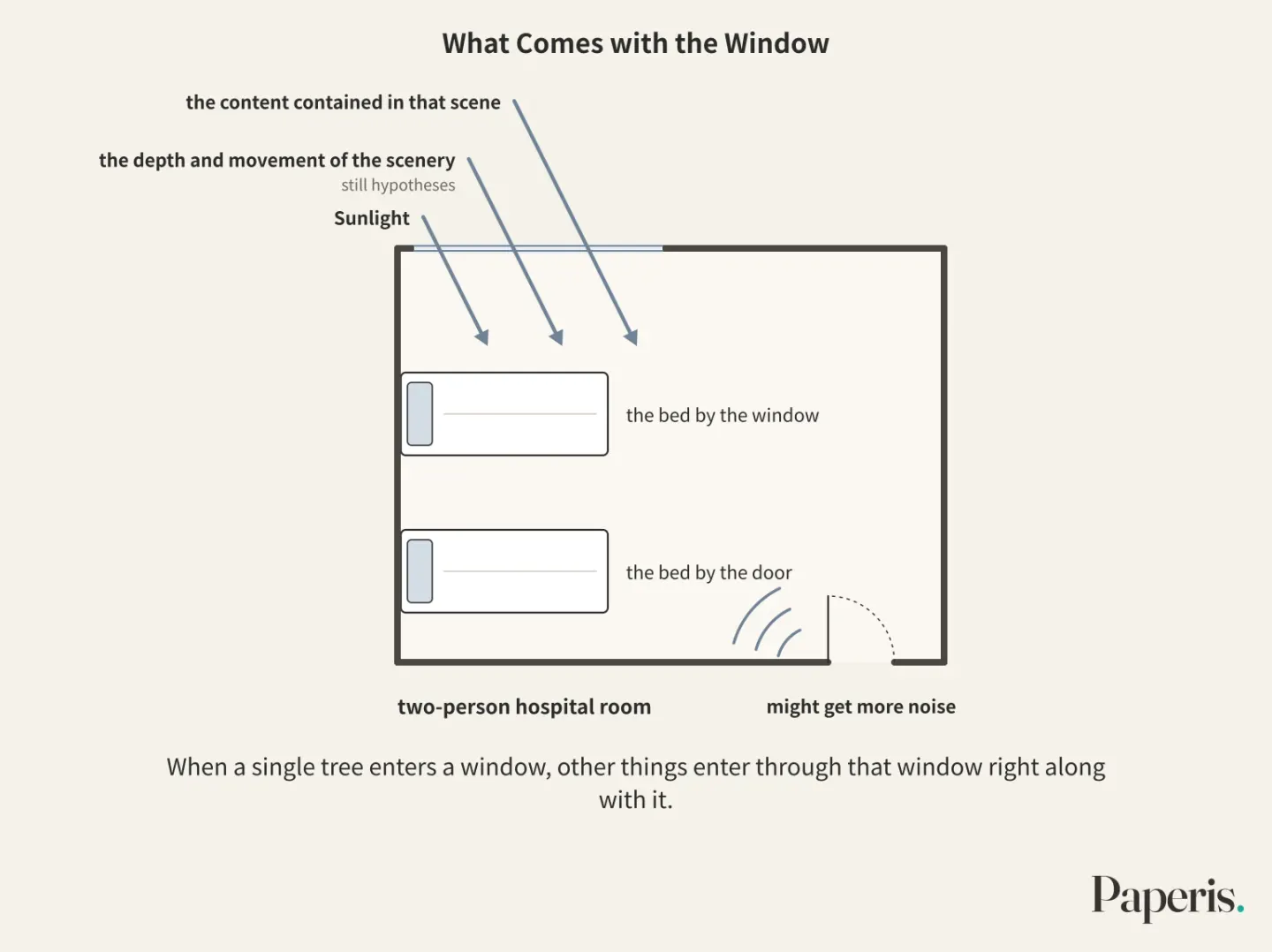
The first thing that enters is sunlight. Looking beyond hospital rooms to indoor spaces in general, there is a 2024 systematic review that gathered 33 studies—which either blocked the view or kept conditions matched while changing only sunlight—and 67 relationships between sunlight factors and recovery indicators. 49% of the effects were null, 42% showed that more sunlight was better for recovery in terms of cognitive, emotional, physical, and clinical indicators, and only 3% were in the bad direction. The highest level of consistency was found in the orientation of the window, meaning whether the room received direct sunlight. While viewing this as promising evidence, the authors noted that most of the studies were observational, controlled experiments were rare, and there were many null results (DOI: 10.1016/j.jenvp.2024.102323). How light coming through a window changes a room was covered in "Light — How One Window and One Curtain Change a Room". What the authors of the intensive care unit study left as their next step for research was directing window light straight at the patient (DOI: 10.1097/ccm.0b013e318287f6cb).
There are also cases where sunlight and greenery canceled each other out. A study looking at the records of 244 patients admitted for mood disorders at a psychiatric hospital between 2013 and 2018 divided the scenery using photographs taken out of each room's window, calculated the ratio of green in the photos, and measured room brightness with a lux meter. When rooms with tree views and rooms with building views were divided into two groups and compared, there was no difference in length of stay. However, when the green ratio and brightness were entered together, both appeared to tilt toward reducing the length of stay (PMID 35189997). The authors explained that in that ward, the greenest room was also the darkest room, meaning the green and the brightness canceled each other out. The windows of this ward show that if you measure only one side, the two effects can erase each other so that no difference appears.
The second thing that enters is depth and movement. A 2026 re-evaluation paper presented visual data showing that the two window views from a 1984 study also differed greatly in the depth of the scenery and the amount of movement visible within it. And in a series of studies conducted by the authors, both the depth of the view and the visible movement were reported to affect stress (DOI: 10.18848/2156-8960/cgp/a447). How those studies were designed does not appear in the abstract. The authors put forward the hypothesis that these two factors may have also contributed to the 1984 results, and noted that research controlling for them is needed. This means that in those two windows, "nature is present" and "depth and movement differ" may have been bundled together.
The third is what is visible. An experiment in a simulated hospital room where participants' hands were immersed in ice water to induce pain divided nature photos into open scenes, scenes with places to hide, scenes that looked dangerous, and scenes mixing the first two. The group that saw the mixed scenes reported less sensory pain, and the group without photos felt the pain as more distressing. The dangerous-looking nature photos distracted from the pain the best and also lowered diastolic blood pressure, but mood was the worst (PMID 21165860). The authors concluded that these photos could not be seen as a beneficial distraction. The ways in which open seating and hiding spots read a space were covered in "Space and Scale — The Seat with Its Back to the Wall, Facing the Window". Even with the same nature, reactions can differ depending on what the scene contains.
A single tree outside a window can bring other things along with it. Sunlight, the depth and movement of the scenery, bed placement, and the content contained in that scene are like that, and most of the hospital studies gathered here failed to measure these things separately. Among them, depth and movement are still hypotheses, and the spinal surgery study comparing bed placements found no difference.
So What Did We Find Out?
Returning to our initial question, regarding "does seeing trees outside the window speed up surgery recovery?", the evidence-backed answer is as follows.
The 1984 study showed in the records of 46 gallbladder surgery patients at a hospital that patients facing the natural scenery had shorter hospital stays and used fewer strong painkillers, and the author introduced those results as "may have an effect" (PMID 6143402). A 2003 editorial described the same study as having "proved" it (DOI: 10.1093/heapro/dag012).
In studies covering actual outdoor locations, places with nature received higher ratings for restoration (the magnitude of which varied greatly across studies), and while the emotional effects were robust, body metrics showed results that varied widely from study to study (DOI: 10.1177/0033294119884063) (PMID 31100773). Short experiments showing scenes through screens or virtual reality found differences in only some metrics (PMID 35688224) (PMID 36208780), and an experiment with 164 people found differences only in later-rated evaluations (PMID 42657391). In hospitals, records of over 12,000 intensive care unit patients at one university hospital found no difference in windows or natural scenery (based on general patients), and records of 448 adolescent spinal surgery patients at one hospital found no difference in distance from the window (DOI: 10.1097/ccm.0b013e318287f6cb) (PMID 41657938). Records from an intermediate ward in Sussex found differences in the degree of visible nature, and records from a cardiac intensive care unit in the southeastern United States found differences among patients on ventilators in rooms with both sunlight and scenery (PMID 41476005) (DOI: 10.1016/j.jointm.2022.11.002). Most studies that found differences and those that did not were record comparisons, and among the studies gathered here, there is not a single randomized study that isolates the view from sunlight, depth, movement, and seating position.
Therefore, current evidence supports neither "looking at nature cures illness" nor "windows have nothing to do with recovery." While evidence has accumulated that people feel restored when they are in nature, it has not yet been confirmed that a single window accelerates surgical recovery. As next steps, the authors of the intensive care unit study noted directing window light straight at patients and high-risk patients (DOI: 10.1097/ccm.0b013e318287f6cb), and the authors of the review paper noted studies controlling for the depth and movement of the scenery (DOI: 10.18848/2156-8960/cgp/a447).
If we picture such a study once, we can see where the pieces produced so far fit in. Like the Taiwanese cesarean section study that randomly assigned patients to rooms, rooms are left to chance; like the cardiac intensive care unit study, rooms with only sunlight are separated from rooms with both sunlight and scenery; like psychiatry studies, the green outside the window and room brightness are measured separately; and the conditions are matched for the depth and movement of the scenery mentioned by the review paper. And as outcomes, length of hospital stay and painkillers are measured, exactly as the 1984 study measured them. These pieces are currently scattered across different studies in different hospitals, and among the studies gathered here, none has brought them together into a single study.
What the 23 pairs from 1984 left behind is closer to a question than an answer. That question remains open today, and in the meantime, the things that can come along with a single window have each earned a name.
Source Papers
- "View through a window may influence recovery from surgery." (1984) — PMID 6143402 — Records from 1972 to 1981 of gallbladder surgeries at a suburban Pennsylvania hospital; 23 patients in rooms with natural views had shorter post-surgical hospital stays, fewer negative evaluations in nursing notes, and used less strong pain medication than 23 matched patients in rooms with brick walls.
- "Visual landscapes and psychological well‐being" (1979) — DOI: 10.1080/01426397908705892 — Stressed people showed increased positive emotions and decreased fear after viewing nature slides, while urban scenes increased sadness. An exploratory primer that raised questions about hospital windows.
- "Health and nature—new challenges for health promotion" (2003) — DOI: 10.1093/heapro/dag012 — An editorial in a health promotion journal. Described the 1984 study as having "proved" faster recovery, shorter hospital stays, and reduced pain medication.
- "[Healing garden: Primary concept]." (2015) — PMID 26115787 — A review of the history of healing gardens. Introduced Ulrich's study as famous research "showing" that nature outside a window has a beneficial effect on inpatient recovery.
- "Foreword: Isolated, yet connected" (2026) — DOI: 10.17613/npf0k-j8t41 — A foreword to a special issue of an architecture journal. Stated that Ulrich's study popularized the idea that view rooms speed up recovery after surgery, and noted that the idea had existed since ancient times.
- "Revisiting the Landmark Paoli Hospital Patient Study: The Potential Stress-Reducing Roles of View Depth and Wind Movement" (2026) — DOI: 10.18848/2156-8960/cgp/a447 — The hypothesis that the original study's two views also differed in depth and visible movement; the authors found in their research that both factors affect stress. Controlled studies are needed.
- "Do Windows or Natural Views Affect Outcomes or Costs Among Patients in ICUs?" (2013) — DOI: 10.1097/ccm.0b013e318287f6cb — Records of 6,138 medical ICU patients and 6,631 surgical ICU patients at a Philadelphia university hospital. After instrumental variable analysis and multiple comparison correction, there was no difference, and general patient outcomes did not improve. Light and high-risk groups remain tasks for future work.
- "A room with a view: Recovery bed environment following pediatric spinal fusion." (2026) — PMID 41657938 — 448 adolescents who underwent idiopathic scoliosis fusion surgery at a single hospital (325 by a window versus 123 by a door); no differences in length of stay, complications, pain, or pain medication.
- "Impact of nature visibility on length of stay in the intermediate care unit: a quality improvement project." (2025) — PMID 41476005 — 459 patients across two Sussex intermediate care wards; each step increase in nature visibility reduced hospital stay by about 8.7%, regardless of season. A quality improvement project and retrospective observation.
- "The impact of daylight and window views on length of stay among patients with heart disease: A retrospective study in a cardiac intensive care unit" (2022) — DOI: 10.1016/j.jointm.2022.11.002 — 2,319 cardiac ICU patients in the southeastern United States; among mechanically ventilated patients, those in rooms with sunlight and views stayed 16.8 hours less than those in windowless rooms.
- "Impact of window views on recovery-an example of post-cesarean section women." (2019) — PMID 31125086 — 296 women who underwent cesarean sections randomly assigned to 46 hospital rooms across 3 hospitals in Taiwan; higher view satisfaction correlated with lower pain (pain medication P=0.057).
- "The Physiological Impact of Window Murals on Pediatric Patients." (2019) — PMID 30309256 — 90 pediatric patients randomly assigned; heart rate and systolic blood pressure improved in rooms with window murals, with tree murals showing the most indicators.
- "The role of nature in coping with psycho-physiological stress: a literature review on restorativeness." (2014) — PMID 25431444 — A review. Strong experimental evidence between nature exposure and recovery from physiological stress and mental fatigue, along with increased positive emotions.
- "Restorativeness in Natural and Urban Environments: A Meta-Analysis" (2019) — DOI: 10.1177/0033294119884063 — 22 studies evaluating natural environments as having higher restorativeness than urban ones (d=1.99), with very high heterogeneity between studies and potential individual differences.
- "Psycho-Physiological Stress Recovery in Outdoor Nature-Based Interventions: A Systematic Review of the Past Eight Years of Research." (2019) — PMID 31100773 — 36 papers; emotional effects are robust, while physiological indicators are heterogeneous.
- "Brief virtual nature exposure and acute stress: inconclusive evidence regarding stress reactivity, recovery, and emotion regulation." (2026) — PMID 42657391 — 164 healthy adults randomly assigned; participants rated nature videos as more restorative, but all preregistered hypotheses were non-significant, though small-to-moderate effects cannot be ruled out.
- "Indoor nature integration for stress recovery and healthy eating: A picture experiment with plants versus green color." (2022) — PMID 35688224 — 92 people; plant pictures scored highest in restorativeness and helped recover positive emotions, with no difference in recovering from negative emotions or stress.
- "Physiological and affective responses to green space virtual reality among pregnant women." (2023) — PMID 36208780 — 63 women in early pregnancy randomly assigned; systolic blood pressure and salivary alpha-amylase decreased while positive emotions increased in VR with abundant greenery.
- "Restorative effects of daylight in indoor environments – A systematic literature review" (2024) — DOI: 10.1016/j.jenvp.2024.102323 — 33 papers and 67 relationships; 49% null, 42% positive, 3% negative, with direct sunlight direction being the most promising, and many observational studies.
- "On the relation between a green and bright window view and length of hospital stay in affective disorders." (2022) — PMID 35189997 — 244 psychiatric inpatients; binary comparisons were null, but when green ratio and brightness were included together, both shortened hospital stays (suppression effect), and the greenest room was the darkest.
- "The effects of nature images on pain in a simulated hospital patient room." (2010) — PMID 21165860 — A cold pressor pain experiment; mixed views and refuge pictures reduced sensory pain, while threatening scene pictures provided the highest distraction but also the highest mood disturbance.
Sources (21)
- View through a window may influence recovery from surgeryPMID 6143402
- Visual landscapes and psychological well‐beingDOI 10.1080/01426397908705892
- Health and nature—new challenges for health promotionDOI 10.1093/heapro/dag012
- [Healing garden: Primary concept]PMID 26115787
- Foreword: Isolated, yet connectedDOI 10.17613/npf0k-j8t41
- Revisiting the Landmark Paoli Hospital Patient Study: The Potential Stress-Reducing Roles of View Depth and Wind MovementDOI 10.18848/2156-8960/cgp/a447
- Do Windows or Natural Views Affect Outcomes or Costs Among Patients in ICUs?DOI 10.1097/ccm.0b013e318287f6cb
- A room with a view: Recovery bed environment following pediatric spinal fusionPMID 41657938
- Impact of nature visibility on length of stay in the intermediate care unit: a quality improvement projectPMID 41476005
- The impact of daylight and window views on length of stay among patients with heart disease: A retrospective study in a cardiac intensive care unitDOI 10.1016/j.jointm.2022.11.002
- Impact of window views on recovery-an example of post-cesarean section womenPMID 31125086
- The Physiological Impact of Window Murals on Pediatric PatientsPMID 30309256
- The role of nature in coping with psycho-physiological stress: a literature review on restorativenessPMID 25431444
- Restorativeness in Natural and Urban Environments: A Meta-AnalysisDOI 10.1177/0033294119884063
- Psycho-Physiological Stress Recovery in Outdoor Nature-Based Interventions: A Systematic Review of the Past Eight Years of ResearchPMID 31100773
- Brief virtual nature exposure and acute stress: inconclusive evidence regarding stress reactivity, recovery, and emotion regulationPMID 42657391
- Indoor nature integration for stress recovery and healthy eating: A picture experiment with plants versus green colorPMID 35688224
- Physiological and affective responses to green space virtual reality among pregnant womenPMID 36208780
- Restorative effects of daylight in indoor environments – A systematic literature reviewDOI 10.1016/j.jenvp.2024.102323
- On the relation between a green and bright window view and length of hospital stay in affective disordersPMID 35189997
- The effects of nature images on pain in a simulated hospital patient roomPMID 21165860