
Paperis Articles
The Open-Plan Office — The Distance You See, the Distance You Speak
Does tearing down walls make people talk more? In two corporate headquarters studied in 2018, face-to-face interaction fell by about 70% after the move; other before-and-after studies repeatedly recorded complaints about speech and privacy, though some moves saw conversation rise. Results split by conditions, and the evidence rests on designs with real limits.
Your field's papers, as audio
Pick your fields and journals — Paperis summarizes the key papers and turns them into audio. Listen on your commute.
Start Paperis free →The Open-Plan Office — The Distance You See, the Distance You Speak
The Expectation That Knocking Down Walls Increases Talk
120 employees changed their entire workplace. They moved from an office where desks were lined up in rows, mixed with half-blocked rooms and private offices, to an open layout called a "landscape" arrangement. A field study published in 1972 administered the same questionnaires to these people just before the move and nine months later (DOI: 10.1177/001872087201400502). The attempt to measure what an office with its walls removed does to the people inside it began half a century ago.
Let us first define the names of the offices this article deals with. An open-plan office is one where multiple people work together in a single space without walls and doors dividing rooms. Places with low partitions between desks also fall into this category. The side that studies use as a comparison point is the private office. A private office is one where a single person sits and works in a room divided by walls and doors. Between the two are offices where several people share a room, and many studies count this separately.
The expectation that pushed open-plan offices forward was clear. Transforming offices into an "open" architecture that reduces spatial boundaries like walls and doors and lets people see each other clearly came from an organizational desire to increase workplace collaboration (PMID 29967303). The productivity benefits of open-plan offices have been thought to come from human-to-human interaction and opportunities for knowledge exchange (DOI: 10.1108/jcre-11-2016-0037). The common belief this article will follow is this single line. If people can see each other and are close, they will talk more.
Calculations were also attached to this expectation. Open-plan offices can reduce real estate costs (DOI: 10.1007/s11301-022-00316-2) and can provide financial gains to management (DOI: 10.1177/2158244020988869). The desire for collaboration and the calculation of costs pointed in the same direction.
This article follows this question across three distances. The distance at which colleagues are visible, the distance at which colleagues' speech can be heard, and the distance at which people actually speak to one another. The conventional view assumed that reducing the first would also reduce the third. What the studies below measured is where that assumption holds true and where it fails, and how the second distance changes when walls disappear.
Studies Measuring Before and After
Evaluations that the new office looked good rose clearly, while evaluations that it was efficient for working fell. This is the answer left by 120 people in 1972. The center of complaints was noise felt to have grown, vanished privacy, and increased visual distractions, while a few good points also came out regarding getting along within the group (DOI: 10.1177/001872087201400502).
The method used by this study became the basic framework of this field. Before-and-after comparison studies are research that measures and compares the same people before they move offices and after they move. Because the same people are measured twice, differences arising because the people are different are reduced. Instead, other things that changed together during the move—namely, the new building, new furniture, and changed ways of working—are not filtered out.
In a large corporation's relocation reported in 1982, 70 employees answered questionnaires six months before the move and six weeks after the move. Neither satisfaction with communication nor the feeling about noise changed. What fell was satisfaction with privacy, and that too among people who had moved from rooms with walls. That the degree to which shared conversations did not leak out decreased came out in both questionnaires and acoustic measurements (DOI: 10.1177/0013916582143007). In the same relocation, secretarial positions moved from desks without partitions to half-enclosed stations, so walls were actually created for these people. The single sentence "Moving to an open-plan office" was a different change for each person.
In a 2009 study measuring 31 people before and after they moved from private rooms to an open-plan office shared by more than 20 people, the results gathered on one side. Distractions and difficulty concentrating increased, and the self-evaluation that less work was accomplished due to noise doubled. Collaboration became less enjoyable and less direct, and the flow of information did not change. The research team summarizes that the benefits commonly attached to open-plan offices did not appear (PMID 19851909). These 31 people were professionals who mainly did work they accomplished alone. Concluding that open-plan offices are not recommended for professionals, the research team added that the same study should be done in other job groups as well (PMID 19851909).
There is also a 2015 study that extended the follow-up period to 1 year. Questionnaires were sent one month before the move and at 3 months, 6 months, and 12 months after the move to people doing similar work in three departments of a corporate group who were scheduled to move from private offices to an open-plan office. Initially, 82 copies were sent and 85% answered, and afterwards 70–81% answered. Self-perceived health, job satisfaction, and work performance generally worsened, and that decline was recorded over 12 months after the move (DOI: 10.3233/wor-131798). The decline continued for twelve months after the move, and this is not a study comparing them with people who did not move.
Results in the opposite direction also came from the same design. A 1995 conference presentation paper observed 12 employees who did a lot of computer work for three months after they moved from a room enclosed by four walls to a more open room with only three walls. The research team saw that as the layout opened up, interaction and communication among employees increased. In the same relocation, perceived privacy clearly decreased and distractions catching the eye and ear increased, and desks that allow sitting and standing also came in together (DOI: 10.1177/154193129503900704). A government office relocation reported in 2008 is also a case where communication increased. A place where people moved from an open-plan office surrounded to some degree by partitions at each station to an open-plan office where stations were fully open was observed and surveyed by walking along a set path roughly 1 year before the move and more than 1 year after the move. In the new office, the degree to which people could see and approach each other improved, face-to-face conversation increased, and perceived privacy also improved. Those who answered the survey were 35 people from the old office, among whom 29 answered again in the new office (DOI: 10.1068/b33034).
When before-and-after comparison studies are placed side by side, what is repeated most frequently are complaints about speech sound and privacy. There are also results that communication increased. Whichever the case, they are the same in that they are studies at the scale of one or two offices and 12 to 120 people.
In 2018, Face-to-Face Conversations at Two Corporate Headquarters
The headquarters of two companies moved to more open-plan offices. A study published in 2018 measured face-to-face conversations using devices worn on employees' bodies, measured email and instant messaging using company server records, and compared the before and after of the move (PMID 29967303). The first metric the researchers measured is face-to-face interaction. Face-to-face interaction is conversation and meeting face-to-face in the same spot.
The results were in the same direction for both places. The amount of face-to-face interaction dropped by roughly 70%, and electronic communication increased alongside it (PMID 29967303). The researchers introduced these findings with the phrase "contrary to common belief," and interpreted that open architecture provoked a natural response of social withdrawal from colleagues, replacing it with communication via email and messaging. The researchers also stated that this study's place is being the first to measure face-to-face conversation and electronic communication together before and after a move (PMID 29967303).
At the two headquarters, the distance at which colleagues were visible decreased, but face-to-face conversations actually decreased. The scope of what this study tells us is precisely that. The subjects are one move each for two companies, and "withdrawal" is an interpretation attached to the measured values by the researchers. Results measuring separately why people reduced conversation—whether due to noise or line of sight—are not in this study's report.
Even in studies with different designs, the picture that "the more open it is, the easier it is to talk" did not emerge. In a single-point survey reported in 2018 that sent questionnaires to 1,500 Swedish real estate agents and received 271 usable responses, the more colleagues sharing a single space, the lower the job satisfaction. People working in small- and medium-sized open-plan offices answered less that it was easy to interact with colleagues compared to people working in private offices or rooms shared by a few people, and the connection to job satisfaction ran sequentially through this ease of interaction and subjective well-being (PMID 29334117). Because it was a survey asked once at a single point in time, it cannot distinguish which came first. Still, it points in the same direction as the results from the two headquarters. Making the visible distance shorter and making the conversational distance shorter were not the same thing.
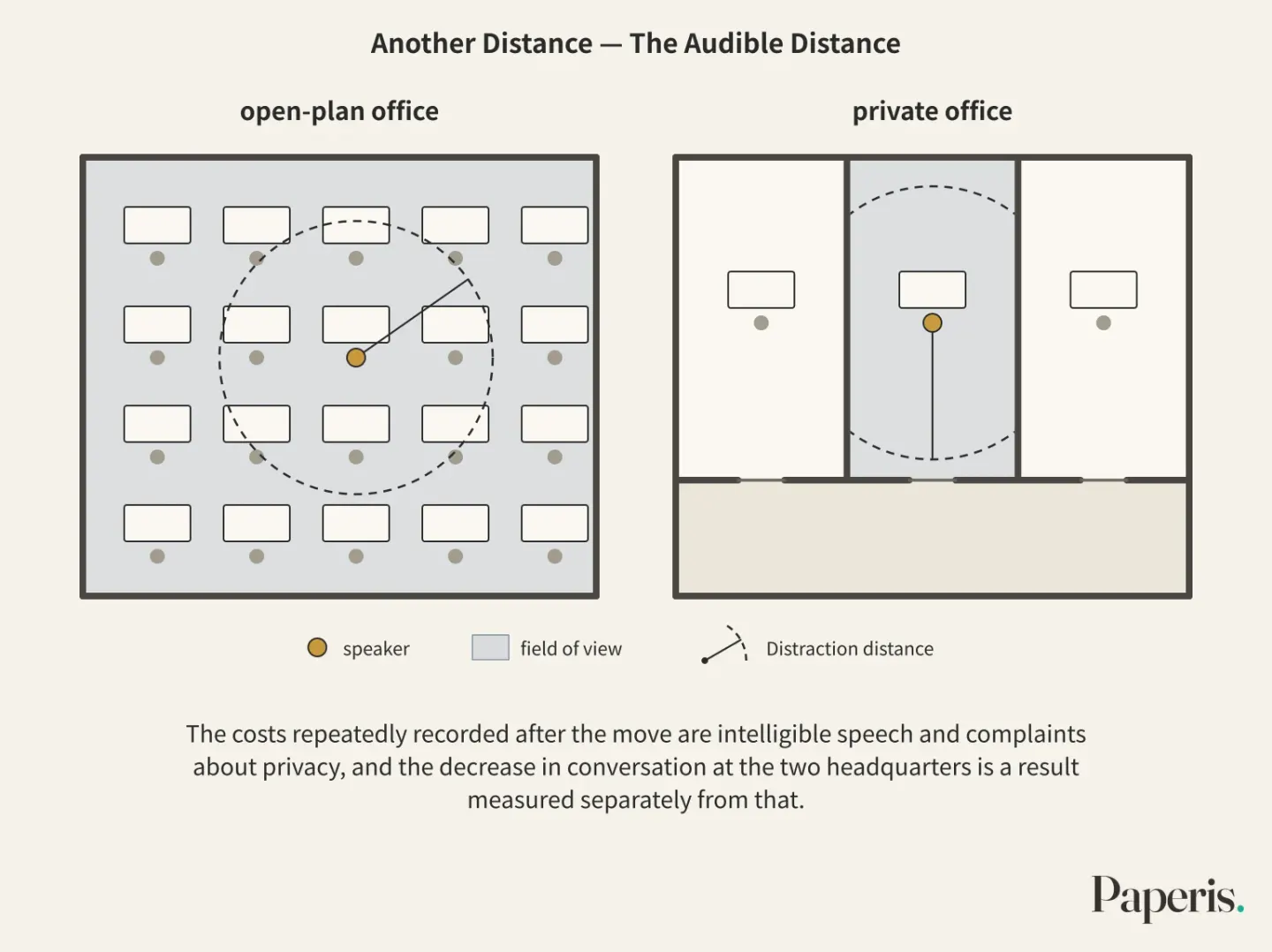
Another Distance — The Audible Distance
The daily average sound level was the same as before the move. This is the story of 31 people who moved into an open-plan office in 2009. What changed noticeably was a different value. Speech privacy is the degree to which my words are not understood by others, and others' words are not understood by me. In acoustic measurements, this speech privacy dropped markedly compared to before, while the fluctuations in sound level actually decreased. The tasks most disrupted by noise were those requiring heavy mental effort and making phone calls, and behaviors to cope with the disruption also increased (PMID 19851909). Even though the average noise level remained the same, complaints about disruption increased.
The same picture emerged from a broader set of data. There is also a separate value that measures the distance over which speech is audible. Distraction distance is the distance measured to find out how far the speech travels from the speaker so that it can be clearly understood. In a 2017 study that re-analyzed individual-level data combining surveys of 883 respondents across 21 open-plan offices and indoor acoustic measurements, the overall noise perceived by people was mostly explained by distracting background speech. The longer the distraction distance, the greater the noise disturbance, and other values like the average level of background noise might not have linked to disturbance on their own. The researchers concluded that this result supports the role of architectural acoustic design in absorbing, blocking, and masking sound (PMID 28147583). Across the data from 21 locations, what best explained the noise perceived by people was not the volume of the sound, but intelligible speech. How walls and ceilings reflect sound back was covered in "Material and Texture — A Wall the Fingertips Know, a Room That Returns a Clap".
This toll did not arrive with the same magnitude for all tasks. In a laboratory study reported in 2006 where 36 people performed tasks while listening at the same volume to three sound environments for four hours each — intelligible speech, speech rendered indistinct by other sounds, and steady noise — proofreading scores dropped only in the intelligible speech condition. Reading comprehension and various computer tasks were not affected (DOI: 10.1080/00140130600679142). In another study from 2012, tasks that required holding recently seen information in mind by rehearsing it were more easily disrupted by irrelevant speech, while tasks that did not require rehearsal or that retrieved older memories were less disrupted. The researchers concluded that tasks like searching for information and memorizing content are unsuited to environments where irrelevant speech is constantly present (PMID 23257585). Because both studies were experiments conducted under controlled conditions, one must take a careful step when applying these findings to an actual office day.
There is also a 2020 study that directly measured performance in the field. When 113 employees across five offices were asked to solve tasks requiring concentration, the performance of people who had been working in shared and open-plan offices before the move was 14% lower than that of people who had worked in private offices. The noise level in the private offices, measured by an acoustics expert, was 15 decibels lower (PMID 33052159). This 14% is a figure comparing people who were already in different offices all at once. In a 2019 survey of 1,078 people, people in open-plan offices used headphones playing music to block out colleagues' speech more frequently than those in rooms shared by a few people (PMID 30669442). This study also did not measure the same people before and after a move.
Let us measure these facts against a day after moving into an open-plan office. The daily average noise is similar to before, but acoustic measurements show that the degree to which speech does not leak out has decreased markedly. The times when noise is most disruptive are when grappling with tasks requiring mental effort and when taking personal phone calls (PMID 19851909). Conversely, my own speech leaks out to others just as much, and people who moved from rooms with walls reported that the degree to which conversations do not leak out had decreased (DOI: 10.1177/0013916582143007).
One question remains. Whether the increased distance over which speech is audible is connected to the reduced face-to-face conversation observed in two headquarters in 2018. The researchers at the two headquarters interpreted the reduced conversation as "withdrawal", and whether the cause was sound is not covered in the evidence gathered in this article. The costs repeatedly recorded after the move are intelligible speech and complaints about privacy, and the decrease in conversation at the two headquarters is a result measured separately from that.
What Sick Leave Records Say and Do Not Say
There is a 2020 study that asked 6,328 Norwegian office workers about their office type through a survey, and then compared this against physician-verified sick leave recorded in national registers over the following 12 months. Compared to private offices, the risk of taking at least one instance of physician-verified sick leave was 1.18 times higher for people working in shared rooms with a few people, and 1.12 times higher for those in open-plan offices. This value was adjusted for the survey year, and showed no association with the number of sick leave days. This association remained consistent even when broken down by organization, age, gender, management responsibility, and education level (PMID 31647108). The researchers viewed these offices as a risk factor for sick leave and concluded that providing opportunities to work in private offices could reduce absenteeism (PMID 31647108). This conclusion came from observational comparisons of people already in those offices, and a subsequent 2024 Norwegian research team noted that a more robust design is needed to tease out causation (PMID 38785098).
A 2023 meta-analysis gathering five such studies (2008–2020, totaling 13,277 people) calculated sick leave days compared to private offices in two groupings. Small open-plan offices shared by 4 to 9 people had an odds ratio of 1.27 for higher sick leave (confidence interval 0.99–1.54), and multiple open-plan offices shared by 4 or more people had an odds ratio of 1.24 (0.96–1.51). For both estimates, the lower end of the interval is slightly below 1, which denotes "no difference," so based on this interval alone, it is indistinguishable from no difference. The researchers wrote in the same abstract that this was a statistically significant higher odds ratio, meaning the numbers within the abstract do not even add up. Given that the largest sample among the five studies was 6,328 people, the earlier Norwegian study is likely included here. The researchers considered these findings to be consistent with previous reviews addressing health and well-being, while pointing to various design strategies to balance the pros and cons of open-plan offices as a subject for future research (PMID 35675991).
There are also records that gave different answers to the same question. A study of three Swedish organizations reported in 2020 took issue with the fact that previous studies relied on self-reports, which are prone to fading memory, and thus analyzed employer absenteeism records (988 people) and self-reports (1,237 people) separately. Office type was generally associated with neither the frequency nor the days of sick leave. The exceptions were that total sick leave days in hot-desking offices—offices where employees do not have assigned desks—were 2.46 times those of private offices, and that self-reported absenteeism was higher in medium-sized open-plan offices. The researchers wrote that this study did not allow for the conclusion that open-plan offices are associated with sick leave (PMID 32348340). Conversely, a 2014 study that had 1,852 people self-report their sick leave two years later found more short-term sick leave across all three sizes of open-plan offices, while long-term sick leave and total sick leave days showed different office types standing out depending on gender. The researchers viewed the differences between office types as varying depending on the number of people sharing the space and the degree of personal control one has (PMID 24460745).
A 2024 study also asked why these associations arise. It linked surveys from 5,512 people—selected to be representative of Norway—with national registers, looking at physician-verified sick leave in the year following the survey. Compared to private offices, the risk was 1.12 times for ordinary open-plan offices, 1.20 times for hot-desking open-plan offices, and 1.29 times for hot-desking shared rooms. When the observational data were broken down using a statistical model, the degree to which individuals could decide when and how to do their work was calculated to explain 19% to 34% of this difference. The researchers viewed this as a potential mechanism, while noting that research must continue with designs capable of more solidly isolating the cause (PMID 38785098).
Although the record studies showed a small association between open-plan offices and sick leave, the meta-analysis interval includes "no difference," the Norwegian register interval begins just above it, the Swedish employer records showed generally no association, and the cause has not yet been pinned down. The data from these studies may partially overlap. What current records say goes only as far as a small association between groups, and they contain no information to predict an individual's health.
Results That Vary Depending on Conditions
Among 113 employees across five offices, people from four of them moved to an activity-based workspace. An activity-based workspace is an office without assigned personal desks, where people choose and sit at different desks arranged for the task at hand—such as focusing, meeting, or making phone scores—each time. In this study reported in 2020, after the move, scores for focused tasks were lower in the "activity zone," which lacked noise restrictions, than in all other zones. When the same person moved from an open desk in the activity zone to a quiet zone, their score rose by 16.9%, and when they moved to a private single-person studio, it rose by 21.9% (PMID 33052159). Even within the same office, choosing a different seat changed the outcomes.
Previous studies that looked at moves from open-plan offices to activity-based workspaces frequently recorded improvements in satisfaction. A 2018 study compared 896 survey responses across ten layouts—four activity-based layouts and six other layouts (termed "combi" in the abstract) before and after the move from open-plan offices to activity-based workspaces—across the layouts. Even though the measured indoor environmental conditions showed no major differences between the layouts, satisfaction with the indoor environment, self-perceived productivity, and health were higher on the activity-based workspace side. The results described in the abstract are comparisons between layouts, and before-and-after changes for the same individuals are not reported separately (DOI: 10.1080/09613218.2018.1476372). In a survey of 34 people from 2017 comparing a company before and after its relocation, satisfaction with acoustic privacy, background noise, and aesthetics increased. On the other hand, complaints emerged that communication within teams was lacking, and people attributed this to a shortage of desks relative to the number of people and a lack of rules. Self-perceived performance did not change (DOI: 10.1080/00140139.2017.1398844). In a 2021 study measuring 61 people who moved from an open-plan office 6 weeks before and about 8 months after the move, the more types of desks available to choose from and the more people felt that others followed usage rules, the better the match between the privacy they needed after the move and the privacy they actually obtained (DOI: 10.1108/jcre-12-2020-0066). In a 2017 study measuring people who moved from private offices 1 month and 8 months after the move, disruptions decreased, and those who answered that their desks suited their needs experienced greater increases in satisfaction and exchanges between teams (DOI: 10.1177/0013916517697766).
Offices that eliminated assigned desks also show records on the other side. In the Swedish records mentioned earlier, the only offices with a higher total number of sick leave days than private offices were offices without assigned desks (PMID 32348340), and in 2024 Norwegian data as well, the risks compared to private offices were 1.20 times for open-plan offices without assigned desks and 1.29 times for shared rooms without assigned desks. Ordinary open-plan offices stood at 1.12 times, and results separately filtering out the differences between these values are not in the abstract (PMID 38785098). A 2023 review gathering 46 empirical studies concluded that activity-based workspaces negatively affect not only performance but also satisfaction and health, summarizing that while they have the potential to foster collaboration and interaction, this depends on professional and proactive management (DOI: 10.1007/s11301-022-00316-2).
It was also observed that desks with a short visible distance actually became desks where people spoke to each other. In a case reported in 2019, when an organization piloted such an office and observed it systematically, the frequency of collaboration was high at work desks outside of assigned desks, particularly in open areas with good visibility and easy approachability, and those desks supported impromptu conversations. In the same office, people who needed privacy sought out enclosed desks more often, and nearly half of the teams gathered and sat by defining their own zones (DOI: 10.1108/jcre-08-2018-0028).
Even within the same open-plan office, the seated desk made a difference. In a 2021 study analyzing employee surveys from the headquarters of a global technology company in the UK alongside the visual field from each desk, the more other desks there were in the field of view, and the more a person sat with their back to the room with the space behind them wider than the perimeter, the worse they rated the working environment. Because it was a survey at a single point in time, this represents an association where such desks were associated with lower ratings in teamwork aspects such as information sharing and team cohesion, with the difference being largest in working with concentration and working productively (DOI: 10.1371/journal.pone.0250058). Why a desk with an open back and an enclosed desk feel different to a person was covered in "Space and Scale — The Seat with Its Back to the Wall, Facing the Window".
Who does what and what work they perform were also crossroads. Professionals centered on solo tasks (PMID 19851909), and people who lost walls versus people who gained walls in the same relocation (DOI: 10.1177/0013916582143007), yielded different results. In a 2017 single-point survey of 220 office workers in the Middle East, productivity advantages and disadvantages were experienced evenly across open and closed offices, and the factors with the greatest impact on self-perceived productivity were whether multiple layouts could be chosen, whether interactions could be self-regulated, and whether there were shared break areas (DOI: 10.1108/jcre-11-2016-0037). There was also a connection to organizational circumstances. In an exploratory tracking study from 2025 during the transition of two departments (598 and 304 employees) across two Swedish public sector organizations to open-plan offices, the more people answered that collaboration within their department was good before the change, the fewer answers stated they accomplished less work due to the working environment after the change. This association appeared in both organizations, whereas several other factors were prominent in only one organization. The researchers pointed out as the main lesson of this study that office changes always take place within the organization's unique context (DOI: 10.1186/s12889-025-22953-4).
Even within the same "openness," results varied depending on whether one could choose a quiet desk to work at, where one sat, and what kind of work one performed.
Still Debating — What Was Measured and How
Out of 10,242 papers, 31 directly compared open-plan and private offices. The results of a 2021 systematic review that selected and gathered these studies leaned to one side. Working in an open-plan office was associated with worse outcomes across many measures of health, satisfaction, productivity, and social relationships, along with lower overall health and higher stress. The environmental traits that proved particularly problematic were noise and disturbance, a lack of privacy, lighting and glare, and difficulty controlling temperature, with most studies reporting negative impacts on social relationships and interactions. The authors evaluated that the financial gains open-plan offices might offer management appear to be offset by the invisible costs borne by the workers, and recommended further examining the design factors and employee traits that could yield better outcomes in open-plan offices (DOI: 10.1177/2158244020988869). Another review gathering 46 papers from 2005 to 2022 reported that open-plan offices incur performance drops larger than the initial cost savings, and summarized that in most cases—especially for knowledge workers—private offices were the environment showing the best performance (DOI: 10.1007/s11301-022-00316-2).
The abstracts of both reviews did not separately state the design or the quality of the evidence of the gathered studies. Looking only at the field research featured in this article, there are three branches. First are before-and-after comparison studies. Most span one or two offices and a scale of 12 to 120 people, and they fail to isolate the effects of the layout from the furniture, buildings, and working methods that changed together during the move. Among the studies featured in this article, only one used a non-moving location as a comparison baseline, and even that study moved to an activity-based workspace. Among 261 employees across five workplaces at a Swedish government agency reported in 2022, four sites moved from private and open-plan offices to an activity-based workspace while one did not. At the moved sites, perceptions of managers' relationship-centered behaviors decreased, people who moved from open-plan offices also saw decreases in perceptions of other leadership aspects, and the non-moving site remained unchanged (DOI: 10.3390/ijerph192013557). Second are single-point-in-time surveys. Because they compare people already in those offices, who was assigned to which office gets mixed into the results. Third are studies chaining national and employer records. While the sample is large and sick leave is an objective record, office type is typically self-reported and layout is observed.
The evidence for productivity is thinner. The double the amount of less work done due to noise (PMID 19851909), the worsened performance over one year (DOI: 10.3233/wor-131798), and the productivity increased in an activity-based workspace (DOI: 10.1080/09613218.2018.1476372) are all self-rated values. Objectively measured values like task scores are rare, and among them, the 14% difference in a 2020 study compared different people (PMID 33052159). For sick leave as well, self-reports and employer records gave different answers (PMID 32348340).
The evidence leans to one side — toward complaints about speech noise and privacy increasing in open-plan offices, the expected increase in communication failing to clearly appear, and two reviews summarizing associations with worse outcomes in health, satisfaction, productivity, and relationships. However, since most of that evidence relies on designs without random assignment, it has not reached the stage where we can pin it down and say, "open-plan offices are the cause."
So What Did We Learn?
We return to the three distances. Knocking down walls reduces the distance at which colleagues are visible. Conventional wisdom expected that, as a result, the distance for striking up a conversation would also shrink. What research has shown is that that expectation does not happen on its own. In two headquarters in 2018, face-to-face conversation fell by roughly 70% (PMID 29967303), and a before-and-after comparative study from 1982 and 2009 showed no increase in communication. On the other hand, in one government office in 2008, face-to-face conversation increased (DOI: 10.1068/b33034), and communication also increased in a 1995 conference paper covering 12 people who moved to rooms with three walls and brought new desks along with them (DOI: 10.1177/154193129503900704).
The second distance was recorded separately. At the desks of people who left wall-containing rooms in two relocations, acoustic measurements showed that the degree to which speech failed to leak out decreased (PMID 19851909) (DOI: 10.1177/0013916582143007), and data from 21 locations showed that intelligible speech accounted for most noise complaints (PMID 28147583). That cost was large for tasks involving memory and correction in experiments. Although there was a relocation where privacy improved (DOI: 10.1068/b33034), this is the cost most frequently repeated across the studies examined in this article. Whether this cost led to the reduced conversation in the two headquarters remains a question. None of the studies gathered in this article measured that.
The magnitude of that cost was determined by conditions. Whether people could choose a quiet spot and a room for individual use, whether the rules governing the use of those spaces were respected, whether they sat in seats with their backs open to the room, whether the work was individual focus work or collaborative, and how the organization originally collaborated split the results. Therefore, the claim "Open-plan offices increase communication" is not supported by this evidence. The conclusion organized by two reviews, "Open-plan offices are bad," is the side toward which the results lean, and the small association between speech and privacy complaints and sick leave also points that way. However, because the designs lacked random assignment, it cannot be pinned down as the cause, and the results varied depending on quiet seats, seating arrangements, and the type of work. The method of asking people who have come in and worked what a building is like was covered in "Paths and Use — A Newcomer's Steps, an Occupant's Word".
The act of reducing the distance at which colleagues are visible and the act of reducing the distance at which one speaks to colleagues were not the same thing, and what was repeatedly recorded as the cost of an office where walls had vanished was the distance at which speech could be heard.
Source Papers
- "The Office Environment: Space Planning and Affective Behavior" (1972) — DOI: 10.1177/001872087201400502 — 120 people, immediately before moving to a landscape-style open layout and 9 months later: aesthetic evaluation increased, functional efficiency evaluation decreased, complaints of noise, loss of privacy, and visual distraction, with some improvement in peer socialization.
- "Privacy and Communication in an Open-Plan Office: A Case Study" (1982) — DOI: 10.1177/0013916582143007 — 70 people before and after relocation: communication satisfaction and noise perception unchanged, privacy satisfaction decreased for those coming from walled rooms (decreased conversation confidentiality, surveys and acoustic measurements).
- "Effects of acoustic environment on work in private office rooms and open-plan offices - longitudinal study during relocation." (2009) — PMID 19851909 — Private rooms to open-plan offices of 20+ people for 31 people: speech privacy decreased, average noise unchanged, disturbance and difficulty concentrating increased, self-rated performance loss due to noise doubled, collaboration less direct, information flow unchanged; not recommended for professionals, research on other job types needed.
- "Work environment perceptions following relocation to open-plan offices: A twelve-month longitudinal study" (2015) — DOI: 10.3233/wor-131798 — Private offices to open-plan offices, surveyed 1 month before and 3, 6, and 12 months after: health, job satisfaction, and perceived performance generally worsened.
- "Effects of Office Layout and Sit-Stand Adjustable Furniture: A Field Study" (1995) — DOI: 10.1177/154193129503900704 — Conference paper, 12 people, closed room to more open room (simultaneous introduction of sit-stand adjustable furniture): interaction and communication increased, privacy decreased, disturbance increased.
- "Space, behavior, and environmental perception in open-plan offices: A prospective study" (2008) — DOI: 10.1068/b33034 — Government offices, somewhat enclosed open seats to open-plan seats: visibility and accessibility increased, face-to-face conversation increased, perceived privacy increased (survey 35 to 29 people).
- "The impact of the 'open' workspace on human collaboration." (2018) — PMID 29967303 — Before and after relocation to open-plan offices at two headquarters, wearable devices and server logs: face-to-face interactions decreased by about 70%, electronic communication increased; authors interpret this as social withdrawal.
- "The relationship between office type and job satisfaction: Testing a multiple mediation model through ease of interaction and well-being." (2018) — PMID 29334117 — Cross-sectional study of 271 Swedish real estate agents: number of people sharing space increased to job satisfaction decreased, sequentially mediated by ease of interaction and well-being.
- "Distraction distance and perceived disturbance by noise-An analysis of 21 open-plan offices." (2017) — PMID 28147583 — Meta-analysis of individual data from 883 people across 21 locations: noise perception is mostly explained by distracting speech, distraction distance increased to disturbance increased.
- "The effect of speech and speech intelligibility on task performance" (2006) — DOI: 10.1080/00140130600679142 — Laboratory with 36 people: proofreading scores decreased only under intelligible speech, reading comprehension and computer tasks unaffected.
- "Open-plan office noise: the susceptibility and suitability of different cognitive tasks for work in the presence of irrelevant speech." (2012) — PMID 23257585 — Rehearsal-based short-term memory tasks are vulnerable to irrelevant speech.
- "Objective measures of cognitive performance in activity based workplaces and traditional office types." (2020) — PMID 33052159 — 113 people: scores in shared and open-plan offices before relocation were 14% lower (noise in private offices was 15 dB lower); within activity-based spaces, quiet zones +16.9%, single-occupant rooms +21.9%.
- "A Cross-Sectional Survey on the Impact of Irrelevant Speech Noise on Annoyance, Mental Health and Well-being, Performance and Occupants' Behavior in Shared and Open-Plan Offices." (2019) — PMID 30669442 — Cross-sectional study of 1,078 people: use of music headphones to cope with speech noise in open-plan offices.
- "The impact of office design on medically certified sickness absence." (2020) — PMID 31647108 — 6,328 people in Norway, 12-month records: shared rooms RR 1.18, open-plan offices RR 1.12 (occurrence of sick leave), regardless of duration; authors' conclusion is a risk factor.
- "Association of open-plan offices and sick leave-a systematic review and meta-analysis." (2023) — PMID 35675991 — 5 studies with 13,277 people: small open plan OR 1.27 (0.99–1.54), 4+ people OR 1.24 (0.96–1.51).
- "Sickness absence and sickness presence in relation to office type: An observational study of employer-recorded and self-reported data from Sweden." (2020) — PMID 32348340 — Employer-recorded data for 988 people and self-reported data for 1,237 people: largely uncorrelated, total days IRR 2.46 for flex offices; no causal conclusion can be drawn.
- "Office design's impact on sick leave rates." (2014) — PMID 24460745 — 1,852 people 2 years later self-reported: short sick leaves increased in open-plan offices, gender differences.
- "Does job control contribute to differences in physician-certified sickness absence across office concepts? A mediation analysis in a nationally representative sample." (2024) — PMID 38785098 — 5,512 people in Norway: open plan RR 1.12, desk-free open plan 1.20, desk-free shared room 1.29, job control mediates 19–34%; stronger causal designs needed.
- "Designing activity-based workspaces: satisfaction, productivity and physical activity" (2018) — DOI: 10.1080/09613218.2018.1476372 — Before and after open-plan office to activity-based space, 896 survey responses: small differences in measurement conditions, but satisfaction, cognitive productivity, and health increased.
- "Perceptions of performance and satisfaction after relocation to an activity-based office" (2017) — DOI: 10.1080/00140139.2017.1398844 — 34 people before and after: acoustic privacy, noise, and aesthetic satisfaction increased, lack of intra-team communication (lack of desk ratios and rules), cognitive performance unchanged.
- "Office relocation: changes in privacy fit, satisfaction and fatigue" (2021) — DOI: 10.1108/jcre-12-2020-0066 — 61 people from open to activity-based: desk variety and adherence to rules improved privacy fit.
- "Need–Supply Fit in an Activity-Based Flexible Office: A Longitudinal Study During Relocation" (2017) — DOI: 10.1177/0013916517697766 — Private office to activity-based, measured 3 times: disturbance decreased, better need-supply fit led to increased satisfaction and cross-team interaction.
- "The productivity tax of new office concepts: a comparative review of open-plan offices, activity-based working, and single-office concepts" (2023) — DOI: 10.1007/s11301-022-00316-2 — Review of 46 papers: performance degradation in open-plan offices, collaboration potential in activity-based working depends on management, private offices best for knowledge workers.
- "Activity-based flexible office: Exploring the fit between physical environment qualities and user needs impacting satisfaction, communication, collaboration and productivity" (2019) — DOI: 10.1108/jcre-08-2018-0028 — Pilot case: collaboration frequency increased in highly visible and easily accessible alternative open seats, privacy needs led to demand for enclosed seats.
- "Differential perceptions of teamwork, focused work and perceived productivity as an effect of desk characteristics within a workplace layout" (2021) — DOI: 10.1371/journal.pone.0250058 — A headquarters, view analysis per desk: greater number of desks in view and larger space behind back led to lower evaluations, maximized focused work effectiveness.
- "Workplace productivity and office type: An evaluation of office occupier differences based on age and gender" (2017) — DOI: 10.1108/jcre-11-2016-0037 — 220 people in the Middle East: benefits and losses evenly distributed across open and closed offices, layout choice, communication control, and break areas had the greatest impact.
- "The influence of psychosocial factors on productivity when implementing new office designs - a longitudinal explorative study in the Swedish public sector" (2025) — DOI: 10.1186/s12889-025-22953-4 — Two public organizations: intra-departmental collaboration before relocation was a protective factor, changes had contexts unique to each organization.
- "A Comparison of Psychological and Work Outcomes in Open-Plan and Cellular Office Designs: A Systematic Review" (2021) — DOI: 10.1177/2158244020988869 — 31 papers: open-plan offices associated with negative outcomes in health, satisfaction, productivity, and relationships, financial gains appeared offset by hidden costs, research on design factors and employee characteristics recommended.
- "Changing the Office Design to Activity-Based Flexible Offices: A Longitudinal Study of How Managers' Leadership Behaviours Are Perceived" (2022) — DOI: 10.3390/ijerph192013557 — 261 people, one of five sites compared against a control group: perception of relationship-oriented leadership decreased at the relocated site while the control group remained stable.
Sources (29)
- The Office Environment: Space Planning and Affective BehaviorDOI 10.1177/001872087201400502
- Privacy and Communication in an Open-Plan Office: A Case StudyDOI 10.1177/0013916582143007
- Effects of acoustic environment on work in private office rooms and open-plan offices - longitudinal study during relocationPMID 19851909
- Work environment perceptions following relocation to open-plan offices: A twelve-month longitudinal studyDOI 10.3233/wor-131798
- Effects of Office Layout and Sit-Stand Adjustable Furniture: A Field StudyDOI 10.1177/154193129503900704
- Space, behavior, and environmental perception in open-plan offices: A prospective studyDOI 10.1068/b33034
- The impact of the 'open' workspace on human collaborationPMID 29967303
- The relationship between office type and job satisfaction: Testing a multiple mediation model through ease of interaction and well-beingPMID 29334117
- Distraction distance and perceived disturbance by noise-An analysis of 21 open-plan officesPMID 28147583
- The effect of speech and speech intelligibility on task performanceDOI 10.1080/00140130600679142
- Open-plan office noise: the susceptibility and suitability of different cognitive tasks for work in the presence of irrelevant speechPMID 23257585
- Objective measures of cognitive performance in activity based workplaces and traditional office typesPMID 33052159
- A Cross-Sectional Survey on the Impact of Irrelevant Speech Noise on Annoyance, Mental Health and Well-being, Performance and Occupants' Behavior in Shared and Open-Plan OfficesPMID 30669442
- The impact of office design on medically certified sickness absencePMID 31647108
- Association of open-plan offices and sick leave-a systematic review and meta-analysisPMID 35675991
- Sickness absence and sickness presence in relation to office type: An observational study of employer-recorded and self-reported data from SwedenPMID 32348340
- Office design's impact on sick leave ratesPMID 24460745
- Does job control contribute to differences in physician-certified sickness absence across office concepts? A mediation analysis in a nationally representative samplePMID 38785098
- Designing activity-based workspaces: satisfaction, productivity and physical activityDOI 10.1080/09613218.2018.1476372
- Perceptions of performance and satisfaction after relocation to an activity-based officeDOI 10.1080/00140139.2017.1398844
- Office relocation: changes in privacy fit, satisfaction and fatigueDOI 10.1108/jcre-12-2020-0066
- Need–Supply Fit in an Activity-Based Flexible Office: A Longitudinal Study During RelocationDOI 10.1177/0013916517697766
- The productivity tax of new office concepts: a comparative review of open-plan offices, activity-based working, and single-office conceptsDOI 10.1007/s11301-022-00316-2
- Activity-based flexible office: Exploring the fit between physical environment qualities and user needs impacting satisfaction, communication, collaboration and productivityDOI 10.1108/jcre-08-2018-0028
- Differential perceptions of teamwork, focused work and perceived productivity as an effect of desk characteristics within a workplace layoutDOI 10.1371/journal.pone.0250058
- Workplace productivity and office type: An evaluation of office occupier differences based on age and genderDOI 10.1108/jcre-11-2016-0037
- The influence of psychosocial factors on productivity when implementing new office designs - a longitudinal explorative study in the Swedish public sectorDOI 10.1186/s12889-025-22953-4
- A Comparison of Psychological and Work Outcomes in Open-Plan and Cellular Office Designs: A Systematic ReviewDOI 10.1177/2158244020988869
- Changing the Office Design to Activity-Based Flexible Offices: A Longitudinal Study of How Managers' Leadership Behaviours Are PerceivedDOI 10.3390/ijerph192013557